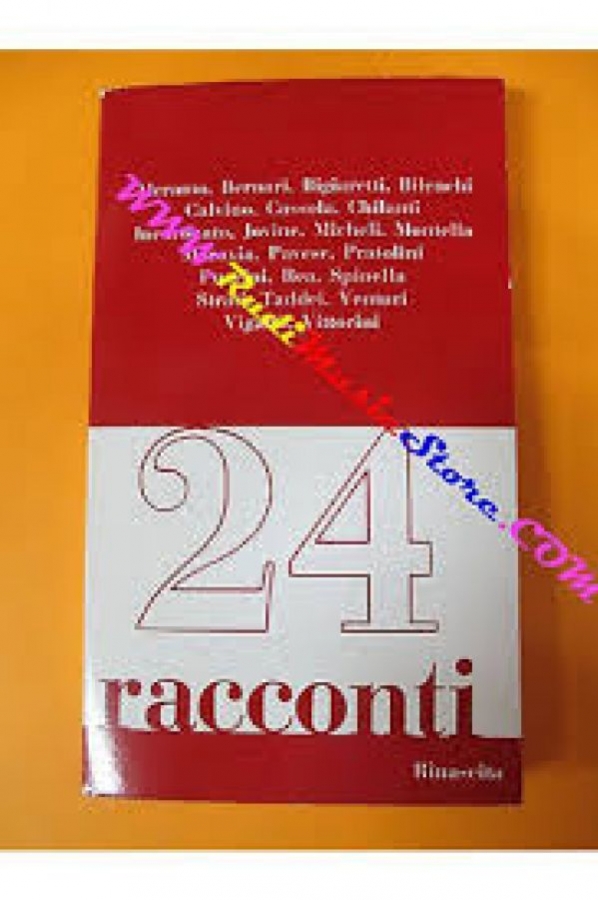
24 stories
Under the title *La Rinascita*, in June 1944 the first issue of the Communist Party’s monthly journal was published. Italy is not yet free; the partisan struggle is underway, and yet from its very first issue the journal devotes several pages to literature. There are poetic works (by Umberto Saba and Salvatore Quasimodo), texts by foreign authors, and contributions from Italian writers as well, from Alberto Moravia to Cesare Pavese. This book collects some of these short stories, published between 1945 and 1956, during a period of fierce political struggle and in the full bloom of Neorealism. The stories are steeped in social themes; many deal with the Resistance, featuring contributions from Renata Viganò, Italo Calvino, Marcello Venturi (an important and forgotten chronicler of the partisan struggle), and Mario Puccini—the latter with a moving tale about a father’s anxieties for a son engaged in operations against the Germans. I have chosen three to review, not only because they are the finest, in my judgment, but also because they are representative of our country—of peasant Italy and of an urban middle class that would carry forward from Fascism the indelible marks of superficiality. Francesco Jovine is the author of a novel, *Le Terre del Sacramento*, which chronicles a South forever condemned to exploitation and forever betrayed by its ruling class: a writer of resignation and defeat. In the short story *La morte del patriarca*, published in 1949, a grandson speaks of his grandfather, a justice of the peace in a southern village and trusted confidant of the primary landowner, the quintessential southern *latifondista*. The grandfather is a patriarch to his family and the entire community: he does not exploit the owner’s absenteeism to enrich himself, but rather stands as a defender of the peasants. He is a bulwark and a mythical figure. > On summer nights he would wander the moonlit streets together with his fellow peasants, enchanting them by softly playing his flute. (...) Often, when he was away, the young men would be seized by sudden rages and reach for their hatchets. But when the grandfather was there, nothing occurred that was not placid and gentle; one could hear those notes taking flight, like turtledoves in love, accompanied by the hornet-like drone of a *chitarra battente*; the old peasants would awaken from their sleep and imagine summer fields laden with heavy ears of wheat, and succulent fruits bathed in the morning dew. What will become of the village after the patriarch’s death? > Suddenly an old woman from the back began to weep aloud and sing her sorrowful lament for the impending loss. Slowly, in a rhythmic voice, she spoke: you are departing, our honour and our defense; you are departing, brilliant sword. Without you, a youthful voice took up on the final laisse of the song, we have neither light nor judgment left. In *Il mondo salvato a spalle*, published in 1951, Felice Chilanti recounts the dramatic flooding of the Polesine, offering a realistic and evocative sketch of peasant solidarity. "Run, people, the water is overflowing along the entire embankment!" Giovanni and his fellow peasants rush to rally the men and rescue the women and children. And the village shopkeeper shouts, "And you, Giovanni, and you, Gabana, and you, Tabanin, weren't you already thrown in jail a year ago for this kind of work? Do you really want to save Cané's land and cattle?" > Canè is the great landowner of the area, whose brother, the cripple, screams like a madman at the peasants laboring to save the Cané family and their household goods. "You want to start a revolution, you wretches! Come and get me, you'll taste the lead of my pistol... (...) Giovanni and his companions carried the world on their shoulders to safety: the entire world just as it was, friends and enemies, the society in which they lived and fought; they carried to safety the landlord and his property, the priest and his prayers, the maresciallo of the carabinieri and his handcuffs." The title of Libero Bigiaretti’s short story (*Un altro destino* > 1951) echoes Jack London’s *Martin Eden*. Two young men strike up a friendship because they work together on a construction site: Renato comes from a working-class background, intelligent, combative, capable of asserting his views with clarity and energy > , Giulio comes from a bourgeois family, restless, he dropped out of school and would like to publish his poems in *La Fiera Letteraria*. Unlike Giulio, thoroughly steeped in fashionable names and trendy books," Renato "read whenever he had the chance, with a stubborn desire to understand things to the very core > . Giulio meets Elena, Renato's sister, with whom he begins a relationship. We parted, I full of dismay and confusion, she calm; she told me to wipe my lips, for they must be smeared with lipstick. (...) I can't help laughing, looking back on it. When I think how, throughout the evening and the night, that most ordinary of adventures got tangled up in my head. "What if I had to marry her?" "Did you know that Giulio goes walking around the Mercati Generali with a greengrocer girl?" (...) Then I met Loredana with whom, between kisses, one could discuss literature. And Loredana also knew how to kiss me much better than Elena." The stories are certainly no masterpieces; behind a veneer of Neorealism there emerges a melodramatic and bombastic streak, originating from Fascist literature and from even deeper roots within a provincial Italy, alien to European culture. It is remarkable how one can already detect a sense of weariness, of resigned acceptance of what Italy would become: inward-looking, mellifluous, and hypocritical. A touch of nostalgia arises when reading these stories. Back then, a party journal made room for literature, for Italy's foremost writers; today we are reduced to reading disjointed remarks on Facebook and Twitter, while writers speak of other matters, far removed from politics. Is it perhaps from here that the by now tiresome crisis of the Left originates? Why read it? It is worthwhile for reminding us what the culture of the Left once was.

Alma
Questo romanzo riporta la mente ad un altro libro, apparentemente così lontano nel tempo e nei contenuti: *Le Confessioni d'un italiano* di Ippolito Nievo (vedi la recensione in questo sito). Come per Alma, il grande racconto di Nievo è una storia d'amore, che prende le mosse dall'infanzia in quella terra marginale che è il Nord Est dell'Italia. Carlino, il protagonista narrato da Nievo, è innamorato della bella cugina Pisana, che solo nel punto di morte riconoscerà di averlo sempre amato, così Alma rincorre Vili, quel > bambino magro, gli occhi neri e una frangia scura da teppisti , che ha fatto irruzione inspiegabilmente in una famiglia in strano e incerto equilibrio, portandosi via l'attenzione del padre. E come per i protagonisti delle *Confessioni*, la vita di Alma > è sempre stata immersa fino al collo nelle questioni che il passato o la memoria e perfino le ossa sotto terra proiettavano nel presente, e lei non aveva fatto altro che camminare sul filo di una ragnatela sforzandosi di evitare le trappole della Storia, quando invece ci stava camminando sopra. Se, però, la storia d'amore di Nievo si sviluppa dentro la grande e gloriosa cavalcata del Risorgimento, quella di Alma è segnata e travolta dalle tragiche vicende del «di là», quel mondo sconosciuto oltre Vienna e Trieste, quelle terre sempre rimosse dall'immaginario collettivo, il dissolvimento della Jugoslavia tra il 1991 e il 1995, e oggi la guerra in Ucraina. Alma vive ormai da molti anni a Roma, apprezzata giornalista, ricercata dagli uomini per quel fascino che hanno quelli «di là», ma non può confessare, perché non sarebbe capita, che > solo un esule da quei mondi è in grado di suscitare in lei qualcosa di simile a un innamoramento. L'occasione per tornare «di là» è la morte di suo padre che le ha lasciato «una scatola», in cui dovrebbero esserci i segreti della sua famiglia, insieme con quelli della grande Storia. L'attende confuse combinazioni di sensazioni in cui presente e passato si mescolano insieme, ma non c'è mai il futuro: la nostalgia per i nonni materni, per la bella e solida casa mitteleuropea; la villetta sul Carso dove sono andati a abitare i genitori, per stare lontani dai nonni e dalla buona borghesia; gli arrivi e le partenze improvvise del padre, sempre coinvolto nelle grandi vicende; la madre anch'essa distante perché sempre occupata nella «Città dei Matti»; i bagni e i giochi sulla riviera di Barcola; e poi i morti, gli stupri, le stragi delle guerre balcaniche, immortalate dalle foto di Vili: > una fossa piccola, una fossa enorme, una fossa con dei corpi, il viso di una ragazza tenuta per i capelli. Scoprirà che nella scatola non c'è niente d'importante, come nel grande romanzo di Kenzaburo Oe (*La foresta d'acqua*, vedi la recensione in questo sito). Ciò che troverà sarà lo svelamento del mistero di Vili: fotografo delle stragi perpetrate dai serbi per dare testimonianza dei crimini commessi durante le guerre balcaniche. Se questa rivelazione potrà dare sollievo all'animo di Alma, non sarò possibile ritrovare l'amore per chi ha sempre amato. > I loro destini si sono incrociati, pensa Alma. e questo è tanto, i tentativi di fuga non contano. (...) Si guardano. E' così sexy, pensano. La solitudine e le incomprensioni, tutto l'amore e tutti quei morti, (...) quei loro teneri anni, e anche tutti quei pensieri sul caos delle loro vite lontane. Ci sono romanzi che vogliono dire troppo, che mescolano grandi affreschi della storia con le vite familiari, senza però riuscire a approfondire a sufficienza le diverse dimensioni dell'esistenza; e tutto resta in superficie. La relazione privilegiata del padre con Vili (quelle passeggiate insieme che escludevano Alma) non è analizzata nei suoi risvolti psicologici ed emotivi: è come il contenuto della scatola che non dice nulla di intimo. Lo stesso legame tra Alma e Vili, che attraversa tanti anni della loro vita, è trattato con spicchi d'esistenza, certamente meglio nella seconda parte del romanzo, nella Belgrado sotto la guerra, ma mai portato fino in fondo. Chi era Vili, una comparsa della Storia, obbligata, come dice lui stesso, > a essere uno che mente, un falsario, un vigliacco, ad alzare il calice a brindisi disgustandosi illudendomi che così avrei salvato qualcuno? E perché Alma perde sempre l'occasione per rompere il guscio entro cui si appaga Vili? Perché non li dice semplicemente che l'ama e lo porta con sé a Roma, lontano da «di là»? O c'è un mistero indicibile (la rigidezza degli affetti familiari, le stragi e le morti, il mondo dei Matti) che impedisce di dispiegare il senso di umanità reciproca? Troppe domande rimaste senza risposta! Sotto il profilo stilistico il romanzo si avvia faticosamente per salire di livello nella seconda parte, quella della guerra, senza dubbio la migliore. Il continuo avanti e indietro nel tempo e nello spazio confonde il lettore che deve di continuo riprendere le fila della narrazione. E' vero che il flusso dei ricordi e delle sensazioni non ha tempo, e tutto ritorna senza mai andare avanti, ma è pur vero che non seguire una sequenza disorienta il lettore, lo confonde inutilmente. La scrittura è di alta qualità, nei dialoghi così come nelle descrizioni: manca tuttavia di mordente, non lascia il segno, anche per l'uso di un italiano standard, scolastico sotto il profilo lessicale. Perché leggerlo? Interessante la sovrapposizione della Storia con le vicende familiari.This novel brings to mind another book, seemingly so distant in time and content: Ippolito Nievo’s *Le Confessioni d'un italiano* (see the review on this site). As with Alma, Nievo’s great narrative is a love story that has its roots in childhood, in that marginal territory that is northeastern Italy. Carlino, the protagonist recounted by Nievo, is in love with his beautiful cousin Pisana, who will only on her deathbed acknowledge having always loved him; just so, Alma pursues Vili, that > skinny boy, with black eyes and a dark, hoodlum fringe , who inexplicably burst into a family balanced on a strange and precarious equilibrium, capturing her father’s attention. And as with the protagonists of the *Confessioni*, Alma’s life > had always been immersed up to her neck in the issues that the past or memory and even the bones beneath the earth projected into the present, and she had done nothing but walk a spiderweb's thread, striving to avoid the traps of History, when in fact she was walking right over them. Yet, if Nievo’s love story unfolds within the grand and glorious sweep of the Risorgimento, Alma’s is marked and overwhelmed by the tragic events of "over there"—that unknown world beyond Vienna and Trieste, those lands perpetually banished from the collective imagination, the dissolution of Yugoslavia between 1991 and 1995, and today the war in Ukraine. Alma has now lived for many years in Rome, an esteemed journalist, sought after by men for that fascination possessed by those from "over there," but she cannot confess, because she would not be understood, that > only an exile from those worlds can awaken in her something akin to falling in love. The occasion to return "over there" is the death of her father, who has left her "a box" that is supposed to contain the secrets of her family, together with those of grand History. A tangled combination of sensations awaits her, where present and past blur together, but the future never appears: nostalgia for her maternal grandparents, for the handsome, solid Central European house; the small villa on the Karst where her parents went to live to get away from the grandparents and the respectable bourgeoisie; the sudden arrivals and departures of her father, always embroiled in grand events; her mother, likewise distant, forever busy in the "City of the Mad"; swimming and games on the Barcola seafront; and then the dead, the rapes, the massacres of the Balkan wars, immortalized by Vili's photographs: > a small pit, an enormous pit, a pit with bodies, the face of a girl held by her hair. She will discover that there is nothing of importance in the box, as in Kenzaburo Oe's great novel (*La foresta d'acqua*, see the review on this site). What she finds instead is the unveiling of Vili's mystery: a photographer of the massacres perpetrated by the Serbs, to bear witness to the crimes committed during the Balkan wars. If this revelation may bring relief to Alma's spirit, it will not be possible to rekindle love for the one she has always loved. > Their destinies crossed, Alma thinks. and that is a great deal, the attempts to escape do not count. (...) They look at each other. It's so sexy, they think. The loneliness and the misunderstandings, all the love and all those dead, (...) those tender years of theirs, and all those thoughts, too, about the chaos of their distant lives. There are novels that strive to say too much, blending grand historical canvases with family lives, without, however, managing to delve sufficiently into the diverse dimensions of existence; and everything remains on the surface. The father’s privileged relationship with Vili (those walks together that excluded Alma) is not analyzed in its psychological and emotional ramifications: it is like the contents of the box, which reveals nothing intimate. The bond between Alma and Vili itself, spanning so many years of their lives, is treated through fragments of existence—certainly better in the novel's second part, in Belgrade under the war, but never pursued to its ultimate depth. Who was Vili—an extra in History, forced, as he himself says, > to be someone who lies, a forger, a coward, raising a glass in toasts with disgust, deluding myself that I was saving someone this way? And why does Alma constantly miss the opportunity to break through the shell in which Vili is content? Why doesn't she simply tell him that she loves him and take him with her to Rome, far away from "over there"? Or is there an unspeakable mystery (the stiffness of family affections, the massacres and deaths, the world of the Mad) that prevents the unfolding of their mutual sense of humanity? Too many questions left unanswered! Stylistically, the novel gets off to a labored start, only to elevate its register in the second part—that of the war—which is undoubtedly the finest. The constant shifting back and forth in time and space confuses the reader, who must continually pick up the narrative thread. While it is true that the flow of memories and sensations is timeless, and everything recurs without ever moving forward, it is equally true that failing to follow a sequence disorients the reader, causing unnecessary confusion. The prose is of high quality, in the dialogue as well as in the descriptions; yet it lacks bite, leaves no lasting impression, owing also to the use of a standard Italian that is lexically textbook. Why read it? The intertwining of History and family fortunes is compelling.

The Palestinian Lover
Can a love story bridge the ineluctable chasm between two peoples? The novel answers this perhaps overly naive question in the negative. And it does so by retracing a bewildering affair: the relationship between Golda Meir, an authoritative Israeli prime minister in the early 1970s, and Albert Pharaon, scion of a wealthy Palestinian family. The book traces the history of the nascent State of Israel from 1917 (the year of the Balfour Declaration, in which the British Empire declared itself in favor of the establishment “in Palestine of a national home for the Jewish people”) through the 1948 war, as a result of which the State of Israel was founded and the exile of over seven hundred thousand Palestinians began. The novel’s opening is remarkably evocative. On one side is Golda, still a young woman, in the kibbutz. The Zionist ideal of a demanding, communal life is admirably epitomized in the vigor and courage of the young Golda: > so luminous, so self-assured and confident, an olive tree flourishing in a barren land . On the other side is Albert, an “exquisitely cultured man of the world” for whom “nothing in social life is enticing enough to tear him away from his sweet idleness.” If Golda personifies the unstoppable force of an idea, fueled by despair and the memory of persecutions, Albert effectively represents a landowning caste who watch the Jewish immigration with stunned disbelief, confounded by their mad determination to forge a state, and are above all alarmed by socialist ideology, which might nurture “strange aspirations” among the perpetually exploited Palestinian peasants. Disparate as they are, Golda and Albert meet, feel drawn to one another, and carry on a clandestine, intensely carnal affair for several years. At the root of their relationship, however, lies a misunderstanding. For Albert, their bond is logical and possible. The fact that one is Palestinian and the other Jewish presents no obstacle to someone who has always lived in a land where numerous communities coexisted without friction. For Golda, the barrier of nationality is insurmountable. In a conversation decisive for the future of their relationship, when Albert urges her to acknowledge that Jews will have to live alongside Palestinians, Golda shouts in fury: > we came here so we would no longer depend on anyone, do you understand? There is no other us but us . The sacred tenets of Zionism (“becoming masters of our own destiny”) prove stronger than any love. And so the two lovers > throw themselves upon each other, collide, clutch desperately, surrendered to an irresistible urge to tear one another apart, so that nothing remains of them or of their impossible relationship . The love story between Golda and Albert stands as a metaphor for the tragic fortunes of two peoples. The most evocative part of the novel is the section leading up to Golda and Albert’s encounter. Up to this point, the narrative remains open to unpredictable developments. The reader expects the author to delve into Golda’s personality: wife, mother, lover of many men, vigorous idealist, political figure, leader of her people. Was the affair with Albert merely the diversion of an intensely sensual woman, or did it answer, instead, an unconscious need to break free from the cultural and social molds of her Jewish identity? Were there contradictions within Golda’s world, or merely the whims of a woman of power? Through Albert, could Golda have been the “Prince Charming” who cast the Palestinian people “into modernity like shrimp into boiling water,” yet paving the way for eventual coexistence? The narrative abandons this potential trajectory, perhaps for lack of documentation or out of reluctance to strain historical reality too far. Instead, it focuses on the figure of Albert—languid, indolent, and inconsequential. And this is a pity, for the narrative loses its allure, turning into the chronicle of a man’s decline whose ending was already written in the preface, in his very character. Why not read it? It is a fragile narrative: it adds nothing to our understanding of the Israeli-Palestinian conflict, and it lacks intrigue because it fails to probe the central figure, that of Golda.

American Pastoral
The book is divided into three chapters, each possessing its own distinct identity. In the first, bearing the evocative title *Paradise Remembered*, the narrator is the writer himself. The idol of his youth is Seymour Levov, “the Swede”: handsome, blond, athletic, a formidable sportsman. The memory of his feats epitomizes a golden era where harmony triumphs. Now in his sixties, the writer is invited to lunch by Seymour under a pretext. The meeting turns out to be mundane and pointless; later, however, at a reunion of old classmates, the writer learns that Seymour was suffering from cancer and had been shattered by the actions of his daughter, who had bombed a general store, killing a bystander. > The gentle man with his delicate ways of dealing with conflict and contradiction, the confident former athlete, responsive and resourceful in any fair-minded struggle with fair-minded foes, is up against a foe who is not fair-minded, a devil rising out of the human feelings, and he is overwhelmed. He learns to live behind a mask . The writer decides to write a book about Seymour, even as he wonders—with a deeply autobiographical undertone—whether the man inside the man is ultimately knowable, whether he is a “jar you cannot open.” Yet does the story he writes conform to reality, or is it merely the author's invention? In the two subsequent chapters, the writer shifts to a third-person narrative. In the second chapter, titled *The Fall*, the dramatic story of Merry is recounted: Seymour’s stuttering daughter who, at sixteen, vanishes after committing a heinous crime, sinking ever deeper into hiding and self-destruction. At the root of the daughter’s conduct lies a hatred for her parents, their orderly home, their life built on bourgeois values—and, by extension, for American society itself. Yet how could > his daughter be so blind as to want to destroy the very system that had granted her family so many opportunities for success? To destroy her capitalist parents as though their wealth were anything other than the product of the steadfast labor of three generations? . Is Merry, then, an inexplicable anomaly? In truth, in the final chapter, *Paradise Lost*—which largely details a dinner party among the Levovs and their friends (a dinner that concludes tragically with the stabbing of Seymour’s father)—it becomes evident that the “moral disease” afflicts not merely the girl, but an entire society in which > what was supposed to exist did not exist. Deviance prevailed. You cannot stop it. Undeniably, what was not supposed to happen had happened, and what was supposed to happen had not. The old system that created order no longer works. All it has left behind is fear and dismay, now concealed by nothing . The themes of this undoubtedly formidable book are essentially two: generational relations and, above all, the agony of a parent who views himself as blameless, who wishes to protect his family and cannot fathom why a daughter so cherished grew up so estranged from his world; and the unraveling of a society built by immigrants who toiled tirelessly to integrate and be embraced as successful citizens, only to watch the foundational values of social cohesion disintegrate. Seymour’s ordeal is that of a father, but it is also the tragedy of the American pastoral. Roth’s narrative structure is exceptionally rich and intricate. It relies neither on a lavish surplus of adjectives, as with Updike, nor on the expansive periodization of Bellow (all chroniclers of the crisis of American society). It is precisely this syntactic framework that constitutes Roth’s strength, yet also proves to be his weakness: the sentences are often overly convoluted, making for an exhausting read and fostering a redundancy of phrasing and, above all, of syntactic constructions. A greater frugality would certainly have served the book’s otherwise compelling themes far better. Why pass on it? It is deeply demanding, particularly the third chapter. It should be taken in small doses.
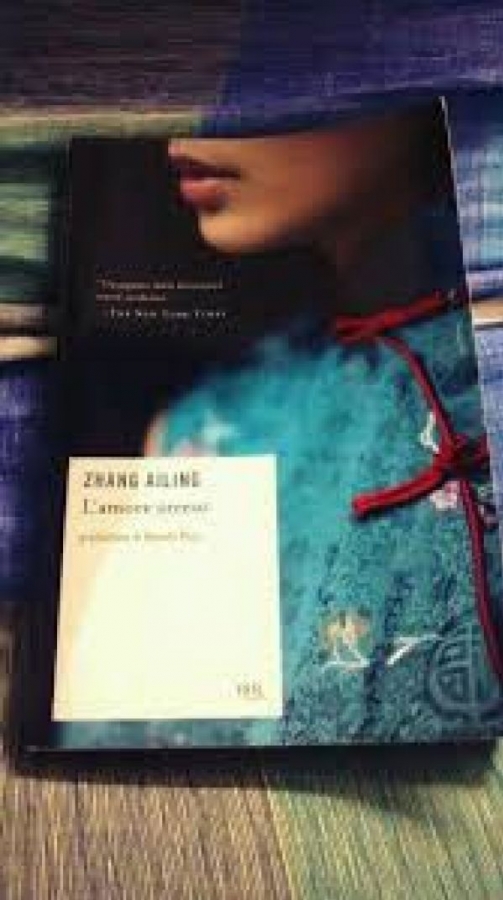
Surrendered Love
In an earlier novel, *The Golden Cangue*, the protagonist fails to escape the mechanisms of her family and descends into madness, bringing ruin upon herself and those around her. In the first of the two stories in this book, *Love in a Fallen City*, Liusu is likewise despised by her relatives, but seizes the opportunity of a chance encounter to escape a house that > had something of a dwelling of fairies and spirits: here, the slow passing of a day was like the lapse of a thousand years in the world. Yet spending a thousand years here was roughly like a single day, because all the days were equally monotonous and senseless . And it is boredom, not passion, that drives her—watchful and almost reluctant—to enter into a liaison with a Westernized Chinese man, a figure of dubious repute: wealthy, cultured, and refined, yet hostile to marriage. From the outset, Liusu knows full well that binding herself to this man means becoming his concubine. While yielding to her lover’s flatteries, she thinks to herself: > if I were a thoroughly respectable woman, you would not have noticed me at all. Yet she smiled, tilted her head toward him, and said, You want me to be a respectable woman in front of others, but not with you . With consummate skill, the author guides us through the unraveling of a relationship in which > both [were] too busy talking about love; where could they find the time to truly love each other? . The conclusion is a foregone one: the wealthy lover accommodates Liusu in a grand, empty house, where she will await his visits like a quintessential concubine. What overturns this destiny is the war. The Japanese bomb Hong Kong, and amid the battered city, the man resolves to marry Liusu. > Hong Kong’s fall had sealed her victory. Yet in this unreasonable world, who could ever tell cause from effect? Who could know? And had an entire city fallen merely so that she might triumph? In the second story, *Red Rose, White Rose* > , the author ponders whether transgression and respectability can coexist within the same personality. Zhenbao is a rational and meticulous sort, through and through the perfect modern Chinese man. Having started out on the right foot from the very beginning, (...) he now held an excellent position in a renowned foreign textile firm > Everything seems beyond reproach: the university-educated wife from a good family, the little daughter for whom funds have already been set aside for college tuition, the devoted care shown toward his mother and siblings, his dedication to work, and his benevolence toward friends. Yet is that truly the case? From the story, we learn that Zhenbao had an intense, fulfilling affair with a married woman. When his lover, genuinely enamored, confesses the adultery to her husband, Zhenbao abandons her because he realizes the scandal would ruin him. Merely crossing paths with the woman many years later is enough to unhinge him and shatter his drab bourgeois existence: he frequents prostitutes, succumbs to drink and gambling, neglects his work, beats his wife. And you. Are you well?, she asked. As he searched for the right words to summarize the perfect happiness of his life in a few simple sentences, Zhenbao raised his head and saw his own face in the mirror to the driver’s right. (...) Suddenly, however, he began to tremble in earnest and saw in the mirror that tears were streaming down his cheeks. He himself did not understand why. In that sort of encounter, it is always she who weeps, not he. (...) Far from consoling him, she fell silent for a long time, then said: Isn’t this your stop? > The author probes the ambiguity of the human soul through a markedly Western lens. While the opening of the first story still evokes the traditional Chinese family, the remainder of the tale could easily be set in any European city. The thematic core and the very prose of the second story echo much of Western literature, from which the author drew extensively. There is little originality. What continues to captivate the reader is Zhang’s mastery in navigating chiaroscuro and plumbing the depths of the human psyche, particularly the female heart. Jiaorui and Zhenbao are in bed: the woman realizes that the man intends to leave her. Lifting her swollen, flushed face, Jiaorui stared at him, then sprang to her feet, almost astonished herself to have been reduced to such a state. (...) She dried her eyes with her handkerchief, blew her nose, and walked out. (...) In his sleep, it seemed to him that someone had lain down on top of him, weeping. (...) He realized Jiaorui had returned. (...) The warmth of that womanly body enveloped him like a down quilt lined with silk, imparting a pleasant, intensely sensual warmth. When Zhenbao was fully awake, Jiaorui slipped away without a word, nor did he utter a sound". Why read it? They are short tales, the prose is fluid and graceful, and certain pages are remarkably evocative.
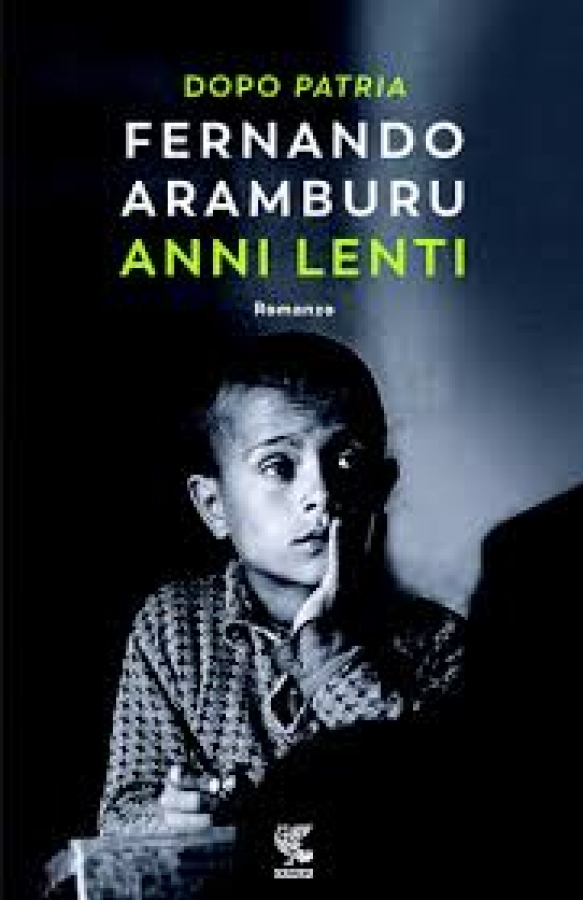
Slow Years
In *Patria*, the author confronts with forceful tones the psychological and existential consequences of the civil war that bloodied the Basque Country from 1968 to 2011 (see the review on this site). With *Slow Years*, Aramburu tackles the same themes, yet with placid, almost dreamlike accents. Then again, > when I pause to review my memories of those years (those of Franco's Spain), an old feeling of slowness returns to me. (...) I am tempted, at least in certain stretches of the novel, to make an effort to convey through a deliberately slow style that sensation of historical stagnation. To give this impression of a history > that dragged on sluggishly , the author imagines that an “informant” provides him with the raw materials to construct a novel, even > if it becomes necessary to stray from the informant's testimony, so be it. Literature first, then, if any room remains, the truth. And so a person, now grown up, recounts to Aramburu his childhood living with relatives in San Sebastián. He, > a little Navarrese shit , as his cousin Julen greets him, finds himself living in a Basque family: an authoritarian, abrupt aunt; a melancholic, absent uncle; an ugly, fat female cousin who sleeps around with all the boys; and Julen, who upon seeing him cry consoles him by mocking him: > if you were Basque you wouldn't cry. Have you ever seen iron weep? But, since you are a soft-boiled Navarrese, what happens happens. Strong, swaggering, self-confident, spoiled by his mother, Julen recalls Joxe Mari from *Patria* and, indeed, his story shares many similar traits: he joins ETA, is forced to flee to France, but, unlike Joxe, Julen cannot endure the loneliness and hardships of underground life; he betrays the organization and returns to San Sebastián, bringing shame upon his family. All of this is depicted through the eyes of a child, who does not fully grasp the dangers surrounding these events and their impact on his aunt and uncle's family. It is true, a shiver of fear ran through him whenever he saw the Guardia Civil pass by, but > those mustaches, do you remember them? Those hard stares, the batons and helmets, the weapons that my adolescent imagination struggled to conceive of outside cowboy-and-Indian movies. In the child’s imagination everything blurs together, creating something like a commedia dell'arte where comical or frightening figures bustle about within the same surreal, comedic atmosphere. Consider the fat cousin who, having fallen pregnant, is forced to marry the village idiot, himself obese and misshapen. Or the grotesquely solemn figure of the parish priest, assertive in inciting young men to join ETA, yet trembling when at risk of arrest. And yet, the subtle, amusing account of the child informant fails to bring peace, to permit reconciliation, even forty years later. The novel concludes with a bitter recollection by the author. On a bus, he runs into Julen’s father, but turns away. > They infected me with hatred. (...) I would like to ask his forgiveness, but he is dead. There are many ways to speak of a country's tragedies, the lacerations of a community, and the grief of people who were scarred by those events. In this novel, Aramburu does so with a reckless approach, perpetually teetering on the thin line between the comic and the dramatic; what emerges is a sense of narrative inadequacy that deepens as one delves further into the tale, where one would expect it to evolve toward a greater depth of exposition and judgment. Perhaps Aramburu chose the wrong informant—what could a child do? He could do nothing but defend his childhood behind a fantastical vision, as if everything were that game of plastic cyclists, the child informant's only toy, which > move forward in turns, by as many spaces as indicated by the die. Aramburu consistently displays remarkable narrative inventiveness. If in *Patria* it was the shifting of the narrator mid-stride (from “I” to “she” within the same sentence), here it is instead the pairing of the child's account with a sort of working outline by the writer on how to develop the novel: the plot, the setting, the deeper explorations, the words. These are “notes” that gradually overshadow the narrative, losing their character as a reflection on himself and the writer's craft to become increasingly another tale altogether, silencing the child's own. At first, this literary device is intriguing because of its novelty, but it eventually proves repetitive, disrupting the linear development of the story. Why read it? Enjoyable, yet in the end the story fades away.
Apartment in Istanbul
The protagonist is a German woman in her forties who lives in Turkey and runs a bookshop specializing in crime fiction. She describes herself this way: > I have a double chin, orange hair, a mobile phone (an older model, though), and a circle of friends on antidepressants. I am always nervous, but I don't know why . Saddened and disheartened following an argument with her boyfriend, she sets out to find an apartment to buy. Among those brought to her attention, she attempts to view one that happens to be illegally occupied. In trying to see it, the protagonist—impulsive and quick-tempered—clashes with the tenant, who refuses to let her inspect the premises. As chance would have it, the tenant is murdered: thus begins a detective story in which the protagonist, partly because she is a suspect and above all because she enjoys playing detective, sets out to find the killer. It must be said that, as a noir, it is hardly compelling, particularly because it lacks twists and turns and everything feels rather predictable. Far more interesting is the sketch of a woman poised between two such disparate societies: the German one (where “people are always in a foul mood, unhappy, and dissatisfied”) and the Turkish one, where > the interiors of the houses and the windowpanes are polished to a shine, but the balconies and streets are so filthy as to disgust anyone who sets foot there . What the protagonist wants is clear—after all, where else could a woman live, if not in a Mediterranean city, when she prefers “a new apartment rather than another man” entering her life? The book possesses one undeniable virtue: offering the prospective tourist a list of Istanbul's most interesting neighborhoods. The protagonist is sketched with hurried, superficial strokes, almost deliberately avoiding any psychological or sociological depth. Life moves quickly, and there is no time to understand why one lives in Istanbul rather than Berlin, why one prefers living alone—with the pleasure of playing detective—over having a husband and the friendships typical of a middle-aged progressive German woman, such as having > peroxide-blonde friends who lived in residential complexes with swimming pools, complained about snoring husbands, wore silver ballet flats, and voted for the Social Democrats . Why read it? It is an enjoyable read, but the narrative is evanescent and flimsy. A translator's labor must cost very little indeed to justify publishing such a predictable book in Italian.
Artemisia and the Colors of the Stars
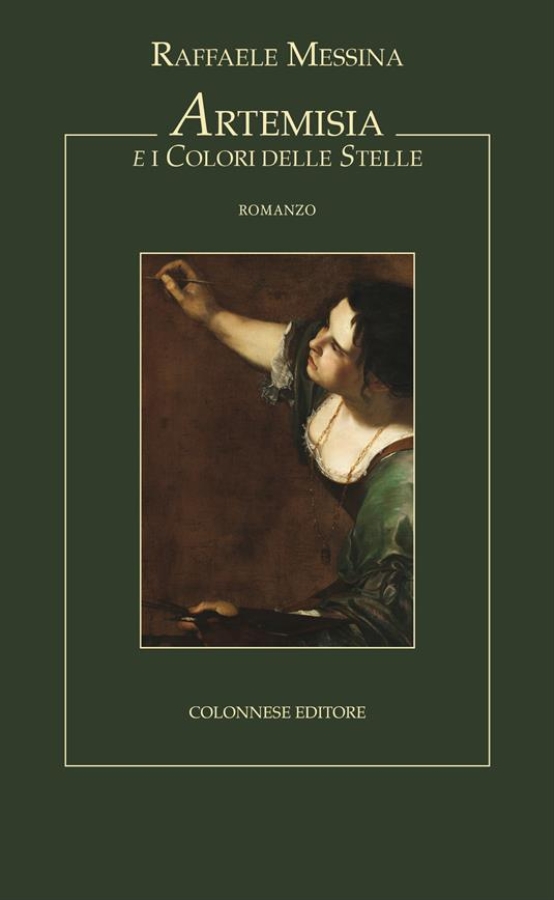
There are artists who remain forever pinned to an idea we hold of them, one that prevents us from truly appreciating them. Consider Dino Campana, the mad poet, and how his poetry was reduced to his presumed madness, casting his stylistic qualities and sources of inspiration into the background (see the review on this site of *La notte della cometa* by Sebastiano Vassalli). The same happened to Artemisia Gentileschi, a painter who lived between 1593 and 1653. Although she produced some fifty paintings and achieved fame throughout Europe, the memory of this great artist remains inextricably linked to the rape and subsequent trial she underwent in 1612. > Yet none of this will be enough to make my worth shine in the eyes of the world. Like a curse I bear upon me, for everyone—collectors and biographers alike—I will always be the paintress of scandal, rape, and revenge. Thus the author of this novel imagines Artemisia reflecting on her life, when she is already an established woman, well integrated into the society of her time. In Artemisia, that refrain they sang to her outside the courtroom, acquitted of all guilt, constantly resurfaces, > amid winking smirks, lewd propositions, merciless jeers, (...) *Paintress, lady painter, take this brush and warm it in your cunt.* And how could it be otherwise when we admire her Judiths, struck by the ferocious realism of the images: the first painting (*Judith Slaying Holofernes* from 1612), in which the biblical episode is transformed into a depiction of the wronged woman’s revenge, and the second from the end of her life (*Judith and Her Maidservant with the Head of Holofernes* from 1650), in which the two women flee with the man’s head after decapitating him. How deep the wound in an abused woman, that it surfaces even after so many years! The luxury of denial is not granted to woman, as Teju Cole observes in *Open City* (see the review on this site). All the more so when the rape was abetted by her father Orazio, who used his beautiful young daughter to curry favor with the powerful and forge business ties; and even more so when, in lodging the complaint that permanently disgraced his daughter, the father did not seek to punish the rapist, but intended to recover a painting the rapist had stolen: a painting whose conception the father claimed as his own, but which was in fact by the twenty-year-old Artemisia. We speak of the first Judith, through which Artemisia took eternal revenge upon man and embodied female solidarity against male society. Thus triply betrayed by her father, Artemisia suffered trial and disgrace in a papal Rome that was corrupt, violent, and lustful. In the novel, Artemisia is no weeping victim; she is a strong, clear-eyed young woman who knows that a woman must fight alone. She defends, desperately and proudly, her future as a painter, acutely aware of her worth. When she returns home after undergoing torture, the insolence of men does not trouble her (she is used to it!); she is concerned instead with her hands, with whether she will still be able to paint. While the first part of the novel recounts the intrigue surrounding Artemisia's ordeal, in the second part, set in Naples in 1648, Artemisia is by now an established woman, and it is difficult to find in the narrative the dramatic tension that characterized the first half. In truth, no significant events occur; the narrative moves along placidly, though Artemisia's restlessness continually surfaces—her inclination toward violent, scandalous, and sordid scenes typical of Naples' plebeian quarters, contrasting with the overt opulence of the Spanish rulers, far from the fine portraits painted for illustrious men, ever sinking into the mire of suffering. We may wish to look beyond the Judiths, yet it is always they who dominate our vision of Artemisia. It is difficult to discern a clear narrative thread in a plot woven from too many episodes loosely bound by the story’s development. The temporal leap itself and the shift in setting—first Rome, then Naples—do not aid the unity of the tale. The novel’s virtue lies, rather, in certain environmental descriptions; scenes rendered in vivid colors, coarse language, and subtle irony, traits reminiscent of Boccaccio that turn the narrative almost into a social novel. One senses the influence of the great post-war Neapolitan writers, such as Domenico Rea (see the reviews of *Spaccanapoli* and *Ninfa plebea* on this site). To give a sense of Raffaele Messina’s style, one might take as an example one of the finest passages in the novel: “At the Tavern of the Fountain,” where the patrons insinuate that it was the father himself who deflowered his daughter. > Tossed out like that, onto that rough board soaked in animal fat, the hypothesis seized the attention of every patron in the room. The dice, thrown amid ceaseless blasphemies, died away inside the overturned mug; the cards, laid face up on the table or still face down, ceased passing from hand to hand. (...) > You Jew of an innkeeper, give us yer take! (...) With a steaming dish of farro soup and pork rinds held aloft in his right hand, he turned slowly toward his interlocutor and answered with a ruddy smile: Fucking is as sweet as drinking wine. Whose hole it may be, or from what vine, is no host's concern, but a lawyer's quibble! > . The prose flows smoothly, interspersed with deft citations from the transcripts of the rape trial or from Artemisia’s own letters; digressions that lend veracity and color to the narrative, though within a typically contemporary style that occasionally slips into journalistic mannerisms, such as the overuse of the period” and the resulting verbless sentence. Why read it? For its fine descriptions of the setting.

Barrier
Barriera is a suburb of Turin roughly two kilometers from the city center: once a working-class town, now a multiethnic neighborhood rife with petty crime and drug dealing. > Barriera never changes. (...) Families go to the supermarket or the shopping mall. The old folks to the cemetery. The poor to the flea market. The Chinese to their shops. The Senegalese pushers to their corners. Nigerian and Moldovan prostitutes dividing up the rest. Here, all you can ever become is a label they’ve slapped on you. A label you can’t shake off . If in *Il lato oscuro della Luna* (see the review on this site), Marco Magnone and Fabio Gedda recounted an ill-fated love story between two teenagers in a Berlin still divided by the Wall, here the core of the narrative is the relationship between two brothers: Malik, the elder, freshly released from prison, "carries wounds that don’t have time to scar over, they just kill you"; Yasin is gentle, slender, and slightly built, completely different from his brother; yet Malik > was the superhero. Mine. Even when he ended up inside. Even when, after getting out, he walked out of the house without saying a word. That’s why when he offered for me to go live with him, start over from scratch, together, I fell for it right away. Because it was him and me again. Playing piggyback. Fighting the bad guys. But now instead . Malik has become a drug dealer, peddling a dangerous synthetic drug on behalf of a Nigerian criminal organization; in doing so, he has caused the death of a girl with whom Yasin shared his first romance. "You killed her, (...) with those damn pills," Yasin shouts, > Now it’s my turn to step toward him. And raise my voice against him, for the first time in my life . Yasin pleads with his brother to go to the police to report the criminal syndicates he works for. It would be too neat if Malik actually went to the police; the culture of violence is too deeply ingrained in him to ever put his faith in the law. The narrative structure mirrors the one adopted in the previous novel: the events are recounted by both brothers in dedicated, alternating chapters. The story is thus observed from differing points of view, yet it all too often turns out repetitive and fragmented, losing any sense of the overarching whole. Moreover, violence is the defining hallmark of this book; at times, Castagna and Magnone seem fond of lingering over brutal scenes where the strongest always prevails—one need only think of the boxing bouts and the gym milieu, populated by brawling yet valiant characters presented in an almost edifying light. While in *Il lato oscuro della Luna* a sense of melancholic sweetness prevailed, however devoid of a future, here no hope remains, and these adolescents stand before the void: Barriera is a metaphor for our present day, > nothing but the damn cold biting hard. And the silhouettes of abandoned factories looming here and there as if out of thin air . The prose is characterized by short sentences that leave little room for depicting the setting and the characters; while this approach reflects the starkness of the story, it does little to deepen the tragedy of Malik and Yasin and their shattered brotherhood. The extensive use of full stops and frequent verbless clauses makes for an easier read, clearly targeted at young adults, but it impoverishes the language—and, it must be said, not everyone is Cesare Pavese (see the review of *La casa in collina* on this site). Why skip it? Fragmentary and superficial

The Librarian
> The earthly USSR was a crude, imperfect body, but in the hearts of old romantics and the children of happy cities, its artistic ideal existed apart: the Celestial Union. With the disappearance of mental spaces, the inanimate geographical body had died as well . The dissolution of the Soviet Union was not merely a shattering political and institutional phenomenon; it inflicted a deep psychological and cultural laceration upon the collective consciousness. In present-day Russia, small communities attempt to recover an identity by reading the works of a deceased writer. There are six books which, read exclusively in their original editions, are capable of transmitting positive feelings and energies. These groups—the smaller ones known as reading rooms, the larger ones as libraries—fight among themselves to defend their own volumes and seize others. The battles, invariably brutal, are waged according to the customs and rules of medieval armies, reminiscent of the feudal lords who held sway in pre-Tsarist Russia. Aleksej, a disoriented young man lacking any clear perspective for his future, finds himself drawn, against his will, into the bloody conflicts between the rival communities, inheriting the role of Librarian upon the death of his uncle, who held this position in a small reading room. Aleksej is hardly a warrior at heart, yet he must acquire the courage and resolve necessary to lead his faction in clashes with other gangs. In truth, the book is an unrelenting succession of combats, painstakingly detailed by the author. The most significant of these, and the decisive one for the protagonist's future, unfolds in a forest. Aleksej’s small reading room takes refuge in a now-abandoned village, specifically in the Village Council building—where the council of elders once gathered in Tsarist Russia and the soviet convened during the Soviet era. Here, numerous gangs, led by a malevolent old crone, attack Aleksej’s group while singing hymns lauding the heroic deeds of Soviet Russia’s soldiers and workers. The depiction of the battle evokes the *Iliad*: a valiant few hold off hundreds of assailants, only to be slaughtered in the end, save for Aleksej. The young man is captured and taken to a retirement home that has been seized by its elderly female residents, invigorated by reading the six books after massacring the staff. The protagonist is locked in a cell to read, and reread, all six books. And it is then that Aleksej's destiny is fulfilled: to be the living icon, the eternal repository of the soul of Great Mother Russia. > If the Motherland is free, its borders inviolable, it means that the librarian Aleksej Vjazincev stubbornly stands guard in the underground bunker, tirelessly weaving the thread of the protective veil of the Intercession cast over the Country. In defense against enemies visible and invisible . The idea of small communities dedicated to safeguarding a country’s historical heritage and the appeal to the power of books to awaken and fortify human consciousness are truly two brilliant premises. In a fragmented and violent world, what remains to us if not the solidarity of comrades and the defense of the past? Yet might this not lead to a new Middle Ages? The problem is that well over half the book’s pages are devoted to describing savage clashes and bloody combat, while a modest—and decidedly insufficient—space is allotted to the characters' personal stories and their relationship with the books. The narrative arc suffers heavily as a result, growing verbose, tedious, and redundant. The conclusion feels weary and muddled, leaving the reader exhausted by an excess of battles. In short, it is a missed opportunity. Why not read it? If one has no fondness for battle scenes, it is better left unread.

Butcher's Crossing
The year is 1873 and Butcherʼs Crossing is a Kansas town, in reality a small settlement of buffalo hunters. Andrews is a twenty-year-old youth; he has abandoned Boston for a vague notion of freedom. > Sometimes, after listening to the hushed voices in church and school, he would pass beyond the borders of Cambridge into the lands and woods lying to the southwest. There, in some solitary place, standing motionless upon bare ground, he felt his mind fill with the clear air and plunged into infinite space: the emptiness and constraint he felt were dissolved in the wild nature that surrounded him . The young man meets a hunter and allows himself to be drawn into a venture: to go beyond the Great Plains, into the mountains, where thousands of buffalo still graze. > He realized that the hunt was merely a stratagem, a deception practiced upon himself. (...) No business impelled him... he was going there for freedom . An odd team is assembled: Miller the leader, a paranoid hunter who kills buffalo for the sheer pleasure of it, and not merely out of greed; Schneider, a pragmatic and cynical man, tasked with skinning the beasts with Andrewsʼs help; and with them an old alcoholic madman, Charley Hoge. With this group, Andrews ventures into the Wild West—at once an adventure and a physical and spiritual transformation. They represent another vastness and another horizon, yet the young manʼs mind remains “full of the wonders he had known as a child.” Francine, a prostitute, tells him affectionately, smiling gently: > you will come back; but you wonʼt be the same. You wonʼt be so young; you will become like the others. Andrews looked at her, confused, and in his confusion cried out: I will only become myself . The stages of his transformation, from youth to adulthood, are marked by the different phases of the journey. First, they travel for many days across the Great Plains, and Andrews must accustom himself to the long hours on horseback in a flat and monotonous landscape: > he felt like the earth, identityless and formless (...), he sensed his body slowly becoming lean and strong: he thought at times that he was entering into a new body, or a real body, previously concealed by an unnatural softness, whiteness, and delicacy . The second phase consists of the buffalo hunt: the merciless slaughter, the beast skinned and butchered. > To Andrews, the entire business seemed like a dance, a dark minuet ; the endless slaughter like > a mechanism, an automation, (...) like a cold, senseless response to life. (...) He realized he was turning away not out of some womanish nausea at the blood, (...) but from the shock of seeing the buffalo, moments before proud and noble and full of dignity, now stripped and helpless, an inert piece of flesh. (...) Its being had been killed, and in that killing he felt the destruction of something within himself, and he was unable to face it . And finally, there is the long winter: the group finds itself trapped by snow until spring, freezing and completely isolated. > He came to accept the silence in which he lived, and no longer sought any meaning in it. (...) He vaguely recalled the comforts of his home in Boston; but that seemed unreal and distant, and of those thoughts there remained only faint ghosts of remembrance : a sort of alienation, a loss of consciousness and identity. The wilderness, inscrutable and indifferent, gets the better of the young manʼs dreams: it creates a hard man, incapable of affection, solitary and individualistic. And when the party finally returns to Butcherʼs Crossing, having lost their entire cargo of hides while crossing a swollen river, and when Miller and his men discover that the price of hides has collapsed, that their toil was for nothing, Andrews wonders what the meaning of it all was. Where had he been, and why? Nothing remains but to leave, to take to the road again, alone. > Even now, in the light of dawn, the town was like a small ruin; the light struck the edges of the buildings and made all the more evident a emptiness that was already there. (...) He did not know where he was going; but he knew that (the direction) would come to him later in the day. He rode on unhurriedly, and felt behind him the sun rising slowly and warming the air . One must not be deceived by the story, by the meticulous descriptions of the landscapes and the buffalo hunt: the subject of the narrative is not the Wild West. Nor are we dealing with a *Bildungsroman*, because Andrews has not truly become an adult—borne out by the fact that he abandons the woman, Francine, who welcomed him with love upon his return from the long journey. The subject of the novel is estrangement from the world: the sense of not belonging to anything, a solitary man in an incomprehensible world, devoid of friendships and values. If the great conquest of the West, the American myth, had been this, what would become of the values of community and freedom that nevertheless underpin American society? The novel does not speak of this, though it might seem to; the narrative unfolds within the authorʼs own consciousness, addressing the failed search for a balance between individuality and sociality. The story is very well written. The style is elegant, the sentences flow smoothly and pleasantly, and the documentary element is well integrated with the plot and characters. One senses, however, a pronounced intellectualized quality, something contrived—the product of research rather than a lived world, at least in its ideals. It speaks of wilderness, of men struggling against a hostile environment, but if one compares the novel to the works of Jack London, and in particular to that masterpiece *White Fang*, it becomes quite clear how John Williams is merely yet another intellectual, writing about himself and—why not?—about men and environments he knows only from books, because he has studied them. Why read it? Fine prose, superb descriptions of setting, admirably etched characters.
Falling Out of Time: A Story in Multiple Voices
Grossman lost a son, killed during military service. It is a wound so immense that he feels > mutilated in memory.... a prisoner of a remote cell in the penitentiary of my spirit , as though "my life resembled something that never happened." And so he feels the need to create a tale. > That motherfucking thing that happened to me and my son, yes, I must blend it into a story, I must. With a plot, and imagination! And visions and freedom and dreams! Let it burn! A boiling pot!.... if I do not write I will not even be able to understand who he is now, my son, I mean Grossman imagines a village where everyone has lost a child, but they cannot fully express their despair by decree of the duke—that is, of power: > indifferent, slow, sluggish, without a doubt: an exemplary duke . The scribe is tasked with spying on the inhabitants to monitor any violations of the ban. In a way, he performs the function of the external narrator. He transcribes the voices of the grieving parents who, as in a Greek tragedy’s chorus, cry out in a funereal chant—at once sweet and wrathful—their own stories and their yearning to have their child back. Their chant gives voice to all the nostalgia and anguish of a bond between parent and child abruptly severed: the tender memory of birth and of his boyhood, the remorse of not having been a good father, of not having been close to him, the desire to smell his scent, if only for one last time, to touch his skin, to embrace him. > And suddenly, inside us, rises the vapor of his whole body, intact, and for an instant we can imagine: he is here . The immobility of grief could last forever, but it is broken by a man who decides to set out toward "down there," where he believes his son to be. The man’s desperate act sets the other inhabitants in motion as well. As in a sacred procession, they walk toward that mysterious place that is the afterlife. Their march halts before a wall, in front of which they drop to their knees > and each of them, and each of us, whispers their child's name And then Grossman understands that his son is dead: > I recognize the truth of these words. He is dead, he is dead, but his death has not died . Memory detaches itself from pain and, as far as possible, we remember without suffering. Yet then the story, like the ritualization of mourning, allows the son to be distanced: > it is only that my heart breaks, my darling, at the thought that I could find words for all of this . The book is a hybrid of prose and verse poem. Written in prose are the notes of the scribe and the reflections of the Centaur—half writer and half desk—who unquestionably represents the author. The verse structure is used for the chorus, which serves two functions: recounting the dialogues between the various characters, who, rather than speaking to one another, communicate with their lost child; and giving collective voice to the "wanderers," the group heading into the afterlife in search of their deceased children. The narrative form is typical of Greek tragedy, with the significant difference that there is no plot development, no final moment of genuine catharsis. There is no dramatic tension in the overarching plot; in fact, there is no real story. On the other hand, the narrative is introspective, entirely contained within the author's consciousness. The setting is Kafkaesque, surreal, not tragic. It is an interior journey in which the characters are nothing more than instantiations of Grossman’s despair, of his anguish, and of his desperate attempt to accept the death of his son. The lack of a narrative plot allows the detail to prevail over the overarching world of the tale. The narration fractures into poetic fragments, evocative in themselves, yet isolated and sprawling within a narrative context devoid of development. The reader must therefore surrender to the spell of individual words and phrases. Consider the following passage: > as in the moment when a newborn bursts from the womb and from the mother's body, my son's death transformed me into the father I never was, pierced me with a tear and a wound and a sense of emptiness, while filling me with his presence, which has overwhelmed me ever since with an intensity never before seen. His death made me capable of conceiving him. His death made me an empty shell of a father and also of a mother. His death leads me to bare a breast to one who will never suckle, and upon the walls of my womb, formed that day, carves with the nails of an escaping prisoner the tally of days spent without him. Thus, with a transparent chisel, his death carved into me an awareness: whoever loses a child is inevitably a woman . Why not read it? Too many evocations within a story devoid of narrative rhythm. In the end, it is boring.

Morning chant in the grass
> The whole world was full of enchantments brewing in the sprawling mist. The blocks of lava turned into fortresses, the rock peaks into towers.... the mist hovered over the valleys, transforming them into boiling cauldrons, cauldrons of the Norns, and glided over the lava, over sacred places, over distant heights invisible from the beaten horse trails. And the mist pours in. Where do you come from? What are you waiting for? Do you have something ahead of you?, something behind? Or is it just this, just your life, here and now, which is to say nowhere? How, why, you? An unreal atmosphere and existential anguish run through the entire novel. We are in the Middle Ages, in mythical Iceland; Sturla is a historical figure who pursues the ambitious design of unifying the whole island. In the first part of the book—the most evocative, perhaps because it is set amidst the mysterious nature of an island cold and warm at the same time—the easy friendship of youth turns into betrayals, killings, and violence that mark the relentless clan warfare. The opening storm scene is magnificent, where solidarity allows the group of youths to survive: yet it is a bond that can endure only in dreams, within an enchanted castle from which one must emerge to meet one's destiny: > then he was overcome by such a torpor that it was impossible for him to stay awake. And it was as if the halls within were closing themselves into the mountain. It seemed to him that he started awake, and that the landscape vanished into the mist. Then he woke. And never again did he find that castle and its dwellers . The inter-clan feud drives Sturla to commit crimes, even against the Church. In the second part of the novel, Sturla goes on a pilgrimage to Rome to seek absolution: a journey across a medieval Europe torn apart by violence, through a bleak, somber landscape. Remorse haunts Sturla, manifesting in nocturnal nightmares, in terrifying visions of butchered bodies. Great must be his surprise when what greets him is not a holy city, but a picturesque and corrupt Rome, which absolves him in a surreal, Dionysian, Felliniesque scene, amidst masked figures more befitting an orgiastic revel than a ceremony of expiation. On his return from Rome, Sturla stops in Paris to master the arts of black magic, thereby gaining another means to conquer Iceland. The third part of the novel is an epilogue. Sturla embarks on new battles and commits further atrocities: but he is no longer sure of himself; his weakness will ruin him and lead to his death. He is now a two-faced man, like a legendary figure of whom it was said that > on one side his face was ugly and frightening, and so too was his body, while on the other it was as fair and handsome as one could ever desire . The strength and weakness of the novel lie in its fragmentation: a sequence of scenes, formed by an accumulation of episodes and dreams, the character's thoughts, sustained by an evocative prose that in some respects verges on poetry. Although deeply rooted in the Icelandic setting, from which it draws its fascination and inspiration, what truly emerges is the drama of a man moving toward modernity, unable to let himself be confined, or curtailed, by the rules of medieval society. In his doubts and internal conflict, Sturla is truly a two-faced character: the past, and his social role, which demands he be a warrior and clan chieftain; and the awareness of existential futility, of becoming. In the titular chapter, the metaphysical description of the morning crystallizes this suspension and illuminates the allure of the writing. > It is morning. All was still as the sun climbed the mountain ridge, first flooding the pass with light, then hastening to embrace rock faces and crags. It softened boulders and jagged stones, whitening some, gilding others, blunting the harshness of peaks and cliffs. The wind was so faint that the blades of grass stood motionless, mirrored straight and stiff in the small stream, waiting. For what?. For the time to come, once again. And the flowers exulted when the sun embraced them so gently that not a calyx nor a petal stirred. Neither joy nor sorrow held sway; they were one and the same. They were one and the same, it made no difference. Yet if it was sorrow, it was so mild in that newborn glow, in that golden resurrection, that it was not grief; if, instead, it was joy, it was not happiness. But time lay in wait, with the transience inherent to all things within the eternity of the whole, when everything tends to return to the earth, to crumble and dissolve into primordial matter in search of new, unknown forms . Why not read it? The evocativeness of the vignettes, the depth of the concepts, and the beauty of the natural descriptions fail to compensate for the narrative's fragmentation and the frequent incomprehensibility of its content and sequence of events.
The Captain of the Yucatan
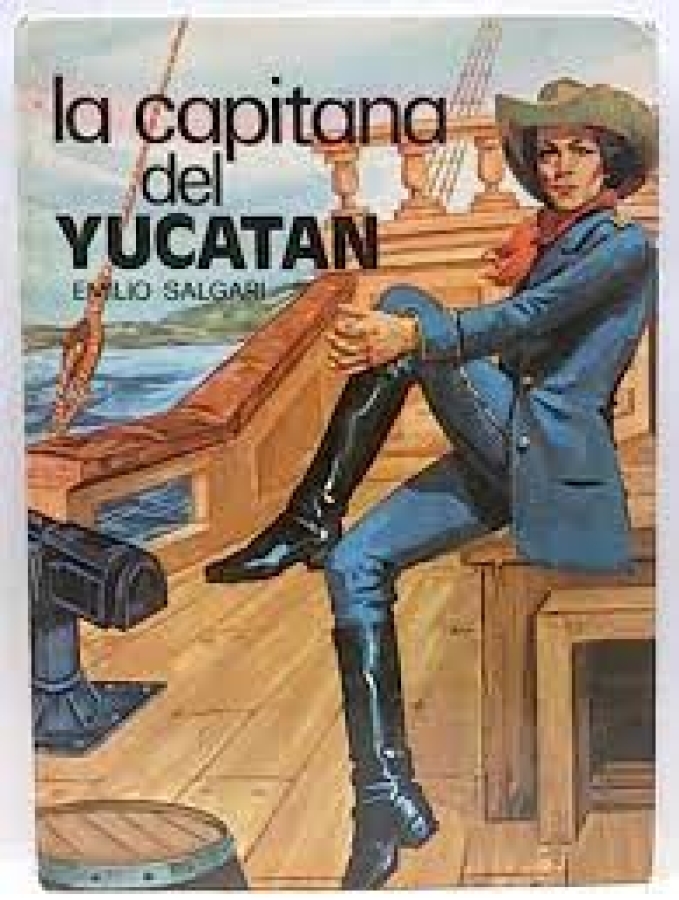
The novel is set in Cuba during the Spanish-American War of 1898, which led to Spain losing its final colonies. A “yacht,” the *Yucatan*, must run the United States naval blockade to bring weapons and provisions to the Spanish troops, who are in dire straits due to the concurrent advance of the pro-independence rebels and the pressure of the mighty American fleet. It is a small vessel, yet a masterpiece of engineering: its engines allow it to reach twenty-six knots, its steel hull is divided into several watertight compartments and fitted with a protective belt made of coconut fibers, rendering it unsinkable. And a marvel of technology! The “yacht” can submerge itself, leaving only its deck visible, so as to appear as a piece of drifting wreckage. Salgari too was dazzled by the wonders of technology, or perhaps sought in this way to emulate the allure of Jules Verne’s *Nautilus*, his direct rival. In command of the *Yucatan* is the Marchioness de Castillo. The Capitana > had a handsome head, crowned with an abundant mane of hair, of a deep, sombre black and wavy like that of Spanish gypsies, (...) she had skin of that lusterless pallor, of a strange hue found only among the Creoles of the Greater Antilles, (...) eyes of a consummate black, (...) long, silky eyelashes, (...) lips as red as a pomegranate. After such a description, we would have expected an enthralling tale like that of *Yolanda, the Daughter of the Black Corsair* or an ambiguous and mysterious one like the story of *Capitan Tempesta* (see reviews on this site); instead, the Marchioness de Castillo remains on the margins, emerging only fitfully and in a supporting role, while the true protagonist is Lieutenant Cordoba, > a sea dog (...) rather short in stature, all sinew and muscle, with an angular face bronzed by the sun of the torrid zone and the brine of the sea air. It is he who leads the *Yucatan* and its crew through a succession of adventures, at sea and on land. In one of these exploits, Cordoba, aboard a small launch, releases torpedoes against a gunboat, blowing it up and clearing the way for the small vessel; in another, the *Yucatan* conceals itself in a sea cave; in yet another, it skillfully slips away amidst a multitude of reefs and shoals. We are on the southeastern coast of Cuba, facing Mexico, riddled with islets and fjord-like sea channels, rich in a luxuriant nature that is consistently depicted in sombre tones, as if to foreshadow the sorrowful conclusion. The sea is inhabited by > splendid jellyfish resembling large lamps of frosted glass, of an exceedingly pale hue ; the flamingos take on a fantastical appearance, with their tails > covered in feathers of a splendid carmine pink, which along the wings turns into a magnificent coral red or fiery red ; in the forests, giant mango trees predominate, with > immense lianas climbing up and down the trunks in a thousand contortions or clinging to an infinity of parasitic plants that formed dense festoons ; and > the air is so heavy with moisture that it corrupts everything , everything spoils, turns moldy, decomposes; over all hangs the terrible yellow fever. Amidst these noxious miasmas, the *Yucatan* runs its final course. The power of the United States is overwhelming! The marvelous vessel cannot be surrendered to the American imperialists; far better to scuttle it with dynamite. > The Marchioness cast a tearful glance upon the smoldering hulk, half-submerged between the water and the sand, and murmured with a sigh: “Our mission is ended!” To a greater extent than in other novels, Salgari the popularizer comes to the fore. Interweaving landscapes familiar to him with the accounts of travelers and geographers (who, in the second half of the nineteenth century, were also possessed of vivid imaginations), the writer depicts the sea and coasts in meticulous fashion, rich in naturalistic and nautical detail. He adopts the same approach in recounting the Siege of Santiago, enumerating American warships and illustrating the various engagements. On one side stand the valorous yet ill-fated Spaniards, and on the other the treacherous Americans, > the financiers' syndicate , the cowardly blacks ( > huge, clumsy hats, gigantic feathers, (...) a frantic trembling) , and the Creoles who lack courage—perhaps, Salgari wonders, owing to the climate or the relentless Spanish oppression. One detects a whiff of racism or, more mundanely, a desire for vindication following Italy's crushing defeat in Ethiopia (the Battle of Adwa took place in 1896). This didactic intent weighs down the narrative pace, fragmented and bogged down by excessive digressions. Moreover, the character ensemble typical of Salgari’s novels, which usually helps leaven the plot, is conspicuously absent: a dark, brooding protagonist flanked by two sidekicks, often lightly ironic and shrewdly pragmatic. Here, Cordoba dominates the scene, a figure far too conscious of his own superiority as an old sea dog to leave room for the other players—even the Capitana herself, who, indeed, professes to be his pupil. Why read it? It is verbose and at times repetitive, yet it offers a compelling glimpse into a little-known chapter of history.
The Cases of Inspector Croce
In the prologue, Ricardo Piglia cites a note by Karl Marx on evil, as > the fundamental principle that makes us social creatures, (...) here lies the true origin of all arts and sciences, and from the moment evil should cease, society would necessarily decay, if not perish altogether . If we consider the history of Argentina—a history the author traverses skipping here and there—violence, the extermination of native peoples, repeated military coups, Peronist populism and ruthless neoliberalism, police repression culminating in the *desaparecidos*, are not anomalies but elements inherent to a capitalist society; and only through a rational approach can a plausible explanation be found. To achieve this end, Ricardo Piglia invented Commissioner Croce, a "brilliant investigator" bearing the name of an Italian Hegelian philosopher, Benedetto Croce. Is it a coincidence? Certainly not, considering that "the true destiny of a Kantian is the police academy," even if > no one is master of their own thoughts. There is no such thing as one's own ideas; thinking is either appropriate or it is not appropriate and also "if we do not destroy thoughts, thoughts destroy us." To range freely, Piglia does not develop a single plot, but relies on short stories, which the author seems to present as random, included without a logical thread. In reality, perhaps stretching the author's intention, we can group them into several strands. *The Film*, *The Exception*, *The Impenetrable*, *The Promise* > , are stories that deal with salient moments in Argentine history. Take *The Impenetrable* > where Croce is tasked with solving the disappearance of engineer Panizza, a well-known industrialist with an obscure past. Croce travels up the Río de la Plata, which was easy for him because he had spent many summers on the vast lagoon (...) to escape routine and lead a philosophical life." And when he meets him, Panizza utters enigmatic words (such as "the organization of time, and not the invention of the steam engine, is the key to capitalism > ) only to slip away for good. Who is Panizza? Is he one of the many Europeans who fled after the Second World War and do not want to be found? And what of the commissioner's weeping at the end of the story *The Film* > , when Croce discovers that the blonde girl starring in the pornographic film is Evita Perón, that woman whom so many had loved as a virgin > . Other stories represent the essential traits of Argentine society: melancholy ( *The Music*), superstition as in *The Astrologer* and in *Tigre*, virility as in the paradoxical and indecipherable *Mrs. X*, the love of risk as in *The Gambler* > . And finally, Piglia dwells on the crime genre, revealing his predilection for detective stories in the vein of Agatha Christie and for the bewildering mysteries of Poe. The stories are a manual of instructions and reflections, from which we discover that Croce's method operates "through metaphorical analogies, combines poetic intuition with mathematical precision" (*The Lecture*, *The Resolution*, and *The Method*). In the background, there is always Argentina: > the streets are deserted, there isn't a soul anywhere, there's no one at the port, everything is dead, something demented, acres and acres of countryside and behind it there is nothing, stray dogs, bones in the sun, and only wind, dust, and solitude. (...) We have been defeated so many times that now we no longer change . One would need to know Argentina and its history to truly appreciate these stories; and yet, these short tales arouse a certain envy, imagining what our own Noir—so successful today—could be if it retraced our recent past, fostering the transmission of Memory. From a narrative perspective, the reading brings to mind Dino Buzzati's *Sixty Stories* (see review on this site): the same sense of paradox and the very same resigned disillusionment. Considering that *The Cases of Commissioner Croce* is Piglia's final book, written when he was already suffering from advanced ALS, we find ourselves before a truly poignant testament, coupled with the desire to bequeath a literary approach and convey a passion for the crime genre. It is a struggle to finish reading; at times the stories are rambling, with numerous narrative digressions, and at times too paradoxical—as happens with Buzzati—making it difficult to remain engaged. Why not read it? It is interesting, but prolix and fragmentary.
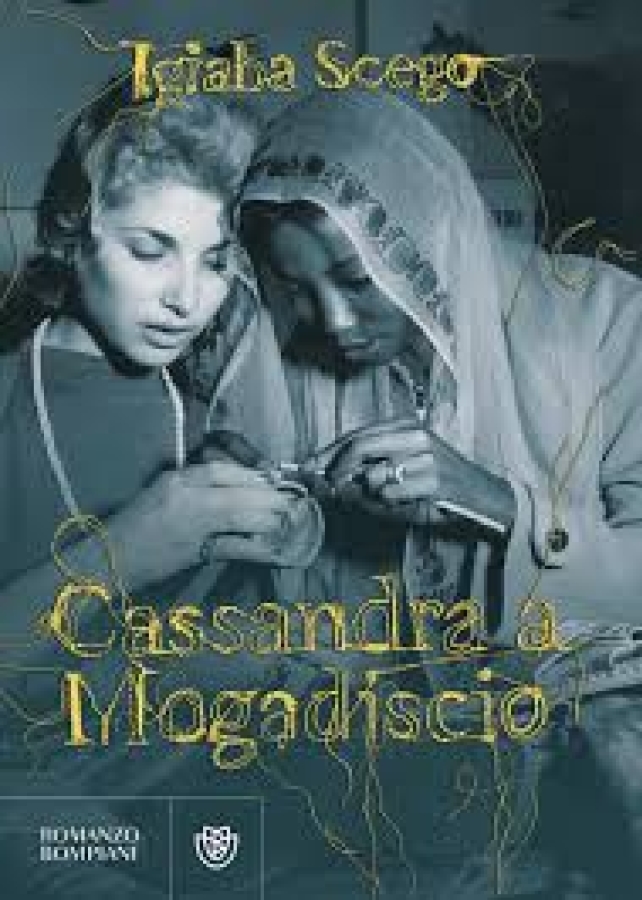
Cassandra in Mogadishu
> In Somali, *jirro* means "illness"—literally so. (...) But for us, *jirro* is a vaster word. It speaks of our wounds, our pain, our post-traumatic, post-war stress. *Jirro* is our broken heart. Our life in precarious balance between hell and the present. This book speaks of this illness, both physical and spiritual, searing and nostalgic; and it does so through an autobiographical lens, constructed > in constant motion. The past is never still; it follows our transformations , as Scego writes in her afterword. The author imagines a dialogue with her niece living in London, and the plot is punctuated by Somali keywords, which, beginning with *Jirro*, progress through a series of stages encompassing personal, familial, and collective history: events, relationships, physicality, memories, prophecy. There are two pivotal events: 1971, when her parents fled Somalia following Siad Barre's coup d'état, and 1991, when Somalia collapsed into the chaos of gang warfare. > "No road will lead us back home, my daughter," she (Halima, Scego's mother) says, with a harshness I had never heard in her before. > The roads have been cut off. The houses have caved in on themselves. We have become beasts. And Mogadishu has been buried by its own inhabitants beneath an endless heap of corpses . Somalia at war, yet ever-present in the heart, tears at the relationship between mother and Igiaba. One day in 1989, her mother crosses Rome for a prospective job as a domestic worker, only to be rejected because she is Black. > She screams in the silence. (...) And with that voiceless scream, with that timeless humiliation, the Mogadishu skyline creeps into a mind flooded with nostalgia. Arriving there, at the center of her sighs, to comfort her. She returns to Somalia; she vanishes for two years without word, swallowed up by the civil war. For Igiaba, still an adolescent, this abandonment has a devastating impact: she begins to suffer from bulimia nervosa. > Dagalka wabu dilai je'eelka. War kills love. (...) I vomit the war. Until every dream inside me is erased. Until every self inside me is erased. Like those relatives of my mother lost in the haze of their discontent. And in the *Jirro* that gave them no respite. Upon her return, Halima begins to speak to her daughter, > woman to woman. If before she had told her of her childhood, in the countryside herding sheep, she now recounts her real life. > The trauma of having lost the homeland—she her country of birth, I my country of origin—united us in mourning. (...) She wanted, on an unconscious level, (...) to pass her life on to me. Because it was no longer just a family story. Halima recalls how she was infibulated, and naturally > she spoke of Dad. She constructed his legend. (...) She, a switchboard operator, and he, a remarkably handsome man, the mayor of a city that smelled of spices. Then, wrapped in her white robe, every now and then (...) she sought me out with her gaze. And in that locking of eyes, I the daughter, she the mother, we thought of the refugee. Of the exile we had traversed together. That eye condition haunting Igiaba today, as she approaches menopause, having neither children nor a husband—does all of this stem, perhaps, from having somatized the rupture of her life, she an Italian in love with Rome, she the daughter of a ruined Somalia? Could the tragedy of colonized peoples, shattered and consigned to oblivion, the sufferings of the world's migrants, the wars, the massacres, the women and children raped and slaughtered—could all of this be a portent of a fate that awaits us too, the wealthy, comforted by our fine laws and air conditioning? A friend suggested Igiaba read Euripides' *The Trojan Women*. At its core is Cassandra, who says: > I hold aloft the torch, I celebrate, I flood the temple with light—behold—with this lamp of mine. Like Cassandra, we too (a torn humanity) carry the torch. (...) Bearing it is our burden. Scego's novels share a common thread: the intertwining of personal stories and overarching history, and the premise that one can only discover oneself, and others, through the unraveling of this entanglement within one's own consciousness. It is therefore indispensable for the author to craft complex narratives with numerous parallel plotlines in a strongly political, rather than psychological, context. In *Oltre Babilonia* (2008), the point of synthesis is language, set in that Arabic school where people of diverse backgrounds study this "Esperanto"; in "*Adua* > of 2015, the author speaks of a betrayal, of a beloved Italy that casts out the migrant, and finally, in that blend of reality and imagination that is *Una linea di colore* > of 2020, two women who actually lived are synthesized into an invented character who bears the wounds of emigration and slavery (see the reviews of these books on this site). In *Cassandra a Mogadiscio*", Scego shifts perspective; more than ever, she speaks of herself, confessing her own physical and psychological fragilities. The brilliant and personable writer, encountered at so many *Internazionale* festivals, reveals herself to be a tragic figure, evoking and internalizing existential and planetary grief: a contemporary Ungaretti. Is she speaking of Somalia? No, she is speaking of her beloved country, Italy, on the brink of fracturing; of her Rome, at the mercy of verbal and physical violence; of her cherished language, Italian, which now seems destined to regress into its ancient local dialects. In short, by narrating her family and her country of origin, Scego reflects upon herself as an Italian. Where is the Promised Land? Or was Ungaretti's merely a desperate utopia? Scego's strength remains her writing; even in simple, immediate Italian, the author evokes sensations that leave a mark on the reader: they are often short, unexpected sentences, not always woven into the narrative thread, as if Scego allowed herself to be carried away by emotion rather than plot. The latter is a weakness; the narrative's richness is not effectively distilled into a synthesis easily traceable by the reader. Contributing to this narrative confusion are the literary devices the author seems so fond of; here, it is the dialogues with her niece and the structuring of chapters around keywords, which often fail to encapsulate the chapters' actual contents. Moreover, in digging as never before into her innermost self and foundational relationships—particularly with her mother—the lack of psychological depth becomes apparent. Scego's works, like those of many non-Western writers, are choral stories, introjections of universal suffering rather than introspections into personal sentiment. Why read it? One discovers an unfamiliar Scego; the reading, however, is demanding.
Chi dice e chi tace
The novel is set in Scauri, a town in the province of Latina, where the author was born and raised. > Along the promenade, the beach resorts gleamed in the golden light of sunset. (...) Young couples walked linked together, two women, both wearing chenille tracksuits, walked briskly...(...) The plaster on the houses struggled against the sea salt, danceable music drifted from the Bussola, and men smoked and drank beer, cradling their bellies. (...) Affixed to the walls of the railway workers' club were a faded photograph of Gramsci, a reconstructed portrait of Berlinguer, the front page of the inaugural issue of *l'Unità*... It is in this insignificant and sleepy town on the Lazio coast that Vittoria takes up residence, living in a villa with a young woman. > Eyes not light in color but filled with light, she wore a straw hat that had seen better days, loose trousers, a white cable-knit sweater, (...) Vittoria looked as if she had stepped out of the pages of *Oggi*. (...) She looked like an Arab princess on a Tuscan country estate. Who was Vittoria? Lia seeks to answer this question when the woman's lifeless body is found in the house’s bathtub. In an indifferent and gossipy environment, Lia seems the only one concerned with the causes of death (suicide or murder?) and, above all, with who Vittoria truly was: why she had abandoned Rome and why she was cohabiting with a young woman who certainly could not have been her daughter. And Lia discovers that Vittoria is like > Greek; she had left few traces, and to arrive at a meaning—assuming there was one—one had to proceed by recombining the elements, conscious that a margin for interpretation would always remain or, in the worst-case scenario, that none of the combinations would make sense. It is clear that Chiara Valerio has deeply loved and endured ancient Greek! Beneath the veneer of a noir story, Lia ventures into the labyrinth of that mystery residing within us all—indecipherable, yet one we endeavor to bring order to. To this inner conflict that animates literature, as Ungaretti used to say, the author attempts to provide a resolution through an overly rational approach, turning it into a philosophical or mathematical puzzle that conceals the fear of straying from well-defined and reassuring prevailing values. And what if Lia had been romantically attracted to Vittoria? Along a promenade that is not that of Scauri, perhaps on the banks of the Nile or in a desert oasis, > I saw Vittoria. (...) I drew closer and asked her. Why? Vittoria smiled, (...) took my face in her hands, kissed me. I even closed my eyes. In the dream, I was happy. Another sound, a voice, two voices. I broke my lips away from Vittoria’s and looked around. My daughters were running toward me.... For me, it was an arduous read, abandoned and then taken up again out of a determination to see it through to the end and uncover the enigma and the myth of Vittoria. The two facets overlap: on the one hand, unveiling what lies behind this woman of the respectable Roman bourgeoisie; on the other, understanding why, in the small, provincial setting of Scauri, Vittoria turned into an idealized, mythologized reference point. These would have already been two complex themes to sustain in tandem, vacillating between noir and social novel; yet Valerio also wished to delve into Lia’s lived experience, without, however, fully laying bare her psychology, her frustrations, and her transgressive yearnings. Everything remained on the surface. The prose accentuates the reader's strain: the stark, apodictic sentences, the repeated use of full stops to conclude verbless clauses, the frequent shifts in narrative point of view—I, she, and you—the numerous digressions, the overcrowding of characters, and the sudden shifts in narrative trajectory are stylistic traits that heighten the narrative's fragmentation and disrupt the discursive flow. Chiara Valerio possesses an angular, essayistic style, whereas the strongest passages are precisely those where one glimpses oneiric elements and a subtle nostalgia for her Scauri. Why read it? The figure of Lia is interesting, but it is a taxing novel.
The City of Marvels
The novel recounts the history of Barcelona between 1888 and 1929: a span of time bounded by two world's fairs, which witnessed the urban and social transformation of the city. Mendoza—a Catalan journalist, though not an advocate of independence—narrates Barcelona’s changes through the eyes of a wretched country boy who comes to Barcelona to work on the construction of the facilities for the 1888 Exposition; a young man who, after a brief period in the service of the labor movement, becomes an unscrupulous and somewhat criminal businessman. This is how the author introduces Onofre Bouvila: > short in stature, with broad shoulders, (...) pale and coarse features, ruffled black hair. His clothes were patched, disheveled, and none too clean. (...) There is something in his gaze that makes one uneasy. Yet, there is nothing to fear, > another little sardine that the whale (Barcelona) will swallow without even noticing. It will not be so. Onofre will rise rapidly through the ranks of the anarchist union thanks to his dedication and leadership qualities. He could continue his political activism, likely ending up in prison, certainly remaining poor and exploited. Instead, without apparent regret, he becomes the bodyguard of a speculator who uses Onofre as an unscrupulous enforcer, useful in a city swept up in real estate speculation, corruption, and graft, with a burgeoning bourgeoisie ready to do anything to enrich itself. Like a sort of Catalan *Mastro-don Gesualdo* (see the review of Verga's novel on this site), Onofre climbs the social ladder, cultivates the right connections with the high bourgeoisie, marries a scion of a prominent Barcelona family, and becomes a powerful, immensely wealthy man, devoid of moral qualms, ever determined on his path to success. What drives him? One day, early in his social ascent, he visits a fortune-teller to learn his future. The cards' answer is vague, as always; but the woman sees that neither happiness nor wealth is in store for him: what Onofre pursues is revenge. His father, a businessman, a braggart and a bungler, was humiliated in life; Onofre wants to redeem him by proving that the son will not only become rich and powerful, but will bring to its knees the very bourgeoisie that had so despised and cast out his father. Is he like *The Count of Monte Cristo* or a banal representative of the corrupt system that shaped Barcelona? We will never know; the author does not delve into Onofre’s soul, a character who remains forever in the foggy shadows of a tumultuous city, the true protagonist: in effect, Barcelona has devoured the sardine, even though Onofre believes he commands it. And perhaps, precisely to desperately assert his supremacy, for the 1929 Exposition Onofre commissions the construction of a helicopter—a prodigious contrivance at the time—and in this craft disappears into the sky before a stunned crowd and under the incredulous gaze of Alfonso XIII and the dictator De Rivera. Is it an escape? Has he ascended to Heaven? Or did the helicopter simply explode, killing Onofre? The author does not say, leaving it to us to find the ending to an extraordinary life. What is certain is that by the end of 1929 De Rivera would be forced to resign, and the following year Alfonso XIII would abandon the throne, ushering in the Republic. An era has ended for Spain and Barcelona; another history begins. As often happens with modern novels, the book is lengthy and rambling. The finest section is the first, in which the author recounts Onofre’s arrival in Barcelona, his living conditions, the squalor, the toil, and the odd characters who frequent the boarding house where the boy finds lodging. Particularly intriguing is the figure of Dolfina, a comrade in struggle, always accompanied by a wild, aggressive black cat; a girl who becomes the naive Onofre's first love, in courting whom he already exhibits that cynicism and determination that will accompany him throughout his life: he kills the black cat, eliminating it because it is an obstacle, just as he will dispose of anyone who stands in the way of his goals, irrespective of emotional ties. In the atmospheric construction one senses Charles Dickens (see the reviews of *David Copperfield* and *Oliver Twist* on this site), even if Mendoza treats it all with an ironic and detached touch, free of moralizing. It is a pity that this narrative style dissolves over the course of the novel, along with the ability to construct characters—who grow increasingly banal—forfeiting the historical-sociological approach that had so sharply delineated the opening section. Why is Barcelona the city of marvels? Certainly not for its corrupt system, of which Onofre is merely an exponent; Barcelona is an astonishing city because it has continually reinvented itself in an endless process of creative destruction, fighting, however quixotically, against Madrid and circumstances that were often hostile to it. Mendoza seems to suggest that the total annihilation of the city in the early eighteenth century, at the end of the War of the Spanish Succession, wiped the slate clean and helped foster a future-oriented cultural and social climate, ever poised to overhaul the city from an urban, architectural, and economic standpoint. Why read it? It is historically interesting, but too long.
The Clan of the Cave Bear (Ayla, figlia della terra)
The novel is the first in a successful saga centered on a Sapiens woman in a Europe of millions of years ago, when our species coexisted for a long period with Neanderthal man. In the aftermath of an earthquake, young Ayla is left abandoned, indisputably doomed to die. She is taken in by a Neanderthal tribe. Custom would dictate that an individual of the “Others” be killed because > any deviation from usual behavior could unleash the wrath of the spirits. And the little girl is truly different: > she was barely four years old, (...) but walked upright on strong, muscular legs, (...) her low forehead sloped back into a long, wide head that rested on a short, thick neck , she could articulate sounds, she could even laugh. Those who save her are two prominent figures of the Clan: Iza, the medicine woman, and Creb, the shaman. They are moved by a mingled sense of curiosity and solidarity. They are fully aware that Ayla will grow up in a suspicious, if not openly hostile, environment, and will have to learn to behave like the Clan people: adopt the proper posture of a Neanderthal female, respect rigid social roles, master sign language, and suppress any urge toward spoken speech. > There will be time, Iza thought, to teach her manners. She was already beginning to think of the child as hers. (...) Creb was silent, full of thoughts. > Being accepted into the Clan does not change who she is. She was born of the Others, how can she learn all the knowledge you have? You know she has no memory . She lacks the Neanderthals' past, that body of knowledge and values accumulated over millennia that constitutes the backbone of their society. For instance, tradition dictates that females must not hunt, a social function reserved exclusively for males, upon which they have built their power. Restless, inquisitive, and undisciplined, Ayla secretly learns to hunt with a sling, and excels at it. It is the first, but certainly not the last, deviation from the rules. Each time, Ayla’s generosity, her evident desire to integrate into the Clan, and the widespread belief that she is protected by a superior Spirit lead the tribe to forgive her, eventually coming to see her as one of their own. Ayla experiences an inner conflict between integrating into the community and being free, being herself, no longer oppressed by a claustrophobic society. What holds her back is her affection for Iza and Creb, who took her in against everyone’s judgment. Despite her efforts, Ayla has an implacable enemy: Broud, the future leader of the Clan. He is antagonized by the falsely submissive demeanor of this woman of the “Others,” irritated by her growing popularity, and challenges her very inclusion in the Clan as contrary to tradition. He is driven by a mixture of power urges, obtuse adherence to tradition, and an unconfessable attraction to Ayla. As with all males driven into a corner, only rape remains. Broud violates Ayla, who becomes pregnant and gives birth to a boy bearing the traits of both *Homo sapiens* and Neanderthal man. He is a monster! shouts Broud; he must be put to death according to the rules. Yet this does not happen; on the contrary, the Clan females who have just given birth make themselves available to nurse Ayla’s son, after her own milk dries up. Female solidarity proves stronger than tradition! Nearing death, Iza reminds Ayla that one day Broud will be leader, and then > I don't think you should live with this Clan when Broud becomes leader. (...) I think it would be better if you left. Decreed dead while living by Broud, isolated and marginalized, Ayla has no choice but to take the path toward other lands, in search of the “Others.” The author skillfully draws upon anthropology to reconstruct the social mechanisms of the Clan, which are depicted in minute detail. One might easily object that Neanderthal society could have been profoundly different from the primitive societies of *Homo sapiens*. It is an accurate observation, yet irrelevant to the reading of the novel, whose central theme is the welcoming of the other. It must be said that integration fails: despite all efforts, Ayla remains one of the “Others,” yearning for freedom, an innovator and explorer (the pages depicting young Ayla discovering the forest are evocative); the Clan people attempt to include Ayla, but cannot bring themselves to rebel against Broud—they cannot break the rules or defy tradition. The message is pessimistic: in light of contemporary conflicts, will we ever be capable of welcoming those who are different from us? Perhaps, if we liberate ourselves from Memory. The novel is long and prolix, alternating moments of tension with lengthy stretches that add little to the narrative. Constructed around an intricate cast of characters, the storytelling scatters into a sea of names, losing focus on the protagonists and on the depiction of the setting, both social and natural. One reads on, constantly expecting something novel, such as the encounter with the “Others”; instead, nothing disruptive occurs, and the conclusion feels predictable. The prose is straightforward, elegant, and lexically rich: fine English. Why read it? It is very long, but worthwhile in the end.
Guilt
Is it possible to escape anguish merely by rummaging through one's own mind, pursuing a > lucid madness of constructing possibilities that are terrible because they are plausible, plausible because possible, possible because thought, thought because present somewhere, in the mind... (like) a Prometheus naked, flushed, dripping, bound by imagination with steel ties to the highest, most exposed peak overhanging the abyss ? Or is an event necessary—even a traumatic, violent one—that forces one out of their nightmares, to rediscover friendship, to reinvent “tenderness and assaults” from “drapes and gutted mattresses”? This novel recounts a rebirth into a new life. In a Marecchia described as a wild land, a “black and barren wasteland,” Estefan is an adrift, disoriented nineteen-year-old, like so many young people. He carries a deep sense of guilt. When he was still a child, his little brother died beside him during the night, without him noticing. Could he have saved him? Or was it he who killed him? From that moment on, Estefan became the > shittiest son, cat in the headlights, punchbag for boxers... better not to exist, sometimes, for others. Better, sometimes, not to exist at all . And ever since, a nightmare has haunted him: he imagines standing at the edge of a pit whose depth reveals no distinct contours and whose colors he cannot grasp, yet he glimpses “children, swings, slide, shrieks, tears” and, above all, > Cardboard-cutout killer Mom... Terrifying Mom, Mom with artery-colored lips, so very thin. Thin enough to cut. She is dressed in torn black poppies.. (and) she laughs, and it is an ugly laugh, a laugh that seems hauled up by powerful hooks that could tear Mom's whole face to shreds . One could easily, and superficially, say that Estefan needs the affection of his parents, and especially of his mother. Yet reality is not so simple, for the loss of the little brother shattered a once-peaceful family, destroyed their relationships, and burdened Estefan with the guilt of having survived. The narrative recounts Estefan’s disordered, aimless life amidst car races, joints and alcohol, nightclubs, constantly away from home and defiant toward school, locked in a perpetual, muted conflict with the adult world. There is, however, a deep friendship—the one with Martino, another troubled youth, who alternates between apparent docility and sudden outbursts of violence. He too carries a wound from childhood: he was raped by his uncle as a young boy (honestly, a useless redundancy for narrative purposes). One evening, wandering through the “wild” Marecchia, Estefan stumbles upon the isolated farmhouse of an old farmer who lives with his granddaughter, a girl orphaned since birth. Her mother was an addict who died giving birth to her. Estefan’s tribulations among the farm animals and his encounter with the little girl are among the story’s most successful passages. Yet the author fails to break free from her indulgence in introspective, hallucinatory references, falling once more into the trap of disturbing imagery without surrendering to the sweetness of the fable. The dung, the hay, the farmyard animals, the equipment become, for both protagonist and author, a > non-place. A place of thought where time is smashed to pieces. There’s the fossil combine harvester, the hay and the spiders, the chicken, and who knows what else. Microbes and bacteria raining down, cobwebs of embarrassing perfection, and a delirium of light play to be savored in silence. Here past and present interpenetrate... (but) the future is fucked . The story is, however, more tenacious than the penchant for self-destructive delirium. An affectionate and singular friendship develops between Estefan and the child: a bond that endures even when guilt resurfaces. Indeed, through a series of coincidences, the girl’s grandfather, having gone out into the night to search for her, kills himself with a gunshot. Estefan flees in desperation after making sure the girl is in good hands. During his flight, he suffers a very serious accident. We find him in the hospital, alone and with “pain occupying his mind,” but Martino and the little girl are there waiting for him. > The boy (Martino) takes his fingers in his own. Estefan opens his eyes, focuses. And it doesn’t seem real to him; for the first time, he does not miss the white . In the acknowledgments, the author observes how > writing this book meant giving meaning to many events for me; it was a painful and magnificent process . Undoubtedly, this internal journey came at the expense of overall lucidity, the plot, and character development. The reader appreciates the narrative premise and the contours—however sketchy—of the characters and setting, but cannot help lamenting the lost opportunity, what the novel could have been had the author refrained from chasing the nightmares and deliria of the mind. The writing is redundant with adjectives and imagery, almost baroque and often cryptic. It needs to be rewritten. Why not read it? Chasing the abysses of the mind is, in the end, boring.
A coup d'état
This is a short story, set in Benin, describing several episodes of a coup d'état. The author finds himself in the African country and is captured, along with a Frenchman, by military forces whose allegiance—whether to the regular army or the putschists—remains unclear. Throughout the narrated events, a general confusion prevails regarding the origins of the coup, the roles played by the military forces, and the very figures encountered. A sense of frustration predominates in the author: he is interrogated, held in captivity without food or drink, struck, and then released with profuse apologies for the misunderstanding. It seems an unreal affair, as if fabricated, and precisely for this reason emblematic of a collective madness. It is Africa unraveling, and the author is its stunned, incredulous spectator. Why not read it? It is a story too slight to prove interesting and engaging.

Confessions of Felix Krull, Confidence Man
What mystery lies behind this novel that accompanied Thomas Mann throughout his entire life? Begun in 1910 and later abandoned, it was taken up again in 1954, a year before the author's death. Thomas Mann imagines a singular character—an enchanter or mere charlatan—recounting his life, and does so beginning with an emblematic episode of his youth. Still a boy, he is taken by his father to the circus, where he marvels at the performance of a renowned clown, whose demeanor, even through varied situations, whether scandalous or comic, > preserved a grace free from all vulgarity and neglect... free and witty, radiating the joy of life, if one can denote by this expression that exquisite and painful sense of envy, nostalgia, hope, and need for affection ignited in the human soul at the sight of what is beautiful and blithely perfect . At the end of the show, the father takes the child backstage to meet the famous clown, and before the boy appears a "revolting sight": a vulgar man, smothered in hideous little pustules, in an atmosphere heavy with ointments and stage paint. > But did the adults, the worldly people who surrendered so willingly, indeed so passionately, to his charms, not know they were being deceived, or, by tacit agreement, did they simply refuse to regard that deception as deceit? Perhaps that was it, when one thinks about it: at what moment does the firefly reveal its true nature—when it glides through the summer night as a poetic spark, or when it squirms in the palm of our hand, reduced to a wretched insect? The theme is thus that of man's dual personality, of his ambiguous and perpetual disguise, whereby one assumes the guise of whatever pleases: life is a deception practiced upon others and upon oneself. Felix Krull is the son of a petty German industrialist, a fraudulent producer of counterfeit sparkling wine. Graceful without being handsome, > fair and dark at once, with the light of blue eyes... the veiled charm of the voice, the silky sheen of the hair , Felix would gladly have prolonged the indolent rhythm of his adolescence, had he not been forced, at the age of nineteen, to seek employment following his father's bankruptcy and suicide. A family friend secures him a post at a grand hotel in Paris. Here the young man leads a dual existence: lift boy and apprentice waiter during working hours, an elegant and refined Parisian in his leisure time, living off the money of the hotel's wealthy female guests, upon whom he bestows his amorous favors. He had attained his deepest aspiration, "permutability": merely by changing his attire and his hair, he could be, at will, either servant or gentleman. It is a life that suits him, until a wealthy young man, infatuated with an operetta singer, proposes that Felix take his place on a voyage around the world, forced upon him by his parents in the hope that he might forget his scandalous mistress. It is the great leap: > I was seized with a thrill of joy at the thought of the reconciliation between being and semblance that life was willing to grant me, of the appearance that it wished to add to being . One might expect a Pirandellian situation; instead, Thomas Mann leads us through philosophical and sociological digressions that overlay the narration of the principal stages of Felix's social conquest. The first leg of the journey is Lisbon, where the protagonist is readily embraced by high society. What attracts him in particular are the wife and daughter of the Director of the Science Museum: the former a buxom and rigid noblewoman ("not pretty, but handsome"), the latter a young maiden, "with lips proudly compressed," possessing the typical austerity of the South. It is the "double image" of feminine allure: haughty nobility alongside graceful, callow youth. Felix would like to savor both; he even dreams of marriage, but it is the noblewoman who urges him not to "seek fortune in childish fancies" and instead allow himself to be swept away by the "whirlwind of primeval forces" unleashed by a regal, mature bosom. And here the first part of Felix Krull's memoirs breaks off, leaving us to assume that the young man abandons any pretensions to a solid bourgeois horizon—which is, in any case, precluded by living under an assumed identity—to press on with his life as an adventurer and a swindler. Yet we shall never know, for the account of Felix's life remains unfinished. The novel is divided into two parts. Up until the substitution between Felix and the wealthy youth, we recognize the style of the great Thomas Mann: the narrative unfolds linearly, the treatment of episodes and characters is brilliant, even mildly ironic, and the "caprices" (the digressions, the chronological disruptions, the analytical elaborations) are functional to an overall understanding. In the second part, the structure of the narrative becomes rambling and disordered. It is unquestionably clever to relate and gloss the events through the letters of the putative son, Felix, to the putative parents—who are, moreover, bewildered by what is recounted, suspecting, quite rightly, that it is a figment of the imagination. This literary device demonstrates Mann's mastery, yet it fails to restore the novel to even a minimum of compactness and lucidity. It seems as though the author is chasing, with the last vestiges of his strength, the completion of a work very dear to him. Yet his momentum gets the better of him, and an excess of themes and reflections crowd together without order. Why not read it? It is simply not worth the trouble.
The Courage of the Robin
> There is no naivety in those who think that a people can truly exist only if there is something, such as a book, to recount them to others . So explains the typesetter Ruben to the young Saverio, urging him to chronicle Carlomagno and its people. We do not know where this village was; perhaps it lay in the Apuan Alps, but it was certainly a community of quarrymen—hard, wild, stubbornly attached to their own brand of Christianity, woven of legends, communal values, and freedom of conscience. And this is what the novel is about: *The Courage of the Robin*. > I would like permission, Your Lordship, to go wherever I please, for I would bother no one, small as I am . Thus the robin asked the king of the woodland birds; and in reply the kestrel broke one of his legs, forcing him to fly with only one wing. Yet the little robin did not surrender, and > flew higher and higher, and a little beyond the place they had assigned to him , until > from above, he began to bombard the head of the king of birds with droppings . To tell of this imaginary village, and of the freedom professed there, the author takes the long way round—perhaps overly so. Saverio lives in Alexandria, Egypt, and is the son of an anarchist baker who, like all his friends, considers Ungaretti to have been an arch-fascist. Upon his father's death, Saverio discovers a collection of poems, *Il porto sepolto*, and is particularly struck by these verses of Ungaretti: > The poet arrives there/And then returns to the light with his songs/And scatters them/Of this poetry/I am left with/That nothing/Of inexhaustible secret . What did the poet wish to express? And why was his father reading this book? A shallow youth and an idler, from that moment on he is seized by a mounting restlessness that not even a journey into the desert can quell. He wants to know his father's village, Carlomagno itself. He travels to Italy and visits Rome, "in the grip of a sensation of fairytale overabundance." He crosses paths with Ungaretti. > The old man, but how old he was! Looking at him so close, he seemed older than a stone. (...) the blazing eyes of a Zulu idol, (...) he seemed unreal to me, made of air like the jinn . The great poet seems to recognize him and slips him a scrap of paper, written in archaic and garbled Italian, stating that a certain Pascal, a "perfidious Lutheran," was burned at the stake. Pascal was his surname; could it refer to an ancestor of his? Saverio fails to reach Carlomagno because the police expel him from the country. He returns to Alexandria and undertakes ever deeper and more perilous dives; perhaps he imagines he will find the buried port of which Ungaretti speaks. Struck by an embolism, he is admitted to a clinic, where he lies for months in an abulic state, stripped of strength and will. To provoke a reaction, he is coaxed into recounting his life, as well as the dreams of his restless nights. And thus, everything we come to know is a story within a story, > a dreamt story, fabricated out of whole cloth, a story from five centuries ago in a place lost to the world . In a Europe devastated by the wars of religion between Catholics and Protestants, Pascal, an aging soldier of fortune, finds himself in Carlomagno, where he is chosen as a husband by Sua (a strange custom, yet the world was turned upside down in that remote and singular village). Sua intends to write the history of Carlomagno; she wishes to be its poetess. She urges her husband, ordinarily cautious and shrewd, to undertake a journey to procure the means to print a book. They secure a Bible in Italian, translated by a Calvinist, read it in secret, and eventually arrive in Val Pellice, the valley of the Waldensian heretics. Yet when they return to Carlomagno, the Inquisition has arrived, determined to normalize the village and its people. Pascal is accused of heresy and dragged to the stake; Sua, pregnant, escapes on her mother's back, "on the back of a demon, make of it what you will." And Sua was able to print her book, and Saverio dreamt it and recounted it, so that it might serve as a "combat robin." Everything was set in motion by a poem, and an obscure one at that. A few words brought to the surface an awareness, a breath of freedom, an irresistible urge to discover one's roots, however tragic. Among the many themes it addresses, the countless evocations, the excessive digressions, the novel speaks of the power of storytelling, of the book written and recounted; and in doing so, it transports us into a free world, into that Protestant Italy that could have been an opportunity for our country, had it not been smothered, condemning us to a destiny of indolence, ignorance, and hypocrisy. It is, therefore, a political book nestled within the shell of a fable. The dream is the finest part of the novel, perhaps also because the author treads on familiar ground. The prose is consistently refined and effective; nevertheless, the narrative is rambling, all too often a bloated potboiler. Maggiani tried to say too much, and in doing so spoiled the core essence, formed by the dream and the imaginary village of Carlomagno. Why read it? It enlivens us with a Protestant spirit.
Cyclops
The novel opens with a historical premise: a ship with a mysterious cargo sinks off the coast of Cuba. Immediately thereafter, the scene shifts to a Florida beach in the 1980s. A blimp, > motionless in the tropical air, poised and tranquil, like a fish suspended in an aquarium , awaits an American tycoon to embark on a search for the alleged treasure that sank to the ocean floor with the shipwreck. > What no one knew, or could possibly suspect, was that Raymond LeBaron and his friends aboard the *Prosperteer* had vanished into a mystery that went far beyond any search for treasure. From this moment onward, an incredible and convoluted series of events begins to unfold. After five hundred pages, unraveling the narrative threads is no easy task; let us attempt it. LeBaron is part of a secret circle of capitalists that has established a base on the Moon, where the Soviets have also landed; the latter will attempt to storm the American outpost, only to be wiped out by the valiant defenders in a battle fought on the surface of our satellite—and all this unbeknownst to the President of the United States! LeBaron and his men were not killed in the blimp's crash, but were taken prisoner by the treacherous communists at a secret base in Cuba; what is more, the Soviets intend to eliminate Fidel Castro, who wishes to break free from the Soviet Union. Such a tangle of events already demands a hero to unravel it, and that hero is Dirk Pitt, a sort of Sandokan at the very center of Cussler's literary output. In this novel, we first meet him in a gripping scene on a Florida beach, where our hero prevents the wind-tossed blimp from wreaking havoc among the poor holidaymakers, caught between fascination and terror: > the multicolored sails of the "windsurfer" fleet flashed across the blue-green water like a crazed prism. We then find Pitt, presumably weary after this heroic escapade, > among three dozen gleaming vintage cars, an antique airplane, and a late-nineteenth-century railway carriage. Pitt barely has time to gaze fondly upon a fabulous sports coupé, destroyed by an explosion and which he intends to restore to its former elegance and beauty, when he receives a phone call from LeBaron's wife asking him to help her find the hidden treasure. And yet more adventures follow until our American Sandokan leads "the good guys" to foil the plots of the villainous and bumbling Soviets, even uncovering the mysterious cargo. Overwhelmed, yet glad for such superficiality after having read László Krasznahorkai's *The Melancholy of Resistance* (see the review on this site), I set the book aside, certain that I will not read another by this author. There are thrillers, and then there are thrillers. To judge the novel, however, we must look to the myriad American films that pack cinema halls and flicker across our television screens. The sheer crowding of characters and subplots masks the thriller writer's struggle to lend depth to stories and protagonists. In this novel, Pitt seems indifferent to the charms of the sole female figure, the beautiful widow; there is only a brief and chaste love scene, while he displays empathy and solidarity toward his fellow adventurers in a distinctly camaraderie-driven style. He is not, therefore, a true Sandokan—dark and melancholy because his beloved is his enemy's daughter. To the author's credit, it must be said that the violence is restrained, perhaps because the novel was written in the 1980s. From a stylistic point of view, the novel is well written. The descriptions are particularly striking in their precision and detail. The finest scenes are those on the water, confirming the author's love for this environment. Why read it? It can provide a moment of diversion if one is weary of dense reading. But only once!
Her Side of the Story
> Behind the wall supporting one another, huddling together, forming a clot of suffering and waiting. (...) I heard them moaning, pleading, unheard: because a woman's voice is merely poor breath; and the wall is stone, cement, bricks . This novel speaks of the separateness between man and woman, of two distinct worlds whose boundary is impossible to cross. This theme is "decked out in a rag of a plot," as Melania Mazzucco writes, and unfolds between two inevitable endings: suicide or the murder of the beloved man. The first chapter is set in Rome in the 1930s; in an impoverished and cramped family setting, young Alessandra watches her mother wear away, torn between the longing for love and a > petty-bourgeois husband, (...) even his physical appearance was devoid of any spirituality . Even then, Alessandra grasps the distance between the world of women and that of men. She perceives the "affectionate indulgence" that binds women, > all, resigned, accepted, with the dawn of a new day, the burden of new toils . On the other side, men > told nothing, disliked conversation, jokes, smiled little, (...) lumping her together with the children, the mother-in-law, the maid: lazy, wasteful, ungrateful people. (...) Gradually, beneath a semblance of resignation, there had arisen in the women a livid resentment for the deception into which they had been drawn . Alessandra experiences female friendship, welcoming and complicit; towards men she is shielded by her lean, angular body, even though she is the object of the possessive yet respectful attentions of Claudio, a decent young man whom she nevertheless does not love. After her mother's suicide, Alessandra is sent to her paternal relatives in Abruzzo, where the second chapter is set—undoubtedly the best of the entire novel. Here she comes into contact with the resigned steadfastness of the Grandmother (with a capital G): > why shouldn't a woman wish to die? Up there, there is a sweet scent of lilies, (...) down here, working, bringing children into the world. (...) And always being afraid of men because they are in a bad mood, because they have a mistress and spend money on the mistress. For the Grandmother there are only two alternatives: either yield to man, accepting his whims, his selfishness, and his betrayals, or else retreat imperiously into one's own world, "always saying yes, yes, and then doing the exact opposite." This could be Alessandra's future if she were to accept a decent local youth, but as the Grandmother observes, Alessandra too is enchanted by men—not driven by sex, but convinced that it is possible to speak the language of women to men, and be happy. When she returns to Rome to care for her now-blind father, she meets Francesco, a university professor. The third chapter is set in Rome during the war and the German occupation. Prior to marriage, her relationship with Francesco consists of long walks, close and intense conversations, love letters: Francesco is serious, devoted, cultured, and handsome; with him, perhaps, it is possible to live on feelings, small kindnesses, affectionate gestures. But the idea men have of marriage (the woman as the "angel in the house"), alongside political and intellectual commitments deemed too significant to be within a woman's grasp, estranges Francesco; not because he betrays her or lacks respect and affection, but because the bond has become a routine that shuts Alessandra out. > "Why don't you write me love letters anymore?" I would say to him. He remained pained, perplexed. "It is true," , he would reply, "perhaps because now I can speak to you whenever I want." "But you no longer speak of love to me." (...) "Many significant things are happening, and it is difficult for me to think of anything else. Perhaps you cannot understand because you are a woman" > . With a long narrative, which wears the reader out to the point of exhaustion, the author leads us to the only possible ending for a woman who asked to be loved as women would wish to be loved, affectionately listened to in every gesture. "Francesco," I burst out in despair, "help me, Francesco." He barely stirred; "sleep," he murmured, (...) In me the rabid dog leapt up, lunged forward. I hurled myself at Francesco and emptied the pistol into his back. The interpretive key proposed by the author herself in the 1994 preface, and which Melania Mazzucco seems to embrace in her introduction, is that of a novel straddling gender narrative and a metaphor for the disillusionment of an Italy starkly different from the one envisioned through the Resistance, in which Alba de Céspedes took part. There is said to be a break with her previous novel, which recounts the lives of boarders living in suspension, protected by the convent school walls, and able to say "it is lovely to sit and talk among ourselves, all women: if there were a man, we would not have dared speak" (see the review of *Nessuno torna indietro* > on this site). If we do not allow ourselves to be swayed by the noble gloss the author sought to bestow on it many years later, we realize there is a common thread running between the two novels: women's search for their own distinctive female happiness, regardless of men, and of sex. Yet while the schoolgirls pursue their own individual paths, not always fortunate, but nonetheless full of hope, here instead there is no horizon for the desire for love. One cannot deny the echoes of *Madame Bovary* and even *Anna Karenina*, especially in the words that conclude the preface: *Dalla parte di lei*, despite its tragic conclusion, sought to resist the notion that love was an illusion > (see the reviews of these two books on this site). I like to compare Alessandra to the figure of Murasaki, who understands that life is not like literature (the Grandmother too urges her granddaughter not to read books), Genji is not a figure, male and female combined, in whom one can place one's trust, and the great Japanese poet has the protagonist die. (see the review on this site of *The Tale of Murasaki* > ). Alba de Céspedes is an elegant author whose writing evokes Alberto Moravia. The novel’s seemingly nineteenth-century profile, suspended between fairy tale and chronicle, recalls *Menzogna e Sortilegio* by Elsa Morante (see the review on this site). The circular structure, constantly turning back upon itself without any real development, compromises the narrative's effectiveness, making it verbose, almost as if the author reached the end through sheer exhaustion, without an overarching design. Why read it? The theme remains relevant, but the narrative is too long.

Continental Drift
Questo romanzo è un vortice dʼacqua, che risucchia lʼintero racconto in un unico incomparabile episodio, tragico ed intenso, dopo il quale niente è come prima. Il problema è che questo mulinello è una «sabbia mobile», così lento e vischioso da sfinire il lettore. Ma andiamo con ordine. Bob è un giovane di trentʼanni, padre di due bambini, sposato con una donna che lo ama; ha un posto fisso e unʼamante. Non cʼè nulla di apparentemente sbagliato nella sua vita, eppure Bob la odia: in parte per il solito sogno americano (la vecchia metafora dellʼAmerica alla quale tutti sembrano crederci), ed in parte perché Bob > ha lasciato nel mondo reale un uomo irreale, inventato, che fa il suo dovere, prudente, responsabile, fedele ed equilibrato, mentre nel mondo invisibile (...) Bob è inconcludente, avventato, irresponsabile, infedele, irrazionale, (...) lʼuomo che è un bambino . Questo lato invisibile prende il sopravvento e lo spinge ad abbandonare una vita prosaica ma sicura, per cercare qualcosa che lui stesso non sa cosa sia. Lascia la casa di proprietà e il posto fisso, e trascina la famiglia in Florida a vivere in un caravan, a lavorare prima con il fratello (uno smargiasso truffatore) e poi con un amico (un altro mascalzone). È una deriva inesorabile: non solo è un fallimento economico, è pure una discesa psicologica e morale. Bob uccide un uomo, anche se per difendersi, si disinteressa della famiglia, è coinvolto nel suicidio del fratello, fa finta di non accorgersi dei loschi affari dellʼamico, finisce a fare traffico illegale di clandestini. Accanto al racconto di Bob si sviluppa la storia degli immigrati haitiani, in particolare di una donna con il suo bambino. È inutile soffermarsi su questo filone narrativo, che avrebbe potuto dare molto se non fosse stato infarcito di riti vudu, del fascino dellʼesoterico, di visioni stucchevoli del «buon selvaggio». Caro Banks le sofferenze dellʼimmigrazione sono troppo gravi e serie per essere lʼoccasione di artefatti e folcloristici racconti! I due filoni narrativi (le vicende di Bob e quelle degli haitiani) convergono in un evento drammatico ed ad un tempo emblematico di una condizione universale. Bob trasporta con la sua barca un gruppo di haitiani, determinati ad arrivare in tutti i modi in America. Lo fa per soldi, ma il suo atteggiamento è di empatia per questa povera gente: li porta dellʼacqua, offre delle sigarette, sembra volersi far coinvolgere. Quando però vengono avvistati dalla guardia costiera e dunque cʼè il rischio di essere arrestati, Bob non esita a buttare a mare gli haitiani (uomini, donne e bambini), condannandoli ad una morte certa per annegamento. > È caduto in un luogo oscuro e freddo, dove le pareti sono perpendicolari e scivolose e tutte le uscite sono state sigillate. È solo. (...) Ecco come un uomo perde la sua bontà. (...) Dalla bocca allʼinguine, Bob percepisce il proprio corpo come una fredda barra dʼacciaio, braccia e gambe si induriscono come ghisa, la testa, occhi bocca naso orecchie, sembra chiudersi al mondo a poco a poco . Il capitolo «Per mare» narra la terribile vicenda dellʼassassinio dei clandestini, lasciati annegare per un pugno di soldi: è di una potenza evocativa straordinaria, anche alla luce di ciò che avviene giornalmente nel nostro mediterraneo. Lʼautore mostra una grande abilità stilistica, nella costruzione della trama e nellʼuso delle parole. Sino allʼultimo il lettore spera che ci sia un diverso finale, nel quale Bob palesi la sua bontà, una effettiva compassione verso gli haitiani, «così fragili, delicati e sensibili». Ed invece, lui, «un tipo gentile e socievole», commette un delitto orrendo, una strage. E ci fanno ancora più ribrezzo le sue banali giustificazioni, come «nulla gratis nella terra della libertà», o la sua auto commiserazione: «e infatti eccomi qui. Peccato che non sono più io». È facile, tuttavia, scandalizzarci per il comportamento di Bob; in realtà le sue azioni e i suoi pensieri esprimono molto bene la distanza tra ciò che proclamiamo e ciò che facciamo, quellʼipocrita perbenismo, la nostra falsa coscienza. Ed allora perché rovinare tanta bravura stilistica in banali disgressioni di carattere filosofico e perché tante lungaggini sulla cultura haitiana? Non era forse meglio focalizzarsi sui personaggi, o lavorare sulle reali condizioni degli immigrati, in viaggio verso il sogno americano? È un libro rovinato dalla presunzione dellʼautore di essere in grado di trattare troppi temi, invece di concentrarsi su limitate ma efficaci chiavi di lettura. Perché leggerlo? Vale la pena leggerlo solo per il capitolo «Per mare».
Of Blood and Ice
Imagine a *Promessi Sposi* where Renzo and Lucia are two lunatics—or presumed to be such—the setting is a late-nineteenth-century Lecco teetering between superstition, charlatanry, and positivism, the center of the narrative is an insane asylum, and the author is not Manzoni, but a debut writer. Antonio Ghislanzoni, the only historical figure among them, tells his friend Baldo Bandini, a penniless theater man: > we are not Manzoni or Stoppani; we are weary old *scapigliati*, good only for playing pranks and taking the petty bourgeoisie for a ride. (...) We may well die before the twentieth century begins, and we shall endure even less in memory and history. Ranocchio, on the other hand—I believe Ranocchio will endure. Not him personally, of course, you understand. But his breed cannot be extinguished. It is the dynasty of the mad and the misfits, of those whose only home is the street and the leper hospital, the plague-ridden wretches who make you hear the bell of the *monatti* at the mere sight of them . Ranocchio, or rather Ranocchia, is the nickname of a boy—a stuttering, odd fellow abandoned by his parents, to whom Bandini acts as a father, because “fools go to the next world in pairs.” Found half-drowned and stark naked, brought home by a desperate Bandini, the boy went on for days producing > greenish drool, (...) singing (...) songs in a dialect he didn't even remember, clicks of suspended consonants, vague and indistinct howls hanging in mid-air . It is decided to commit him to the asylum. But what had happened? > Good Friend (Ghislanzoni wrote to Bandini), the solution is simple. As is often the case, our Ranocchio’s madness is of the worst kind. Its name is love, and the contagion comes from a woman . And it is one of the worst contagions, because the beloved woman is Bianca, the schoolmistress: frigid, as though she were always clad in armor, she had allowed him, poor and ignorant Ranocchio, “to breach her fortress.” > When he watched her walk from afar, during those long evening strolls with her handsome blond Kraut (Bianca’s lover is an Austrian officer), Ranocchia could have sworn he saw her in armor. The shield and helmet gleamed, the spear was leveled: not even in the company of that beardless macaque face could she rid herself of the burden she carried within. And yet she took his arm, her gaze veiled beneath half-closed lids . What blossomed could only be an infatuation so intense that it drove the boy to feign madness in order to be committed to the asylum, where the schoolmistress had been sent following a nervous breakdown after her lover’s departure, or perhaps to conceal a scandalous pregnancy. Up to this point the novel runs smoothly, intriguing in its eccentric characters and its depiction of a Lecco and a lake belonging, to be sure, to another century, yet both so vivid with color and light as to seem living portraits: the author's love of the setting guides his pen, working a minor miracle of writing. Then, the story gets tangled and descends into banality. The many pages devoted to the asylum are cold, predictable, false; the place resembles a Nazi camp more than “a great resonance chamber” where “delirium becomes an echo / anonymity a measure,” where one spends a > time lost in whirling thoughts / crowded behind the bars / like naked swallows (Alda Merini). The plot frays further when the author turns to Ranocchia’s escape, the desperate search for Bianca just to know whether she is still alive after fleeing the asylum, and ultimately the unraveling of Bianca’s mystery, aided along the way by a witch and a parish priest who bears a damned close resemblance to Don Abbondio. Without spoiling the ending, one can say that the schoolmistress is strange, introverted, and self-absorbed, but certainly not mad; on the contrary, she is sensible enough to stage her own disappearance to escape a bigoted, obtuse Lecco. And since nothing is spared us, the final section even serves up a touch of esoteric mystery—a matter of incomprehensible numbers whose code only a child, himself a bit simple, manages to crack. One must accept that > in reality the world is uncertain and vague, like the sky clouding over in August when you cannot tell whether it will rain or the wind will turn : a conclusion worthy of Manzoni, for whom the common folk must not raise their heads, but place their trust in Divine Providence. Why ruin a fine idea—the portrayal of the world of the *Scemerelli*—with so many useless words? Perhaps that is the real mystery of the book. Yet we need not despair: in this debut novel, the author displays clean, elegant prose. The sentences unfold linearly, punctuation is handled masterfully—certainly better than Manzoni’s—the use of adjectives is sparing yet effective, and unusual words and idioms embellish the narrative. Not to mention the descriptions of Lecco and the lake, evocative and naturalistically vivid. In short, the author needs to place greater faith in his writing and streamline his plots, rather than overcrowding them with situations and characters. Why read it? It is intriguing in its first part; on the whole, it is well written.

The Dismantling
The decommissioning with which the book deals is that of the Bagnoli steelworks in Naples. Through the literary device of a technician, Vincenzo Buonocore, recounting his story directly to the writer, the history of the factory’s closure and its impact on the social fabric of this town in Campania is interwoven with a personal tale. > If I am to be completely in this book, and Rosaria must be in it, Marcella must be in it, Martinez must be in it, the disappearing factory must be in it, Bagnoli changing its face; if you yourself must also be in it, with your pretension of telling all this using me, and my mediocre human story must be in it, with all its weaknesses, grudges, and regrets, what sense would there be in keeping silent about what happened that evening between my wife and me? The story is very simple. Buonocore is a technician who entered the factory at a very young age as a laborer; over time, however, his skill, dedication to work, and above all his passion for the plant—for the continuous casting machine—led him to devote himself to maintenance. When the decision is made to sell the plant to the Chinese, Buonocore is entrusted with managing relations with the Chinese technicians and overseeing the dismantling of the facility. Meanwhile, Buonocore finds himself involved in a relationship—one that remains purely platonic—with the daughter of a colleague, Marcella: an adrift young woman yearning to lean on a more mature figure. The two narrative threads, the relationship with Marcella and the shutdown of the plant, reach a grim conclusion with the girl's death and the definitive demolition, by dynamite, of the factory's remains, whose finest components, such as the casting plant, have been dismantled and sold off. Moreover, his wife Rosaria's discovery of her husband's relationship with Marcella compromises Buonocore's marriage as well. From the reading, an impression of contrivance emerges. The relationship between Buonocore and Marcella is a succession of episodes whose premises and emotional implications remain obscure; its repercussions for Rosaria are likewise investigated only superficially. At times, the depiction of the demolition takes on melodramatic overtones, traits of a social inquiry and political protest, yet fails to convince or truly convey the sense of what occurred. The most compelling aspect is, in truth, the relationship between Buonocore and the industrial plant. At the beginning of the novel, Buonocore enters the facility by night and climbs onto the casting floor to look down from above. > There it is, my plant, immense as a cathedral with a single grey-blue nave, its high ribbed vault and flanks arabesqued by geometric structural ironwork, traversed by bundles of pipes like venous networks, stairs, tracks, aerial walkways The improvements he managed to introduce to the plant convince him that > the machine does not yield to any bullying, it rewards solely and exclusively your intelligence . Yet once the plant is demolished, Buonocore realizes that a bond of friendship has been severed. > And now here we are, facing one another. There is only us: me, the crane, and this vast wreckage that I no longer recognize and that in turn no longer recognizes me; perhaps because it no longer possesses cognitive faculties, having lost its soul, its speech, its feeling . The most interesting aspect of the book is the grand theme of the relationship between man and machine, of a sort of infatuation that has characterized and continues to characterize technical culture, and which has steadily dissipated with the deindustrialization of the 1980s and 1990s. Why not read it? Whatever perspective one might adopt in approaching the book (a personal story, the depiction of a society in transition, political denunciation, an analysis of technical culture), the treatment remains superficial, the style unappealing, and in certain respects prosaic and tedious.

Dream Story
Fridolin and Albertine are a couple belonging to the solid, respectable bourgeoisie. Their union is founded on "a perfect interpenetration of feelings and ideas." Yet, a masked ball is all it takes—where both had been courted, he "with insinuating kindness," she > at first fascinated and then suddenly offended... with an insolent swearword , for them to be brushed by, > and not for the first time, a shadow of adventure, of freedom and of danger . From this insignificant prelude arise the hint, the desire, the possibility of a second life, made of transgressions, voluptuous secrets, daring acts, and even cruelty. Fridolin, a physician by profession, must visit a patient in the evening. During the night, seized by a restlessness unpredictable in so measured a man, he is gratified by a daughter’s declaration of love at her father’s bedside, is on the verge of brawling like a schoolboy with a gang of drunken students, finds himself in a disreputable neighborhood and accepts the invitations of a young prostitute, and finally attends an extraordinary gathering. Men, dressed in "festive costumes as white, blue, and red cavaliers," dance with women, > their head, forehead, and neck draped in dark veils, small black lace masks over their faces, but otherwise entirely naked . At first the scene is austere. Then the men rush > all toward the women, who received them with furious, almost wicked laughter . > The ineffable pleasure of the sight transformed within him into an almost unbearable torment of desire , but Fridolin is soon discovered. He is an intruder; he would be punished were it not for a lady stepping forward, naked but veiled, who declares she will "redeem" him, assuming the consequences of her act. He is safe and returns home. Albertine is fast asleep, but, upon his arrival, awakens with a shrill, sinister laugh. It is the conclusion of a dream in which Albertine imagines being amid "an infinite sea of nakedness" and witnessing the torture of Fridolin, "without feeling pity or horror, with absolute detachment": right up to the murder of her husband, during which > I was tempted (said Albertine) to mock you. to laugh in your face , to wish "that you could at least hear my laughter while they crucified you." Fridolin is shaken and, after entertaining the fleeting notion of "beginning a new life under another guise," resolves to take revenge on his wife by somehow seeing the night's adventures through to the end. But retracing his steps proves disappointing and concludes at the morgue with the sight of the lady's corpse—the one who saved him, and who was likely poisoned as punishment. > A stranger, an unknown woman never met before... represented nothing to him, nor could represent anything other than the pale corpse of the previous night, irrevocably destined for decomposition . "No dream is entirely a dream," just as, > the reality of a night, and indeed not even that of an entire human life, does not signify, at the same time, its deepest truth . A part of ourselves is, therefore, dark, pierced only with difficulty in reality, yet more readily knowable through fantasy, in dreams. This concept, the central thread of the novel, can bear two meanings. The first is comforting, albeit limiting, and reflects what Lorenzo the Magnificent states so well in a sonnet: > O Love, too envious of my bliss, let me at least be happy in sleep . The second meaning is more unsettling and leads back to the fact that each of us assumes that > the dwelling place of one's own mind is not, cannot be, entirely opaque to him (Teju Cole, *Open City*). We do not rationally accept what we truly are because we would have to acknowledge that we are not heroes. It is no coincidence that in the novel Fridolin does not go all the way, even though he would like to: he does not have sexual intercourse, for example, with the young prostitute, just as he would like, as a nobleman, to refuse the lady's sacrifice. Albertine, on the other hand, whose second life unfolds only in dreams, is free to give unbridled rein to her lasciviousness and her longing for transgression (she, married young and still a virgin), and to display coarsely the contempt and rancor toward her husband, rationally repressed. The novel's flaw lies in the sluggishness of the plot, which could be encompassed in a few pages, but which the writer instead drags on with pedantry. In fewer than a hundred pages, he manages to make the story tedious and prolix. Why not read it? It is pointless.

Ebony
*The Shadow of the Sun* is a collection of notes from journeys across Africa spanning thirty years: from the independence of the continent to its more recent upheavals, such as the Rwandan genocide. The book encompasses both the nature of an essay and that of a memoir of lived experience, profoundly engaging for the author. A penniless reporter for an equally cash-strapped Warsaw daily, Kapuściński falls ill with tuberculosis and explains to the doctor that he cannot return home: “The dream of my life, working in Africa, would have vanished forever.” From this passion for travel and for Africa begins a journey across the continent: from Ghana on the west coast to the island of Zanzibar in the east, through Sub-Saharan and tropical Africa, all the way to the Horn of Africa and the Great Lakes. The reader skips along, and > everything blurs, overlaps, fades. (...) Often our memory is so saturated with names of localities, regions, and countries that we can no longer associate them with an image, a view, a landscape, an episode, or a face. (...) World unity, so difficult to achieve in practical reality, comes into being in our brains, in their layers of lost and confused memory . No differently from the superficial businessman who knows only the world's airports, fine restaurants, and luxury hotels, the inquisitive reporter risks his life to deliver the very same portrait: an Africa unchanged across time and space, and ever devoid of hope, because all corners of the vast continent are united “by the same misfortune, the same fate, and the same uncertainty.” To be sure, Kapuściński raises his voice loud and clear against “the international of predatory rabble,” just as he feels part of the “tormented life, the painful vegetating forever on the brink of death” of an oppressed and violated people, and for that reason perpetually in exile. Yet, after so many years on the road, the splendid concluding chapter, bearing the evocative and elusive title “In the Shade of a Tree, in Africa,” leaves us with a message of bitter resignation. Slavery, rapacious and cruel colonialism, the greed of ruling elites, desertification and environmental plunder, and the death and displacement of entire populations have destroyed the “shade of the tree” under which stories and traditions were once handed down: without this shade, the African > would lose every notion and even the memory of his yesterday, becoming people without a past, that is to say, nobody. Those men would lose everything that united them, scattering each on his own way, alone. Africa spans an area of 30.37 million square kilometers—large enough to contain the United States, China, India, Europe, and several other nations. It has 54 states and 1,500 languages. One cannot help but wonder why we persist in viewing Africa as a monolith, never attempting to grasp its diversity, and with it the changes and potential of this great continent. However well-meaning and observant, Kapuściński falls into the same Eurocentric and exoticizing trap that has long characterized relations between the West and Africa. From this, and not merely from the disjointed structure of the book (travel notes left as they were, without an overarching narrative), arises a sense of repetitiveness: each account seems identical to the last, personal encounters and singular stories rarely break through, while the critical assessments—agreeable though they may be—feel prepackaged. In *Orientalism* > Edward Said argued that the West sees the Orient as a mirror of itself: it seeks what it fantasizes the Orient to be (a cherished idea, sedimented across its history) without genuinely studying the peoples and cultures that make up the Orient of today; through this very same process, we view Africa: it is always *Heart of Darkness*", a land vibrant and fascinating, to be sure, but forever detached from modernity and consequently doomed to subjugation, to endure unspeakable suffering from which it cannot escape. Why read it? It is worth it for the final chapter.
The Paseo de Gracia
Eugenio is a well-known Italian set and costume designer living in Los Angeles. A phone call from Italy takes him back to the origins of his career and to the figure of Olga. Many years earlier, when he was still in Italy, Eugenio had had an affair with a friend of his wife, namely Olga: > petite, pretty, dark-haired, with fringe and kiss curls à la Louise Brooks (...) she had an elusive, ambiguous gaze . Eugenio loved his wife, an intelligent, cultured, and refined woman, yet he was captivated by the repetitive cadence of the encounters with his mistress: a long period of indifference, a furtive, silent, violent, swift coupling, and then indifference once more, as if nothing had happened. What is the appeal of a betrayal so barren of eroticism and sentiment? > Eugenio felt superior to Olga, (...) to the point of taking pleasure only if he risked—oh, with impunity!—the charade of pretending to be inferior and worshipping her as though she were truly his superior (...) (yet) Eugenio always knew that Olga was a wretched slave . It was the pleasure of deceiving himself, even if only for five minutes (the duration of the coupling), that was the trigger of Eugenio’s desire; he who, in his selfishness, relished the thought that Olga deluded herself into believing she was the mistress, knowing all the while that it was merely a game. Naturally, this was not the case: the woman had no desire to be the futile occasion for the man’s outsized ego, for a "double lie" perpetually identical to itself. > Eugenio never noticed, and found it convenient not to notice, or even suspect, that she too might possess a soul, might even, in the long run, begin to care for him . Olga fled, vanishing without a trace, yet she lingered in Eugenio’s fantasy: the aspiration of a subject woman who becomes sovereign for a few minutes. The novel resumes "in the present." Eugenio has returned to Italy to shoot a film, but his stay in Europe is nothing other than a search for Olga. And when he must travel to Barcelona, where the woman is rumored to live, Eugenio repeatedly walks down El Paseo de Gracia in the hope of crossing paths with Olga, who, > strangely, miraculously, would appear to him identical to how she had been fifteen years before: with her sleek helmet of hair à la Louise Brooks, her silly yet sly little face, her pouty smile . And he would have said to her, > with the greatest possible composure: Of course it is all over. But... but perhaps, we could try once more... just once . The backdrop is the marvelous yet hollow world of cinema. The author also develops a series of intrigues, intended to impart at least some narrative pace to a plot composed essentially of sensations and reflections. A primary layer of meaning in the novel lies in the depiction of transgression, all the more captivating the further removed it is from ordinary life. As the author observes, > long periods of abstinence (...). Then, a sudden, subtle awakening of desire, but, for a few days, merely a distracted reminder, a seemingly harmless memento. Finally, all at once, a restlessness that gave him no peace (...) And everything repeated itself more or less as it had the time before . There exists, moreover, a deeper, existential and philosophical key to the text, aptly expressed by the passage on the obsession with tiles. Eugenio sees the same pattern continually repeated across the bathroom tiles, yet with endless subtle variations. Viewing the tiles from different vantage points, two recurring figures emerge: the Bravo, who could be recognized > always in profile, his coarse, heavy hooked nose immediately visible, his cruel mouth, the piercing eye of a stalking beast; and the Soubrette, a small and graceful little face (...) with her delicate little mouth smiling in turn . The Soubrette was the Bravo reversed: the dominator can become the dominated, the violent the docile, and so forth; in varying circumstances, we can all be both at the same time. Already in *Lo Smeraldo*, a visionary novel, Soldati explored the theme of the double by resorting to the device of the dream. Do other worlds exist within us? In the more traditional *A cena col commendatore*, he returns to the complexity of the human soul: the mask behind which we hide is not an artifice, but an intrinsic part of consciousness. In these two novels, the narrative is sustained by the prose; in the former, D’Annunzian and lavishly imaginative; in the latter, simple and reminiscent of the nineteenth century. In this book, by contrast, the style is fractured, laborious, verbose, poorly sustained by a slender and inconclusive plot. Why avoid it? It does not do justice to Soldati the writer. It marks a decline in quality.

The Elegance of the Hedgehog
Renée is the concierge of an elegant Parisian apartment building, inhabited by well-to-do bourgeois families. Outwardly, she behaves like a typical concierge: obliging, reserved, and humble. In reality, Renée is a woman of vast culture and refined intellect: she reads high literature, takes an interest in philosophy, listens to fine music, and appreciates quality cinema. She never reveals these pursuits, preferring to live hidden, far from the “indifference that surrounds us,” like a hedgehog. In the same building lives Paloma, a young girl endowed with a keen critical spirit, an “absolute pitch for contradictions.” For two hundred pages, the novel develops along two parallel tracks: the life and reflections of Renée, often too steeped in intellectualism to captivate the reader, and the diary of Paloma, who depicts family life with the attitude of an angry adolescent already disillusioned with the world. Elegance—understood also as subtle irony, disdain for the unsightly, and the quest for beauty—characterizes the narratives of both characters, always delivered in the first-person singular: at times, it almost seems as though the novel is merely an opportunity for the author to assemble and present a series of philosophical and literary reflections, reducing the characters to mere vehicles of communication, devoid of a life of their own. The arrival in the building of a Japanese man and the fortuitous meeting between Renée and Paloma trigger a change in the characters’ lives as well as in the narrative pace. At the root of Renée’s peculiar behavior lies a family tragedy. At last, Renée manages to recount to Paloma the events that led to her sister’s death and her decision to become a “clandestine figure,” since > as I could no longer cease being what I was, I understood that my destiny was secrecy, I had to keep silent about who I was and never mingle with the other world . With this confession, Renée emerges from her hedgehog shell and begins to live, forging ties outside her social station with the wealthy Japanese man and the bourgeois adolescent. It is not, therefore, culture that dismantles social hierarchy, but rather the pursuit of spiritual affinities, of deeper commonalities. Yet just as Renée begins to live, she loses her life in a banal accident. At the moment of death, she feels the longing for a cup of tea, for performing once more a ritual forever identical to itself, shared by rich and poor alike, during which > silence falls, the wind howling outside can be heard, autumn leaves rustling and taking flight, the cat sleeps in a warm light. Time is sublimated . Is the life of the hedgehog, then, the best one? Of this book, one can say that it is very elegant, often rich in evocative ideas and reflections, yet devoid of life—almost an intellectual exercise. Why read it? It consists of a series of fragments that come together in the final part. The elegance of the style, the author’s consistently witty reflections, and the singularity of the situations make it possible to stay the course until the very end.

Elias Portolu
Upon picking up this novel by Grazia Deledda, one's mind immediately turns to *Canne al Vento* (see the review on this site), hoping to rediscover the same magical atmosphere of the Sardinian author’s masterpiece. The environmental and social context is the same; here too, pain is treated as destiny, life as a journey toward death, yet that living, magical, and indecipherable nature—the hallmark of *Canne al Vento*—is missing. Instead, the Sardinian landscape serves as a counterpoint to a human drama irremediably doomed from the outset. This is how the author describes the *tanca*, the land set aside for pasture. > The lush pastures, as spring drew to a close, took on a luminous, golden green: thistles opened their golden and purple blossoms, brambles flaunted their wild roses. (...) In certain places, the watercourse flowed among groves of elder trees, where the sun barely penetrated, forming mysterious green pools surrounded and intersected by rocks, against which the water broke murmuring . Petrarch’s verses seem to echo here, yet we are not in Provence; we are in harsh, savage, ancestral Sardinia. It may well be that the verdant, luminous *tanca* is not real, but rather a delirium of Elias Portolu, a way to bring solace to a restless soul. Unlike his brothers and his father, "short, sturdy, bearded, with bronzed faces and long black hair," Elias "was tall and slender, with an extremely pale, delicate, clean-shaven face." He has returned from the prisons of the Kingdom, and this experience has transformed him profoundly, physically and spiritually: > the long imprisonment had made his hands and face pallid, (...) his laugh was tired and fractured, his voice faint; (...) he looked like a woman dressed as a man. Furthermore, his language had taken on something peculiar, half Italian and half dialect, with curses that were entirely continental . In prison he learned to read and write; he brought back church books with him, which he studies in secret. "Confused visions" sway through his sleep. In his dreams, it seemed to him that > strange sheep with human faces leaped over the wall that enclosed the *tanca*; and he pursued them, panting . When a man comes toward him. It is Uncle Martinu, a sort of giant whom everyone calls the father of the forest. To him, still in his dream, Elias confesses that he is weak, that he can take no more. And with his mighty voice the giant tells him, "if you don't want trouble, go become a priest!" And it is to Uncle Martinu once again that Elias turns, no longer in a dream, when he realizes he has fallen in love with his future sister-in-law, the beautiful Maddalena; he rejects the old man's counsel to openly declare his love, fearing he might offend his brother, shatter a marriage arranged long ago by the families, terrified of scandal, lacking courage. But > unfailingly, Maddalena appeared to him in dreams. And they were dreams that troubled and painfully aroused him. Above all, the scene of the dance with Maddalena returned incessantly in his dreams, > for his shoulders, his waist, his hand retained intact the physical impression of Maddalena’s body and hand: and his mind, recollecting her words, lost itself once again in a vertigo of pleasure and anguish . His pusillanimity will be his undoing, and it will be up to Death to decide for him. Before the lifeless little body of the child had with Maddalena, he will feel "a tenuous veil of peace and almost joy descend," alone and free from all human passion. If we look beyond the Sardinian context, the figure of Elias is emblematic of those unable to break out of society’s constraints, of unwritten rules of which he is, in fact, a prisoner. How difficult it is to voice one's feelings and be authentic! Reaching perhaps beyond Grazia Deledda’s own intentions, there appear to be three worlds in the novel: the simple world of the common folk who accept death and suffering with resignation, and who would be ready to acknowledge the love between Elias and Maddalena; the hypocritical and superstitious world of religion, which represses feelings while tolerating petty carnal sins provided they remain buried beneath a blanket of silence; and the figure of the wild sage, who does not believe in God and urges courageous choices. It is an interpretation that would make the novel compelling, were it not engulfed by a melodramatic and penitential tone. Why not read it? Melodramatic and mawkish, a disappointment.
The Enchantress of Florence
We are in the East, in the magical empire of Akbar the Great. > If the war-torn world was a hard truth, then Sikri (the capital of the empire) was a splendid lie . It is a magical world where the mystery of the great sovereign "enchants all the earth, and the future, and all of eternity." Into this wondrous land arrives a traveler hailing from the West, who calls himself Mogor dellʼAmore. He enchants the sovereign and the entire court with tales of an incredible city, Florence: > for him knowledge was of no use, except to remind him of what should never be forgotten: that sorcery requires no potions, familiar spirits, or magic wands. Language made of silver words is enough for enchantment . Mogor dellʼAmore tells of three young Florentines: one of them leaves his native city in search of adventure and becomes a great general in the Ottoman army. In a war against the Persians, he meets a princess who becomes his bride. With this woman he returns to Florence to become the captain of its army. This princess is "the enchantress of Florence," who uses her magical powers to bewitch the entire city. Yet the boundary between sorcery and enchantment is exceedingly tenuous, and soon superstition is unleashed against the woman. What a contrast between the magical world of Sikri and the paltriness of Florence! The princess flees to the New World, but > her magic was no longer strong enough to help withstand temporal forces, just as it was not powerful enough to alter the geography of the earth. No middle passage was found, and she found herself trapped in the new world until she chose to die . Yet even the magical world of Sikri must vanish to yield to the force of reality. > I have returned home after all (said the princess to the great emperor), you allowed me to return, and so here I am, at the end of my journey. End until you are not, said the great regulator of the universe, my love, until you do not exist . Everything can exist within the imagination, even beyond time; nothing can survive in reality. With an imagistic and baroque style, the author narrates an incredible, entirely fictional tale that nonetheless, beneath the tone of a fairy tale, develops three arguments: a) the East is superior to the West, insofar as the East gives expression to the wealth of the imagination; b) fantasy is an enchanted realm that allows one to achieve perfection; c) the movement of history from East to West (from Sikri to Florence, and ultimately to the New World) corresponds to a slow, inexorable decline of civilization. The individual words and the phrasing captivate the reader, yet the events are too implausible and, at the same time, excessively real to enthrall and convince. The digressions—which appear to stem more from a brand of literary narcissism than from the requirements of the plot—encumber the novel, rendering it prolix. Why not read it? Certain pages are delightful, the premise of the book is intriguing, yet it is too fragmented and long-winded to make the overall reading experience genuinely compelling.
Heinrich von Ofterdingen
> When numbers and figures are no longer the key to every creature, when those who sing or kiss know more than the learned, when the world returns to free life, and returns into the world, when light and shadow unite once more in authentic clarity, and the eternal tales of the world are known in fables and poems, then before a single secret word, absurd existence will vanish . These verses express “in the sweetest way the spirit that animates” Novalis’s book: a spiritual journey, even before a physical one, leads a young man to understand how only poetry can synthesize the dichotomies that trouble the world (good and evil, light and shadow, peace and war, man and nature); at that point “freedom will break through,” yet with it an existence will come to an end—one that holds meaning only in the perpetual search for balance with itself and with the world. A contemporary of Goethe and Kant at the height of the Enlightenment, Novalis is a restless soul who remains unsatisfied by truths old and new alike. To express this longing for something else, the author imagines that in medieval Germany the young Heinrich embarks on a journey from his father’s house to that of his mother's parents—from a cold, industrious, and mundane Thuringia to a warm Swabia, full of allure and passion. In a propitiatory dream, Heinrich finds himself immersed in a magical nature, in which > new images, never seen before, (...) seemed like a dissolution of alluring maidens. (...) A sweet slumber overcame him, (...) What drew him, however, was a tall, luminescent blue flower, (...) this began to stir and transform; the leaves grew more radiant, (...) the flower leaned toward him, and its petals revealed a wide blue corolla in which hovered a tender face . What does the blue flower represent, unattainable yet all-encompassing? An expectation, which can only be defined through the various stages of the journey and its characters: the merchants who accompany him, taking him under their wing and telling him fantastic tales; the crusaders with their exaltation of war; the young Eastern slave girl and the injustices she suffered; the miner who reveals to him the complexity and grandeur of nature; and finally the hermit, whose wisdom demonstrates that inner peace can be achieved only in solitude. In each of these episodes and characters, an ambivalence of opposing sentiments and contrasting situations still lingers: the spirit has not yet reconstituted itself into unity. This occurs upon his arrival in Swabia, where Heinrich not only encounters love—the young Mathilde—but, above all, listens to a long fairy tale. Rich in mythical and symbolic motifs, in oneiric and speculative digressions, the tale begins with the destruction of celestial harmony at the hands of the King’s scribe—a sordid personification of the intellect. The scribe has seized dominion over the world, ridding himself of Sophia (wisdom) and Eros (love). It will fall to Fable, the personification of poetry, to restore peace and order to the world, uniting Eros and Sophia, love and wisdom. > The handsome stranger will not tarry long. Warmth approaches, eternity begins. (...) The cold night will depart from these realms only when Fable claims her ancient right. (...) Founded is the realm of eternity; in love and peace the struggle ends, the long dream of sorrow is passed. Sophia is, for eternity, the priestess of hearts . The work is neither poetry nor prose, but stands at the threshold between the two literary genres; it is an early and unfinished work, as Novalis died in 1801 at only thirty years of age. It exerted a profound influence on German literature as a harbinger of Romanticism, through its intense and evocative style and its near-pantheistic conception of nature. Beyond these considerations, what endures of such a unique work? Precisely its core message: namely, the idea that without deep feeling, it is impossible to bring harmony to the World. For instance, what is missing today from the European Union—a complex yet successful institutional construct, given that it has secured peace for Europe? Precisely the lack of a vision, of grand aspirations—in short, of poetry. Solidarity and wisdom are not enough to tear down nationalistic barriers unless sustained by a powerful idealistic drive. Rich in poetic digressions, Novalis’s work often loses itself in heavily philosophical dialogues and narratives; all of this drains the overall narrative of its momentum, often reducing it to meditations on the world and life. So immense is the urge to say, and so pervasive the reliance on myth, symbols, and even the esoteric, that the lengthy fairy tale—the central pivot of the book—proves difficult to comprehend in all its narrative and expressive ramifications. Why read it? It is brief, fascinating, and offers abundant food for thought.
The Equation of the Heart
Massimo, an elderly retired mathematics professor, lives in solitude on an island in the Gulf of Naples: he lost his wife Maddalena a few years ago; his daughter Cristina married a wealthy northern entrepreneur and only returns in the summer for a brief stay, accompanied by her eight-year-old son, Checco. In dreams, Massimo imagines telling his wife about the fruit trees and > that sea bass and grey mullet could be caught from the rocks year-round, whereas striped seabream and gilthead bream only in spring. (...) Maddalena, whose voice was so low that it was strange it could even be heard amidst the blowing of the wind and the cries of the seagulls , would ask him about Cristina, and the old professor would reply that he had so much to do and, above all, could dedicate himself to mathematics, > follow the cyclical waves of the sea and calculate their variables with the wind and the moon ; and Maddalena, before fading away, would remind him that behind a daughter, even an adult one, "one must see a child that never ends." The state of bliss in which the old professor seems to live is abruptly shattered by a telephone call announcing the death of his daughter and son-in-law in a car accident, in which Checco was also involved and is now in hospital in critical condition. Massimo is forced to leave his earthly paradise and travel, reluctantly, to a cold and foggy northern town. For a while, the narrative seems intent on exploring industrious provincial Italy, with its undercurrent of intrigue, gossip, and tedious, fragile affluence; then it takes the path of Noir, albeit grafted onto a story that has little of the classic "mystery" about it. The book's true theme lies elsewhere: how to reconcile rationality and feeling? A rational approach would dictate ending Checco's life when faced with the prospect of the child remaining in a coma or emerging severely disabled. And so the professor would do (he could return at once to his earthly paradise!) were it not for the furious intrusion of Alba, the child's nanny. > Who the fuck are you, useless hermit, not even knowing how much he loves you...? (...) Massimo stood motionless where he was, in the exact same position. Suddenly he felt cold, an immense cold. (...) Yes, perhaps I didn't take something important into account, doctor . Alba's outcry, in its primal and boundless love, compels the old professor to react. He does so in his own way. He must understand why a seemingly flawless order—a constellation of affluence, social prestige, and strong family ties—shattered, leaving Checco on the brink of death. "Tomorrow I leave, if there is nothing for me to understand." It remains unclear whether the old professor wishes to investigate the causes and dynamics of the accident out of genuine empathy, or whether he does so merely to identify a rule that might "render the disorder intelligible," bringing peace to his mathematical mind. Dear professor, there is not always a relationship of cause and effect; at times it is impossible to find a method that lends equilibrium to human beings; often emotions burst in unbidden where reason would have it otherwise. In the final chapter, de Giovanni cites Paul Dirac's equation, erroneously dubbed the equation of love: it supposedly indicates that two particles that have interacted with each other for a certain time will continue to do so even after they have been separated. It is like saying that bonds of love are destroyed and do not evolve, insofar as two people who have loved each other are indissolubly linked. In reality, the physicist Dirac's equation states the opposite: it describes the motion of a free particle that interacts neither with external fields nor with other particles. It is disheartening that a writer like de Giovanni resorts so superficially to an urban legend used to sell tattoos to lovers; nor is it clear why he should do so, foregoing a deeper exploration of the story of an old hermit discovering his daughter's true personality and finally grasping his profound bond with his grandson. The novel is very well written; the narrative flows pleasantly and smoothly. The first fifty pages possess great intensity; thereafter, the plot unfolds laboriously, almost as if the writer had lost his direction. The shifting of the narrative voice, increasingly frequent over the course of the story, and the recourse to conversations with the comatose grandson are devices that demonstrate de Giovanni's storytelling skill, but they also expose the structural weakness of the narrative: it does not hold up if left to its natural evolution, neither as a Noir nor as psychological analysis. Why read it? It is enjoyable.

The Discreet Hero
Don Rigoberto is the director of a major insurance company, has just retired, and is about to embark on his long-awaited trip to Europe. He is a cultured man, a lover of literature: he chose a managerial career "out of cowardice," deciding to > not be a creator, only a consumer of art, a dilettante of culture. (...) How sad to be forced to deal with lawyers and judges, (...) instead of immersing oneself from morning to night in those volumes, those engravings, those drawings, and, listening to good music, daydreaming, traveling through time, experiencing extraordinary adventures, being moved, growing sorrowful, reveling, weeping, being exalted and thrilled . Felicito Yanaqué is the owner of an established transport company: a pragmatic man, a self-made, successful entrepreneur who rose through sheer determination and hard work, he too needs to dream; he has done so by taking a mistress, a young woman—a kept woman, admittedly, but one with whom he has nonetheless fallen in love, without many illusions. Two ordinary lives, until certainties are shattered and everything seems to descend into chaos. The insurance company's owner, an octogenarian widower, decides to marry his maid, young and beautiful; a scandal that Don Rigoberto is forced to confront alone because the "newlyweds" have embarked on an extended trip to Europe. Felicito receives threatening letters and extortion demands. The man, a true "discreet hero," refuses to submit, even though he is terrified and everyone advises him to give in and pay the protection money. He constantly remembers the words uttered by his father before dying: > never let anyone walk all over you, son. This advice is the only inheritance I can leave you . The two storylines develop in parallel, with a narrative pacing that aspires to be that of a thriller, yet falls short; the figure of Don Rigoberto serves as a pretext for lengthy digressions on art and the human condition, all of which weighs down the narrative and sidelines Felicito’s story, whose stubborn moral fortitude fails to emerge as forcefully as it should. The two plots conclude, intertwining, with a series of plot twists: surprises that should not be revealed so as not to spoil the reader's enjoyment of the tale; suffice it to say that this is not about organized crime, but about petty, sordid family affairs. As Don Rigoberto—behind whom the author hides—puts it, > in this country one cannot build even the tiniest space of civilization; barbarism eventually destroys everything . There are no redemptive spaces, which is to say > the idea that civilization (...) survived in minuscule citadels, built across time and space, which resisted the permanent assault of that instinctive, violent, obtuse, ugly, destructive, and bestial force that ruled the world . The contrasts between the two protagonists are the linchpin of the entire narrative: on one hand, Don Rigoberto retreats into aestheticism and individualism; on the other, Felicito, naive to the point of absurdity, fights for his dignity and takes charge of his own destiny. Whose side are we on? At one point, Don Rigoberto’s son notes that his father is always talking about Europe and asks him if there is anything he actually likes about Peru. The answer is disconcerting: > three things, Fonchito, he said, feigning the pomp of a great visionary, the paintings of Fernando de Szyaszlo, the poetry in French of César Moro. And the Majes river shrimp, naturally. How often have we heard the very same remarks from a representative of our ruling class—xenophilic, defeatist, and provincial? Could it be that hope lies precisely within the many "discreet heroes" rather than vain intellectuals? Beneath the surface and with subtle irony, Vargas Llosa’s book speaks to the inadequacy of a ruling elite. It is certainly not Vargas Llosa’s best novel. The prose, the portrayal of the characters and settings, the plotting all remind us of the great author; yet the narrative is lackluster and devoid of bite, as though the hand were tired, longing only to drift into senile fantasies. Why read it? It is enjoyable, but do not expect the great Vargas Llosa.
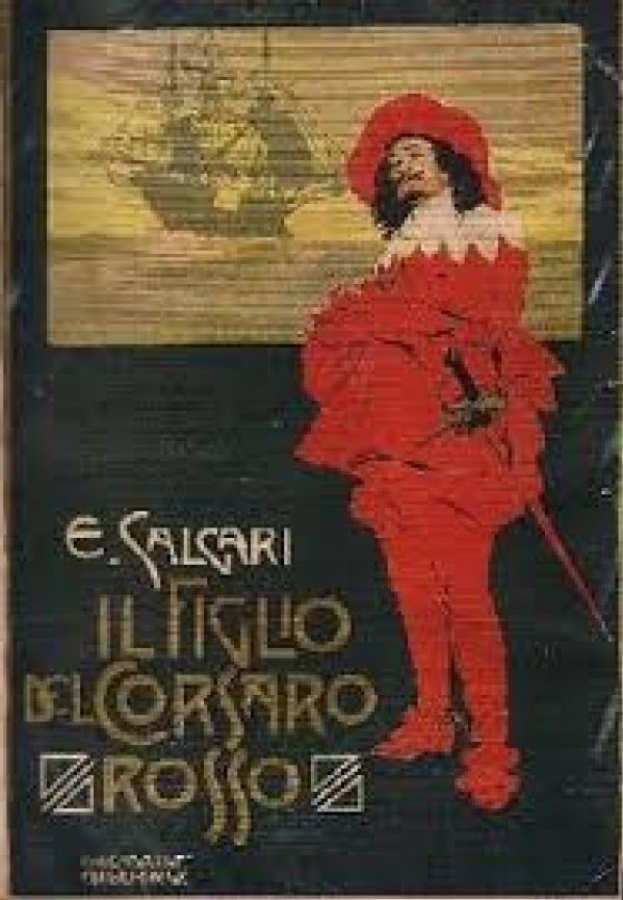
The Son of the Red Corsair
The Son of the Red Corsair > was a handsome young man, (...) of exceedingly elegant form that bespoke the great lord, with jet-black, fiery eyes, a black moustache, and very pale skin . One would expect a new Black Corsair. Yet such is not the case: first, because the son of the Red Corsair frequently distances himself from the pirates, even paying them out of his own pocket to prevent them from sacking conquered cities—confirming a notion widespread among the buccaneers, namely that the counts of Ventimiglia (the Black, Red, and Green Corsairs) were always “amateur corsairs”; second, because the son of the Red Corsair does not seek revenge, but merely wishes to find his sister, even though she is held by the Marquis of Montelimar, the very man who killed the Red Corsair and now keeps his daughter captive. The relentless hatred of the Black Corsair is missing. And this is why the exploits of the son of the Red Corsair lack the tension of the great novels of the Caribbean cycle: *The Black Corsair*, *The Queen of the Caribbean*, *Jolanda, the Daughter of the Black Corsair*. The classic ingredients of Salgari’s narrative structure are all present: the duels, the equatorial rainforest, the naval battles, the sieges of Spanish fortresses. What is missing is the sense of these adventures, the anticipation of something dark and brooding—the true source of the author’s astonishing narrative rhythm. The book’s peculiarity lies elsewhere. In Salgari, we invariably find sidekicks flanking the protagonist, often helping to humanize him and introduce elements of levity. Here, the system is inverted: the son of the Red Corsair remains in the background, while ostensibly supporting figures take center stage. The first part of the novel takes place on the island of Santo Domingo. Our heroes are pursued by the Spanish and by “exceedingly ferocious” hounds. The setting is at once terrifying and wondrous: thickets of vegetation, marshes, and deadly quicksands alternate with islets, boasting > splendid clumps of rhododendrons, over ten meters high, (...) clusters of purple flowers, (...) magnificent palms crowned by parasols of immensely long palmate leaves, cascading elegantly with spathes of an iridescent violet edged in purple, and clusters of fruit that resembled green apples . In this unreal nature, described with a few grammatical lapses (*parasole* being an invariable noun), the son of the Red Corsair comes across a buccaneer who appears quite savage. He lives by hunting and inhabits a > wretched dwelling made of crudely woven branches and a few poles . Aided by wine and conversation with a European gentleman, the buccaneer reveals, “with dilated eyes, his face bathed in sweat,” his terrible secret: > I must drown distant memories! Ah, the sad fate that has struck me down! (...) Well, such is this terrible life, if one falls prey to an evil genius . Thus we learn that the buccaneer was a nobleman of France, who dishonored his ancestors’ coat of arms and fled to America. Can the Count of Ventimiglia restore him to his former rank? It is no longer possible, > everything is past, everything has been forgotten. I killed two wild pigs, down there on the edge of the marshes... that is my trade. The buccaneer leads the son of the Red Corsair to safety, who then discovers that his sister has been taken to Panama. We move on to the wealthy Spanish cities of Central America’s western coast. The chases, clashes, and sieges are repetitive, almost formulaic. An exception is the duel between the son of the Red Corsair and a hitman, a skilled swordsman hired to kill the Count of Ventimiglia. Deluded fool! The bandit “crouched down completely, almost curling into a ball.” It was his secret move: the hundred-pistole strike. The count’s sword caught him in the throat, sinking in several centimeters. > He stood almost upright for a moment, arms outstretched, then tumbled heavily into the sands, murmuring: I am finished . In this section of the novel as well, the real protagonist is a supporting character: a Gascon—a drunkard, a chatterbox, always ready to throw punches, yet capable of resolving the direst predicaments through his cunning and brazen audacity. The band of buccaneers is on the verge of being captured by the Spanish in the city of Panama. Whereupon the Gascon, instead of fleeing, steps forward and tells the guards he was there to serenade his > splendid Catalan girl, you know, with two eyes that sparkle like stars and... a sweet little mouth, my dear sirs, enough to turn the head even of the Lord President of the Royal Audiencia . On another occasion, he poses as a Castilian nobleman, the Count of Alcalá, laden with titles and names, and even manages to obtain horses, provisions, and muskets—naturally, to make his escape. It is one of the rare instances where Salgari departs from adventurous, imaginative, or shadowy storytelling to invent an amusing, witty character, a sort of Harlequin. The story naturally has a happy ending, yet a feeble and hurried one. Despite not knowing him, the sister, still a young girl, embraces her brother and flees with him. Yet she had never seen him before! She feels the pull of the blood tie: a somewhat shallow explanation. Even more so is another fact: once the son of the Red Corsair is captured, it is the Marquis of Montelimar himself who leads him to his sister. A true gentleman! What remains of the gloomy saga of *The Black Corsair*? Very little, merely the trappings! By the end of this lengthy novel, Salgari seems more preoccupied with convincing the reader that what he recounts is true, not invented, than with lending rhythm to the tale. The entire narrative frays; the author himself realizes he has dragged it out too far and for too long. Why skip it? It is dull, and that is surprising for Salgari.

Cotton Flower
On December 15, 1943, the Jewish De Fano family was arrested and sent into internment: Omero, «the gentle bookbinder», the elementary school teacher Alma, her mother, and little Velia, the couple's daughter, an albino child nicknamed Fiordicotone. In the chaos of the roundup, the girl was hidden beneath a man's black cape, thereby surviving. Omero and the elderly mother were immediately put to death, while Alma was set aside for the SS officers for their sexual diversion. «Do whatever they ask of you, if only to save your life», her mother had told her, «naked among other stripped women». Yet if placing her body at the service of her tormentors had preserved her life, the experience had profoundly wounded her spirit. Looking into the mirror after the liberation, Alma > could not recognize herself. She had unbuttoned tunic and shirt and looked at herself. A perfect, desirable body. She saw herself colorless, her eyes worn out, her face faded and lifeless. In that body she once loved so much, she caught the sadness, the anguish of a solitude continuously abused . It was from this dual suffering, as an internee and as a prostitute, from the heaps of the dead and the humiliation endured ( > the sour taste in her mouth, on her skin the wretched, lingering scent of violence ) that there grew in Alma the perception that no afterwards existed, > for that hell was so bottomless and devoid of dignity as to leave no room for hope. Nothing was left. Only Fiordicotone. As is to be expected, the book recounts the search for the daughter: the initial shelter in Switzerland, the journey through a ruined Italy as far as Lugo, the discovery that the girl was no longer in the town, the struggles to learn where she was, and finally the encounter with Velia. An old blind woman's omen hung constantly over Alma: «You will find her, and when you have found her, you will return to the shadows». Like Alma, the reader too fails to understand the words, obscure as the oracles of the Sibyl. What does it mean to return to the shadows? We discover throughout the narrative that Alma cast no shadow; she was like a ghost, corporeal yet insubstantial, soulless. Alma «was the prisoner of a tattooed number», had no hope, and did not believe there was a future for her daughter. In tones perhaps overly melodramatic, yet keeping us suspended in anxious anticipation, the author carries us through to the conclusion. In an earlier novel (*Il bambino del treno*, reviewed on this site), Paolo Casadio took as his starting point a true event, set in a precise location: a small, now-abandoned station on the Faenza–Florence railway line. Both the setting and the historical episode provided a concrete anchor for the narrative; along with the elegant style, they contributed to the novel's success. In *Fiordicotone*, Casadio disperses his focus across too many themes, from the existential drama of the internees to the search for the daughter. The unifying thread is not so much the story or the protagonist, but an aura of death, of ghosts hovering from the past, running the risk of slipping into «fantasy» (one need only consider the image of the shadow, frankly overstated) or, more nobly, into the evanescent, abstract register of much of Mario Luzi's poetry. In attempting to say too much, the author neglects the setting of Lugo di Romagna, the characters, and in particular the reconstruction of the ambiguities, the craven compromises, and the petty, well-intentioned subterfuges of so many people who nevertheless acquiesced to the horrific aims of the Nazi regime: consider, for instance, the figure of the *maresciallo*. The frequent resort to full stops, with the resulting verbless sentences, fragments the narrative and undermines the elegance of the prose: a detrimental legacy of the prevailing journalistic style. Why read it? It reads very well and is interesting from a historical perspective.

Maybe Esther
The narrator-protagonist sets off from Berlin on a long journey through the countries to the east of Germany, across that vast geopolitical space where everything seems to have taken place unbeknownst to us Western Europeans. First, she visits the grand German Historical Museum in Berlin with her daughter (a visit I recommend to everyone), and in the area dedicated to the Shoah, her daughter asks her: > where are we here on this panel, Mama? (...) I would have liked to add that we did not appear in that image at all . Yet that is not true, and it is perhaps for this reason that she seeks to trace back her family tree: Jewish, partly Polish and partly Russian, victim of dramatic upheavals: the collapse of great empires, the Russian Civil War, the rebirth and partition of Poland, Nazism and Stalinism with their massacres, slaughters, ghettos, concentration camps, millions of dead; and worse still, the loss of one's own language and one's own history. And indeed the author skips, “in an odd and clumsy way, like the needle on a record that has reached its end.” Names and pet names follow one another along the family tree, and it is futile to identify and remember them; the confusion is perhaps intentional. Certain passages of the narrative leave a lasting impression, such as the genocide at Babi Yar, not least through the words of the great poet Yevgeny Yevtushenko (“Every old man shot here/me. Every child shot here/me”). In general, people, events, places, and words are like “lost scripts,” inscriptions found by chance that one tries to decipher, without even understanding which alphabet they belong to. > I realized that I had arrived too late, that knowledge had been lost, and I lacked the strength to recover it; I had lingered, with my birth and in general; it was not a fault, it was just too late . But does it make sense, then, to search for one's roots? Or does that “naturally” used by the author at the opening of the story serve to > underline the senselessness of her journey, (...) as if that disappearance and that nothingness were natural or even obvious phenomena . In Warsaw, the author believed she had found the house where her family had lived, only to discover it was another one, now destroyed. > During the night I couldn't sleep, I dreamed of the sauna, the ghetto, naked bodies twisted in death or pleasure, I dreamed of difference, men and women, (...) I don't know whether I was ever among my own people and who my people are, these ruins around us and inside us, and the transition from one language to another that I undertake in order to be on both sides, to be at once me or not-me, (...) in German language is feminine, in Russian it is masculine, what have I done with this exchange? It is a difficult book due to its disorderly plot, as if it were an assemblage of anecdotes, places, and characters crowding the mind without finding an order, a rational arrangement. It is as if memory loomed over and overwhelmed the protagonist; the images are too powerful, the pain too intense. > Knife blades emerge from the wall and move a short distance from the body. They hang somewhere, (...) and you describe them from a theoretical perspective, (...) but you cannot convey that terror, nor the horror of their presence, because to convey it means acknowledging it and granting it access. So terrible are these things. Granted, the family history is exceptional, but one wonders whether it truly makes sense to lift the lid on the past—what does it lead to, if not tears and delirium? The novel closes with an emblematic episode. > When I found myself in front of the house that was supposed to be mine, (...) an elderly lady (...) said to me—or was it perhaps a reprimand?—I've run into you a bit too often around here lately! And in astonishment I replied that I hadn't been there in years. That doesn't count for anything, she said . It is a splendid metaphor for the dark fascination of remembrance. Why read it? It is difficult, yet elegant and refined. It offers a narrative reflection of a history and culture unknown to us

Freedom
Among the possible meanings of the word *Freedom*, one defines it as > being able or having the opportunity to do what one wants without being restricted by something or someone (Collins Dictionary). The characters in this novel have always lived poised between the “set of possibilities” and events (what used to be called destiny), which push inexorably toward a specific direction in life. There are no externally imposed constraints; rather, it is the very nature of things that leads down one path rather than another. And life is made up of the complexity of interpersonal structures, of conformism, and of the pursuit of realizing ideas that are often theoretical and generic. The story unfolds between the Reagan and Obama presidencies, set within an increasingly frightened American middle class, riddled with divisions, moral and political dilemmas, and a burgeoning awareness of the nation’s decline. As in all good bourgeois stories, it begins with a triangle: Walter, an earnest young man brimming with environmentalist ideals, loves Patty, a star basketball player who feels rejected, on account of this passion, by her politically prominent, establishment family. Patty, in turn, is drawn to Richard, a musician and Walter’s close friend. Patty and Richard take a car trip together to join Walter, and for Patty it becomes a missed opportunity: Richard, a consummate womanizer, refuses to sleep with his best friend’s fiancée. The bond between Patty and Richard feeds on regret. > in all these years, (Patty) had treasured the memory of their little trip, had kept it locked in a deep interior space, letting it age like wine, so that, symbolically, what might have happened between them remained alive and grew older with the two of them . Within Richard there grew “envy of his friend for his unwitting possession of his wife.” Walter and Patty’s marriage drags on wearily (“they could not live together, but could not imagine living apart”), until a vacation by Patty and Richard in Walter’s beloved old lake house, set in a stunning natural landscape, precipitates events: the two sleep together. Walter cannot accept being betrayed by his best friend: the couple separates, doing so just as Walter finally realizes he cannot pursue abstract environmental ideals with the money of American capitalism. And it is precisely from the breakdown of false interpersonal relationships and the undoing of vague ideals that Patty and Richard find each other again and can rebuild the family. In truth, the book is not confined to these three characters; it also involves the younger (Walter and Patty’s children) and older generations, chronicling the histories of their families of origin. There are also numerous forays into the political and social issues that have characterized America in recent decades; the author is particularly invested in environmental themes, which are also framed as an emblem of the hypocrisy and vacuity of much of the bourgeoisie. The message seems invariably the same: it is impossible to change the world; we must learn to live with ourselves and our problems. Emblematic in this regard is the final chapter. Walter has retreated into nature, finding his life’s mission in the defense of migratory birds, particularly against a domestic cat prone to murderous rampages. This stance puts him in conflict with the small middle-class community bordering the nature reserve. The tensions are resolved when Patty returns; she nurtures social ties with the neighbors (the conformism of the American bourgeoisie) and eventually brings Walter back to New York, back to the family. At that point, the organization managing the reserve erects a dividing wall between the natural habitat where the migratory birds nest and the small community. Is the world, then, composed of countless walls, within which each person seeks their own freedom? And does true freedom perhaps lie in that other possible meaning of the word *Freedom*: “the condition of being able to move around,” even within separate worlds? The book’s greatest strength undoubtedly lies in its style—marked by tight, highly effective dialogue—and in the depth of its psychological and existential exploration of the characters and their mutual relationships. The narrative pacing is slow, and the story unfolds sluggishly. Overall, it is dominated by that intellectualized, erudite, yet often evanescent approach typical of many contemporary American writers. Why read it? It is interesting, but recommended only to a very patient reader.
Friendly fire
Eyal, Yirmy’s son, was killed during his military service by his own comrades, who mistook him for a wanted Palestinian. Amotz, Yirmy’s brother-in-law, in breaking the news of his son’s death, inadvertently uses a cruel term: Eyal was killed by friendly fire. This is the premise of the narrative, which gets underway from the moment Daniela, Yirmy’s sister-in-law, departs for Africa, where her brother-in-law has sought refuge and where her sister died. From this point onward, the novel unfolds along two parallel trajectories: Daniela’s journey to Africa and the life of Amotz, alone, in Israel. Daniela wants to know where her sister died, and in some way she is undertaking a journey of liberation from grief and death. Yet she also wants to understand why her brother-in-law, now in his seventies, chooses to live in Africa. The landscape, the animals, and the people form the backdrop of an ongoing dialogue between Daniela and Yirmy, in which familial themes (the sister, Yirmy’s quest to uncover the true circumstances of his son’s death) overlap with broader issues linked to the condition of Israel and the peculiarities of a religion—Judaism—so unyielding and severe. If it is possible to come to terms with the death of one’s loved ones, it is far more difficult to serenely overcome the existential anguish of an entire people. And so, the only recourse is flight to a distant continent: I came, Yirmy says, > to take a break from my people, from Jews in general and from Israelis in particular “everything that oppresses me slips away without philosophies and arguments.” Meanwhile Amotz, head of an engineering design firm, must find a solution to strange noises emanating from the elevator shaft of an apartment building: is it a technical issue, or is there something mysterious, unfathomable, arising from a country blithely living on the edge of a precipice? *Friendly Fire* addresses many themes, perhaps too many: death, family, religion, the destiny of a people, flight from it all. The underlying thread is the notion that the true threat comes not from without (for instance, from the Palestinians), but from within—from a people, the Jews, who have always wandered without ever wishing to integrate with others. The book does not intend to be an indictment of Israel, even if the passages concerning the Bible are undeniably critical; rather, it constitutes an expression of profound existential suffering. The Israeli people today are like that elephant paraded around as an attraction because of its gigantic eye. > Daniela feels her heart ache at the sight of its suffering, as though it were a relative. And in that iris flecked with blue, yellow, and green looking at her with sadness, a drop gathers that gradually turns into a tear, followed by another, and the weeping of that mute, and perhaps even grateful, animal shakes Daniela to the core, as if in that moment the desire that brought her to Africa during the festival of Hanukkah were finally fulfilled . *Friendly Fire* expresses the suffering of a people and its inability to break free from its condition. The flaw of the book, however, is that the theme unfolds sluggishly, almost smothered by words that seem to serve only to conceal and dissipate it. The phrasing is pleasant, but the sluggishness, the lack of narrative drive, and the monotonous reliance on the device of parallel plots are all factors that render the book verbose and tedious. Why not read it? It is a rambling, ponderous tale despite the author’s seasoned skill. The reader gets lost in an infinity of words.

The Cat Who Saved Books
What is the fascination of books? Why do so many of us spend so much time reading novels and poetry? The author attempts to answer these questions through a coming-of-age story, a cross between *Harry Potter* and *Treasure Island* (see the reviews on this site). Natsuki Rintaro is the typical *hikikomori*, a term synonymous with an antisocial, apathetic, and misanthropic adolescent. To be sure, he possesses a passion for reading, born of living in his grandfather’s crowded, dusty bookshop. It is a small secondhand bookshop with a peculiar layout. > When entering the bookshop through the brightly lit front door, the room seemed in perspective far deeper than it actually was, and for a moment it felt as though that book-lined corridor stretched out endlessly into the darkness . There is a power in books, the grandfather used to tell his grandson as he quietly opened a volume. Upon his grandfather’s death, the boy is supposed to go live with an aunt—a fate he accepts passively, almost indifferently. Suddenly, out of nowhere, a cat appears; with gentle yet firm manners, it invites him on a quest: to save books. Together with the cat, the boy ventures down the corridor beyond the back wall of the bookshop; the two find themselves in palaces, veritable labyrinths, from which the boy will only be able to escape if he frees the books. Each labyrinth corresponds to a specific way of understanding our relationship with this “collection of sheets of paper covered in printed characters”: the obsessive urge to hoard, the pursuit of digests that allow one to consume the greatest number of writings in the shortest possible time, and the conception of the book as a consumer good—a business in which everything that does not sell must be destroyed. It is a taxonomy all too familiar to us book lovers, yet one forgets that > reading a book is rather like climbing a mountain. (...) Every now and then you have to examine line by line, re-read the same sentence backwards several times, and proceed slowly, striving to understand. As a result of such arduous effort, suddenly your mind opens up . These are the grandfather’s words resurfacing in the boy’s mind, dense and vigorous words. Through the climbing metaphor, the grandfather means that one can only endure the grueling ascent if one loves the mountain. And it is this very argument that disarms his interlocutors and saves the books: how can one hold them prisoner, chop them up, and treat them as mere commodities, if one truly loves them? The journey of personal growth is not yet complete. To paraphrase Karl Marx in *The Poverty of Philosophy*, we are still in the realm of ideas, bound in an erudite and narcissistic attachment to reading. Only the final trial will bring the adolescent’s maturation to fruition: as Confucius held, the humanities, literature, and poetry allow us to understand “the sense of reciprocal humanity”—that is, the empathy that binds all human beings together. The author attempts to give narrative momentum to the story while simultaneously conjuring a magical atmosphere. To this end, he resorts to the literary device of the cat, a frequent trope in Japanese literature—one need only think of Natsume Soseki’s *I Am a Cat* (see the review on this site). Yet while in Soseki’s work the cat is an ironic, wise figure, an alter ego to the dull and narrow-minded schoolmaster, here the small feline is a plodding censor of the protagonist, akin to the Owl in *Pinocchio*. The long corridor that opens mysteriously into the labyrinths calls to mind the far more original railway platform from which the magical adventure of *Harry Potter* begins; moreover, the description of the palaces is so meticulous as to become predictable and verbose. Having started off well, the novel lapses into a pedantic meditation on the book, containing reflections that would be agreeable and worthwhile were this a work of non-fiction. What elevates the novel’s quality is the prose: plain, pleasant, and fluid, even if occasionally repetitive; the brushstrokes portraying the bookshop and sketching the boy and his friends are spot-on. What a pity the author did not develop the characters more thoroughly! Why read it? It speaks of our love for books.

God help the child (Children first)
For many of us, childhood was a source of suffering. > And each will rewrite this story forever, knowing the sorrow, imagining the plot, inventing its meaning, and forgetting its origin . Then one day we discover that > you accepted like a beast of burden the weight of an incomprehensible curse and the unjustified threat that binds you to wounds and leaves you with a fate; and you spend your life denying, even though that hateful word is only a fragile line drawn on a rock, quickly dissolved at any moment by the force of the sea . But what is this force? The author seems to suggest it may be love, attested by the birth of a child. Two young people meet by chance, each bearing a secret. Bride was born with skin of a “terrible color”: black. She repulsed her mother to such an extent that she never touched her, even though it was hardly the child’s fault, but rather the twenty percent Negro blood in her family. Still a young girl, in an effort to gain acceptance Bride commits a terrible act: through her testimony, she sends a woman to prison by accusing her of sexual molestation, knowing full well she is innocent. Booker is a brilliant young man and a talented musician; his life was shattered by the death of his brother, raped and tortured by a sexual predator. He wishes to live in memory and has run away from home, confronted by his family’s refusal to persist in perpetual commiseration. They spend six intense months together, marked by overwhelming passion and a profound communion of purpose and feelings; yet both keep their painful secrets hidden from one another. And then, one day, Booker walks out, simply saying: “you’re not the woman.” Did he do it, perhaps, because she is Black, despite being glamorous and wealthy? Can neither beauty nor success overcome racism? Is it still the ancient sin of being born with that skin color? Bride wants to know; she sets out in search of Booker, eventually finding him at an elderly aunt’s home. While searching for him, a strange phenomenon befalls her: she reverts to being a child, as though life were starting over from the beginning: > a child. New life, immune to evil or disease, protected from kidnapping, violence, rape, racism, insult, hurt, self-loathing, abandonment, Error-free, All goodness. Angerless. Or so they believe . Through this inexplicable transformation, Bride frees herself from guilt and is ready to confess the terrible truth, as well as to embrace Booker’s suffering: she realizes he left her because he loves her, > so as not to overwhelm her with a grief so deep it would have broken her heart : > Now she is pregnant. Good luck. (...) Listen to me, You are about to find out what it takes, what the world is like, how it works and how it shifts when you are a parent. Good luck and God help the child . It is difficult to grasp the narrative line of this novel; too many themes overlap: violence against children, racism, liberation from suffering, and perhaps others besides. The plot is muddled, and the constant shifting of narrator (the mother, Bride, the friend, the third-person narrative) certainly does not help; on the contrary, it disorients the reader by forcing them to piece the overarching thread back together, without adding anything to the understanding of the story or the characters. What redeems the novel is the prose: even if weary when compared to the author’s other works, it still manages to enthrall with its elegant, muted syntactic construction, with words so evocative as to create expectations of meaning that nevertheless slip away and remain suspended. In short, one is left somewhat disappointed. Why read it? It is intense.

The Golden Notebook
It is the mid-1950s in England. Anna is a writer living off the royalties of her successful novel, set in Africa during the Second World War. Divorced after a brief, loveless marriage, she is the mother of a young daughter and a friend to Molly, who is likewise divorced from an immensely wealthy man and the mother of a twenty-year-old son. "Free women," independent, shouldering the burden of raising their children, yet destined for loneliness and relationships with men incapable of meeting women's needs: > women's emotions are still geared to a kind of society that no longer exists. My deep emotions, the truest ones, are about my relationships with men. One man. But I don't live that kind of life, and I know few women who do. I ought to be like a man, care more for work than for people; I ought to put my work before everything, and take men as they come, or find an ordinary but well-off man for financial support, but I won't do it, I can't be like that . Anna can no longer write and turns to a psychoanalyst, who advises her to keep a diary. *The Golden Notebook* consists of four notebooks: the black one, concerning Anna the writer; the red, for politics (Anna is a member of the British Communist Party); the yellow, for stories outside of real experience; and the blue, which attempts to be a genuine diary. A spiral unfolds in which reality blurs with imagination, a sort of descent into the depths of consciousness. It all unfolds unexpectedly, because > the things that are important in life advance furtively, by surprise; one doesn't expect them, they take no shape in the mind. They are recognized when they appear, that is how it is . The book becomes a sort of box which, when opened, > instead of beautiful things, there is a mass of fragments and pieces. Not a whole thing, broken into fragments, but little pieces from everywhere, from all over the world.... seeing the mass of horrible fragments was so painful that I could not look, and I closed the box . But what is so terrible within consciousness? The dissolution of human bonds, the pain that inexorably marks relationships between individuals, the chaos of a world hurtling toward destruction, and hence loneliness within chaos, from which the only possible remedy seems to be the aridification of emotion—erecting a defense against the destruction of human relationships, against their reduction purely to the forces "of property, money, and power." Anna’s is an existential and cosmic suffering that cannot but lead to madness. Yet at the end of the journey, Anna realizes that salvation is anchored in the deepest bonds: those of affection and care. At the climax of a deeply fraught passage, a simple sentence offers the alternative to death: "I can hear Janet (Anna’s daughter) coming up the stairs." It is a highly complex novel, philosophically as well, open to many readings: the exhaustion of hope for the future, of the grand ideologies; the culmination of a political and literary trajectory asserting female independence—one that began with Jane Austen's heroines and ends in Anna's profound solitude, where, in a passage unquestionably shocking for the era in which the book was written, she declares that she prefers masturbation to sex with men incapable of love; the theme of psychoanalysis and thus the discovery of one's unconscious; literature as imagination, but also as a search for self, as memory and nostalgia. What makes the book timely is its reflection on the repercussions of a world in destruction upon individual consciousness, the author’s ability to grasp how the absence of a broader hope has a devastating impact on human relationships themselves: one cannot be saved by retreating into the domestic sphere, nor, however, can one rely on outworn ideologies. The narrative is sustained by an elegant prose style, pleasurable to read. The multi-layered structure of the tale would have required a tremendous ability to maintain a compact narrative architecture, which instead fragmented and dissolved. That very intellectual richness, while often offering compelling food for thought, does not favor the frugality and concision of the narrative. Why not read it? A few pages hold up well, but the overall reading proves ponderous and prolix.
The Grand Sophy
Georgette Heyer was one of the most popular twentieth-century English writers. *The Grand Sophy*, recently translated into Italian, chronicles the intrusion of an independent, daring, and willful young woman into a traditional family of the English upper nobility at the beginning of the nineteenth century. The novel opens with Sir Horace’s unexpected request to his sister, the mild-mannered Lady Ombersley, to host his seventeen-year-old daughter, Sophy, for several months. The reader is immediately introduced to the cast of characters and to the circumstances from which the narrative unfolds: the two eldest children, the authoritarian and short-tempered Charles and the “so typically English” Cecilia, a female figure straight out of Jane Austen; the family’s financial ruin following Lord Ombersley’s gambling debts; and the providential inheritance bequeathed to Charles, which has cast him in the role of head of the family, fostering an atmosphere of subservience and reverent dread among his brothers and numerous sisters. Then there are the impending marriages. Charles has engaged himself to Miss Wraxton, unquestionably of high breeding and moral standing, yet detested by the Ombersleys for her patent intention to impose order on a household management she considers far too lax and permissive. Cecilia has accepted Lord Charlbury’s suit, yet has become infatuated with a handsome, penniless young poet. Lady Ombersley’s anxieties are thus manifold; she initially attempts to resist her brother’s insistent pleas, but ultimately agrees to take Sophy in, expecting a timid adolescent eager to be welcomed into the warmth of a home, having been orphaned of her mother as a young child and raised by a father, Sir Horace, who was perpetually on the road. She is consequently left stunned and somewhat alarmed when, accompanied by a mountain of luggage, a greyhound, a small monkey, and a splendid black horse, there appears an imposing girl—not pretty, but > built on generous lines, tall, with a fine bosom, an intensely lively countenance, and a wealth of rich brown hair under one of the most dashing hats her cousins (the numerous young Ombersleys) had ever seen . Her appearance reveals the girl’s character: impatient of rules, stubborn, capricious, and generous all at once, but above all > Sophy could not see anyone in trouble without instantly wishing to discover the cause, and, if possible, to set it right . This attitude cannot fail to bring her into conflict with Charles, by now accustomed to commanding. The girl causes a scandal (driving unchaperoned through London in a racing carriage!), flouts his directives, and openly challenges his betrothed, a sanctimonious busybody. Above all, however, Sophy schemes to make people happy, brushing aside the dictates and conventions of polite society. Yet, as so often happens, strong personalities relish encountering minds capable of defying them, and gradually Charles falls in love with Sophy. Could it be that the girl had been maneuvering from the very outset to conquer her sullen and difficult cousin? The plot is the novel’s greatest strength: unexpected twists, brisk dialogue, and Sophy’s subtle machinations coming to fruition in the teeth of adversity, malicious gossip, and the opposition of Miss Wraxton—virtually the only character who makes a pitiful attempt to thwart her. One senses that quintessential self-critical complacency of English culture, which views itself as rigid and conventional in contrast to Continental culture, imagined conversely as nonconformist and free. It is a trope reflected in the overly schematic portrait of Sophy—monotonously self-consistent, far too assured and mature for her years—and in the profiling of the other characters, so formal and predictable. Cecilia and Charles are the exceptions. The former asserts her complete independence—unprompted, in this instance, by her exuberant cousin—the moment she declares that she does not love Charlbury, but intends to marry the dreamy, handsome poet. Yet it will ultimately be Sophy who plays precisely upon the girl’s ingrained English values—her regard for propriety and respectability—to lead her back to desiring her original betrothed. Charles, on the other hand, represents the synthesis. While it is true that he is mindful of society’s rules and conventions, there resides within him that Elizabethan vigor that underpinned the British Empire. He is, after all, the hero, and one is left to wonder whether it will be he who changes Sophy, molding her into the noblewoman her rank naturally calls her to be. The scene in which Charles and Sophy declare their love is so thoroughly dominated by him that it raises the apprehension that Sophy’s future may simply be to yield to the conformism that surrounds her. Why read it? The plot is full of twists—somewhat predictable, perhaps, but thoroughly entertaining.
The Great Crossing
We find ourselves inside a major publishing house, in the department tasked with compiling dictionaries. Despite being a profitable business, the staff is remarkably small, not least because preparing a new dictionary is an exceptional endeavor—a difficult, complex undertaking that does not happen every year; between an old dictionary and a new one lies a process of continuous revision, which nevertheless does not overhaul the entire structure of the work. We learn how a dictionary must be exhaustive, up-to-date yet concise, especially since it is compressed into pages where each headword (as the individual entries are called) must occupy a space calibrated so as not to disrupt the balance with the other entries. For example, how does one describe a great poet from around the year 1000 (samurai, monk, and poet), whom tradition named Saigyō—a term laden with meanings, from “immortal” to “wandering pilgrim,” and even “freshwater snail”? Should some of the poet's verses be quoted? Is it right to state that every Japanese person “cannot help but be moved” by Saigyō's poetry? A dictionary ought to be precise and objective, eschewing value judgments. Another challenge is the paper: it must be extraordinarily thin, yet prevent ink from bleeding through to the reverse side. It is hardly surprising that such peculiar work requires individuals so engrossed in the secrets of words as to think of nothing else. Compulsively, > they studied and analyzed them with extreme detachment, almost as if vivisecting them. There was something vindictive about their obsession, as though they were hunting down a hated enemy, gathering information to catch it red-handed and make it pay . Our story begins when the department head retires and seeks someone to replace him. In the office, there is a seasoned colleague, but he suffers from a fatal flaw: he lacks the meticulous obsession required for lexicographical work. Over in sales works a young man, a fellow with “madman's hair who never sheds those hideous black sleeve protectors.” His very name intrigues the department head: Majime is an unusual word, apparently meaning “horse supplier.” When, over lunch, the young man describes his favorite pastime (watching people ride the escalator), the department head knows he has found his man. Just as people queue two by two in a harmony that is “fabulous, elusive,” an enthusiastic Majime exclaims, so too an astonishing tide of words arriving from all quarters can be classified, arranged into columns, and set in immaculate order across the pages of a dictionary: it is within this order that the lexicographer's pleasure resides. Majime gradually settles into his new responsibilities, falls in love, and marries a brilliant young chef. They seem an improbable match, yet they are bound by the same meticulousness and quest for order: Majime in his obsessive exploration of words, and she in the impeccable preparation of traditional Japanese dishes. The publisher decides to embark on a major new dictionary, titled *The Great Passage*. Time is of the essence; they must outpace the competition, which is also working on a new lexicon. The staff needs reinforcing, and an employee from the Marketing Department arrives. Incredulous and intimidated by Majime's “ardent, almost devilish expression,” Kishibe feels she lacks both the competence and the passion; she stands before “a steep, jagged wall impossible to scale.” Yet she gradually comes to realize that this new dictionary—to be published as quickly as possible, concise and precise as any good lexicon must be—is for her a true passage. > She had carried on with her life and career without ever pausing to reflect. (...) Becoming aware of the power of words—the power not to harm others, but to respect them, to communicate, and to forge healthy interpersonal relationships—had taught her to know herself better and to understand the thoughts and feelings of others . All of us, avid readers that we are, believe that words have the power to change people, or at least to offer a deeper understanding of oneself and others. To develop such a compelling and poignant thesis, however, the characters needed greater psychological depth. Instead, Majime is a monolith, fated from the outset to harbor a morbid obsession with minutiae; Kishibe is more complex as a personality, yet she attains self-knowledge through sheer grit and determined labor, without our ever understanding where she comes from or where she truly wishes to go. At times, the author seems eager to inject a suspenseful, quasi-thriller tone into the narrative: will our heroes manage to complete the dictionary against a thousand obstacles and setbacks, despite the skepticism of corporate executives? Yet the plot is sluggish and devoid of surprises, lapsing at times into melodrama and superfluous detail. Why read it? It is pleasantly written and opens a window onto the world of dictionaries.
William and the Gold Coin
It is a book for children aged 9–10. Guglielmo is a young boy who finds a gold coin and discovers that people, even good ones, turn false and wicked out of greed. The only bonds left to him are those with his dog and a vagrant, a former soldier. In the end, Guglielmo realizes that, if > a man is free, has friends, has honest work, cares for people, well, perhaps he has something more than one gold coin, or a hundred. Therefore he is rich . The book is pleasant, but it strikes me as somewhat dated, overly simple, and lacking that touch of suspense needed to keep the reading from being entirely predictable.

The house of sleep
The theme of sleep purports to be the book’s unifying thread, to the point that the novel is divided into parts corresponding to the various stages of sleep. In reality, it is a device—perhaps overly intellectual—to tell the story of the love between Robert and Sarah. We find ourselves in a university hall of residence. Sarah suffers from a sleep disorder that leads her to confuse dreams with reality. At their first meeting, Robert tells her he has just lost a cat to which he was deeply attached. Sarah dreams that Robert has lost a twin sister, Cleo, who does not actually exist. And it is upon this misunderstanding, originating in Sarah’s secret—her sleep disorder—that their relationship takes root: > as she left, they looked directly into each other's eyes for the first time; and something happened then, some connection was made, just for a moment . Their relationship is built on confidences, which > ranged freely over feelings, friendship, families and gender, shared intimacies and self-revelations which became deeper and more frequent as the objects themselves grew larger and more complex . The relationship between Robert and Sarah cannot, however, develop into a true romantic affair, partly because Sarah is a lesbian and partly due to Robert’s inability to translate his feelings into romantic advances. Their story remains in limbo until Sarah’s and Robert’s paths diverge: their university years come to an end, and when Sarah terminates a relationship with a woman, Robert realizes he is incapable of seizing this opportunity to translate his affection for his friend into a sexual relationship. At this point, the plot (in truth, the narrative constantly jumps between past and present, complicating the reading experience) shifts into the future, when the university residence has been converted into a sleep clinic—as it turns out, run by Sarah’s first lover, a paranoid man convinced that his mission in life is to find a way not to sleep. This is the least convincing section of the book, which seems to slide into a thriller, peppered with superficial musings on psychological science and references to analogies between dreams, fantasy, and cinema. The finest pages are those chronicling the life of Sarah, now a schoolteacher, in some way haunted by her sleep disorder—with which she has come to terms—and ever waiting for Robert, the only person with whom she knows she is truly in tune. Only towards the end of the novel is it revealed that Robert has undergone gender reassignment (because he understood his true nature, or out of love for Sarah?), becoming Cleo, a physician specializing in sleep disorders. And, like any thriller, everything is resolved, and Cleo can finally reveal herself to Sarah. The book’s primary virtue is the prose: pleasant, brilliant, and fluid. Its chief flaw is the inconclusiveness of the events and the characters: everything remains superficial, creating a palpable disconnect between the narrative structure of a thriller and the unmistakable ambition to deliver something more. What, exactly? It is impossible to say. Why read it? The individual pages read exceptionally well; the story as a whole disappoints.
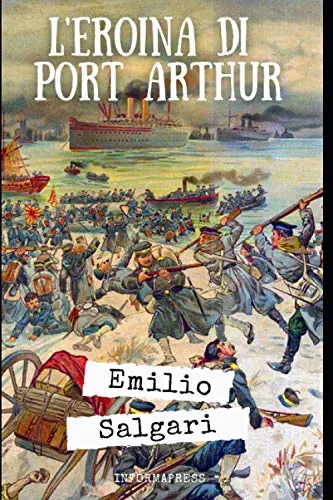
The Heroine of Port Arthur
Emilio Salgari was exceptionally swift at fashioning stories around events that gripped the public imagination; he did so by blending a certain exoticism with wars and romantic intrigues. Such had been the case with *La capitana del Yucatan* and *Le Stragi delle Filippine* (see the reviews on this site), and so it is in this novel, published under a pseudonym in 1904. The backdrop is the Russo-Japanese War of 1904–1905, in which > "little Japan," as the Russians contemptuously called it, confronted and defeated the vast Russian Empire. The setting is Port Arthur, the gateway to the conquest of Korea and at the time in Russian hands. The narrative opens with a scene of simultaneous splendor and decay: a *daimyo* (that is, a feudal lord) passes through the crowd alongside his stunning daughter, Shima. > She was barely sixteen, (...) not tall, exquisitely proportioned, with deep black eyes that bore no trace of slant, (...) skin with alabaster hues, (...) with a lovely little mouth, its somewhat thin lips hinting at an extraordinary resolve. A lavish reception is set to take place at the daimyo’s residence to celebrate Shima's betrothal to Boris, a Russian officer. The prospective groom fails to appear: he is having an affair with a geisha and knows that war with Japan is imminent, rendering marriage to a Japanese woman impossible. The city is steeped in an atmosphere of tense anticipation, which allows the two women to face one another: Shima, > with blazing eyes and an inflamed countenance, demands to know whether the geisha truly loves Boris; the other implores her to let her keep her love, > why wrest from me, a poor geisha, the love of a single man—the only one who has ever truly loved me, and whom I love? I am a wretched flower cast to the mercy of the wind, destined to wither unless someone gathers me and exposes me to the dew and the sun. Never in his numerous novels had Salgari chronicled a conflict of such passion and social resonance, pitting a beautiful, wealthy aristocrat against a destitute prostitute in love. In a writer so attuned to public sentiment, one detects echoes of Gabriele D'Annunzio, Guido Gozzano, Gian Pietro Lucini, and French *poètes maudits* such as Paul Verlaine and Charles Baudelaire. Regrettably, this social and romantic conflict fails to evolve, cut short by the outbreak of war; upon both women falls a single, overriding duty: to serve the homeland, Japan. > The homeland!, exclaimed the geisha, in a sudden burst of fervor, (...) The danger facing our homeland in this solemn hour unites the common people and the nobility for the supreme defense of the country, bridging the abysses that divide them, Shima said in a solemn voice. She drew her into her arms and kissed her on the forehead, saying: for the homeland! And we are no longer in distant Port Arthur; it is as if we were commemorating the martyrs of Dogali and Adwa, the heroes who defended the Nation against the fierce Ethiopians! Salgari extols a nationalist, colonialist, and irredentist Italy, which would march exultantly into Libya and later to liberate Trento and Trieste in the catastrophic slaughter of the First World War. "Little" Japan becomes the mirror of modern Italy: its war dead the future martyrs, the two women the archetypes of all the mothers, wives, and daughters who will sacrifice their personal affections for the Motherland. A keen reader of war correspondence, Salgari displays a remarkable grasp of the dynamics of the naval clash unfolding at Port Arthur, where the formidable Japanese fleet, deftly commanded and equipped, pinned the Russian vessels inside the harbor before closing the city in a pincer movement from sea and land. Yet it is precisely the sheer scale and protracted duration of the battle that make it difficult for Salgari to provide overall clarity and highlight the dramatic turns of events. The author operates far better when only a few ships clash, making it easy to focus the reader’s gaze on the pivotal locations of the action. In the same vein, Salgari abandons his customary narrative blueprint of a central figure supported by secondary characters. Here that role might have belonged to Shima, but the "heroine" is overwhelmed by events, struggling to coexist with the minor figures. And where is the enemy, the traitor Boris? This incomplete and ill-defined system of characters stands as the novel's primary weakness. Why read it? For a fleeting spell, one conjures up the Salgari of *Il Corsaro Nero* (see the review on this site).

The Sentimental Man
An opera singer recounts a dream in which he relived a love affair: several years earlier, in Madrid, he had met and spent time with a couple—the wife of a prominent businessman and her male companion. The singer had fallen in love with the woman, whose husband later killed himself out of despair. While writing down the contents of the dream, news reaches him of the accidental death of his former girlfriend. The device of the recounted dream seems intended to recreate that atmosphere of enchantment, present with greater force in the author's other novel, recently reviewed. In truth, the author intended to tell a love story to demonstrate how that feeling > always requires something fictitious beyond what reality affords it. Love is based to a great extent on its anticipation and its memory . From this point of view, the true protagonist is the husband, who did not opt for reality but lives in yearning and thus in an expectation of love, constituted by his wife's acceptance of his affection and passion. I do not know why, but the book recalls a Pirandellian plot, insofar as the impression emerges that reality is not what it appears to be, but rather what one would wish it were, and despair is born precisely at the moment one realizes the profound divergence between reality and imagination. The various protagonists—the wife, the companion, the husband, and the former girlfriend herself (who held no importance while alive, yet acquires it through her death)—are analogous to Pirandello’s *Six Characters in Search of an Author*. They are attempting to escape unreality through the opera singer, who appears to be a passive subject in the affair, enduring events that he actually sets in motion. Does the passivity with which the singer accepts being abandoned by the woman perhaps intend to signal the prosaic nature of reality compared to the depth and vitality of the imagination? The book is very well written, but it possesses less depth, stylistically as well, compared to the previous one.
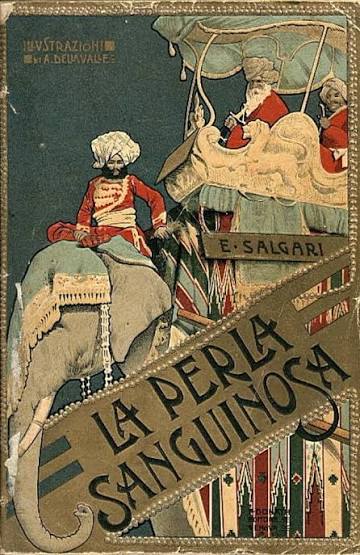
The Bloody Pearl
Although he went by the moniker "Captain Salgari," the Veronese writer never actually traveled; for his novels, he relied on the numerous accounts of explorers and geographers who brought back to Europe tales of hitherto unknown worlds—accounts that blended reliable reports with fanciful inventions, steeped in a burgeoning racism. Our author was always deft at promptly seizing upon "the trend," chasing the public’s appetite for strange and exotic novelties. Right from the mysterious and evocative title, one enters the atmosphere: *La perla sanguinosa* (*The Bloody Pearl*) is a pearl of rare beauty, stolen from a sacred temple in Ceylon (modern-day Sri Lanka) and steeped in the color of the blood of the thief who took it, only to drown later in the great shoal of Manaar, an extensive shallow reef situated between southern India and Ceylon. Behind the pearl lies a love story: a maiden has been forced to become a Buddhist nun and can only be redeemed through the delivery of the bloody pearl; vying for both pearl and maiden are a humble pearl diver and the One-Eyed, a villainous impostor. Both are held in the prison of Port Cornwallis, a British penal colony located in the Andaman archipelago, a group of islands in the center of the Bay of Bengal. It is from this prison that the novel sets forth: three inmates (our diver, an English sailor, and an Indian machinist, all wrongfully imprisoned) manage to escape the colony and head toward Ceylon in a fragile boat to recover the bloody pearl and redeem the beloved maiden. Not only are they pursued by the One-Eyed, but they must also confront a series of ordeals: from the assault of a sea vampire—perhaps a "lamprey," a fish with a sucker mouth that feeds on blood—to a terrible storm with gigantic waves, culminating in their capture by the Queen of Nicobar, who wishes to take the handsome Englishman as her husband, much like Circe with Odysseus. Salgari’s imagination knows no bounds, conjuring up the Vadassi, whose valiant chieftain Adikar—fascinated by Napoleon—sought to emulate his deeds and lead his people to triumph, a sort of feral Sandokan; and what of the "crucified dolphins," in reality a small cetacean that inhabits Antarctic waters, far removed from the Bay of Bengal. To this muddled wealth of geographical, zoological, and anthropological references corresponds an equally muddled plot, packed with adventures that are all too often repetitive and prolix. Salgari’s narrative formula hinges on a central protagonist flanked by supporting characters who leaven the narration and throw the hero into sharp relief. When he departed from this model successfully, as in *Capitan Tempesta* and *La stella dell'Araucania* (see the reviews on this site), it was because he proved capable of constructing a compelling, intense love story. The setting, while ever-present, always remained in the background, instrumental in evoking an exotic and mysterious atmosphere. Here, the narrative functions are inverted: setting takes center stage; the band of fleeing prisoners is flat, devoid of a true leader (the Englishman predictably emerges, yet remains a faded figure), and lacks any clear hierarchy of roles; the love story remains suspended and remote, and the villain is easily defeated. Layering adventure upon harrowing description fails to impart rhythm to the narrative or captivate the reader. One finds solace only in a few isolated descriptions, as in the recounting of the struggle with the vampire: > it had wrapped itself around my body with all its tentacles, and the monster’s eyes—those huge, glaucous eyes—were fixed upon me, motionless, as if relishing my torment; and through that nearly transparent body, I watched the transfusion of my own blood flowing from the suckers into its mouth and passing thence into the ventricle. Why read it? As a testament to how the world was viewed in nineteenth-century Italy.
The Lantern of Diogenes
This is a narrative that can be divided into two parts. In the first, the author recounts his bicycle journey from Milan to the Romagna coast, although, in reality, he stops in the mountains of Modena. The second part depicts his stay in Bellaria. The first part is very fine and lively. One senses a feeling of escapism, of flight from the city and industrial society; the landscape, the inns, and the people encountered are described in a style that is ironic yet affectionate. In these pages, there also prevails a literary self-indulgence, in both diction and references, which comes at the expense of the narrative’s spontaneity. In the second part, this characteristic becomes more pronounced, accompanied by a lyricism that seeks effect for its own sake and remains redundant in relation to the story’s content. The subject, indeed, is Romagna at the beginning of the twentieth century, with the harshness of its life, its poverty, and its squalor. The journey to Comacchio is remarkable: the arduous bicycle route, the town in the evening, the overnight stay, and so forth. The depiction of the family living in a shack on the beach takes on almost Verist undertones: the man’s ravenous meal, the children’s curiosity, and the woman’s ragged clothes. Yet the powerful character of these pages is lost in a generic, conservative moralism, when the writer reminds us that misfortunes can strike any social class: his companion suffers from a serious illness that forces him onto a strict diet! As the 1935 Treccani Encyclopedia writes (an era beyond suspicion from a political standpoint), Panzini’s work tends, > despite its classicist premises and its intentions of objectivity, of composure... , toward lyrical confession, impressionistic notation, an interior soliloquy varied by melodic cadences and veritable flights of song ; all traits that made reading another work, *Viaggio di un povero letterato*, unbearable.

White Nights
> I am a Dreamer... I have so little real life! In reality, I have lived moments such as these so rarely that I hope to make them live again in my dreams. I will dream of you all night, every week, every month, all year round.... This is how the first-person narrator expresses himself when, one night, he meets a weeping girl who also describes herself as a "dreamer." We will never learn his name; hers we discover is Nasten'ka, and she lives with her grandmother, who keeps her pinned to her skirt with a safety pin to prevent her from wandering off. It is a peculiar sort of cloistering, given that Nasten'ka slips out into the night without trouble and has embarked on a relationship with a young neighbor who promised to marry her—an improbable, "tear-jerking" tale that would have seduced no one but our naive Dreamer. On the other hand, he is a young man disillusioned with life, possessing *a fantasy sick with anguish*, waiting for a > spark from which to flare up a fire to warm the frozen heart, from which to revive that which was once so dear, which touched the soul and made the blood boil, which drew tears from the eyes and deceived so majestically. And if for Nasten'ka the encounter is a way to console herself and, if you will, a coquettish, self-victimizing pose to win admiration and toy with feelings, for the Dreamer the young woman is the continuation of the Dream, of a fantasy of Love. > Oh Nasten'ka, Nasten'ka, if only you knew how alone I am. the Dreamer cries out, as though the girl could, or wished to, fill his void. Poor Dreamer! The subtle game of seduction is carried to the point where our Dreamer is ready to marry her, given that Nasten'ka's betrothed has failed to show up to honor his promise of taking her to the altar. Better a Dreamer than an old maid pinned to her grandmother's skirts! > I had looked at her... She had leaned against me more heavily. At that moment a young man passed us by. (...) God, what a cry! What a shudder! How she tore herself from my arms to run toward him. (...) I remained there, for a long time, watching them... In the end, both had vanished from my sight. In her fine introduction, Sarah Tardino evokes the distant love of the Provençal poet Jaufré Rudel; in this light, Nasten'ka would be a Fantasy of Love, a figure both idealized and real who, as Giosuè Carducci sang, "three times the trembling mouth / with love’s kiss did kiss." Far too much grace for the wretched Dreamer! This interpretation focuses attention on the relationship between the two youths, losing sight of the core of the tale: the Dream. Within a narrative structure hinged upon dialogue, the story is actually a long soliloquy, in which the part recounted by Nasten'ka is merely the distorted mirror of the Dreamer's suffering and of his need to construct a narrative wherein he is the protagonist, the savior of the sorrowful maiden. In this dialogue born of the Dreamer's fantasy, Nasten'ka asks herself > why can we not all be like brothers? (...) Why can one not speak plainly what is in one's heart...? Why can the Dream not become real, I would add? Why can one not meet someone to confide in, and fall in love with, with whom to escape from loneliness? Or perhaps, it is better to go on dreaming. Why read it? A fragile tale, difficult to grasp, yet admirably written.

The Vanished Reader
Vince, an eternally precarious literature teacher, has invented a new profession for himself: bibliotherapy—dispensing reading advice to help people resolve their existential and psychological issues. But do books truly possess this therapeutic power, which «wards off the pull of emptiness and black bile» as the ancient Greeks believed? Or does reading fiction merely and humbly lead us to daydream about another life, with a different ending? Hampered by a tenuous plot and flimsy characters, the novel attempts—perhaps—to answer these questions through two parallel narrative strands. In the first, we witness Vince’s sessions with his patients: women who come to recount their stories to a penniless, inexperienced therapist, sitting on the sofa bed of a squalid studio apartment. Some leave in indignation without paying; others accept his reading recommendations, though we will never know if they actually read the suggested titles. One might anticipate amusing or paradoxical scenes, but in truth, these consultations serve merely as a pretext for the author to flaunt his bookish erudition. Coupled with the French epigraphs opening each chapter, beyond the narrative void, one's mind turns not to Italo Calvino’s *Six Memos for the Next Millennium*, but rather to Matei Vișniec’s *Panic Syndrome in the City of Lights*, in which a chaotic succession of characters and authors overwhelms the reader in the absence of narrative unity (see the review on this site). Whence this compelling urge to foist a disguised bibliography upon us, much like in another tedious and futile book, that of Alba Donati (*The Bookshop on the Hill*, reviewed on this site)? The second strand concerns the disappearance of an elderly female neighbor, who left behind as her only trace a list of books borrowed from a local bookshop. What do all these authors have in common: from Paul Auster to Raymond Chandler and John Updike (several reviews of this author can be found on this site: *Rabbit Redux*, *Terrorist*, *Villages*) all the way to John Fante (on this site you can read reviews of *1933 Was a Bad Year*, *The Brotherhood of the Grape*, *Wait Until Spring, Bandini*), among still others? > Inevitably, I wondered about them too: what relational dilemmas might they illuminate, and to what paths of self-awareness and reconstruction of the personality did they lead? I was terrified by this. Would I ever again read solely for pure, childlike pleasure? It is difficult to find an interpretive key to the novel, beyond the flimsy investigative inquiry, tacked on merely to inject some semblance of pace into the storytelling. Certainly, the grand theme of the interplay between literature and life remains present, along with the yearning or hope of turning our dreams into reality. Perhaps meaning can be wrested from this deluge of cited books by returning to the author's locus: Rome. > Down below, Stassi notes, the city had once again become an anagram to be solved, a charade of streets heading in confusing directions. (...) Walking in Rome means moving toward something without any specific destination. At certain hours, this involuntary commuting becomes the space of a perfect solitude, one that brings neither pain nor sorrow. Lacking any distinct personality, the prose flows smoothly within a skillful syntactic construction, the sentences gliding along effortlessly, unhindered and without friction. What emerges is the impression of an artificial narrative, lifelessly engineered at the desk: «literary emotions», as the author himself admits. Why skip it? Pointless and prolix.
The love of a good woman
This is a series of short stories exploring the lives of women. The narratives unfold delicately, pivoting entirely on emotion, the depiction of context, and interpersonal relationships. The stories have no definitive conclusion, imparting a sense of how life, seen through the eyes of women, is somehow more attuned to the “process” than to the results. The prose contributes admirably to creating this sense of suspension: it is delicate, elegant, rich both in its vocabulary and syntactic construction, yet without excess—hitting precisely the right note. It would be interesting to read a novel by the author.
The Silent Duchess
We are in eighteenth-century Sicily. Marianna belongs to a wealthy aristocratic family from Palermo. She is deaf and mute, but her impairment has not prevented her from becoming a resolute, cultured, courted, and ultimately independent woman, capable of disregarding the rules and customs of her contemporary society. Indeed, > her impairment has made her more attentive to herself and to others, so much so that she at times succeeds in gleaning the thoughts of those beside her . She would like to > shake her head to rid herself of those inopportune thoughts, sticky as carob juice... in the end she falls right into them, into people, drawn by a certain lively fluttering of their thoughts that promise who knows what surprises . Marianna’s life unfolds precisely within the cage wrought by her disability: on the one hand, she must force others to write to her in little notes to which she replies with slips of paper of her own—a filtered relationship, therefore, hindered by her interlocutors’ poor grasp of the written word (the aristocracy itself being largely semi-illiterate); on the other hand, Marianna possesses a sort of telepathic power, which is simultaneously lip-reading, sensory acuity, and the imagination of a melancholic and solitary soul. It is, nonetheless, an invasive form of communication, devoid of respect for personal privacy. Outwardly, Marianna’s life holds nothing exceptional for the era: married while still a child to an uncle, who becomes “the uncle-husband,” she bears many children, devotes herself to managing her vast estates, and prefers the reading of books to high society, in which she partakes merely out of duty. The marriage is consummated in a series of loveless couplings, yet she harbors no particular rancor toward the uncle-husband, even when she discovers that it was he who raped her when she was five years old. Yet it is to her father—loved and admired—that Marianna, now a widow and a mature woman, attributes her mutilation; for it is to him that she owes the silence surrounding what happened to her as a child, and a gruesome marriage to her own violator. > She understands with adamantine clarity that he, her father, is responsible for her mutilation... it is he who cut out her tongue and it is he who filled her ears with molten lead so that she would hear no sound and turn perpetually upon herself in the realms of silence and apprehension . And it is at the end of her long life, once she has discovered both sensual and literary love, that Marianna abandons Palermo, alone with a mad servant girl. Wandering through Italy, she travels with a troupe of actors, and at last Marianna > tasted freedom: the past was a tail she had curled up beneath her skirts... the future was a nebula inside of which one could glimpse the lights of a carousel. And there she stood, half fox and half siren, for once unburdened by mental weights, in the company of people who did not give a damn about her deafness and spoke to her merrily, contorting themselves into generous, irresistible grimaces . Enzo Siciliano, a prominent literary critic, places the book within the tradition of Verga, De Roberto, and Lampedusa. It is a misguided comparison. The historical backdrop, much like the family saga, serves merely as a pretext to recount something else: the woman’s solitude, exacerbated by deafness and muteness; the struggle to break free, to carve out a space of her own within a petty, coarse, and hypocritical society. It is an intimate, contemporary novel, not least in the role—both redemptive and insular—entrusted to fantasy. At one point, Marianna “reads with her chin resting on her hand” a sentence by David Hume in a notebook, perhaps left behind by a traveler in her library: > the intellect, says the English philosopher, entirely subverts itself... we are saved from this skepticism by means of that singular and seemingly vulgar property of the imagination (to penetrate) into the most recondite aspects of things . Imagination is the key to comprehending reality, and the novel can be interpreted—through its baroque style and precious, timeless descriptions—as a continuous escape from the harshness of everyday life, within which one would find oneself imprisoned were one to rely on reason alone. A philosophical novel, then, beneath the guise of a family chronicle and historical narrative? Such an interpretation is also prompted by the narrative structure, composed of sketches and episodes, and by the prose, which is at times bombastic, imagistic, and affected. And it is these very traits that make the narrative wordy, sluggish, and tedious. Why not read it? It is boring.

Notes from Underground
In the preamble, the author himself divides the tale into two parts. In the first, entitled "Underground", > the character presents himself, his views, and seems to wish to elucidate the reasons why he appeared, and was bound to appear, in our midst, that is, how in the era of positivism and dominant reason, it was necessary to acknowledge a primordial force within man—one rising from the underground, driving one to be wicked, to debase oneself in abjection, making one cry out with self-satisfaction: > I am a sick man... I am a wicked man. It is thus a philosophical manifesto, a nihilistic culmination concerning human nature. In the second part, "Apropos of the Wet Snow" (a title one might expect from a Japanese novel), the protagonist narrates an episode from his life meant to explain the ideas and impressions voiced in the first part. It is as if the protagonist, forty years old at the moment he expounds his theories, returns in memory to when he was twenty and to an encounter that altered his life. If we liberate ourselves from the framework cunningly proposed by the author, we realize that Woman lies at the heart of the tale. A clear hint is already present in the verses quoted by Dostoevsky at the opening of the second part: "when, out of the darkness of error, /(...) you told me the story of what had been before me/and suddenly, covering your face with your hands,/overcome with grief and shame,/indignant and appalled,/ you wept..." (Nikolay Nekrasov, 1846). Here it is a young prostitute, Liza, whom the protagonist meets in a brothel and urges to turn her life around, offering his help. He had been captivated by her > fresh, young, rather pale face, with straight, dark eyebrows and a serious, somewhat astonished look. In making her this reckless promise of redemption, our protagonist is not moved by genuine empathy. > A sordid thought was born in my mind and crept through my whole body like an unpleasant sensation, akin to descending into a damp and musty cellar. (...) Now, however, the absurd idea—loathsome as a spider—of depravity became clear to me, which, without love, in a brutal and vulgar way, begins precisely with that: the crowning of true love. There is, as it were, a faint boundary between subjugation, the pleasure of humiliating, and sincere, pure affection for a Woman; between love as lust and Love without ifs or buts. And when Liza arrives at the protagonist's home, he pursues a cruel game of insults and spite, almost as if it were the poor girl's fault for having caught him in a shabby dressing gown— > filthy, wretched, disgusting, (...) a scoundrel, a rogue, a loafer, no longer the hero of their encounter at the brothel. And then *a strange thing happened*. Humiliated, insulted, in the face of abasement, Liza > had understood, above all, what a woman always senses before anything else, if she is truly in love: namely, that I was unhappy. (...) I had not even imagined that she had not come to hear pitiful words, but to love me, because for a woman all resurrection, all salvation from whatever ruin, and all rebirth lie in love alone, which cannot manifest itself except in love. Unfortunately, > we are stillborn, and for a long time now we have not been fathered by living fathers, and we like it more and more. We do not know how to recognize and accept Love. The tale is an existential, introspective, and philosophical analysis of an antihero, or rather of a split within the Self, between our self-representation in fantasy and literature and concrete life, in which we are no longer great men, but petty and wicked beings. I do not know whether D'Annunzio ever read *Notes from Underground*, but without doubt the novella's protagonist seems to foreshadow the characters of our writer's novels and plays: supermen in art and abject in life. It is not the protagonist-narrator who remains etched in our imagination; on the contrary, we ultimately grow weary of the redundant flood of words behind which he takes refuge. It is Liza who gradually emerges—from a wretched prostitute into a woman wounded in her betrayed love, in her proud refusal of a payment brutally thrust upon her. She is a dynamic, non-stereotypical figure, the only one to evolve within a static narrative where situations and characters seem pinned down in their functions, beginning with the protagonist. It is no accident that *Notes from Underground* did not achieve critical or popular success, precisely because it lacks plot and the development of human figures in their psychological and spiritual dimensions. Why read it? It is of great interest for understanding Dostoevsky's "philosophy".

Memoirs of an Ethiopian Princess
> When I was four years old, in my father's house, life tasted of true happiness, and before my siblings and me lay the opening of a fairy-tale existence . Memories, nostalgia, and a sense of one's own rank are the distinctive traits of this autobiographical novel, set in Ethiopia and Italy between 1925 and 1946. The author is the daughter of Dejazmach Nasibu Zamanuel, a prominent figure of the feudal aristocracy, a hero of the resistance against Italy, who was poisoned to death by mustard gas—a weapon the Italian army deployed extensively during the 1935 invasion. Martha was driven to write the novel “by a sense of duty”: to shed light on the events that devastated her family and to convey the > astonishing atmosphere that emanates from my country, evoking its colors, flavors, and customs, as well as the vitality of a refined, generous people who deeply respect the dictates of the Christian values upon which they founded their very existence (book presentation, Rome, July 17, 2006). The book is divided into two parts. The first recounts the author's childhood through her mother's stories and the wonder-struck eyes of a little girl. What emerges is a dazzling, sumptuous, magical world, remote from our time and from the reality of Ethiopia itself. These are vignettes of life centered around the figure of the father. At a grand social gathering of the feudal aristocracy, in the presence of the Emperor, Dejazmach Nasibu appears > draped in a diaphanous shamma with broad red silk borders, his broad shoulders cloaked in a blue velvet cape embellished with gold trim, (...) in the saddle of his magnificent white horse harnessed with rich trappings gleaming with gold ornaments. (...) In the cloud of dust kicked up by the tumultuous gallop, a young woman riding sidesaddle drew alongside him . She is Martha’s future mother, the daughter of a Russian prince, and love seems to blossom from the splendor of these two nobles and Ethiopian high society. It is pointless to ask inopportune questions, such as inquiring into what brutal exploitation lay behind such magnificence; we too, like Martha, are captivated by “very distant memories,” when one feels sheltered by parental love, games can go on indefinitely, and > no one would ever have foreseen that anything could disturb the course of our lives . On October 3, 1935, Italy invaded Ethiopia with a well-armed army of 350,000 men, supported by aviation. After a glorious yet futile resistance, ground down by the spraying of nerve gas, Ethiopia surrendered. The magic dissolves. > Memory, as if erased, fails to bring forth even the faintest recollection of those moments. Of what followed, nothing remained with me but a feeling of numbness . Augusto Graziani, appointed Viceroy of Ethiopia, consents to spare the hated family of Dejazmach Nasibu, but exiles them to Italy. We arrive at the second part of the book. The narrative sheds its fairy-tale qualities to become the painful chronicle of a wandering exile: after a stay in Naples, they are sent to Tripoli, then to an oasis in the Libyan desert, where Graziani perhaps hopes they will perish from hunger and disease. Brought back to Tripoli, they are sent to Rhodes, subsequently to Val di Fassa, and then to Florence, where they live until the city’s liberation amidst hardships, aerial bombings, and strict police surveillance. One might expect hatred toward the Italians; not in the least: not only the Italian populace, but the fascists themselves—the *federali* and government officials—seem to display a singular tolerance toward Nasibu’s family: in short, «*italiani brava gente*!». We cannot discern whether it is the adolescent Martha’s optimistic gaze that views events in a positive light, or if this benevolent attitude was genuine, perhaps owed to the family's princely status. It matters little: what is missing is Martha's inner lived experience, as she enters adolescence during exile; there are delightful episodes (such as the evacuation to San Giustino and her camaraderie with the children of the small village) and vivid, painterly depictions of nature through which we understand how the young Martha was captivated by Italy’s beauty. Our country must have left an indelible mark on the young princess’s maturation, given that, once back in Ethiopia, she would leave again for a new exile—because her deeply loved native land, in the end, felt too confining. On the other hand, “life is a story”: we remember only that which contributes to the depiction of ourselves. Let us detach ourselves for a moment from Ethiopia and from the crimes of Italian colonialism, rightly recalled by Angelo Dal Boca in his passionate preface to the book: let us dwell instead on the theme of remembrance. In a regrettably forgotten novel (*Il Giorno del Giudizio* > , reviewed on this site), Salvatore Satta, as death approaches, retraces the Nuoro of his youth through a gallery of portraits, and distant faces reappear (...) and perhaps as I think of their lives, because I write their lives, they feel me to be a ridiculous god who has summoned them on the day of judgment, to free them forever from their memory > . Martha's memoir is entirely different: even amid so many calamities, both of her country and her family, the characters and events resurface as if bathed in a bright, clear sky, beneath a canopy of stars, in vivid shades of bright azure. "How beautiful this world is, Mama, (...) It looks like paradise to me!," the child Martha exclaims at the sight of Naples from the sea. It is truly regrettable that the narrative failed to preserve in its second part the vividness and magic of the first. The drop in tension, the inability—or unwillingness—to evolve the narrative into a *Bildungsroman* and, why not, a work of social and political reflection, are all factors that compromise the overall quality of the story, ultimately rendering it verbose, banal, and tedious. Why read it? The first part is a splendid fresco of Ethiopian society, a magnificent cavalcade of memories.

The Merchant of Cursed Books
The inside back cover likens the book to Umberto Eco’s *The Name of the Rose* and Ken Follett’s *The Pillars of the Earth*. Nothing of the kind: if one insists on finding a literary reference, one might point instead to *The Da Vinci Code*. The setting is the Middle Ages. A merchant arrives at a monastery in the Polesine region. He is in search of a mysterious book, but also of a young novice who was raised among the monks. From here begins a sort of treasure hunt across Europe’s major monasteries (Santiago de Compostela, predictably, could not be omitted) to recover fragments of the mysterious text and piece together, through various clues, a puzzle of meanings and magical formulas. Throughout this quest, the merchant and his companions (the young novice and a valiant French knight) are pursued by the knights of the Sainte-Vehme, a mysterious and powerful chivalric order. What follows is a succession of ambushes, surprises, and dramatic turns. Naturally, the story has a happy ending, yet it leaves the reader disappointed, unable to understand what was so significant about the long-sought book in the first place: could it be just another sham? The novel is clearly a thriller, yet it lacks all the ingredients that could grant it depth and distinctive character. The medieval setting is pointless. Beyond the sequence of monasteries, there is no thorough or evocative world-building rooted in a genuine grasp of the customs and culture of the period. The characters are flat, and even the figure of the merchant, who might have possessed some allure, comes across as cold, incomprehensible, and superficial. The book is packed with plot twists, yet they are never preceded by an atmosphere of suspense; as a result, they remain entirely predictable, both in their unfolding and in their outcomes. It feels almost as if the author focused exclusively on the plot, only to become entangled in a tangle of episodes and circumstances. Why not read it? Unless one is thoroughly exhausted and in need of something requiring minimal concentration, it simply is not worth the time.
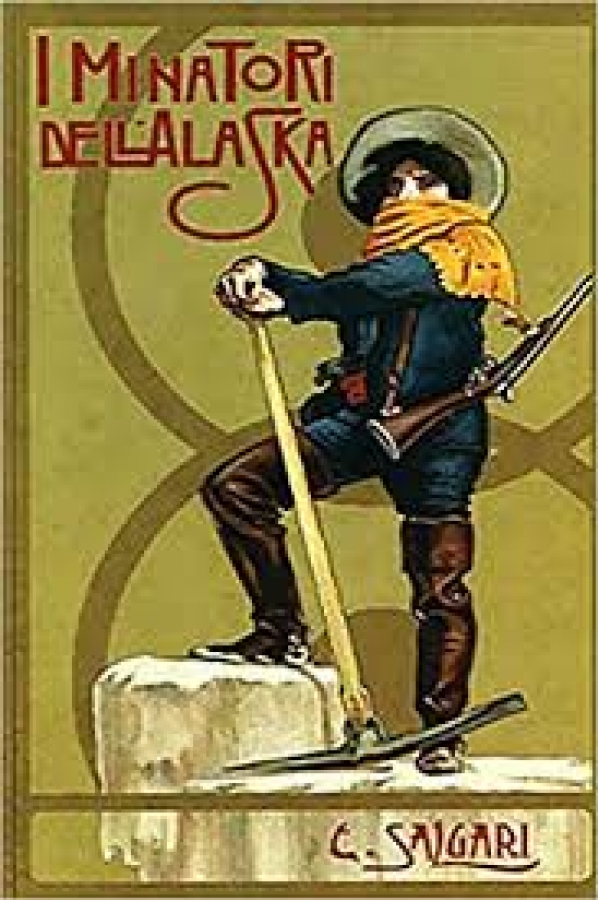
The Alaskan Miners
The true title of *The Miners of Alaska* ought to be *The Great Crossing of the Plains and the Rocky Mountains All the Way to Alaska*; indeed, the search for gold is marginal to the overall story, serving merely as an occasion for Salgari to depict the North American environment as it was related in the nineteenth century. To gain insight into the true history of the American West, and of the United States, I recommend Massimiliano Galanti’s book *La questione indiana* (Odoya, 2016). The formula is classic Salgari. There is the protagonist, Bennie the Great Hunter, described thus: > tall, muscular, with powerful arms, a broad chest, a forceful head covered with long, ringleted black hair that was already beginning to turn grizzled, with piercing eyes and a goatee trimmed to a point . In short, Buffalo Bill! Serving as sidekicks, in keeping with the traditional Salgarian mold, are: a Mexican companion of Bennie's ( > very dark-complexioned, chubby, (...) with pitch-black eyes, the true Hispanic-American type ) and two Italians, survivors of an Indian raid. Falcone has been scalped and miraculously survived; he has an intimate knowledge of the gold-rich mines of Alaska and possesses a crucial instrument for seeking the precious metal: a special sieve that allowed one to separate the gold from the dirt without wading into the water. Armando, Falcone's nephew, has only recently arrived in America, but will prove to be a skilled marksman and an excellent companion to Bennie in hunting and in clashes with the Indians. This group decides to set out for Alaska to capitalize on Falcone's knowledge and his useful implement. The long journey is a succession of adventures: not only escaping treacherous Indians, but also measuring oneself against a wild and mesmerizing nature. The pattern repeats itself with a certain monotony: Bennie and Armando wander away from camp to scout the surrounding area and track down game; they encounter treacherous terrain and must battle terrifying beasts, such as the great brown bear, wolf packs, and stampeding herds of bison. Everything is here: from mysterious dancing plants (tumbleweeds swept along by the wind) to accounts of cannibalism, all the way to the discovery of prehistoric animal remains. It is easy to smile at the travel accounts of nineteenth-century explorers, narratives from which Salgari drew copiously, naturally superimposing his own feverish and inexhaustible imagination. We must allow ourselves to be carried away by a fabulous century, steeped in prejudice and brimming with evocative charm: let us read our beloved author's descriptions of nature with relish. > The moon had set by then, and a dense darkness had fallen across the immense plain. (...) Bennie (...) gazed in all directions, tracking with his eyes the capricious fiery trails of the fireflies, and listening to the monotonous chirping of rejoicing crickets, the distant cries of coyotes, the lowing of cattle . If this reminds us all too much of our own landscape, what can be said of the > meadows formed of tiny mosses of a splendid emerald hue (...) the clearings were covered with expanses of stony, tenacious lichen, resembling dried mushrooms, or tall, pitch-black mosses, soaked with moisture . And from whom did Salgari draw this raw portrayal of the Alaskan miners? > More than human beings, they seemed beasts brutalized by hard labor and privation. They were all ragged, filthy, their shirts blackened by campfire smoke or soiled by mud from the pits, their trousers patched in a thousand ways, their boots worn through and leaving their toes exposed, hats defying description or hoods that had long since lost their fur: yet all wore belts bristling with revolvers and gleaming bowie knives . Were they not armed, they might well be our own miners from Mount Amiata or the mines of Porto Empedocle. What a contrasting attitude Salgari displays toward the redskins compared to the wretched souls prospecting for gold! The former treacherous, cruel, and superstitious; the latter greedy and desperate, yet not devoid of a kind of justice. A child of the nineteenth century, our beloved author could hardly avoid a touch of racism! Within Salgari's vast output, we are dealing with a minor novel, albeit sustained by the brisk pace of its adventures and the pursuit of the marvelous. Plot twists and gear shifts are lacking: the enemies are bound to succumb, pretty much all in the same manner—whether they be Indians, outlaws, or ravenous wolves: a rifle shot, an audacious and unexpected stunt, a prudent and shrewd strategy. Nor is there any dynamic between the characters: Bennie is a hero devoid of passion (did he ever have a sweetheart? did he suffer injustices?), and those who ought to serve as his foils are faded figures, lacking that vibrancy and irony that distinguish so many of Salgari’s minor characters. Why read it? It is packed with adventure; I particularly recommend the chapter recounting the wolf attack.
The Makioka Sisters
The setting is Japan across a chronological span that stretches from the years immediately preceding the Second World War up to the outbreak of the conflict. Against a backdrop of unease and mounting economic hardship, a family drama unfolds: the story of four sisters. An ancient family, now in decline, has split into a main branch—which moves to Tokyo and retains the authority over fundamental family decisions—and a secondary branch, residing in Osaka and centered around the protagonist, one of the sisters: Sachiko. This woman assumes responsibility for her two younger sisters: one unable to find a husband due to her shyness and aloofness, and the other, more modern and emancipated, who works as an artist and weaves a web of romantic affairs, including with men of a lower social standing than the family. The novel is an assemblage of small episodes, featuring a narrative arc that appears fragmented, yet builds precisely upon the portrayal of the intimacy of a Japanese household, and the clash between the tradition of customs and values on the one hand and Western modernity on the other. The women wear kimonos, but also Western dress; they attend the theater to watch ancient Japanese performances, yet devour Western books and films. Even the most rebellious girl, one of the younger sisters, who dreams of going to France to study dressmaking, attends a traditional dance school and gains renown by crafting traditional Japanese dolls. The strictures of tradition fail to confine or ossify familial affections. Sachiko’s repeated matchmaking efforts on behalf of one of the younger sisters fall through because she cannot bring herself to thwart her sister’s will and temperament. The scandals provoked by the other sister ultimately meet with Sachiko’s forgiveness and benevolence. The love among the sisters and within the family proves stronger than any rule or imposition. One might assume the context is defined by the war, and that conflict must eventually burst into the novel (much like a sort of *War and Peace*). This is not the case: the war remains perpetually in the background, scarcely mentioned, and what matters above all are the private tribulations, the protagonists' search for serenity and balance. Only the letters from Western friends who have left Japan evoke the approaching military conflict, of which, however, there is not yet full awareness. Perhaps the author wishes to reassure the reader (it should be remembered that it was serialized during the war), or perhaps he offers a subtle critique of familism, of that excessive fixation on individual feelings and personal friendships, which delays an awakening to the reality of unfolding events. It would have been compelling had there been a sequel to the novel, to observe the characters’ conduct during the final phase of the conflict, beneath the bombings. The true fabric of the novel is woven from the customs and values of Japanese society, captured across myriad moments yet epitomized by nature—such as the family’s excursions to view the cherry blossoms. The peace, order, and serenity emanating from the natural world stand in stark contrast both to the complexity of the emotions and events, and to the creeping emergence of the war. The novel unfolds slowly, marked by a pronounced scarcity of plot-driven action, as everything hinges on minute particulars. Ultimately, it feels long-winded, though never dull, and at times repetitive.
A noble madness
Igino Ugo Tarchetti lived between 1839 and 1869. He is, therefore, a Risorgimento writer who was sidelined because he advanced a fierce critique of war and a clear recognition of the value of desertion and conscientious objection. The novel, partly autobiographical, relates the trials of Vincenzo D.: > one of those minds that cannot choose between prosperity and conscience, and are ever wretched creatures . The narrative is structured into three parts. The first part concerns the protagonist's childhood and adolescence. Abandoned, he grows up in an orphanage, where he meets Margherita, the great love of his life. It is a bombastic and rhetorical section, dominated by a romantic and spiritualistic view of life and the world. It is an unmitigated exaltation of love and nature, taken as an idyllic realm. A typical dialogue runs as follows: Margherita asks: > Where are we going? To love each other. And what are those fireflies doing? They love each other. And all those stars? They love each other. God, how beautiful the night is! It is love that adorns it . By page 71, the temptation to abandon the book is strong. The second part recounts the military life of Vincenzo D. Just as the two lovers resolve to marry, Vincenzo is called to arms. In pages of great efficacy, the narrative chronicles the individual and social transformation of a person forced to endure military discipline. Anyone who has completed military service cannot fail to recognize themselves in the author's words: > the drills, the march, the measured and mechanical motion, the deafening cadence of the drum, the novelty of the uniform, the harshness of command, and the discipline daze his mind, divert it from serious and sustained reflection, create new needs, new ideas, new semblances. The good have become bad, the bad worse, the worse wicked . Vincenzo's military life takes a turn when he is summoned to fight in the Crimean War. The very casus belli invoked by the author is of such futility that it constitutes in itself a critique of the absurdity of armed conflict: a Russian prince refuses to pay a visit to the Turkish minister and strolls through the streets of Constantinople with "whip in hand." This section of the book features the description of the Battle of the Chernaya: it feels like watching a modern special-effects film and, at once, a battle from the *Iliad*. Mangled bodies, severed heads, blood, and devastation are depicted with such chromatic force that one visualizes them as if in a painting. The narrative reaches its peak impact when nature itself (here no longer benign, but man's adversary) takes part in the battle: > the sea casts back upon the shore the masts, the rigging, the corpses. A gigantic wave, which seems to reabsorb into itself all the other waves of the ocean, draws near slow and majestic to the shore. A long line of shipwrecked men appears atop it, thrashing their chests and arms: they feel the ground beneath their feet, but the wave pressing behind them surges forward, breaks over them, sweeps them away, and drags them back onto the high surface of the sea . Yet Vincenzo manages to survive, having not yet killed anyone, buried as he was beneath a heap of corpses. Upon regaining consciousness, he faces an enemy soldier and, much like in Fabrizio De André's *Canzone di Piero*, he is forced to kill him, only to rush to beg his forgiveness and realize that the slain soldier > was handsome, with a beauty at once virile and gentle; he had blond, ringleted hair, a broad and serene brow . On the verge of death, the soldier asks Vincenzo, "Why did you kill me?" At that point, the protagonist resolves to desert and claim his freedom: > I had thrown down the gauntlet to humanity; I had nothing with me but my conscience: how was I to sustain that struggle? The third part is the descent into madness, rooted in the homicide. By now, the narrative devolves into philosophy and a collection of aphorisms, in some instances nonsensical. A trenchant declaration against war and, above all, against military life clearly emerges, while a pantheistic worldview now prevails. The whole degenerates into a confused political manifesto. The author relies on a narrative framing device (Vincenzo D. recounts to the writer, who in turn recounts to a friend), which, rather than enlivening the reading, contributes to weighing it down, as the tale unfolds entirely in the first person in the form of a narration: a narration that often serves as an occasion for tedious philosophical digressions that drag down the narrative pace. The bombastic, emphatic style, heavily laden with adjectives, frequently makes for a turgid read. Why not read it? It is sufficient to visit a public library and confine oneself to the pages depicting military life and the great Battle of the Chernaya (forty pages in all).
Nostromo
The novel opens with the description of the setting in which the story will unfold. Sulaco, a natural harbor on the western coast of Costarica, is an > enormous semicircular and unroofed temple, open to the ocean, with its walls of lofty mountains adorned with mourning draperies of clouds . In this natural amphitheater there is a > sanctuary inviolable by the temptations of world trade in the solemn hush of the deep Golfo Placido : It is a peninsula, which > lies out on the sea like a rough head of stone, and extends from a green-clad coast at the end of a slender spit of sand overgrown with patches of thorny scrub . Waterless, arid, > the poor man, mingling with an obscure instinct of consolation the ideas of the devil and of wealth, will tell you that it is lifeless because of its hidden treasures . It is in this coastal wasteland that legend has it three men vanished in search of gold. The opening of the novel encapsulates the narrative style and the meaning of this sprawling book. The moral and idealistic degradation of men swept away by an unstoppable fate—that of triumphant capitalism—is narrated by Conrad in a rich, lush, evocative prose, at times bombastic and redundant. The heart of the novel is Sulaco, perhaps the true protagonist: a small town cut off from Costarica by high mountains, an easy haven for ships and favored by nature with an inexhaustible silver mine, its fortune but also its damnation. In the background lies the quintessential South American country, burdened by the > lawlessness of a people of every color and race, by barbarism, by an irremediable tyranny . As Bolívar, the great liberator, used to say: > America is ungovernable. Whoever works for its independence has drained the sea . In this context there is no room for feelings, for delicate, fragile souls, fraught with uncertainty: everyone must be a "hero > , men of action and not of thought, driven by grand ideals or ignoble designs. Sulaco hosts numerous strong-willed characters: the Garibaldian who took refuge in the New World because he refused to bow after the betrayal of Aspromonte; the haughty young Costarican woman devoted to a dream of moral and political rebirth for her country; her fiancé, seemingly disillusioned, yet whose love for her leads him to the idea of separating Sulaco from the volatile Costarica to forge a solid, democratic, Western state. Among these, and many others, stands the figure of Nostromo: a man with the weight of countless generations behind him and with no ties to account for..... like the People > . Nostromo is strong, courageous, driven by the desire for renown: he is a quintessential man of the people, with an obscure sense of greatness, with his boundless devotion to something desperate, just as his passions are desperate (...) Splendid, robust, and agile, he threw back his head, spread his arms, and stretched out with a slow twist of the torso and a deep breath, calm and menacing, natural and free from evil at the moment of awakening, like a magnificent, unconscious wild beast. Then, with a suddenly rigid stare fixed upon nothingness from beneath a pensive expression, the man appeared > . An exaltation of the primordial authenticity of male physicality that could almost be Pasolini’s! What disrupts this world of pure heroes, possessing a virtue equal to that of untamed nature, is the arrival of an Englishman, Gould, determined to exploit the silver mine. Mind you, it is not a lust for money that drives him, but a vision—one might say today, a strategic one: silver is the symbol of a rebirth, of a new world. Yet, as his wife well understands (the only sensitive soul, filled with doubts and dismayed by the moral and social implications of what is unfolding), the mine has turned into a fetishism, and now the fetishism had grown into a monstrous destructive force > . To save the silver, threatened by yet another Costarican revolution, Nostromo is entrusted with the task of transporting a shipment by sea to a vessel waiting offshore in the ocean. A series of unfortunate circumstances shipwrecks the boat upon the very arid and mysterious peninsula described at the beginning of the novel. Here, Nostromo abandons his traveling companion to certain death—the very young idealist in love, who vanished without a trace, swallowed up in the immense indifference of things > : an obvious metaphor for how ideals are valued. In that same grim spot, he conceals the precious cargo. From that moment on, he becomes a rich man, but at the cost of a vile betrayal. On the other hand, old or young, everyone likes money, and they will speak well of the man who gives it to them > . The novel ends tragically. Nostromo is killed by mistake by a friend, who mistakes him for his daughter's suitor, when in fact the man was going to retrieve some silver from his hidden hoard. One might say on the surface that greed is stronger than grand ideals. In reality, the theme of the novel is something else, encapsulated in this sentence by Gould: Saleco is no longer a paradise of snakes. We have brought humanity and we cannot turn our backs to leave and start a new life > . Capitalism brings civilization, but all this comes at a cost: the loss of heroes > . In short, Conrad is a bard of imperialism, with the difference compared to other Western authors (such as Kipling) that in him lives the myth of the noble savage. The novel is very long, extremely uneven, and devoid of narrative rhythm. Alongside very fine pages, generally those dedicated to the description of the environment, there follow monotonous and repetitive dialogues, abrupt scene shifts—often temporal and disconcerting—while the historical and political descriptions disrupt the narrative without adding anything of interest. The characters are stereotypes, devoid of psychological and existential depth; the web of relationships is superficial, poorly developed. The writing is linguistically fascinating, with occasionally poetic flourishes, evocative of an imaginative world; on the other hand, all this is life, it must be life, even though it is so like a dream". The author allows himself, however, to be carried away by the sheer indulgence of writing, by the redundancy of words, by the pleasure of the baroque and the marvelous. Consequently, the narrative style also becomes ponderous and at times suffocating. Why not read it? It is long and prolix.
New Italian Short Stories
The book brings together 29 short stories, an anthology that includes famous writers such as Bassani, Buzzati, Gadda, Moravia, Pasolini, Pratolini, Cassola, and others; but also lesser-known authors, nonetheless representative of our country's literature. It is impossible to account for every story—many, in fact, not particularly successful—so I shall dwell only on a few. They share a common trait: they speak of the material living conditions of 1950s Italy, through an approach poised between truth and poetry, between social design and personal histories. Carlo Bernari is a forgotten writer today, yet in 1929 he penned a novel (*Tre operai*) that offered a realistic portrait of the working-class condition under Fascism, and which for this reason circulated semi-clandestinely. In his long story, *Il crumiro*, Bernari tells us of Peppino, a resourceful Neapolitan: in post-war Bari, he manages to find work as a factory handyman, build himself a house—unauthorized, naturally—hook into the electricity and water supplies, on the sly as always, and raise a family. > The Neapolitan way, his workmates would tease him, when in the morning they discovered the mended tap, the new steam intake, a stool fashioned from an old packing crate (...). Not exactly by the book, but haphazardly—yes, the Neapolitan way—yet it was done all the same . And if it is true that everything (the house, the job, and the numerous brood) comes with its drawbacks ( > but really, inside they hear us, outside they see us, will you tell me what kind of love this is? ) Peppino feels he has achieved many milestones, modest to today's eyes, yet significant in the Italy of that era. When, following a rain that had been pouring down for days, > the drains blocked, a muddy, greenish water surged back up from underground (...) reaching the furthest courtyard, where Peppino lived: and there it stagnated and destroyed the house of Peppino and his family, annihilating his dreams. Alongside Rea, Prisco, Ortese, and others, Raffaele La Capria belongs to that Neapolitan narrative vein tracing back to Matilde Serao. In this short story (*Ninì prende il largo*), La Capria speaks of freedom, and does so through the Posillipo sea. Ninì is a «scugnizzo». His bony, sun-blackened back, flecked with salt, one with the rock, was already beginning to scorch under the sun (...) But Ninì's attention was fixed on the transparent little hollow, among those four stones on the bottom, which if you picked them up and brought them to the surface were stones like any other, (...) yet when you saw them under half a meter of water so clear, they were full of adventures«. He is fishing for rock goby (a rockfish that »even the cat turns its nose up at > ), when a friend shouts for him to get into the boat. And there he is, rowing towards the tip of Posillipo, calling out to the girls to come to the balconies, playing the swaggerer to those on the rocks: and he wiggled his little backside on the prow of the boat, drumming with his heels against the sides, as if to spur it on. (...) Now, as the boat pressed forward, the horizon line shifted further and further away, behind the Cape of Posillipo, and the promontory receded further into the coast, and before Ninì's eyes the perfect circle of the gulf opened up, revealing glimpses of other distances. (...) Thinking back on it now, the transparent hollow beneath the rocks of Palazzo Donn'Anna seemed to Ninì no larger than a washtub > . Bonaventura Tecchi won the Premio Bancarella in 1960 with the novel *Gli egoisti*«. In *La ragazza della filanda*, the protagonist is a mill worker »big and bony, almost like a man > , (...) retaining beneath that masculine frame a curious innocence, partly timid and partly simple-minded . She has not yet known sex, and laughs when her workmates tell her that love > is a taste, pretty much like the one you get from eating delicious treats . > It seemed that her very body, so square and strong, was a suit of armor, inside which love could never have entered through malice, perhaps only through violence . And so it happens: a man, simply because he «had her close at hand», courts her, convinces her to let him take her home, and when he realizes that > she truly had never been touched by love, he felt almost a sense of resentment, (...) and when the swift, violent pleasure arrived, and the immense satisfaction, his male pride, even then there remained (...) the desire to humiliate her . And she, dumped after a few days, walks > away alone down the lane, those bony shoulders shuddering under the little shawl, yet without crying. Giovanni Testori is known as a playwright, but he wrote numerous short stories and novels. The short story *Guardati intorno ed impara* is enigmatic, so much so that its overall meaning remains unclear until the very end. A young woman flees from a house, stumbles, leans against a wall, attempts to reconnect with life: she realizes > that she has nothing left to do but hide herself, not only from people but from things as well . This is the opening of a story: as it slowly unfolds, we understand that the young woman has killed a man, not because she truly wanted to, but because of a familial mechanism. Sister, brother, and mother are bound to one another by a knot that > in its elemental nature was almost tragic: bonds withheld from any sentimental expression, yet manifesting in all their force whenever the family's life passed through some difficult situation. Then a word, a question, or a mere reference was enough for the three to find themselves constrained and almost damned to a single destiny. (...) It would have been necessary to destroy, by dint of being all-powerful, every human remnant. The stories of Peppino, Ninì, the mill worker, and the young woman are paradigmatic of a society and an existential condition. Hustling, often in vain; yearning for freedom, even for a fleeting moment; settling for any kind of love; letting oneself be ensnared by familial mechanisms—these are the defining traits of an Italy on the verge of change, yet where resignation still prevails. Despite the prevailing pessimism, the four stories exhibit narrative power and innovation: the authors construct elegant and compelling plots, significant and substantial characters; they have something to say, and they do so in a prose that is cultured, yet already contemporary. Spoken language is making its way into the written word and will later do so with overwhelming force; for now, it serves to prevent the stories from cutting "the tedious and wretched figure of the antiquated (Antonio Baldini in the introduction). Why not read it? They are four fine stories, but they are not worth the chore of reading more than five hundred pages..
The Shadow of the Hills
The novel opens with a dream. The protagonist, Stefano, who is also the first-person narrator, is taken hunting by his friend Francesco among the hills of his native Piedmont. The woods are a composite of «cascades and pyramids of assembled nightingales», a paradise of happiness; and then, suddenly, the > treetops were mounds of tiny, corroded, greenish skulls, chiming sinisterly against one another by the millions . The dream foreshadows the overarching meaning of the novel, which unfolds between memory and present life, between violence experienced and imagined on the one hand and the «tangle of everyday things» on the other. > I must force myself to remember. I must try, because these memories lie buried, in bristling confusion and separated from me. I was fine, normal and cheerful and aggressive as long as I managed to live outside of myself . The country house is a significant touchstone for the protagonist, both for the nature surrounding it and for the terrible events that befell him in his youth: the death of his grandfather, the killing of a German soldier, his participation in the partisan resistance. Stefano now lives in Rome, a successful man, but a growing restlessness has prevented him from marrying, and he drags out a monotonous relationship with his now-former fiancée. The decision to visit the old country house together, where his stern father still lives, seems capable of rekindling their relationship, but the weight of memory is too overpowering. > I grew up among the dead, Lu, and I was able to put them aside, to place them far off, by dint of hoping for peace, for the shared and long-awaited victory... And today, it is only right that I return to scrutinize them at my side.... Don't be frightened, Lu, everything will carry on as before anyway, as it always has, even us! even through our own fault! . The return to the places of his youth is futile. «Perhaps, the author concludes, we shall have to submit to an eternal resignation». It is an illusion to hope that returning to the past might bring deliverance from the nightmares born of memory and the disillusionment of youthful hopes and desires: only living «in the humble dawn of each day», devoid of plans and dreams, can offer a measure of peace. It is a deeply pessimistic novel, wherein the writing achieves its finest expression precisely when it assumes lyrical and evocative tones, as in the depiction of the hills and the narration of dreams. In the background loom the momentous events of the post-war era (the bewilderment following the collapse of fascism, the Resistance, the failure to enact the anticipated changes), but what truly interests the author is conveying a sense of existential anguish, and he succeeds precisely through language, through a masterly command of adjectives and punctuation. When, conversely, he turns to sketching characters and constructing dialogue, one witnesses a faltering in the narrative rhythm, which turns monotonous and redundant. Why not read it? Certain passages are remarkably fine and address a highly topical theme: the disillusionment of contemporary Italy. On the whole, however, the novel proves tedious and prolix.
Open City
When walking the streets of a city > every decision, where to turn, how long to linger lost in thought before an abandoned building, was of no consequence, and for this reason was a sign of freedom. I traversed the city’s neighborhoods as though I had to measure them with my stride, and the subway stations served as recurring motifs of my unending wandering . The protagonist and narrator of this novel is a young psychiatrist of Nigerian descent, the child of a mixed couple: an African father and a European mother. He spends much of his free time wandering the streets of New York. > The walks fulfilled a need: they were an escape from the strictly regimented mental environment of work, and once I discovered them as therapy, they became normal, and I forgot what life had been like before I began walking . Wandering the city on foot is a grand metaphor. It is a toponymic itinerary, a geographical discovery, and as such “a regime of competence and perfection.” At the same time, it is a journey into the labyrinth of the mind. Like the urban plan of a city, the human mind is a network of logical intersections, a rational model within which, however, we move in leaps. An image, a snatch of conversation, a chance encounter is enough to carry us “far away,” to other images, to memories, to the depths of the unconscious toward an "I" > never fully explored and unlocked. The novel can be read on three levels. First and foremost, it is an account of the protagonist’s urban wanderings. Moving aimlessly, he encounters places meticulously described in their history and urban function; they are also, and above all, watersheds between neighborhoods and unpredictable turning points in his journey on foot. Walking allows one to upend the rational model, since one is not constrained to follow traffic arteries, inadvertently leading to unexpected quarters of the city—historically significant, yet long forgotten in the consciousness of its inhabitants. The improvisation and slowness of walking also allow for encounters with others. Many are casual encounters, while others involve habitual acquaintances, yet always met by chance. In any case, they offer the opportunity to hear others’ lives narrated: their memories, their aspirations, and the ideas that animate their existence. Our protagonist does not like to speak; he prefers to listen, yet he does so without curiosity, almost as if fulfilling his psychiatric vocation even outside of work. The city then yields unexpected discoveries that bring us to the novel’s second level of interpretation: the genocides perpetrated by Western man. It is incredible, but in Manhattan itself, at the very center of global capitalism, there are sites that recall the slaughter of indigenous peoples, just as entire neighborhoods of skyscrapers and apartment buildings were erected over a burial ground where slaves were interred—those who died during the crossings from Africa or perished just after arriving in America. For all its pomposity, the West does not even respect the veneration of the dead! The city thus expresses a cosmic wound, a universal sorrow, latent and concealed within the consciousness of contemporary man. Aimless roaming also stirs remembrances, ushering us to the narrative’s third level: childhood, with the brief and intense bond with his maternal grandmother, his father’s funeral, the military academy where the young protagonist completed his education before moving to the United States. It is Nigeria resurfacing, with its spiritualism so distant from Western culture. Yet above all, it is the unresolved relationship with his mother, who carries a deep wound: she is the product of a rape, for which she blames her own mother, the maternal grandmother, and her native land, Belgium. Pursuing the labyrinth of the mind, the protagonist has thus arrived at a dark juncture: his mother’s existential grief, which prevented her from truly loving her son. Have we reached the conclusion of this journey into the unconscious? Is there something else the protagonist refuses to acknowledge and accept? In his peregrinations along the city streets, the protagonist happens to meet the sister of a childhood friend. It is she who recognizes him and speaks to him. They exchange the customary pleasantries of people who have not seen each other in a long time, between individuals whose relationship was superficial and slight. The friend invites the protagonist to a party at her boyfriend’s home. While looking out from the terrace at the countless lights of Manhattan, the friend pulls the protagonist aside and reminds him that, when she was fifteen years old and I was a year younger..... I had forced myself into her... afterward, she said, in the weeks that followed, in the months and years that followed, I had acted as if I knew nothing, I had even forgotten her to the point of not recognizing her when we met again, and never tried to acknowledge what I had done... but it was not so for her, she said, the pleasure of denial had not been possible for her". > Each of us must, at some level, take oneself as the yardstick of normality, must assume that the mansion of one's own mind is not, cannot be, entirely opaque to him To myself, I am always the hero > and so, what does it mean when, in someone else's version, I am the villain? The novel concludes with a highly evocative metaphor. The Statue of Liberty is what all immigrants see upon arriving in New York. Yet against this great statue hundreds of birds crash, driven by the currents and the wind. A precise system of statistics records each death: species, number, date, and weather conditions. With scientific precision, an attempt is made to bring rationality to a cosmic and existential phenomenon that encapsulates the destiny of each of us: as an emigrant people and as an individual in search of himself. We are faced with a complex book, difficult in its content, intellectually rich yet lacking in vigor, in some ways cryptic and prolix. What sustains a nonexistent narrative plot and an equally fragile system of characters is the prose: an English that is elegant, delicate, sophisticated, and simple all at once. It is read with pleasure, yet one gets lost in the narrative dispersion and in the obsessive effort to give voice to too many topics and reflections. Why not read it? Too long and verbose. One loses oneself.
Greek Lessons
In the first canto of the *Paradiso*, Dante uses the word “trasumanar” to denote that transcending of human limits without which it would be impossible to contemplate God in all His power; then, as we read this cantica, we discover that the journey through the various Heavens will be a transformation of sight and hearing, so as to endure the light and sounds of the Empyrean. But what if, instead, reconciliation with oneself and with others took place along an inverse path, through silence and blindness? Since childhood, for the protagonist of this novel > the most mundane sentence revealed, with the transparency of crystal, perfections and imperfections, truth and deceit, beauty and ugliness. She felt ashamed of those sentences, which unraveled white as spiderwebs from her hands and her tongue. Divorce and the loss of custody of her son fling her into silence: > it is a cold, rarefied silence, like a shadow deprived of its own body, like the hollow trunk of a dead tree, like the dark space between one meteor and the next. The male protagonist, on the other hand, grew up in Germany and was diagnosed with the gradual, inexorable loss of his sight; he has returned to Korea, where he teaches Ancient Greek to a handful of students, among whom is our protagonist. Through the Greek language, the author seems to invoke Plato's Allegory of the Cave: in this famous allegory, the prisoners see nothing but shadows cast by the fire onto the wall of the cave facing them, believing these visions to be real objects, just as they take the echoes from passersby outside the prison to be real. Were these prisoners to leave the cave, they would discover that those objects and voices were mere illusions; we are condemned to an eternal obfuscation by our senses, philosophy will not save us, and reconciliation will not be attained through sight and hearing, through Dante's noble senses. The encounter will occur only when we entrust ourselves to the other senses, just as our protagonists seem to do: > with eyes closed, he brushes his cheek against her face, (...) kisses her mouth. The wet hair behind her ears, the eyebrows. Like a faint response coming from afar, the cold fingers brush his eyebrows and vanish. (...) Hearts and lips touching, united and eternally separate. How often have I thought that our enormous, complex brain is a superstructure weighing down on human relationships like a boulder; that animals are happier in their naive immediacy. Perhaps this is what this novel means to say, placing Plato’s language at its core and recounting the strange story of a woman and a man who will ultimately love each other without speaking or seeing one another. Or perhaps it is simply too difficult for us Westerners to understand a novel from a culture and language so distant from our own. It is probable that the author intended to say something else, but this is what I seemed to grasp. Han Kang has enjoyed massive editorial promotion since winning the Nobel Prize. Reading this short novel, one cannot help but wonder whether this fame is due to actual literary quality or rather to an exotic taste, to the desire to discover an as yet unfamiliar country such as Korea. This question arises naturally in light of the lack of distribution of the novels of László Krasznahorkai**, of far greater depth and quality. (see the review of *The Melancholy of Resistance* on this site).** **Why not read it? Extremely difficult to understand.**
Homeland
On a rainy evening, a small Basque entrepreneur is killed by an ETA commando, a terrorist organization that bloodied Spain from 1968 to 2011, causing over 800 deaths, including 240 civilians (source: Wikipedia). Txato, as the victim was named, had refused to pay protection money, and his assassination was preceded by a barrage of insults and increasing ostracism by the village where the businessman and his family had lived for years. Joxe Mari, the son of Txato’s best friend, is affiliated with ETA and operates underground; on one of the evenings prior to the attack, he was sent on reconnaissance near the victim's house, > no sooner had he started walking than he saw me. The Browning gripped in my pocket, and Txato, what does he do, what on earth does he do, he crosses the street and comes straight toward me. The scene wasn't in the script. “Hey, Joxe Mari. You back? I’m glad.” Those eyes, those huge ears, that friendly demeanor. His father’s friend, who used to buy him ice cream when he was a boy. (...) Don't do it. Don't kill him. They had stood mute facing each other. (...) I am a member of ETA and I've come to execute you. But he hadn't told him. It hadn't come out. High above, the bell had chimed a no. This scene, described on page 445, could have been a possible opening for the novel, lending unity, in my view, to the exploration of the consequences—not social and political, but psychological and existential—of a civil war that tore an entire community apart. Instead, Aramburu narrates the individual stories in a disordered fashion, shifting back and forth, trailing the trajectories of single characters as though they were mundane, predictable, run-of-the-mill tales, invigorated only by their connection to that single terrible event. Txato’s murder destroys long-standing bonds of friendship, dictates everyone's life—their emotional ties as well as the material conditions of their existence—and freezes them into roles defined by hatred and grief. Joxe Mari will end up serving a life sentence, condemned to being a hero of the Basque Country’s liberation. His mother, Miren, takes on the role of the fierce, unyielding protector of her persecuted son, > fanaticized by maternal instinct. Miren’s husband and Txato’s best friend retreats into himself; a coward, he conceals his grief over Txato’s death and his disapproval of Joxe Mari’s choices. The other children have fled that cursed land, just as Txato’s children have. They are all > satellites of a murdered man. Whether they wanted it or not, their respective lives had revolved for long years around that crime, around that ceaseless fire of—of what?—fuck, of sorrow, of grief, and this story must end and I no longer know how. Shattering the paralysis of suffering is Bittori, Txato’s widow, with her decision to return to the village and reopen the old house: > a strange atmosphere enveloped the ornaments, the walls, the furniture, a characteristic odor that, without being sickening, was anything but welcoming. And it was the same smell my mother's clothes give off when I hug her. We are past 2011; the civil war is over and everyone would like to forget. The parish priest stops Bittori on the street to urge her not to return to the village, > not to reopen old wounds. The woman’s reply is cutting: she is here > to draw out all the pus that is still inside. Otherwise, it will never heal. Resolute, Bittori will succeed in having Joxe Mari ask her for forgiveness, because only then can there be genuine reconciliation, rather than a craven, omertà-bound oblivion. Bittori’s determination will stir all the other protagonists of the story, who will emerge from their suffering to find themselves once again, finally processing their grief and coming to terms with their destiny. The core themes of the book are rupture and reconciliation: violence born of hatred and the will to rebuild fraternity. The author eschews rhetoric and moralism, delving instead deep into the characters' consciences. The figures constantly teeter between painful paralysis and the possibility of liberation from their fate; to achieve this, they need an external force, embodied by Bittori, who casts off the guise of the inconsolable widow to take on that of a tragic heroine—bearer, in spite of herself, of a universal and eternal task: to bring the perpetrator to acknowledge his guilt, to confess it, and in doing so free himself from remorse. Mention has already been made of the narrative's disordered nature. Generally pacing the novel three chapters at a time, the author explores its various characters without establishing a hierarchy of importance, as though there were no true protagonist. This approach grants the reader the freedom to choose the key figure of the tale (for me, Bittori), yet it blurs the focus and hinders the reconstruction of the storylines, which remain inconclusive. The alternation between first and third person as the narrative voice is intriguing at first, creating a disorienting effect. It is a stylistic dexterity that, over time, confounds the narrative: every sentence is interesting, but the whole becomes disjointed. Finally, the novel is very long, prolix, and repetitive. Why read it? The themes addressed are compelling.
The Little World of the Past
The setting is Lake Lugano, and Valsolda in particular. We are between the two Wars of Independence. Franco is the grandson of a powerful marchioness and is in love with Luisa, a young woman from a respectable and honorable, yet modest, family. The conflict between the marchioness and Franco is not limited to the young man’s love for Luisa, but extends to their divergent political views: the woman is loyal to the Austrian dynasty, the man a staunch patriot. Franco marries Luisa without the marchioness’s knowledge, forcing the young couple to endure financial hardship, which is aggravated at a certain point by the dismissal of Luisa’s uncle—an honest, upright official of the Lombard-Venetian administration—engineered at the behest of the powerful marchioness. Life flows peacefully, revolving around the couple’s young daughter, little Maria. The only discord between husband and wife stems from their differing religious convictions: Franco is a devout and practicing Catholic; Luisa is practically indifferent, an atheist in her conscience. There are also their political ideals, shared by the couple and their small entourage, which, together with their economic struggles, prompt Franco to move to Turin. Finally, domestic harmony is disrupted and further tension is sparked between the spouses by the discovery of a document in which Franco’s grandfather, the marchioness’s late husband, reportedly bequeathed the estate to his grandson. Out of pride, Franco has no intention of enforcing the document concealed by the marchioness; this decision outrages Luisa, not so much for financial reasons as for the injustice endured. Upon the couple’s life—upon the «little world of the past»—tragedy intrudes with the death of Maria, who drowns in the lake. Luisa retreats into a tragic grief, consumed by guilt over the child’s death. Luisa feels barren and cold; a wall rises between husband and wife, threatening to destroy their relationship. The Second War of Independence breaks out; Franco, who has meanwhile returned to work in Turin, invites his wife to meet at Isola Bella prior to his departure for the front. Luisa hesitates deeply, but is persuaded by her uncle; en route to the island, aboard the boat, she observes a group of soldiers heading off to war and realizes that there are sufferings and heartaches far greater than her own. The reunion with Franco is initially cold, then gradually thaws, and the two find one another again, bringing forth a new child. As in all fine stories, love ultimately triumphs. It is, therefore, a romantic tale, one that caused a stir in its day on account of the religious ideas expressed within it. Through the character of Luisa, a sharp critique of religion was advanced—particularly against its official and sanctimonious forms—to the point where she declared that «God is cruel» or even that God does not exist. Viewed through modern eyes, what remains of genuine value in the novel is, instead, the tension between the intimacy of the domestic realm and participation in momentous historical events. At its core lies the depiction of the «little world of the past», which, as the author observes, > was even more secluded from the great world than at present, was more than at present a world of silence and peace, where the officials of Church and State, and, following their venerable example, several loyal subjects as well, dedicated many an hour to edifying contemplation . This world is Valsolda, whose landscape and community the author portrays alike. And it is precisely here that the novel proves weakest: nature is approached with a romantic sensibility, tending toward the «marvelous», evocative of a mere «tourist's» gaze, and ultimately rings hollow and detached; the characters, innumerable as they are, are depicted primarily through their mutual interactions, yet reduce to caricatures of small-town archetypes (the unfaithful maid, the curate, the schoolmaster, the informer, and so forth), without ever managing to achieve a truly ironic portrayal. Even the recourse to dialect fails to lend vibrancy or authenticity to the dialogues, ending up tedious and superfluous. The figure of Franco is flat, even implausible, considering that he endures a horrific tragedy which he seems to surmount with ease. The only character who emerges as contradictory and complex is Luisa: she is conscious of her husband’s frailty, of the vacuity of religion, yet she resigns herself to the social role of wife and mother. Only her daughter’s death shatters this precarious balance, driving her to the brink of madness. Yet, in the end, she redeems herself by reassuming the role assigned to her by society. *Piccolo Mondo Antico* is the novel of an affluent, cultured nineteenth-century Italian bourgeois, convinced that only by shouldering one’s social responsibilities can one attain salvation and mature as an individual. The pre-industrial tradition is thus something to be overcome, as is the inward retreat into personal grievances, petty interpersonal ties, and the pursuit of metaphysical and irrational solutions (religion, spiritualism). The theme of responsibility and the transcendence of the familial and parochial dimension remains remarkably timely in Italian society: perhaps the very superficiality with which it was treated in the novel is the reason why, as history has shown, familism and localism remain the enduring vulnerabilities of Italian society today.

A Penguin in Trieste
The May 1953 issue of the *Giornale di Trieste* reported the news of the arrival in Trieste of the penguin "Marco". > Having arrived from the distant lands of the Cape of Good Hope, where a singular destiny had led him, (...) Marco was seduced by the affectionate attentions of an old sea dog, the boatswain of the motor vessel Europa Drawing inspiration from a real-life event, Carminati has written a coming-of-age novel that lends a touch of lightness to a troubled moment in Trieste’s history, between 1950 and the riots of November 1953, when a protest over the secret agreement between the United States and Yugoslavia—assigning the city to Italy and Istria to Yugoslavia—ended in deaths and injuries. Niccolò is still a child in 1950, > with few worries and plenty of freedom, when he flees Lošinj for Trieste, where he goes to live with an uncle. In a hidden box, he accidentally discovers a telegram reporting that his father was missing, presumed drowned, following the sinking of the steamship on which he was sailing. Why had his uncle never shown it to him? Perhaps > because he wanted me to remain a child for as long as possible, he wanted me to believe in the tooth mouse, Saint Nicholas bearing gifts, the Befana, shooting stars, my father alive somewhere in Africa. I looked out toward the open sea. The waves shuddered: (...) ten years earlier my father had died at sea, and for ten years he had lived only in my imagination. From a newspaper clipping (the January 1953 issue of *Il Tempo*), Niccolò learns that four sailors from the sunken steamship were saved in a lifeboat; what if his father were among them? What if he were still alive somewhere along the shores of the Indian Ocean, where the vessel had gone down? In an act blending hope, courage, and a spirit of adventure, Niccolò signs on as a deckhand on a steamship bound for Cape Town—still an adolescent and, to make matters worse, one who suffers from seasickness. Perhaps the search for his father is merely an occasion to come of age, much like Jim in *Treasure Island* (see the review of *Treasure Island* on this site). > I would return home, Niccolò admits, > with a new map: the one charted by my feet and my eyes. The novel is constructed with great skill and elegance, successfully weaving an adolescent’s feelings, curiosities, and discoveries into an engaging plot, complete with its share of surprises, albeit perhaps somewhat predictable ones. There are no villains! We are overtaken by a sort of hopeful cheer, accustomed as we are to despotic tales even in young adult fiction: consider *Borders no Borders* or the sprawling *Berlin* saga (see the reviews on this site). It is all rather excessive—too facile, one might say, and just as detached from the historical events of Trieste as it is from today’s reality. We must offer a positive perspective, yet we must do so while acknowledging current problems, lest we succumb to the lure of a "pretty fairy tale." The true merit of the novel lies in the writing: elegant, syntactically flawless, and lexically rich. Carminati recovers the very best of our language through a judicious use of punctuation, avoiding the stylistic traps so prevalent today: from the overuse of the full stop, which results in fragmented discourse, as in Nicola Lagioia’s acclaimed *La Ferocia*, to the rambling syntax where the flow of words relies not on punctuation but on mere sound, as in Federica Manzon’s overrated *Alma* (see the reviews on this site). Why read it? It is enjoyable, and it is a fine story. Assessment: medium-low.
The Port of Crossed Dreams
According to Buddhism, suffering arises from opposing the flow of life and clinging to forms that are deceptively permanent, whether they be things, events, people, or ideas. And yet man is like the flight of a bird or the passage of a fish through water, leaving no trace behind; he is like sailing a boat, guided by the winds. And who better than a sailor personifies this condition of transience? We are in a pub in an Irish town, where four people meet; strangers to one another, yet all living in a port town and all having crossed paths with the captain of a cargo ship: Marcel. Rosa Moreno has the smile of Ingrid Bergman, and risks spending her entire life in the same bar in a small port on the Atlantic coast of Spain: and then > everything seemed black to her, as if life were not worth living . A night spent with Marcel gave her dreams of freedom, the possibility of a new life, but also a tangible legacy: a child. Madame Le Grand is a still-attractive widow who spends her life cataloging the stories of all the sailors passing through her port city, > to ensure that all the people she met left a trace behind, instead of vanishing into nothingness, as if they had never existed . She invites Marcel and his crew to dinner and is fascinated by a man who > did not care to know what comes next, (...) greatest desire: none, because it makes one unhappy . Peter Sympson is a jeweler to whom Marcel entrusts a highly valuable gemstone for sale, while revealing to him the profound meaning of his life: > your hobby is precious stones. Mine is fleeting acquaintances and their dreams of life. Jacob Nielsen is a computer scientist who lives in the world of the internet; at times restlessness takes hold of him, and then it takes only > a gust of wind from the sea to sweep away his longing for elsewhere . He meets Marcel and is captivated by the idea of a network of "intertwined ports," of which the captain he met by chance could be the unwitting fulcrum. > And what if in that way they managed to prove that the world is not an impenetrable chaos, a whirlpool of anonymous human beings drowning and lost in their very profusion and diversity? . Rosa Moreno, Madame Le Grand, Peter Sympson, and Jacob Nielsen are there, by chance in the very same pub, to see the man who pulled them out of their monotonous daily existence and propelled them into a hope-filled uncertainty. All four are deluding themselves. For Marcel > binding himself to other human beings would have been like running a mortal danger. Because who better than he could know that all bonds of that kind can be broken? To be alone and free to dance had become his destiny on this side of the grave . Marcel flees on his sailboat, even after learning that Rosa carries his child in her womb. > Strange is the heart of the sailor: he hopes, he fears, he ventures closer and veers off the coast, at last refits the torn sail, and turns his shattered bow toward the ocean, crestfallen, reversing course ( Robert Louis Stevenson, *Underwoods* from *Poesie*, Oscar Classici Mondadori 1997). Stevenson's beautiful quotation is inappropriate. The great English writer is referring to the sailor's life, his irrepressible longing for solitude. Larsson is not speaking of this: the distant, romantically depicted sea remains on the margins; nor is he truly writing about the characters. Even when we learn of Marcel's childhood, in which the captain suffered the loss of all his kin, we realize that it is not this terrible wound of the past that perpetually drives him to flee. The other characters have suffered too; nonetheless, they desperately seek something solid, certainties and relationships to which they can anchor themselves and for which they can live. The novel is a philosophical narrative. The real theme is the contradiction between permanence and transience: impermanence is not an unstable condition to be escaped; it is the very mode of reality, the sign that leaves no record, "emptiness" as an essential given of human being. What nostalgia for the writing of *The True Story of the Pirate Long John Silver*. Just as the narrative style in that splendid novel is vivid and evocative, here the delivery is flat, prosaic, cold. The events unfold without momentum, developed in a bureaucratic and repetitive manner. Why not read it? Trite, flat, and prosaic.
A fiery spring
In the conflict between Israelis and Palestinians, the events between 2000 and 2002 represent a fundamental watershed. Prior to September 2000, the onset of the so-called Second Intifada, there reigned in Palestine > an order imposed by an occupation that had lasted for years and generations, which had become a habit, or rather a routine, a way of life; yet the butterfly continued to struggle, it could catch fire, it could explode and make it falter . And when the visit of Ariel Sharon—then leader of Likud and later Prime Minister of Israel—provoked Palestinian religious sentiment as he prayed on the Esplanade of the Mosques in Jerusalem, a wave of violence erupted, leading to Israel’s military reaction, the siege of Arafat, and the subsequent occupation of the Palestinian territories by Israeli forces. The novel seeks to recount these dramatic events through the eyes of two brothers, Magid and Ahmad, and their friend, Su’ad. The narrative is divided into two parts. In the first—undoubtedly the most evocative and well-structured—the underlying theme revolves around dreams in wartime, anchored by a famous line from Mahmoud Darwish: “leave me alone, let me go where I want to go.” Magid is a splendid young man who dreams of becoming a famous singer. Ahmad is still a boy: shy, introverted, solitary, and sensitive. He strikes up a secret friendship with a young Israeli girl, communicating with her through few words and mostly gestures, across the barbed wire dividing the settlers’ territory from that of the Palestinians. Yet dreams are laden with deceptive hopes! Chance drags the two boys into the dramatic reality that grips their society. Magid is accused, despite his innocence, of the assassination of a high-ranking Palestinian government official, loathed as an alleged collaborator. Forced to flee, he joins the resistance. Ahmad’s story is paradoxical. In an attempt to retrieve his beloved cat, inadvertently taken by his little Israeli friend, he is caught inside the settlement and thrown into prison, suspected—mere child that he is—of being a terrorist. In the second part, the novel shifts perspective. On the one hand, the author pursues a political reflection on the role of the Palestinian Authority. There are more questions than answers. Faced with leaders who seem to favor careerism and visibility over the fulfillment of their people’s hopes, the author wonders whether > is the Cause not like a love story, starting sweet, strong, and overwhelming, and then, with time, withering, dying, and decaying? On the other hand, the female perspective emerges. Su’ad becomes the protagonist; she loves Magid, yet watches him transform into an elegant man dressed in a suit and tie. > With the artist and the revolutionary gone, nothing remains but the opportunist plotting his climb to power... Is this how power diminishes a promising young man?.... And what about us women? What do we know, what do we feel, what do we do? Not much; to them, we are mere background, nothing more . Women are thus left alone, yet within them all the struggles of a people at war are epitomized. > Inner sieges, outer sieges, the siege of society and that of Israel; men know only one. She, on the other hand, endured them all at once . And so only a woman can cry out: > Palestine, piece of the sky, your name upon my lips is a prayer.... a kind of azure prayer stretching as wide as the horizon . The tragedy of the Palestinian people unfolds hand in hand with the withering and dissolution of the passions of adolescence and youth. The book is an elegiac—at times epic—narrative of a homeland’s destruction, from which not even the inner world of intimate affections is spared. > Run, run. Barefoot, half-dressed, in slippers and sandals, with children, without children. The elderly, the aged, and the wounded clambering over rubble, stones, shattered glass, fires, garbage strewn everywhere. And corpses. And the wounded with injuries of every kind and severity—some in the hand, some in the foot, some blinded by the heat blasts, some struck mute and unable to utter a word. And screams. All that remains is the mortification of one’s tears and the humiliation of a life consumed by adverse fate. The novel’s true shortcoming lies in its narrative plot. In the first part, it manages to maintain an internal logic; this, however, splinters in the subsequent pages into a confused and disordered succession of events: the epic depiction of the assault on Arafat’s presidential compound and the Palestinians’ flight under military aggression; the musings and disillusionments of Su’ad, who occasionally steps in as narrator (further disorienting the reader); the author’s political reflections, often merely hinted at and thus impenetrable to those unfamiliar with the events; and the elegiac interludes on the pain and despair of the Palestinian people, at times rhetorical and repetitive. It is as though a surge of thoughts overwhelms the author, ultimately to the detriment of both characters and story. The frequent reliance on rhetorical questions further weighs down the prose, never fully concluding either argument or narrative. Why not read it? After an engaging start, the reading grows steadily more fragmented, often redundant and dull.

The Scent of Lemon Leaves
Juliàn is a former inmate of a Nazi concentration camp, > obsessed with a past that no longer mattered to anyone, yet of which he could not forget a single day . On the threshold of old age, he travels to Spain after learning that a group of Nazi war criminals has taken refuge on the Costa Blanca. He is driven by a profound hatred for these "dying monsters," by the desire to instill the very fear and suffering he witnessed and endured in the camp: > I had been left behind, trapped in my own world, with my hatreds, my friends, and my enemies . His path crosses that of Sandra, a pregnant woman in her twenties, uncertain and confused about the direction her life should take. To the aged Juliàn, Sandra appears as the embodiment of the present and the future—realms he has never truly known, consumed as he was by a far stronger sentiment: hatred, and thus the past. > Her hair had various shades ranging from red to black, long on one side and shorter on the other. She also wore a small nose ring. Her eyes were somewhere between green and brown, and she had an aquiline nose. The sunlight striking her face gave her gaze a faintly ironic air . An encounter between two such disparate lives was made possible because Sandra had been taken in by an octogenarian Nazi couple, who, deep down, had been charmed by the girl in the very same way Juliàn was. With growing conviction, Sandra assists Juliàn in his investigation into this ring of criminals. In truth, it gradually becomes apparent that these former Nazis are themselves unhappy old men, locked in their own fantasies of power and youth, trapped in a web of relationships dominated by abuse and even deceit. The futility of hatred becomes increasingly evident to Juliàn, not least because he realizes that his obsession could place the young woman in grave danger. He finally understands that there are things far more important than constantly returning to the past. He at last makes peace with his concentration camp ordeal, to the point of choosing to stay in a retirement home where two elderly Nazis have also found shelter. For Sandra, on the other hand, the events in which she has become entangled propel her into adulthood, leading her to realize that her life’s purpose is to provide a peaceful existence for the child she carries. All she is left with is the memory of her love for a young, alleged Nazi who saved her life. There remains, in some way, an unresolved mystery—something unfinished that she may well carry within her, once again ushering in that fate of perpetual return to the past that had once been Juliàn's. The theme of Nazism, viewed from the perspectives of both tormentor and victim, serves as an opportunity to examine the relationship between past and present, as well as the communication breakdown between generations—a gulf that can only be bridged through "doing" (Juliàn and Sandra coming together in their investigation into the criminal ring) rather than "telling," that is, the narration of lived experience. Yet there is something more to this novel. There is a sense of contrast between the certainty of the old and the uncertainty of the young (Juliàn is as monotonous in his hatred as Sandra is fresh in her naivety), a conflict emblematic of an epochal transition, much like our own historical moment. In this sense, it is telling that Sandra's adulthood begins in a state of suspension that leaves the novel open-ended: what will become of Sandra and her life? The story is told through two alternating voices (Juliàn and Sandra), a literary device that renders the narrative redundant and repetitive. The plot, purporting to be that of a detective investigation, is devoid of incident and narrative twists. The setting is so sparse that it could easily be any generic tourist resort, just as the characters remain thinly sketched, despite confronting ethically and existentially complex themes. Why skip it? It is tedious and trite.

When you recognize me
Castenate is an imaginary small town in Northern Italy, a > prim and proper little village, where to your face everyone (...) is polite: good morning, good evening, how are things? how is Camilla doing? which school is she attending next year? Yet everyone knows, everyone talks. In this "prim and proper little village", the author sets two storylines that run distinct and parallel for much of the book. One is set in the 1990s and chronicles the relationship between two teenagers: Camilla, > beautiful, with her red hair and green eyes. All teenage girls resemble one another, but she is special. She knows it, and she takes pride in it; Enea, a shy, bookish boy who always raises his hand in class because he—unlike the others—has studied. Camilla delights in bullying poor Enea, humiliating him in front of their peers, as when she pulled down his shorts, shaming him before the female classmate he fancied. Above all, Camilla's insult weighs heavily on Enea: your grandmother > is a whore, the whole town knows it. While this story is steeped in adolescence, tracing a relationship that evolves from friction to friendship and ultimately to love, the other is set during the years of the Second World War and is pervaded by the violence of that era. Rodolfo is handsome, daring, poor, and anti-fascist—viscerally so, belonging to a family of farmhands exploited by agricultural landowners. It is to this very landowning class that Viola belongs; indeed, her father is one of Castenate’s fascist hierarchs, respected and feared throughout the town. So too is her intended husband (they were seen kissing in a reed bed!): a violent young man, always eager to beat up suspected anti-fascists like Rodolfo. Despite being worlds apart socially and politically, a passion flares between Rodolfo and Viola—initially resisted by the young woman, only to erupt into a loving bond when Rodolfo must leave Castenate, ultimately to die in the Russian campaign. From this passion a child is born, who will be raised by Viola in the bigoted climate of post-war Italy. These are two vastly different stories in terms of historical context and emotional stakes; while in the former, set in the 1990s, it is possible to grant love time to unfold, in the other, during those harrowing 1940s, there can be no waiting—everything must hasten forward. For many pages, the reader looks for some clue as to how the two narratives intertwine. Then, much like in Majgull Axelsson's splendid *Io non mi chiamo Miriam* (see the review on this site), the grandmother reveals to Enea that she is not Rita, but Viola, and that he is the grandson of Rodolfo, the twin brother of the man who killed his maternal grandfather. > Rotten blood, all rotten blood, those filthy partisans. The worst part is that that rotten blood contaminated my son as well. In his veins runs Rodolfo's blood, partisan blood. But he will never return. And yet I wait for him, and it destroys me to think I can never have him for myself again, and I despise myself for this weakness. (...) I have no peace, Enea. I have spent my life lying. The novel should have evolved around this dramatic revelation—around that confession, so steeped in both hatred and love, which the grandmother makes to her grandson. Instead, the author crowds the narrative with too many themes, ranging from adolescent issues to the partisan struggle. What emerges is a muddled plot, compromised by a narrative imbalance between the two storylines that comes at the expense of pacing and renders the account redundant. The ending, which perhaps aspires to be a surprise, is instead mundane and tedious. Its fundamental merit lies in making us realize just how distant today's Italy is from the dramatic events our country endured during the war. The prose is simple, effective, and elegant all at once. The brief sentences and tight dialogue suggest that the author intended to appeal to a teenage readership, who might perhaps better appreciate Camilla and Enea's love affair than an adult reader, who is left more struck by Viola's tragic omertà. It is a pity that the author did not devote more effort to capturing the provincial atmosphere, the "prim and proper little village"; had he done so, he would have lent depth to the entire narrative, framing it far more effectively within its social and cultural context. Why read it? It reads well, but it is dull.

The Four Housewives of Tokyo
Masako, Kuniko, Yoshie, and Yayoi are four housewives; they work the night shift in a food-packaging plant. It is precisely there that they are introduced to us, across the various stages of production, from their arrival at the factory—always in the dark, gripped by the fear of being assaulted—to the assembly line, attentive to the rhythm of the packaging and the reprimands of the overseer. A shared habit develops, one that also breeds solidarity, if not friendship. The four women are markedly different: Masako, hardened and aloof, is a former bank clerk dismissed for her professional ambitions, suffering from a profound loneliness after having been cast aside by her husband and son; Kuniko is mired in debt due to her compulsive spending; Yoshie is a widow, forced to tend to her aged mother-in-law, who loathes her; Yayoi, delicate and gentle, is devastated by her husband’s confession that he has squandered their modest savings on gambling and prostitutes. One evening, thrown out by the owner of the club he frequented, the husband beats his wife. Yayoi unexpectedly retaliates by strangling him. > When she thought back to her husband’s face, the belt tight around his neck, right there in the entryway, she felt fabulously, utterly diabolical once more. Gotcha, serves you right! she thought . At a loss for what to do, Yayoi turns to Masako, who lucidly decides to dismember the man’s corpse in order to dispose of it more easily in dumpster bins. Taking part in the butchery, which unfolds in Masako’s bathroom, are Kuniko and Yoshie as well—partly out of solidarity, and largely for the money. Quite a way to make violent men pay! But why does Masako help Yayoi? Certainly not for the money. Out of friendship? Or because she feels > an almost savage desire to make a clean sweep of her relationships with others ? Is there a dark side to her personality that she herself does not know? It seems like the perfect crime, were it not for a petty loan shark who uncovers what happened; Kuniko confessed it to him to clear her debts. Instead of turning the four women in, the man proposes going into business with Masako: namely, making the dismembered corpses of victims of the yakuza, the powerful Japanese syndicate, vanish without a trace. Masako agrees. Had the novel pursued this narrative thread, we would have found ourselves before an original and entertaining tale: ordinary housewives turning a profit from corpses, mostly male; in short, a reversal of roles, a gender vengeance, however macabre. Instead, the author retreats into a conventional plot. In their investigation, the police had focused on the man who had thrown Yayoi's husband out: Satake, a psychopath who had served a long prison sentence for stabbing a woman to death while raping her. Satake had rebuilt his life, but the police inquiry ruins him, not least by unearthing the old, bloody crime. The man resolves to take revenge. He easily discovers what the four housewives have done and begins to stalk them. He is particularly intrigued by Masako’s personality, by her cold detachment and resourcefulness, but also because he realizes they are kindred spirits. He longs to re-enact that horrific congress with her. A duel begins between Satake and Masako, in which she maneuvers with consummate skill, even managing to turn the yakuza against him. Yet one night, she is ambushed and dragged by Satake into an abandoned warehouse. Is this the end for Masako? We will not reveal how the tale concludes so as not to spoil the surprise; suffice it to say that Masako finally comes to know herself. > Just as she was willing to let herself be killed by him, he wanted to be destroyed by her. Suddenly Masako understood Satake.... and loved him. (...) Their eyes met, their bodies became one. Now in Satake’s eyes she could see only the reflection of herself. A wave of incredible ecstasy was about to engulf her . The opening is promising; the first three hundred pages maintain a relentless pace, with episodes and characters that unfailingly surprise the reader. A subtle irony snakes through the narrative; the four women are examined in all their ambiguity: fundamentally decent women, criminals out of necessity. Masako’s personality is commanding—the unyielding, authoritative leader of a pack of terrified women who draw courage from her resolve. Rivalry, deference, envy, and fear churn among the friends, unsettled by Masako’s utter lack of empathy. Then the novel lapses into a conventional narrative: it loses its bite, turning sluggish, oppressive, predictable. One reaches the conclusion exhausted. Why read it? It is intriguing, yet one can abandon it without finishing.
The Girl Who Played with Fire
The novel is, in some ways, a continuation of the previous book. This time the protagonist is the girl, Lisbeth Salander. The opening is slow and leisurely. Lisbeth, now immensely wealthy, lives in the Caribbean and later returns to Sweden, where she resumes a relationship with an old friend and reconnects with her former guardian, hospitalized after a stroke. The journalist, on the other hand, is involved in an investigation into sexual exploitation, conducted by a couple—a university researcher and a journalist. Meanwhile, Lisbeth’s new guardian, a depraved lawyer, seeks revenge against the girl, who holds him in her grip with video footage showing him raping her, and thus enlists a gang of criminals. At this point, the novel takes on a more intense rhythm: the lawyer is murdered with the same gun used that same night to assassinate the university researcher and her cohabiting journalist partner. Lisbeth is accused, dredging up the old narrative of the girl’s psychological instability. The entire country is drawn into the hunt for her, whom both the mass media and the police depict as a psychopath. It is evident that the truth is entirely different: the girl had been branded a psychopath (and consequently first committed to an asylum and later placed under guardianship) because she was the daughter of a notorious Russian spy who had defected to Sweden. The girl’s father was in fact—he, truly—a violent psychopath, and he is behind the murders out of fear that the truth will be exposed. A series of adventures ensues, but in the end the girl is saved, this time, by her journalist friend: > she opened her eyes a little and stared at him for a long moment. Her gaze was unfocused. He heard her murmur something so softly that he could barely make out the words, goddamn Kalle Blomkvist . The themes of sex and sexual violence against women remain the central subjects of the book. Added to these are two others, which gain prominence as the novel unfolds: on the one hand, a corrupt and superficial police apparatus; on the other, child social services, which often operate according to conventional formulas and under pressure from psychologists and experts who are themselves corrupt and dominated by obsessions and stereotypes. Lisbeth was a victim not only of the secret services, who wanted to institutionalize her to avoid complications in managing an inconvenient figure, as her father was, but she also suffers from the entrenched attitudes of the social welfare system, which views «outsiders» as a threat to social cohesion, irrespective of their intelligence and fundamental honesty. It is the antisocial individual who causes disturbance and must somehow be removed. The book is weighed down by too many «digressions» and characters relative to the central plot; at times, the dialogue proves prolix and repetitive, just as certain narrative resolutions appear somewhat predictable and implausible: for instance, the police failing to examine the murdered journalist’s computer, the presence of a giant—incidentally the girl’s half-brother—who seems invincible because he cannot feel pain, yet is easily chained up by Blomkvist, and the girl’s survival, managing to save herself despite having been buried alive.
Convenience Store Woman
In Japan, *konbini* are small convenience stores stocking everything; and it is here that a story unfolds, seemingly light and predictable, which instead confronts a crucial issue: as the protagonist observes following a conversation with her sister, people prefer someone who is > "normal," even if plagued with problems, to a sister who is quiet but "abnormal," from another planet. Keiko grew up in a peaceful household, with attentive parents and a loving sister; yet from early childhood she was a "strange" girl—antisocial, at times even aggressive. The widespread disapproval following singular acts, such as killing a sparrow, led her to withdraw into herself. > I was approaching adulthood, the hour of truth, and kept telling myself that I had to be cured at all costs. The turning point comes when she is hired at a *konbini*. After a brief training period, Keiko learns how to stock shelves, highlighting promotional items, keep the store clean, and, above all, greet customers in a loud voice. > Irasshaimase! (welcome, in Japanese) I cried (...) bowing by the book and beginning to scan the items. In that moment, for the first time in my life, I savored the feeling of having found my place in the world. I am born, at last!, I thought elatedly. (...) The repeated chime that heralds the entrance of customers rings out like church bells. The rectangular box of luminous, transparent glass takes me into itself. A perfect world, which continues to turn relentlessly. I hold a blind, absolute faith in this gleaming microcosm— With gentle irony, the author guides us to appreciate life in the *konbini*: the bustle of customers, colleagues growing increasingly indistinguishable in their demeanor and even their accents, the succession of store managers, each to be accepted along with their flaws, and then the merchandise on the shelves—the heart of the store—products that have evolved over time to adapt to shifting patterns of consumption. The years go by; Keiko grows older under her part-time contract, living in a squalid studio apartment, still a virgin. She is content, fulfilled by the "music of the *konbini*," > a myriad of sounds blending together and seeping endlessly into me. For her parents and sister, for her friends as well as her own coworkers, Keiko cannot be happy because she is different, estranged from social conventions dictating that a woman must marry, procreate and raise children, and hold a secure job with a decent wage. To justify her "strange" life, Keiko invents an illness, but this excuse cannot hold up for long. To silence everyone—and not out of affection—Keiko takes in a selfish, deadbeat young man; at last, she can claim to have a man, perhaps even marry. > Virgin, spinster, and a poor *konbini* clerk, (...) everyone will believe you are sexually the same, and you will be just like all the other women on the planet. Yet Keiko discovers that within her "gleaming microcosm" she is no longer merely the clerk to be dealt with professionally; she is a vulnerable woman, before whom > it was no longer my eighth manager, but merely a male of the human species, eager like all the rest to see one of his own kind mate and reproduce. In the name of the perpetuation of the species. What is left to do? Flee the *konbini* in search of something else, or recognize without pretense that > even before being a human being, I am a *konbini* clerk? With engaging prose and a narrative detached from psychologisms and moral judgments, the author shows us that not everyone must belong to the "tribe of the normal," that the pursuit of happiness takes many paths, and that embracing one's own—however modest and devoid of ambition—allows one to be at peace with oneself. In the tale of the *konbini* girl, there is undeniably a critique of Japanese social conventions; from a distance, there also emerges the desire to turn inward, to avoid being inevitably ensnared by love, sex, and childbearing. The *konbini* functions like a monastery where a woman can finally be free, shielded by the armor of professionalism within a workplace that is stationary, yet radiant with lights and sounds. The plot is tenuous, the narrative develops slowly, burdened by long, often tedious and inconclusive dialogues. The secondary characters are either banal or implausible, serving merely as foils to the protagonist: she never truly breaks free, in fact, from her own "narrating I," ironic and sharp, yet ultimately stale and predictable.
The road
> The ashes of the lost world spread across the desolate wasteland, (carried) hither and thither into the void by storm winds. Hauled and tossed and hauled again. Everything torn from its roots. Unsupported in the dusty air. Sustained by a breath, trembling and brief. If only my heart were stone . In a post-apocalyptic era (following an unspecified catastrophe) > all food stores had been exhausted and murder was everywhere upon the earth. The world was soon largely peopled by men who would eat their children before their very eyes, and the cities themselves were ruled by bands of filthy scavengers who rummaged through the rubble and crawled from the refuse, (lit only) by the white of teeth and eyes, carrying charred and anonymous tins of food in nylon bags, like patrons in the restaurants of hell. (...) Out on the road the pilgrims sank down, fell, and died, and the veiled and barren earth (like a shroud) continued to glide with the sun and revolve again like the trackless, unmarked course of any sister world, unnamed and unreachable in the primordial dark. This lengthy quotation gives a sense of this novel’s style: lyrical, rich in evocative imagery, syntactically and lexically intricate, difficult to translate, captivating to critics, far less so to ordinary readers. Evoking the author’s own words introduces the setting of the slender plot: a father and his son, still a young boy, journey through a devastated world of charred trees and desolate wastes, bereft of animals and plant life, amid other human beings who have turned to cannibalism to survive. The father knows he will soon die (the dust is killing him) and wants to lead his son to the sea: he is convinced that along the coast there are still "good people." They could stop, but they cannot, for they risk being ambushed by murderous gangs. > Ten thousand dreams buried within their wandering souls. They went on. Crossing the lost world on a cart, hidden like rats. The dead nights in their fixity and deader still in the darkness. So cold . The father shows no pity; he does not answer cries for help, refuses to be moved by human beings who will likely become food for others and desperately beg for aid; he cannot afford to, having a mission: to survive and bring the boy to safety. The son, by contrast, is the critical conscience; not only does he plead for humanity, but he demands that his father remain consistent with the stories he tells him. "You want me to tell you stories," the man says. > The boy looked at him and looked away. (...) Those stories are not true. They don't have to be true. They are stories. Yes (says the boy). But in stories we are always helping people and instead we don't help other people.(...) Well. I think we are still here. A lot of bad things have happened but we are still here . When they reach the coast, there is no scent of the sea; the water is not blue but gray, covered in ash, > only fish bones in their millions scattered along the beach as far as the eye can see like a line of death. A huge salt sepulchre. Senseless. Senseless . The novel can be interpreted in many ways. One can read the narrative literally, as the tale of what will become of us after a catastrophe—whether climatic, pandemic, or nuclear; yet too many narrative elements are missing (not least the causes of the environmental disaster) to suggest that the author intended to write a standard dystopian work. One might turn to another of McCarthy's books (see the review of *All the Pretty Horses* on this site), in which the writer dwells on the demise of the cowboy world and wild horses across the green plains of the West; *The Road*, too, is set across vast prairies, albeit ravaged by catastrophe, as if the author had returned to mourn, now without hope, the inexorable and agonizing loss of his world—transformed into an apocalyptic landscape by the disorderly and pervasive spread of factories, reckless overdevelopment, and shopping malls with their glut of commodities. How vast our hoard of goods and food must be if, even after years of looting, we can still unearth something useful amid the rubble and refuse! Reading it imparts a metaphysical sense of existence, beyond time and space, transcending the individual story. The journey of the two pilgrims is a metaphor for Death, a march toward the end of being. Not only is there no meaning in living in a horrifying reality where even memory slips away and dreams can only be nightmares; death is our inevitable arrival, yet dying is an agonizing ordeal in a world devoid of peace. Viewed from this perspective, the narrative centers entirely on the bond between father and son. Why does the man go on living and struggling? Why does he insist on recounting stories falsely steeped in humanity? Why does he deceive the boy? A powerful message emerges: our attachment to life must not reside in material possessions, in the mundane routine of an increasingly futile, fragile, and painful existence; we insist on not dying because we must still protect our loved ones. When an eschatology no longer exists—be it the City of God or the Sun of the Future—all that remains is to anchor ourselves to our responsibilities toward those nearest to us, in foundational bonds such as that between father and son. The narrative is structured in brief paragraphs, like a collection of prose poems that could almost stand alone. The fascination of the reading lies precisely in the sound that springs from the lexical richness of the words and an unconventional syntactic structure, hovering as if suspended and inexplicable. It is a tour de force of stylistic mastery, yet a quest for effect that comes at the expense of the story: everything repeats in an eternal return; the landscapes, situations, and dialogues (effectively confined to father and son) unfold monotonically and, in the end, predictably. One waits anxiously for something to break the tedium, yet nothing comes, save for an improbable ending. A sense of oppression lingers, and perhaps that was precisely the author’s intent. Still, the book's immense success remains hard to fathom; it is prolix, and reaching the end is a struggle. Why read it? Solely out of obligation, and drawn by its stylistic mastery.
Russian novel
The novel is set in Russia between 1987 and 1991, during the Mikhail Gorbachev years, amid those turbulent events that led to the dissolution of the Soviet Union in December of that same year. What unfolded was > a carpet woven of countless threads , a sort of Rubik's cube across which fingers chase > the colored squares that never click into the right place. To untangle this knot, without success, Barbero imagines "someone" recounting what occurred: a first-person narrator, perhaps an obscure Muscovite Jewish actor who, faced with a demonstration of anti-Zionist hatred, > suddenly had a flash of an idea which, for who knows what reason, did not seem monstrous to him at all, but rather most felicitous: well now, he thought, I will stand by and watch, and then I will describe everything in my novel. For, of course, how else could one survive such filth?. And if the plot lacks the order of great nineteenth-century novels, one must resign oneself to it, for it is devised by an actor, or perhaps by a historian who, like Ariosto with *Orlando Furioso*, is delighting in the captivating passion of storytelling. Besides, even the great Emmanuel Carrère lost his way describing recent Russian events (see *Limonov* on this site). The novel revolves around two characters. Tania, a young historian, has decided to write her doctoral dissertation on the obscure disappearance of Party officials in Baku during the 1940s. Why are they no longer mentioned in the minutes of congresses and regional committees? It must be a delicate matter, since the novel itself opens with a scene at once amusing and alarming: two envoys from Baku dump tomato sauce over the desk and suit of Tania's supervisor to make him understand that it would be best for the girl to abandon her inquiry into what happened. > Never mind the merits and the faults. But oblivion, no. A free people must remember , and with the resolve of one who believes in "historical truth" as a moral imperative for the researcher, Tania sets off for Baku to uncover the mystery, unbeknownst to the Historical Institute where she works, and at the risk of her life. Nazar is a federal prosecutor: he believes fiercely in justice—a legality by now eroded by the Brezhnevian swamp—nostalgic as he is for Stalinist severity, to the point of championing capital punishment (at home he proudly keeps the "pink slips" recording the executions of his death sentences!). He is assigned to investigate the murder of an ayatollah in Baku; it is feared that Armenians might be blamed, unleashing the vengeful fury of the Azerbaijanis: we are witnessing the disintegration of Soviet power. As in a thriller, the two plotlines unfold with twists, moments of danger in distant Baku as well as in a safer Moscow, intertwining in surprising and haphazard ways. In a world disintegrating in terms of values as well as state institutions, who cares about historical or judicial truth? Nothing remains but to withdraw into familial affection. Losing oneself in the narrative, a doubt arises: is Barbero speaking of Russia or of Italy? Rampant corruption at every level, the intertwining of political power and criminality, ideology reduced to mere ritual, the complete absence of any vision of the future, the disregard for "truths" except on the part of a stubborn few—all are elements we find in our own country's recent history. As in *Limonov*, one must admit that dissolving societies, whether Russian or Italian, possess a certain allure, especially when described ironically, without passing pointless moral judgments. Moreover, the world of historians is depicted in its inner workings, where power, complacency, archival research, and methodology mingle in unpredictable ways, and only those driven by an unshakeable faith, like Tania, can see it through to the end. Barbero speaks of himself, as both historian and Italian. Barbero writes the way he speaks: colloquially, with constant parentheticals and delectable descriptions, blending factual events with sketches of social mores, not forgetting a dash of sex. The pages turn briskly and pleasantly; nevertheless, the reader gets lost in the narrative’s countless embellishments, to the detriment of the overall pace—essential in what is ostensibly a thriller—and of a coherent grasp of the plot. Barbero must have realized this toward the end, for he offers a preemptive defense: > And it all comes down to this, that one has to be good: it would be too easy if the first comer were able to write in a flash what crosses the minds of his characters at a moment like this. (...) The pen writes and knows not what, the ink does not corrode the paper, the notebook does not catch fire.... Why read it? Enjoyable and interesting; the figure of Tania is finely drawn.

The Secret of the Old Woods
At the beginning of the tale, Dino Buzzati imagines a nineteenth-century abbot who, "with succinct and very clear accounts," speaks of "a wondrous vision" upon beholding the old forest; in a footnote, the author observes how some men grasp the secrets of the woods, perceiving them by "nature," while others will never possess this sensitivity, > and will pass impassively (...) along the shadowy forests, without even suspecting what goes on in there . Communion with the trees, the capacity to perceive their magic, belongs to children; as Bernardo explains—the tree-genie who has taken upon himself the burdensome task of conversing with adults— > at a certain age all of you, men, change. Nothing remains of what you were as children. You become unrecognizable . Adulthood causes one to lose the quality of feeling part of the whole, of playing in the woods alongside the animals, of understanding the birdsong, of perceiving and distinguishing the vibrant and grandiose orchestra of forest sounds. Because adults will never love nature, the genie Bernardo befriended the old owner, persuading him to leave the old forest untouched. What an ordeal it was to spend evenings in long games of cards, in tedious conversations while > through the window, with the fragrance of precious resins, entered the deep voice of his brothers, singing carefree ! The situation changes when the old owner dies and the new master arrives. Procolo, a retired colonel, is a rigid, somber man, solitary and impervious to any communion with the woods, which he sees merely as an opportunity for exploitation. It is not that he is greedy; he is simply a petty soul, and how can one who lacks generosity find pleasure in the rustlings and scents of the woods? He allies himself with the wind Matteo to bend the tree-genies and force them to work for him in exploiting the forest; he kills the magpie that stands sentinel over the house, only to plummet into the silence of the night, trapped inside his nightmares. Wretched and wicked, he seeks to rid himself of young Benvenuto, heir to the forest, of whom he is the guardian; with the aid of the wind Matteo, he does not hesitate to abandon the child in wild reaches of the woods, where Benvenuto would surely have perished. He fails, yet believes no one knows of his murderous intent. But when he ventures into the thick of the forest, > behold, the birdsong wanes, squirrels and dormice flee, silence settles upon the boughs, and at times ominous clouds even appear in the sky. (...) Clearly he struck a false note in that blissful corner of the woods; clearly the trees and birds could not bear him . Even his shadow abandons him, so disgusted is it by the barrenness of its lifelong companion. Procolo is alone. And yet, little by little, reluctant and astonished, on a sleepless night Procolo recognized the sounds of the forest. He counted fifteen of them, meticulously noted one by one. > But two or three times, that night, there was also true silence, the solemn silence of ancient woods, comparable to none other in the world, which very few men have ever heard . And the goodness that resides in all human beings is finally liberated from the representation of self, from that "false self" that had accompanied him throughout his life. Procolo dies, but is saved. Buzzati’s tale can be interpreted as a fascinating metaphor for the human soul, where the woods are not Dante’s *selva oscura*, but rather a kind of Shinto paradise in which trees are benevolent genies and winds are hostile, dark forces: a depiction, in short, of the intricate tangle of consciousness. I prefer to interpret *The Secret of the Old Forest* literally, as a great woodland fairy tale, devoid of ulterior meanings. Raised by parents who loved the mountains and made me spend long summers amidst the greenery of the Alps, walking among the trees has always been part of my life, without my ever understanding why. Reading Buzzati’s tale helped me comprehend my passion. And it is precisely for this reason that I associate it with Petrarch, fully aware of how bold such a connection is. When Francesco Petrarch recounts his walks in Provence and Tuscany, I recognize the feeling that stirs within me whenever I, too, make my way through the forest: the desire for detachment from the world’s frenzy, a reunion with oneself—solitary, silent, absorbed in physical exertion, steeped in the vitality of the trees, conscious of the bond connecting all living beings. Often, as I wander free and aimless amid the light and sounds of the forest, the lines of Canto XXXV of the *Canzoniere* come to mind: > alone and lost in thought the most deserted fields / I go measuring with steps slow and halting, / and keep my eyes alert to flee / wherever human trace marks the sand .

The silence of the cloisters
Petra Delicado, the protagonist of Bartlett’s novels, has married an architect who has no fewer than four children. Petra thus finds herself juggling her duties as a police detective, a marital venture she desperately wants to succeed, and relations with stepchildren backed by her husband’s irascible ex-wives. Into this fraught domestic arrangement intrudes a complex and mysterious case: inside a convent, a friar is murdered and the body of a blessed man, venerated as a relic, is spirited away. Unable to make sense of the crime, Petra pursues numerous leads, assisted—or more accurately, steered—by one of the convent’s nuns, who conceals a terrible secret. The novel moves along sluggishly, somewhat limp, alternating the police investigation with protracted conversations between Petra and the Mother Superior, depictions of life at the precinct, and domestic tensions that gradually give way to a cheerful, serene environment. In the end, the mystery is solved purely by chance, leaving the reader weary and disappointed rather than surprised. As in all her novels, Bartlett tackles themes far beyond the boundaries of the detective genre: in this case, the arcana of conventual life and of the Catholic Church more generally, as well as the tribulations of living together in a complex, blended family. As for her anticlericalism, the author makes her stance immediately clear, defining Catholics as > those who haven’t recovered from the traumas of a Catholic education, those who live perpetually imprisoned by guilt. In a word: poor wretches . As for cohabitation, the struggles of a couple’s relationship are summed up as follows: > Marcos and I were there, united before the law but separated by the incommensurable divide between the worlds in which we moved . Why not read it? As a detective story, it is weak and dull; as an account of social milieus and human emotions, its contents are far too superficial to hold the reader’s interest. Its sole merit is a pleasant prose style, even if it leans too heavily on dialogue—especially between Petra and her colleague Garzón; but then, why don’t the two of them just get married?
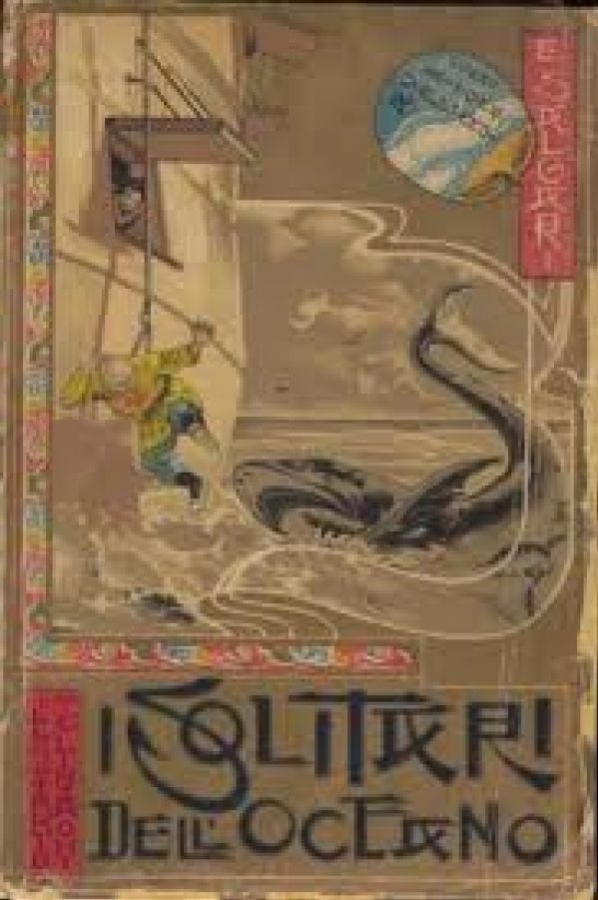
The Solitaries of the Ocean
Salgari wrote over eighty novels, and not all of them possess the same literary quality. In this case, two hallmarks of the author’s pen are absent: the pulse of adventure and the exotic, yet often captivating, depiction of the setting. The opening is promising. In the mid-nineteenth century, the slave trade is replaced by the recruitment of Chinese laborers, who supply South America with cheap labor. The transport conditions endured by these poor souls, deluded into believing they would find dignified work, are even more harrowing than the African slave trade. Indeed, since they are not regarded as chattel, the Chinese possess no asset value, and exorbitant profits lead shipowners to accept an appalling mortality rate. The opening chapters could easily be set today, amid the plight of migrants crossing the Mediterranean. Salgari’s indignation is profound at the perfidy, deceit, and senseless cruelty of those who exploit (recruiters, shipowners, sea captains, and large landowners) the misery and aspirations of the world’s dispossessed—in this case, the Chinese. We find ourselves aboard the *Alcione*, a vessel sailing from China to Peru with a cargo of over four hundred Chinese, crammed into the hold, poorly fed, and forced to survive without access to fresh air. Plague breaks out, and Salgari portrays, with grim power, the corpses of the Chinese, snagged with a hook, hoisted from the hold without being touched by the crew, and cast to the ravenous sharks. It is a harbinger of the book's core theme: the cannibals and their craving for white flesh. A mutiny erupts, and the captain, unable to quell it, abandons ship along with his crew, though not before poisoning the provisions. All the Chinese perish, save for their leader, Sao-King, two Peruvians, and an Argentine officer who had opposed the captain’s cruelty. The four men must navigate the *Alcione* alone through fierce storms, seeking refuge on islands inhabited by cannibal populations, only to be captured at last by pirates, who seize the sailing ship. The adventures revolve around two protagonists: Sao-King and Ioao, the younger of the two Peruvians. The two, evidently formidable swimmers, manage to escape the ship while underway and find safety aboard a naval schooner. With the warship’s aid, and through further heroic feats, they vanquish the pirates and rescue their companions. Salgari repeats a literary formula common to all his books: a hero, Sao-King, accompanied by a less experienced and vigorous sidekick, here Ioao. Displaying great courage and remarkable prowess, the two confront numerous, incredible ordeals. These episodes, however, are not woven into a cohesive narrative structure and unfold sluggishly. It is evident that Salgari is weary, drained, incapable of breathing vigor into the scenes, and perfunctory in his depiction of the setting and characters. Moreover, a true antagonist is missing, as the adversaries to be overcome shift constantly: the cruel captain, whose vengeance one would expect to be a guiding thread, disappears for most of the narrative, only to resurface reduced to a skeleton in the launch with which he fled the ship; the anthropophagi (hideous and treacherous) are too primitive to be considered genuine foes; and the pirate chief, who will end his own life, is ruthless yet benign enough to spare our four friends. The theme of cannibalism—already present in other novels, though never so repetitively—casts a lugubrious pall that spoils any relish of the adventure. Yet perhaps this very motif mirrors Salgari’s psychological decline: moving from the depiction of grand heroes, even if tormented like *Il Corsaro Nero* or ambiguous like *Capitan Tempesta*, to a tragic worldview where, confronted with sheer ruthlessness, one can only defend oneself or succumb. Why avoid it? It simply isn’t worth it.

The Sovereign of the Golden Field
This novel belongs to the Western cycle. Influenced by the figure of Buffalo Bill, Salgari developed a series of stories set against the historical backdrop of the mythical conquest of the West, amidst heroic figures, savage Indians (Apaches and Navajos), and American villains. A young woman (the Sovereign of the Golden Field), whose father has been abducted by bandits demanding a hefty ransom, decides to put herself “up for auction” to raise the sum required to free him. The winner of the auction will take her as his bride. Participating in the auction are a young engineer and a wealthy black man who oversees the crab fishing and trade, controlled by the Chinese; for this reason, he is known as the King of the Crabs. The young engineer lacks the funds to rival the wealthy merchant, yet, with the help of a young clerk, manages to outwit the King of the Crabs, win the auction, and flee into the West with the young woman to rescue her father. Naturally, the villainous merchant sets off in pursuit. Everyone travels by train, the revolutionary conveyance that collapses distances and stands as emblematic of American technological superiority. A sequence of adventures unfolds aboard the train; we witness the passage of an enormous herd of bison; and finally the three youths—the girl, the young engineer, and the clerk—set out on foot through Apache territory to reach the hideout where the father is held captive. Accompanying them are Buffalo Bill and a handful of valiant men. Further adventures ensue, as the wealthy merchant, joined by a band of ruthless Mexicans, remains in hot pursuit. While fleeing the villain, the three youths are captured by the Apaches. We witness a sort of trial convened by the Indian chiefs, in which white society is indicted (this is the novel’s political juncture, where Salgari’s anti-colonialist vision reemerges). The three youths are condemned, but the young engineer and the clerk manage to escape (via a subterranean stream), while the young woman remains a prisoner. The narrative reaches its pivotal moment: a duel between the young American woman and an Indian warrior woman, from which the former emerges victorious. From that point on, the novel slides toward a happy conclusion: Buffalo Bill arrives, the kidnapper's hideout is uncovered—the villain having meanwhile joined forces with the wicked merchant—and ultimately the father is freed and the villains vanquished. The plot is highly intricate, but unlike the novels of the Malaysian cycle and the Caribbean cycle, it lacks narrative tension. First and foremost, the author fails to create that suspense, that sense of anticipation characteristic of the works in the other two cycles: one senses something artificial and contrived, which the plot’s intricacy futilely attempts to replace. Secondly, at the center of the novel stands the figure of a heroine, hardly a novelty for Salgari if one recalls *Jolanda, la figlia del corsaro nero* and *La regina dei Caraibi*. In this instance, however, the heroine is a cold character who remains impassive even in the face of death, betraying no affection toward the enamored young engineer. She is all strength and all courage—perhaps how Salgari imagined the American woman. What constrains the entire novel, perhaps, is an admiration for American society that feels too conventional to lend emotional depth to the characters and their setting. Only the plot remains.
The Bishop's Bedroom
> In the late afternoon of a summer day in 1946, at the helm of a large sailboat, I arrived at the port of Oggebbio on Lake Maggiore . In a few words, the author captures the atmosphere of the entire novel: the immediate post-war period with its yearning to reclaim one's prime years, lost to the war or in prison camps; the freedom of sailing without ever returning home, like modern-day Odysseuses; and the unreal atmosphere of the lake, with its charming coastal villages, light breezes and sudden gales, mist and towering mountains, and «the fragrant olea in gardens of bitterness» (Vittorio Sereni, quoted at the opening of the book). In this suspended realm, within consciences even before the landscape, the first-person narrator and his casual friend, Doctor Orimbelli, attempt to > invent a second youth for themselves, a reclamation, capitalizing on their still-fresh age and a certain bodily vigor . Nor is there any lack of Penelopes: Orimbelli’s wife and sister-in-law—the former having waited for him for ten years, by now disillusioned with her husband; the latter awaiting her spouse, presumed lost in the war. Ithaca is there as well: Villa Cleofe, a sumptuous and decadent estate. Cruising this way and that in the boat, the narrative frays amidst pretty girls and hotel rooms. The author attempts to invigorate the plot by devising a mysterious crime and a surprise ending; it is a futile attempt, for everything dissolves into the languid, cynical climate of an amoral society, such as that of post-war Italy would become. There is something reminiscent of Giorgio Scerbanenco’s *L'isola degli idealisti* (see the review on this site). Just as in Scerbanenco’s novel, Villa Cleofe is a place of suspension, offering safety to men weary of too many harrowing events; except that in Piero Chiara, the resolution does not reside in an idealism that, however naive, remains charged with hope. Rather, serenity is to be found in living day to day, in refusing to see oneself as the hypocrite and scoundrel one fundamentally is. It is no coincidence that the first-person narrator considers himself morally superior to Doctor Orimbelli—a liar and a cad—yet continues to play along, lending himself to his friend's petty and grand villainies, as if ensnared by a voluptuous torpor. Only flight seems capable of saving him: as soon as the boat > began running before the wind, I turned toward the coast and picked out the villas one after the other, interspersed with their grounds, (...) while the wind shifted a quarter and, between Canneto and the mouth of the Tresa, the waters of home opened before me, to be furrowed for the last time. The primary virtue of the book is the writing: everything flows seamlessly; the pen glides light and assured across the blank page. The plot is lacking, and it is at times long-winded, but the reader is captivated by the exquisite prose, capable of concealing the narrative void. Why read it? Beautiful Italian.
The Story of the Lost Child
The story of the friendship between Elena and Lila continues, its conclusion offering us the meaning of this long narrative: in vain do we attempt to bring clarity to the disorderly flow of events and feelings. In the previous book, we left Elena fleeing with Nino, abandoning a prosaic bourgeois life. For many pages—too many, even—Elena remains at the center: a separated mother and, above all, a mistress. To be close to Nino, Elena returns to Naples, dragging her two daughters along with her. She moves into a sunlit apartment on Via Tasso, far from the neighborhood, which she nonetheless frequents often. She fails to > recapture Lila immediately along with all the complications she brings with her or, worse, I allow myself to be caught up in the events of my own life because I dash them off with greater ease . Nino proves to be an evanescent man; with barefaced brazenness he refuses to leave his wife for Elena; he is selfish, vain, wildly ambitious, a natural-born betrayer. Can an intelligent, educated woman accept being the concubine of a scoundrel? > The more I traveled toward Milan, the more I discovered that, once Lila was set aside, I did not know how to give myself solidity except by modeling myself on Nino. I was incapable of being my own model. Without him, I no longer had a core from which to expand beyond the neighborhood and into the world; I was a heap of debris . The spell breaks; Elena catches Nino in a sordid embrace with the maid—the most bourgeois of betrayals. And she discovers that Nino is “nothing alien, then, but rather much that is foul.” She leaves the man and the bright home behind to go live in the neighborhood, right above Lila’s apartment. The narrative develops the friendship between the two women within an unusual context, that of family: both of their careers (Elena’s often taking her far away), five children, two of whom—Tina and Imma—are young girls of the same age, the former Lila’s daughter, the latter Elena’s, fathered by Nino. The story proceeds slowly, steeped in neighborhood affairs, petty domestic conflicts, and the conflicting emotions of the two friends, until suddenly a dramatic turn occurs: Tina vanishes. The “lost child” brings us back to *My Brilliant Friend*: Lila is once again at the center, and with her, Naples. It is not as one might expect. Lila’s grief remains ever in the background. It is true > Tina had become encysted inside her. (...) A way had to be found to set the child’s story flowing again . Yet Lila does so in her own way, setting out to discover Naples: putrefaction and splendor all at once. In what other city has a church (San Giovanni a Carbonara) been built over a ditch known as the Carbonara because the rotting corpses and severed limbs of men and beasts were dumped there? > I often had the impression that Lila used the past to normalize the present (...). In the Neapolitan things she recounted, there was always something ugly at the origin, something fractured, which later assumed the shape of a handsome building, a street, a monument, only to lose its memory and meaning, worsening, improving, worsening again, according to a flow inherently unpredictable, composed entirely of swells, dead calms, sudden downpours, waterfalls . Is life not, after all, a perpetual “dissolving of margins,” > a melting down of heterogeneous matter, a blurring and reshuffling ? Why, then, be surprised by Lila’s vanishing, by her decision to depart leaving behind no trace of herself, save for two fifty-year-old dolls sent to Elena one day? To be sure, Elena is left with the impression of having been deceived, of having been dragged wherever Lila wished. > All her life she had narrated a story of redemption, using my living body and my existence. (...) I have been writing for too long and I am weary; it grows ever harder to keep the thread of the narrative taut amid the chaos of the years, of events great and small, of moods. (...) Unlike in stories, real life, once past, leans out not toward clarity, but toward darkness. Once again, the author lingers far too long over a trite tale of betrayals, domestic trivialities, and social relationships. She seeks to delve into Elena’s soul to probe the reasons behind her submissiveness toward an overtly unfaithful lover, yet the narrative ends up bland, superficial, and dull. There is the life of the neighborhood; dramatic events unfold in succession, such as the earthquake, yet it all feels pasted on, devoid of any sociological analysis. There are Elena’s daughters, astonishingly adaptive to new environments and life changes, yet it defies belief that they could pass through childhood and adolescence entirely impervious to the domestic turmoil, to a mother perpetually occupied elsewhere, and to the neighborhood's endemic violence. The novel takes flight only when Naples enters the scene. It feels then as though one were reading Matilde Serao or Anna Maria Ortese—the great Neapolitan women writers. The credit belongs to Lila, a character capable of taking on a life of her own whenever she is not eclipsed by the excessively bourgeois and predictable Elena. Why read it? It is somewhat tedious, but it is worth reading to see how the grand saga ends.

Those Who Leave and Those Who Stay
> To become. It was a verb that had always obsessed me (...). I wanted to become, even though I hadn't known what. And I had become, that was certain, but without an object, without a true passion, without a determined ambition. I had wanted to become something, that was the point, only because I feared that Lila would become who knows who and I would be left behind. My becoming was a becoming in her wake. I had to start becoming again, but for myself, as an adult, outside of her . This long quotation captures the essence of this third volume in the story of a friendship, that between Elena and Lila. The former has reached > a land of good reasons, governed by rules (...) that gave meaning to everything : already a successful writer, married to a young, brilliant professor, > always guided by a higher order that, while having a familial rather than divine origin, nonetheless gave him the certainty of being on the side of truth and justice. Yet beneath a veneer of bourgeois—albeit left-wing—achievements, a deep and intimate dissatisfaction lurks within Elena. Her visits to the neighborhood are always greeted with deference and admiration, even if tinged with an envious acrimony toward someone who has abandoned her roots; but how to explain the cost of this extraordinary social climb, that > since the age of six I have been a slave to letters and numbers, that my mood depends on the success of their combinations, that this joy of having done well is rare, unstable, lasting an hour, an afternoon, a night? For much of its length, the novel follows a predictable path, with Elena as the judicious, self-assured woman and Lila in her role as the tormented, unfortunate friend. The lengthy account of the misadventures of the “brilliant friend” (Lila), her illness—undoubtedly psychosomatic in origin—and Elena's decisive intervention seem to confirm the predictable roles between the two friends. And the reader expects new literary triumphs for Elena, an intense life from an intellectual and political standpoint, the pursuit of social advancement: none of this comes to pass. Slowly, but inexorably, Elena retreats into an opaque bourgeois life. A mother of two young girls, it seemed to her that daily chores bore witness to her maturity as a woman, > that becoming like the mothers of the neighborhood was not a threat, but the natural order of things. It’s fine like this. I told myself . That a subtle malaise lies beneath this quiet family life is shown not so much by the arid marital relations, accepted with resignation, as by the loss of that authenticity which had sustained Elena as a young writer. And it once again falls to Lila to tell her the truth, as has always been the case. After reading her friend's second book, Lila hurls her rage in her face: > don't make me read anything anymore, (...) the disgusting face of things was not enough to write a novel: without imagination it didn't look like a real face, but a mask . And it is precisely this judgment, inexorable and cruel, through which Lila asserts her “unrivaled power,” that drives Elena to a disruptive act. She meets Nino, the man yearned for in her adolescence and stolen away by her friend; she begins an extramarital affair with him that culminates in fleeing her family. At the news, Lila > began to scream. (...) Why did you study so much? What the fuck was the point of imagining that you would enjoy a wonderful life for me, too? I was wrong, you're an idiot . Yet wasn't Nino the very man who had brought Lila close to self-annihilation? But then, Elena wonders after an intense day of lovemaking with her lover, “we weren't doing, but redoing.” One might hastily say that Lila's verdict on Elena's book applies to this third volume as well. The narrative has lost its vigor; it lingers pointlessly on the clichés of the 1960s, on facile observations regarding the female condition, and on fragile, predictable psychological insights. Lila's figure recedes into the background and, consequently, the novel loses its originality; Elena comes across as a bored, inconclusive, petty-bourgeois woman; the other characters are vacuous figures, beginning with Nino—a capricious and irresponsible lover, for whom the love affair with Elena is a “repetition,” as Elena herself acknowledges. The only truly compelling scene in the book is the one set in a drawing room in Posillipo: the Solaras, neighborhood bosses who have grown rich, celebrate their mother's sixtieth birthday in their luxurious apartment. *Napoletanità* returns to breathe life into the narration, drawing all the characters back into the life of the neighborhood. Ultimately, this lack of energy is reflected in the writing—still fluid, but tired and prosaic. Why read it? To see how it ends.

The Donbas Road
Questo romanzo fa parte di una trilogia, che include *Mesopotamia* e *The Orphanage* (*Il Convitto*), quest'ultimo recensito in questo sito. L'ambiente è sempre il Donbas, una terra dove > tutto scompare -- le città, la popolazione, le infrastrutture. (...) Si stendeva e si levava un vuoto leggero e profondo, dipanandosi direttamente sotto i nostri piedi verso oriente e verso meridione. E' una terra di transito dove si possono incontrare carovane di zingari e pastori con le greggi, abbandonati villaggi di minatori e aeroporti in dissesto dell'era sovietica, sconosciute comunità religiose, camion e treni carichi di merci di contrabbando, bande criminali bramose di denaro e potere; pianure popolate da animali notturni: > i serpenti uscivano strisciando lungo i binari lucidi, (...) i ragni correvano per la sabbia, spingendosi in alto, dall'altra parte della luce della luna. E le fulve volpi, con un ghigno minaccioso, si avvicinavano alla ferrovia cercando di saltare l'ultimo confine che le divideva da terre sconosciute. Il Donbas è una distopia, riecheggiando il mondo perduto di Cormac McCarthy (si veda la recensione di *The Road* in questo sito), o è un luogo di purificazione, verso cui > il popolo devoto con larghi giri si dispiega e stende, e drizza a l'Oliveto il lento moto ? (si veda il Canto XI verso 10 della *Gerusalemme Liberata*, di cui si può leggere la recensione in questo sito). Di certo non lo sa Herman quando riceve da un amico d'infanzia una telefonata, che lo informa che il fratello è scomparso, lasciandogli sulle spalle un distributore di benzina, che con leggerezza Herman aveva accettato di intestarsi. Non sappiamo se Herman fosse già stanco della propria vita; tant'è si convince presto a restare nel Donbas, a cercare di salvare l'attività del fratello, pur tra attentati intimidatori di bande locali che vogliono impossessarsi del distributore. > Mi trovavo fra persone che conoscevo da anni e altre che non conoscevo affatto, che mi guardavano con attenzione, che volevano qualcosa da me, si aspettavano da me un gesto speciale. Alcuni erano amici e amiche della giovinezza, della stessa scuola, degli stessi campi di calcio e delle medesime bevute; altri erano nuovi personaggi e nuovi amori. A Tamara chiede se non volesse andar via dal Donbas ed ella gli risponde che c'è sempre qualcosa che ci trattiene ed è > la certezza di ieri. A volte basta questa a trattenerci. O forse, come succede spesso, sono i luoghi che ci fanno rimanere: > la valle laggiù si immergeva nel buio. A oriente il cielo si copriva di una foschia torbida, mentre da occidente, proprio sopra le nostre teste, fuochi rossi si spargevano per tutta la valle annunciando che sarebbe rapidamente arrivata la notte. (...) Se si sceglie bene il posto, a volte si può sentire tutto questo insieme: per esempio, come s'intrecciano le radici, come scorrono i fiumi, come si riempie l'oceano, come volano i pianeti per il cielo, come i vivi si muovono sulla terra e come i morti si muovono nell'aldilà. Sarebbe un errore interpretare il romanzo alla luce degli avvenimenti successivi, che hanno fatto del Donbas un tragico campo di battaglia. Il tema è la peregrinazione tra gente amica e luoghi amati, un ritorno senza speranza, un girare insofferente nella propria terra. E' un viaggio onirico dentro la propria coscienza, come se si scorresse un vecchio album di foto, dove > uomini e donne, vecchi e giovani, studenti, militari, operai, diplomande in grembiule bianco, morti nelle bare con le monete sugli occhi, bambini con i giocattoli preferiti -- tutti in attesa che qualcuno guardasse di nuovo le loro pupille a colori o in bianco e nero, per cercare di capire cosa li tenesse insieme, cosa li unisce, di cosa erano vissuti e perché erano morti. Il pregio fondamentale del romanzo è la scrittura, che alterna descrizioni di grande efficacia espressiva a dialoghi serrati che riconducono ai personaggi e alle storie. In questo oscillare tra divagazioni oniriche e approccio tradizionale la narrazione si frammenta, diviene prolissa, spesso confusa, tanto che il romanzo non si conclude con un finale definito, perdendosi via via nei puntini. A tratti si percepisce una poesia prosa; aspetto che, se delizia il lettore ( riecheggiando i *Canti Orfici* di Dino Campana), risulta dispersivo e rende difficile ricomporre l'intera storia. I personaggi emergono dal nulla senza approfondimenti, scompaiono e ricompaiono senza se ne capisca veramente il ruolo e la psicologia. Perché leggerlo? Vale la pena ma si fa fatica.
The Forbidden Terrace
As the author explains, there are two types of harems. Imperial harems are the ones best known to us Westerners: lascivious and indolent women, guarded by eunuchs, and ever-ready to satisfy their master’s desires. Domestic harems, on the other hand, are extended families in which women are confined within a physical boundary (generally the walls of a palace or townhouse when living in the city) or a virtual barrier in the countryside, where a woman could theoretically go outside but is prevented from doing so by social codes and customs. This novel concerns the domestic harem. We are in Fez, Morocco, during the 1940s, probably during the Second World War. The novel chronicles the author’s childhood within the extended family of her father and uncle. In several chapters, the narrative shifts to the countryside, to the sprawling house of her maternal grandfather—a polygamist, unlike the paternal household, which comprises solely monogamous couples. Three narrative threads can be identified in the book. The first, and most compelling, is the story of a young girl coming of age. The recited—never read—tales of the house’s many women, the discovery of the grand palace, the taste for the forbidden, and the play and solidarity among cousins fill Fatema’s life with joy and wonder. Fascinated by the adult women, their vitality, and their dreams, the young girl yearns for freedom, more out of affinity than a sense of deprivation. Indeed, she confesses > my childhood was happy because the boundaries were of a crystalline clarity . > Looking for frontiers became my life’s occupation.... everything seems easy looking at you (women of the harem)..... fragile, you, in the dead of night, on the distant terrace, yet so full of life, nurturers and guardians of wonders. I will become a magician. I will chisel words that give body to dreams, that will render borders vain . This wondrous childhood comes to an abrupt halt at the age of nine, when her cousin Samir, her peer and partner in games and mischief, confronts her with a choice: play with him or devote herself to making herself pretty. Still a child, Fatema chooses the latter path and breaks off her friendship with her cousin. The second narrative thread addresses the condition of women, deprived of freedom within the harem. Enclosed within the palace walls, even nature is replaced by > geometric and floral designs reproduced on the tiles... all the windows opened onto the courtyard . This physical deprivation becomes an existential sorrow, which only dreaming makes it possible to combat: > oh, yes, I would tell them of the impossible of a new Arab world, where men and women, locked in an embrace, dance away, with no more borders between them, nor fears... trust is the new game to learn..... they move forward, putting one foot in front of the other, their eyes fixed on the new, almost unimaginable horizon, unknown yet devoid of menace . For the intellectual Mernissi, the harem was a reality lived as a child, but it is also a metaphor for all the barriers erected against the potential of women—and of men. The third strand is sociological rather than narrative. The author describes harem life and, along with it, the customs of traditional Moroccan society. It is a particularly interesting aspect for Western readers. Indeed, what emerges is a North African and Muslim society previously unknown to us: culturally rich, tolerant, and open to changing customs and values. These are three narrative threads, yet the most spontaneous—Fatema’s childhood—is stifled by the other two, in which the adult woman takes over. Is it plausible that such a young girl could perceive the unease and yearning for freedom of the harem women with such philosophical clarity? Or is it Mernissi rereading the characters and events of the harem through the lens of her consciousness as an adult, intellectual, and politically engaged woman? Furthermore, the narrative thread tied to the condition of women is itself weighed down by the book’s obvious intention to document the harem and the Moroccan world: an undertaking in which the sociologist overshadows the creative writer. The layering of themes, the digressions on female emancipation, and the primacy given to social inquiry render the narrative verbose and redundant, stripping away the freshness and naivety that occasionally shimmer through the experiences of the young Fatema. The author fails to let political and social themes organically emerge from the novel—and thus from imaginative storytelling—relying all too often on the prose style and framing typical of an essay. Why read it? It is deeply interesting as an insight into the Muslim world. In certain passages, a strong poetic resonance makes itself felt.
The Lands of Sacramento
The novel is set in Molise between 1921 and 1922. It is our South: peasant-bound, archaic, and motionless for centuries. The lands of Sacramento are a fiefdom, left fallow because of a divine curse upheld by the Church, from which the estate had been expropriated by a wealthy family, the Cannavales. Paradoxically, the abandonment of this land places it at the disposal of the peasants. Some, the wealthiest and most unscrupulous, have shifted boundaries, effectively seizing the most fertile tracts; the majority, instead, turn to the fields to gather firewood, graze their few beasts, and forage for fruit and roots. On the other hand, the owner, the lawyer Enrico—sole heir of the Cannavales—is the quintessential apathetic Southern proprietor, squandering his vast inheritance on gambling, women, and travel, surrounded by a brood of petty parasites and exploiters. Luca, a twenty-year-old youth, tall, sturdy, and intelligent, is the son of impoverished peasants. He was destined to become a priest; then, restless and wavering, he abandoned the seminary to his mother’s deep sorrow, only to find himself a law student, penniless and without prospects. It would seem the classic destiny of so many Southern youths whose families made enormous sacrifices to have an educated son, however poor. What upends Luca’s life, and the future of the Sacramento lands, is the sudden intrusion of Laura. Raised in Naples and accustomed to the brilliant high society of the Parthenopean city, Laura was forced to relocate to Molise upon the death of her brother. Ambitious, she refuses to resign herself to the dullness of provincial life. She marries Lawyer Cannavale and resolves to develop the lands of Sacramento. She needs an intermediary between her designs and the peasantry. She finds him in Luca: who better than he—educated, driven, and respected by his people—can convince the farmhands to clear and till the Sacramento lands with the promise of holding them under emphyteusis? And Luca, naive and captivated by the woman, labors with vigor and success, placing his utmost trust in Laura. For many pages, the reader too indulges the illusion that Laura genuinely wishes to bring progress to these desolate Molise wastes. At last, a Southern proprietor who aspires to be an entrepreneur! Who loves her land! In reality, the peasants, and Luca with them, have been duped: the land has become the property of a Neapolitan corporation in which Laura is a shareholder. The peasants must resign themselves to remaining mere impoverished day laborers, doomed to destitution. They were used to break the ground, to dispel the curse, to inflate the sale value of the estate. And as has always happened in our South, the peasants’ protest ends in violent, tragic repression, with Luca himself paying the ultimate price, cut down and killed. The book is, first and foremost, a social novel, steeped in an intense realism. The author depicts, with grim fatalism, an affair that could have repeated itself across the centuries, ever identical to itself: the yearning for the land, the figure of a young man turned intellectual who naively fails to grasp the machinations of power, and an indifferent, selfish, and rapacious ruling class. After all, why trouble oneself over the lives of people who grow up, age, and die through the unfolding of physical existence, yet in a state of total mental inertia? This reading of the novel holds true for most of the events and characters, the latter serving as stereotypes of a social function rather than beings endowed with a rich inner life. Yet this becomes less tenable when confronted with the figure of Laura. Who is this woman? Cold, ambitious, amenable to a marriage of convenience, yet often affectionate, gentle, attentive to human relationships. Is she truly a manipulator, or is she herself a victim? > Laura stretched out her free hand toward Luca, smiling at him affectionately.... (then) Laura’s smile faded . Why not read it? It is slow and monotonous, failing to engage the reader.
Female Terrorists
The author is an American writer, but I read the book in its French translation. A young man, the son of an Irish woman and an Egyptian father who abandoned him, lives in sharp conflict with American society—a conflict that also reflects his troubled relationship with his mother, a free-spirited woman full of artistic ideas, and an idealized vision of his father’s society: the Muslim world. He develops a profound faith in this religion by attending the Quranic study classes of an imam by whom he is deeply influenced. Meanwhile, another narrative unfolds: a Jewish high school teacher—at the school where the boy is, in fact, a brilliant student—leads a drab existence steeped in disillusionment and existential weariness. In his role as guidance counselor, he approaches the boy to persuade him to go to university, but meets with an outright refusal, as the young man has decided to obtain a truck driver’s license. Indeed, he goes to work at a furniture store whose owner, a Lebanese man, is a friend of the sheikh. In reality, it is a terrorist front, and the young man is persuaded to drive a truck laden with explosives into a congested city tunnel in order to perpetrate a massacre. The Jewish teacher, having learned that the police suspect an impending attack and that the Lebanese merchant has been killed by fellow Lebanese because he was an undercover police informant, pursues him to convince him to desist. He then climbs into the truck, seemingly deciding to meet his death as well, and the book ultimately concludes leaving the reader in uncertainty regarding the explosion: it remains unclear whether the young man resolved to carry out the attack after all, or if he desisted, persuaded by the teacher. The fundamental theme of the novel is the young man’s innocence set against an American society in the throes of moral and spiritual decay, and an adult world that is both hypocritical and resigned. Even the figures the boy regarded as role models, such as the imam and the Lebanese merchant, ultimately prove to be frauds who exploit the youth and abandon him to his fate. The girl he ideally loves is, in reality, a prostitute paid by the Lebanese merchant to sleep with him. His mother loves her son, but her “head” is always on other things; she does not listen to him even at the most difficult moment of his life, as he heads toward a suicide bombing. Only the Jewish teacher stands close to the boy and understands his motivations. And here we find a juxtaposition of powerful political resonance: adherents of two religions that today seem worlds apart prove instead to be kindred spirits, perhaps because the Torah shares so many affinities with the Quran, and perhaps because the Jewish teacher is so repulsed by American society that he understands the young man’s suicidal impulse. The underlying premise of the book is thus very strong and echoes, if you will, Dostoevsky’s *The Idiot*: the young man is an idiot, an anti-hero, because he does not understand the rules of the world. The trouble is that the pacing remains persistently sluggish, often verbose and redundant, only acquiring at the very end, in the final chapter, a velocity that would have been far better encountered earlier. By contrast, the characters are thinly sketched; they remain flat, at times inscrutable. Even the surrounding environment is stereotypical and predictable, rendering its depiction largely ineffective.
The Thicket (the forest)
In the face of evil, violence, countless innocent victims, genocides, and mass exterminations, we often wonder whether God exists or, if He does, whether He is an indifferent Being unmoved by the human condition. And often we are inclined to reply with the words of Shorty, one of the novel’s characters: > God is an idea, and the devil is us. (...) Life ain't black and white, here and there. There's some mud in it, and we are part of the mud . This novel tackles the question of good and evil, doing so through a tale that is adventurous, terrifying, and cynical. A smallpox epidemic has orphaned two adolescents, Jack and Lula. They are taken in by their grandfather: a paragon of virtue and steadfast values, at least in the eyes of the children. > He was a religious man and was always convinced that he would see everyone in heaven. It was a firm and solid thing in him, and it comforted him in every situation, and he had taught me that this was the way one had to deal with the world . They set out on a journey that was meant to bring the youngsters to live with an aunt; however, while crossing a river on a small ferry, the grandfather is murdered by a rogue, the boat capsizes, and Lula is abducted by bandits. Jack is terrified and immediately resolves to set out in search of his sister. Arriving in the nearest town, he runs into a dwarf, the aforementioned Shorty, and Eustace, a Black giant who is never without his hog. The two agree to help Jack, won over by the boy’s promise of an inherited property as a reward. They are ne'er-do-wells, or so it seems; but Jack’s misgivings lie elsewhere: > We might not have to kill anyone. Shorty and Eustace looked at me as if my pants had just fallen down and I’d dropped a big turd right there in the room. Might not have to kill anyone? Eustace said. You had a drink or two without me noticing? Jack loses his virginity to a young prostitute, from whom he learns that his grandfather had been one of her frequent patrons. He witnesses the torture of one of the outlaws at the hands of Eustace and Shorty; the latter recounts the chilling backstory of the sheriff, whose family was gruesomely slaughtered by Indians. Jack tries not to give in, turning to God, > but prayers felt meaningless to me, unlike when I was at home and my family was in the house with me and everything was in order. Prayers seemed real back then, but now they felt empty . They learn that the outlaws have holed up in a thicket—an impenetrable tract under bandit control. Thus begins “a noble rescue expedition”; pity that the party consists of such improbable figures: an inept tracker (Eustace), a pig that acts almost like a dog, a dwarf far too wise to be real, a prostitute partly infatuated and partly on the run, a desperate sheriff, and a wretched janitor who tags along out of fear or sheer lack of alternatives. Is this a metaphor for the wretched of the earth? Be that as it may, Jack plunges into the thicket alongside this bizarre entourage: he encounters gruesomely disfigured corpses and survivors still traumatized by the ruthless cutthroats; he hears harrowing tales of atrocious crimes and finds himself entangled in shootouts and killings, in which his companions display the very same disregard for human life as the bandits. It is like a descent into the underworld; human wickedness knows no bounds. Until, in a high-tension climax, the heroes—whom we would wish to be righteous—slaughter their enemies and rescue Lula. During the clash, Jack harbors no qualms; he has become a determined killer, stripped of moral restraint, no longer seeking Justice, expecting nothing from the law, devoid of any reverence for human life: > I felt further from Jesus and closer to Satan than I had ever been before . It is best not to disclose the novel’s ending: it lapses into a disappointing sentimentality of the “happily ever after” sort—a narrative stumble following a tale that leaves nothing to the imagination, so detailed and repetitively tedious are its gruesome acts of cruelty. One is left wondering about the author's purpose: an ode to violence, a portrait of modern society disguised as the American West, or, worse still, an attempt to convince us that coming of age requires accepting evil as the defining element of human existence across all eras. If this is the case, we counter with the words of a great Confucian philosopher (Wang Yang-ming, who lived between 1472 and 1529): the Mind, also known as Heart/Spirit (the unifying principle of the universe), > shares the very essence of human nature, and since human nature is fundamentally good, an equal perfection must be attributed to the Mind . It is pointless to ask whether God is good, evil, or indifferent, for He is nothing more than a projection of human nature: it is up to us to cultivate ourselves through knowledge, conduct, compassion, and sincerity, so as to act righteously and banish evil from our midst. The primary virtue of the novel lies in its narrative style. It is not an easy English, steeped as it is in slang and an apparently convoluted syntactic structure; yet it is precisely the writing that lends originality to the tale, intriguing and mesmerizing the reader. It is a pity that such skill was placed at the service of so misguided a message. Why read it? At times tedious, redundant in its cruelty, marred by too many digressions: what captivates is the prose.
This side of Brightness
In seeking meaning in this intense, tangled novel, *Gerusalemme Liberata* came to mind, a metaphor for a collective and individual purification that ought to lead to resurrection. For McCann too, the tunnel—the true protagonist of the narrative—evokes a journey at the end of which there should be light. Yet just as Torquato Tasso’s knights cannot attain sanctity because of themselves (“I shall live amid my torments, [...] raving, wandering: I shall fear myself”), so for the author every shadow of ourselves leads to another shadow, every tunnel to another tunnel. As Amelia Rosselli writes, > stationary before a destiny ever self-propelling or unrecognizable, among the tall stunted pines, among the many other things we do not write of so long as we manage to live them, among the tents of the campsite were indeed the usual traitors: myself disguised as a poor emperor, (...) I have undone all the tunnels of the sultry afternoon lull (from *Documenti*): there is no way out of depression, there is no hope. The trouble is that McCann attempts to tackle this existential theme within a traditional narrative structure. And indeed, the story sets out from the construction of the great underwater tunnel required to build the New York City subway. We are at the turn of the twentieth century: the undertaking is titanic, technical means rudimentary, working conditions punishing and arduous, the risks staggering. Working in the tunnel is Nathan Walker: a powerfully built black man, > the great arms, the thick chest, the knot of muscle, (...) happy and unhappy enough, sufficiently solitary, predominantly alone, Walker is capable, like a man who spends much time with himself, of laughing out loud for no apparent reason . The man takes care of the newborn daughter of a friend killed in a severe workplace accident. Over the years, affection for the girl turns into love; an aging man marries a very young woman, a black man joins with a white woman. This theme is then abandoned by the author (why introduce it, then?), or perhaps it hints at the mingling of different ages and races as a sin that lies at the root of a cascade of misfortunes: the wife is struck and killed by a car, the son takes revenge by murdering the driver and is subsequently shot dead by the police, the daughter-in-law turns to drugs and dies of an overdose, the grandson, Clarence Walker, lapses into depression after witnessing the death or suicide of his grandfather. It is truly too much! Alongside this honestly implausible storyline, the true theme of the novel slowly surfaces: Clarence Walker (referred to for many pages as “Treefrog,” a frog that lives in trees) has hidden himself in a tunnel among the homeless, carving out a lair in an inaccessible spot, reached only by a perilous catwalk. > Everything is in the purest darkness so that he can hardly see even the palm of his hand in front of his face. And then there is a slow coming of an array of tunnels and flashes of light and he can see through the shadows. He listens to the movements and fear drops down into his belly and settles in his liver : memories, evanescent portraits, a past no longer real, merely dreamed with nostalgia, in a ruthless indifference. And what is love like in the tunnel, this metaphor for our lives? > Angela’s nails scraped along his back, leaving marks in the skin, and the rhythm of their breath quick quick quick quick, a wild thrusting from them both, until everything unraveled into long gasps of breath, slow slow slow slow, and then the two of them could lie there waiting for something more . Like any good American novel there must be a happy ending: yet it feels too tacked-on to offer relief, after the strain of doggedly reaching the story’s conclusion. The writing is the book's redeeming virtue and what holds it aloft. Amid a messy plot, with superficially drawn characters and never a deep dive into the narrative’s countless turns, the reader must surrender to the grip of the prose, the syntax, the capacity to summon feelings, images, human conditions. One cannot help admiring certain subtle references, such as the phrase “funhouse darkness,” echoing the song by American singer-songwriter P!nk: “dancing through this empty house it tears us down throws you out screaming in the halls spinning all around and now we fall..... Why read it? It is strenuous, but the writing is fascinating.
A thousand splendid suns
Female friendship lies at the core of this novel. The author chronicles the condition of women in Afghanistan across an extensive span of time, from the 1960s to the present day—from the monarchy to the invasion by Western forces, spanning the “Soviet” period, the civil war, and the Taliban regime. He portrays the harsh reality of women's lives through the trajectories of two female figures: Mariam and Laila. Mariam is fifteen years old in 1974 when her father gives her in marriage to a much older man: Rasheed. The marriage is intended to remedy a scandalous situation. Mariam is an illegitimate child and thus, following her mother's suicide, cannot be taken into her father's household. For the young girl, this marks the end of a relatively happy adolescence, nourished by the myth of her father and the dream of being recognized as a daughter in her own right, of no longer being a bastard. Yet, though betrayed by her father—a weakling and a coward—Mariam bravely confronts her new life in the metropolis of Kabul. Yet Rasheed proves to be a despotic and violent man, particularly after Mariam fails to bear him a son, miscarrying the baby girl she was carrying instead. The monarchy is supplanted by the communist regime, and the status of women improves, at least in official rhetoric and for a narrow stratum of the population. Yet for Mariam, nothing changes: she lives cloistered at home, subjected to her husband’s brutal dominion. The narrative then turns to the adolescence of Laila: a lively, restless, educated girl, in love since childhood with a playmate: Tariq. War among tribal factions fosters a mounting climate of violence, killings, abductions, and rapes, driving many families—including Tariq's—to flee to Pakistan. A bomb destroys Laila's house, killing her parents. The girl is rescued and taken in by Rasheed and Mariam. In truth, the man aims to marry her and succeeds, partly through deception (with the false news of Tariq's death) and partly because Laila is pregnant with Tariq's child and sees marriage as a solution for herself and, above all, for her unborn baby. At first, Mariam treats Laila with hostility, viewing her as an interloper who has usurped her role as sole wife; yet Rasheed’s sheer cruelty, the birth of two children, and the harshness of life under the Taliban regime gradually forge a growing solidarity between the two women that blossoms into a profound friendship. It is a distinctly feminine bond, arising from the care of the children and the resolve to resist—with steadfastness and stubborn determination—the unprecedented violence inflicted upon them by Rasheed. And it is Mariam herself—the meek, submissive Mariam—who strikes down her husband with an axe as he attempts to murder Laila. Mariam thereby enables Laila’s escape while condemning herself to death at the hands of the Taliban: an ultimate sacrifice for the future happiness of her friend and her children. The finest sections of the novel are those devoted to depicting the childhood and adolescence of Mariam and Laila: the representation of the rural world—Mariam's—contrasted with the Kabul setting where Laila grew up; the innocence and dreams of the two girls, so disparate yet so akin, typical of youth; their affection for their fathers—mythologized for Mariam, tangible for Laila; the emotional detachment of the mothers, and the deeply rooted bond between Laila and Tariq, unquestionably the redeeming facet of an otherwise grim and somber novel. When the narrative moves on to depict the vicissitudes of the two marriages, however, one senses an air of abstraction and contrivance. The author relies in vain on the literary device of alternating perspectives between the two women: both personalities remain relegated to the background, flattened by scenes of violence and Afghan life that are themselves repetitive and precisely as we in the West imagine them to be. In particular, the friendship between the two women is never explored in depth; instead, it surfaces superficially, its underlying motivations and contradictions left unexamined. Mariam’s extreme decision to kill her husband and liberate Laila feels abrupt, devoid of any perceptible maturation, with the result that Mariam herself is reduced to a secondary figure compared to Laila, when in fact she bears all the hallmarks of a heroine of Greek tragedy. Why not read it? It is overly long and at times redundant.

Please let me hate you
Welcome back, superficiality! The novel is a modern love fable, complete with all its ingredients: the little Cinderella, in the guise of an angry, progressive young woman; Prince Charming, albeit independent and career-driven; the clash between bourgeois values and the aristocratic sphere, all set in the modern London of investment banking. The protagonist, who also serves as the narrator of the tale, is Jenny. Born into a vegan, animal-rights, pacifist, and anti-capitalist family, Jenny pursued a career as a tax attorney—not entirely betraying her native values (she is merely a vegetarian!), but choosing to forge her own life, one that does not simply mirror the family tradition. She has fashioned a self-image as a strong, “all brains” woman, drifting through failed romances with cultured, “left-wing” men adored by her family, but not by her. At the investment bank where she works and is held in high esteem, she has been waging a years-long “war” with Jan, the scion of a highborn lineage—brilliant, yet vain, arrogant, and obnoxious. Jenny must concede that he is a charming man, yet Jan’s background, his demeanor, and the competitive streak driving the young woman fuel a genuine hostility toward the handsome aristocrat. In an altercation that has since become notorious, Jenny, impetuous by nature, went so far as to break Jan’s noble nose. Working together is therefore out of the question. Yet a high-profile client insists on being represented by both, forcing them, much to their dismay, to “be a team.” Predictably, the “magical attraction” Goethe speaks of in *Elective Affinities* triumphs over differences in temperament, ideology, and social standing, as well as over their mutual competitiveness. Jenny and Jan find themselves in situations of escalating physical proximity: an accidental touch that nonetheless sends strange vibrations, a staged kiss (to spite Jan’s admirers), a kiss that is no longer staged, culminating in physical intimacy. > It is like eating something you know will upset your stomach, but which you simply cannot resist . The “armor” the girl has forged for herself dissolves like a wave in Jan’s arms. But if she did not want to be won over by her Prince Charming, why, when going out with Jan, does she let her friends convince her to dress provocatively and sensually? The ending is a foregone conclusion: the two marry in a lavish ceremony (500 guests). The young woman asserts her “proletarian” spirit by foregoing the veil, yet agrees to wear her husband’s splendid family jewels. A fitting compromise between socialist ideals and aristocratic ones! The novel’s primary virtue lies in its style: delicate, ironic, understated. The narrative relies fundamentally on dialogue, punctuated by Jenny’s sensations rather than reflections. And it is precisely the lightness and elegance with which the author depicts the young woman’s gradual surrender to the allure of the senses that constitutes the novel’s pleasantly engaging element. A pity there is no suspense: everything is entirely predictable, devoid of twists or genuine moments of rupture in a narrative plot far too weak to captivate. Another missed opportunity is the setting. The world of investment banking, with its ruthless rules of career advancement and competition, remains relegated to the background; indeed, at times, it verges on the implausible—one need only consider the boss, far too understanding to be real. Why read it? If one is in need of lightness, it makes for a pleasurable read.
The Last Province
Luisa narrates in the first person her entry into her husband's family. Cosimo is the son of a Sicilian prefect who travels across Italy guided by two tenacious principles: nostalgia for Sicily, > when we were at Bosco Canniti...(...) a small piece of black earth, fine as sand, rugged with lava boulders, with ledges, knolls, sudden precipices: (...) a latifundium in its tenderness ; having a post where there is no "noxious weed," that is, where "poverty and a right-wing majority imprinted a slow breath." When Cosimo declared that he would spend the summer at the prefecture in his father's new post, "at that moment my human interest in him was born," along with a curious and affectionate willingness to let herself be drawn into a provincial family, so distant from her own culture and social background. And herein lies the essence of this novella. Luisa, an urbanite, left-wing and independent, does not adopt an attitude of superiority toward her husband’s family; rather, she describes with gentle irony the traits of a small social unit (the Prefect, the Prefettessa, the maid Concetta, and the dog), stubbornly Sicilian throughout, despite their numerous relocations across Italy. They form a series of portraits marking a sort of *Bildung* for the young woman, initially bewildered and amused, and later permeated by the subdued sweetness of provincial life. A few examples: The Prefettessa is ill, and amidst her feverish delirium fears that the faithful maid will abandon her: «Is it true that you are leaving with the *mondine*?, she asked breathlessly.» «Cu cui? [With whom?],» the other retorted, «and from that moment on it became a habitual curse:» «Cu' sti mondini». And the discovery of pyjamas at the dinner table? «In pyjamas, alongside care for one's clothing, one drowns self-control, and the restraint of one's speech. Mostly they stay silent, content, with the murky air of someone who has just got out of bed. If they speak, it is only in dialect. If they shout, it is 'cacchio'. Cacchio of a woman, of light, of a fly, depending on whatever jolt stirs them > . Official ceremonies are duties that the Prefect carries out with pained yet meticulous solicitude. He had put on a pair of comfortable shoes. (...) It was the feast of Saint Joseph (...) a procession with ranks of boarding-school boys, of little orphans.... grey rows of yoked young girls. (...) In April he had followed the Good Friday procession, in May that of the patron saint.... > . Having become a mother, with her baby in swaddling clothes, holidays at Borgo Canniti are an astonishing discovery for Luisa. Right from the ferry across the strait, soaring and solitary on a flat horizon Mount Etna had appeared, (...) A fine plume, ave!« exclaimed the Prefect. On the small farm »the heat was shelterless. (...) Indifferent to the dazzling reality, the Prefect was content with a straw hat, pyjamas, and a walking stick, to pace the grounds several times each day > . (...) When the sun disappeared behind the mountain and the small houses rose like a curtain to let in the evening air, the voices and noises seemed to die down. (...) From the bricks rose to our legs, enveloping them, an animal warmth that the fresh breath of the sea gradually cooled: the scent of jasmine was so sharp and precise that one could almost hear it To the child > Ce lo date 'u succu d'uva? the Prefettessa's sister asked in the meantime. (...) Within a few hours, before the gathered family, Concetta was slipping the first spoonful of juice into the child's mouth . The novella is slender, devoid of a true plot, vague and light like a sketched painting. Sustaining it is a refined, evocative, and pleasing style of writing, in which the recourse to dialect enriches the narrative, offering moments of fantastic suspension. It is as if an ancestral world, magical and intimate, peeked through an educated and thus distant stylistic approach: dialect breathes life into the characters and the descriptions of the settings. Too much is left unsaid for one to offer a wholly positive assessment. Why read it? Pleasant

Unless (unless)
Reta, a doctor’s wife and mother of three, is with her friend Danielle, for whom she translates from French into English. > It would be better (...) to use the word mind instead of heart; (...) referring to the heart as the seat of feelings is no longer in fashion, condemned by critics as evanescent. (...) Danielle pondered for a moment, then smiled at me affectionately yet mordantly, and placed her hand on her breast: but this is where I feel grief, she said, and tenderness . Is it possible to confront rationally a daughter’s abandonment, the profound grief that turns the small habits of life into “costume jewelry”?. > In our big, old house (...) we lived the life we chose long ago: abundant, intense, yet with interludes of peace, surrounded by furniture, books, soft cushions to lie upon, food in the fridge, even more in the freezer . Suddenly Norah, the eldest daughter, drops out of university, takes to the street to beg with a sign bearing the word “Goodness”. How to react? The malaise is so profound, invading every moment of life and engulfing the whole family, driving each of them to withdraw into themselves, desperately trying to make sense of it, to offer help, to endure the sorrow while continuing the routine of daily life. Yet it is not possible; the suffering is too immense. Reta finds herself in the restroom of a restaurant and on impulse writes on the wall: > my heart is broken, which I would later recognize as an act dramatic, childish, indulgent, grandiose, and full of strength. (...) Immediately I felt relief between my ribs. (...) Something akin to joy swept over me, if only for a moment (...) as if under an enchantment. I had allowed myself to be receiver and transmitter at once, not a dead thing but a living link to all that would become unbearable suffering. In that moment I trusted my instinct, I set down words that revealed the truth, bearing witness to the most private and alarming of visions, rather than the self-pitying and melodramatic graffiti it actually was. Reta reacts by dedicating herself to writing a novel, a work of fiction she wants to be light, superficial, and blessed with a happy ending. Two fiances are meant to marry, but she is not convinced about marriage; she is not truly in love. How much of Reta’s suffering finds its way into the novel? And how much does it reflect her own marriage? Reta is at a crossroads: to give the story a dramatic twist, as her editor would like in order to turn it into a work of substance, or to stick to the original idea, namely a "romance > , aimed at the general reading public rather than the critics. Reta remains anchored to her project because she clings to hope, to the longing to find her daughter again. The protagonist does not marry; she chooses her own happiness; just as the writing of the novel concludes, Norah’s ordeal also comes to an end. Through a sequence of fortunate circumstances, the daughter, gravely ill, is rescued in extremis and treated; she returns to her family. In the hospital, the doctors notice that Norah has numerous burns; she had in fact been caught in a fire, when a young woman committed suicide by setting herself ablaze. In that moment Norah realized that the world is not good—that, on the contrary, injustice and existential suffering prevail outside the walls of home and university. God is dead! Like Simone Weil, who saw in her own physical wasting the only way to resurrect God, so Norah pursues her own self-destruction to cry out her longing for God, to bear witness to the desire for Goodness. And thus Norah’s behavior also has its logical explanation, an understandable motive: it is the mind, and not the heart, that is the source of Norah’s act. It is a complex and difficult book. The writing is elegant and masterly, the reading flows smoothly, enthralled by the beauty of the language. Too many themes are addressed, from philosophical questions to the female condition, down to the cathartic function of narrative imagination; missing, however, is psychological depth, which would better illuminate the motives behind Norah’s behavior and the reactions of Reta, her husband, and their other daughters. It is as though the author fled from the human condition to retreat into a metaphysical, political, and sociological dimension: an approach that dissipates the universality of a story told with such skill and preciousness. On the other hand, the use of unless” (in Italian “a meno che non”) presupposes the third conditional form, already indicative in itself of a deliberately sophisticated approach to narrative: perhaps greater simplicity would have lent more vigor to the story. Why not read it? It is difficult to grasp, at times prolix and tedious.
Vanishing Acts
Delia’s father had always told her that her mother was dead, so much so that she has become a memory continually resurfacing in her mind. > I used to imagine how my mother would come back. (...) In all of these daydreams, death was not as absolute as it was supposed to be, and we always found each other by accident. In all of these daydreams, my mother and I recognized each other without a single word. Delia's life has unfolded peacefully, with a loving father and two friends: Fritz and Eric, the latter of whom Delia falls in love with as a girl and with whom she has a daughter. Her only torments are that ever-present feeling of having lost something and the fact that Eric is an alcoholic. Until, suddenly, the police show up at the house to arrest her father, Andrew, accused of having kidnapped his daughter twenty-five years earlier. The novel tackles many themes—perhaps too many: Andrew's deceit, having concealed the existence of her mother, Elise, from Delia; Eric's alcoholism, resurfacing under stress and upon discovering that Elise had also struggled with alcohol addiction; the dynamics between the three friends, Delia, Eric, and Fritz, the latter having always been in love with her (serving in the novel as a kind of guardian angel); the new surroundings where Delia moves with her daughter to attend the trial and where she meets Rutham, a blend of Native medicine woman and hippie grandmother; the harshness and brutality of the prison where Andrew is incarcerated; potential childhood sexual abuse, repressed by Delia but brought back to light by her father's accusations against Elise during the trial (perhaps yet another lie); and finally the trial itself, recounted with the standard American police-procedural approach. To impose order on such a sprawling narrative, a review must select a single thread, even at the risk of stripping away the plot's richness. One might begin with a curious question the Native medicine woman poses to Delia: > What if the whole kidnapping experience wasn't Delia's story? What happens if disappearing wasn't the most catastrophic event in your life? What else would it be? (asks Delia). Ruthman raises her face to the sun. "Coming back," she says. And indeed, Delia is not happy when she meets her mother; Elise, tears in her eyes, realizes this and tells Delia that she has lost her once again, and forever. Too vast is the divide between fantasy and reality! > My mythical, imaginary mother was a god and a superhero and a comfort to me. (...) It took me twenty-five years to be able to admit that I'm glad I didn't know my mother until now. Not because, as my father suspected, she might have ruined my life, but because this way, I didn't have to witness her ruining her own. As the author states, through Delia's voice, > What matters is not what you have accumulated over the years, but those few things you can carry with you. It is a pity that such a compelling theme—the confrontation between memory and reality—is compromised by a plot overcrowded with narrative threads, superfluous characters, and redundant episodes. Why depict prison life only to traffic in clichés, and why become entangled in the interpersonal dynamics of childhood friends transitioning into adulthood? It would have been far better to examine in psychological depth Delia’s discovery of her mother as well as the mother's own emotions, which remain perpetually relegated to the background until fading away entirely. Further accentuating its melodramatic potboiler quality is the now ubiquitous technique of multi-voiced narration: each chapter recounts the story from the perspective of a different character, generating a redundancy of the "I" (is one not enough?) that renders the whole enterprise long-winded, repetitive, and tedious. The novel's merit lies in its prose: a syntactic structure that is straightforward yet far from trivial, and an elegant vocabulary enriched by idioms, adjectives, and verbs drawn from colloquial speech, marked by a distinctly American cadence. Distant from New York intellectualism and the overwrought virtuosity of certain contemporary American authors (one need only think of the much-celebrated Cormac McCarthy; see the review of *The Road* on this site), Picoult returns us to a style accessible to the general reader. Why read it? The prose is engaging; the premise, potentially intriguing.
The Paths of the Imagination
Maja and Klaas met in the editorial office of a provincial daily newspaper; their falling in love was accompanied by endless conversations and much reading, > their world was made of printed paper, of taking stances, analyses, written and oral reflections . The birth of three children forced Maja to dedicate herself to the family, abandoning her work. A prosaic life lies ahead, from which to derive a decorous pleasure, a love slowly turning into an affectionate friendship. Until three events change the couple's lives. Klaas discovers an unknown poet, Bernard Mork. He comes into possession of his poems and is captivated by them, particularly by the progression of the themes addressed: in *Morning Songs for Eve* there emerges an outburst of sensual ecstasy, such that to Klaas "his very existence suddenly seemed dry and barren"; in *Principles of Order* one witnesses a gradual return to self-control; and the *Letters to Baucis* are filled with an austere serenity. It is the story of a love affair between a man and a woman, a kind of *Canzoniere*, in which, along the long journey through existence, Petrarch moves from erotic fantasies about the beloved woman to a muted nostalgia for the sweetness of Laura's eyes, and finally to a fearful inwardness before impending death. But who is Bernard Mork? While Klaas is absorbed in this investigation, Maja undergoes another experience, equally comprehensive and mysterious. During a journey relocating to the Côte d'Azur, they have a car accident: Klaas must stay behind to wait for the car to be repaired, while Maja and the children continue on aboard a truck. > In the dim light of the dashboard, the truck driver beside her was a mountain of shadow (...), a giant, a superhuman force, who had taken them under his protection . In a state of near-unconsciousness, an "insignificant cog in that colossus on wheels," Maja listens to the truck driver’s stories. In all of them, mysterious women appear—apparitions or human beings, malevolent witches or lost creatures: in any case, swept away by the desire for death. If Klaas's quest still bears the semblance of reality, even as poetry fuels fantasy, the truck driver's tales belong to the realm of the imagination, perhaps to Maja's own nightmares. What is unquestionably real, yet indecipherable, is what occurs in the splendid villa on the Côte d'Azur. Owned by a wealthy Russian aristocrat, absent because constantly traveling, it is looked after by the caretaker, a suspicious and irascible man, repeatedly caught selling off the villa's valuable items. In particular, the children are forbidden from playing near a small shed: merely a tool shed, or the hiding place for something far more unsettling, such as the corpse of the wealthy Russian lady? The three narrative strands develop in parallel, culminating in the discovery of the poet’s true identity: Bernard Mork is a woman! But how does a woman write about eroticism, how does she recount her love affair? For Maja, the answer is simple: > in her poetry she was both man and woman. (...) But in order not to wrong her daughter, Eva, she was forced to change. It was a conscious choice. That is the reasoning of a mother, not of a poet > , replies Klaas, who then sinks into a literary dissertation. It would not be enough to listen to truck drivers' stories > to understand that the real theme is the strength of the woman who wants to become the protagonist, at least in poetry. The novel remains suspended, closing almost out of weariness. If we strive to offer a unified interpretation of a narrative fragmented into its three storylines, we might make this observation: three spheres coexist within all of us—the real world, the ideal, and the internal. In the real world there may be crimes, even if unsolved; there are characters and places, and therefore realist descriptions and the order of events; in the ideal world there are literature, philosophy, and so forth; in the internal world there are feelings, nightmares, and dreams. Wherever we attempt to position ourselves (for instance, Klaas in literature, Maja in dreams), it is difficult to defend against the imagination, for its paths are manifold. By chance while you sleep/by an involuntary movement of the fingers/I tickle you and you laugh/you laugh without waking/so pleased with your body you laugh/you approve of life even in sleep/like that day you told me:/let me sleep, I have to finish a dream" (Luciano Porta, from the collection *Invasioni*). A major Dutch writer, Haasse develops the story with prose that is simple, elegant, and effective. It makes for pleasant reading, as one gets lost in details that are meticulous and evocative; yet, on their own, they are unable to sustain a plot that is slender, jagged, and rambling. The relationship between Maja and Klaas remains in the background, left unexplored by the syntax and the words: it stands there motionless, each spouse enclosed within their own incommunicable self, despite the imagination. What the story fails to deliver might have been offered by narrative style; such is not the case. Why read it? Pleasant
Life
> When a thing has passed, what distinguishes it, in the reality of the present, from an illusion or a fantasy? Even if it once had an existence of its own, thereafter it will have none, save in memory . The author reconstructs the American story of her grandfather, Diamante, and of his love for a girl, Vita. In the early years of the twentieth century, poverty and despair drove Italians to emigrate to the United States. Diamante, eleven years old, and Vita, still a child, journeyed to New York to join her father. The sea voyage and the grueling life in the New World forged an indissoluble bond between them—one that, as so often happens, never managed to crystallize into an enduring and stable relationship. The narrative unfolds in three parts. In the first part, entitled *“The Line of Fire,”* the author recounts the arrival of the two children in America and describes, in grim, harsh, and at times harrowing pages, the Italian immigrant milieu. Squalor and violence predominate. The Italians struggle to survive and send a few coins back to Italy. For Diamante and Vita, there is also the specific context in which they are forced to live: the sordidness and greed of the girl’s father; his mistress, the sole maternal figure for Vita, yet despised precisely for driving a wedge between her and her real mother, who remained in Italy; and their fellow countrymen who, brutalized by hard labor, frequent the boarding house run by Vita’s father. It could easily be a Dickensian narrative or a Zolaesque realist novel: it is neither. The episodes unfold as if in a succession of nightmares, accursed reveries, outward projections of the author’s own existential anxieties. Over everything looms the damned city, whose depiction recalls—in the imagery deployed and its emphatic style—D’Annunzio’s *Città terribili*. This part of the novel concludes dramatically: Vita sets fire to her father’s mistress in an attempt to kill her. In the second part, *“The Road Home,”* Vita’s son, serving as an American soldier on the Italian front during the Second World War, retraces the search for Diamante and his family. We then find ourselves in the Italy of the 1950s, where Vita, now an affluent widow and an established woman, comes to Rome to meet Diamante and ask him to live together. She meets with a tacit refusal: it is too late. In the third part, *“The Trickle of Water,”* the scene shifts back to America with Diamante and Vita, still young, but by then estranged. Vita, for her part, has betrayed Diamante, prompting the youth to flee in an attempt to forget her. When he returns to New York to board a ship bound for Italy, he asks her whether she wishes to leave as well. Yet by now the two young people are too far apart, their worlds irrevocably detached: “I like America, I'm fine here,” Vita thinks. Yet is this story a reconstruction based on documents and accounts from the protagonists, or is it rather the fruit of the author’s imagination? Diamante undoubtedly existed, but he was a taciturn, reserved man who disclosed little about his life. Of the girl, Vita, the writer found no trace, not even after a meticulous search through the parish archives of her native village. Perhaps the love between Diamante and Vita is merely an ideal, a wistful yearning, a blurred photograph—much like the one the author imagines the two youths having taken of themselves. > Their faces were a hesitant, blurry halo, as if at the very last moment they had preferred not to be captured, not to surrender the unrepeatable instant they were living to a dead memory. Diamante was a flash of black. Vita a blot of white. Their features superimposed and indistinguishable, as though they belonged to a single person . The core premise of the book is compelling. To narrate Italian emigration through the love of two characters: a childhood romance perpetually pursued and never realized, for no discernible reason. It is a pity that this idea is developed without a genuine narrative plot, ultimately proving discursive and fragmented. The style—dense with parenthetical clauses, overburdened with vocabulary and imagery—fails to impart vitality and allure to the narrative, which consequently remains stranded among disparate literary genres: family chronicle, social novel, and the imaginative quest for an existential and emotional trajectory of one's own. Why skip it? The reading experience is tedious and often ponderous. It does little to illuminate the phenomenon of Italian emigration. The love between Diamante and Vita lingers suspended and indistinct, never truly engaging the reader.

The Lying Life of Adults
Giovanna, the first-person narrator, is an adolescent living in an affluent neighborhood of Naples with educated, left-wing parents: her father a university professor, her mother a high school teacher and translator. The couple of friends they spend time with shares the very same traits: he, too, an academic, a habitual partner in heated debates with the father; she, a woman of high society, ever elegant and often sporting a splendid bracelet. Then there are their daughters, Giovanna's friends and confidantes. A fine bourgeois family, in short! The girl begins to falter at school and overhears a remark made by her father at the door. > adolescence has nothing to do with it: she's taking on the face of Vittoria. (...) That was how, at twelve, I learned from my father's voice, muffled by the effort to keep it low, that I was becoming like his sister, a woman in whom—I had heard him say for as long as I could remember—ugliness and malice were perfectly matched . An irrepressible desire arises in Giovanna to meet Aunt Vittoria, so hated by the father that her image had been excised from a family photograph. She wanted to know whether her father’s harsh words were merely the result of a momentary vexation, or whether he, so astute, had detected > the traits of a future defect of mine. (...) I wanted to understand whether my aunt was truly emerging through my body: the exceedingly thick eyebrows, the eyes too small and of a lusterless brown, (...) the short upper lip with a repulsive dark fuzz, (...) the sharp chin and the nose, ah the nose, the way it thrust gracelessly toward the mirror, (...) were these already features of Aunt Vittoria’s face, or mine and mine alone? (...) Was I myself, or the vanguard of my aunt, she in all her horror? Giovanna does not realize that the journey she is embarking on—getting to know her aunt and her world (the working-class neighborhoods of Naples)—will not merely confirm or disprove the roots of her presumed ugliness: it will be a descent toward the demolition of her parents, the loss of her mother, and the estrangement of her father. The parental figures, previously seen as an Olympus of perfection and models to be emulated, crumble to the point of dissolution. > What was happening, then, in the adult world, in the heads of perfectly reasonable people, in their bodies laden with knowledge? What reduced them to animals among the most untrustworthy, worse than reptiles? It is not the discovery of the sordid affair binding the parents to the couple of friends: the father having for years taken his colleague's wife as a mistress, while the colleague in turn carries on with Giovanna's mother; nor is it the murky history of the bracelet worn so ostentatiously by the father's mistress: having come by hazy means to Aunt Vittoria, who intended it as a gift for Giovanna, only for the father to present it to his lover. It is words that devastate the end of childhood: the time of adolescence ought to be slow, > made of great gray blocks and sudden swellings of green or red or purple. The blocks have no hours, days, months, years, and the seasons are uncertain, it is hot and cold, rainy and sunny. (...) The moment you search for words, that slowness turns into a vortex and the colors blur together like different fruits in a blender . And so we arrive at the heart of the matter: the theme of culture. Unlike Confucius, who regarded culture as the key to grasping "the sense of mutual humanity," Elena Ferrante appears to share my view: a good formal education, command of language, familiarity with books and culturally engaged circles, are a cage that imprisons feelings, submerging them beneath skillful semantic play, fostering pretense rather than sincerity. The trouble is that Giovanna, while recognizing in Aunt Vittoria the prodigious force of candor (hatred voiced without filters, intimacy, overflowing emotions, the authenticity of living), nevertheless falls in love with an intellectual, captivated by his words as much as by his appearance. Culture, a false chimera! One does not know humanity through thought; one grasps it through empathy. Fortunately, Aunt Vittoria bursts in to save her. > Did you hear that, Giannì? Here they call you a child. But are you a child? Then why do you get between Giuliana and her boyfriend? Answer me, instead of busting my balls over the bracelet. Are you worse than my brother? Tell me, I’m listening: are you more arrogant than your father? The book is a coming-of-age novel. It is intriguing at the beginning, stoking the reader’s anticipation of Aunt Vittoria: the expectation of a temperamental, visceral, and full-blooded character. Instead, this figure remains sidelined, occasionally summoned into the plot but never a protagonist. The narrative unfolds—or rather, tumbles—along a banal storyline and a fragile cast of characters. Failing to lean on plot and characterization, on the complexity of their bonds as in *My Brilliant Friend*, the writing reveals all its limitations: fluent, yet feeble, devoid of grit, as superficial as the story itself. Why read it? Those who fell in love with *My Brilliant Friend* cannot miss it.
Wait until spring, Bandini
The story belongs to *The Bandini Quartet* saga, chronicling the fortunes of the Italian-American Bandini family, and of Arturo Bandini in particular. The setting is the family: a bricklayer father who is consequently unemployed during the long Colorado winters, a mother striving to maintain a sense of decency and a bare minimum of subsistence, and three sons, the eldest of whom, Arturo, must also shoulder the burden of his father’s frequent, drunken disappearances. In this already fraught domestic sphere, the father’s infidelity with a wealthy local woman triggers the mother’s breakdown; she sinks into prolonged bouts of depression and refuses to let her husband back into the home. It falls to Arturo to seek out his father and bring him back. The themes are those familiar to the author: family dynamics, the bond between son and parents, Catholic culture, and so forth. The narrative unfolds sluggishly, at times becoming tedious and verbose. The musical cadences that characterized the previous novel are absent here. Predictable tropes tied to Italian heritage and Catholicism often seem to dominate (for instance, guilt, recourse to confession, and rituals). The mother’s revolt—her defiance in the face of wounded dignity—emerges as a high point in the narrative and constitutes its finest pages. Another theme is Arturo’s coming-of-age, a journey inevitably accelerated by his mother’s fragility and his father’s absence.

The way home
Chris grew up in a respectable middle-class family. His father runs an installation business: hardworking, reserved, yet attentive to the family’s needs; like all parents, he is full of expectations regarding his son’s future. The mother is protective, affectionate, ready to indulge anything from her boy, so loved and desired. It is a peaceful and well-off household, yet how is it possible that Chris deals drugs, gets involved in petty theft and brawls? > He was not trying to hurt his parents, really. But in his mind there was this thought: they have unreasonable expectations of me. They do not understand who I am... I don't want to be their good boy and I don't want the things they want for me. If they do not understand, it is their problem, not mine . Charged with drug dealing, assault, and causing accidents while attempting to flee the police, Chris receives a severe sentence. He is committed to a juvenile correctional facility, predominantly populated by Black youths. Proving to possess greater resilience than anticipated, the young man manages to survive in an environment that should be hostile to him. Indeed, he establishes a series of friendships that endure beyond prison walls. His only friction is with an older, violent, and aggressive youth named Lawrence. The author does not, however, delve deeply into the prison environment, which resembles a boarding school more than a prison, even a juvenile one. Attention is entirely focused on depicting the relationship between Chris and his father: a cold, detached dynamic marked by mutual distrust. For the father, the disappointment was too profound to offer solidarity and affection to his son. The boy senses his parent's low esteem and withdraws into himself, bolstered by his new experience, which he regards as an achievement. Parent-child relations are fraught to such an extent that one is astonished when, in the novel’s second half, Chris is found working for his father. During an installation job in an apartment, Chris and Ben, a former fellow inmate, discover a bag of money under a floor. They do not steal the cash; they leave it where they found it, promising each other to keep quiet. Ben, however, mentions it to Lawrence over drinks one evening. Lawrence steals the money, unaware that it belongs to two dangerous criminals who stashed it away to retrieve upon their release from prison. The two thugs murder Ben in an effort to discover who has the cash. Chris reveals nothing to his father or the police, contacting Lawrence instead to seek mutual vengeance for their friend’s death. Such is the prison code of honor. To his girlfriend, who urges him against it, Chris replies that > there are two personalities in me, there is the person you know, and the one that is still inside me. The boy who did bad things and was locked up in prison. The one you have never met . It seems Chris is lost for good, yet it is Lawrence who saves him, ensuring Chris does not carry out the revenge, which falls solely upon himself, the bad seed. Indeed, destiny is sealed at birth: Chris was "born in a good suburb, raised in a loving home," while Lawrence > had never found that place ( where) they speak to you with kindness and patience instead of sarcasm and cruelty . The novel pursues several narrative threads: intergenerational conflict, the passage from adolescence to adulthood—which often finds positive resolution through sheer luck alone—and parents coming to terms with the fact that their children harbor their own aspirations and desires. The happy ending should not lead us into facile optimism regarding social change. Everything is already determined from birth: those who are white can be saved, even if they occasionally lose their way; those who are Black can only be dragged down, back into the world from which they desperately strive to rise. Compelling social and psychological themes are diluted by a sluggish narrative pace, devoid of action and at times mundane. Particularly in the depiction of prison life, the author seems eager to present a placid, reassuring vision of the so-called rehabilitation of juvenile offenders. The leap between the first part—the bad Chris—and the second—the good Chris—is so pronounced and thinly explored that it strains the credibility of the entire narrative. Finally, reviews often tout Pelecanos as a writer of noir, albeit with a social bent. From this vantage point, one is left disappointed by the dearth of action and suspense. Why read it? It makes for a pleasant read, but nothing more.