Finished reading on: January 01, 2025
Chi dice e chi tace
AI Translation Notice: This review was translated from the original Italian using artificial intelligence. Book quotes and excerpts are translated interpretations and will not match the author's original English phrasing or official published translations.
The novel is set in Scauri, a town in the province of Latina, where the author was born and raised.
Along the promenade, the beach resorts gleamed in the golden light of sunset. (...) Young couples walked linked together, two women, both wearing chenille tracksuits, walked briskly...(...) The plaster on the houses struggled against the sea salt, danceable music drifted from the Bussola, and men smoked and drank beer, cradling their bellies. (...) Affixed to the walls of the railway workers' club were a faded photograph of Gramsci, a reconstructed portrait of Berlinguer, the front page of the inaugural issue of l'Unità... It is in this insignificant and sleepy town on the Lazio coast that Vittoria takes up residence, living in a villa with a young woman.
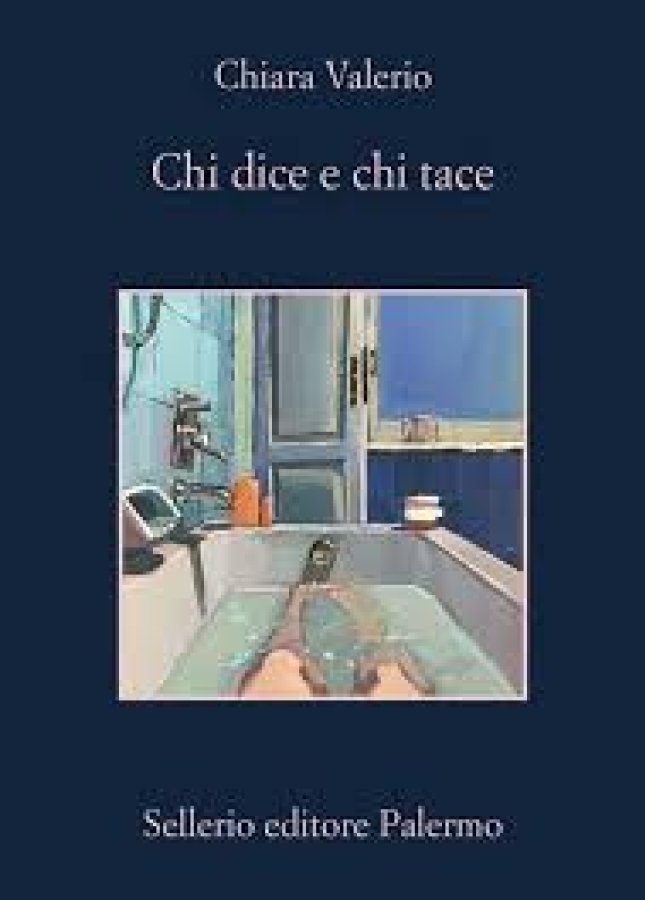
Eyes not light in color but filled with light, she wore a straw hat that had seen better days, loose trousers, a white cable-knit sweater, (...) Vittoria looked as if she had stepped out of the pages of Oggi. (...) She looked like an Arab princess on a Tuscan country estate. Who was Vittoria? Lia seeks to answer this question when the woman's lifeless body is found in the house’s bathtub. In an indifferent and gossipy environment, Lia seems the only one concerned with the causes of death (suicide or murder?) and, above all, with who Vittoria truly was: why she had abandoned Rome and why she was cohabiting with a young woman who certainly could not have been her daughter. And Lia discovers that Vittoria is like
Greek; she had left few traces, and to arrive at a meaning—assuming there was one—one had to proceed by recombining the elements, conscious that a margin for interpretation would always remain or, in the worst-case scenario, that none of the combinations would make sense. It is clear that Chiara Valerio has deeply loved and endured ancient Greek! Beneath the veneer of a noir story, Lia ventures into the labyrinth of that mystery residing within us all—indecipherable, yet one we endeavor to bring order to. To this inner conflict that animates literature, as Ungaretti used to say, the author attempts to provide a resolution through an overly rational approach, turning it into a philosophical or mathematical puzzle that conceals the fear of straying from well-defined and reassuring prevailing values. And what if Lia had been romantically attracted to Vittoria? Along a promenade that is not that of Scauri, perhaps on the banks of the Nile or in a desert oasis,
I saw Vittoria. (...) I drew closer and asked her. Why? Vittoria smiled, (...) took my face in her hands, kissed me. I even closed my eyes. In the dream, I was happy. Another sound, a voice, two voices. I broke my lips away from Vittoria’s and looked around. My daughters were running toward me....
For me, it was an arduous read, abandoned and then taken up again out of a determination to see it through to the end and uncover the enigma and the myth of Vittoria. The two facets overlap: on the one hand, unveiling what lies behind this woman of the respectable Roman bourgeoisie; on the other, understanding why, in the small, provincial setting of Scauri, Vittoria turned into an idealized, mythologized reference point. These would have already been two complex themes to sustain in tandem, vacillating between noir and social novel; yet Valerio also wished to delve into Lia’s lived experience, without, however, fully laying bare her psychology, her frustrations, and her transgressive yearnings. Everything remained on the surface.
The prose accentuates the reader's strain: the stark, apodictic sentences, the repeated use of full stops to conclude verbless clauses, the frequent shifts in narrative point of view—I, she, and you—the numerous digressions, the overcrowding of characters, and the sudden shifts in narrative trajectory are stylistic traits that heighten the narrative's fragmentation and disrupt the discursive flow. Chiara Valerio possesses an angular, essayistic style, whereas the strongest passages are precisely those where one glimpses oneiric elements and a subtle nostalgia for her Scauri.
Why read it? The figure of Lia is interesting, but it is a taxing novel.