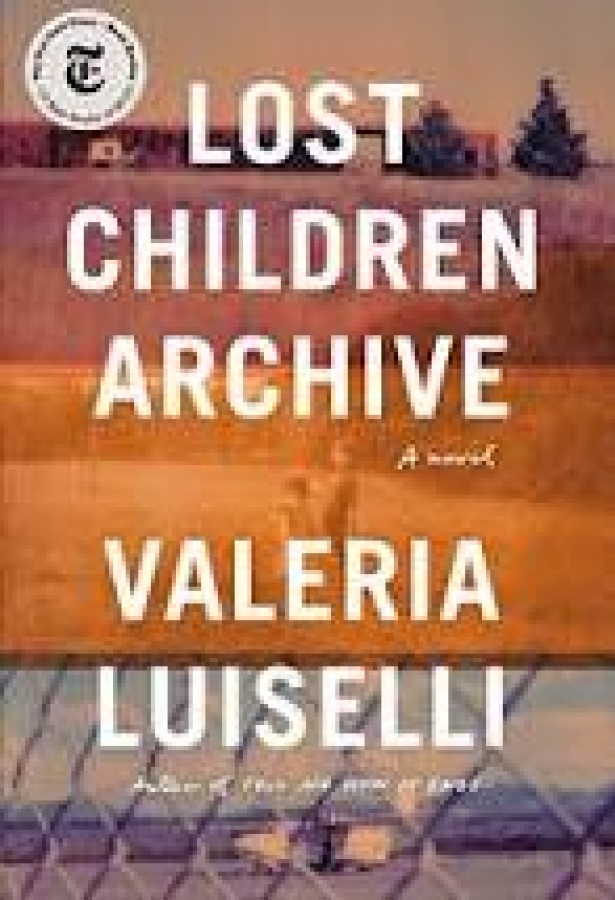
There are books that overwhelm the poor reader with their narrative and stylistic complexity; one feels inadequate and wanders through the pages, fascinated and frightened, without finding the unraveling thread. And then one discovers, or believes one discovers, the path charted by the talented Valeria Luiselli, a Mexican writer writing in English. How can we ensure that the voices of the world do not become mere echoes of background noise?
> Memory / day by day disappears / the heart grows ever deafer / to distant, wretched plights
(Carlo Vallini, *«Da un giorno»*). The author seems to find the answer in children: in the stories of those who are lost and in the journeys of those who courageously retrace the experience of disappearance. If in Torquato Tasso’s *Gerusalemme Liberata* it is knights who set out in search of the holy sepulchre, of truth and light (see review on this site), here it is children, like the “Eagle Warriors” (Native American child warriors), who venture into a tunnel, fearful yet determined.
> Children used to play in this tunnel, they held their breath as the train rushed toward darkness, they allowed themselves to breathe again only once the train car had crossed the entrance vault, returning into the light, and the valley opened wide again, like a terrifying and blinding flower, before their eyes
. In the first part, a journalist is the first-person narrator: mother of a four-year-old girl, she is married to a researcher specialized in collecting and archiving the sounds of the city; he is, in turn, the father of a 10-year-old boy. It is a marriage in crisis: love has cooled, and above all the differing interests of the two partners have emerged—the man a dreamer, ever distant in his thoughts; she, instead, practical, attentive to the care of the children and to what is unfolding in society. The husband decides to embark on a journey toward the American South in search of traces of the Apaches; the choice is grudgingly accepted by the journalist, who ultimately agrees to it because she wishes to gather information and testimonies about the “lost children”: having entered undocumented and locked in detention centers awaiting repatriation, all trace of these children is lost. Confined to the cabin of a car, the four travel together the many miles between New York and the South,
> looking out the windows at a landscape wounded by decades or perhaps centuries of systematic agricultural aggression: land dissected into quadrangular grids, gang-raped by heavy machinery, fattened with modified seeds and drenched in pesticides, (...) land caged within circles of green crop strips, resembling Dante's Inferno; (...) and land turned into non-land, under the weight of concrete, solar panels, storage tanks, enormous wind turbines...
At first, the children are helpless spectators to the crumbling of the marriage and everything happening around them; then, slowly,
> our rational, linear, and organized world dissolves in the chaos of our children's words, (...) their thoughts are filling our world... (...) I understand now, perhaps too late, that my children's repetitive games in the back seats were perhaps the only way to really narrate the story of the lost children
. The turning point comes from the sight of the young migrants boarding, all in a mournful line, the plane that will take them back to their country of origin. The older boy, imbued with his mother’s civic passion and captivated by his father’s evocation of Echo Canyon, where the voices of the last Apaches dispersed, decided to go in search of the lost children. He sets off, backpack in hand, together with his little sister. At this point, the narrative structure and the writing change. The boy becomes the narrator of this adventure while the story of seven children in search of their families unfolds in the third person: these are the “Lost Children Elegies”: a series of fragments that elevate one of the tragedies of our time into song, recalling David Grossman’s poem in their intensity and evocative power (*Falling Out of Time: A Novel in Voices*, reviewed on this site). If in the first part the style is linear, almost essayistic, it becomes increasingly lyrical, relying on words rather than syntax, lending force to a rhythm so pressing and relentless as to leave the reader’s conscience defenseless. The two stories converge in the desert, in a makeshift shelter, and the children, now together, can tell each other their adventures: the “lost” children can leave a testimony of themselves. By a stroke of fortune, the two runaways manage to find Echo Canyon, and by shouting their names they are heard by their parents. Our children are saved, while the young migrants disappear into the desert, and only their little skeletons will speak of their fate, one day. The happy ending confirms how even the courage of children is futile. After photographing the seven young migrants,
> I was looking at them, concentrating hard, when you suddenly came up with an intuition, which was true and smart but also terrifying. You said: look, everyone in this picture is disappearing
. And then the echoes are merely incomprehensible words, merely noises,
> so strange that I didn't know if they were in my mind or in the air, (...) and I wondered if we were listening to the sound of all the dead in the desert, of all the bones scattered there
.
“The world is broken,” the author synthesizes.
> No one is capable of capturing what is happening and saying why. Perhaps it is just that we sense the absence of a future, because the present has become too oppressive, so the future has become unimaginable. And without a future, time is perceived only as an accumulation. An accumulation of months, days, natural disasters, television series, terrorist attacks, divorces, mass migrations, births, photographs, sunrises
. All that is left for us is to
> record the sound of the wind, (...) trying to capture their past presence, make it audible, despite their absence today, archiving whatever echo still reverberates of them. (...) Echoes of the echo:
mem, mem, mem, mem, wa, wa, wa...cow, horse...bzzzzz, bee buzzing... “As the poet says,” and imagine the boundless number / of perturbed open permutations (like a limitless / lyricist, in an unstable / Scrabble-like kaleidoscope), which thus multiplies us” (Edoardo Sanguineti from “*Senza titolo Glosse 15*
> ).
It is impossible to express the kaleidoscopic beauty of Luiselli's writing: the richness of the vocabulary, the shimmering style, shifting from traditional prose to sentences unburdened by periods, the continuous and innovative experimentation, the intense engagement of language with the subject narrated, never approached in a bureaucratic or prosaically literary way. It is a masterpiece! We urge the reader to read and reread the Fifth Elegy, magnificent and powerfully evocative, as well as the telephone game of the
lost children,” the desperate nostalgia: a page that takes our breath away, to be savored in apnea.
Why read it? A masterpiece.