Finished reading on: August 23, 2026
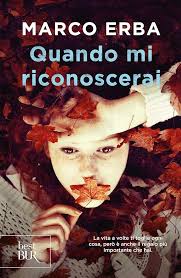
When you recognize me
Title of the original version reviewed: «Quando mi riconoscerai»
AI Translation Notice: This review was translated from the original Italian using artificial intelligence. Book quotes and excerpts are translated interpretations and will not match the author's original English phrasing or official published translations.
Castenate is an imaginary small town in Northern Italy, a
prim and proper little village, where to your face everyone (...) is polite: good morning, good evening, how are things? how is Camilla doing? which school is she attending next year? Yet everyone knows, everyone talks.
In this "prim and proper little village", the author sets two storylines that run distinct and parallel for much of the book. One is set in the 1990s and chronicles the relationship between two teenagers: Camilla,
beautiful, with her red hair and green eyes. All teenage girls resemble one another, but she is special. She knows it, and she takes pride in it;
Enea, a shy, bookish boy who always raises his hand in class because he—unlike the others—has studied. Camilla delights in bullying poor Enea, humiliating him in front of their peers, as when she pulled down his shorts, shaming him before the female classmate he fancied. Above all, Camilla's insult weighs heavily on Enea: your grandmother
is a whore, the whole town knows it.
While this story is steeped in adolescence, tracing a relationship that evolves from friction to friendship and ultimately to love, the other is set during the years of the Second World War and is pervaded by the violence of that era. Rodolfo is handsome, daring, poor, and anti-fascist—viscerally so, belonging to a family of farmhands exploited by agricultural landowners. It is to this very landowning class that Viola belongs; indeed, her father is one of Castenate’s fascist hierarchs, respected and feared throughout the town. So too is her intended husband (they were seen kissing in a reed bed!): a violent young man, always eager to beat up suspected anti-fascists like Rodolfo. Despite being worlds apart socially and politically, a passion flares between Rodolfo and Viola—initially resisted by the young woman, only to erupt into a loving bond when Rodolfo must leave Castenate, ultimately to die in the Russian campaign. From this passion a child is born, who will be raised by Viola in the bigoted climate of post-war Italy. These are two vastly different stories in terms of historical context and emotional stakes; while in the former, set in the 1990s, it is possible to grant love time to unfold, in the other, during those harrowing 1940s, there can be no waiting—everything must hasten forward. For many pages, the reader looks for some clue as to how the two narratives intertwine. Then, much like in Majgull Axelsson's splendid Io non mi chiamo Miriam (see the review on this site), the grandmother reveals to Enea that she is not Rita, but Viola, and that he is the grandson of Rodolfo, the twin brother of the man who killed his maternal grandfather.
Rotten blood, all rotten blood, those filthy partisans. The worst part is that that rotten blood contaminated my son as well. In his veins runs Rodolfo's blood, partisan blood. But he will never return. And yet I wait for him, and it destroys me to think I can never have him for myself again, and I despise myself for this weakness. (...) I have no peace, Enea. I have spent my life lying.
The novel should have evolved around this dramatic revelation—around that confession, so steeped in both hatred and love, which the grandmother makes to her grandson. Instead, the author crowds the narrative with too many themes, ranging from adolescent issues to the partisan struggle. What emerges is a muddled plot, compromised by a narrative imbalance between the two storylines that comes at the expense of pacing and renders the account redundant. The ending, which perhaps aspires to be a surprise, is instead mundane and tedious. Its fundamental merit lies in making us realize just how distant today's Italy is from the dramatic events our country endured during the war.
The prose is simple, effective, and elegant all at once. The brief sentences and tight dialogue suggest that the author intended to appeal to a teenage readership, who might perhaps better appreciate Camilla and Enea's love affair than an adult reader, who is left more struck by Viola's tragic omertà. It is a pity that the author did not devote more effort to capturing the provincial atmosphere, the "prim and proper little village"; had he done so, he would have lent depth to the entire narrative, framing it far more effectively within its social and cultural context.
Why read it? It reads well, but it is dull.