Carlo Ruiz Zafon
Books by this author (1)
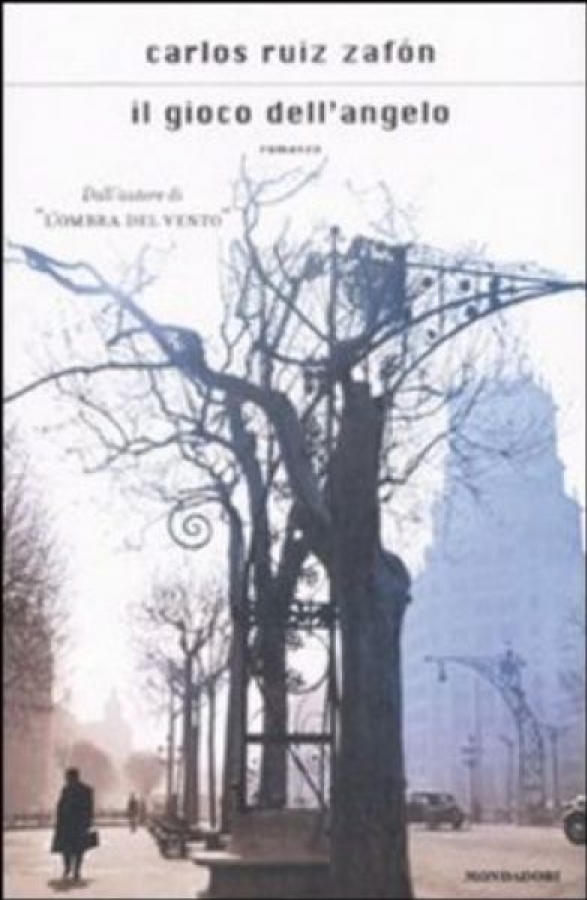
The Angel's Game
David Martin is a young journalist, who begins writing serialized stories for his newspaper. These stories meet with considerable success, and he is consequently put on salary by a publisher to write a series of novels belonging to a cycle entitled *The City of the Damned*. With the money he earns, he rents a mysterious house, abandoned for many years and previously owned by a strange character, Diego Malasca. Meanwhile, several plotlines intertwine: David is in love with Cristina, who convinces him to secretly write a book for a wealthy friend who wishes to become a famous author. He is contacted by a French publisher—who will later turn out to be the devil, or the personification of evil—who persuades him, for a handsome fee, to devise a new religion. At the request of a bookseller friend, he hires a young girl (Isabella) as his assistant, who aspires to become a writer. David, while continuing to write the commissioned book, launches an investigation to discover who the French publisher is and why he wants to formulate a new religion. At this point, a series of gruesome murders ensues, and David becomes embroiled in surreal and implausible events, all steeped, however, in mystery. In vain does Isabella try to bring him back to reality; David desperately pursues the mystery, and with it, his ill-fated love for Cristina. Everyone close to him, friend and foe alike, dies in a horrific and mysterious manner: Cristina, for example, having lost her mind, drowns in a frozen lake before the eyes of her friend. After a succession of grim events and terrible deaths, David manages to flee to a distant foreign land, only to meet the devil one day, many years later, who entrusts to him Cristina as a child, thereby opening up the prospect of a future. The scene faithfully mirrors a photograph David had found many years earlier, depicting the devil walking hand in hand with Cristina as a young girl. Mystery reigns unchallenged. What is the meaning of this book? There are, undoubtedly, numerous interpretative hypotheses: the construction of a religion of death that is nevertheless overcome by love, an unhappy love story, a "noir > inexplicable, a labyrinth of ideas and situations whose guiding thread remains elusive. I like to think that the common motif is the book itself. Books are the true protagonists of the novel, and with them, fantasy and imagination. At the beginning of the novel, when the author speaks of his childhood, David recalls that where my friends saw traces of ink on incomprehensible pages, I saw light, streets, people. Words and the mystery of their occult science fascinated me, and they seemed a key with which to unlock an infinite world > . At another point in the novel, Samperi, his bookseller friend, predicts that David will become a new Edgar Poe. And this writer indeed seems to be the guiding inspiration of the novel. Are the events narrated real, or the product of imagination and fantasy? Is it not always the *Cities of the Damned* dominating the scene? Could David have invented everything in a fit of delirium within the cursed house, or might he himself be the perpetrator of so many crimes? From this perspective, the character of Isabella gains meaning, embodying reality, concreteness, and pedantry in a situation where unchecked fantasy has run rampant. As the devil remarks, Everything is story, narrative, a sequence of events and characters that convey an emotional content". A complex book that nevertheless proves verbose and constantly in search of sensational effect, failing, however, to generate either genuine suspense or real action. Events unfold predictably, and in certain instances the overt borrowing of literary imagery is glaringly evident. In my view, the novel lacks life; it is formal and merely literary.