Finished reading on: September 07, 2026
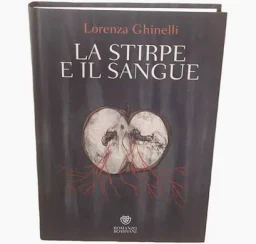
Lineage and Blood
Title of the original version reviewed: «La stirpe e il sangue»
AI Translation Notice: This review was translated from the original Italian using artificial intelligence. Book quotes and excerpts are translated interpretations and will not match the author's original English phrasing or official published translations.
In fifteenth-century Transylvania,
there is a story fording rivers, flying through leafy woods, and snagging on the lips of passersby. A tale that horrifies, (...) an immortal creature of violent hunger, thirsty for blood, seemingly roams the countryside. (...) For two months, a comet has been furrowing the sky like a knife wound from which drips the blood of creation.
It is Dracula—not the historical Count Vlad Dracula, who, despite his cruelty, was certainly neither immortal nor nourished by the blood of his victims. In our story, he is Radu, a slight adolescent, a predator ever ready to spring at the throat,
swift as a flea, but with a lethal bite, (...) a maddened, spurting moth.
In a narrative paced by death itself, within an environment ravaged by wars, violence, and massacres, enveloped in a bleak, terrifying atmosphere where the sun never seems to shine, a small family struggles to survive: Maria, the mother, deeply versed in herbs, even those that kill—a witch, perhaps; Anna, the daughter who, still a child, must protect her newborn brother; and Radu himself, who, still an infant, must feed on blood, unable to draw sustenance from his mother's depleted milk.
He is tiny, purple, smeared with blood and woman's humors.
He ought to die, says the midwife, because
he is not wanted by the spirits of the wind, (...) Anna snatches him from her hands and presses him to her chest; his first wail is born there, in the arms of his little sister.
And so Radu, the future "vampire," is the fruit of his little sister's love—she carries him along, watches over him and hides him, giving him whatever meager food she can find. In the forest, the small family must defend themselves against wild beasts; when abducted, they must save themselves from men. There is no need to delve further into the plot, intensely Gothic in its framework, so surreal as to verge on "Fantasy"; it is better to let oneself be carried away by the imagination, and to consider this tale, so distant in time, as ultimately a metaphor for our current condition: wars, massacres, violence, and genocides can only give birth to a Monster; and we are left to wonder whether Anna did right in saving and nourishing Dracula, offering him all her love.
There is no sense in comparing this novel to Bram Stoker's Dracula (see the review on this site): a work steeped in positivism that recounts the clash between science and the unknowable, where Dracula is not a real character, but an allegory for our deepest, unutterable drives. Perhaps, beyond its Gothic undertones, the novel is the continuation of La Colpa (see the review on this site). Certain themes seem to recur: the untamed environment (here Transylvania, there the desertified Marecchia); in both, "the lucid madness of constructing possibilities that are terrible because they are plausible, (...) a naked, reddened, dripping Prometheus..."; an existential dimension where only friendship and love can save. In La stirpe e il sangue, written ten years after La Colpa, it seems the author has slipped into that very precipice envisioned in the 2012 novel, and only by retreating into Fantasy was she able to survive.
The fundamental merit of the narrative lies in the writing: short yet evocative sentences, almost prose verse, that embed themselves in the reader's mind. One senses the influence of a poet like Beatrice Masini.
Why read it? It is gory, at times excessively so, but the prose captivates. And so tender is the figure of Anna.