Oe Kenzaburo
Books by this author (3)

The Eternal Virgin
The author imagines a former schoolmate, now a film producer, proposing that he write the screenplay for a film based on *Michael Kohlhaas*, an 1810 novella by Heinrich von Kleist. The plot lends itself to a theme particularly dear to Kenzaburo Oe: that of freedom and rebellion against the abuses of Power. Set in the sixteenth century, Von Kleist's novella recounts the story of a horse dealer who refuses to accept being robbed and humiliated by a powerful feudal lord and, stubbornly and desperately, fights for Justice. It is only natural for Kenzaburo to transpose this tragic tale to the peasant uprisings that shook Japan in the second half of the nineteenth century, which swept through the writer's own native village, as previously described in *The Water Forest* (see the review on this site). Such is the context thus far; yet from the very first pages, one senses that something else lies beneath the plot, as though the screenplay were unleashing primordial forces that well up from the underground of the human soul. Unlike Fyodor Dostoevsky's *Notes from Underground* (see the review on this site), here it is not malice, but that subtle, ambiguous, and shameless desire for erotic fantasies that can still overpower an old man. Indeed, the novel is structured around two distinct periods in Kenzaburo's life: in the first, he is already an established writer, yet deeply depressed and trapped in a severe creative crisis; in the second, he is an elderly gentleman in physical decline. The clue to an "underground" theme beneath the official plot is found in the quotation of a poem by Edgar Allan Poe, written in 1849, the year of Poe's death (how many "allegorical" references abound in the great Japanese author!): "It was many and many a year ago / in a kingdom by the sea / that a maiden there lived whom you may know / by the name of Annabel Lee; / and this maiden she lived with no other thought / than to love and be loved by me". These are Poe's verses, laden with erotic evocations; but who is Annabel Lee to Kenzaburo Oe? She is Sakura-san, a Japanese actress famous in Hollywood whom the producer wishes to cast as the lead in the film on Michael Kohlhaas. As coincidence would have it, Kenzaburo had already seen the young Sakura—and had been "captivated" by her—in a short film on Annabel, where Sakura, then still a child, starred in the final scene in the guise of a > maiden in a flowing white gown, who beneath the purity of the image possessed > something ambiguous and mysterious. The novel's plot unfolds around Sakura's "underground," beyond her calm, self-assured demeanor. First of all, the actress is determined to center the film on the woman who led the peasant revolt in the second half of the nineteenth century and who was gang-raped before being murdered: the ordeal of this woman, known in legend as Meisuke's mother, was the subject of a stage play organized by Kenzaburo's grandmother and mother, in which the writer took part as a young boy. Later, the writer learns that Sakura is known as the "Eternal Virgin": while still a child, Sakura was taken to America by a soldier who became her husband and launched her film career; a man who loved her, yet with whom Sakura was never able to consummate a full sexual relationship. It is from this that a recurring nightmare of Sakura's arises: > in the dream I felt an unspeakable fear, yet I didn't quite know why; I couldn't bring it into focus. And yet in that short film on Annabel Lee, directed by her husband himself, such purity shone through the image of the child Sakura reclining on a tree trunk by the riverbank, just as in Poe's poem. But there was something else, something hideous in the short film's ending—a conclusion kept hidden, and which Sakura unconsciously sought to retrace as the lead in the theatrical staging of the tragic tale of Meisuke's mother. > Thanks to an extremely placid and bucolic passage, I was even able to imagine Meisuke's mother setting out along a mountain path leading deep into the forest. (...) I felt a profound regret, thinking that I had lived so many years without reflecting deeply on what might truly lie hidden beyond this path; I had become a seventy-year-old man who had done nothing but listen to that melody, so simple and pure (Beethoven's Piano Sonata Opus 111, accompanying the short film on Annabel Lee), which dragged me inexorably toward the unknown. I could not, and will never be able to, rid myself of the image of that thick, stubby thumb forcing its way into that small slit.... > I awake in the darkness that precedes dawn, floundering among the agonized shreds of dreams that still linger in my consciousness, in search of a burning sensation of anticipation. (..) I have slept with my arms and legs bent to the side, in the posture of someone who refuses to remember his own nature or the predicament in which he finds himself. So writes Kenzaburo Oe in *The Silent Cry* (see the review on this site), as if to express what we have repressed our whole lives, only for it to return in old age, fiercer than ever. In *The Eternal Virgin*, it is an old man's erotic impulses, in a narrative revolving around a woman who is captivating precisely because of her deepest secrets—so deeply buried in the "underground" of the soul as to be unknown even to herself. Artistic creation is essential to dredge a lifetime of grief back to the surface. The novel is a hymn to literature, to its capacity to interweave historical events, literary references, self-reflection, and therapeutic powers. One senses an undercurrent of regret for what was left undone, and unlived. It is a flawless novel! To be sure, with subtle irony, Kenzaburo pokes fun at his own tendency to lose himself in the narrative, to often be verbose and rambling. That cannot be said of this work: the plot develops seamlessly, steering the reader with a steady hand toward the dark core of the story. The success of the narrative stems, perhaps, from having focused on a single character who grows and asserts herself, slowly but inexorably, throughout the novel, in search of herself and of her determination to remain authentic, like a Japanese Anna Karenina (see the review of Tolstoy's masterpiece on this site). The prose flows with elegance and precision, displaying such stylistic mastery as to leave one astounded. Why read it? It is a masterpiece.
The Water Forest
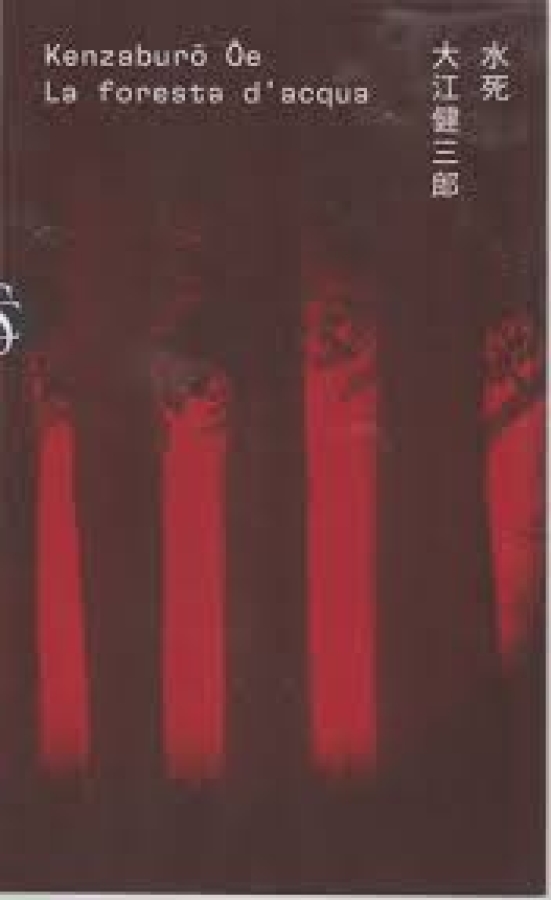
A renowned septuagenarian writer, Choko Kogito, returns to his childhood home to examine the suitcase where documents said to reveal the reasons behind his father's suicide are supposedly hidden. We find ourselves in a forest on the banks of the waters where his father drowned on a stormy evening. Choko visits the memorial commissioned by his mother to commemorate the tragic event. > A large, rounded stone protruded from the bare earth, resembling a fragment of a meteorite. When I drew closer and tried to get a better look -- it also bore a likeness to a strange, sea-green cluster of vegetation -- I noticed that it carried an inscription of merely five lines. (...) > You did not prepare Kogii to climb into the forest/ And as though caught by the river's current you will never return./ In Tokyo during the dry season/ Memories surface in my mind in reverse/ From old age back to the years of childhood . The first two lines were written by his mother, urging Choko to prepare for death, but also to ready his son—her grandson, burdened with a severe disability—for the end of life. This is an initial leitmotif running through the entire novel: the contemplation of Death, the desperate clinging to life that manifests as the > lack of the courage needed to attempt writing his "final work" and upend his entire oeuvre. The remaining lines, composed by the writer himself, signal the other theme, likewise characteristic of old age: journeying back to the years of childhood, confronting the figure of the father, interrogating the manifold facets of Memory. Other novels come to mind, such as Salvatore Satta’s *The Day of Judgment* or Christine Dwyer Hickey’s splendid *The Cold Eye of Heaven* (see the reviews on this site). Kenzaburo does not wish to write an "I-novel," where the subject stands at the very center of the narrative, ceaselessly speaking of himself, reducing setting, events, and other people to a mere "mirroring ego." To avoid lapsing into the narcissistic ego so pervasive in our time, Kenzaburo resorts to accounts related by others and to theatrical representations, casting the writer as an astonished, admiring spectator. As in Dante, the protagonist-narrator remains in the background, overshadowed by characters and events. This preamble sidelines the plot, which nevertheless exists and will burst forth toward the end of the novel. Choko wants to recount his father's drowning, which he witnessed helplessly as a child. Why did his father kill himself? And why did Kogii, the imaginary friend, lure him toward the waters? What does memory hold? At first, everything seems distinct; then, everything blurs and vanishes between imagination and reality. > All at once I saw dozens of silvery dace before me, (...) and beneath that school of fish, enveloped in the silt of the dark riverbed, I had the distinct impression of catching sight of a large, naked body.... my father! His character gently floated, cradled by the underwater current. And there I was, watching him, trying to mimic his movements. (...) I took an index card and wrote: "I love my father desperately." The suitcase contains no clues to decipher his father’s suicide; Choko sinks into depression, withdraws into himself, mistreats his son, and might even kill himself. What saves him is a young actress, Unaiko, who involves him in the scriptwriting of an episode dating back to the mid-nineteenth century: a peasant revolt led by a woman, a rebellion bloodily suppressed, with the woman subjected to a gang rape before being executed. It seems an "innocuous" historical incident to commemorate, until Unaiko decides to declare during the performance that as a child she was repeatedly raped by her uncle, a powerful official, and that the entire matter was silenced. A scandal looms, the hypocrisy of Japanese society is laid bare, reality bursts onto the stage, and Choko is saved. It is difficult to summarize this complex novel in a review. Alongside the themes already noted, there are many others: the physical decline of the man and the writer, reminiscent of Thomas Mann's *Death in Venice* (see the review on this site); disability, and thus the burden of having a "different" child; the cathartic role of theater, which also enables the demystification of one of the seminal texts of modern Japanese literature, Natsume Sōseki's *The Heart of Things* [*Kokoro*] (review on this site); the magical allure of nature, a quintessential Japanese motif; and finally, the social and cultural transformations of contemporary Japan, still suspended between tradition and modernity. Many topics are present—perhaps too many. The reader presses forward, losing themselves in the meanders of the narrative, at once fascinated and fatigued. To his father, who was speaking to him of the *Great Dictionary of Chinese Characters*, the adolescent Kenzaburo Choko replied: > if all words are in a dictionary, then it will no longer be possible to find new ones, and there won't be any fun left! With an elegant, fluid style, drawing upon deft technical and stylistic devices, the writer explores numerous modes of expression, from epistolary exchanges to theater, from music to oneiric lyricism. It is a broad narrative keyboard (with a lexical one impossible to pin down), in which Kenzaburo indulges all too frequently, ultimately weighing down and protracting the tale, causing the central core to be lost from view. As the author himself observes, they seem like "fragments," as though the unity of Being were no longer attainable. Why read it? It is a stream of consciousness with an unobtrusive "I."
The Silent Cry
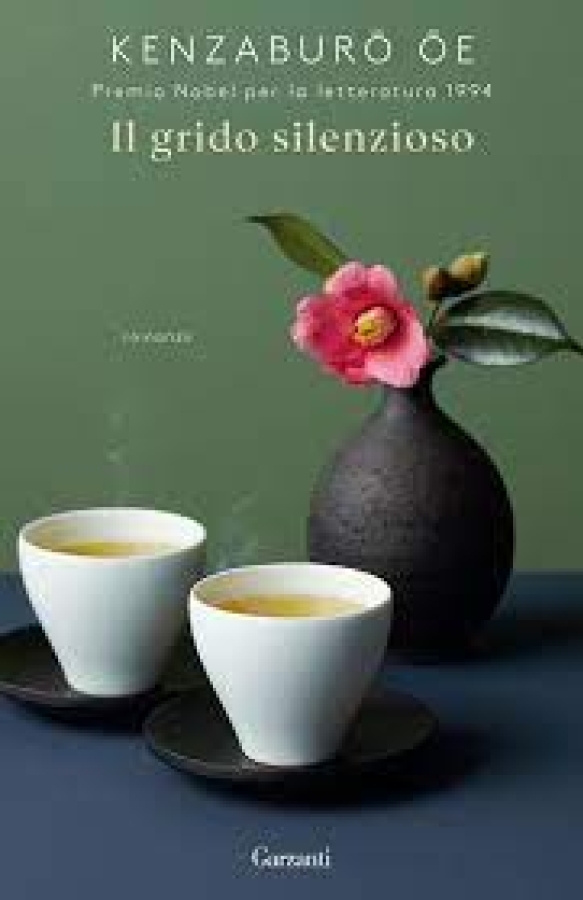
> I wake in the darkness before dawn, flailing among the agonized shreds of dreams that still linger in my consciousness, searching for a burning sense of anticipation. (...) In every part of my body, I perceive separately the distinct weights of flesh and bone, sensations that coalesce into a dull ache within my consciousness, reluctant to resurface into the light. (...) I have slept with my arms and legs curled to the side, in the posture of one unwilling to recall his own nature or the circumstances in which he finds himself. This is the novel’s opening; it encapsulates the essential traits of a narrative that is oneiric yet deeply rooted in reality: the refuge of dreams to flee suffering—the latter manifested through bodies often described in grotesque terms; memory as a prison enclosing a human destiny already doomed; the ambiguity of familial and social ties, thickened by resigned silences and unspeakable memories. We find ourselves before a stream of consciousness set against a backdrop portrayed both naturalistically and like a dark fable. Mitsui, the first-person narrator, is shattered by the tragicomic suicide of a friend. His life is already scarred by his son’s monstrous disability and his wife’s alcoholism; furthermore, tragic family events weigh upon him, their recollection repressed yet ever-present in his consciousness. Perhaps to effect a turning point in his life, he accepts the invitation of his brother Taka to return to the village at the edge of the “mighty” forest, where the family home stood and where they grew up as children. It is a return to the past: for Mitsui, a desperate hope for change that translates into the definitive awareness of his estrangement from the world; for Taka, a desire for self-punishment enacted by retracing dramatic events that engulfed their family. In 1860, upon the fall of the Shogunate, their great-grandfather’s brother led a peasant uprising, later bloodily suppressed; at the end of the Second World War, in the very same village, a brother died in a clash between Japanese and Koreans, the latter prisoners of war. Seeking to retrace the deeds of his uncle and brother, Taka decides to lead the villagers in pillaging the local supermarket, owned by a Korean known as “The Emperor” (perhaps to confer upon him a sacred aura, Korean as he is!). Mitsui remains aloof from the events, curling further into his stupor, while Taka emerges as a vigorous and cunning leader; yet it is all a charade through which Taka seeks to punish himself for a grave sin: as a youth, he raped his disabled sister, driving her to suicide. Taka confesses to a murder he did not commit and then, disbelieved by Mitsui, kills himself. > He looked like a life-size plaster dummy, entirely red and dressed only in trousers. shouts the wife to Mitsui, who tries to justify himself. > You reject people and let them die, and the only thing you can do to make amends is cry out in your sleep: “I have abandoned you!” (...) In the deep gloom of the cellar, stirred by swirling eddies of wind, I saw the eyes of a dying cat. (...) As I contemplated them in the darkness, the eyes of my cat, a companion of many years, became the eyes of Taka, the eyes of the great-grandfather’s brother I had never known, and the eyes of my wife, red as plums; and they all merged into a luminous circle that was rapidly asserting itself as an undeniable part of my being. (...) And I would survive in an agony of shame, beneath the light of those stars, peering with my single eye and the timidity of a mouse into a vague, dark outside world... The setting is similar to that of *The Water Forest* (see the review on this site), and certain historical references are analogous, such as the peasant uprisings of 1860, but the narrative structure is profoundly different. Unlike in *The Water Forest*, here the first-person narrator is redundant, just as the familial relationships are intricate, unfolding along two axes: the bond between Mitsui and Taka, a mixture of affection and revulsion, and the former's relationship with his wife, which seemingly remains in the background. > Remaining silent for a moment and then staring at me with eyes full of desperate hostility, this time red from tears rather than whisky, my wife said to me: > When the time comes when, as you say, we must acknowledge that there is no turning back, perhaps then we will be a little kinder to each other! . Despite the complex interplay of themes and narrative layers, perhaps the unifying meaning of the novel lies in the acceptance of the disabled child—the sole possibility for rebuilding a relationship torn apart by merciless fate. The narrative unfolds slowly, with numerous references and digressions, as if the author were wary of uncovering the depths of consciousness too quickly. One is captivated by the spell of the words, rich in psychological and social resonance; yet an oppressive sense of claustrophobia looms over everything, offering no glimpse of development or resolution, so that reading becomes burdensome and one reaches the novel's end with difficulty. Why read it? Splendid prose, and the haunting allure of pain and death.