Finished reading on: September 26, 2023
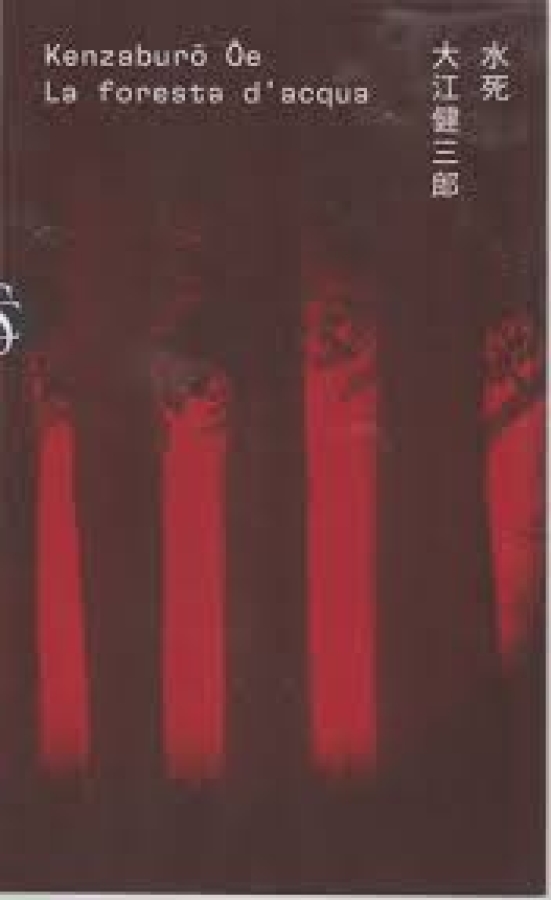
The Water Forest
Title of the original version reviewed: «La foresta d'acqua»
AI Translation Notice: This review was translated from the original Italian using artificial intelligence. Book quotes and excerpts are translated interpretations and will not match the author's original English phrasing or official published translations.
A renowned septuagenarian writer, Choko Kogito, returns to his childhood home to examine the suitcase where documents said to reveal the reasons behind his father's suicide are supposedly hidden. We find ourselves in a forest on the banks of the waters where his father drowned on a stormy evening. Choko visits the memorial commissioned by his mother to commemorate the tragic event.
A large, rounded stone protruded from the bare earth, resembling a fragment of a meteorite. When I drew closer and tried to get a better look -- it also bore a likeness to a strange, sea-green cluster of vegetation -- I noticed that it carried an inscription of merely five lines. (...)
You did not prepare Kogii to climb into the forest/ And as though caught by the river's current you will never return./ In Tokyo during the dry season/ Memories surface in my mind in reverse/ From old age back to the years of childhood
.
The first two lines were written by his mother, urging Choko to prepare for death, but also to ready his son—her grandson, burdened with a severe disability—for the end of life. This is an initial leitmotif running through the entire novel: the contemplation of Death, the desperate clinging to life that manifests as the
lack of the courage needed to attempt writing his "final work" and upend his entire oeuvre.
The remaining lines, composed by the writer himself, signal the other theme, likewise characteristic of old age: journeying back to the years of childhood, confronting the figure of the father, interrogating the manifold facets of Memory. Other novels come to mind, such as Salvatore Satta’s The Day of Judgment or Christine Dwyer Hickey’s splendid The Cold Eye of Heaven (see the reviews on this site). Kenzaburo does not wish to write an "I-novel," where the subject stands at the very center of the narrative, ceaselessly speaking of himself, reducing setting, events, and other people to a mere "mirroring ego." To avoid lapsing into the narcissistic ego so pervasive in our time, Kenzaburo resorts to accounts related by others and to theatrical representations, casting the writer as an astonished, admiring spectator. As in Dante, the protagonist-narrator remains in the background, overshadowed by characters and events. This preamble sidelines the plot, which nevertheless exists and will burst forth toward the end of the novel. Choko wants to recount his father's drowning, which he witnessed helplessly as a child. Why did his father kill himself? And why did Kogii, the imaginary friend, lure him toward the waters? What does memory hold? At first, everything seems distinct; then, everything blurs and vanishes between imagination and reality.
All at once I saw dozens of silvery dace before me, (...) and beneath that school of fish, enveloped in the silt of the dark riverbed, I had the distinct impression of catching sight of a large, naked body.... my father! His character gently floated, cradled by the underwater current. And there I was, watching him, trying to mimic his movements. (...) I took an index card and wrote: "I love my father desperately."
The suitcase contains no clues to decipher his father’s suicide; Choko sinks into depression, withdraws into himself, mistreats his son, and might even kill himself. What saves him is a young actress, Unaiko, who involves him in the scriptwriting of an episode dating back to the mid-nineteenth century: a peasant revolt led by a woman, a rebellion bloodily suppressed, with the woman subjected to a gang rape before being executed. It seems an "innocuous" historical incident to commemorate, until Unaiko decides to declare during the performance that as a child she was repeatedly raped by her uncle, a powerful official, and that the entire matter was silenced. A scandal looms, the hypocrisy of Japanese society is laid bare, reality bursts onto the stage, and Choko is saved.
It is difficult to summarize this complex novel in a review. Alongside the themes already noted, there are many others: the physical decline of the man and the writer, reminiscent of Thomas Mann's Death in Venice (see the review on this site); disability, and thus the burden of having a "different" child; the cathartic role of theater, which also enables the demystification of one of the seminal texts of modern Japanese literature, Natsume Sōseki's The Heart of Things [Kokoro] (review on this site); the magical allure of nature, a quintessential Japanese motif; and finally, the social and cultural transformations of contemporary Japan, still suspended between tradition and modernity. Many topics are present—perhaps too many. The reader presses forward, losing themselves in the meanders of the narrative, at once fascinated and fatigued.
To his father, who was speaking to him of the Great Dictionary of Chinese Characters, the adolescent Kenzaburo Choko replied:
if all words are in a dictionary, then it will no longer be possible to find new ones, and there won't be any fun left!
With an elegant, fluid style, drawing upon deft technical and stylistic devices, the writer explores numerous modes of expression, from epistolary exchanges to theater, from music to oneiric lyricism. It is a broad narrative keyboard (with a lexical one impossible to pin down), in which Kenzaburo indulges all too frequently, ultimately weighing down and protracting the tale, causing the central core to be lost from view. As the author himself observes, they seem like "fragments," as though the unity of Being were no longer attainable.
Why read it? It is a stream of consciousness with an unobtrusive "I."