Finished reading on: August 21, 2026
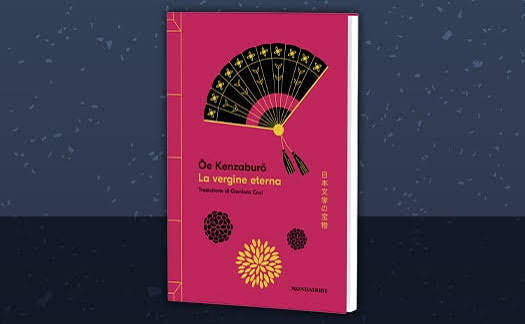
The Eternal Virgin
Title of the original version reviewed: «La vergine eterna»
AI Translation Notice: This review was translated from the original Italian using artificial intelligence. Book quotes and excerpts are translated interpretations and will not match the author's original English phrasing or official published translations.
The author imagines a former schoolmate, now a film producer, proposing that he write the screenplay for a film based on Michael Kohlhaas, an 1810 novella by Heinrich von Kleist. The plot lends itself to a theme particularly dear to Kenzaburo Oe: that of freedom and rebellion against the abuses of Power. Set in the sixteenth century, Von Kleist's novella recounts the story of a horse dealer who refuses to accept being robbed and humiliated by a powerful feudal lord and, stubbornly and desperately, fights for Justice. It is only natural for Kenzaburo to transpose this tragic tale to the peasant uprisings that shook Japan in the second half of the nineteenth century, which swept through the writer's own native village, as previously described in The Water Forest (see the review on this site). Such is the context thus far; yet from the very first pages, one senses that something else lies beneath the plot, as though the screenplay were unleashing primordial forces that well up from the underground of the human soul. Unlike Fyodor Dostoevsky's Notes from Underground (see the review on this site), here it is not malice, but that subtle, ambiguous, and shameless desire for erotic fantasies that can still overpower an old man. Indeed, the novel is structured around two distinct periods in Kenzaburo's life: in the first, he is already an established writer, yet deeply depressed and trapped in a severe creative crisis; in the second, he is an elderly gentleman in physical decline. The clue to an "underground" theme beneath the official plot is found in the quotation of a poem by Edgar Allan Poe, written in 1849, the year of Poe's death (how many "allegorical" references abound in the great Japanese author!): "It was many and many a year ago / in a kingdom by the sea / that a maiden there lived whom you may know / by the name of Annabel Lee; / and this maiden she lived with no other thought / than to love and be loved by me". These are Poe's verses, laden with erotic evocations; but who is Annabel Lee to Kenzaburo Oe? She is Sakura-san, a Japanese actress famous in Hollywood whom the producer wishes to cast as the lead in the film on Michael Kohlhaas. As coincidence would have it, Kenzaburo had already seen the young Sakura—and had been "captivated" by her—in a short film on Annabel, where Sakura, then still a child, starred in the final scene in the guise of a
maiden in a flowing white gown,
who beneath the purity of the image possessed
something ambiguous and mysterious.
The novel's plot unfolds around Sakura's "underground," beyond her calm, self-assured demeanor. First of all, the actress is determined to center the film on the woman who led the peasant revolt in the second half of the nineteenth century and who was gang-raped before being murdered: the ordeal of this woman, known in legend as Meisuke's mother, was the subject of a stage play organized by Kenzaburo's grandmother and mother, in which the writer took part as a young boy. Later, the writer learns that Sakura is known as the "Eternal Virgin": while still a child, Sakura was taken to America by a soldier who became her husband and launched her film career; a man who loved her, yet with whom Sakura was never able to consummate a full sexual relationship. It is from this that a recurring nightmare of Sakura's arises:
in the dream I felt an unspeakable fear, yet I didn't quite know why; I couldn't bring it into focus.
And yet in that short film on Annabel Lee, directed by her husband himself, such purity shone through the image of the child Sakura reclining on a tree trunk by the riverbank, just as in Poe's poem. But there was something else, something hideous in the short film's ending—a conclusion kept hidden, and which Sakura unconsciously sought to retrace as the lead in the theatrical staging of the tragic tale of Meisuke's mother.
Thanks to an extremely placid and bucolic passage, I was even able to imagine Meisuke's mother setting out along a mountain path leading deep into the forest. (...) I felt a profound regret, thinking that I had lived so many years without reflecting deeply on what might truly lie hidden beyond this path; I had become a seventy-year-old man who had done nothing but listen to that melody, so simple and pure (Beethoven's Piano Sonata Opus 111, accompanying the short film on Annabel Lee), which dragged me inexorably toward the unknown. I could not, and will never be able to, rid myself of the image of that thick, stubby thumb forcing its way into that small slit....
I awake in the darkness that precedes dawn, floundering among the agonized shreds of dreams that still linger in my consciousness, in search of a burning sensation of anticipation. (..) I have slept with my arms and legs bent to the side, in the posture of someone who refuses to remember his own nature or the predicament in which he finds himself.
So writes Kenzaburo Oe in The Silent Cry (see the review on this site), as if to express what we have repressed our whole lives, only for it to return in old age, fiercer than ever. In The Eternal Virgin, it is an old man's erotic impulses, in a narrative revolving around a woman who is captivating precisely because of her deepest secrets—so deeply buried in the "underground" of the soul as to be unknown even to herself. Artistic creation is essential to dredge a lifetime of grief back to the surface. The novel is a hymn to literature, to its capacity to interweave historical events, literary references, self-reflection, and therapeutic powers. One senses an undercurrent of regret for what was left undone, and unlived.
It is a flawless novel! To be sure, with subtle irony, Kenzaburo pokes fun at his own tendency to lose himself in the narrative, to often be verbose and rambling. That cannot be said of this work: the plot develops seamlessly, steering the reader with a steady hand toward the dark core of the story. The success of the narrative stems, perhaps, from having focused on a single character who grows and asserts herself, slowly but inexorably, throughout the novel, in search of herself and of her determination to remain authentic, like a Japanese Anna Karenina (see the review of Tolstoy's masterpiece on this site). The prose flows with elegance and precision, displaying such stylistic mastery as to leave one astounded.
Why read it? It is a masterpiece.