Finished reading on: December 20, 2009
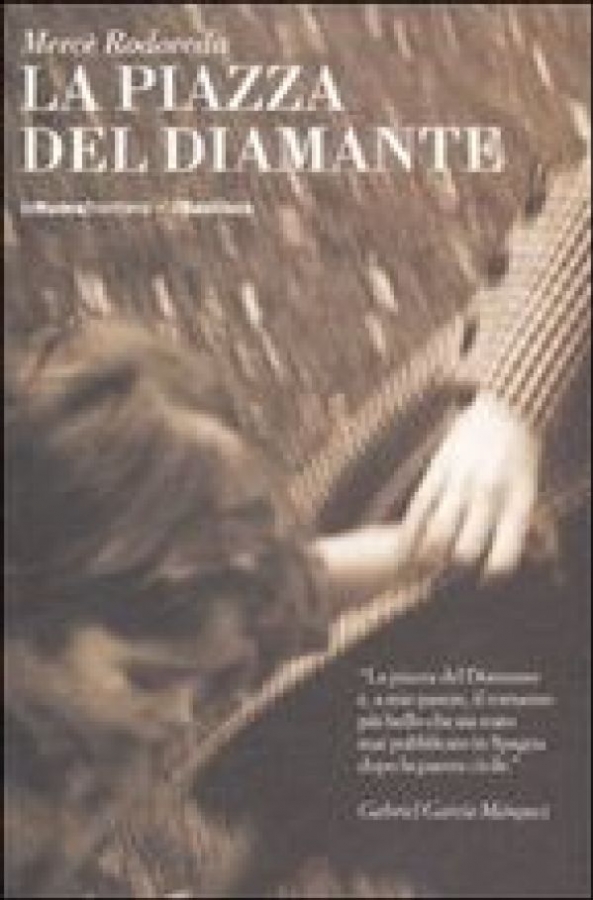
The Diamond Square
Title of the original version reviewed: «La piazza del diamante»
AI Translation Notice: This review was translated from the original Italian using artificial intelligence. Book quotes and excerpts are translated interpretations and will not match the author's original English phrasing or official published translations.
I lived as a cat must live: up and down, tail lowered, tail held high, now it is time to eat, now it is time to sleep; with the difference that a cat does not have to work to live.
At home we lived without words, and the things I carried inside frightened me because I did not know whether they were mine
.
The protagonist, Natalia, known as Colombetta, is the first-person narrator.
She is a young woman working in a pastry shop.
She marries Quinet, a selfish and restless yet charming young man, with whom she has two children.
Quinet works as a restorer, but he begins breeding pigeons in the attic of their home.
Soon the birds overrun the entire house, and Natalia finds herself enduring an increasingly burdensome and exhausting life, caught between caring for her children, working as a maid for an affluent family, and cleaning the house.
Yet it is not the toil that frightens Colombetta; it is the growing sense of living a life that is not her own, but determined by others.
This anguish drives her to commit the sole act of rebellion in her life: getting rid of the pigeons by preventing them from breeding.
Meanwhile, the civil war breaks out.
Quinet leaves to fight with the Republican army, Colombetta loses her job and sinks into deepening destitution, to the point where she can no longer feed her children and resolves to kill them and then herself.
It is the darkest hour of her despair: she feels defeated not merely by the dramatic events of the civil war, but by the crushing weight of her own solitude.
I had to turn myself to cork to keep going, because if instead of being made of cork with a heart of ice I had been, as before, made of flesh, which hurts when pinched, I could never have crossed a bridge so high, so narrow, and so long.
And I walked through the streets, dirty and desolate by day, dark and blue by night, dressed entirely in black and, perched on top, a sort of white smudge, my face growing tinier and tinier
.
She goes to a grocer’s shop to buy acid to kill her children and herself, and at that dramatic moment a turning point occurs in her life: the grocer, aware of Quinet’s death, proposes marriage.
Once again, Natalia accepts as though the decision belonged to someone else.
This new life of comfort for herself and her children does not free her from existential anguish.
One day, in a state suspended between reality and dream, she returns to the old house she once shared with Quinet.
She searches for a hole near the lock, which had been plugged with cork.
I began digging out little pieces of cork with the tip of the knife.
And the cork crumbled and flaked away.
I removed all the cork, and only then did I realize that I could not get in
.Colombetta then goes to Piazza del Diamante, once full of life and now «an empty box made of old houses with the sky for a lid».
And upon her shoulder
perched a satin-ruffed pigeon, unlike any I had ever seen, with lacquered feathers, and I felt a storm wind whirling inside the funnel now almost sealed, and with my arms over my face to shield myself from I knew not what, I let out a hellish scream.
A scream I must have harbored inside for many years, and from my mouth came a tiny sliver of nothing, and that tiny sliver of nothing that had lived so long within me was my youth fleeing with a scream that I could not comprehend...
detachment?
.
The novel unfolds through the perspective of the first-person narrator, Natalia.
This literary device makes the protagonist's detachment—almost that of a bystander—from the events of her own life all the more striking.
Natalia narrates in a painstaking and detailed manner (consider the description of the house where she works as a maid, or the splendid depiction, almost a painting!, of Piazza del Diamante teeming with life), yet it all reads like the field notes of a geographer, of an explorer.
Alongside this seemingly realistic representation of life are Natalia's dreams, largely revolving around birds, pigeons, and the presence of the figures who have dominated her life.
Existential anguish and the sense of emptiness do not manifest in the recounting of real events; rather, they find expression solely within the symbolic realm.
From this vantage point, the episodes involving the pigeons constitute, perhaps, the bridge between realism and symbolism—virtually the physical embodiment of the protagonist's existential dread.
It is a magnificent novel, seemingly simple in style, yet fundamentally built upon sentence structure.
The author has no need for a surplus of words, an excess of adjectives, nor for imposing an intense pace on the narrative: syntax is the very instrument that imparts narrative power to the novel.
Why read it? It is a captivating novel, intricate and demanding to interpret, yet one that confronts a universal theme: the difficulty of living life as protagonists rather than mere spectators.