Sibilla Aleramo
Books by this author (1)
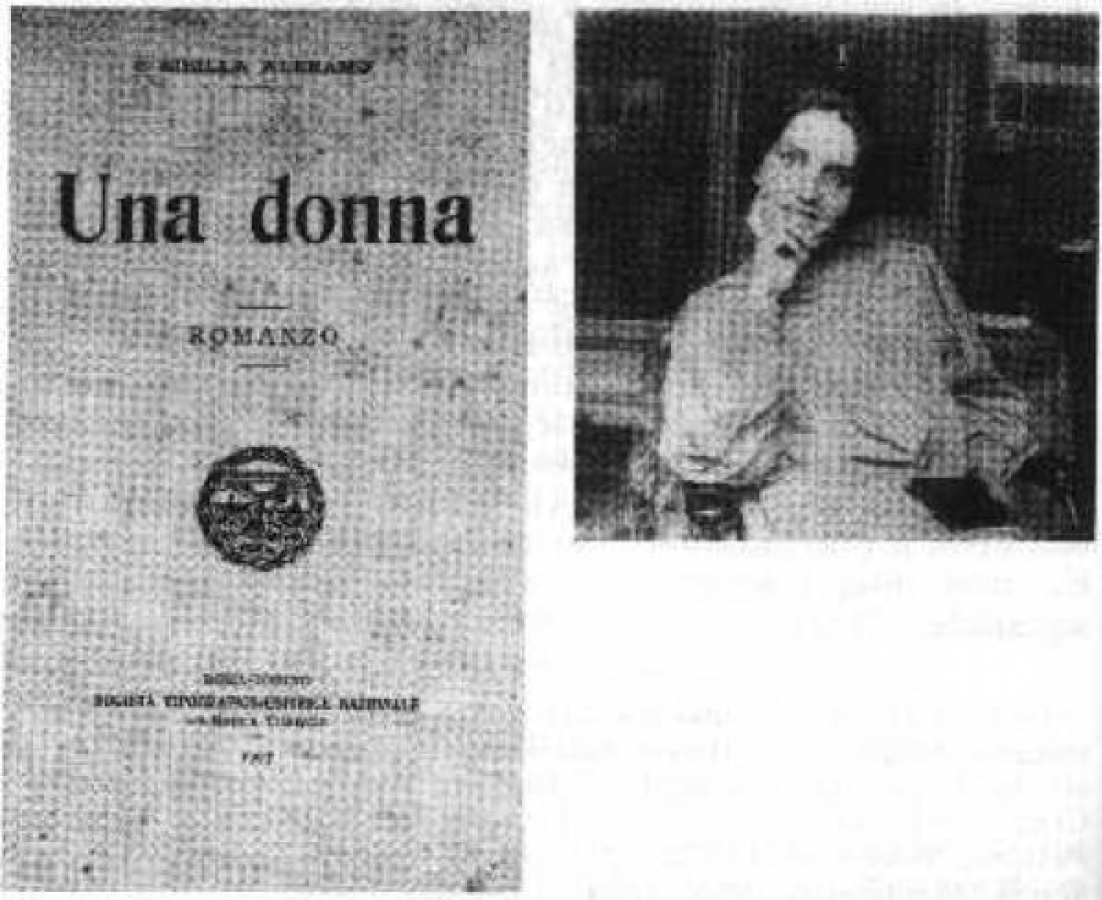
A Woman
The book is autobiographical in nature and historically set in the early twentieth century. The protagonist, still a girl, is raped by a young man whom she later marries and with whom she has a child. She lives with her husband in a small provincial town, where she strives to abide by social conventions that dictate a woman be confined to the home, in total dependence on man. When her husband loses his job, the couple relocates to Rome, where the protagonist begins writing for a literary journal, makes herself known in cultural circles and within the feminist movement, and cultivates a broad network of friendships—among them a singular intellectual with whom she becomes fascinated. The husband himself is attracted to one of his wife's colleagues, and thus traditional social values begin, in a sense, to shatter. The husband, however, finds the opportunity to return to work in the small provincial town, and the protagonist once again finds herself locked within domestic walls, despite having awakened to the ideals of the feminist movement, to her own literary abilities, and, above all, to the fact that she no longer loves—and can no longer endure—her husband. The crisis erupts, turning into a tragedy for the woman, as she knows that should she decide to leave her husband, she will lose her son. Yet she resolves to move to Milan, enduring an agonizing separation from her child. With great discernment, the author titled the book *Una donna*, because, beyond its autobiographical dimensions, it chronicles woman's emancipation and, above all, the spiritual conflicts that engulf her on a path that runs counter to the maternal role. "It struck me as strange," writes the author, recounting a parliamentary debate, > inconceivable that educated people attached so little importance to the social problem of love. Not that men were unconcerned with woman; on the contrary, this seemed to be their principal concern, or nearly so. Poets and novelists continued to rehearse the eternal duet and trio, with sentimental complications and sensual perversions. No one had been able to create a great figure of a woman . And this is the premise of the book: to narrate the realm of male-female relations as seen by woman. In this sense, the novel deals not so much with the social emancipation of woman as with her role within the couple's relationship. Its contemporary relevance lies precisely here: the great social revolution that shattered the nineteenth-century social fabric is woman's autonomy from husband and children, even if this autonomy is subsequently circumscribed by woman's acceptance of male benchmarks in the workplace and, more broadly, in politics. There are four fundamental themes in the novel: the rupture of the dependent relationship with man in order to construct a different relationship with the other. > How can she become a woman, if her relatives surrender her—unaware, weak, incomplete—to a man who does not receive her as his equal; who uses her as a piece of property; who gives her children with whom he leaves her alone, while he fulfills his social duties, so that she may continue to play with trifles as in childhood? and further > between the two phases of female life, between the virgin and the mother, stands a monstrous, unnatural being, created by a bestial male egoism: and she avenges herself, unwittingly. Here is the crisis of the struggle of the sexes. The naive, dreaming virgin finds in her bridegroom a sorrowful heart and withered senses: made a woman and experienced, she understands how her love was forestalled by a brutal initiation. Between the two, the intruder often returns, and the mere memory degrades their kiss ;eroticism, namely the pursuit of pleasure, including physical pleasure, in the relationship with man. > He would enter the dark room, tired or irritated, light the lamp, move about without looking to see if I was asleep. Then, my eyes were shut, and I would feel a heavy mass stretch out beside me; in the silence a few words, meant to express passion, ecstasy; and I was in his power.... This is my life. To be used as a thing of pleasure, to feel my innermost substance bound. And to see days follow nights, one after the other, without end ;the crisis of motherhood as both a bond and a prison for woman’s autonomy, but above all the depiction of the harrowing conflict ignited by two opposing imperatives: love for one’s children and the pursuit of a full and complete life. > Why in motherhood do we worship sacrifice? Whence has this inhuman idea of maternal immolation descended upon us?... It is a monstrous chain... What if, once and for all, the fatal chain were broken, and a mother did not suppress the woman within herself, and a child learned from her life an example of dignity? . the pursuit of truth, which transcends the hypocrisy, ambiguity, and deceit of a society capable of accepting anything so long as it is not spoken or done openly, in the light of day; and all this even at the expense of the relationship with her son, opening a lacerating conflict. > To leave, to leave forever. Never again to relapse into lies. For my son even more than for myself! To suffer everything—his absence, his oblivion—to die, but never to feel disgust at myself, never to lie to the child... This was the dreadful dilemma. If I left, he would be an orphan. If I stayed? A debasing example; he, too, would grow up between crime and madness . I do not know for what reason, after an initial great success, this book was cast aside in Italian literature, accused of aestheticism and sentimentality. Criticisms were even leveled against its excessive fidelity to reality, to the author's actual lived experiences. Pirandello himself believed that the novel should have concluded with the protagonist departing with her son: talk about a happy ending! The novel exhibits lapses in style, at times overly lyrical and emphatic, and in narrative pacing, especially in the section dealing with life in Rome. It is nevertheless a profoundly relevant book, precisely because it brings to light the figure of woman as an individual, in her expectations and her contradictions, demonstrating how the quest for an autonomous female role generates harrowing conflicts of great depth and complexity: in particular, the relationship with motherhood and children. It would do well for this book to be read—indeed, learned by heart—by people like Buttiglione, who presume to accuse women of superficiality and hedonism merely because they seek to claim a fully realized role as individuals.