Finished reading on: July 27, 2025
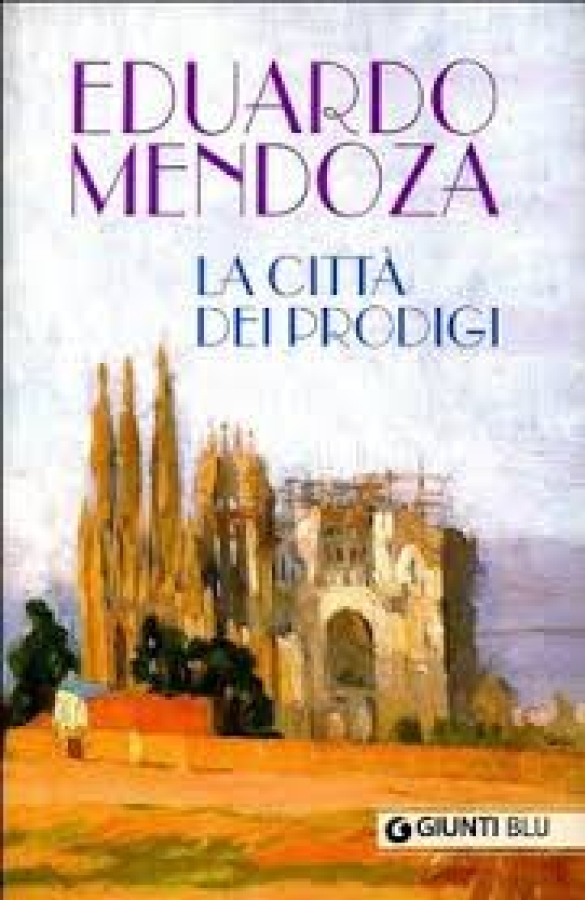
The City of Marvels
Title of the original version reviewed: «La città dei prodigi»
AI Translation Notice: This review was translated from the original Italian using artificial intelligence. Book quotes and excerpts are translated interpretations and will not match the author's original English phrasing or official published translations.
The novel recounts the history of Barcelona between 1888 and 1929: a span of time bounded by two world's fairs, which witnessed the urban and social transformation of the city. Mendoza—a Catalan journalist, though not an advocate of independence—narrates Barcelona’s changes through the eyes of a wretched country boy who comes to Barcelona to work on the construction of the facilities for the 1888 Exposition; a young man who, after a brief period in the service of the labor movement, becomes an unscrupulous and somewhat criminal businessman. This is how the author introduces Onofre Bouvila:
short in stature, with broad shoulders, (...) pale and coarse features, ruffled black hair. His clothes were patched, disheveled, and none too clean. (...) There is something in his gaze that makes one uneasy. Yet, there is nothing to fear,
another little sardine that the whale (Barcelona) will swallow without even noticing. It will not be so. Onofre will rise rapidly through the ranks of the anarchist union thanks to his dedication and leadership qualities. He could continue his political activism, likely ending up in prison, certainly remaining poor and exploited. Instead, without apparent regret, he becomes the bodyguard of a speculator who uses Onofre as an unscrupulous enforcer, useful in a city swept up in real estate speculation, corruption, and graft, with a burgeoning bourgeoisie ready to do anything to enrich itself. Like a sort of Catalan Mastro-don Gesualdo (see the review of Verga's novel on this site), Onofre climbs the social ladder, cultivates the right connections with the high bourgeoisie, marries a scion of a prominent Barcelona family, and becomes a powerful, immensely wealthy man, devoid of moral qualms, ever determined on his path to success. What drives him? One day, early in his social ascent, he visits a fortune-teller to learn his future. The cards' answer is vague, as always; but the woman sees that neither happiness nor wealth is in store for him: what Onofre pursues is revenge. His father, a businessman, a braggart and a bungler, was humiliated in life; Onofre wants to redeem him by proving that the son will not only become rich and powerful, but will bring to its knees the very bourgeoisie that had so despised and cast out his father. Is he like The Count of Monte Cristo or a banal representative of the corrupt system that shaped Barcelona? We will never know; the author does not delve into Onofre’s soul, a character who remains forever in the foggy shadows of a tumultuous city, the true protagonist: in effect, Barcelona has devoured the sardine, even though Onofre believes he commands it. And perhaps, precisely to desperately assert his supremacy, for the 1929 Exposition Onofre commissions the construction of a helicopter—a prodigious contrivance at the time—and in this craft disappears into the sky before a stunned crowd and under the incredulous gaze of Alfonso XIII and the dictator De Rivera. Is it an escape? Has he ascended to Heaven? Or did the helicopter simply explode, killing Onofre? The author does not say, leaving it to us to find the ending to an extraordinary life. What is certain is that by the end of 1929 De Rivera would be forced to resign, and the following year Alfonso XIII would abandon the throne, ushering in the Republic. An era has ended for Spain and Barcelona; another history begins.
As often happens with modern novels, the book is lengthy and rambling. The finest section is the first, in which the author recounts Onofre’s arrival in Barcelona, his living conditions, the squalor, the toil, and the odd characters who frequent the boarding house where the boy finds lodging. Particularly intriguing is the figure of Dolfina, a comrade in struggle, always accompanied by a wild, aggressive black cat; a girl who becomes the naive Onofre's first love, in courting whom he already exhibits that cynicism and determination that will accompany him throughout his life: he kills the black cat, eliminating it because it is an obstacle, just as he will dispose of anyone who stands in the way of his goals, irrespective of emotional ties. In the atmospheric construction one senses Charles Dickens (see the reviews of David Copperfield and Oliver Twist on this site), even if Mendoza treats it all with an ironic and detached touch, free of moralizing. It is a pity that this narrative style dissolves over the course of the novel, along with the ability to construct characters—who grow increasingly banal—forfeiting the historical-sociological approach that had so sharply delineated the opening section. Why is Barcelona the city of marvels? Certainly not for its corrupt system, of which Onofre is merely an exponent; Barcelona is an astonishing city because it has continually reinvented itself in an endless process of creative destruction, fighting, however quixotically, against Madrid and circumstances that were often hostile to it. Mendoza seems to suggest that the total annihilation of the city in the early eighteenth century, at the end of the War of the Spanish Succession, wiped the slate clean and helped foster a future-oriented cultural and social climate, ever poised to overhaul the city from an urban, architectural, and economic standpoint.
Why read it? It is historically interesting, but too long.