Finished reading on: November 18, 2010
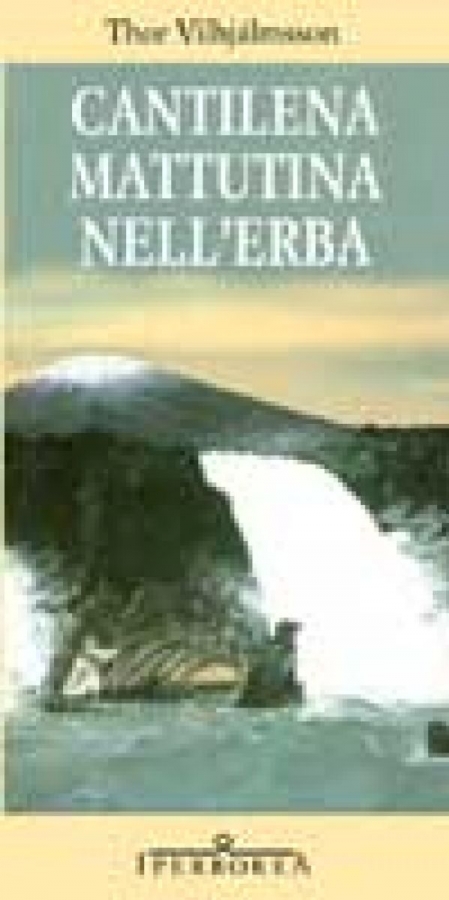
Morning chant in the grass
Title of the original version reviewed: «Cantilena mattutina nell'erba»
AI Translation Notice: This review was translated from the original Italian using artificial intelligence. Book quotes and excerpts are translated interpretations and will not match the author's original English phrasing or official published translations.
The whole world was full of enchantments brewing in the sprawling mist.
The blocks of lava turned into fortresses, the rock peaks into towers....
the mist hovered over the valleys, transforming them into boiling cauldrons, cauldrons of the Norns, and glided over the lava, over sacred places, over distant heights invisible from the beaten horse trails.
And the mist pours in.
Where do you come from? What are you waiting for? Do you have something ahead of you?, something behind? Or is it just this, just your life, here and now, which is to say nowhere? How, why, you?
An unreal atmosphere and existential anguish run through the entire novel.
We are in the Middle Ages, in mythical Iceland; Sturla is a historical figure who pursues the ambitious design of unifying the whole island.
In the first part of the book—the most evocative, perhaps because it is set amidst the mysterious nature of an island cold and warm at the same time—the easy friendship of youth turns into betrayals, killings, and violence that mark the relentless clan warfare.
The opening storm scene is magnificent, where solidarity allows the group of youths to survive: yet it is a bond that can endure only in dreams, within an enchanted castle from which one must emerge to meet one's destiny:
then he was overcome by such a torpor that it was impossible for him to stay awake.
And it was as if the halls within were closing themselves into the mountain.
It seemed to him that he started awake, and that the landscape vanished into the mist.
Then he woke.
And never again did he find that castle and its dwellers
.
The inter-clan feud drives Sturla to commit crimes, even against the Church.
In the second part of the novel, Sturla goes on a pilgrimage to Rome to seek absolution: a journey across a medieval Europe torn apart by violence, through a bleak, somber landscape.
Remorse haunts Sturla, manifesting in nocturnal nightmares, in terrifying visions of butchered bodies.
Great must be his surprise when what greets him is not a holy city, but a picturesque and corrupt Rome, which absolves him in a surreal, Dionysian, Felliniesque scene, amidst masked figures more befitting an orgiastic revel than a ceremony of expiation.
On his return from Rome, Sturla stops in Paris to master the arts of black magic, thereby gaining another means to conquer Iceland.
The third part of the novel is an epilogue.
Sturla embarks on new battles and commits further atrocities: but he is no longer sure of himself; his weakness will ruin him and lead to his death.
He is now a two-faced man, like a legendary figure of whom it was said that
on one side his face was ugly and frightening, and so too was his body, while on the other it was as fair and handsome as one could ever desire
.
The strength and weakness of the novel lie in its fragmentation: a sequence of scenes, formed by an accumulation of episodes and dreams, the character's thoughts, sustained by an evocative prose that in some respects verges on poetry.
Although deeply rooted in the Icelandic setting, from which it draws its fascination and inspiration, what truly emerges is the drama of a man moving toward modernity, unable to let himself be confined, or curtailed, by the rules of medieval society.
In his doubts and internal conflict, Sturla is truly a two-faced character: the past, and his social role, which demands he be a warrior and clan chieftain; and the awareness of existential futility, of becoming.
In the titular chapter, the metaphysical description of the morning crystallizes this suspension and illuminates the allure of the writing.
It is morning.
All was still as the sun climbed the mountain ridge, first flooding the pass with light, then hastening to embrace rock faces and crags.
It softened boulders and jagged stones, whitening some, gilding others, blunting the harshness of peaks and cliffs.
The wind was so faint that the blades of grass stood motionless, mirrored straight and stiff in the small stream, waiting.
For what?.
For the time to come, once again.
And the flowers exulted when the sun embraced them so gently that not a calyx nor a petal stirred.
Neither joy nor sorrow held sway; they were one and the same.
They were one and the same, it made no difference.
Yet if it was sorrow, it was so mild in that newborn glow, in that golden resurrection, that it was not grief; if, instead, it was joy, it was not happiness.
But time lay in wait, with the transience inherent to all things within the eternity of the whole, when everything tends to return to the earth, to crumble and dissolve into primordial matter in search of new, unknown forms
.
Why not read it? The evocativeness of the vignettes, the depth of the concepts, and the beauty of the natural descriptions fail to compensate for the narrative's fragmentation and the frequent incomprehensibility of its content and sequence of events.