Finished reading on: May 31, 2024
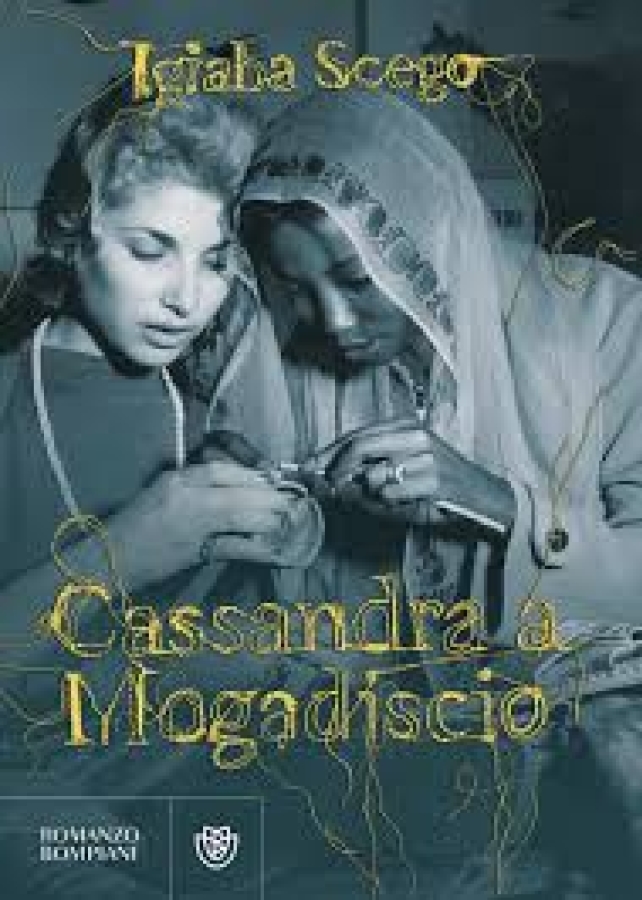
Cassandra in Mogadishu
Title of the original version reviewed: «Cassandra a Mogadiscio»
AI Translation Notice: This review was translated from the original Italian using artificial intelligence. Book quotes and excerpts are translated interpretations and will not match the author's original English phrasing or official published translations.
In Somali, jirro means "illness"—literally so. (...) But for us, jirro is a vaster word. It speaks of our wounds, our pain, our post-traumatic, post-war stress. Jirro is our broken heart. Our life in precarious balance between hell and the present. This book speaks of this illness, both physical and spiritual, searing and nostalgic; and it does so through an autobiographical lens, constructed
in constant motion. The past is never still; it follows our transformations
, as Scego writes in her afterword. The author imagines a dialogue with her niece living in London, and the plot is punctuated by Somali keywords, which, beginning with Jirro, progress through a series of stages encompassing personal, familial, and collective history: events, relationships, physicality, memories, prophecy. There are two pivotal events: 1971, when her parents fled Somalia following Siad Barre's coup d'état, and 1991, when Somalia collapsed into the chaos of gang warfare.
"No road will lead us back home, my daughter," she (Halima, Scego's mother) says, with a harshness I had never heard in her before.
The roads have been cut off. The houses have caved in on themselves. We have become beasts. And Mogadishu has been buried by its own inhabitants beneath an endless heap of corpses
. Somalia at war, yet ever-present in the heart, tears at the relationship between mother and Igiaba. One day in 1989, her mother crosses Rome for a prospective job as a domestic worker, only to be rejected because she is Black.
She screams in the silence. (...) And with that voiceless scream, with that timeless humiliation, the Mogadishu skyline creeps into a mind flooded with nostalgia. Arriving there, at the center of her sighs, to comfort her. She returns to Somalia; she vanishes for two years without word, swallowed up by the civil war. For Igiaba, still an adolescent, this abandonment has a devastating impact: she begins to suffer from bulimia nervosa.
Dagalka wabu dilai je'eelka. War kills love. (...) I vomit the war. Until every dream inside me is erased. Until every self inside me is erased. Like those relatives of my mother lost in the haze of their discontent. And in the Jirro that gave them no respite. Upon her return, Halima begins to speak to her daughter,
woman to woman. If before she had told her of her childhood, in the countryside herding sheep, she now recounts her real life.
The trauma of having lost the homeland—she her country of birth, I my country of origin—united us in mourning. (...) She wanted, on an unconscious level, (...) to pass her life on to me. Because it was no longer just a family story. Halima recalls how she was infibulated, and naturally
she spoke of Dad. She constructed his legend. (...) She, a switchboard operator, and he, a remarkably handsome man, the mayor of a city that smelled of spices. Then, wrapped in her white robe, every now and then (...) she sought me out with her gaze. And in that locking of eyes, I the daughter, she the mother, we thought of the refugee. Of the exile we had traversed together. That eye condition haunting Igiaba today, as she approaches menopause, having neither children nor a husband—does all of this stem, perhaps, from having somatized the rupture of her life, she an Italian in love with Rome, she the daughter of a ruined Somalia? Could the tragedy of colonized peoples, shattered and consigned to oblivion, the sufferings of the world's migrants, the wars, the massacres, the women and children raped and slaughtered—could all of this be a portent of a fate that awaits us too, the wealthy, comforted by our fine laws and air conditioning? A friend suggested Igiaba read Euripides' The Trojan Women. At its core is Cassandra, who says:
I hold aloft the torch, I celebrate, I flood the temple with light—behold—with this lamp of mine. Like Cassandra, we too (a torn humanity) carry the torch. (...) Bearing it is our burden.
Scego's novels share a common thread: the intertwining of personal stories and overarching history, and the premise that one can only discover oneself, and others, through the unraveling of this entanglement within one's own consciousness. It is therefore indispensable for the author to craft complex narratives with numerous parallel plotlines in a strongly political, rather than psychological, context. In Oltre Babilonia (2008), the point of synthesis is language, set in that Arabic school where people of diverse backgrounds study this "Esperanto"; in "Adua
of 2015, the author speaks of a betrayal, of a beloved Italy that casts out the migrant, and finally, in that blend of reality and imagination that is
Una linea di colore
of 2020, two women who actually lived are synthesized into an invented character who bears the wounds of emigration and slavery (see the reviews of these books on this site). In
Cassandra a Mogadiscio", Scego shifts perspective; more than ever, she speaks of herself, confessing her own physical and psychological fragilities. The brilliant and personable writer, encountered at so many Internazionale festivals, reveals herself to be a tragic figure, evoking and internalizing existential and planetary grief: a contemporary Ungaretti. Is she speaking of Somalia? No, she is speaking of her beloved country, Italy, on the brink of fracturing; of her Rome, at the mercy of verbal and physical violence; of her cherished language, Italian, which now seems destined to regress into its ancient local dialects. In short, by narrating her family and her country of origin, Scego reflects upon herself as an Italian. Where is the Promised Land? Or was Ungaretti's merely a desperate utopia?
Scego's strength remains her writing; even in simple, immediate Italian, the author evokes sensations that leave a mark on the reader: they are often short, unexpected sentences, not always woven into the narrative thread, as if Scego allowed herself to be carried away by emotion rather than plot. The latter is a weakness; the narrative's richness is not effectively distilled into a synthesis easily traceable by the reader. Contributing to this narrative confusion are the literary devices the author seems so fond of; here, it is the dialogues with her niece and the structuring of chapters around keywords, which often fail to encapsulate the chapters' actual contents. Moreover, in digging as never before into her innermost self and foundational relationships—particularly with her mother—the lack of psychological depth becomes apparent. Scego's works, like those of many non-Western writers, are choral stories, introjections of universal suffering rather than introspections into personal sentiment.
Why read it? One discovers an unfamiliar Scego; the reading, however, is demanding.