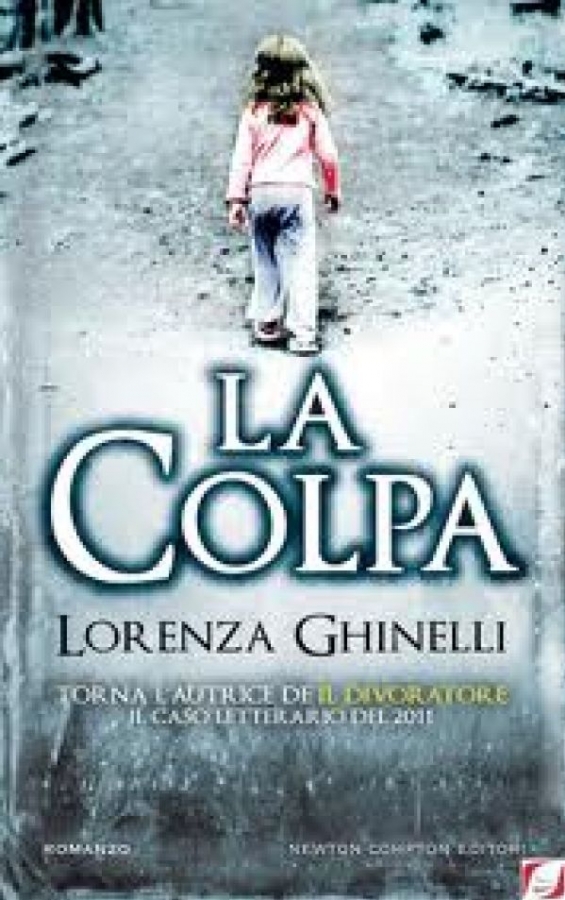
Finished reading on: December 24, 2013
Guilt
Title of the original version reviewed: «La colpa»
AI Translation Notice: This review was translated from the original Italian using artificial intelligence. Book quotes and excerpts are translated interpretations and will not match the author's original English phrasing or official published translations.
Is it possible to escape anguish merely by rummaging through one's own mind, pursuing a
lucid madness of constructing possibilities that are terrible because they are plausible, plausible because possible, possible because thought, thought because present somewhere, in the mind...
(like) a Prometheus naked, flushed, dripping, bound by imagination with steel ties to the highest, most exposed peak overhanging the abyss
? Or is an event necessary—even a traumatic, violent one—that forces one out of their nightmares, to rediscover friendship, to reinvent “tenderness and assaults” from “drapes and gutted mattresses”? This novel recounts a rebirth into a new life.
In a Marecchia described as a wild land, a “black and barren wasteland,” Estefan is an adrift, disoriented nineteen-year-old, like so many young people.
He carries a deep sense of guilt.
When he was still a child, his little brother died beside him during the night, without him noticing.
Could he have saved him? Or was it he who killed him? From that moment on, Estefan became the
shittiest son, cat in the headlights, punchbag for boxers...
better not to exist, sometimes, for others.
Better, sometimes, not to exist at all
.
And ever since, a nightmare has haunted him: he imagines standing at the edge of a pit whose depth reveals no distinct contours and whose colors he cannot grasp, yet he glimpses “children, swings, slide, shrieks, tears” and, above all,
Cardboard-cutout killer Mom...
Terrifying Mom, Mom with artery-colored lips, so very thin.
Thin enough to cut.
She is dressed in torn black poppies..
(and) she laughs, and it is an ugly laugh, a laugh that seems hauled up by powerful hooks that could tear Mom's whole face to shreds
.
One could easily, and superficially, say that Estefan needs the affection of his parents, and especially of his mother.
Yet reality is not so simple, for the loss of the little brother shattered a once-peaceful family, destroyed their relationships, and burdened Estefan with the guilt of having survived.
The narrative recounts Estefan’s disordered, aimless life amidst car races, joints and alcohol, nightclubs, constantly away from home and defiant toward school, locked in a perpetual, muted conflict with the adult world.
There is, however, a deep friendship—the one with Martino, another troubled youth, who alternates between apparent docility and sudden outbursts of violence.
He too carries a wound from childhood: he was raped by his uncle as a young boy (honestly, a useless redundancy for narrative purposes).
One evening, wandering through the “wild” Marecchia, Estefan stumbles upon the isolated farmhouse of an old farmer who lives with his granddaughter, a girl orphaned since birth.
Her mother was an addict who died giving birth to her.
Estefan’s tribulations among the farm animals and his encounter with the little girl are among the story’s most successful passages.
Yet the author fails to break free from her indulgence in introspective, hallucinatory references, falling once more into the trap of disturbing imagery without surrendering to the sweetness of the fable.
The dung, the hay, the farmyard animals, the equipment become, for both protagonist and author, a
non-place.
A place of thought where time is smashed to pieces.
There’s the fossil combine harvester, the hay and the spiders, the chicken, and who knows what else.
Microbes and bacteria raining down, cobwebs of embarrassing perfection, and a delirium of light play to be savored in silence.
Here past and present interpenetrate...
(but) the future is fucked
.
The story is, however, more tenacious than the penchant for self-destructive delirium.
An affectionate and singular friendship develops between Estefan and the child: a bond that endures even when guilt resurfaces.
Indeed, through a series of coincidences, the girl’s grandfather, having gone out into the night to search for her, kills himself with a gunshot.
Estefan flees in desperation after making sure the girl is in good hands.
During his flight, he suffers a very serious accident.
We find him in the hospital, alone and with “pain occupying his mind,” but Martino and the little girl are there waiting for him.
The boy (Martino) takes his fingers in his own.
Estefan opens his eyes, focuses.
And it doesn’t seem real to him; for the first time, he does not miss the white
.
In the acknowledgments, the author observes how
writing this book meant giving meaning to many events for me; it was a painful and magnificent process
.
Undoubtedly, this internal journey came at the expense of overall lucidity, the plot, and character development.
The reader appreciates the narrative premise and the contours—however sketchy—of the characters and setting, but cannot help lamenting the lost opportunity, what the novel could have been had the author refrained from chasing the nightmares and deliria of the mind.
The writing is redundant with adjectives and imagery, almost baroque and often cryptic.
It needs to be rewritten.
Why not read it? Chasing the abysses of the mind is, in the end, boring.