Emilio Salgari
Books by this author (21)


The Heroine of Port Arthur
Emilio Salgari was exceptionally swift at fashioning stories around events that gripped the public imagination; he did so by blending a certain exoticism with wars and romantic intrigues. Such had been the case with *La capitana del Yucatan* and *Le Stragi delle Filippine* (see the reviews on this site), and so it is in this novel, published under a pseudonym in 1904. The backdrop is the Russo-Japanese War of 1904–1905, in which > "little Japan," as the Russians contemptuously called it, confronted and defeated the vast Russian Empire. The setting is Port Arthur, the gateway to the conquest of Korea and at the time in Russian hands. The narrative opens with a scene of simultaneous splendor and decay: a *daimyo* (that is, a feudal lord) passes through the crowd alongside his stunning daughter, Shima. > She was barely sixteen, (...) not tall, exquisitely proportioned, with deep black eyes that bore no trace of slant, (...) skin with alabaster hues, (...) with a lovely little mouth, its somewhat thin lips hinting at an extraordinary resolve. A lavish reception is set to take place at the daimyo’s residence to celebrate Shima's betrothal to Boris, a Russian officer. The prospective groom fails to appear: he is having an affair with a geisha and knows that war with Japan is imminent, rendering marriage to a Japanese woman impossible. The city is steeped in an atmosphere of tense anticipation, which allows the two women to face one another: Shima, > with blazing eyes and an inflamed countenance, demands to know whether the geisha truly loves Boris; the other implores her to let her keep her love, > why wrest from me, a poor geisha, the love of a single man—the only one who has ever truly loved me, and whom I love? I am a wretched flower cast to the mercy of the wind, destined to wither unless someone gathers me and exposes me to the dew and the sun. Never in his numerous novels had Salgari chronicled a conflict of such passion and social resonance, pitting a beautiful, wealthy aristocrat against a destitute prostitute in love. In a writer so attuned to public sentiment, one detects echoes of Gabriele D'Annunzio, Guido Gozzano, Gian Pietro Lucini, and French *poètes maudits* such as Paul Verlaine and Charles Baudelaire. Regrettably, this social and romantic conflict fails to evolve, cut short by the outbreak of war; upon both women falls a single, overriding duty: to serve the homeland, Japan. > The homeland!, exclaimed the geisha, in a sudden burst of fervor, (...) The danger facing our homeland in this solemn hour unites the common people and the nobility for the supreme defense of the country, bridging the abysses that divide them, Shima said in a solemn voice. She drew her into her arms and kissed her on the forehead, saying: for the homeland! And we are no longer in distant Port Arthur; it is as if we were commemorating the martyrs of Dogali and Adwa, the heroes who defended the Nation against the fierce Ethiopians! Salgari extols a nationalist, colonialist, and irredentist Italy, which would march exultantly into Libya and later to liberate Trento and Trieste in the catastrophic slaughter of the First World War. "Little" Japan becomes the mirror of modern Italy: its war dead the future martyrs, the two women the archetypes of all the mothers, wives, and daughters who will sacrifice their personal affections for the Motherland. A keen reader of war correspondence, Salgari displays a remarkable grasp of the dynamics of the naval clash unfolding at Port Arthur, where the formidable Japanese fleet, deftly commanded and equipped, pinned the Russian vessels inside the harbor before closing the city in a pincer movement from sea and land. Yet it is precisely the sheer scale and protracted duration of the battle that make it difficult for Salgari to provide overall clarity and highlight the dramatic turns of events. The author operates far better when only a few ships clash, making it easy to focus the reader’s gaze on the pivotal locations of the action. In the same vein, Salgari abandons his customary narrative blueprint of a central figure supported by secondary characters. Here that role might have belonged to Shima, but the "heroine" is overwhelmed by events, struggling to coexist with the minor figures. And where is the enemy, the traitor Boris? This incomplete and ill-defined system of characters stands as the novel's primary weakness. Why read it? For a fleeting spell, one conjures up the Salgari of *Il Corsaro Nero* (see the review on this site).
The Bloody Pearl
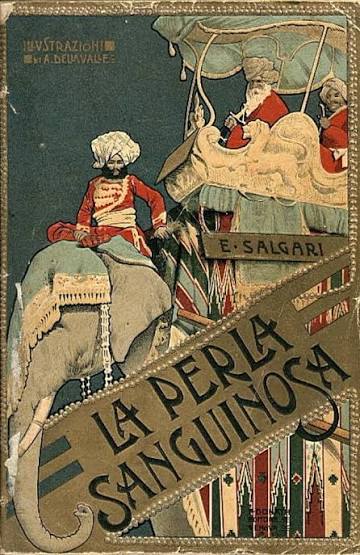
Although he went by the moniker "Captain Salgari," the Veronese writer never actually traveled; for his novels, he relied on the numerous accounts of explorers and geographers who brought back to Europe tales of hitherto unknown worlds—accounts that blended reliable reports with fanciful inventions, steeped in a burgeoning racism. Our author was always deft at promptly seizing upon "the trend," chasing the public’s appetite for strange and exotic novelties. Right from the mysterious and evocative title, one enters the atmosphere: *La perla sanguinosa* (*The Bloody Pearl*) is a pearl of rare beauty, stolen from a sacred temple in Ceylon (modern-day Sri Lanka) and steeped in the color of the blood of the thief who took it, only to drown later in the great shoal of Manaar, an extensive shallow reef situated between southern India and Ceylon. Behind the pearl lies a love story: a maiden has been forced to become a Buddhist nun and can only be redeemed through the delivery of the bloody pearl; vying for both pearl and maiden are a humble pearl diver and the One-Eyed, a villainous impostor. Both are held in the prison of Port Cornwallis, a British penal colony located in the Andaman archipelago, a group of islands in the center of the Bay of Bengal. It is from this prison that the novel sets forth: three inmates (our diver, an English sailor, and an Indian machinist, all wrongfully imprisoned) manage to escape the colony and head toward Ceylon in a fragile boat to recover the bloody pearl and redeem the beloved maiden. Not only are they pursued by the One-Eyed, but they must also confront a series of ordeals: from the assault of a sea vampire—perhaps a "lamprey," a fish with a sucker mouth that feeds on blood—to a terrible storm with gigantic waves, culminating in their capture by the Queen of Nicobar, who wishes to take the handsome Englishman as her husband, much like Circe with Odysseus. Salgari’s imagination knows no bounds, conjuring up the Vadassi, whose valiant chieftain Adikar—fascinated by Napoleon—sought to emulate his deeds and lead his people to triumph, a sort of feral Sandokan; and what of the "crucified dolphins," in reality a small cetacean that inhabits Antarctic waters, far removed from the Bay of Bengal. To this muddled wealth of geographical, zoological, and anthropological references corresponds an equally muddled plot, packed with adventures that are all too often repetitive and prolix. Salgari’s narrative formula hinges on a central protagonist flanked by supporting characters who leaven the narration and throw the hero into sharp relief. When he departed from this model successfully, as in *Capitan Tempesta* and *La stella dell'Araucania* (see the reviews on this site), it was because he proved capable of constructing a compelling, intense love story. The setting, while ever-present, always remained in the background, instrumental in evoking an exotic and mysterious atmosphere. Here, the narrative functions are inverted: setting takes center stage; the band of fleeing prisoners is flat, devoid of a true leader (the Englishman predictably emerges, yet remains a faded figure), and lacks any clear hierarchy of roles; the love story remains suspended and remote, and the villain is easily defeated. Layering adventure upon harrowing description fails to impart rhythm to the narrative or captivate the reader. One finds solace only in a few isolated descriptions, as in the recounting of the struggle with the vampire: > it had wrapped itself around my body with all its tentacles, and the monster’s eyes—those huge, glaucous eyes—were fixed upon me, motionless, as if relishing my torment; and through that nearly transparent body, I watched the transfusion of my own blood flowing from the suckers into its mouth and passing thence into the ventricle. Why read it? As a testament to how the world was viewed in nineteenth-century Italy.

The Alaskan Miners
The true title of *The Miners of Alaska* ought to be *The Great Crossing of the Plains and the Rocky Mountains All the Way to Alaska*; indeed, the search for gold is marginal to the overall story, serving merely as an occasion for Salgari to depict the North American environment as it was related in the nineteenth century. To gain insight into the true history of the American West, and of the United States, I recommend Massimiliano Galanti’s book *La questione indiana* (Odoya, 2016). The formula is classic Salgari. There is the protagonist, Bennie the Great Hunter, described thus: > tall, muscular, with powerful arms, a broad chest, a forceful head covered with long, ringleted black hair that was already beginning to turn grizzled, with piercing eyes and a goatee trimmed to a point . In short, Buffalo Bill! Serving as sidekicks, in keeping with the traditional Salgarian mold, are: a Mexican companion of Bennie's ( > very dark-complexioned, chubby, (...) with pitch-black eyes, the true Hispanic-American type ) and two Italians, survivors of an Indian raid. Falcone has been scalped and miraculously survived; he has an intimate knowledge of the gold-rich mines of Alaska and possesses a crucial instrument for seeking the precious metal: a special sieve that allowed one to separate the gold from the dirt without wading into the water. Armando, Falcone's nephew, has only recently arrived in America, but will prove to be a skilled marksman and an excellent companion to Bennie in hunting and in clashes with the Indians. This group decides to set out for Alaska to capitalize on Falcone's knowledge and his useful implement. The long journey is a succession of adventures: not only escaping treacherous Indians, but also measuring oneself against a wild and mesmerizing nature. The pattern repeats itself with a certain monotony: Bennie and Armando wander away from camp to scout the surrounding area and track down game; they encounter treacherous terrain and must battle terrifying beasts, such as the great brown bear, wolf packs, and stampeding herds of bison. Everything is here: from mysterious dancing plants (tumbleweeds swept along by the wind) to accounts of cannibalism, all the way to the discovery of prehistoric animal remains. It is easy to smile at the travel accounts of nineteenth-century explorers, narratives from which Salgari drew copiously, naturally superimposing his own feverish and inexhaustible imagination. We must allow ourselves to be carried away by a fabulous century, steeped in prejudice and brimming with evocative charm: let us read our beloved author's descriptions of nature with relish. > The moon had set by then, and a dense darkness had fallen across the immense plain. (...) Bennie (...) gazed in all directions, tracking with his eyes the capricious fiery trails of the fireflies, and listening to the monotonous chirping of rejoicing crickets, the distant cries of coyotes, the lowing of cattle . If this reminds us all too much of our own landscape, what can be said of the > meadows formed of tiny mosses of a splendid emerald hue (...) the clearings were covered with expanses of stony, tenacious lichen, resembling dried mushrooms, or tall, pitch-black mosses, soaked with moisture . And from whom did Salgari draw this raw portrayal of the Alaskan miners? > More than human beings, they seemed beasts brutalized by hard labor and privation. They were all ragged, filthy, their shirts blackened by campfire smoke or soiled by mud from the pits, their trousers patched in a thousand ways, their boots worn through and leaving their toes exposed, hats defying description or hoods that had long since lost their fur: yet all wore belts bristling with revolvers and gleaming bowie knives . Were they not armed, they might well be our own miners from Mount Amiata or the mines of Porto Empedocle. What a contrasting attitude Salgari displays toward the redskins compared to the wretched souls prospecting for gold! The former treacherous, cruel, and superstitious; the latter greedy and desperate, yet not devoid of a kind of justice. A child of the nineteenth century, our beloved author could hardly avoid a touch of racism! Within Salgari's vast output, we are dealing with a minor novel, albeit sustained by the brisk pace of its adventures and the pursuit of the marvelous. Plot twists and gear shifts are lacking: the enemies are bound to succumb, pretty much all in the same manner—whether they be Indians, outlaws, or ravenous wolves: a rifle shot, an audacious and unexpected stunt, a prudent and shrewd strategy. Nor is there any dynamic between the characters: Bennie is a hero devoid of passion (did he ever have a sweetheart? did he suffer injustices?), and those who ought to serve as his foils are faded figures, lacking that vibrancy and irony that distinguish so many of Salgari’s minor characters. Why read it? It is packed with adventure; I particularly recommend the chapter recounting the wolf attack.

The Black Corsair
We are in the seventeenth century, the age of pirates, > folk made up mostly of misfits, soldiers, and sailors greedy for plunder , roaming the Caribbean Sea > to lay their hands on the rich mines from which Spain drew rivers of gold . Among these “sea robbers” was also an Italian nobleman, the Count of Ventimiglia, the Black Corsair: > he was dressed entirely in black.... even that man’s appearance held, like his attire, something funereal, with that pale, almost marmoreal face . The story begins with the news of the hanging of the Red Corsair, the Black Corsair’s brother, who met the same fate as the other two brothers, all treacherously murdered at the hands of Duke Wan Guld. The Black Corsair resolves to retrieve his brother’s body to give it a proper burial. The expedition to Maracaibo, where the Red Corsair was hanged, serves as a preamble to the book’s central themes: plot twists, duels, cunning, and heroic deeds, framed by a lush and wondrous nature, with vignettes of a typical colonial town inhabited by Spanish merchants and cavaliers. Men fight and kill, yet there is no hatred between pirates and Spaniards: there is only one true enemy, Duke Wan Guld: the treacherous Fleming. We arrive at a turning point in the novel. Having recovered his brother’s body, the funeral takes place aboard the *Folgore*, the Black Corsair’s ship: > the sea still flared around the ship, murmuring dully.... those swells held strange whispers at that moment. Now they seemed the moans of souls, now hoarse sighs, now faint laments . Before a crew moved yet terrified by the ghosts of the dead brothers, the Black Corsair breaks the funereal silence with a terrible oath: > may my soul be damned for eternity, if I do not slay Wan Guld and exterminate his entire family as he has destroyed mine! . Destiny is sealed: there is no longer room for other choices, for an alternative will. The Black Corsair’s life can follow only the path carved out by this oath. The Black Corsair seeks vengeance, yet instead—and unpredictably—encounters love. The *Folgore* comes across a Spanish ship, captured after a bloody battle, where the pirates take a young woman captive, > a beautiful figure of a maiden, tall, slender, supple, with delicate skin of a faintly rosy white . What a contrast between the lugubrious appearance of the Black Corsair and the fair radiance of the maiden! From the outset, one understands that love has blossomed, but this love carries tragedy in its wake. Salgari leaves us in suspense; he does not immediately reveal who the maiden is, yet it is clear that the Black Corsair knows that > the dead can leave the deep chasms where they rest and rise to the surface to shatter any hopes of happiness. For her part, the young woman senses that the traitor upon whom that “funereal gentleman from overseas” seeks vengeance might well be her father. The reader must wait a little longer. The pirates set out to conquer Maracaibo, and then the Black Corsair pursues Wan Guld through the forests and swamps of Central America. Nature, splendid yet merciless, becomes the novel’s protagonist for numerous pages. The adventurous, exotic Salgari writes here some of his finest pages. Wan Guld manages to flee, but unfortunately a Spaniard reveals to the Black Corsair that the maiden is the daughter of the treacherous Fleming. The Black Corsair does not abide by the maxim observed by the pirates, who never demand that their women account for what they have done in the past, but only for what they will do in the future. For the Black Corsair, the past is locked within his inhuman oath: the maiden is cast adrift in a longboat: "the wind blew hard then, and vivid lightning flashed in the depths of the sky, while the roar of thunder joined the crashing of the waves... as the longboat drifted ever farther away... amid the moans of the wind and the roar of the waves, dull sobs could be heard at intervals... Look up there! (says faithful Carmaux) the Black Corsair is weeping! *The Black Corsair* is Salgari’s masterpiece and, without doubt, one of the finest books in Italian literature, not merely of adventure fiction. Only an elitist critical tradition, such as the Italian one, could fail to grasp the novel’s complexity. It is an adventure book, and something more besides. First and foremost, it is an explosion of fantasy, a relish for the marvelous and the gruesome that only the imagination can achieve. One need only consider the rich, meticulous description of the natural setting, the attention to garments—all embroidered, laden with lace, and overflowing with color—and the gruesome, brutal battle scenes. Fantasy also constitutes an escape from an existential anguish, which lies at the foundation of the Black Corsair’s persona. Life’s vicissitudes bring only grief, affections are a source of suffering, and one must flee a reality that yields neither happiness nor peace. In some way, a demon drags man toward his sorrowful fate, and so it is better, while there is still time, to take refuge in the imagination. Why read it? It is an adventure book, Romantic yet also modern in its message of sorrow and anguish.
The Solitaries of the Ocean
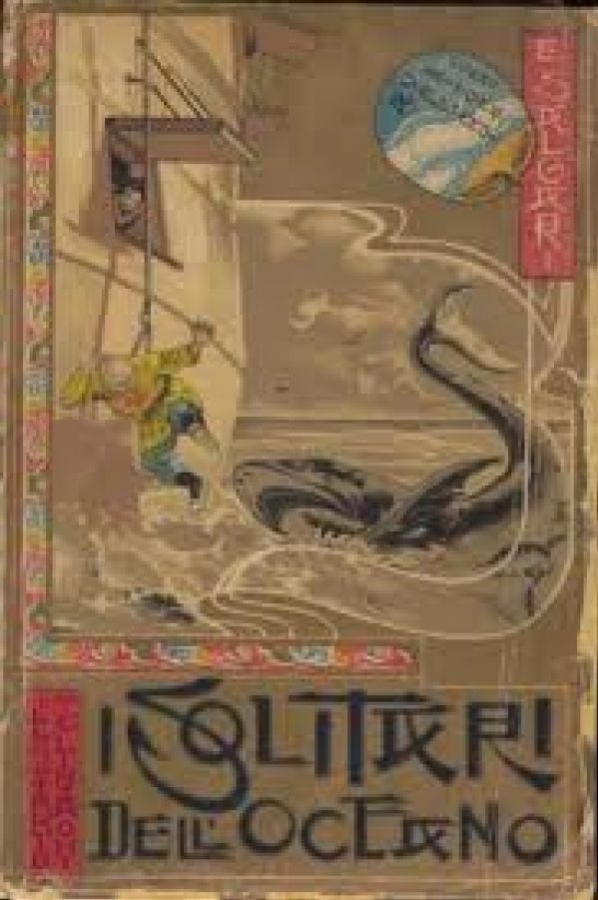
Salgari wrote over eighty novels, and not all of them possess the same literary quality. In this case, two hallmarks of the author’s pen are absent: the pulse of adventure and the exotic, yet often captivating, depiction of the setting. The opening is promising. In the mid-nineteenth century, the slave trade is replaced by the recruitment of Chinese laborers, who supply South America with cheap labor. The transport conditions endured by these poor souls, deluded into believing they would find dignified work, are even more harrowing than the African slave trade. Indeed, since they are not regarded as chattel, the Chinese possess no asset value, and exorbitant profits lead shipowners to accept an appalling mortality rate. The opening chapters could easily be set today, amid the plight of migrants crossing the Mediterranean. Salgari’s indignation is profound at the perfidy, deceit, and senseless cruelty of those who exploit (recruiters, shipowners, sea captains, and large landowners) the misery and aspirations of the world’s dispossessed—in this case, the Chinese. We find ourselves aboard the *Alcione*, a vessel sailing from China to Peru with a cargo of over four hundred Chinese, crammed into the hold, poorly fed, and forced to survive without access to fresh air. Plague breaks out, and Salgari portrays, with grim power, the corpses of the Chinese, snagged with a hook, hoisted from the hold without being touched by the crew, and cast to the ravenous sharks. It is a harbinger of the book's core theme: the cannibals and their craving for white flesh. A mutiny erupts, and the captain, unable to quell it, abandons ship along with his crew, though not before poisoning the provisions. All the Chinese perish, save for their leader, Sao-King, two Peruvians, and an Argentine officer who had opposed the captain’s cruelty. The four men must navigate the *Alcione* alone through fierce storms, seeking refuge on islands inhabited by cannibal populations, only to be captured at last by pirates, who seize the sailing ship. The adventures revolve around two protagonists: Sao-King and Ioao, the younger of the two Peruvians. The two, evidently formidable swimmers, manage to escape the ship while underway and find safety aboard a naval schooner. With the warship’s aid, and through further heroic feats, they vanquish the pirates and rescue their companions. Salgari repeats a literary formula common to all his books: a hero, Sao-King, accompanied by a less experienced and vigorous sidekick, here Ioao. Displaying great courage and remarkable prowess, the two confront numerous, incredible ordeals. These episodes, however, are not woven into a cohesive narrative structure and unfold sluggishly. It is evident that Salgari is weary, drained, incapable of breathing vigor into the scenes, and perfunctory in his depiction of the setting and characters. Moreover, a true antagonist is missing, as the adversaries to be overcome shift constantly: the cruel captain, whose vengeance one would expect to be a guiding thread, disappears for most of the narrative, only to resurface reduced to a skeleton in the launch with which he fled the ship; the anthropophagi (hideous and treacherous) are too primitive to be considered genuine foes; and the pirate chief, who will end his own life, is ruthless yet benign enough to spare our four friends. The theme of cannibalism—already present in other novels, though never so repetitively—casts a lugubrious pall that spoils any relish of the adventure. Yet perhaps this very motif mirrors Salgari’s psychological decline: moving from the depiction of grand heroes, even if tormented like *Il Corsaro Nero* or ambiguous like *Capitan Tempesta*, to a tragic worldview where, confronted with sheer ruthlessness, one can only defend oneself or succumb. Why avoid it? It simply isn’t worth it.

The King of the Sea
The book is structured in two parts. The first part recounts the adventure of Yanes, who sets out to rescue Tremal-Naik and his daughter Darma. The setting is Borneo, rich in strange fauna and an exotic atmosphere. Plot twists follow one after another, yet a certain artificiality and repetitiveness emerge, rendering the reading tedious. This section of the book closes with yet another surprise: the terrible leader of the Thugs had a son, who now seeks to avenge his father’s death and has allied himself with the British to defeat Sandokan. The island of Mompracem has been conquered, and the pirates of Malaysia decide to declare war on England. In the second part, the true protagonist emerges: the cruiser *Re del Mare*, aboard which the Tigers roam, fight, and conquer. Seascapes return—a tempestuous sea and rugged, inaccessible coastlines. And an impossible love story unfolds, between Darma and the son of the terrible Thug. The narrative becomes more intricate, as combat episodes alternate with conversational interludes, gradually forging a kind of friendship between the son of the Terrible Thug and the pirate chieftains. As in *The Black Corsair*, one would expect an unhappy ending; indeed, here matters reach the point where Sandokan and Yanes could well be defeated, killed, or taken prisoner. Sandokan, in particular, is weary; he is no longer the man he once was, far less marmoreal than he appeared in the other novels. Yet in the end comes the plot twist: love triumphs, and out of love, the son of the terrible Thug realizes that vengeance is pointless, not least because by pursuing it he would lose his beloved. The pirate chieftains are freed. Unlike the other books in the Malaysian cycle, here one faces a flagging narrative momentum (so much so that the author leans heavily on his well-worn techniques without any innovation), and even the depiction of the setting (the sea and the jungle) seems marginal to the tale. What does emerge, however, is a theme absent from the other novels: technology, embodied in the cruiser's sheer power and the introduction of an inventor capable of triggering remote explosions. Technology renders Sandokan and Yanes obsolete: their life cycle has ended because the world has changed; it is no coincidence that they are defeated by four cruisers, likewise powerful and swift. Yet technology has its frailties: the *Re del Mare* sails under the constant dread of finding no coal to feed its boilers, and the inventor perishes, struck down by a mere shell. The age of sail fades away, but the new technologies grant the "heroes" far less autonomy and independence.

Adventures Among the Redskins
The novel, published under the pseudonym Guido Landucci, is an adaptation of one of the earliest Western-genre tales, written in 1837: *Nick of the Woods: A Tale of Kentucky* by Robert Montgomery Bird. Perhaps for this reason, the novel exhibits several unique traits compared to Salgari’s typical approach. The author’s traditional formula is as follows: a hero, often defrauded of his wealth and social standing, is flanked by supporting characters whose role is to lighten the protagonist's profile, which is most often rigid and unyielding. At times, the author introduces disconcerting and ambiguous elements: as in *La Stella dell'Araucanìa*, where a nobleman turns cannibal through his contact with savages, corroborating the dark side inherent in each of us, even the civilized. In *Avventure fra le pellirosse*, the paradigm shifts: a secondary character reveals himself to be the protagonist, while the narrative—dense with dialogue, as usual—is interspersed with accounts of gruesome, bloody massacres perpetrated by redskins; an element in stark contrast with Salgari’s naive anti-colonialism, which routinely championed oppressed peoples. Let us turn to the plot. Two young people, Rodolfo and Mary, arrive in Texas in search of gold: they have been stripped of the inheritance of an exceedingly wealthy uncle, whose will was contested by the guardian of a young boy named as heir. From the outset, it is evident that the two youths have no grasp of the perils awaiting them: a vast, desolate prairie that turns into dense thickets near the Pecos River—a river that must be crossed if one hopes to reach the areas rumored to harbor gold. Joining the expedition are other characters worth noting: Telie, a young woman desperate to find her father who was abducted by Indians, and Morton the Bloodthirsty, accompanied by his inseparable little dog. He is a Quaker, regarded as “the most inoffensive man on the plain,” armed with an ancient, “almost” ruined rifle and a knife that “had probably never left its sheath to slay an Indian.” Roaming the plains alongside the savage redskins is Scibellok, believed by the Indians to be an infernal spirit: he kills them by crushing their skulls, leaving a cross carved into their chests as his signature mark. We find ourselves squarely in the territory of the classic English Gothic novel! Rodolfo is a valiant youth, yet utterly incapable of leading the small party; indeed, after various misadventures, the two girls, Mary and Telie, are kidnapped by the Indians. In an attempt to rescue them, Rodolfo is taken prisoner as well. At this juncture, we discover that Telie’s father has become an Indian chief and, worse still, is in the pay of the treacherous guardian: the latter intends to marry Mary and murder Rodolfo, since the genuine will names the two youths as the rightful heirs. Morton, too, is captured. > The Black Vulture is not accustomed to sparing his prisoners. I love slaughter, and I do not disdain drinking the blood of white men. (...) Morton (...) had been seized by a nervous trembling so violent that he could no longer stand on his feet. Whether it was the shock, fatigue, or something else, the trembling had turned into a convulsive seizure . The Black Vulture believes Morton to be a great sorcerer capable of leading him to Scibellok, the exterminator of the redskins. Do you want to know the ending? I will not spoil the surprise; suffice it to say that it all concludes with a happy ending. The novel is a miscellany, effectively blending Salgari’s style—typically rational and mechanistic—with Montgomery Bird’s redundant, brooding Gothicism. Morton is the protagonist, and in his figure pacifism and hatred, communal belonging and isolation, strength and fragility converge: conflicting sentiments that cannot coexist for long, foreshadowing a terrifying and harrowing end. There is also a peculiar sidekick: a little white dog—a novelty for Salgari—the faithful companion of a recluse and an extraordinary guide across the vast prairie. Furthermore, all the ingredients that make Salgari so beloved are present: the relentless succession of adventures, the surprises, the cliffhanger chapter endings heralding further action, the compulsive urge to read on. The Italian author does not linger; he charges straight ahead with his brisk, gripping narrative pace. Why read it? It is not entirely Salgari’s own creation, but it is masterfully adapted and an absolute pleasure to read.
The Sovereign of the Golden Field
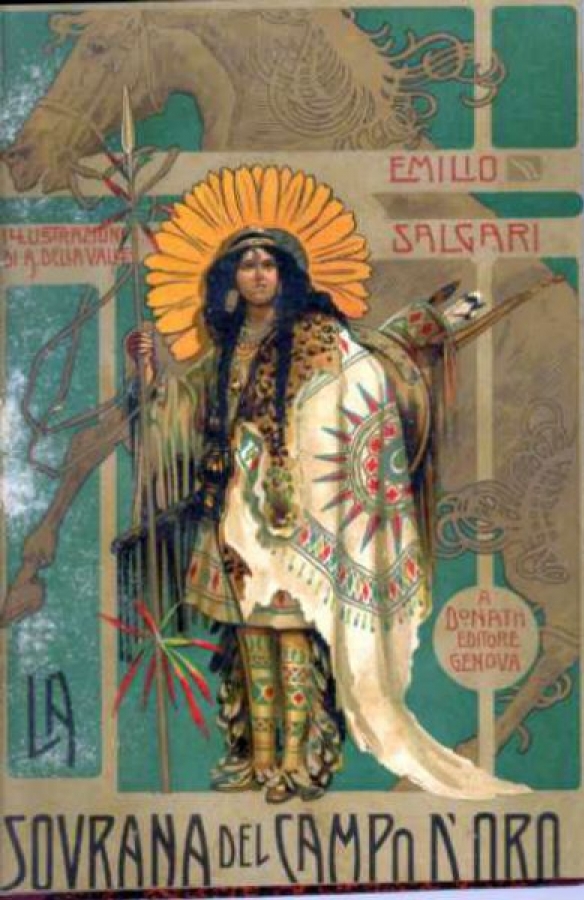
This novel belongs to the Western cycle. Influenced by the figure of Buffalo Bill, Salgari developed a series of stories set against the historical backdrop of the mythical conquest of the West, amidst heroic figures, savage Indians (Apaches and Navajos), and American villains. A young woman (the Sovereign of the Golden Field), whose father has been abducted by bandits demanding a hefty ransom, decides to put herself “up for auction” to raise the sum required to free him. The winner of the auction will take her as his bride. Participating in the auction are a young engineer and a wealthy black man who oversees the crab fishing and trade, controlled by the Chinese; for this reason, he is known as the King of the Crabs. The young engineer lacks the funds to rival the wealthy merchant, yet, with the help of a young clerk, manages to outwit the King of the Crabs, win the auction, and flee into the West with the young woman to rescue her father. Naturally, the villainous merchant sets off in pursuit. Everyone travels by train, the revolutionary conveyance that collapses distances and stands as emblematic of American technological superiority. A sequence of adventures unfolds aboard the train; we witness the passage of an enormous herd of bison; and finally the three youths—the girl, the young engineer, and the clerk—set out on foot through Apache territory to reach the hideout where the father is held captive. Accompanying them are Buffalo Bill and a handful of valiant men. Further adventures ensue, as the wealthy merchant, joined by a band of ruthless Mexicans, remains in hot pursuit. While fleeing the villain, the three youths are captured by the Apaches. We witness a sort of trial convened by the Indian chiefs, in which white society is indicted (this is the novel’s political juncture, where Salgari’s anti-colonialist vision reemerges). The three youths are condemned, but the young engineer and the clerk manage to escape (via a subterranean stream), while the young woman remains a prisoner. The narrative reaches its pivotal moment: a duel between the young American woman and an Indian warrior woman, from which the former emerges victorious. From that point on, the novel slides toward a happy conclusion: Buffalo Bill arrives, the kidnapper's hideout is uncovered—the villain having meanwhile joined forces with the wicked merchant—and ultimately the father is freed and the villains vanquished. The plot is highly intricate, but unlike the novels of the Malaysian cycle and the Caribbean cycle, it lacks narrative tension. First and foremost, the author fails to create that suspense, that sense of anticipation characteristic of the works in the other two cycles: one senses something artificial and contrived, which the plot’s intricacy futilely attempts to replace. Secondly, at the center of the novel stands the figure of a heroine, hardly a novelty for Salgari if one recalls *Jolanda, la figlia del corsaro nero* and *La regina dei Caraibi*. In this instance, however, the heroine is a cold character who remains impassive even in the face of death, betraying no affection toward the enamored young engineer. She is all strength and all courage—perhaps how Salgari imagined the American woman. What constrains the entire novel, perhaps, is an admiration for American society that feels too conventional to lend emotional depth to the characters and their setting. Only the plot remains.

The Queen of the Caribbean
The novel is the continuation of *The Black Corsair*. The pirate is still in pursuit of the hated Duke Wan Gould, and the book unfolds across a series of combats and adventures, interspersed with long, captivating descriptions of the Caribbean forest. The Duke perishes with his ship, and in the end the pirate is reunited with his beloved Honorata, who has become queen of the cannibals. The book displays a highly complex structure and develops across several planes, with the introduction of new characters. At the center of the novel lies the fatalism of the Black Corsair, now convinced that he is condemned to unhappiness and destined to bring grief to others as well. In a conversation with Yara, the young Indian woman who will be killed by the Spaniards, the pirate confesses his conviction of being predestined to bring misfortune to women: > One cannot love the Black Corsair, maiden. I bring misfortune to the women who draw near me. You have seen it! and again, after Yara's death, > I am fatal to all – he said in a somber voice – take care of this maiden, Marchioness . On the other hand, the thirst for vengeance overwhelms the Black Corsair, constituting a destiny from which he cannot escape, even should he wish to. In his conversation with the Marchioness of Bermejo (a splendid new character of Salgari’s), when asked what he would do with the Duke if Honorata were alive, the Black Corsair replies > do you believe, Madame, that the souls of my brothers have been appeased? When the sea turns phosphorescent, the Red Corsair and the Green, the Duke's victims, resurface: they demand vengeance. When the hurricane sweeps in from the East, amidst the howling of the wind, I hear a voice that comes from the shores of Flanders: it is that of my elder brother, treacherously murdered by the Duke, and that voice demands vengeance as well . Even at the moment he meets Honorata, whom he is finally free to love since the Duke is dead, the Black Corsair yearns for death ("Yes, death, oblivion!") and his dark despair is such that he seems to see the dead calling to him ( > Look at them, Honorata, look at them... There is the Green Corsair... there is the Red... there is your father... and my other brother, too, slain on the lands of Flanders... ) and the pirate wishes to join them ("I am coming!... Brothers!... I am coming!"). Only love saves him, and to the Black Corsair's question of whether to choose between life and death, Honorata whispers, "Your love." Alongside this struggle between hatred and love move the secondary characters surrounding the Black Corsair, who are in fact central to the novel: in particular, his companions, Carmaux, Wan Stiller, and Moko, who tend to the Black Corsair with fraternal devotion and lend the novel a sense of brio by tempering its dramatic intensity: an extraordinarily modern device, essential in giving the book rhythm and reading pleasure. Nature, too, emerges as a major protagonist: a lush nature, teeming with fantastic fauna, especially birds and reptiles, which Salgari describes with meticulous precision and a desire to seek distraction and forget the despair that dominates the figure of the Black Corsair. To claim that this is merely an appetite for exoticism is to overlook the contrast between the surrounding setting and the pirate’s emotions: the description of the environment carries the tone of escape and repose. The final theme of the novel consists of combat, particularly naval battles and shipwrecks; the sea is yet another protagonist, and splendid are the pages depicting the clash between the *Folgore* (the beloved *Folgore*!) and the Duke’s ships. The book is flawless, both in terms of its rhythm and with respect to its characters and plot.
The Pirates of Malaysia
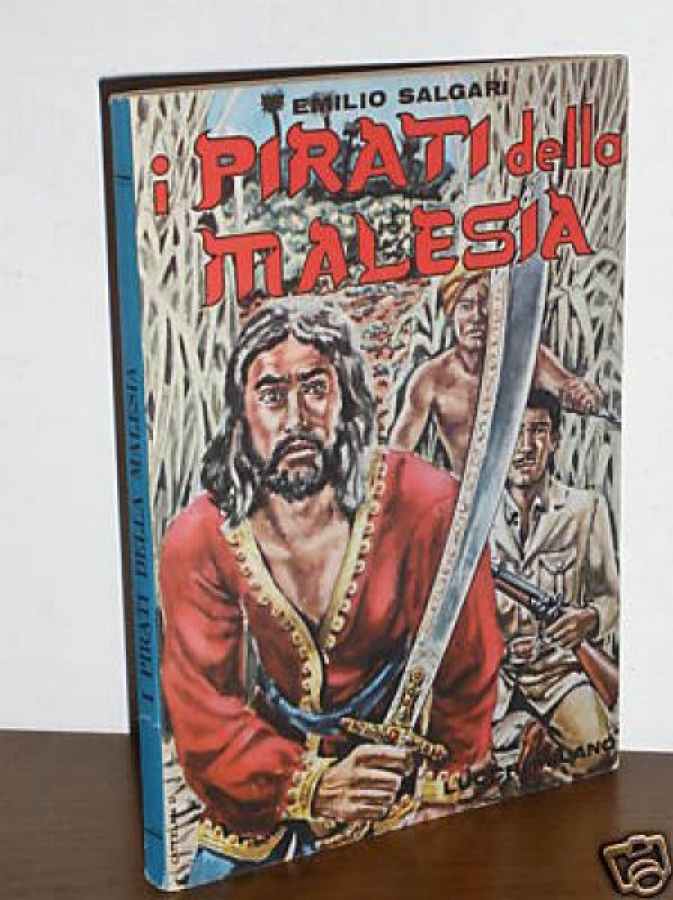
The pirates of Malaysia attack a ship aboard which Kammamuri is traveling with a young girl, mad. Kammamuri’s courage convinces Sandokan to spare his life and help free the girl’s fiancé, who is held prisoner by Rajah James Brooke. A series of intense adventures unfolds, leading to Sandokan’s victory over the Rajah, the liberation of the girl’s fiancé, Tremal-Naik, and the recovery of sanity by the girl herself. The book is characterized by fundamental narrative elements: the setting, the forests of Borneo and the maritime world, described with swift, evocative brushstrokes aimed at crafting an atmosphere that is both fascinating and somber. It is an engaging yet perilous context, far removed from the Western world, concealing not so much a taste for the exotic, but a desire for discovery and an awareness of nature as hostile to man; the heroes, in that all the characters, even the "mad" girl, seem to harbor no doubts and move without hesitation. Loyalty, courage, pride, dignity, and contempt for death are the sentiments that drive and define the novel's characters. In this sense, Salgari expresses a "will to power," a conception of the superman typical of his era. The characters have pre-defined roles: Sandokan, the fearless hero yet capable of weeping at the memory of his lost love; Yanes, the cunning and cold calculator; Kammamuri, the devoted and skilled servant, and so forth. There are no nuances or ambiguities in these figures; the narrative pace is relentless, characterized by rapid dialogues, concise descriptions, continuous moments of suspense, and sudden scene changes, even if it must be said that the final chapters appear rushed to the point that the Rajah's defeat seems scarcely consistent with the intelligence and strength displayed in other chapters by Sandokan's adversary. Magnificent is the chapter describing the revolt of the convicts up to their massacre by the savages. Salgari’s narrative pace anticipates the structure of cinematic screenplays and confirms the modernity of this author, beyond his style—at times elevated and rhetorical, typically nineteenth-century. The modernity and originality of Salgari’s narrative style emerge from two peculiarities: the artificial device of accumulation, whereby, for instance, within a few pages and in a single forest a multitude of fearsome or bizarre animals can converge, which answers > not only to the need to keep the reader in suspense, but also to offer within a limited space the world as spectacle and wonder (*Introduzione a Salgari*, Bruno Traversetti, p. 42); the method of the eternal return (a sort of search for lost time), whereby the heroes have always lost a state of stability (for example, Sandokan was a prince) and tend to return to that state, even distinguishing themselves from ordinary characters (for example, Sandokan is pleased that his wife’s uncle, an English lord, recognizes him as a nephew). The reference is always to a "conventional society" that has been destroyed by an extraordinary event. These devices are widespread in modern adventure cinema, and it is precisely the pursuit of this equilibrium, never fully recovered, that makes Salgari an extremely contemporary author, and from certain viewpoints, an unsettling one.

The Captain of the Yucatan
The novel is set in Cuba during the Spanish-American War of 1898, which led to Spain losing its final colonies. A “yacht,” the *Yucatan*, must run the United States naval blockade to bring weapons and provisions to the Spanish troops, who are in dire straits due to the concurrent advance of the pro-independence rebels and the pressure of the mighty American fleet. It is a small vessel, yet a masterpiece of engineering: its engines allow it to reach twenty-six knots, its steel hull is divided into several watertight compartments and fitted with a protective belt made of coconut fibers, rendering it unsinkable. And a marvel of technology! The “yacht” can submerge itself, leaving only its deck visible, so as to appear as a piece of drifting wreckage. Salgari too was dazzled by the wonders of technology, or perhaps sought in this way to emulate the allure of Jules Verne’s *Nautilus*, his direct rival. In command of the *Yucatan* is the Marchioness de Castillo. The Capitana > had a handsome head, crowned with an abundant mane of hair, of a deep, sombre black and wavy like that of Spanish gypsies, (...) she had skin of that lusterless pallor, of a strange hue found only among the Creoles of the Greater Antilles, (...) eyes of a consummate black, (...) long, silky eyelashes, (...) lips as red as a pomegranate. After such a description, we would have expected an enthralling tale like that of *Yolanda, the Daughter of the Black Corsair* or an ambiguous and mysterious one like the story of *Capitan Tempesta* (see reviews on this site); instead, the Marchioness de Castillo remains on the margins, emerging only fitfully and in a supporting role, while the true protagonist is Lieutenant Cordoba, > a sea dog (...) rather short in stature, all sinew and muscle, with an angular face bronzed by the sun of the torrid zone and the brine of the sea air. It is he who leads the *Yucatan* and its crew through a succession of adventures, at sea and on land. In one of these exploits, Cordoba, aboard a small launch, releases torpedoes against a gunboat, blowing it up and clearing the way for the small vessel; in another, the *Yucatan* conceals itself in a sea cave; in yet another, it skillfully slips away amidst a multitude of reefs and shoals. We are on the southeastern coast of Cuba, facing Mexico, riddled with islets and fjord-like sea channels, rich in a luxuriant nature that is consistently depicted in sombre tones, as if to foreshadow the sorrowful conclusion. The sea is inhabited by > splendid jellyfish resembling large lamps of frosted glass, of an exceedingly pale hue ; the flamingos take on a fantastical appearance, with their tails > covered in feathers of a splendid carmine pink, which along the wings turns into a magnificent coral red or fiery red ; in the forests, giant mango trees predominate, with > immense lianas climbing up and down the trunks in a thousand contortions or clinging to an infinity of parasitic plants that formed dense festoons ; and > the air is so heavy with moisture that it corrupts everything , everything spoils, turns moldy, decomposes; over all hangs the terrible yellow fever. Amidst these noxious miasmas, the *Yucatan* runs its final course. The power of the United States is overwhelming! The marvelous vessel cannot be surrendered to the American imperialists; far better to scuttle it with dynamite. > The Marchioness cast a tearful glance upon the smoldering hulk, half-submerged between the water and the sand, and murmured with a sigh: “Our mission is ended!” To a greater extent than in other novels, Salgari the popularizer comes to the fore. Interweaving landscapes familiar to him with the accounts of travelers and geographers (who, in the second half of the nineteenth century, were also possessed of vivid imaginations), the writer depicts the sea and coasts in meticulous fashion, rich in naturalistic and nautical detail. He adopts the same approach in recounting the Siege of Santiago, enumerating American warships and illustrating the various engagements. On one side stand the valorous yet ill-fated Spaniards, and on the other the treacherous Americans, > the financiers' syndicate , the cowardly blacks ( > huge, clumsy hats, gigantic feathers, (...) a frantic trembling) , and the Creoles who lack courage—perhaps, Salgari wonders, owing to the climate or the relentless Spanish oppression. One detects a whiff of racism or, more mundanely, a desire for vindication following Italy's crushing defeat in Ethiopia (the Battle of Adwa took place in 1896). This didactic intent weighs down the narrative pace, fragmented and bogged down by excessive digressions. Moreover, the character ensemble typical of Salgari’s novels, which usually helps leaven the plot, is conspicuously absent: a dark, brooding protagonist flanked by two sidekicks, often lightly ironic and shrewdly pragmatic. Here, Cordoba dominates the scene, a figure far too conscious of his own superiority as an old sea dog to leave room for the other players—even the Capitana herself, who, indeed, professes to be his pupil. Why read it? It is verbose and at times repetitive, yet it offers a compelling glimpse into a little-known chapter of history.

The Star of Araucanía
The star of Araucania is the young Mariquita, “of marvelous beauty,” who, between the two cousins, Piotre and Alonzo, chose the latter—more gentle and elegant than his coarse, brusque counterpart. Fate dictates that Alonzo is shipwrecked in the wild lands of Tierra del Fuego, and only Piotre’s ship can brave the sea during the terrible winter of the Strait of Magellan. In a dramatic encounter, taking place no less during a condor hunt, Mariquita is forced into a painful bargain: to promise to marry Piotre if he provides his ship and his skill as a captain to go and rescue Alonzo. The expedition originates in an act of blackmail, Piotre’s coercion of the young woman, who lives in deep anguish because Alonzo’s salvation will compel her into an unwanted marriage. Her feelings change radically once Mariquita discovers Piotre’s courage and rectitude: first while navigating stormy seas and colossal icebergs, then during the furious clash with the cannibals who inhabit Tierra del Fuego. As in all of Salgari’s books, plot twists follow in rapid succession, but this tale also features an intriguing inversion of personality, emblematic of how distance from civilization unveils man’s true character. Alonzo has become the chieftain of the cannibal tribe and condones the slaughter and consumption of Piotre’s sailors by the savages. Indeed, he would even be willing to offer up his own cousin as food, so as to rid himself of his rival. > “I no longer recognize the Alonzo of old,” said Mariquita,... “one would say that constant contact with these wretched savages has hardened his heart!... Alonzo, you frighten me!” . Evidently, Mariquita’s choice to break the engagement and marry Piotre is now justified as well by Alonzo’s villainy, whose fate can only culminate in death during a dramatic duel with his cousin in the frigid Antarctic waters. In truth, Mariquita remains perpetually in the background, swept along by events and by the shifting of passions. The novel’s true protagonist is Piotre, whom Salgari introduces in such a way as to accentuate this man’s inner conflict: > steel-colored eyes that held a certain wild flash and betrayed an indefinable roughness, but also sadness . Pride would urge him to reject Mariquita, yet love compels him to accept marrying her even without being loved in return. And it is the perils they must face together (in which Mariquita too proves herself a bold and vigorous woman) and their increasingly frequent physical proximity that soften Piotre’s spirit, laying the groundwork for a love no longer bred of pride and resentment. During the flight from the cannibals, Salgari pens lines reminiscent of D’Annunzio’s sensuality: > and he pressed Mariquita ever tighter to his chest, with a kind of frenzy, running desperately... when the hair of the young Araucanian woman, undone in that mad dash, whipped against his face or coiled around his neck, he lifted his eyes and looked at her, smiling, overjoyed to hold against his breast the woman he had loved so dearly . On the other hand, > Mariquita, resting against the whaler’s broad chest, her hands clasped around his powerful neck, looked at him with admiration . The narrative of this falling in love, rooted in Piotre’s valor and rebirth, would be trite and mawkish were it not set against Tierra del Fuego. In this novel, the environment does not simply serve as a backdrop to the adventures; it forcefully bursts forth, becoming a protagonist in its own right. It offers more than just the occasion for thrilling pages—among the finest being the passage of Piotre’s ship between two gigantic icebergs converging with destructive force upon the vessel. The depiction of Tierra del Fuego gives rise to a fantastical, incredible, compelling chronicle of a world teeming with a multitude of birds, grassy plains, “mostly covered with moss,” vast forests, and rugged, inaccessible coasts. Even the inhabitants are extraordinary—either towering giants or stunted dwarfs, but invariably grotesque. Why read it? I am not entirely sure why it is considered one of Salgari’s minor novels. In reality, it is a breathless read that introduces startling lands and characters.

The Philippine Massacres
With exceptional timing, in 1897 Salgari published a novel "of adventure and love" that recounts the Philippine Revolution between 1896 and 1898: a conflict between the Philippine independence movement and Spain, which would ultimately lead the latter to lose its colony. As had already occurred with Cuba during the Spanish-American War of 1898, recounted by Salgari in another novel (see the review of *La capitana del Yucatan* on this site), the ambiguous American support for the Filipino patriots would culminate in the annexation of the Philippines by the United States. While in the novel set in Cuba Salgari squarely sides with Spain against the perfidious American imperialists, here the author's stance is ambiguous; he is bound to be anti-colonialist, and thus against Spain, yet a growing vein of racism shines through: the insurgents are heroic yet bloodthirsty and cruel, devoid of genuine military competence when matched against the valiant and skilled Spanish officers. Consider the description of the insurgent camp: > it was a chaos of haphazardly pitched tents, improvised huts, hovels of every shape and size, simple lean-tos, absolutely primitive shelters. And what of the > diverse races of the Far East: from the mestizos, a cross between European blood and Asian peoples, and therefore > of lively character, exceptionally quick-witted, who formed the backbone of the insurrection , to the Chinese, > with their faces the color of ripe lemons , down to the Malays ( > with wide mouths armed with sharp teeth like those of wild beasts ), to the Tagalogs, > with almost rhomboidal, bony but pleasant faces. It reads like a treatise by Cesare Lombroso; on the other hand, in 1885 we occupied Eritrea, Italy's colonial venture had begun, and Salgari captures the spirit of the times—nationalistic, imperialist, and racist. The historical and ideological framing risks diminishing the novel: beyond the traditional adventures and plot twists typical of Salgari's tales, here we are faced with an anguished love story that recalls *Il Corsaro Nero* (see the review on this site). The novel opens with a shocking scene in which a mob of opium-intoxicated men, drugged by treacherous Mohammedan priests to take revenge on the infidels, wreak havoc among the population of Manila and are about to butcher Teresita, a seventeen-year-old girl ( > two eyes of a deep black (...) two lips as red as coral ), when two valiant men intervene to save her: the mestizo Romero Ruiz and the Chinese Hang Tu. Romero is in love with the girl, the daughter of one of the chief commanders of the Spanish army. How can one love an enemy's daughter? Making the dilemma even more intriguing, Than Kiù, a heroine of the revolution and Hang Tu's sister, is also in love with Romero. We are faced with a web of sentiments, from Hang Tu's friendship for Romero to the young Chinese woman's passion for the mestizo. Beloved to excess, the mestizo fails to grasp the suffering, even when Hang Tu saves the life of Teresita's father—doing so for Romero's sake—and when Hang Tu nurses the gravely wounded mestizo with devotion. For Romero, only the beautiful Spanish girl exists; besides, how could he fall in love with a Chinese woman, he who is nearly European? Than Kiù and Hang Tù, sister and brother, march toward the same fatal destiny. > Look instead, says Than Kiù to Romero, at my star following that of the white woman. Its pale light constantly flickers as though it might go out from one moment to the next. When it has arrived above my country it will die, and on that day the daughter of the land of the sun will die as well. (...) Hang Tu, ever motionless, watched the black mass vanish into the darkness. When the lanterns disappeared behind the lighthouse, he bowed his head upon his chest and sat beside Than Kiù, murmuring: - I loved you so much, Romero, but you did not love my sister. - A dark, romantically sorrowful thread runs through the entire narrative. We find ourselves before the familiar Salgari, with a plot constructed around desperate clashes, flights through the jungle, and moments of intense suspense. The setting is exotic, almost dreamlike, inhabited by evil spirits: > high above circled legions of those hideous and enormous bats, (...) with bodies roughly forty centimeters long, and membranous wings over a meter wide, (...) in the fruit-bearing trees quite a few of those small quadrumana could be seen stirring (...) with their rich, soft, brownish fur , and then macaques, snakes, crocodiles, quicksand. It is a fantastically grim world, reflecting, perhaps, the torments and nightmares of Salgari the man. Ostensibly an adventure story, the novel is disquieting, a harbinger of the author's horrific suicide. Salgari's limitations also emerge: the characters are stereotypes; the writer fails to delve into the protagonists' inner depths; the adventures feel repetitive to anyone who has read the author's other works, carrying a sense of the predictable, of the déjà vu. Why read it? It is among Salgari's most complex novels, from both a historical and personal perspective.
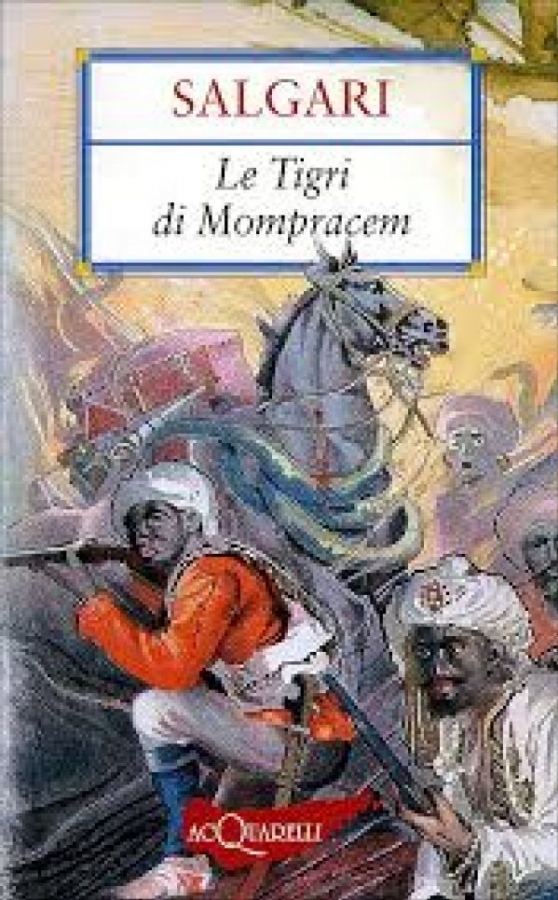
The Tigers of Mompracem
Sandokan > has a broad forehead, shaded by magnificent, boldly arched eyebrows, a small mouth that reveals teeth as sharp as those of wild beasts and gleaming like pearls; two pitch-black eyes, possessing a brilliance that fascinates, that burns, that forces any other gaze to drop . He is the "Tiger of Malaysia", "leader of the fierce pirates of Mompracem", sworn enemy of the British, avenger of oppressed peoples, but also an assassin, cruel, ferocious, terrifying. And so he would have remained, had word not reached him of a woman of great beauty, known as the Pearl of Labuan. An "irresistible force" drives him toward this maiden. He sets out with a few ships and encounters a British cruiser; his fleet is destroyed, his men are killed or drown, and he himself, gravely wounded, barely manages to survive. > I will recover (...) and he uttered that word with such energy as to make one believe he was the absolute arbiter of his own existence , then fear ( > the darkness (...) I do not want to die!...) and finally madness. Completely beside himself, he rushed forward frantically. (...) He believed he saw enemies everywhere. (...) Human beings rose from the ground groaning, screaming, some with bleeding heads, others with severed limbs and torn flanks. All were laughing, sneering, as if mocking the powerlessness of the terrible Tiger of Malaysia > . Sandokan’s delirium is the product of fever and physical exhaustion; the nightmares also arise from the resurfacing in his conscience of all the evil he has done, his ruthlessness, the many dead of his existence. What prevents him from descending into the depths of the earth > is love. After losing consciousness, he comes to in Lord James’s house, where he is cared for by Marianna, the Pearl of Labuan, with whom he falls madly in love: a passion immediately reciprocated. The novel, which seemed to be sliding down the slope of interior soul-searching, regains the typical rhythm of Salgari’s great books: discovered, Sandokan flees, only to return later to free Marianna and take her away; he succeeds thanks to his friend Yanez, who tricks Lord James into undertaking a journey, thereby exposing him to the pirates’ assault. Together at last, Sandokan and Marianna take refuge on Mompracem; to win back the young woman, the powerful Lord James gathers a formidable fleet, which attacks and captures the pirate stronghold after a great battle. It is true that for that heavenly creature, for her I shall have to lose everything, everything, even this sea that I called mine and considered as the blood in my veins. (...) Everything is dead or about to die here > . Marianna asks Sandokan whether he regrets his past power and whether she herself should wield the scimitar", the pirate answers her plainly: "You! You!, he exclaimed, No, I do not want you to become such a woman. It would be a monstrosity". A choice must be made, also because "two happinesses (Marianna and Mompracem) would be too much and I do not want them, (...) and that man, who had never wept in his life, burst into sobs, murmuring: The Tiger is dead, and forever!" The book went through five versions, from the first edition in 1883 to the last in 1891, testifying to a troubled writing process: the author could not find the right register for an audience largely composed of young readers. In particular, it lacks those narrative devices that give pace and surprise to Salgari’s tales. There are some amusing episodes (for instance, when Sandokan and Yanez hide inside a large stove and by pure luck go undiscovered), others seem somewhat contrived and far-fetched, such as the clash between an ape and a panther, while still others recall Salgari’s intense naval battles without the tension and plot twists that typically distinguish them. The author fails to engage the reader because the narrative focuses too heavily on the figure of Sandokan—fascinating, to be sure, but rigid and roughly hewn; nor is he leavened by other characters, as would happen later, when Yanez takes on an expanded, almost protagonist role. Salgari’s craft is not yet fully mastered, and to achieve this the author would have to conceal his own existential anxieties more thoroughly, moving only within a more superficial yet more captivating realm: that of adventure. Why read it? Despite its limitations, the hero Sandokan possesses a powerful appeal.

The Son of the Red Corsair
The Son of the Red Corsair > was a handsome young man, (...) of exceedingly elegant form that bespoke the great lord, with jet-black, fiery eyes, a black moustache, and very pale skin . One would expect a new Black Corsair. Yet such is not the case: first, because the son of the Red Corsair frequently distances himself from the pirates, even paying them out of his own pocket to prevent them from sacking conquered cities—confirming a notion widespread among the buccaneers, namely that the counts of Ventimiglia (the Black, Red, and Green Corsairs) were always “amateur corsairs”; second, because the son of the Red Corsair does not seek revenge, but merely wishes to find his sister, even though she is held by the Marquis of Montelimar, the very man who killed the Red Corsair and now keeps his daughter captive. The relentless hatred of the Black Corsair is missing. And this is why the exploits of the son of the Red Corsair lack the tension of the great novels of the Caribbean cycle: *The Black Corsair*, *The Queen of the Caribbean*, *Jolanda, the Daughter of the Black Corsair*. The classic ingredients of Salgari’s narrative structure are all present: the duels, the equatorial rainforest, the naval battles, the sieges of Spanish fortresses. What is missing is the sense of these adventures, the anticipation of something dark and brooding—the true source of the author’s astonishing narrative rhythm. The book’s peculiarity lies elsewhere. In Salgari, we invariably find sidekicks flanking the protagonist, often helping to humanize him and introduce elements of levity. Here, the system is inverted: the son of the Red Corsair remains in the background, while ostensibly supporting figures take center stage. The first part of the novel takes place on the island of Santo Domingo. Our heroes are pursued by the Spanish and by “exceedingly ferocious” hounds. The setting is at once terrifying and wondrous: thickets of vegetation, marshes, and deadly quicksands alternate with islets, boasting > splendid clumps of rhododendrons, over ten meters high, (...) clusters of purple flowers, (...) magnificent palms crowned by parasols of immensely long palmate leaves, cascading elegantly with spathes of an iridescent violet edged in purple, and clusters of fruit that resembled green apples . In this unreal nature, described with a few grammatical lapses (*parasole* being an invariable noun), the son of the Red Corsair comes across a buccaneer who appears quite savage. He lives by hunting and inhabits a > wretched dwelling made of crudely woven branches and a few poles . Aided by wine and conversation with a European gentleman, the buccaneer reveals, “with dilated eyes, his face bathed in sweat,” his terrible secret: > I must drown distant memories! Ah, the sad fate that has struck me down! (...) Well, such is this terrible life, if one falls prey to an evil genius . Thus we learn that the buccaneer was a nobleman of France, who dishonored his ancestors’ coat of arms and fled to America. Can the Count of Ventimiglia restore him to his former rank? It is no longer possible, > everything is past, everything has been forgotten. I killed two wild pigs, down there on the edge of the marshes... that is my trade. The buccaneer leads the son of the Red Corsair to safety, who then discovers that his sister has been taken to Panama. We move on to the wealthy Spanish cities of Central America’s western coast. The chases, clashes, and sieges are repetitive, almost formulaic. An exception is the duel between the son of the Red Corsair and a hitman, a skilled swordsman hired to kill the Count of Ventimiglia. Deluded fool! The bandit “crouched down completely, almost curling into a ball.” It was his secret move: the hundred-pistole strike. The count’s sword caught him in the throat, sinking in several centimeters. > He stood almost upright for a moment, arms outstretched, then tumbled heavily into the sands, murmuring: I am finished . In this section of the novel as well, the real protagonist is a supporting character: a Gascon—a drunkard, a chatterbox, always ready to throw punches, yet capable of resolving the direst predicaments through his cunning and brazen audacity. The band of buccaneers is on the verge of being captured by the Spanish in the city of Panama. Whereupon the Gascon, instead of fleeing, steps forward and tells the guards he was there to serenade his > splendid Catalan girl, you know, with two eyes that sparkle like stars and... a sweet little mouth, my dear sirs, enough to turn the head even of the Lord President of the Royal Audiencia . On another occasion, he poses as a Castilian nobleman, the Count of Alcalá, laden with titles and names, and even manages to obtain horses, provisions, and muskets—naturally, to make his escape. It is one of the rare instances where Salgari departs from adventurous, imaginative, or shadowy storytelling to invent an amusing, witty character, a sort of Harlequin. The story naturally has a happy ending, yet a feeble and hurried one. Despite not knowing him, the sister, still a young girl, embraces her brother and flees with him. Yet she had never seen him before! She feels the pull of the blood tie: a somewhat shallow explanation. Even more so is another fact: once the son of the Red Corsair is captured, it is the Marquis of Montelimar himself who leads him to his sister. A true gentleman! What remains of the gloomy saga of *The Black Corsair*? Very little, merely the trappings! By the end of this lengthy novel, Salgari seems more preoccupied with convincing the reader that what he recounts is true, not invented, than with lending rhythm to the tale. The entire narrative frays; the author himself realizes he has dragged it out too far and for too long. Why skip it? It is dull, and that is surprising for Salgari.
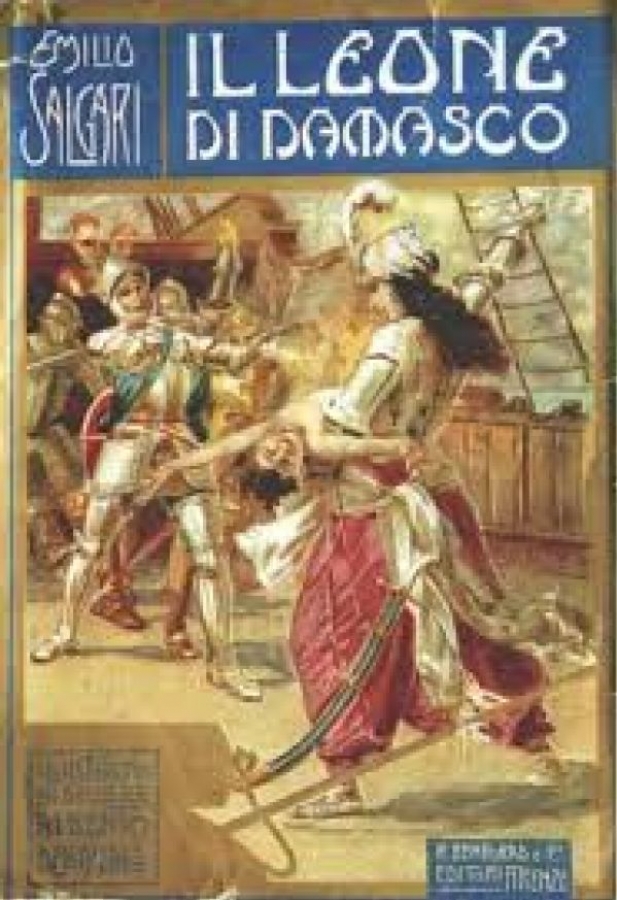
The Lion of Damascus
The novel is meant to be the sequel to *Capitan Tempesta*, a tale set in Famagusta in 1517 during the war between the Venetians and the Turks. The protagonist was a young noblewoman: a skilled swordswoman who, disguised as a man, had set out in search of her betrothed, abducted by the terrible Haradja. Salgari had succeeded in crafting a story full of allure, working upon gender ambiguity, vigorous female figures, and a final plot twist: the love between Capitan Tempesta and the Lion of Damascus—a passion that disregarded different allegiances, both national and religious. One would expect the same intriguing atmosphere and the very same freedom from convention. And the opening shows promise, even if certain signs make it clear from the outset that the story will take a different turn. It begins with the figure of Haradja: > a very beautiful young woman (...) pitch-black eyes, (...) very long, loose hair, of a hue that gleamed like raven wings... (...) the whole of her face had (...) something hard and forceful that instantly betrayed the Turkish woman, ever cruel at heart, as the bloodthirsty sultans of the fifteenth and sixteenth centuries had by then accustomed them to be . Haradja is no longer an unconventional woman: she is part of a cruel and bloodthirsty breed, that of the Turks, and foul black birds, "eaters of the dead," are the living symbol of thousands upon thousands of corpses, left in the sun to be stripped of their flesh. A grim and deathly atmosphere pervades the entire narrative and strips of narrative momentum the adventures that Salgari, despite everything, attempts to construct. Haradja seeks vengeance against Capitan Tempesta, who deceived her by posing as a man and with whom she had become infatuated; she also intends to punish the Lion of Damascus, formerly her betrothed, who had abandoned her for the Christian noblewoman. She therefore kidnaps the couple’s son and the father of the Lion of Damascus. She holds all the cards: overcome by hatred and above all by pride, she challenges Capitan Tempesta to a duel. > The two horses had collided with such impetuosity that they nearly threw their mistresses from the saddle; then came a clattering of weapons against armor. (...) Haradja continued to attack, trying to force down that sword which flashed with fiery gleams beneath the already scorching rays of the sun. (...) By the death of Allah!, cursed the Pasha's niece (Haradja), (...) You stand firm as a rock, do you?.. And yet I shall kill you! (...) A cry was heard, or rather, the howl of a wounded beast; then the great admiral's niece crashed to the ground with a great clash of steel. (...) Finish off the tigress of Hussiff! , shouted the Lion of Damascus; but numerous Turkish soldiers rushed in, preventing Capitan Tempesta from slaying her terrible rival. It is the finest moment of the novel; thereafter, the narrative loses its bite: Haradja and Capitan Tempesta vanish from the story, the Lion of Damascus is present but relegated to the background, faded and irrelevant, while minor characters emerge who, as often happens in Salgari, try to inject brio and establish a dynamic among the roles; meant to act as foils to the protagonist, they merely underscore his insubstantiality. Instead, a real historical figure comes to the fore: Sebastiano Veniero, the great commander of the Venetian fleet, to whom, according to Salgari, the victory of Lepanto against the Turks was owed. The narrative draws to a weary close. The book was published in 1910, a year before the Libyan War (1911–1912), which pitted Italy against the Ottoman Empire. It is possible that Salgari tapped into sentiments widespread among public opinion: the Turk as a cruel oppressor of peoples, bloodthirsty and treacherous. The novel abounds in massacres, tortures, flayings, quarterings, and other gruesome deeds: there is no mercy on the part of the Turks, nor any chivalrous respect for the vanquished. And the Christians know how to die with honor, whispering the *Miserere* "in the excruciating agony of the horrific torment"! Yet there is too much relentless ferocity here to believe that the novel's deathly atmosphere merely answers to an editorial demand or a nationalist resurgence on the author's part. Salgari took his own life the year following its publication, in 1911: the writer was by then living in a profound depression, plagued by frequent self-destructive crises and numerous suicide attempts; the novel mirrors Salgari's despair and his fascination with a gruesome end. At the same time, the narrative suffers from a weariness and an exhaustion of ideas, which the writer desperately tries to compensate for by resorting to prefabricated formulas, no longer embedded within a dynamic narrative framework: evidence of this lies in the repetitiveness of dialogues and scenes, the weakness of the characters, and the sparse descriptions of landscapes—the latter set against a peculiarity of the novel: historical digressions, generally rare in Salgari's oeuvre, a clear sign of a narrative vein that had grown fragile. Why not read it? It is a swan song, a bitter and sorrowful epilogue to a great writer.

The Corsairs of Bermuda
The book belongs to the Bermuda cycle. The context is the American War of Independence (thus the mid-eighteenth century) and the protagonist is Sir William, an English nobleman of French descent who has become a privateer to fight his half-brother, the cruel Marquis Halifax, who seeks to take his beloved from him. Unhappy love and the grand poetry of the sea seem to be the novel’s points of reference: > ah! that night! embraced on the sand dunes, we listened to the sonorous rhythm of the waves. It is a divine music, a music worth all those created by instruments of brass, of copper, of bronze . And at the beginning, one witnesses a naval battle, just as in Salgariʼs finest novels. Subsequently, the plot takes another direction. The beloved is held prisoner in Boston, a city in British hands and under siege by the Americans. Sir William, together with his stalwarts, Testa di Pietra and Piccolo Fiocco, infiltrates the besieged city, and they attempt to free the woman. A series of adventures follows, but in the end, the cruel Marquis of Halifax manages to escape with Sir Williamʼs beloved. The narrative pace is sluggish, weighed down by the constant exchange of jokes and banter between Testa di Pietra and Piccolo Fiocco: dialogues dominate, relegating the action to the background. On the other hand, the novel’s true protagonist is Testa di Pietra, his cunning, his peasant wisdom, his nostalgia for his native land. Brittany. Yet Salgari fails to depict sentiment. Deprived of action and of characters who are both brooding and heroic, the narrative loses its allure and turns tedious. Why not read it? The sea, love, and tragic destiny are nowhere to be found: the true Salgari, then, is absent.

Captain Tempest
We stand before one of Salgari’s most astonishing novels. The events of *Capitan Tempesta* are set in 1571 during the Turkish conquest of the island of Cyprus, which until then had been in Venetian hands. But who is Capitan Tempesta? > He was a remarkably handsome youth, indeed too handsome to be a warrior, somewhat tall, slender, elegantly proportioned, with two pitch-black eyes like glowing carbuncles, the mouth of a maiden with superb little teeth... all in all, he seemed more a most graceful maiden than a soldier of fortune . This very introduction by Salgari brings forth the underlying motif of the novel: the disguise of a splendid Neapolitan noblewoman in search of her betrothed, who has been taken prisoner. The plot unfolds around the ambiguity of Capitan Tempesta. A skilled swordsman and valiant combatant, he/she triumphs in duels over the finest opponents, both Christian and Turk, who then fall in love with the courageous maiden. After fighting in the defense of Famagusta and defeating in single combat one of the most renowned warriors of the Saracen army, the Lion of Damascus, Capitan Tempesta rushes to the castle of Ussif, where her beloved fiancé is held captive. Through cunning subterfuge, she manages to enter the good graces of the cruel Haradja, who becomes infatuated with the handsome youth, unaware of her true nature. Capitan Tempesta succeeds in freeing her betrothed and flees by sea, but is overtaken and captured after a typically Salgarian naval battle. She is freed, however, by the Lion of Damascus, who, hopelessly captivated by the young woman, flees with her to Italy (in the meantime, her beloved fiancé has been murdered). All the quintessential ingredients of Salgari’s novels are present, yet with something more. Not only does the narrative skillfully play upon the dual nature of Capitan Tempesta, but the other characters also rebel against the roles to which society seeks to confine them. Take, for example, the surprising and magnificent figure of Haradja. Fate would have her relegated to a harem, among the many wives of a pasha. Yet > I had the blood of a pirate in my veins, and woman though I was, I felt all its savage impulses . She could not help but fall in love with warriors, with a passion that, once spurned, turned into ferocious hatred. Even the opposition between the Christian and Muslim faiths, which at the outset of the book seemed an irreconcilable conflict, gradually tempers as one reads on, because it becomes evident that everyone moves along a ridge where rules and ideologies lose value and substance. Finally, the character of El-Kadur, Capitan Tempesta’s slave, is magnificent. Smitten with the maiden himself ( > I see you again when, on the sandy beach, you held out dripping seawater before me and rested in the shade of the palms, happy to look upon me ) he suffers terribly because he can never make her his. This unrequited love, of which Capitan Tempesta is fully aware, and his longing for “the vast, luminous horizons and the sand dunes” overwhelm the man to the verge of madness. In forms distinct from those of *Il Corsaro Nero*, where all is gloom and sorrow, here too Salgari operates on a psychoanalytic plane, wherein the characters and events are the iceberg of a subterranean world, forged of fantasies—even erotic ones—and of desires for a different life. Why read it? To adventure, it adds the complexity of the characters.

Jolanda, the Daughter of the Black Corsair
The novel is, in a sense, the continuation of *The Black Corsair*. Jolanda, the pirate’s daughter, returns to the Caribbean to reclaim her mother’s inheritance. Here, she is repeatedly abducted by the Count of Medina, her grandfather’s natural son, who seeks to seize Jolanda’s fortune and, above all, avenge the killing of his father—Jolanda’s grandfather—at the hands of the Black Corsair. Morgan, the pirate friend of the Black Corsair, fights to free Jolanda, culminating in the slaying of the Count of Medina and his marriage to Jolanda, who in the meantime has fallen in love with him. The plot provides the occasion for a series of adventures that unfold across the Caribbean Sea, Venezuela, and Central America, through a succession of naval battles, sieges of Spanish cities, and tempests. The style remains characteristically Salgari’s—brisk and fast-paced in depicting martial engagements—though it must be noted that the narrative suffers from a slackening rhythm and a repetitiveness that at times makes for tedious reading. The finest part of the book is the account of Jolanda and Morgan in the Venezuelan jungle. With the pirate gravely wounded, the young woman is swiftly forced to contend with an astonishing and hostile wilderness, the threat of wild beasts, and attacks by savages. This unfolds as a form of initiation open to multiple interpretations: the exaltation of a heroic figure—here embodied by a woman—the portrayal of an exotic natural world (Salgari’s hallmark exoticism), the passage from youth to adulthood, and the confrontation between the resolve of the will and an antagonistic external environment. As with the story of *The Black Corsair*, a psychoanalytic and autobiographical interpretation of the tale is possible, focusing specifically on Jolanda’s trials in the forest.

The Two Tigers
The setting is India and the cruel Thugs, who have abducted Tremal-Naik’s daughter to make her the “virgin of the pagoda” in service to the ruthless deity, Kali. Sandokan and Yanez set out to rescue the young girl, embarking on an expedition that leads them into the Ganges Delta—a swampy expanse infested with ferocious beasts and plagued by cholera—down into the subterranean lairs inhabited by the Thugs, and all the way to Delhi at the height of the clash between Indians and the British during the 1857 uprising. All the quintessential ingredients of Salgari’s major novels are present: the hostile environment, treachery, Sandokan’s valor and strength, and the enduring themes of friendship and honor. Yet a theme emerges with striking force—one often latent in Salgari’s fiction, though never fully articulated: that of colonialism and the conqueror’s brutality toward the Indian people. From this standpoint, Sandokan assumes an ambiguous posture: he naturally does not side with the British, even though he owes his survival to a British army safe-conduct and his friendship with a French officer; yet neither does he champion the insurgents, remaining indifferent to the wholesale slaughter of women and children. > Terrifying screams rose from every street, accompanied by tremendous volleys... Let us flee as well, said Sandokan . The Tiger of Mompracem is not the *Black Corsair*: he remains a figure confined to his own pirate sphere, bound to ties of personal friendship that never mature into a genuine political consciousness. He lingers, as it were, suspended between hostility toward the oppressor and the conviction that his individual struggle can be resolved on his own, alongside his companions. It is paradoxical that the Tiger of India, the cruel Suyodhama—leader of the Thugs, ultimately slain by Sandokan—feels the cause of the Indian subcontinent’s independence far more acutely than the pirate of Mompracem, valiant and honorable though the latter may be. Salgari’s own perspective seems quite different, as he concludes the novel with a note of admiration for the leader of the rebels: > by now the insurrection was subdued, and only the brave Tantia Topi, with the beautiful and proud Rani of Jhansie, and a handful of valiant men, still held high the banner of freedom, amid the thick jungles and numerous forests of Bundelkund . Why did he never write a novel about this extraordinary figure?