Finished reading on: September 30, 2012
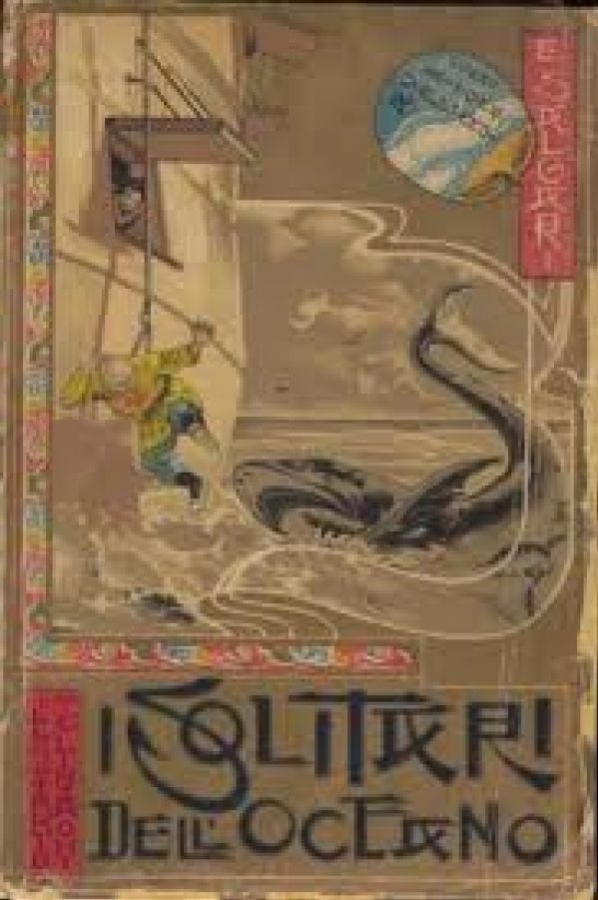
The Solitaries of the Ocean
Title of the original version reviewed: «I solitari dell'oceano»
AI Translation Notice: This review was translated from the original Italian using artificial intelligence. Book quotes and excerpts are translated interpretations and will not match the author's original English phrasing or official published translations.
Salgari wrote over eighty novels, and not all of them possess the same literary quality.
In this case, two hallmarks of the author’s pen are absent: the pulse of adventure and the exotic, yet often captivating, depiction of the setting.
The opening is promising.
In the mid-nineteenth century, the slave trade is replaced by the recruitment of Chinese laborers, who supply South America with cheap labor.
The transport conditions endured by these poor souls, deluded into believing they would find dignified work, are even more harrowing than the African slave trade.
Indeed, since they are not regarded as chattel, the Chinese possess no asset value, and exorbitant profits lead shipowners to accept an appalling mortality rate.
The opening chapters could easily be set today, amid the plight of migrants crossing the Mediterranean.
Salgari’s indignation is profound at the perfidy, deceit, and senseless cruelty of those who exploit (recruiters, shipowners, sea captains, and large landowners) the misery and aspirations of the world’s dispossessed—in this case, the Chinese.
We find ourselves aboard the Alcione, a vessel sailing from China to Peru with a cargo of over four hundred Chinese, crammed into the hold, poorly fed, and forced to survive without access to fresh air.
Plague breaks out, and Salgari portrays, with grim power, the corpses of the Chinese, snagged with a hook, hoisted from the hold without being touched by the crew, and cast to the ravenous sharks.
It is a harbinger of the book's core theme: the cannibals and their craving for white flesh.
A mutiny erupts, and the captain, unable to quell it, abandons ship along with his crew, though not before poisoning the provisions.
All the Chinese perish, save for their leader, Sao-King, two Peruvians, and an Argentine officer who had opposed the captain’s cruelty.
The four men must navigate the Alcione alone through fierce storms, seeking refuge on islands inhabited by cannibal populations, only to be captured at last by pirates, who seize the sailing ship.
The adventures revolve around two protagonists: Sao-King and Ioao, the younger of the two Peruvians.
The two, evidently formidable swimmers, manage to escape the ship while underway and find safety aboard a naval schooner.
With the warship’s aid, and through further heroic feats, they vanquish the pirates and rescue their companions.
Salgari repeats a literary formula common to all his books: a hero, Sao-King, accompanied by a less experienced and vigorous sidekick, here Ioao.
Displaying great courage and remarkable prowess, the two confront numerous, incredible ordeals.
These episodes, however, are not woven into a cohesive narrative structure and unfold sluggishly.
It is evident that Salgari is weary, drained, incapable of breathing vigor into the scenes, and perfunctory in his depiction of the setting and characters.
Moreover, a true antagonist is missing, as the adversaries to be overcome shift constantly: the cruel captain, whose vengeance one would expect to be a guiding thread, disappears for most of the narrative, only to resurface reduced to a skeleton in the launch with which he fled the ship; the anthropophagi (hideous and treacherous) are too primitive to be considered genuine foes; and the pirate chief, who will end his own life, is ruthless yet benign enough to spare our four friends.
The theme of cannibalism—already present in other novels, though never so repetitively—casts a lugubrious pall that spoils any relish of the adventure.
Yet perhaps this very motif mirrors Salgari’s psychological decline: moving from the depiction of grand heroes, even if tormented like Il Corsaro Nero or ambiguous like Capitan Tempesta, to a tragic worldview where, confronted with sheer ruthlessness, one can only defend oneself or succumb.
Why avoid it? It simply isn’t worth it.