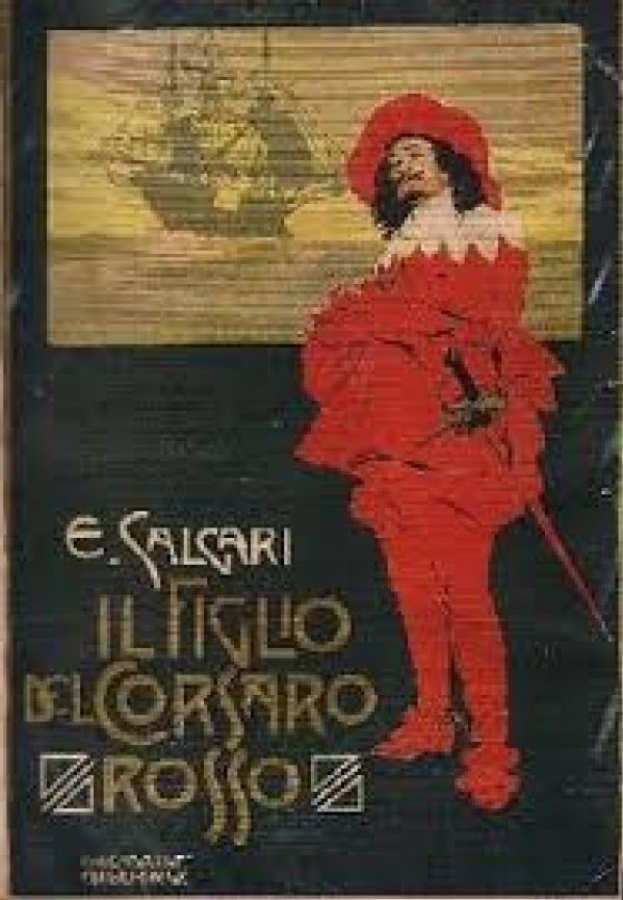
Finished reading on: October 18, 2015
The Son of the Red Corsair
Title of the original version reviewed: «Il figlio del Corsaro Rosso»
AI Translation Notice: This review was translated from the original Italian using artificial intelligence. Book quotes and excerpts are translated interpretations and will not match the author's original English phrasing or official published translations.
The Son of the Red Corsair
was a handsome young man, (...) of exceedingly elegant form that bespoke the great lord, with jet-black, fiery eyes, a black moustache, and very pale skin
.
One would expect a new Black Corsair.
Yet such is not the case: first, because the son of the Red Corsair frequently distances himself from the pirates, even paying them out of his own pocket to prevent them from sacking conquered cities—confirming a notion widespread among the buccaneers, namely that the counts of Ventimiglia (the Black, Red, and Green Corsairs) were always “amateur corsairs”; second, because the son of the Red Corsair does not seek revenge, but merely wishes to find his sister, even though she is held by the Marquis of Montelimar, the very man who killed the Red Corsair and now keeps his daughter captive.
The relentless hatred of the Black Corsair is missing.
And this is why the exploits of the son of the Red Corsair lack the tension of the great novels of the Caribbean cycle: The Black Corsair, The Queen of the Caribbean, Jolanda, the Daughter of the Black Corsair.
The classic ingredients of Salgari’s narrative structure are all present: the duels, the equatorial rainforest, the naval battles, the sieges of Spanish fortresses.
What is missing is the sense of these adventures, the anticipation of something dark and brooding—the true source of the author’s astonishing narrative rhythm.
The book’s peculiarity lies elsewhere.
In Salgari, we invariably find sidekicks flanking the protagonist, often helping to humanize him and introduce elements of levity.
Here, the system is inverted: the son of the Red Corsair remains in the background, while ostensibly supporting figures take center stage.
The first part of the novel takes place on the island of Santo Domingo.
Our heroes are pursued by the Spanish and by “exceedingly ferocious” hounds.
The setting is at once terrifying and wondrous: thickets of vegetation, marshes, and deadly quicksands alternate with islets, boasting
splendid clumps of rhododendrons, over ten meters high, (...) clusters of purple flowers, (...) magnificent palms crowned by parasols of immensely long palmate leaves, cascading elegantly with spathes of an iridescent violet edged in purple, and clusters of fruit that resembled green apples
.
In this unreal nature, described with a few grammatical lapses (parasole being an invariable noun), the son of the Red Corsair comes across a buccaneer who appears quite savage.
He lives by hunting and inhabits a
wretched dwelling made of crudely woven branches and a few poles
.
Aided by wine and conversation with a European gentleman, the buccaneer reveals, “with dilated eyes, his face bathed in sweat,” his terrible secret:
I must drown distant memories! Ah, the sad fate that has struck me down! (...) Well, such is this terrible life, if one falls prey to an evil genius
.
Thus we learn that the buccaneer was a nobleman of France, who dishonored his ancestors’ coat of arms and fled to America.
Can the Count of Ventimiglia restore him to his former rank? It is no longer possible,
everything is past, everything has been forgotten.
I killed two wild pigs, down there on the edge of the marshes...
that is my trade.
The buccaneer leads the son of the Red Corsair to safety, who then discovers that his sister has been taken to Panama.
We move on to the wealthy Spanish cities of Central America’s western coast.
The chases, clashes, and sieges are repetitive, almost formulaic.
An exception is the duel between the son of the Red Corsair and a hitman, a skilled swordsman hired to kill the Count of Ventimiglia.
Deluded fool! The bandit “crouched down completely, almost curling into a ball.”
It was his secret move: the hundred-pistole strike.
The count’s sword caught him in the throat, sinking in several centimeters.
He stood almost upright for a moment, arms outstretched, then tumbled heavily into the sands, murmuring: I am finished
.
In this section of the novel as well, the real protagonist is a supporting character: a Gascon—a drunkard, a chatterbox, always ready to throw punches, yet capable of resolving the direst predicaments through his cunning and brazen audacity.
The band of buccaneers is on the verge of being captured by the Spanish in the city of Panama.
Whereupon the Gascon, instead of fleeing, steps forward and tells the guards he was there to serenade his
splendid Catalan girl, you know, with two eyes that sparkle like stars and...
a sweet little mouth, my dear sirs, enough to turn the head even of the Lord President of the Royal Audiencia
.
On another occasion, he poses as a Castilian nobleman, the Count of Alcalá, laden with titles and names, and even manages to obtain horses, provisions, and muskets—naturally, to make his escape.
It is one of the rare instances where Salgari departs from adventurous, imaginative, or shadowy storytelling to invent an amusing, witty character, a sort of Harlequin.
The story naturally has a happy ending, yet a feeble and hurried one.
Despite not knowing him, the sister, still a young girl, embraces her brother and flees with him.
Yet she had never seen him before! She feels the pull of the blood tie: a somewhat shallow explanation.
Even more so is another fact: once the son of the Red Corsair is captured, it is the Marquis of Montelimar himself who leads him to his sister.
A true gentleman! What remains of the gloomy saga of The Black Corsair? Very little, merely the trappings! By the end of this lengthy novel, Salgari seems more preoccupied with convincing the reader that what he recounts is true, not invented, than with lending rhythm to the tale.
The entire narrative frays; the author himself realizes he has dragged it out too far and for too long.
Why skip it? It is dull, and that is surprising for Salgari.