Finished reading on: July 19, 2026
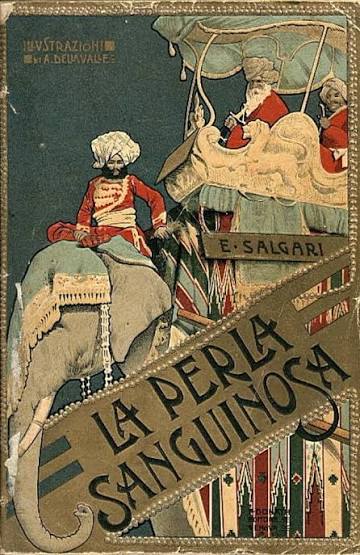
The Bloody Pearl
Title of the original version reviewed: «La perla sanguinosa»
AI Translation Notice: This review was translated from the original Italian using artificial intelligence. Book quotes and excerpts are translated interpretations and will not match the author's original English phrasing or official published translations.
Although he went by the moniker "Captain Salgari," the Veronese writer never actually traveled; for his novels, he relied on the numerous accounts of explorers and geographers who brought back to Europe tales of hitherto unknown worlds—accounts that blended reliable reports with fanciful inventions, steeped in a burgeoning racism. Our author was always deft at promptly seizing upon "the trend," chasing the public’s appetite for strange and exotic novelties. Right from the mysterious and evocative title, one enters the atmosphere: La perla sanguinosa (The Bloody Pearl) is a pearl of rare beauty, stolen from a sacred temple in Ceylon (modern-day Sri Lanka) and steeped in the color of the blood of the thief who took it, only to drown later in the great shoal of Manaar, an extensive shallow reef situated between southern India and Ceylon. Behind the pearl lies a love story: a maiden has been forced to become a Buddhist nun and can only be redeemed through the delivery of the bloody pearl; vying for both pearl and maiden are a humble pearl diver and the One-Eyed, a villainous impostor. Both are held in the prison of Port Cornwallis, a British penal colony located in the Andaman archipelago, a group of islands in the center of the Bay of Bengal. It is from this prison that the novel sets forth: three inmates (our diver, an English sailor, and an Indian machinist, all wrongfully imprisoned) manage to escape the colony and head toward Ceylon in a fragile boat to recover the bloody pearl and redeem the beloved maiden. Not only are they pursued by the One-Eyed, but they must also confront a series of ordeals: from the assault of a sea vampire—perhaps a "lamprey," a fish with a sucker mouth that feeds on blood—to a terrible storm with gigantic waves, culminating in their capture by the Queen of Nicobar, who wishes to take the handsome Englishman as her husband, much like Circe with Odysseus. Salgari’s imagination knows no bounds, conjuring up the Vadassi, whose valiant chieftain Adikar—fascinated by Napoleon—sought to emulate his deeds and lead his people to triumph, a sort of feral Sandokan; and what of the "crucified dolphins," in reality a small cetacean that inhabits Antarctic waters, far removed from the Bay of Bengal. To this muddled wealth of geographical, zoological, and anthropological references corresponds an equally muddled plot, packed with adventures that are all too often repetitive and prolix.
Salgari’s narrative formula hinges on a central protagonist flanked by supporting characters who leaven the narration and throw the hero into sharp relief. When he departed from this model successfully, as in Capitan Tempesta and La stella dell'Araucania (see the reviews on this site), it was because he proved capable of constructing a compelling, intense love story. The setting, while ever-present, always remained in the background, instrumental in evoking an exotic and mysterious atmosphere. Here, the narrative functions are inverted: setting takes center stage; the band of fleeing prisoners is flat, devoid of a true leader (the Englishman predictably emerges, yet remains a faded figure), and lacks any clear hierarchy of roles; the love story remains suspended and remote, and the villain is easily defeated. Layering adventure upon harrowing description fails to impart rhythm to the narrative or captivate the reader. One finds solace only in a few isolated descriptions, as in the recounting of the struggle with the vampire:
it had wrapped itself around my body with all its tentacles, and the monster’s eyes—those huge, glaucous eyes—were fixed upon me, motionless, as if relishing my torment; and through that nearly transparent body, I watched the transfusion of my own blood flowing from the suckers into its mouth and passing thence into the ventricle.
Why read it? As a testament to how the world was viewed in nineteenth-century Italy.