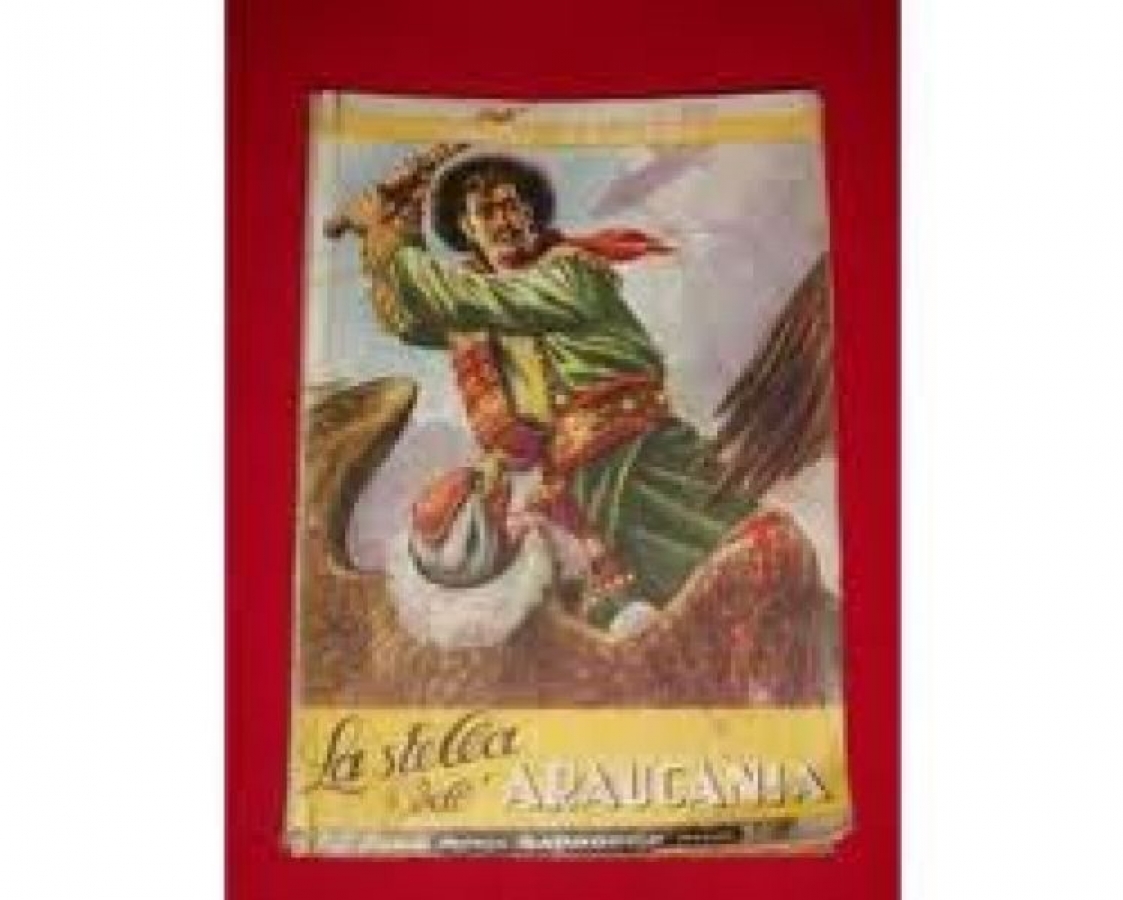
Finished reading on: April 22, 2012
The Star of Araucanía
Title of the original version reviewed: «La stella dell'Araucania»
AI Translation Notice: This review was translated from the original Italian using artificial intelligence. Book quotes and excerpts are translated interpretations and will not match the author's original English phrasing or official published translations.
The star of Araucania is the young Mariquita, “of marvelous beauty,” who, between the two cousins, Piotre and Alonzo, chose the latter—more gentle and elegant than his coarse, brusque counterpart.
Fate dictates that Alonzo is shipwrecked in the wild lands of Tierra del Fuego, and only Piotre’s ship can brave the sea during the terrible winter of the Strait of Magellan.
In a dramatic encounter, taking place no less during a condor hunt, Mariquita is forced into a painful bargain: to promise to marry Piotre if he provides his ship and his skill as a captain to go and rescue Alonzo.
The expedition originates in an act of blackmail, Piotre’s coercion of the young woman, who lives in deep anguish because Alonzo’s salvation will compel her into an unwanted marriage.
Her feelings change radically once Mariquita discovers Piotre’s courage and rectitude: first while navigating stormy seas and colossal icebergs, then during the furious clash with the cannibals who inhabit Tierra del Fuego.
As in all of Salgari’s books, plot twists follow in rapid succession, but this tale also features an intriguing inversion of personality, emblematic of how distance from civilization unveils man’s true character.
Alonzo has become the chieftain of the cannibal tribe and condones the slaughter and consumption of Piotre’s sailors by the savages.
Indeed, he would even be willing to offer up his own cousin as food, so as to rid himself of his rival.
“I no longer recognize the Alonzo of old,” said Mariquita,...
“one would say that constant contact with these wretched savages has hardened his heart!...
Alonzo, you frighten me!”
.
Evidently, Mariquita’s choice to break the engagement and marry Piotre is now justified as well by Alonzo’s villainy, whose fate can only culminate in death during a dramatic duel with his cousin in the frigid Antarctic waters.
In truth, Mariquita remains perpetually in the background, swept along by events and by the shifting of passions.
The novel’s true protagonist is Piotre, whom Salgari introduces in such a way as to accentuate this man’s inner conflict:
steel-colored eyes that held a certain wild flash and betrayed an indefinable roughness, but also sadness
.
Pride would urge him to reject Mariquita, yet love compels him to accept marrying her even without being loved in return.
And it is the perils they must face together (in which Mariquita too proves herself a bold and vigorous woman) and their increasingly frequent physical proximity that soften Piotre’s spirit, laying the groundwork for a love no longer bred of pride and resentment.
During the flight from the cannibals, Salgari pens lines reminiscent of D’Annunzio’s sensuality:
and he pressed Mariquita ever tighter to his chest, with a kind of frenzy, running desperately...
when the hair of the young Araucanian woman, undone in that mad dash, whipped against his face or coiled around his neck, he lifted his eyes and looked at her, smiling, overjoyed to hold against his breast the woman he had loved so dearly
.
On the other hand,
Mariquita, resting against the whaler’s broad chest, her hands clasped around his powerful neck, looked at him with admiration
.
The narrative of this falling in love, rooted in Piotre’s valor and rebirth, would be trite and mawkish were it not set against Tierra del Fuego.
In this novel, the environment does not simply serve as a backdrop to the adventures; it forcefully bursts forth, becoming a protagonist in its own right.
It offers more than just the occasion for thrilling pages—among the finest being the passage of Piotre’s ship between two gigantic icebergs converging with destructive force upon the vessel.
The depiction of Tierra del Fuego gives rise to a fantastical, incredible, compelling chronicle of a world teeming with a multitude of birds, grassy plains, “mostly covered with moss,” vast forests, and rugged, inaccessible coasts.
Even the inhabitants are extraordinary—either towering giants or stunted dwarfs, but invariably grotesque.
Why read it? I am not entirely sure why it is considered one of Salgari’s minor novels.
In reality, it is a breathless read that introduces startling lands and characters.