Finished reading on: December 24, 2025
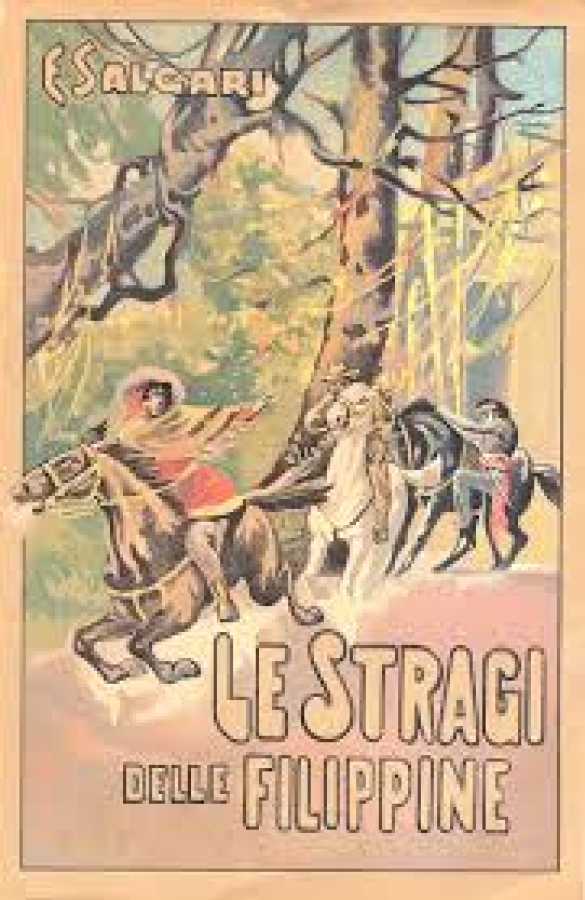
The Philippine Massacres
Title of the original version reviewed: «Le stragi delle Filippine»
AI Translation Notice: This review was translated from the original Italian using artificial intelligence. Book quotes and excerpts are translated interpretations and will not match the author's original English phrasing or official published translations.
With exceptional timing, in 1897 Salgari published a novel "of adventure and love" that recounts the Philippine Revolution between 1896 and 1898: a conflict between the Philippine independence movement and Spain, which would ultimately lead the latter to lose its colony. As had already occurred with Cuba during the Spanish-American War of 1898, recounted by Salgari in another novel (see the review of La capitana del Yucatan on this site), the ambiguous American support for the Filipino patriots would culminate in the annexation of the Philippines by the United States. While in the novel set in Cuba Salgari squarely sides with Spain against the perfidious American imperialists, here the author's stance is ambiguous; he is bound to be anti-colonialist, and thus against Spain, yet a growing vein of racism shines through: the insurgents are heroic yet bloodthirsty and cruel, devoid of genuine military competence when matched against the valiant and skilled Spanish officers. Consider the description of the insurgent camp:
it was a chaos of haphazardly pitched tents, improvised huts, hovels of every shape and size, simple lean-tos, absolutely primitive shelters. And what of the
diverse races of the Far East: from the mestizos, a cross between European blood and Asian peoples, and therefore
of lively character, exceptionally quick-witted, who formed the backbone of the insurrection
, to the Chinese,
with their faces the color of ripe lemons
, down to the Malays (
with wide mouths armed with sharp teeth like those of wild beasts
), to the Tagalogs,
with almost rhomboidal, bony but pleasant faces. It reads like a treatise by Cesare Lombroso; on the other hand, in 1885 we occupied Eritrea, Italy's colonial venture had begun, and Salgari captures the spirit of the times—nationalistic, imperialist, and racist. The historical and ideological framing risks diminishing the novel: beyond the traditional adventures and plot twists typical of Salgari's tales, here we are faced with an anguished love story that recalls Il Corsaro Nero (see the review on this site). The novel opens with a shocking scene in which a mob of opium-intoxicated men, drugged by treacherous Mohammedan priests to take revenge on the infidels, wreak havoc among the population of Manila and are about to butcher Teresita, a seventeen-year-old girl (
two eyes of a deep black (...) two lips as red as coral
), when two valiant men intervene to save her: the mestizo Romero Ruiz and the Chinese Hang Tu. Romero is in love with the girl, the daughter of one of the chief commanders of the Spanish army. How can one love an enemy's daughter? Making the dilemma even more intriguing, Than Kiù, a heroine of the revolution and Hang Tu's sister, is also in love with Romero. We are faced with a web of sentiments, from Hang Tu's friendship for Romero to the young Chinese woman's passion for the mestizo. Beloved to excess, the mestizo fails to grasp the suffering, even when Hang Tu saves the life of Teresita's father—doing so for Romero's sake—and when Hang Tu nurses the gravely wounded mestizo with devotion. For Romero, only the beautiful Spanish girl exists; besides, how could he fall in love with a Chinese woman, he who is nearly European? Than Kiù and Hang Tù, sister and brother, march toward the same fatal destiny.
Look instead, says Than Kiù to Romero, at my star following that of the white woman. Its pale light constantly flickers as though it might go out from one moment to the next. When it has arrived above my country it will die, and on that day the daughter of the land of the sun will die as well. (...) Hang Tu, ever motionless, watched the black mass vanish into the darkness. When the lanterns disappeared behind the lighthouse, he bowed his head upon his chest and sat beside Than Kiù, murmuring: - I loved you so much, Romero, but you did not love my sister. -
A dark, romantically sorrowful thread runs through the entire narrative. We find ourselves before the familiar Salgari, with a plot constructed around desperate clashes, flights through the jungle, and moments of intense suspense. The setting is exotic, almost dreamlike, inhabited by evil spirits:
high above circled legions of those hideous and enormous bats, (...) with bodies roughly forty centimeters long, and membranous wings over a meter wide, (...) in the fruit-bearing trees quite a few of those small quadrumana could be seen stirring (...) with their rich, soft, brownish fur
, and then macaques, snakes, crocodiles, quicksand. It is a fantastically grim world, reflecting, perhaps, the torments and nightmares of Salgari the man. Ostensibly an adventure story, the novel is disquieting, a harbinger of the author's horrific suicide. Salgari's limitations also emerge: the characters are stereotypes; the writer fails to delve into the protagonists' inner depths; the adventures feel repetitive to anyone who has read the author's other works, carrying a sense of the predictable, of the déjà vu.
Why read it? It is among Salgari's most complex novels, from both a historical and personal perspective.