Finished reading on: May 16, 2011
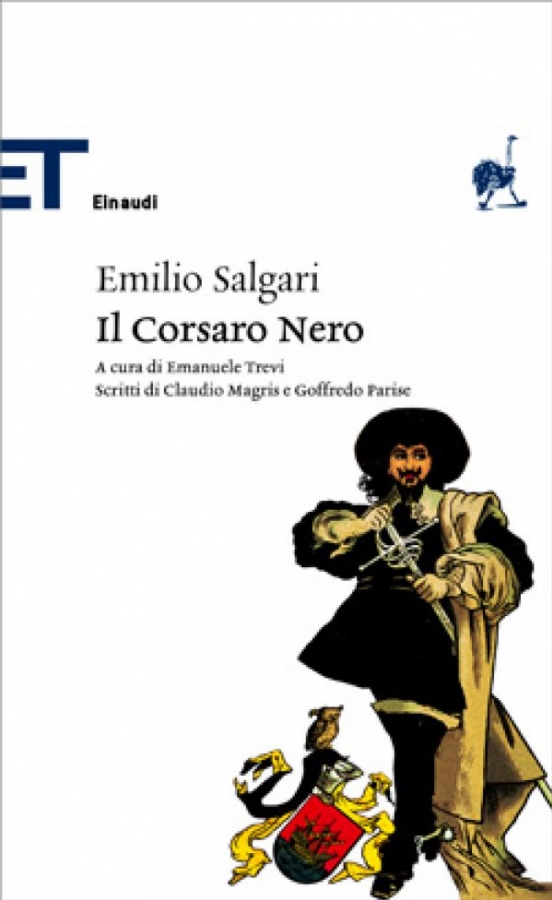
The Black Corsair
Title of the original version reviewed: «Il Corsaro Nero»
AI Translation Notice: This review was translated from the original Italian using artificial intelligence. Book quotes and excerpts are translated interpretations and will not match the author's original English phrasing or official published translations.
We are in the seventeenth century, the age of pirates,
folk made up mostly of misfits, soldiers, and sailors greedy for plunder
, roaming the Caribbean Sea
to lay their hands on the rich mines from which Spain drew rivers of gold
.
Among these “sea robbers” was also an Italian nobleman, the Count of Ventimiglia, the Black Corsair:
he was dressed entirely in black....
even that man’s appearance held, like his attire, something funereal, with that pale, almost marmoreal face
.
The story begins with the news of the hanging of the Red Corsair, the Black Corsair’s brother, who met the same fate as the other two brothers, all treacherously murdered at the hands of Duke Wan Guld.
The Black Corsair resolves to retrieve his brother’s body to give it a proper burial.
The expedition to Maracaibo, where the Red Corsair was hanged, serves as a preamble to the book’s central themes: plot twists, duels, cunning, and heroic deeds, framed by a lush and wondrous nature, with vignettes of a typical colonial town inhabited by Spanish merchants and cavaliers.
Men fight and kill, yet there is no hatred between pirates and Spaniards: there is only one true enemy, Duke Wan Guld: the treacherous Fleming.
We arrive at a turning point in the novel.
Having recovered his brother’s body, the funeral takes place aboard the Folgore, the Black Corsair’s ship:
the sea still flared around the ship, murmuring dully....
those swells held strange whispers at that moment.
Now they seemed the moans of souls, now hoarse sighs, now faint laments
.
Before a crew moved yet terrified by the ghosts of the dead brothers, the Black Corsair breaks the funereal silence with a terrible oath:
may my soul be damned for eternity, if I do not slay Wan Guld and exterminate his entire family as he has destroyed mine!
.
Destiny is sealed: there is no longer room for other choices, for an alternative will.
The Black Corsair’s life can follow only the path carved out by this oath.
The Black Corsair seeks vengeance, yet instead—and unpredictably—encounters love.
The Folgore comes across a Spanish ship, captured after a bloody battle, where the pirates take a young woman captive,
a beautiful figure of a maiden, tall, slender, supple, with delicate skin of a faintly rosy white
.
What a contrast between the lugubrious appearance of the Black Corsair and the fair radiance of the maiden! From the outset, one understands that love has blossomed, but this love carries tragedy in its wake.
Salgari leaves us in suspense; he does not immediately reveal who the maiden is, yet it is clear that the Black Corsair knows that
the dead can leave the deep chasms where they rest and rise to the surface
to shatter any hopes of happiness.
For her part, the young woman senses that the traitor upon whom that “funereal gentleman from overseas” seeks vengeance might well be her father.
The reader must wait a little longer.
The pirates set out to conquer Maracaibo, and then the Black Corsair pursues Wan Guld through the forests and swamps of Central America.
Nature, splendid yet merciless, becomes the novel’s protagonist for numerous pages.
The adventurous, exotic Salgari writes here some of his finest pages.
Wan Guld manages to flee, but unfortunately a Spaniard reveals to the Black Corsair that the maiden is the daughter of the treacherous Fleming.
The Black Corsair does not abide by the maxim observed by the pirates, who never demand that their women account for what they have done in the past, but only for what they will do in the future.
For the Black Corsair, the past is locked within his inhuman oath: the maiden is cast adrift in a longboat: "the wind blew hard then, and vivid lightning flashed in the depths of the sky, while the roar of thunder joined the crashing of the waves...
as the longboat drifted ever farther away...
amid the moans of the wind and the roar of the waves, dull sobs could be heard at intervals...
Look up there! (says faithful Carmaux) the Black Corsair is weeping!
The Black Corsair is Salgari’s masterpiece and, without doubt, one of the finest books in Italian literature, not merely of adventure fiction.
Only an elitist critical tradition, such as the Italian one, could fail to grasp the novel’s complexity.
It is an adventure book, and something more besides.
First and foremost, it is an explosion of fantasy, a relish for the marvelous and the gruesome that only the imagination can achieve.
One need only consider the rich, meticulous description of the natural setting, the attention to garments—all embroidered, laden with lace, and overflowing with color—and the gruesome, brutal battle scenes.
Fantasy also constitutes an escape from an existential anguish, which lies at the foundation of the Black Corsair’s persona.
Life’s vicissitudes bring only grief, affections are a source of suffering, and one must flee a reality that yields neither happiness nor peace.
In some way, a demon drags man toward his sorrowful fate, and so it is better, while there is still time, to take refuge in the imagination.
Why read it? It is an adventure book, Romantic yet also modern in its message of sorrow and anguish.