Finished reading on: February 27, 2007
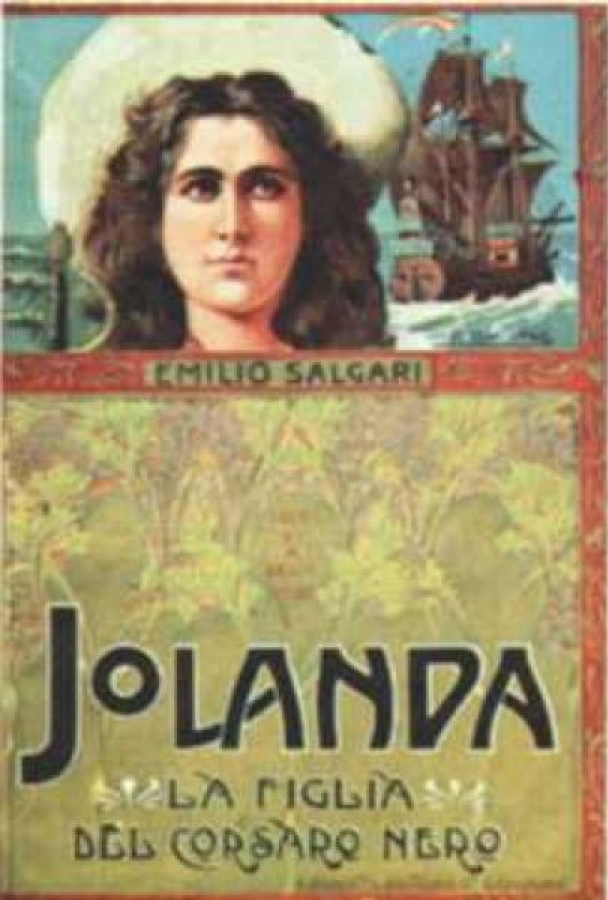
Jolanda, the Daughter of the Black Corsair
Title of the original version reviewed: «Jolanda la figlia del corsaro nero»
AI Translation Notice: This review was translated from the original Italian using artificial intelligence. Book quotes and excerpts are translated interpretations and will not match the author's original English phrasing or official published translations.
The novel is, in a sense, the continuation of The Black Corsair.
Jolanda, the pirate’s daughter, returns to the Caribbean to reclaim her mother’s inheritance.
Here, she is repeatedly abducted by the Count of Medina, her grandfather’s natural son, who seeks to seize Jolanda’s fortune and, above all, avenge the killing of his father—Jolanda’s grandfather—at the hands of the Black Corsair.
Morgan, the pirate friend of the Black Corsair, fights to free Jolanda, culminating in the slaying of the Count of Medina and his marriage to Jolanda, who in the meantime has fallen in love with him.
The plot provides the occasion for a series of adventures that unfold across the Caribbean Sea, Venezuela, and Central America, through a succession of naval battles, sieges of Spanish cities, and tempests.
The style remains characteristically Salgari’s—brisk and fast-paced in depicting martial engagements—though it must be noted that the narrative suffers from a slackening rhythm and a repetitiveness that at times makes for tedious reading.
The finest part of the book is the account of Jolanda and Morgan in the Venezuelan jungle.
With the pirate gravely wounded, the young woman is swiftly forced to contend with an astonishing and hostile wilderness, the threat of wild beasts, and attacks by savages.
This unfolds as a form of initiation open to multiple interpretations: the exaltation of a heroic figure—here embodied by a woman—the portrayal of an exotic natural world (Salgari’s hallmark exoticism), the passage from youth to adulthood, and the confrontation between the resolve of the will and an antagonistic external environment.
As with the story of The Black Corsair, a psychoanalytic and autobiographical interpretation of the tale is possible, focusing specifically on Jolanda’s trials in the forest.