Finished reading on: May 14, 2016
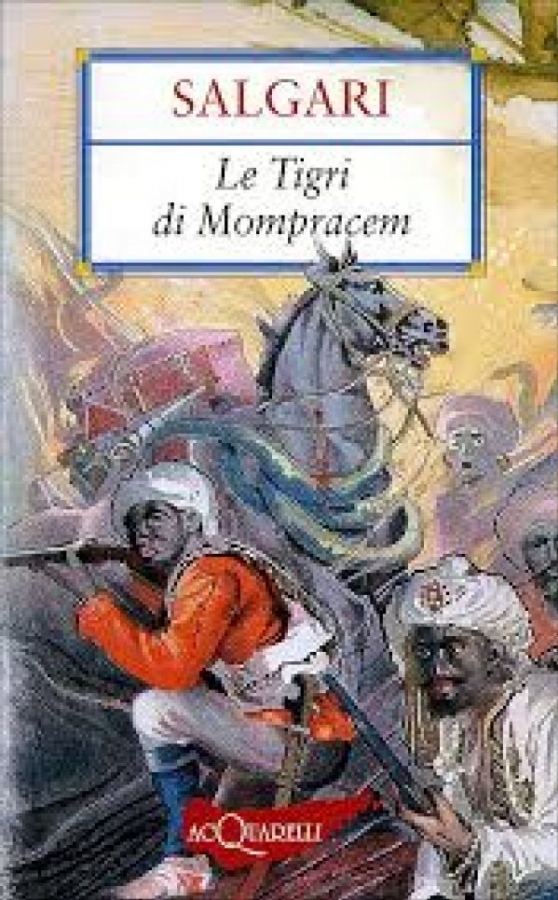
The Tigers of Mompracem
Title of the original version reviewed: «Le Tigri di Mompracem»
AI Translation Notice: This review was translated from the original Italian using artificial intelligence. Book quotes and excerpts are translated interpretations and will not match the author's original English phrasing or official published translations.
Sandokan
has a broad forehead, shaded by magnificent, boldly arched eyebrows, a small mouth that reveals teeth as sharp as those of wild beasts and gleaming like pearls; two pitch-black eyes, possessing a brilliance that fascinates, that burns, that forces any other gaze to drop
.
He is the "Tiger of Malaysia", "leader of the fierce pirates of Mompracem", sworn enemy of the British, avenger of oppressed peoples, but also an assassin, cruel, ferocious, terrifying.
And so he would have remained, had word not reached him of a woman of great beauty, known as the Pearl of Labuan.
An "irresistible force" drives him toward this maiden.
He sets out with a few ships and encounters a British cruiser; his fleet is destroyed, his men are killed or drown, and he himself, gravely wounded, barely manages to survive.
I will recover (...) and he uttered that word with such energy as to make one believe he was the absolute arbiter of his own existence
, then fear (
the darkness (...) I do not want to die!...) and finally madness.
Completely beside himself, he rushed forward frantically.
(...) He believed he saw enemies everywhere.
(...) Human beings rose from the ground groaning, screaming, some with bleeding heads, others with severed limbs and torn flanks.
All were laughing, sneering, as if mocking the powerlessness of the terrible Tiger of Malaysia
.
Sandokan’s delirium is the product of fever and physical exhaustion; the nightmares also arise from the resurfacing in his conscience of all the evil he has done, his ruthlessness, the many dead of his existence.
What prevents him from descending
into the depths of the earth
is love.
After losing consciousness, he comes to in Lord James’s house, where he is cared for by Marianna, the Pearl of Labuan, with whom he falls madly in love: a passion immediately reciprocated.
The novel, which seemed to be sliding down the slope of interior soul-searching, regains the typical rhythm of Salgari’s great books: discovered, Sandokan flees, only to return later to free Marianna and take her away; he succeeds thanks to his friend Yanez, who tricks Lord James into undertaking a journey, thereby exposing him to the pirates’ assault.
Together at last, Sandokan and Marianna take refuge on Mompracem; to win back the young woman, the powerful Lord James gathers a formidable fleet, which attacks and captures the pirate stronghold after a great battle.
It is true that
for that heavenly creature, for her I shall have to lose everything, everything, even this sea that I called mine and considered as the blood in my veins.
(...) Everything is dead or about to die here
.
Marianna asks Sandokan whether he regrets his past power and whether she herself should wield
the scimitar", the pirate answers her plainly: "You! You!, he exclaimed, No, I do not want you to become such a woman.
It would be a monstrosity".
A choice must be made, also because "two happinesses (Marianna and Mompracem) would be too much and I do not want them, (...) and that man, who had never wept in his life, burst into sobs, murmuring: The Tiger is dead, and forever!"
The book went through five versions, from the first edition in 1883 to the last in 1891, testifying to a troubled writing process: the author could not find the right register for an audience largely composed of young readers.
In particular, it lacks those narrative devices that give pace and surprise to Salgari’s tales.
There are some amusing episodes (for instance, when Sandokan and Yanez hide inside a large stove and by pure luck go undiscovered), others seem somewhat contrived and far-fetched, such as the clash between an ape and a panther, while still others recall Salgari’s intense naval battles without the tension and plot twists that typically distinguish them.
The author fails to engage the reader because the narrative focuses too heavily on the figure of Sandokan—fascinating, to be sure, but rigid and roughly hewn; nor is he leavened by other characters, as would happen later, when Yanez takes on an expanded, almost protagonist role.
Salgari’s craft is not yet fully mastered, and to achieve this the author would have to conceal his own existential anxieties more thoroughly, moving only within a more superficial yet more captivating realm: that of adventure.
Why read it? Despite its limitations, the hero Sandokan possesses a powerful appeal.