Finished reading on: May 04, 2019
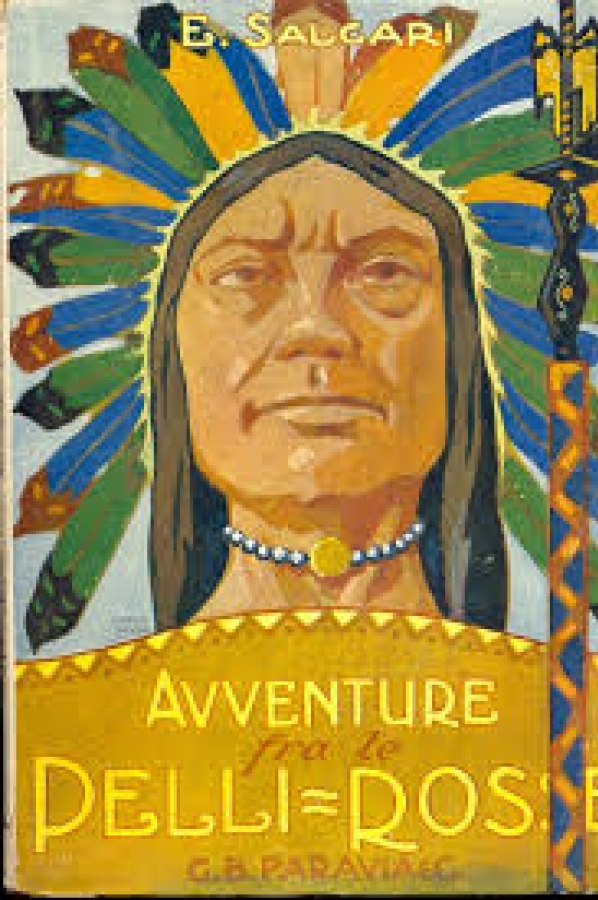
Adventures Among the Redskins
Title of the original version reviewed: «Avventure fra le pellirosse»
AI Translation Notice: This review was translated from the original Italian using artificial intelligence. Book quotes and excerpts are translated interpretations and will not match the author's original English phrasing or official published translations.
The novel, published under the pseudonym Guido Landucci, is an adaptation of one of the earliest Western-genre tales, written in 1837: Nick of the Woods: A Tale of Kentucky by Robert Montgomery Bird. Perhaps for this reason, the novel exhibits several unique traits compared to Salgari’s typical approach. The author’s traditional formula is as follows: a hero, often defrauded of his wealth and social standing, is flanked by supporting characters whose role is to lighten the protagonist's profile, which is most often rigid and unyielding. At times, the author introduces disconcerting and ambiguous elements: as in La Stella dell'Araucanìa, where a nobleman turns cannibal through his contact with savages, corroborating the dark side inherent in each of us, even the civilized. In Avventure fra le pellirosse, the paradigm shifts: a secondary character reveals himself to be the protagonist, while the narrative—dense with dialogue, as usual—is interspersed with accounts of gruesome, bloody massacres perpetrated by redskins; an element in stark contrast with Salgari’s naive anti-colonialism, which routinely championed oppressed peoples. Let us turn to the plot. Two young people, Rodolfo and Mary, arrive in Texas in search of gold: they have been stripped of the inheritance of an exceedingly wealthy uncle, whose will was contested by the guardian of a young boy named as heir. From the outset, it is evident that the two youths have no grasp of the perils awaiting them: a vast, desolate prairie that turns into dense thickets near the Pecos River—a river that must be crossed if one hopes to reach the areas rumored to harbor gold. Joining the expedition are other characters worth noting: Telie, a young woman desperate to find her father who was abducted by Indians, and Morton the Bloodthirsty, accompanied by his inseparable little dog. He is a Quaker, regarded as “the most inoffensive man on the plain,” armed with an ancient, “almost” ruined rifle and a knife that “had probably never left its sheath to slay an Indian.” Roaming the plains alongside the savage redskins is Scibellok, believed by the Indians to be an infernal spirit: he kills them by crushing their skulls, leaving a cross carved into their chests as his signature mark. We find ourselves squarely in the territory of the classic English Gothic novel! Rodolfo is a valiant youth, yet utterly incapable of leading the small party; indeed, after various misadventures, the two girls, Mary and Telie, are kidnapped by the Indians. In an attempt to rescue them, Rodolfo is taken prisoner as well. At this juncture, we discover that Telie’s father has become an Indian chief and, worse still, is in the pay of the treacherous guardian: the latter intends to marry Mary and murder Rodolfo, since the genuine will names the two youths as the rightful heirs. Morton, too, is captured.
The Black Vulture is not accustomed to sparing his prisoners. I love slaughter, and I do not disdain drinking the blood of white men. (...) Morton (...) had been seized by a nervous trembling so violent that he could no longer stand on his feet. Whether it was the shock, fatigue, or something else, the trembling had turned into a convulsive seizure
. The Black Vulture believes Morton to be a great sorcerer capable of leading him to Scibellok, the exterminator of the redskins. Do you want to know the ending? I will not spoil the surprise; suffice it to say that it all concludes with a happy ending.
The novel is a miscellany, effectively blending Salgari’s style—typically rational and mechanistic—with Montgomery Bird’s redundant, brooding Gothicism. Morton is the protagonist, and in his figure pacifism and hatred, communal belonging and isolation, strength and fragility converge: conflicting sentiments that cannot coexist for long, foreshadowing a terrifying and harrowing end. There is also a peculiar sidekick: a little white dog—a novelty for Salgari—the faithful companion of a recluse and an extraordinary guide across the vast prairie. Furthermore, all the ingredients that make Salgari so beloved are present: the relentless succession of adventures, the surprises, the cliffhanger chapter endings heralding further action, the compulsive urge to read on. The Italian author does not linger; he charges straight ahead with his brisk, gripping narrative pace.
Why read it? It is not entirely Salgari’s own creation, but it is masterfully adapted and an absolute pleasure to read.