Finished reading on: February 06, 2024
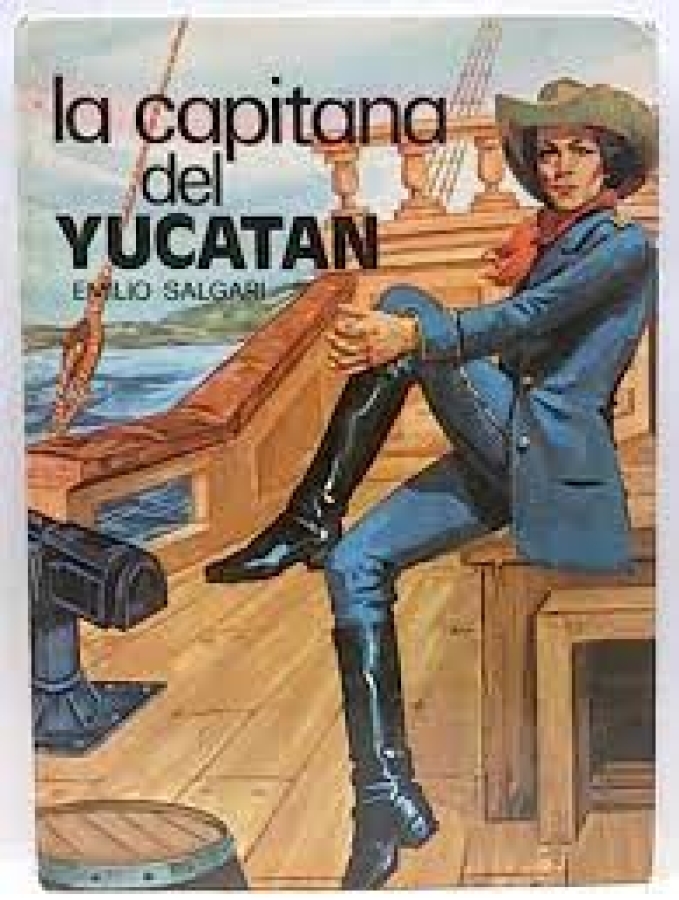
The Captain of the Yucatan
Title of the original version reviewed: «La capitana del Yucatan»
AI Translation Notice: This review was translated from the original Italian using artificial intelligence. Book quotes and excerpts are translated interpretations and will not match the author's original English phrasing or official published translations.
The novel is set in Cuba during the Spanish-American War of 1898, which led to Spain losing its final colonies. A “yacht,” the Yucatan, must run the United States naval blockade to bring weapons and provisions to the Spanish troops, who are in dire straits due to the concurrent advance of the pro-independence rebels and the pressure of the mighty American fleet. It is a small vessel, yet a masterpiece of engineering: its engines allow it to reach twenty-six knots, its steel hull is divided into several watertight compartments and fitted with a protective belt made of coconut fibers, rendering it unsinkable. And a marvel of technology! The “yacht” can submerge itself, leaving only its deck visible, so as to appear as a piece of drifting wreckage. Salgari too was dazzled by the wonders of technology, or perhaps sought in this way to emulate the allure of Jules Verne’s Nautilus, his direct rival. In command of the Yucatan is the Marchioness de Castillo. The Capitana
had a handsome head, crowned with an abundant mane of hair, of a deep, sombre black and wavy like that of Spanish gypsies, (...) she had skin of that lusterless pallor, of a strange hue found only among the Creoles of the Greater Antilles, (...) eyes of a consummate black, (...) long, silky eyelashes, (...) lips as red as a pomegranate. After such a description, we would have expected an enthralling tale like that of Yolanda, the Daughter of the Black Corsair or an ambiguous and mysterious one like the story of Capitan Tempesta (see reviews on this site); instead, the Marchioness de Castillo remains on the margins, emerging only fitfully and in a supporting role, while the true protagonist is Lieutenant Cordoba,
a sea dog (...) rather short in stature, all sinew and muscle, with an angular face bronzed by the sun of the torrid zone and the brine of the sea air. It is he who leads the Yucatan and its crew through a succession of adventures, at sea and on land. In one of these exploits, Cordoba, aboard a small launch, releases torpedoes against a gunboat, blowing it up and clearing the way for the small vessel; in another, the Yucatan conceals itself in a sea cave; in yet another, it skillfully slips away amidst a multitude of reefs and shoals. We are on the southeastern coast of Cuba, facing Mexico, riddled with islets and fjord-like sea channels, rich in a luxuriant nature that is consistently depicted in sombre tones, as if to foreshadow the sorrowful conclusion. The sea is inhabited by
splendid jellyfish resembling large lamps of frosted glass, of an exceedingly pale hue
; the flamingos take on a fantastical appearance, with their tails
covered in feathers of a splendid carmine pink, which along the wings turns into a magnificent coral red or fiery red
; in the forests, giant mango trees predominate, with
immense lianas climbing up and down the trunks in a thousand contortions or clinging to an infinity of parasitic plants that formed dense festoons
; and
the air is so heavy with moisture that it corrupts everything
, everything spoils, turns moldy, decomposes; over all hangs the terrible yellow fever. Amidst these noxious miasmas, the Yucatan runs its final course. The power of the United States is overwhelming! The marvelous vessel cannot be surrendered to the American imperialists; far better to scuttle it with dynamite.
The Marchioness cast a tearful glance upon the smoldering hulk, half-submerged between the water and the sand, and murmured with a sigh: “Our mission is ended!”
To a greater extent than in other novels, Salgari the popularizer comes to the fore. Interweaving landscapes familiar to him with the accounts of travelers and geographers (who, in the second half of the nineteenth century, were also possessed of vivid imaginations), the writer depicts the sea and coasts in meticulous fashion, rich in naturalistic and nautical detail. He adopts the same approach in recounting the Siege of Santiago, enumerating American warships and illustrating the various engagements. On one side stand the valorous yet ill-fated Spaniards, and on the other the treacherous Americans,
the financiers' syndicate
, the cowardly blacks (
huge, clumsy hats, gigantic feathers, (...) a frantic trembling)
, and the Creoles who lack courage—perhaps, Salgari wonders, owing to the climate or the relentless Spanish oppression. One detects a whiff of racism or, more mundanely, a desire for vindication following Italy's crushing defeat in Ethiopia (the Battle of Adwa took place in 1896). This didactic intent weighs down the narrative pace, fragmented and bogged down by excessive digressions. Moreover, the character ensemble typical of Salgari’s novels, which usually helps leaven the plot, is conspicuously absent: a dark, brooding protagonist flanked by two sidekicks, often lightly ironic and shrewdly pragmatic. Here, Cordoba dominates the scene, a figure far too conscious of his own superiority as an old sea dog to leave room for the other players—even the Capitana herself, who, indeed, professes to be his pupil.
Why read it? It is verbose and at times repetitive, yet it offers a compelling glimpse into a little-known chapter of history.