Finished reading on: January 06, 2020
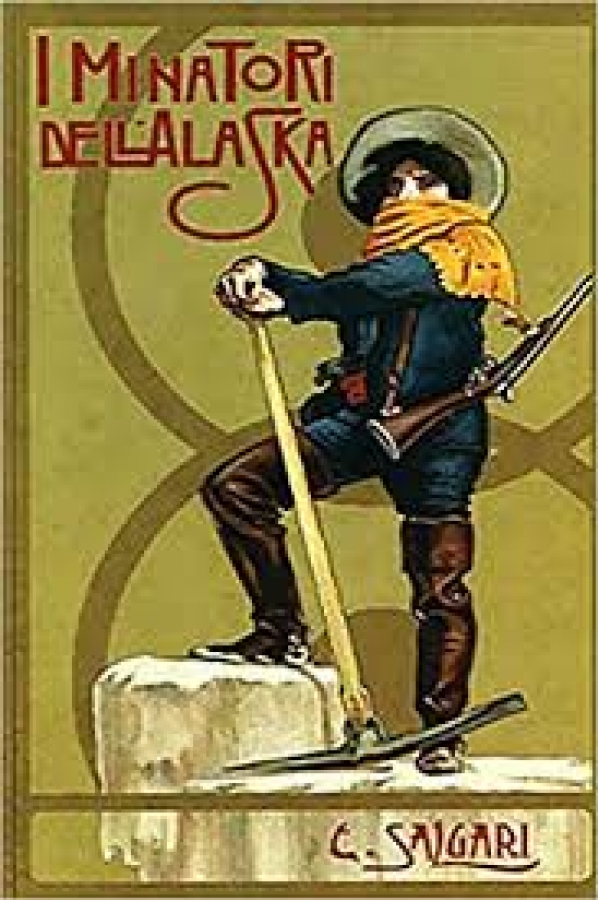
The Alaskan Miners
Title of the original version reviewed: «I minatori dell'Alaska»
AI Translation Notice: This review was translated from the original Italian using artificial intelligence. Book quotes and excerpts are translated interpretations and will not match the author's original English phrasing or official published translations.
The true title of The Miners of Alaska ought to be The Great Crossing of the Plains and the Rocky Mountains All the Way to Alaska; indeed, the search for gold is marginal to the overall story, serving merely as an occasion for Salgari to depict the North American environment as it was related in the nineteenth century. To gain insight into the true history of the American West, and of the United States, I recommend Massimiliano Galanti’s book La questione indiana (Odoya, 2016). The formula is classic Salgari. There is the protagonist, Bennie the Great Hunter, described thus:
tall, muscular, with powerful arms, a broad chest, a forceful head covered with long, ringleted black hair that was already beginning to turn grizzled, with piercing eyes and a goatee trimmed to a point
. In short, Buffalo Bill! Serving as sidekicks, in keeping with the traditional Salgarian mold, are: a Mexican companion of Bennie's (
very dark-complexioned, chubby, (...) with pitch-black eyes, the true Hispanic-American type
) and two Italians, survivors of an Indian raid. Falcone has been scalped and miraculously survived; he has an intimate knowledge of the gold-rich mines of Alaska and possesses a crucial instrument for seeking the precious metal: a special sieve that allowed one to separate the gold from the dirt without wading into the water. Armando, Falcone's nephew, has only recently arrived in America, but will prove to be a skilled marksman and an excellent companion to Bennie in hunting and in clashes with the Indians. This group decides to set out for Alaska to capitalize on Falcone's knowledge and his useful implement. The long journey is a succession of adventures: not only escaping treacherous Indians, but also measuring oneself against a wild and mesmerizing nature. The pattern repeats itself with a certain monotony: Bennie and Armando wander away from camp to scout the surrounding area and track down game; they encounter treacherous terrain and must battle terrifying beasts, such as the great brown bear, wolf packs, and stampeding herds of bison. Everything is here: from mysterious dancing plants (tumbleweeds swept along by the wind) to accounts of cannibalism, all the way to the discovery of prehistoric animal remains. It is easy to smile at the travel accounts of nineteenth-century explorers, narratives from which Salgari drew copiously, naturally superimposing his own feverish and inexhaustible imagination. We must allow ourselves to be carried away by a fabulous century, steeped in prejudice and brimming with evocative charm: let us read our beloved author's descriptions of nature with relish.
The moon had set by then, and a dense darkness had fallen across the immense plain. (...) Bennie (...) gazed in all directions, tracking with his eyes the capricious fiery trails of the fireflies, and listening to the monotonous chirping of rejoicing crickets, the distant cries of coyotes, the lowing of cattle
. If this reminds us all too much of our own landscape, what can be said of the
meadows formed of tiny mosses of a splendid emerald hue (...) the clearings were covered with expanses of stony, tenacious lichen, resembling dried mushrooms, or tall, pitch-black mosses, soaked with moisture
. And from whom did Salgari draw this raw portrayal of the Alaskan miners?
More than human beings, they seemed beasts brutalized by hard labor and privation. They were all ragged, filthy, their shirts blackened by campfire smoke or soiled by mud from the pits, their trousers patched in a thousand ways, their boots worn through and leaving their toes exposed, hats defying description or hoods that had long since lost their fur: yet all wore belts bristling with revolvers and gleaming bowie knives
. Were they not armed, they might well be our own miners from Mount Amiata or the mines of Porto Empedocle. What a contrasting attitude Salgari displays toward the redskins compared to the wretched souls prospecting for gold! The former treacherous, cruel, and superstitious; the latter greedy and desperate, yet not devoid of a kind of justice. A child of the nineteenth century, our beloved author could hardly avoid a touch of racism!
Within Salgari's vast output, we are dealing with a minor novel, albeit sustained by the brisk pace of its adventures and the pursuit of the marvelous. Plot twists and gear shifts are lacking: the enemies are bound to succumb, pretty much all in the same manner—whether they be Indians, outlaws, or ravenous wolves: a rifle shot, an audacious and unexpected stunt, a prudent and shrewd strategy. Nor is there any dynamic between the characters: Bennie is a hero devoid of passion (did he ever have a sweetheart? did he suffer injustices?), and those who ought to serve as his foils are faded figures, lacking that vibrancy and irony that distinguish so many of Salgari’s minor characters.
Why read it? It is packed with adventure; I particularly recommend the chapter recounting the wolf attack.