Finished reading on: August 23, 2008
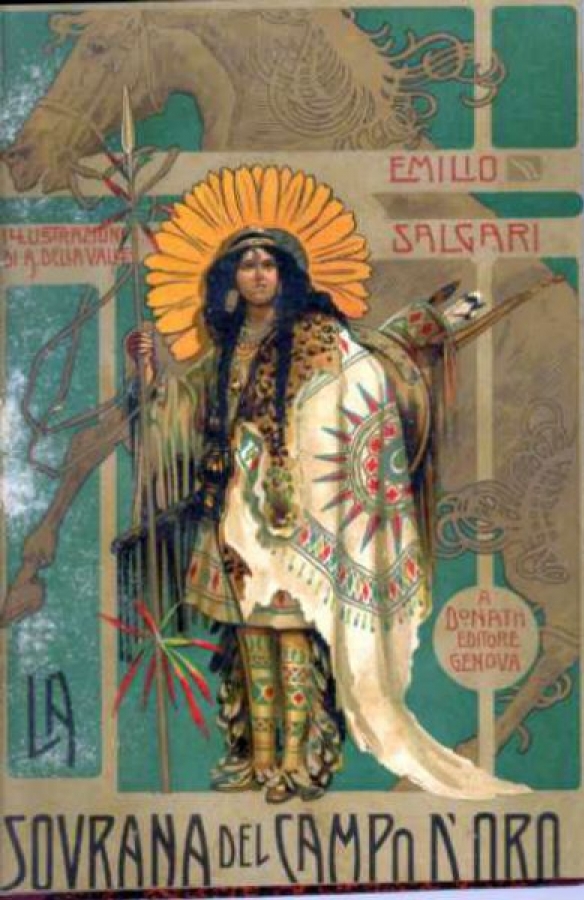
The Sovereign of the Golden Field
Title of the original version reviewed: «La sovrana del campo d'oro»
AI Translation Notice: This review was translated from the original Italian using artificial intelligence. Book quotes and excerpts are translated interpretations and will not match the author's original English phrasing or official published translations.
This novel belongs to the Western cycle.
Influenced by the figure of Buffalo Bill, Salgari developed a series of stories set against the historical backdrop of the mythical conquest of the West, amidst heroic figures, savage Indians (Apaches and Navajos), and American villains.
A young woman (the Sovereign of the Golden Field), whose father has been abducted by bandits demanding a hefty ransom, decides to put herself “up for auction” to raise the sum required to free him.
The winner of the auction will take her as his bride.
Participating in the auction are a young engineer and a wealthy black man who oversees the crab fishing and trade, controlled by the Chinese; for this reason, he is known as the King of the Crabs.
The young engineer lacks the funds to rival the wealthy merchant, yet, with the help of a young clerk, manages to outwit the King of the Crabs, win the auction, and flee into the West with the young woman to rescue her father.
Naturally, the villainous merchant sets off in pursuit.
Everyone travels by train, the revolutionary conveyance that collapses distances and stands as emblematic of American technological superiority.
A sequence of adventures unfolds aboard the train; we witness the passage of an enormous herd of bison; and finally the three youths—the girl, the young engineer, and the clerk—set out on foot through Apache territory to reach the hideout where the father is held captive.
Accompanying them are Buffalo Bill and a handful of valiant men.
Further adventures ensue, as the wealthy merchant, joined by a band of ruthless Mexicans, remains in hot pursuit.
While fleeing the villain, the three youths are captured by the Apaches.
We witness a sort of trial convened by the Indian chiefs, in which white society is indicted (this is the novel’s political juncture, where Salgari’s anti-colonialist vision reemerges).
The three youths are condemned, but the young engineer and the clerk manage to escape (via a subterranean stream), while the young woman remains a prisoner.
The narrative reaches its pivotal moment: a duel between the young American woman and an Indian warrior woman, from which the former emerges victorious.
From that point on, the novel slides toward a happy conclusion: Buffalo Bill arrives, the kidnapper's hideout is uncovered—the villain having meanwhile joined forces with the wicked merchant—and ultimately the father is freed and the villains vanquished.
The plot is highly intricate, but unlike the novels of the Malaysian cycle and the Caribbean cycle, it lacks narrative tension.
First and foremost, the author fails to create that suspense, that sense of anticipation characteristic of the works in the other two cycles: one senses something artificial and contrived, which the plot’s intricacy futilely attempts to replace.
Secondly, at the center of the novel stands the figure of a heroine, hardly a novelty for Salgari if one recalls Jolanda, la figlia del corsaro nero and La regina dei Caraibi.
In this instance, however, the heroine is a cold character who remains impassive even in the face of death, betraying no affection toward the enamored young engineer.
She is all strength and all courage—perhaps how Salgari imagined the American woman.
What constrains the entire novel, perhaps, is an admiration for American society that feels too conventional to lend emotional depth to the characters and their setting.
Only the plot remains.