Finished reading on: May 01, 2018
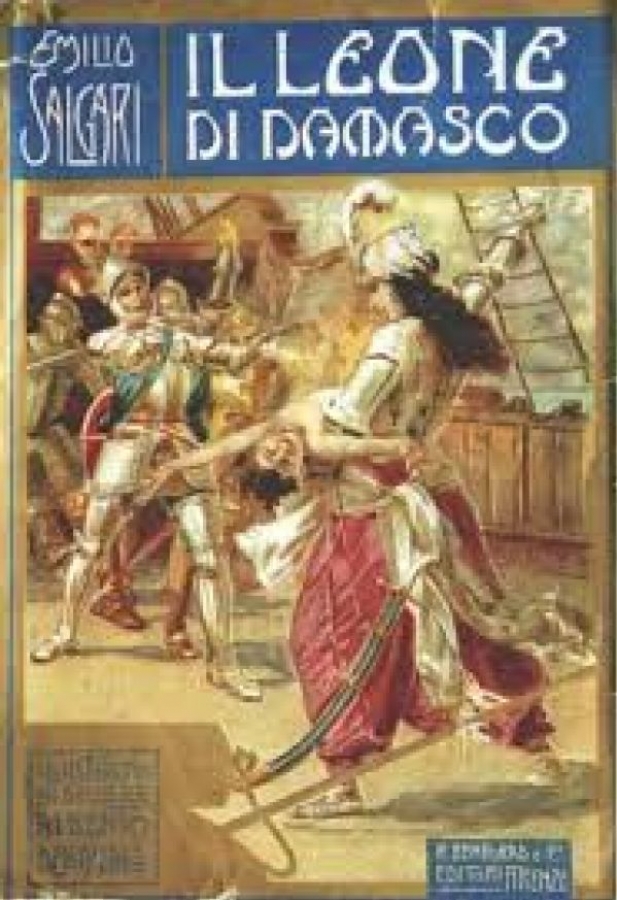
The Lion of Damascus
Title of the original version reviewed: «Il Leone di Damasco»
AI Translation Notice: This review was translated from the original Italian using artificial intelligence. Book quotes and excerpts are translated interpretations and will not match the author's original English phrasing or official published translations.
The novel is meant to be the sequel to Capitan Tempesta, a tale set in Famagusta in 1517 during the war between the Venetians and the Turks.
The protagonist was a young noblewoman: a skilled swordswoman who, disguised as a man, had set out in search of her betrothed, abducted by the terrible Haradja.
Salgari had succeeded in crafting a story full of allure, working upon gender ambiguity, vigorous female figures, and a final plot twist: the love between Capitan Tempesta and the Lion of Damascus—a passion that disregarded different allegiances, both national and religious.
One would expect the same intriguing atmosphere and the very same freedom from convention.
And the opening shows promise, even if certain signs make it clear from the outset that the story will take a different turn.
It begins with the figure of Haradja:
a very beautiful young woman (...) pitch-black eyes, (...) very long, loose hair, of a hue that gleamed like raven wings...
(...) the whole of her face had (...) something hard and forceful that instantly betrayed the Turkish woman, ever cruel at heart, as the bloodthirsty sultans of the fifteenth and sixteenth centuries had by then accustomed them to be
.
Haradja is no longer an unconventional woman: she is part of a cruel and bloodthirsty breed, that of the Turks, and foul black birds, "eaters of the dead," are the living symbol of thousands upon thousands of corpses, left in the sun to be stripped of their flesh.
A grim and deathly atmosphere pervades the entire narrative and strips of narrative momentum the adventures that Salgari, despite everything, attempts to construct.
Haradja seeks vengeance against Capitan Tempesta, who deceived her by posing as a man and with whom she had become infatuated; she also intends to punish the Lion of Damascus, formerly her betrothed, who had abandoned her for the Christian noblewoman.
She therefore kidnaps the couple’s son and the father of the Lion of Damascus.
She holds all the cards: overcome by hatred and above all by pride, she challenges Capitan Tempesta to a duel.
The two horses had collided with such impetuosity that they nearly threw their mistresses from the saddle; then came a clattering of weapons against armor.
(...) Haradja continued to attack, trying to force down that sword which flashed with fiery gleams beneath the already scorching rays of the sun.
(...) By the death of Allah!, cursed the Pasha's niece (Haradja), (...) You stand firm as a rock, do you?.. And yet I shall kill you! (...) A cry was heard, or rather, the howl of a wounded beast; then the great admiral's niece crashed to the ground with a great clash of steel.
(...) Finish off the tigress of Hussiff!
, shouted the Lion of Damascus; but numerous Turkish soldiers rushed in, preventing Capitan Tempesta from slaying her terrible rival.
It is the finest moment of the novel; thereafter, the narrative loses its bite: Haradja and Capitan Tempesta vanish from the story, the Lion of Damascus is present but relegated to the background, faded and irrelevant, while minor characters emerge who, as often happens in Salgari, try to inject brio and establish a dynamic among the roles; meant to act as foils to the protagonist, they merely underscore his insubstantiality.
Instead, a real historical figure comes to the fore: Sebastiano Veniero, the great commander of the Venetian fleet, to whom, according to Salgari, the victory of Lepanto against the Turks was owed.
The narrative draws to a weary close.
The book was published in 1910, a year before the Libyan War (1911–1912), which pitted Italy against the Ottoman Empire.
It is possible that Salgari tapped into sentiments widespread among public opinion: the Turk as a cruel oppressor of peoples, bloodthirsty and treacherous.
The novel abounds in massacres, tortures, flayings, quarterings, and other gruesome deeds: there is no mercy on the part of the Turks, nor any chivalrous respect for the vanquished.
And the Christians know how to die with honor, whispering the Miserere "in the excruciating agony of the horrific torment"! Yet there is too much relentless ferocity here to believe that the novel's deathly atmosphere merely answers to an editorial demand or a nationalist resurgence on the author's part.
Salgari took his own life the year following its publication, in 1911: the writer was by then living in a profound depression, plagued by frequent self-destructive crises and numerous suicide attempts; the novel mirrors Salgari's despair and his fascination with a gruesome end.
At the same time, the narrative suffers from a weariness and an exhaustion of ideas, which the writer desperately tries to compensate for by resorting to prefabricated formulas, no longer embedded within a dynamic narrative framework: evidence of this lies in the repetitiveness of dialogues and scenes, the weakness of the characters, and the sparse descriptions of landscapes—the latter set against a peculiarity of the novel: historical digressions, generally rare in Salgari's oeuvre, a clear sign of a narrative vein that had grown fragile.
Why not read it? It is a swan song, a bitter and sorrowful epilogue to a great writer.