Finished reading on: May 24, 2026
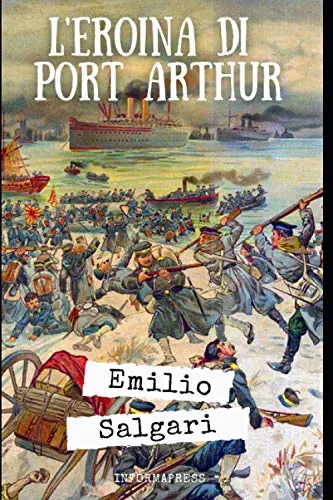
The Heroine of Port Arthur
Title of the original version reviewed: «L'Eroina di Port-Arthur»
AI Translation Notice: This review was translated from the original Italian using artificial intelligence. Book quotes and excerpts are translated interpretations and will not match the author's original English phrasing or official published translations.
Emilio Salgari was exceptionally swift at fashioning stories around events that gripped the public imagination; he did so by blending a certain exoticism with wars and romantic intrigues. Such had been the case with La capitana del Yucatan and Le Stragi delle Filippine (see the reviews on this site), and so it is in this novel, published under a pseudonym in 1904. The backdrop is the Russo-Japanese War of 1904–1905, in which
"little Japan," as the Russians contemptuously called it,
confronted and defeated the vast Russian Empire. The setting is Port Arthur, the gateway to the conquest of Korea and at the time in Russian hands. The narrative opens with a scene of simultaneous splendor and decay: a daimyo (that is, a feudal lord) passes through the crowd alongside his stunning daughter, Shima.
She was barely sixteen, (...) not tall, exquisitely proportioned, with deep black eyes that bore no trace of slant, (...) skin with alabaster hues, (...) with a lovely little mouth, its somewhat thin lips hinting at an extraordinary resolve.
A lavish reception is set to take place at the daimyo’s residence to celebrate Shima's betrothal to Boris, a Russian officer. The prospective groom fails to appear: he is having an affair with a geisha and knows that war with Japan is imminent, rendering marriage to a Japanese woman impossible. The city is steeped in an atmosphere of tense anticipation, which allows the two women to face one another: Shima,
with blazing eyes and an inflamed countenance,
demands to know whether the geisha truly loves Boris; the other implores her to let her keep her love,
why wrest from me, a poor geisha, the love of a single man—the only one who has ever truly loved me, and whom I love? I am a wretched flower cast to the mercy of the wind, destined to wither unless someone gathers me and exposes me to the dew and the sun.
Never in his numerous novels had Salgari chronicled a conflict of such passion and social resonance, pitting a beautiful, wealthy aristocrat against a destitute prostitute in love. In a writer so attuned to public sentiment, one detects echoes of Gabriele D'Annunzio, Guido Gozzano, Gian Pietro Lucini, and French poètes maudits such as Paul Verlaine and Charles Baudelaire. Regrettably, this social and romantic conflict fails to evolve, cut short by the outbreak of war; upon both women falls a single, overriding duty: to serve the homeland, Japan.
The homeland!, exclaimed the geisha, in a sudden burst of fervor, (...) The danger facing our homeland in this solemn hour unites the common people and the nobility for the supreme defense of the country, bridging the abysses that divide them, Shima said in a solemn voice. She drew her into her arms and kissed her on the forehead, saying: for the homeland!
And we are no longer in distant Port Arthur; it is as if we were commemorating the martyrs of Dogali and Adwa, the heroes who defended the Nation against the fierce Ethiopians! Salgari extols a nationalist, colonialist, and irredentist Italy, which would march exultantly into Libya and later to liberate Trento and Trieste in the catastrophic slaughter of the First World War. "Little" Japan becomes the mirror of modern Italy: its war dead the future martyrs, the two women the archetypes of all the mothers, wives, and daughters who will sacrifice their personal affections for the Motherland.
A keen reader of war correspondence, Salgari displays a remarkable grasp of the dynamics of the naval clash unfolding at Port Arthur, where the formidable Japanese fleet, deftly commanded and equipped, pinned the Russian vessels inside the harbor before closing the city in a pincer movement from sea and land. Yet it is precisely the sheer scale and protracted duration of the battle that make it difficult for Salgari to provide overall clarity and highlight the dramatic turns of events. The author operates far better when only a few ships clash, making it easy to focus the reader’s gaze on the pivotal locations of the action. In the same vein, Salgari abandons his customary narrative blueprint of a central figure supported by secondary characters. Here that role might have belonged to Shima, but the "heroine" is overwhelmed by events, struggling to coexist with the minor figures. And where is the enemy, the traitor Boris? This incomplete and ill-defined system of characters stands as the novel's primary weakness.
Why read it? For a fleeting spell, one conjures up the Salgari of Il Corsaro Nero (see the review on this site).