Finished reading on: May 09, 2017
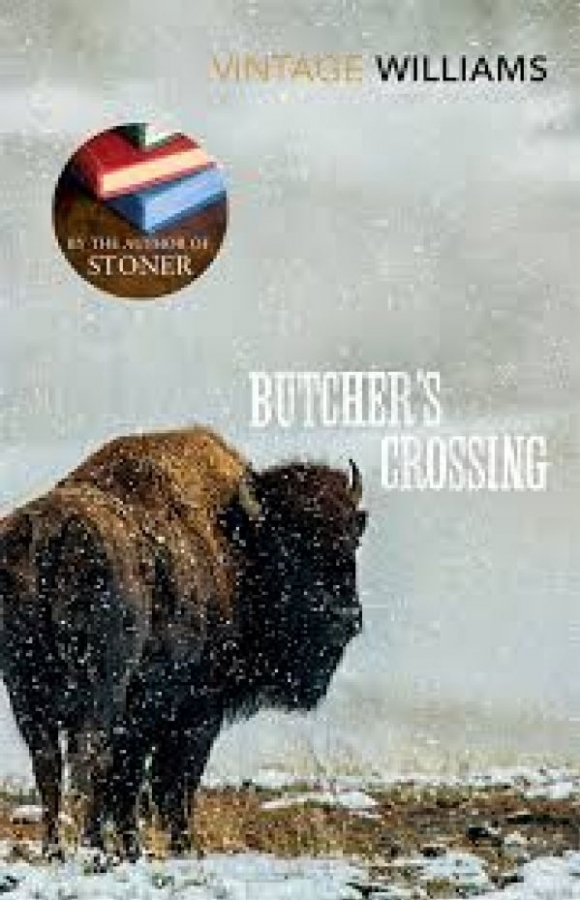
Butcher's Crossing
AI Translation Notice: This review was translated from the original Italian using artificial intelligence. Book quotes and excerpts are translated interpretations and will not match the author's original English phrasing or official published translations.
The year is 1873 and Butcherʼs Crossing is a Kansas town, in reality a small settlement of buffalo hunters.
Andrews is a twenty-year-old youth; he has abandoned Boston for a vague notion of freedom.
Sometimes, after listening to the hushed voices in church and school, he would pass beyond the borders of Cambridge into the lands and woods lying to the southwest.
There, in some solitary place, standing motionless upon bare ground, he felt his mind fill with the clear air and plunged into infinite space: the emptiness and constraint he felt were dissolved in the wild nature that surrounded him
.
The young man meets a hunter and allows himself to be drawn into a venture: to go beyond the Great Plains, into the mountains, where thousands of buffalo still graze.
He realized that the hunt was merely a stratagem, a deception practiced upon himself.
(...) No business impelled him...
he was going there for freedom
.
An odd team is assembled: Miller the leader, a paranoid hunter who kills buffalo for the sheer pleasure of it, and not merely out of greed; Schneider, a pragmatic and cynical man, tasked with skinning the beasts with Andrewsʼs help; and with them an old alcoholic madman, Charley Hoge.
With this group, Andrews ventures into the Wild West—at once an adventure and a physical and spiritual transformation.
They represent another vastness and another horizon, yet the young manʼs mind remains “full of the wonders he had known as a child.”
Francine, a prostitute, tells him affectionately, smiling gently:
you will come back; but you wonʼt be the same.
You wonʼt be so young; you will become like the others.
Andrews looked at her, confused, and in his confusion cried out: I will only become myself
.
The stages of his transformation, from youth to adulthood, are marked by the different phases of the journey.
First, they travel for many days across the Great Plains, and Andrews must accustom himself to the long hours on horseback in a flat and monotonous landscape:
he felt like the earth, identityless and formless (...), he sensed his body slowly becoming lean and strong: he thought at times that he was entering into a new body, or a real body, previously concealed by an unnatural softness, whiteness, and delicacy
.
The second phase consists of the buffalo hunt: the merciless slaughter, the beast skinned and butchered.
To Andrews, the entire business seemed like a dance, a dark minuet
; the endless slaughter like
a mechanism, an automation, (...) like a cold, senseless response to life.
(...) He realized he was turning away not out of some womanish nausea at the blood, (...) but from the shock of seeing the buffalo, moments before proud and noble and full of dignity, now stripped and helpless, an inert piece of flesh.
(...) Its being had been killed, and in that killing he felt the destruction of something within himself, and he was unable to face it
.
And finally, there is the long winter: the group finds itself trapped by snow until spring, freezing and completely isolated.
He came to accept the silence in which he lived, and no longer sought any meaning in it.
(...) He vaguely recalled the comforts of his home in Boston; but that seemed unreal and distant, and of those thoughts there remained only faint ghosts of remembrance
: a sort of alienation, a loss of consciousness and identity.
The wilderness, inscrutable and indifferent, gets the better of the young manʼs dreams: it creates a hard man, incapable of affection, solitary and individualistic.
And when the party finally returns to Butcherʼs Crossing, having lost their entire cargo of hides while crossing a swollen river, and when Miller and his men discover that the price of hides has collapsed, that their toil was for nothing, Andrews wonders what the meaning of it all was.
Where had he been, and why? Nothing remains but to leave, to take to the road again, alone.
Even now, in the light of dawn, the town was like a small ruin; the light struck the edges of the buildings and made all the more evident a emptiness that was already there.
(...) He did not know where he was going; but he knew that (the direction) would come to him later in the day.
He rode on unhurriedly, and felt behind him the sun rising slowly and warming the air
.
One must not be deceived by the story, by the meticulous descriptions of the landscapes and the buffalo hunt: the subject of the narrative is not the Wild West.
Nor are we dealing with a Bildungsroman, because Andrews has not truly become an adult—borne out by the fact that he abandons the woman, Francine, who welcomed him with love upon his return from the long journey.
The subject of the novel is estrangement from the world: the sense of not belonging to anything, a solitary man in an incomprehensible world, devoid of friendships and values.
If the great conquest of the West, the American myth, had been this, what would become of the values of community and freedom that nevertheless underpin American society? The novel does not speak of this, though it might seem to; the narrative unfolds within the authorʼs own consciousness, addressing the failed search for a balance between individuality and sociality.
The story is very well written.
The style is elegant, the sentences flow smoothly and pleasantly, and the documentary element is well integrated with the plot and characters.
One senses, however, a pronounced intellectualized quality, something contrived—the product of research rather than a lived world, at least in its ideals.
It speaks of wilderness, of men struggling against a hostile environment, but if one compares the novel to the works of Jack London, and in particular to that masterpiece White Fang, it becomes quite clear how John Williams is merely yet another intellectual, writing about himself and—why not?—about men and environments he knows only from books, because he has studied them.
Why read it? Fine prose, superb descriptions of setting, admirably etched characters.