Finished reading on: June 20, 2017
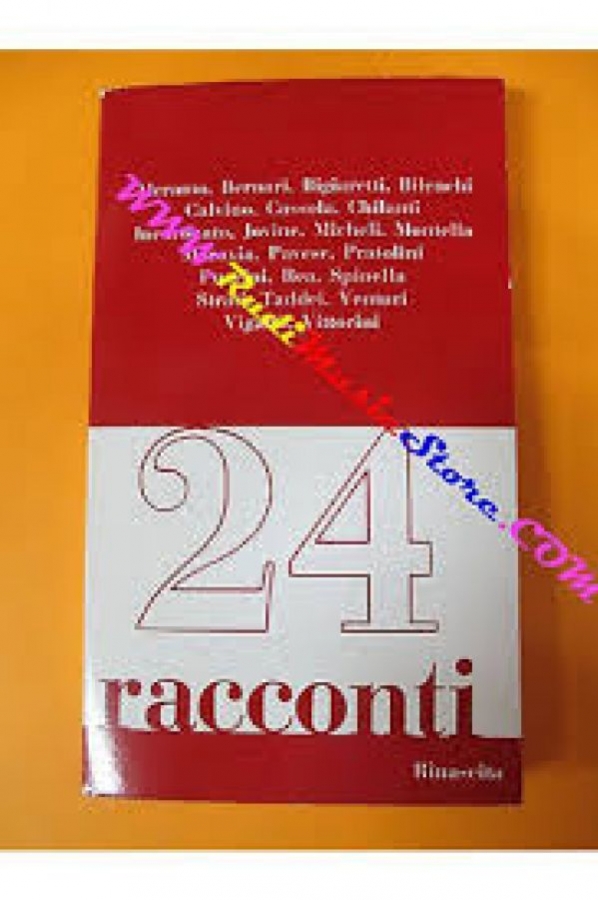
24 stories
Title of the original version reviewed: «24 racconti»
AI Translation Notice: This review was translated from the original Italian using artificial intelligence. Book quotes and excerpts are translated interpretations and will not match the author's original English phrasing or official published translations.
Under the title La Rinascita, in June 1944 the first issue of the Communist Party’s monthly journal was published.
Italy is not yet free; the partisan struggle is underway, and yet from its very first issue the journal devotes several pages to literature.
There are poetic works (by Umberto Saba and Salvatore Quasimodo), texts by foreign authors, and contributions from Italian writers as well, from Alberto Moravia to Cesare Pavese.
This book collects some of these short stories, published between 1945 and 1956, during a period of fierce political struggle and in the full bloom of Neorealism.
The stories are steeped in social themes; many deal with the Resistance, featuring contributions from Renata Viganò, Italo Calvino, Marcello Venturi (an important and forgotten chronicler of the partisan struggle), and Mario Puccini—the latter with a moving tale about a father’s anxieties for a son engaged in operations against the Germans.
I have chosen three to review, not only because they are the finest, in my judgment, but also because they are representative of our country—of peasant Italy and of an urban middle class that would carry forward from Fascism the indelible marks of superficiality.
Francesco Jovine is the author of a novel, Le Terre del Sacramento, which chronicles a South forever condemned to exploitation and forever betrayed by its ruling class: a writer of resignation and defeat.
In the short story La morte del patriarca, published in 1949, a grandson speaks of his grandfather, a justice of the peace in a southern village and trusted confidant of the primary landowner, the quintessential southern latifondista.
The grandfather is a patriarch to his family and the entire community: he does not exploit the owner’s absenteeism to enrich himself, but rather stands as a defender of the peasants.
He is a bulwark and a mythical figure.
On summer nights he would wander the moonlit streets together with his fellow peasants, enchanting them by softly playing his flute.
(...) Often, when he was away, the young men would be seized by sudden rages and reach for their hatchets.
But when the grandfather was there, nothing occurred that was not placid and gentle; one could hear those notes taking flight, like turtledoves in love, accompanied by the hornet-like drone of a chitarra battente; the old peasants would awaken from their sleep and imagine summer fields laden with heavy ears of wheat, and succulent fruits bathed in the morning dew.
What will become of the village after the patriarch’s death?
Suddenly an old woman from the back began to weep aloud and sing her sorrowful lament for the impending loss.
Slowly, in a rhythmic voice, she spoke: you are departing, our honour and our defense; you are departing, brilliant sword.
Without you, a youthful voice took up on the final laisse of the song, we have neither light nor judgment left.
In Il mondo salvato a spalle, published in 1951, Felice Chilanti recounts the dramatic flooding of the Polesine, offering a realistic and evocative sketch of peasant solidarity.
"Run, people, the water is overflowing along the entire embankment!" Giovanni and his fellow peasants rush to rally the men and rescue the women and children.
And the village shopkeeper shouts, "And you, Giovanni, and you, Gabana, and you, Tabanin, weren't you already thrown in jail a year ago for this kind of work? Do you really want to save Cané's land and cattle?"
Canè is the great landowner of the area, whose brother, the cripple, screams like a madman at the peasants laboring to save the Cané family and their household goods.
"You want to start a revolution, you wretches! Come and get me, you'll taste the lead of my pistol...
(...) Giovanni and his companions carried the world on their shoulders to safety: the entire world just as it was, friends and enemies, the society in which they lived and fought; they carried to safety the landlord and his property, the priest and his prayers, the maresciallo of the carabinieri and his handcuffs."
The title of Libero Bigiaretti’s short story (Un altro destino
- echoes Jack London’s Martin Eden.
Two young men strike up a friendship because they work together on a construction site: Renato comes from a working-class background, intelligent, combative, capable of
asserting his views with clarity and energy
, Giulio comes from a bourgeois family, restless, he dropped out of school and would like to publish his poems in La Fiera Letteraria.
Unlike Giulio, thoroughly steeped
in fashionable names and trendy books," Renato "read whenever he had the chance, with a stubborn desire to understand things to the very core
.
Giulio meets Elena, Renato's sister, with whom he begins a relationship.
We parted, I full of dismay and confusion, she calm; she told me to wipe my lips, for they must be smeared with lipstick.
(...) I can't help laughing, looking back on it.
When I think how, throughout the evening and the night, that most ordinary of adventures got tangled up in my head. "What if I had to marry her?" "Did you know that Giulio goes walking around the Mercati Generali with a greengrocer girl?" (...) Then I met Loredana with whom, between kisses, one could discuss literature.
And Loredana also knew how to kiss me much better than Elena."
The stories are certainly no masterpieces; behind a veneer of Neorealism there emerges a melodramatic and bombastic streak, originating from Fascist literature and from even deeper roots within a provincial Italy, alien to European culture.
It is remarkable how one can already detect a sense of weariness, of resigned acceptance of what Italy would become: inward-looking, mellifluous, and hypocritical.
A touch of nostalgia arises when reading these stories.
Back then, a party journal made room for literature, for Italy's foremost writers; today we are reduced to reading disjointed remarks on Facebook and Twitter, while writers speak of other matters, far removed from politics.
Is it perhaps from here that the by now tiresome crisis of the Left originates?
Why read it? It is worthwhile for reminding us what the culture of the Left once was.