Vari Autori
Books by this author (8)
Football in Yellow
The book brings together football-themed short stories by various noir writers, some well-known—such as Aykol, Giménez-Bartlett, Malvaldi, and Manzini—others less familiar: Gian Mauro Costa, Francesco Recami, and Gaetano Savatteri. The plots, characters, and writing styles vary, yet a common thread emerges: football, even at the amateur level or played in the minor leagues, is invariably a sordid, violent affair that brings out the worst in people. The already established authors are predictable: the narrative patterns are those of their novels, unfortunately compressed within the short story form, inherently brief. The contributions of Costa, Savatteri, and Recami are far more engaging; the first two set their stories in Palermo, while the third unfolds against the backdrop of Milan. Recami’s (*«Progresso - Audace 3-2»*) stands out as the finest story, well worth lingering over for its subject matter and deft narration. We find ourselves at a youth match, with parents cheering from the stands. Gianmarco is eleven years old, wrestling with the typical adolescent doubts about his sexual orientation, compounded by the fact that—being gentle, sensitive, and polite—he is mocked by his teammates with taunts like «Giorgi is gay». A talented player, he is targeted by a boy on the opposing team, egged on by his father («break him, take him down, finish him, kill him...»). The man, > an overweight man in his fifties, a third-generation immigrant from Puglia, rather potbellied , «in the throes of an aesthetic crisis», hurls unspeakable abuse at Gianmarco's mother, slaps her, and unleashes the fury of the other mothers, who chase after him intending to beat him. He takes refuge in an abandoned warehouse, where he is caught by Oleg, a giant of a man, clearly a criminal hailing from who knows which Eastern European country. And here the tables turn for our potbellied bully: the braggart turns into a lamb, such a coward that he literally shits himself, completely unable to protect his family from Oleg's threats and violence. Instead, it will be his wife who shields the children and the home, ready to sacrifice herself to do so; yet how could this be? A woman, belonging to the very sex the potbellied man routinely addressed with terms like: «fucking whore...». Meanwhile, Gianmarco makes an astonishing discovery: a famous player, «one of his idols, a tough guy, someone who commanded respect», had come out as gay. How was this possible? «You shouldn’t be surprised in the slightest», Sciacca the school janitor told him from the heights of his wisdom, > in the world of football, they're all faggots. (...) It was undoubtedly the most intense sex education lesson Gianmarco had ever had, and would ever receive in his entire life. He reflected. There was the principle, there was the truth, that’s why at Juventus they’re all faggots. So if I'm gay, does that mean I'm more manly than the pansies who go with women? The female janitor chimes in. > What are you doing, Sciacca, telling the boys your usual dirty little stories? What on earth are you talking about, we were discussing football. The short story format does not lend itself well to noir: it is too brief to allow for the development and suspense that form the very core of a mystery. It feels like watching an episode of *Murder, She Wrote*: at a certain point it must wrap up, and so the story either tumbles into a predictable denouement or remains suspended, leaving the reader unsatisfied. Of greater merit are the settings, the characters, and above all the prose: the latter occasionally proving to be a pleasant surprise. Why read it? It offers the chance to discover lesser-known, yet valuable writers.
The Thousand and One Nights, Volume II
If the tales of the first volume (see review on this site) have a fairy-tale quality, transporting us into a world populated by spirits and magical inventions, here the novellas have a realistic cast; the reading is less enthralling, but we derive from it a portrayal of Abbasid society, of the power of the caliph and his emirs, of court intrigues, and of the resigned obedience of the subjects. In the tale *The Power of Love*, the wretched Ghanin is severely punished on the false accusation of having seduced the caliph's favorite. Blind jealousy drives the "Commander of the Faithful" to persecute the young man and his family. When the caliph realizes his terrible mistake and asks what he can do for him, Ghanin replies that > the servant cannot in any way reproach the master for how the latter saw fit to behave toward him. (...) The servant remains the servant, and the master remains the master ; it is the young man's mother who courageously urges the caliph to reflect upon how fragile human nature is, > how often it is prone to deception and dissimulation. And think of how these wicked inclinations can be exacerbated by jealousy, to which women are all too susceptible. One must not believe that we are dealing with a sort of Arabic *Decameron* or Gogol's *Dead Souls* with a Middle Eastern flavor (see reviews on this site); in the novellas of this second volume as well, prose is interwoven with poetry, the tales interlock with one another, the beauty of men and women prevails, and one flees from reality into the implausible. Is what we recount an illusion? In the opening of the immensely long tale *The Faces of Love*, which depicts a fabulous, boundless world reminiscent of Salman Rushdie's *The Enchantress of Florence* or Abdulrazak Gurnah's *Paradise* (see reviews on this site), the beauty of the young prince is sketched with verses steeped in narcissistic desire: > He is the fawn of the gazelle with a hesitant gait!/He need only take a mirror in hand:/faithful and flattering, it will reflect/the absolute idea of beauty that his dream casts upon it. The finest novellas are those featuring Caliph Harun al-Rashid (who reigned between 766 and 809). It seems that this ruler was > fond of anecdotes, current news, and gossip ; so, disguised as a common citizen, he would go out to discover how ordinary people lived and to play pranks at their expense. How dreadfully dull life must have been in the palaces of Baghdad! In *The Sleeper Who Does Not Sleep*, the caliph, posing as a merchant, makes his way into the home of the honest Hasan; after getting him drunk, he makes him drink a potent sleeping draught; taken to the palace, Hasan spends a night as caliph, believing it to be reality: he is taken for a madman and locked in an asylum. When he comes out, he continues to live no longer knowing whether he is in a dream or in reality. > Why did you instill confusion in my mind, why did you turn my brain upside down?. And "the successor of the Prophet" candidly replies that he does it for pleasure. In the novella *The Caliph and the Madman*, al-Rashid wants to understand whether a person locked in an asylum is truly mad; what emerges is a series of interlocking tales, in a Pirandellian atmosphere, in which the wit of the grand vizier—an ever-present figure in *The Thousand and One Nights*—tests the poor lunatic; it will later turn out that, rather than wit, one should speak of deceit, for the grand vizier wished to prevent the marriage between his daughter and the alleged madman. We leave it to the reader to discover the plot of *The Persian Sage*. Here we shall merely say that a remarkably handsome "cookshop keeper," > he is the stallion/of every grace , manages to win over the splendid princess thanks to a love potion concocted by the wise sorcerer. Let us revel in these delightfully erotic verses: > Side by side, close together, with my own eyes/I saw them, I would have loved/to see them sleep together/upon my very eyelids./They were two gazelles of the desert,/and two radiant stars in the night,/two morning stars, perfect boughs,/and two incarnations of divine Beauty. René R. Khawam, the editor of this edition of *The Thousand and One Nights*, concluded after extensive research that the two books in this second volume, *Wandering Passions* and *The Taste of Days*, complement the better-known ones presented in the first volume: *Illustrious Ladies and Gallant Servants* and *Inhuman Hearts*. Naturally, I am in no position to contest the editor's choices, particularly on an issue so fraught with ambiguity due to the difficulty of imposing order upon this crucial testimony to the Arabic poetry of the Caliphate of Baghdad. It is difficult to believe that we are facing a succession of nocturnal tales, both because of the length of the novellas and because of their realistic framework; poetry too loses weight compared to prose, and the narration no longer possesses the brisk pace of the tales in the first volume. One senses a certain weariness, a certain formalistic and repetitive quality, as though the political and military decline of the great empire were reflected in its song, both nostalgic and despairing. While in the tales of the first volume there is always an ending pointing toward a happy future, here every novella concludes with an invocation of Death, of > the Destroyer of Pleasures and Severer of Gatherings, (...) May God be merciful to us on the day of that appointed meeting. Why read it? It is wordy at times, it takes effort, but it is well worth it.
Nineteenth-Century Southern Fiction Writers
As the editors, Alda and Elena Croce, have noted, Southern Italian literature is strongly influenced by the great French authors, such as Zola, Flaubert, and Maupassant: heedful, therefore, of social conditions, yet marked by a peculiar accent—a blend of ironic, fairy-tale fabulation and melodramatic tones. The survey is limited to 10 writers, some of them well known, such as Capuana, Serao, and De Roberto; how representative it is remains unclear, but within it one can single out two singular pieces. Salvatore Di Giacomo is a prolific Neapolitan writer, journalist, poet, and scholar. He favors tragic spectacles, mixtures of ferocity and goodness; his characters are harlots, *camorristi*, and beggars; his settings are filthy, picturesque alleyways. The short story *La Taglia* offers an effective portrait of a dramatic and forgotten chapter of our history: the great brigandage between 1860 and 1870. We find ourselves in a "disconsolate little village" over which weighed "a silence of death": today the sacking of the mayor's house, yesterday a severed ear to extort a ransom, then a herdsman roasted over firewood like a ram; a horror to which the soldiers react, > without the stir of a trial, without lawyers or courts. Down there, behind the little church, they shot them on the dirt ground . Mariangela is seized by labor pains, surrounded only by her children because her husband has gone off to capture a ruthless bandit on whose head a bounty has been placed; it is a poor wretch's desperate bid to escape destitution. > The toddler had crawled up to the doorstep. (...) The other, the red-haired one, grabbed him from behind and pulled him onto his chest. The naked infant shrieked, growing restless, with his little hands trying to fend him off.(..) The July sun burst inside with a blaze that scorched the flesh and took away one's breath;(...) the broody hen pecked among the scattered grains, (...) a little dog braced its paws on the rim of the pitcher and stretched its dirty snout into it, (...) outside, a heavy silence... The woman is in labor; the eldest boy, the red-haired one, runs off terrified to look for his father. As he makes his way into the brush, he finds a lizard, which he slips into his pocket. He calls desperately for his father, then catches sight of him: > the murdered man's face was barely visible, (...) flies swarmed all over him, (...) a hand stuck out, all bruised and bloody, open. (...) Tata! Tata!, called the little boy, Tata, mama is crying and wants you!... Oi, tata! He grew restless. He lay flat on his belly on the low wall, brought out the lizard, tied a string to the bloody stump of its tail and made it walk, jerking it back with sudden tugs, yelling after it: Ah, Ah!... Isce!... > Vittorio Imbriani, also a Neapolitan, was a university professor, patriot, and combatant, but also an imaginative writer attentive to popular literature. Bearing witness to this is the tale *Le tre Maruzze* > , a true rarity, having been published in an edition of only twenty-eight copies in 1875. In Neapolitan maruzza > means snail; in the story, these little creatures are the guardians of three precious gardens: a rose garden, a wondrous field of maize, and an orange grove. Don Peppino, a young peasant, rescues three filthy beasts (the grass snake, the lizard, and the sewer rat), in truth three fairies, who, as Parini sings, make lovers blissful and in the blink of an eye mingle earth and sea at their whim > . And indeed the good man becomes the King’s gardener, held in high esteem because Don Peppino is sincere and faithful. One day, the Queen and the other Royal Highnesses, piqued and envious at hearing repeatedly that Don Peppino was the only one who never lied, proposed a wager to the King: to tempt the gardener by every means, and if Peppino were to blurt out > a lie, the King’s head would fall; otherwise, those of the Royal Highnesses. Don Peppino resists the princes' overtures, but when the Queen offers herself in exchange for a rose, as Girolamo Fontanella sings, the mawkish versifier, > upon the happy lover she falls and joins breast to breast, mouth to mouth, and heart to heart . And what is to be done now? Telling a lie means incurring the Sovereign's wrath; telling the truth will mean the King loses his head. What weighs most heavily on Don Peppino is the grief of the three fairies (now in the form of a spade, hoe, and shovel), because the man could not resist and “tomorrow will tell the little lie.” But to the Sovereign’s question: “How fare my little snails?” Don Peppino replies: > Mouth of Truth no Lie shall tell, your wife came asking for them; she offered what I might ask, and three she obtained. As price for the first, I kissed her; (...) Spade, hoe, and shovel, that know all, as I have told you shall bear witness to the truth . What moral is to be drawn from this fairy tale? While the powerful amuse themselves with pointless games and foolish wagers, the poor man acts wisely, even if he too has allowed himself to be deceived. Could it be true? "...Cuccurucù...". I have chosen only two stories, because the others add little to literature or even to the narrative of our *Mezzogiorno*. Journalism, the fantastic, and melodrama mingle together, giving us a languid and pessimistic vision of the South. The only story of great power is Federico De Roberto’s (*La Paura*), set in a World War I trench and dealing with foretold death; several soldiers must advance to an outpost, fully aware that they will surely die. It is death, > crouching, watchful, poised to spring and seize; if one must go out to meet it, staring into its eyes, the eyes grow dim, the legs give way, the veins run dry, every fiber trembles, all of life ebbs away. It is a tragic and intensely timely page; yet we are in 1927, a world away from the weary and repetitive tales of the late nineteenth century. Why not read it? Nothing evocative or stimulating.
24 stories
Under the title *La Rinascita*, in June 1944 the first issue of the Communist Party’s monthly journal was published. Italy is not yet free; the partisan struggle is underway, and yet from its very first issue the journal devotes several pages to literature. There are poetic works (by Umberto Saba and Salvatore Quasimodo), texts by foreign authors, and contributions from Italian writers as well, from Alberto Moravia to Cesare Pavese. This book collects some of these short stories, published between 1945 and 1956, during a period of fierce political struggle and in the full bloom of Neorealism. The stories are steeped in social themes; many deal with the Resistance, featuring contributions from Renata Viganò, Italo Calvino, Marcello Venturi (an important and forgotten chronicler of the partisan struggle), and Mario Puccini—the latter with a moving tale about a father’s anxieties for a son engaged in operations against the Germans. I have chosen three to review, not only because they are the finest, in my judgment, but also because they are representative of our country—of peasant Italy and of an urban middle class that would carry forward from Fascism the indelible marks of superficiality. Francesco Jovine is the author of a novel, *Le Terre del Sacramento*, which chronicles a South forever condemned to exploitation and forever betrayed by its ruling class: a writer of resignation and defeat. In the short story *La morte del patriarca*, published in 1949, a grandson speaks of his grandfather, a justice of the peace in a southern village and trusted confidant of the primary landowner, the quintessential southern *latifondista*. The grandfather is a patriarch to his family and the entire community: he does not exploit the owner’s absenteeism to enrich himself, but rather stands as a defender of the peasants. He is a bulwark and a mythical figure. > On summer nights he would wander the moonlit streets together with his fellow peasants, enchanting them by softly playing his flute. (...) Often, when he was away, the young men would be seized by sudden rages and reach for their hatchets. But when the grandfather was there, nothing occurred that was not placid and gentle; one could hear those notes taking flight, like turtledoves in love, accompanied by the hornet-like drone of a *chitarra battente*; the old peasants would awaken from their sleep and imagine summer fields laden with heavy ears of wheat, and succulent fruits bathed in the morning dew. What will become of the village after the patriarch’s death? > Suddenly an old woman from the back began to weep aloud and sing her sorrowful lament for the impending loss. Slowly, in a rhythmic voice, she spoke: you are departing, our honour and our defense; you are departing, brilliant sword. Without you, a youthful voice took up on the final laisse of the song, we have neither light nor judgment left. In *Il mondo salvato a spalle*, published in 1951, Felice Chilanti recounts the dramatic flooding of the Polesine, offering a realistic and evocative sketch of peasant solidarity. "Run, people, the water is overflowing along the entire embankment!" Giovanni and his fellow peasants rush to rally the men and rescue the women and children. And the village shopkeeper shouts, "And you, Giovanni, and you, Gabana, and you, Tabanin, weren't you already thrown in jail a year ago for this kind of work? Do you really want to save Cané's land and cattle?" > Canè is the great landowner of the area, whose brother, the cripple, screams like a madman at the peasants laboring to save the Cané family and their household goods. "You want to start a revolution, you wretches! Come and get me, you'll taste the lead of my pistol... (...) Giovanni and his companions carried the world on their shoulders to safety: the entire world just as it was, friends and enemies, the society in which they lived and fought; they carried to safety the landlord and his property, the priest and his prayers, the maresciallo of the carabinieri and his handcuffs." The title of Libero Bigiaretti’s short story (*Un altro destino* > 1951) echoes Jack London’s *Martin Eden*. Two young men strike up a friendship because they work together on a construction site: Renato comes from a working-class background, intelligent, combative, capable of asserting his views with clarity and energy > , Giulio comes from a bourgeois family, restless, he dropped out of school and would like to publish his poems in *La Fiera Letteraria*. Unlike Giulio, thoroughly steeped in fashionable names and trendy books," Renato "read whenever he had the chance, with a stubborn desire to understand things to the very core > . Giulio meets Elena, Renato's sister, with whom he begins a relationship. We parted, I full of dismay and confusion, she calm; she told me to wipe my lips, for they must be smeared with lipstick. (...) I can't help laughing, looking back on it. When I think how, throughout the evening and the night, that most ordinary of adventures got tangled up in my head. "What if I had to marry her?" "Did you know that Giulio goes walking around the Mercati Generali with a greengrocer girl?" (...) Then I met Loredana with whom, between kisses, one could discuss literature. And Loredana also knew how to kiss me much better than Elena." The stories are certainly no masterpieces; behind a veneer of Neorealism there emerges a melodramatic and bombastic streak, originating from Fascist literature and from even deeper roots within a provincial Italy, alien to European culture. It is remarkable how one can already detect a sense of weariness, of resigned acceptance of what Italy would become: inward-looking, mellifluous, and hypocritical. A touch of nostalgia arises when reading these stories. Back then, a party journal made room for literature, for Italy's foremost writers; today we are reduced to reading disjointed remarks on Facebook and Twitter, while writers speak of other matters, far removed from politics. Is it perhaps from here that the by now tiresome crisis of the Left originates? Why read it? It is worthwhile for reminding us what the culture of the Left once was.
Traveling in Giallo
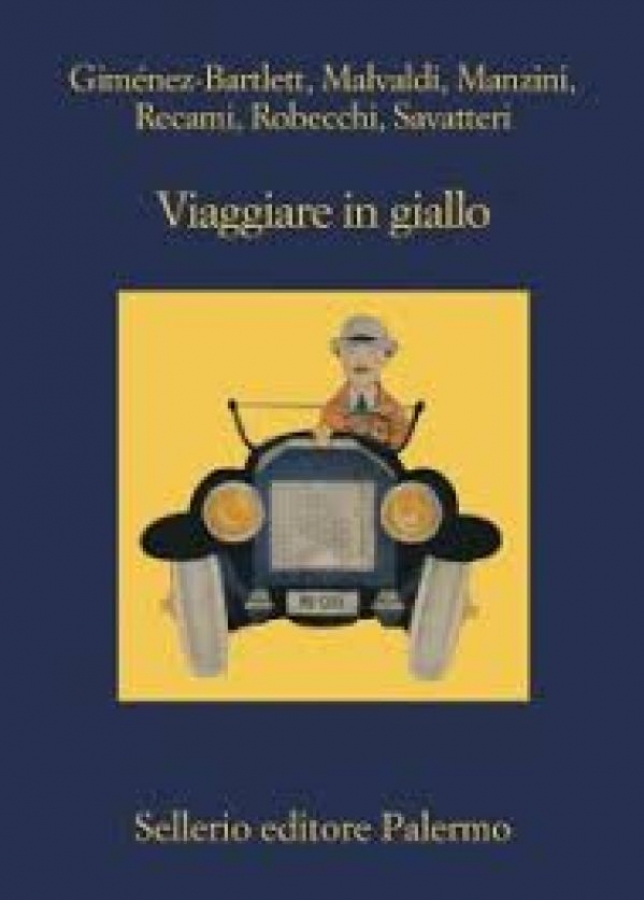
The publisher Sellerio has launched a series of crime anthologies centered on specific themes: it began with *Calcio in giallo* and now tackles the subject of travel. It is an excellent idea, but Gimenez-Bartlett, Malvaldi, Manzini, Recami, Rebecchi, and Savatteri ought to have applied themselves, rather than simply “dashing it off,” striving instead to cultivate the link between the assigned theme and the noir genre. This was not the case; the results are dull, banal, and pointless stories. Let us dwell on the only one worth discussing. In Gaetano Savatteri’s short story, *La segreta alchimia*, Saverio is an unemployed Sicilian; he has written a moderately successful novel and has a girlfriend who works in Milan. He finds himself in a supermarket with his friend Pippo, pretending to shop for a television just to pass the time. Unable to resist the temptation of a promotional deal, he buys some Duracell batteries, turns out to be the millionth customer, and wins a prize trip to Prague. Thus, entirely by accident, he finds himself on a flight to the “magic” city, accompanied by his friend Pippo and bound for his girlfriend, who awaits him in the Czech city. The algorithm that randomly assigns seats (an “electronic god,” a modern Jupiter) places a stunning girl next to Saverio; > as the engineer Gadda used to say, unexpected catastrophes are never the consequence or the effect, if you will, of a single cause, but are like a vortex , Larisa (“a high-class escort or one of Putin’s spies...?”) sweeps the young Sicilian off his feet; with > the movement of her red-painted lips, (...) the pressure of her arm, (...) her crossed legs , she leads him to reflect > on the destiny of peoples, the dictatorship of the proletariat, the gulags, Stalin... , which is to say, on all those historical events that made it possible to > sit serenely beside the splendid Bolshevik comrade Larisa . Yet the “god of low-cost travel” can be exceedingly spiteful: Larisa is an international spy carrying a flash drive loaded with crucial industrial secrets—a drive she slips into Saverio’s jacket to keep it from falling into the hands of other shady traffickers. The vacation turns into a thriller, complete with all its typical ingredients: stakeouts, trashed hotel rooms, nocturnal escapades that are risky but not excessively so, the indifference of the Czech police, and the investigations of the Italian authorities, culminating in a denouement surprising in its sheer prosaicness. There is little real suspense—Savatteri is no le Carré—but above all, the plot is not what interests him: he wants to recount how a young Italian, who fancies himself quite the hotshot, can be duped by the first female fellow traveler who comes along, provided she is slender, blonde, and buxom. Why write crime stories about travel if one has nothing to say? The rules of engagement were clear and simple: situate a noir story within the context of a journey, whether for business or leisure, in a neighboring or distant country, in a great metropolis or an exotic setting—in short, wherever the author pleased. Well, the authors produced an utter fiasco: perhaps they have never traveled, or perhaps, more simply, they just couldn’t be bothered. I suspect it was an act of rebellion: one cannot assign a schoolmasterly task to a writer, penning them within predefined boundaries; the “prompt,” evoking memories of the classroom, withers the imagination and creativity. Why not read it? It is dull and banal: the worst possible failing for a mystery and a travel story alike.
New Italian Short Stories
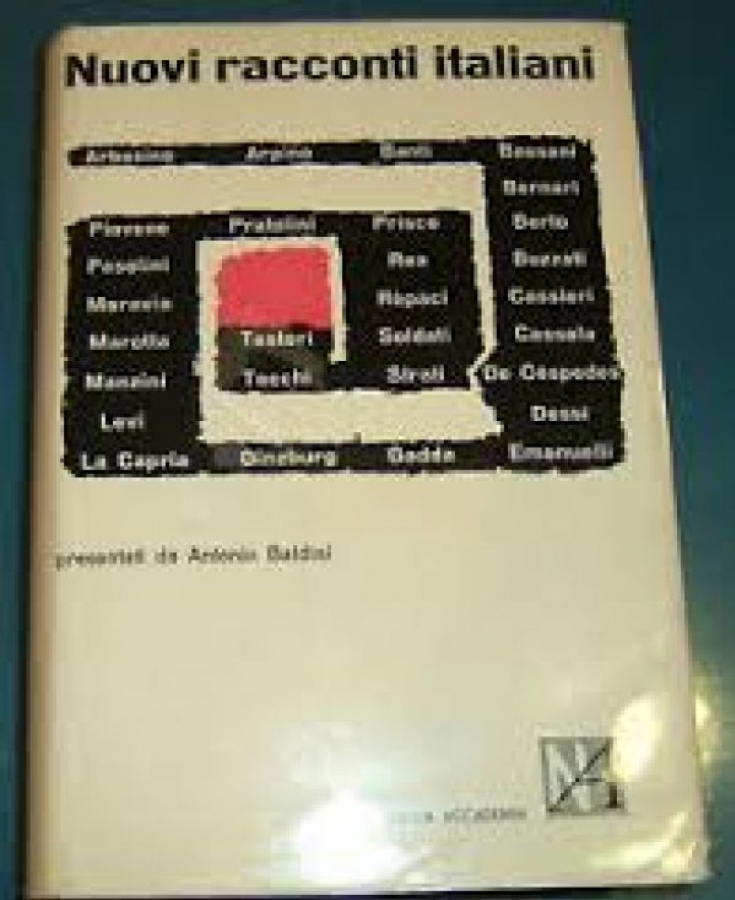
The book brings together 29 short stories, an anthology that includes famous writers such as Bassani, Buzzati, Gadda, Moravia, Pasolini, Pratolini, Cassola, and others; but also lesser-known authors, nonetheless representative of our country's literature. It is impossible to account for every story—many, in fact, not particularly successful—so I shall dwell only on a few. They share a common trait: they speak of the material living conditions of 1950s Italy, through an approach poised between truth and poetry, between social design and personal histories. Carlo Bernari is a forgotten writer today, yet in 1929 he penned a novel (*Tre operai*) that offered a realistic portrait of the working-class condition under Fascism, and which for this reason circulated semi-clandestinely. In his long story, *Il crumiro*, Bernari tells us of Peppino, a resourceful Neapolitan: in post-war Bari, he manages to find work as a factory handyman, build himself a house—unauthorized, naturally—hook into the electricity and water supplies, on the sly as always, and raise a family. > The Neapolitan way, his workmates would tease him, when in the morning they discovered the mended tap, the new steam intake, a stool fashioned from an old packing crate (...). Not exactly by the book, but haphazardly—yes, the Neapolitan way—yet it was done all the same . And if it is true that everything (the house, the job, and the numerous brood) comes with its drawbacks ( > but really, inside they hear us, outside they see us, will you tell me what kind of love this is? ) Peppino feels he has achieved many milestones, modest to today's eyes, yet significant in the Italy of that era. When, following a rain that had been pouring down for days, > the drains blocked, a muddy, greenish water surged back up from underground (...) reaching the furthest courtyard, where Peppino lived: and there it stagnated and destroyed the house of Peppino and his family, annihilating his dreams. Alongside Rea, Prisco, Ortese, and others, Raffaele La Capria belongs to that Neapolitan narrative vein tracing back to Matilde Serao. In this short story (*Ninì prende il largo*), La Capria speaks of freedom, and does so through the Posillipo sea. Ninì is a «scugnizzo». His bony, sun-blackened back, flecked with salt, one with the rock, was already beginning to scorch under the sun (...) But Ninì's attention was fixed on the transparent little hollow, among those four stones on the bottom, which if you picked them up and brought them to the surface were stones like any other, (...) yet when you saw them under half a meter of water so clear, they were full of adventures«. He is fishing for rock goby (a rockfish that »even the cat turns its nose up at > ), when a friend shouts for him to get into the boat. And there he is, rowing towards the tip of Posillipo, calling out to the girls to come to the balconies, playing the swaggerer to those on the rocks: and he wiggled his little backside on the prow of the boat, drumming with his heels against the sides, as if to spur it on. (...) Now, as the boat pressed forward, the horizon line shifted further and further away, behind the Cape of Posillipo, and the promontory receded further into the coast, and before Ninì's eyes the perfect circle of the gulf opened up, revealing glimpses of other distances. (...) Thinking back on it now, the transparent hollow beneath the rocks of Palazzo Donn'Anna seemed to Ninì no larger than a washtub > . Bonaventura Tecchi won the Premio Bancarella in 1960 with the novel *Gli egoisti*«. In *La ragazza della filanda*, the protagonist is a mill worker »big and bony, almost like a man > , (...) retaining beneath that masculine frame a curious innocence, partly timid and partly simple-minded . She has not yet known sex, and laughs when her workmates tell her that love > is a taste, pretty much like the one you get from eating delicious treats . > It seemed that her very body, so square and strong, was a suit of armor, inside which love could never have entered through malice, perhaps only through violence . And so it happens: a man, simply because he «had her close at hand», courts her, convinces her to let him take her home, and when he realizes that > she truly had never been touched by love, he felt almost a sense of resentment, (...) and when the swift, violent pleasure arrived, and the immense satisfaction, his male pride, even then there remained (...) the desire to humiliate her . And she, dumped after a few days, walks > away alone down the lane, those bony shoulders shuddering under the little shawl, yet without crying. Giovanni Testori is known as a playwright, but he wrote numerous short stories and novels. The short story *Guardati intorno ed impara* is enigmatic, so much so that its overall meaning remains unclear until the very end. A young woman flees from a house, stumbles, leans against a wall, attempts to reconnect with life: she realizes > that she has nothing left to do but hide herself, not only from people but from things as well . This is the opening of a story: as it slowly unfolds, we understand that the young woman has killed a man, not because she truly wanted to, but because of a familial mechanism. Sister, brother, and mother are bound to one another by a knot that > in its elemental nature was almost tragic: bonds withheld from any sentimental expression, yet manifesting in all their force whenever the family's life passed through some difficult situation. Then a word, a question, or a mere reference was enough for the three to find themselves constrained and almost damned to a single destiny. (...) It would have been necessary to destroy, by dint of being all-powerful, every human remnant. The stories of Peppino, Ninì, the mill worker, and the young woman are paradigmatic of a society and an existential condition. Hustling, often in vain; yearning for freedom, even for a fleeting moment; settling for any kind of love; letting oneself be ensnared by familial mechanisms—these are the defining traits of an Italy on the verge of change, yet where resignation still prevails. Despite the prevailing pessimism, the four stories exhibit narrative power and innovation: the authors construct elegant and compelling plots, significant and substantial characters; they have something to say, and they do so in a prose that is cultured, yet already contemporary. Spoken language is making its way into the written word and will later do so with overwhelming force; for now, it serves to prevent the stories from cutting "the tedious and wretched figure of the antiquated (Antonio Baldini in the introduction). Why not read it? They are four fine stories, but they are not worth the chore of reading more than five hundred pages..
The Thousand and One Nights, Volume I
*The Thousand and One Nights* is an Arabic manuscript likely dating back to the Abbasid Caliphate, between 750 and 900 AD: the setting is the fabulous empire of Baghdad, stretching from North Africa across the Arabian Peninsula to Central Asia and India. Its discovery is credited to Antoine Galland in the early eighteenth century, and from that moment the text spread throughout the West, sparking wonder and scandal: Orientalism was born. Owing to the many versions of the work, it should be clarified that this review refers to the text established from the original manuscripts by René R. Khawan. Let us begin with *The Weaver of Nights*. The king has been betrayed by his wife: a Moor “lifted her legs in the air, slipped between her thighs, and penetrated her.” From that moment on, the sovereign resolves to take a maiden as his bride each night and execute her at dawn. The vizier's daughter, Shahrazad, who “had read books and writings of every kind,” asks her father to arrange her marriage to the king, saying: > either I shall rise in the esteem of my fellows by freeing them from the peril that threatens them, or I shall die or perish with no hope of deliverance, sharing the fate of those who have died and perished before me . Her father attempts to dissuade her with tales urging a prudent, unassuming life, but the daughter, obstinate and self-assured, replies that she could offer him other stories leading to entirely different conclusions. And herein lies the crux of *The Thousand and One Nights*: the word. Through literary invention, fabulation, and poetry, one can confront the direst straits, vanquish evil spirits, and even bend the will of God to one’s favor. According to the widely accepted interpretation—though not strictly corroborated by the work’s architecture—each night Shahrazad tells a story to the king: enthralled, the sovereign spares the maiden's life out of the desire to hear another tale, ultimately making her his lifelong bride. A miracle of the word! The work follows a recursive pattern: a frame narrative within which other stories unfold, all designed to persuade and astonish the listener. The prose narrative is interspersed with verses in a style characteristic of Abbasid civilization. One does well to surrender to its spell; nevertheless, certain common threads can be traced. In the celebrated *The Fisherman and the Jinni*, the central motif is cunning. A fisherman frees a demon imprisoned for centuries inside a jar at the bottom of the sea. Once liberated, the Jinni seeks to kill the poor man. The fisherman preys upon the demon's vanity, challenging him to demonstrate how he could possibly fit into such a small vessel; it is a ruse to seal the Jinni away once more. To the creature's pleas and promises, the fisherman replies with tales displaying the wisdom of poetry: > they might have remained just and pure,/but they abused their power/ and the world in turn oppressed them/(...) behold them restored to their squalor... One would gladly sink into the allure of the tales of the *Fisherman and the Jinni* (echoing the line “if you return, we shall return”), yet we must hasten to illuminate another magnificent tale: *The Porter and the Ladies*. Here the theme is clemency, itself the fruit of love. A porter finds himself in the house of three ladies of consummate beauty, which prompts the poet to say: > inviolate...when I beseech her to grant me/the embrace. Beauty advises her/to show herself generous,/ but Coquetry forbids her to yield . Three one-eyed mendicants arrive, and presently even the sultan and his vizier. A banquet ensues in which the guests are bound by an oath: > whatever you see us do, whatever you observe around us...do not seek to understand the reason . Yet the strangeness of what they witness is too great for the guests to refrain from questioning. Ten Moors appear, poised to behead the reckless intruders who failed to honor their pledge. To appease the wrath of the three ladies, the mendicants recount their life stories and plead for mercy: it will be granted to all the guests, so profound is the wonder inspired by the tales and the pleasure derived from them by the three magnificent maidens! How can one punish when love is being sung? > The woman took the weapon and advanced until she stood before me. (...) I looked at her for a long time. (...) Her cheeks then expressed the feelings that occupied her soul, and the verses of the poet came to my mind: if my mouth is silent, my glances speak/and they will tell you what I cannot say,/for love makes manifest/the feelings hidden within me.(...)/the one is a writer of genius, though his rhetoric is beholden only to the play of eyelids;/the other is no less fine a man of letters/though he expresses himself solely through the eye . We grasp from these lines how the bewitching word is also the fruit of oral and gestural performance, all within delightful company amidst pleasing music, sweet perfume, and the bliss of embrace, consummate > only if supplied with these four elements/youthful age, wine,/a beloved body, gold coins... One may investigate the myriad underlying themes of the work, from the philosophical to the depiction of a society centered on beauty, art, wealth, the supernatural, and magic, set against a prevailing backdrop of sovereign violence and tyranny. Let us not ask too many questions; let us lose ourselves in the tales, in their astonishing plots, in their incredible deeds and figures, the harvest of an exuberant and irrepressible imagination; let us indulge in the pleasure of the many verses, as seductive and mysterious as the following: > the oath that binds me, I have sworn/by the intoxication stirred within me by the flutter/of her eyelid, by the curve of her hips,/by the bewitched arrows she looses at me/(...) the sorrows have fled as at the radiant rising/of the sun, leaving the moon perplexed./Was the star of day ahead of time?/Did it perhaps already wish to put her to flight?... Why read it? Astonishing, magnificent, spellbinding, an explosion of the imagination.
Italy in Giallo
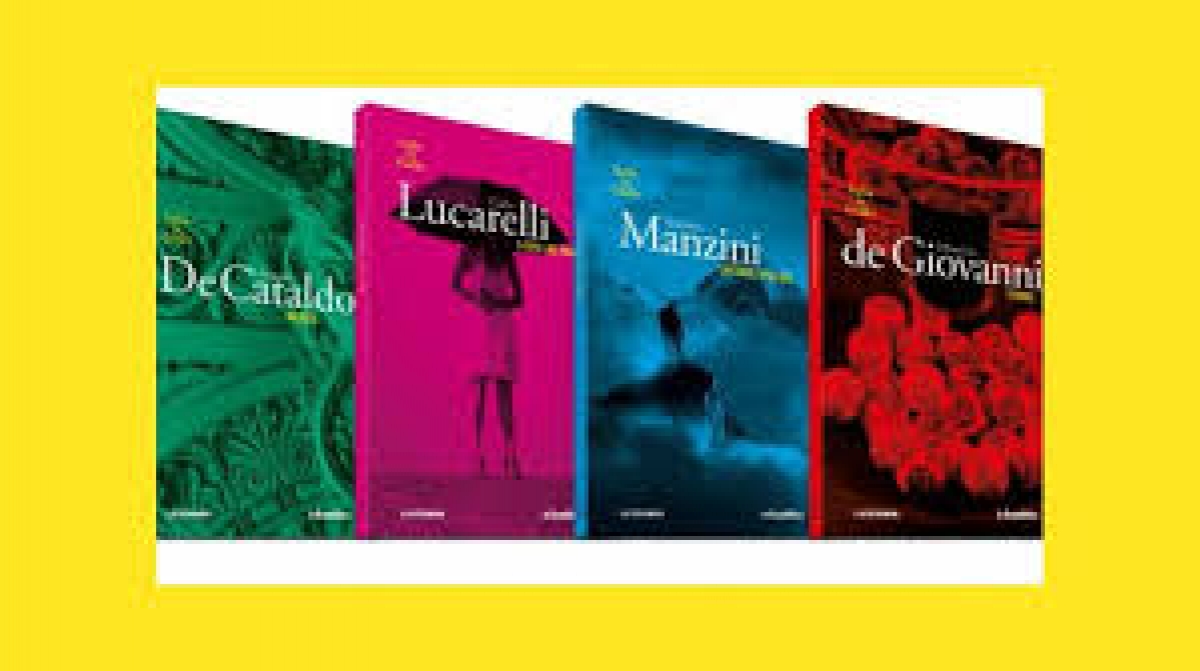
The daily newspaper *La Stampa* offered alongside the paper a series of noir short stories: Macchiavelli, De Silva, Fois, Lucarelli, Manzini, Carlotto, Simi, Robecchi, Malvaldi, Fantini and Pariani, Cassar Scalia, Pastor, Recami, de Giovanni, De Cataldo, and Savatteri. It was an excellent initiative: it provided a survey of the principal Italian writers of the genre. What emerges is that Italian noir is setting-driven, the setting constructed around a character, generally a police inspector; the plot remains in the background and is often predictable. Among Northern authors, the context is realistically raw, a mirror of an amoral Italy devoid of prospects; where the South is concerned, the setting is transfigured into a fantasy of escape from the desolation of Southern society—an aspiration rendered dreamlike by the coquettish use of dialect, in the style of Camilleri. I shall focus on a few of these stories. Maurizio de Giovanni's *La febbre* takes us to Naples, and its very title recalls Matilde Serao's *Il Paese di Cuccagna* (see review on this site). The fever is the lottery game, and the victim is the *assistito*, the medium who provides numbers received from the beyond. One cannot help but feel sympathy for an inspector so intimately affected by the victim’s fate. > In the image that presented itself to my soul's gaze, and whose suffering my soul shared, the blood ran down like a long, unbroken tear, staining the cheek, the neck, and the front of the dressing gown . The story is steeped in Neapolitan spirit: airy, refined in language and syntax, with a well-constructed plot, the brief tale of the *assistito* invites us to explore further works by de Giovanni. In *Romanzo Criminale* (see review on this site), Giancarlo De Cataldo had offered a bleak, resigned fresco of Italy and of Rome in particular, leaving the characters in the background as mere criminal stereotypes. In the story bearing the emblematic title of *Medusa*, the protagonist is the heart of the narrative. Now an elderly, retired teacher renowned for her strictness, Professor Blasi spent her life in a peculiar relationship with a homosexual baron. And when the latter was murdered, > at the Caffè Centrale they spoke of nothing else. And they spoke of it in the Salento manner, with little or no pity , but while > the baron, deep down, could be forgiven anything: he was born that way, and that was how he was bound to end up. But as for her, oh no, that pointless obstinacy of hers would be held against her for eternity . It must be acknowledged: De Cataldo is a cut above other Italian noir authors, in both style and substance. Imagine an elderly man in a Milan "with that yellow sky that boded no good"—what can he possibly think when his doorbell rings? In this little gem, *Ottobre in giallo a Milano*, Francesco Recami weaves a surreal yet plausible tale. The elderly pensioner strikes an intruder, who claims to be a police inspector, with a monkey wrench; gripped by panic over what he has done, rather than turning to law enforcement as a dutiful citizen should, he dumps the bleeding, unconscious body in front of the emergency room with the help of a rogue acquaintance, and then takes refuge in the underbelly of society aided by a scoundrel nephew—part pusher, wholly greedy. What will become of our old man in a Milan, > where it looked as though a nuclear bomb had gone off, or at least that's how they color post-atomic skies in the movies ? I had first encountered Recami in another story, *Progresso-Audace 3-22* (see review on this site under *Il Calcio in giallo*), and had appreciated his elegant depiction of our era's disturbing paradoxes: I believe it would be worthwhile to explore this author through full-length novels. How I enjoy Gaetano Savatteri! The plot is insubstantial, but there is irony to spare! As in *La segreta alchimia* (see review on this site under *Viaggiare in giallo*), the protagonist is an unemployed journalist, relentlessly teased by a devoted friend and an architect who might be his girlfriend, enraptured by works of art, splendid and superfluous. The town is Gibellina, where the Belice earthquake produced a reconstruction made of rationalist urban planning and monuments by celebrated artists; a pity that the landscape is a desert, a surreal abandonment, left behind by inhabitants fleeing to the North and abroad. The subtle irony, the affectionate depiction of the setting, the rhetoric of institutional rituals—the annual conference, the buffet, and the museum visit—the characters confined to their roles: these are all the foundation of a social and political critique, presented with a light touch and therefore never banal. It is a story well worth reading. Why read these stories? They are compelling and thoroughly enjoyable.