Finished reading on: May 30, 2017
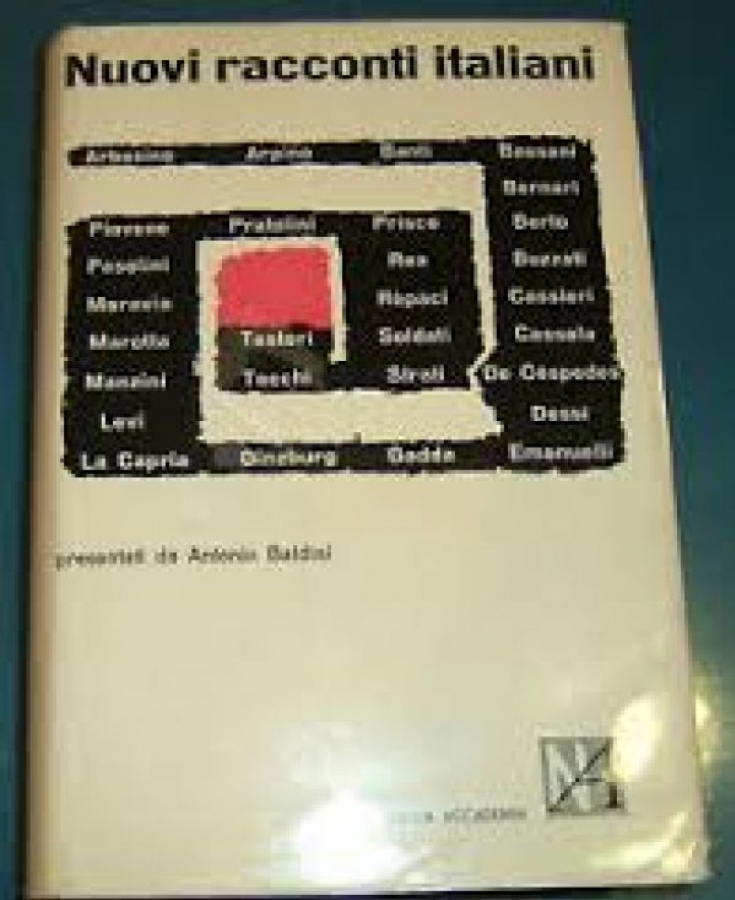
New Italian Short Stories
Title of the original version reviewed: «Nuovi racconti italiani»
AI Translation Notice: This review was translated from the original Italian using artificial intelligence. Book quotes and excerpts are translated interpretations and will not match the author's original English phrasing or official published translations.
The book brings together 29 short stories, an anthology that includes famous writers such as Bassani, Buzzati, Gadda, Moravia, Pasolini, Pratolini, Cassola, and others; but also lesser-known authors, nonetheless representative of our country's literature.
It is impossible to account for every story—many, in fact, not particularly successful—so I shall dwell only on a few.
They share a common trait: they speak of the material living conditions of 1950s Italy, through an approach poised between truth and poetry, between social design and personal histories.
Carlo Bernari is a forgotten writer today, yet in 1929 he penned a novel (Tre operai) that offered a realistic portrait of the working-class condition under Fascism, and which for this reason circulated semi-clandestinely.
In his long story, Il crumiro, Bernari tells us of Peppino, a resourceful Neapolitan: in post-war Bari, he manages to find work as a factory handyman, build himself a house—unauthorized, naturally—hook into the electricity and water supplies, on the sly as always, and raise a family.
The Neapolitan way, his workmates would tease him, when in the morning they discovered the mended tap, the new steam intake, a stool fashioned from an old packing crate (...).
Not exactly by the book, but haphazardly—yes, the Neapolitan way—yet it was done all the same
.
And if it is true that everything (the house, the job, and the numerous brood) comes with its drawbacks (
but really, inside they hear us, outside they see us, will you tell me what kind of love this is?
) Peppino feels he has achieved many milestones, modest to today's eyes, yet significant in the Italy of that era.
When, following a rain that had been pouring down for days,
the drains blocked, a muddy, greenish water surged back up from underground (...) reaching the furthest courtyard, where Peppino lived: and there it stagnated
and destroyed the house of Peppino and his family, annihilating his dreams.
Alongside Rea, Prisco, Ortese, and others, Raffaele La Capria belongs to that Neapolitan narrative vein tracing back to Matilde Serao.
In this short story (Ninì prende il largo), La Capria speaks of freedom, and does so through the Posillipo sea.
Ninì is a «scugnizzo».
His bony, sun-blackened back, flecked with salt, one with the rock, was already beginning to scorch under the sun (...) But Ninì's attention was fixed on the transparent little hollow, among those four stones on the bottom, which if you picked them up and brought them to the surface were stones like any other, (...) yet when you saw them under half a meter of water so clear, they were full of adventures«.
He is fishing for rock goby (a rockfish that »even the cat turns its nose up at
), when a friend shouts for him to get into the boat.
And there he is, rowing towards the tip of Posillipo, calling out to the girls to come to the balconies, playing the swaggerer to those on the rocks: and he
wiggled his little backside on the prow of the boat, drumming with his heels against the sides, as if to spur it on.
(...) Now, as the boat pressed forward, the horizon line shifted further and further away, behind the Cape of Posillipo, and the promontory receded further into the coast, and before Ninì's eyes the perfect circle of the gulf opened up, revealing glimpses of other distances.
(...) Thinking back on it now, the transparent hollow beneath the rocks of Palazzo Donn'Anna seemed to Ninì no larger than a washtub
.
Bonaventura Tecchi won the Premio Bancarella in 1960 with the novel
Gli egoisti«.
In La ragazza della filanda, the protagonist is a mill worker »big and bony, almost like a man
, (...) retaining beneath that masculine frame a curious innocence, partly timid and partly simple-minded
.
She has not yet known sex, and laughs when her workmates tell her that love
is a taste, pretty much like the one you get from eating delicious treats
.
It seemed that her very body, so square and strong, was a suit of armor, inside which love could never have entered through malice, perhaps only through violence
.
And so it happens: a man, simply because he «had her close at hand», courts her, convinces her to let him take her home, and when he realizes that
she truly had never been touched by love, he felt almost a sense of resentment, (...) and when the swift, violent pleasure arrived, and the immense satisfaction, his male pride, even then there remained (...) the desire to humiliate her
.
And she, dumped after a few days, walks
away alone down the lane, those bony shoulders shuddering under the little shawl, yet without crying.
Giovanni Testori is known as a playwright, but he wrote numerous short stories and novels.
The short story Guardati intorno ed impara is enigmatic, so much so that its overall meaning remains unclear until the very end.
A young woman flees from a house, stumbles, leans against a wall, attempts to reconnect with life: she realizes
that she has nothing left to do but hide herself, not only from people but from things as well
.
This is the opening of a story: as it slowly unfolds, we understand that the young woman has killed a man, not because she truly wanted to, but because of a familial mechanism.
Sister, brother, and mother are bound to one another by a knot that
in its elemental nature was almost tragic: bonds withheld from any sentimental expression, yet manifesting in all their force whenever the family's life passed through some difficult situation.
Then a word, a question, or a mere reference was enough for the three to find themselves constrained and almost damned to a single destiny.
(...) It would have been necessary to destroy, by dint of being all-powerful, every human remnant.
The stories of Peppino, Ninì, the mill worker, and the young woman are paradigmatic of a society and an existential condition.
Hustling, often in vain; yearning for freedom, even for a fleeting moment; settling for any kind of love; letting oneself be ensnared by familial mechanisms—these are the defining traits of an Italy on the verge of change, yet where resignation still prevails.
Despite the prevailing pessimism, the four stories exhibit narrative power and innovation: the authors construct elegant and compelling plots, significant and substantial characters; they have something to say, and they do so in a prose that is cultured, yet already contemporary.
Spoken language is making its way into the written word and will later do so with overwhelming force; for now, it serves to prevent the stories from cutting "the tedious and wretched figure of the antiquated (Antonio Baldini in the introduction).
Why not read it? They are four fine stories, but they are not worth the chore of reading more than five hundred pages..