Finished reading on: April 17, 2017
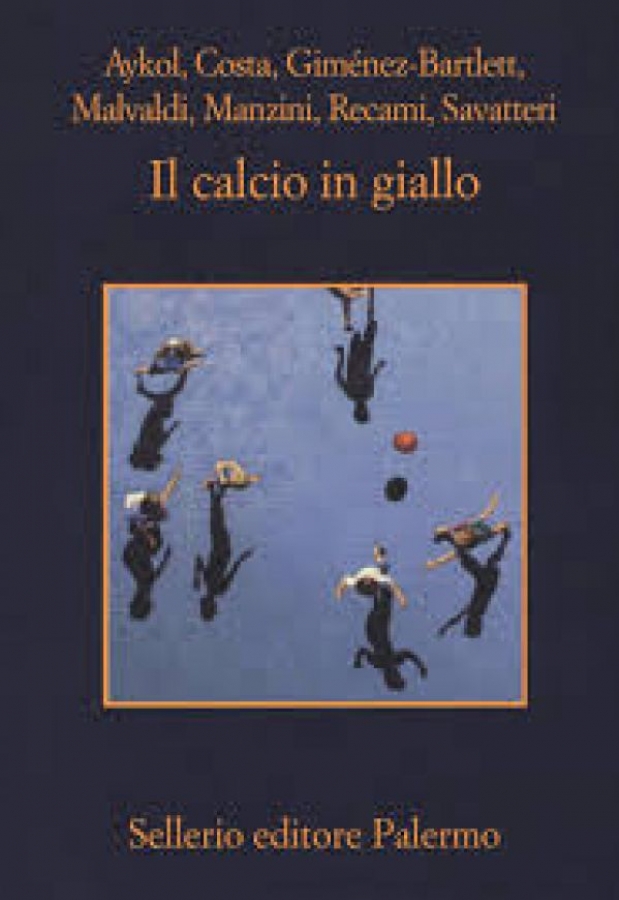
Football in Yellow
Title of the original version reviewed: «Il Calcio in giallo»
AI Translation Notice: This review was translated from the original Italian using artificial intelligence. Book quotes and excerpts are translated interpretations and will not match the author's original English phrasing or official published translations.
The book brings together football-themed short stories by various noir writers, some well-known—such as Aykol, Giménez-Bartlett, Malvaldi, and Manzini—others less familiar: Gian Mauro Costa, Francesco Recami, and Gaetano Savatteri.
The plots, characters, and writing styles vary, yet a common thread emerges: football, even at the amateur level or played in the minor leagues, is invariably a sordid, violent affair that brings out the worst in people.
The already established authors are predictable: the narrative patterns are those of their novels, unfortunately compressed within the short story form, inherently brief.
The contributions of Costa, Savatteri, and Recami are far more engaging; the first two set their stories in Palermo, while the third unfolds against the backdrop of Milan.
Recami’s («Progresso - Audace 3-2») stands out as the finest story, well worth lingering over for its subject matter and deft narration.
We find ourselves at a youth match, with parents cheering from the stands.
Gianmarco is eleven years old, wrestling with the typical adolescent doubts about his sexual orientation, compounded by the fact that—being gentle, sensitive, and polite—he is mocked by his teammates with taunts like «Giorgi is gay».
A talented player, he is targeted by a boy on the opposing team, egged on by his father («break him, take him down, finish him, kill him...»).
The man,
an overweight man in his fifties, a third-generation immigrant from Puglia, rather potbellied
, «in the throes of an aesthetic crisis», hurls unspeakable abuse at Gianmarco's mother, slaps her, and unleashes the fury of the other mothers, who chase after him intending to beat him.
He takes refuge in an abandoned warehouse, where he is caught by Oleg, a giant of a man, clearly a criminal hailing from who knows which Eastern European country.
And here the tables turn for our potbellied bully: the braggart turns into a lamb, such a coward that he literally shits himself, completely unable to protect his family from Oleg's threats and violence.
Instead, it will be his wife who shields the children and the home, ready to sacrifice herself to do so; yet how could this be? A woman, belonging to the very sex the potbellied man routinely addressed with terms like: «fucking whore...».
Meanwhile, Gianmarco makes an astonishing discovery: a famous player, «one of his idols, a tough guy, someone who commanded respect», had come out as gay.
How was this possible? «You shouldn’t be surprised in the slightest», Sciacca the school janitor told him from the heights of his wisdom,
in the world of football, they're all faggots.
(...) It was undoubtedly the most intense sex education lesson Gianmarco had ever had, and would ever receive in his entire life.
He reflected.
There was the principle, there was the truth, that’s why at Juventus they’re all faggots. So if I'm gay, does that mean I'm more manly than the pansies who go with women?
The female janitor chimes in.
What are you doing, Sciacca, telling the boys your usual dirty little stories? What on earth are you talking about, we were discussing football.
The short story format does not lend itself well to noir: it is too brief to allow for the development and suspense that form the very core of a mystery.
It feels like watching an episode of Murder, She Wrote: at a certain point it must wrap up, and so the story either tumbles into a predictable denouement or remains suspended, leaving the reader unsatisfied.
Of greater merit are the settings, the characters, and above all the prose: the latter occasionally proving to be a pleasant surprise.
Why read it? It offers the chance to discover lesser-known, yet valuable writers.