
3012
In 1795, Immanuel Kant drafted a "project for perpetual peace" designed to eradicate war forever. For the German philosopher, as for all of us, only peace guarantees well-being and happiness. And what if this were not so? What if war were the ideal condition for humanity? In the year 3012 AD, men have lived in peace for centuries; yet feelings of solidarity, loyalty, and friendship have dissolved, replaced by a pervasive and immense hatred that requires a ruthless repressive apparatus to be kept in check. The author imagines that, after twenty centuries, a researcher discovers a manuscript by an anonymous writer recounting the advent of the Prophet, the one who preached "perpetual war." According to the anonymous chronicler (doubt is necessary, as legend and historical fact intertwine), the Prophet was a young *vitellone* named Antalo, who lived in Fellinia working as a porn star. He fell in love with a splendid woman who convinced him to follow her to the "Capital of the World," a megalopolis of fifty million inhabitants. It was a trap: his body was meant to rejuvenate wealthy old men, desperate to regain their former vigor. Antalo managed to escape and would become the protagonist of numerous adventures—some amusing, others chilling, all of them astonishing, and often serving as a metaphor for today's world, Italy in particular. At a writers' competition (Antalo was the author of incomprehensible poems, the subject of constant and conflicting interpretations), the future Prophet met a young woman who had entered with war novels and introduced him to a fourteenth-century poem describing chivalric clashes, massacres, and quartered bodies, extolling war, martial courage, concord among fighters, and magnanimity toward the vanquished. It was a revelation. > He put down the book. He held his head in his hands and a Voice spoke within him, saying: go and announce to the world that the accursed age of peace has ended. (...) The darkness will be torn asunder, the virtues believed lost will shine once more, and the brightest among those virtues will be generosity, the love of justice, and mercy toward the weak . But what will be the rules of this new era of war? Chivalric customs and respect for nature. And indeed, in the "memorable sayings" through which the Prophet outlined his vision, it is written: > the war that God wills is just and holy, as long as it is waged against true enemies. But if an enemy, to escape me, climbs a tree, I cannot cut down the tree to bring him down, for the tree is not my enemy . The editor informs us that a new era dawned, but of the "beautiful, just, holy, and necessary" war, little remained. Men > began slitting one another's throats with such enthusiasm that no natural or supernatural force could have stopped them anymore. The human race, then, lived through an unrepeatable season of violence and bloodshed, but was no unhappier than it had been in the past. On the contrary, it was almost happy . And so the anonymous chronicler was right to conclude, > and thus all that is born of man on this Earth is destined to pass away. (...) Amen . It should be made clear that the book is not an essay, but a fully fledged novel, set in a fantastical yet not improbable future. It is a sequence of events over the course of which poor Antalo, a naive young man, finds himself, in spite of himself, the victim of mysterious and incomprehensible forces, all of them violent and cruel. Even when he kills, he does so because he is forced to, refusing to become a manhunter (one of the pastimes in the era of peace), despite knowing that this choice would save his life. Likewise, he rejects rampant corruption and longs to love, not merely to have sexual encounters. He is, in short, "a fish out of water" in the > Great Capital of the World; and it is precisely this innocence that makes him a visionary, capable of giving humanity and the world a sense of perspective. Through an ostensibly ironic and cynical novel, Vassalli wants to tell us that utopia is necessary, but it demands free and naive spirits. The prose is very far removed from that of *The Chimera*, but this is as it must be, for it is an account aimed at capturing the bare essence of the Prophet's story. The flaw of the narrative lies in its excessive references to contemporary Italy—amusing at first, but ultimately tedious and predictable: it almost seems as if the author wanted to settle so many scores". Why read it? It is astonishing.
Evening dress
The novel is set in 1960s Japan, when the upper and middle bourgeoisie is becoming Americanized, flirting with Western customs, eager to forge international ties. Ayako is the daughter of a minor yet rising pharmaceutical entrepreneur: she has “amiable” features. > Over those features, even with fashionable makeup, hovered harmony and freshness, and her face, by no means plump, gave the impression that something inner was rising to the surface Ha un carattere pacato, composto e razionale, > but Ayako was by no means obtuse; it was merely that she lacked an inclination toward momentary enthusiasms and toward exaggerating passions . The young woman frequents a fashionable riding club, where she meets Lady Takigawa, the widow of a high-ranking Japanese bureaucrat. Through a stratagem, the woman introduces her to her son, Toshio, whom she herself describes as > egocentric, selfish, stubborn, caustic—in short, a young lion . And yet Toshio has an entirely different self-image: a kind of robot, rigid and somehow other-directed by his mother. An arranged marriage is brokered, readily accepted by the two young people, partly because they are fond of each other and partly out of obedience to their parents’ wishes. The honeymoon strengthens their bond, which evolves from mere mutual liking into passion, genuine love. It would thus seem a lovely fairy tale, upon which Lady Takigawa intrudes, insinuating an alleged betrayal by Toshio—an insinuation that devastates Ayako. Yet who is Lady Takigawa? She is what used to be called a “merry” widow: wealthy and powerful, she has an immense love for high society, receptions, and social networking. Behind a tender, affectionate face hides an “innocent malice, (...) an unpleasant woman,” a split personality. One evening, the young couple is invited to a reception by Lady Takigawa. Yet right at the threshold, Toshio discovers the unbelievable lie and decides to rebel, refusing to go to his mother’s; Ayako tries to object, but then obeys her husband and follows him to eat at a modest diner. It is a scandal; offended, humiliated, and filled with rage, Lady Takigawa demands that they divorce, accusing her daughter-in-law of showing her a lack of respect. How is the matter resolved? Certainly not by telling the scheming mother-in-law where to go, nor by shrugging one’s shoulders and going about one’s business. We are in a world of conventions as well as interests; Lady Takigawa is wealthy and powerful. Toshio visits a princess of the Imperial Court, asking whether she might be accompanied by his mother on a trip abroad. > In that sort of conversation, Toshio was on his home turf, playing a game the youth of today could never imitate The princess knows full well the reasons for the visit, but > her countenance remained imperturbable, tinged with a tender understanding, enchanting as a dawn sky, then in a clear and decisive tone , she accedes to the young man’s request, on one condition alone: the two youths must show toward Lady Takigawa > a sincere tenderness, (...) asking forgiveness with grace, even should his mother deem it unacceptable . In short, conventions must always be respected, even if deception has been used to circumvent them. The narrative lends itself to multiple interpretations. What is clear is that the two young people undergo a transformation: though both belonging to a social class dominated by form, before marriage they were frank, sincere youths; to survive, they too become mere “semblances,” altered by anxiety and fear. > Perhaps marriage was a school where one is taught the lie of life , for one must > foresee the reactions of the outside world from every angle, as if the doors on all sides of a room, previously hermetically sealed, had been thrown wide open . On the other hand, there is no alternative for poor Ayako, > she could have become a little bird flying away, entrusting its shadow to that plain, but there was an emptiness there and it frightened her, not even a tree branch on which to rest her wings . The story is elegant and subtle, yet superficial: many windows open onto the protagonists that one would like to see explored in greater depth, but they remain mere glimpses; the author hurries off at once toward something else. Absorbed by his critique of Japanese society and its frantic Americanization, the author neglects those parts of the novel that most captivate the reader: how social conventions erode authenticity and the carefree joy of living. Why read it? It is read with great pleasure, for its narrative style and because one grows immediately fond of Ayako.

Accabadora
Maria is a *fillus de anima*, > that is what they call children born twice, of the poverty of one woman (who gives them away) and the barrenness of another (who welcomes and raises them). In our case, Maria has been “adopted” by Tzia Bonaria, an elderly widow. The novel’s first part, the most accomplished, recounts Maria’s childhood and adolescence, and in particular her gradual acquaintance with her adoptive mother—a woman always dressed in black, austere, reserved, who ostensibly earns her living as a seamstress. Tzia Bonaria provides the child with relative comfort, ensures her education, and above all constructs a fragile normality around Maria, behaving “as though the child had been born of her own womb.” For Maria, this filial bond and the acceptance of belonging to two families is a gradual conquest, one that accustoms her to being the focus of public attention, to accepting anomalous situations, and to shaping her own life independently. Her ability to confront the unspeakability of the world and of human nature collides, however, with a jarring and unsettling discovery. Tzia Bonaria is an *accadabora*—that is, a woman who grants a sweet death (euthanasia) to those who ask for it. In a dramatic confrontation, Maria, “with the tearless sob of a strangled beast,” demands that the elderly widow explain “this necessary thing,” the dispensing of a sweet death. And Tzia Bonaria’s justification is startling, lying far beyond Maria’s comprehension. > I learned on my own, says Tzia Bonaria, that children need both the slap and the caress, the breast, and the feast-day wine, and whatever they need, whenever they need it. I had my part to play, too, and I played it.... I was the last mother some ever saw.... When the time comes, Maria, you will discover things about yourself that you do not yet know . The young woman cannot bear the thought of living with a woman who dispenses death and flees far from Sardinia, finding employment with a family in Turin. This marks the second part of the novel, an interlude that also serves as a turning point—albeit a rather obscure one—in the narrative arc. One of the boys entrusted to her care as a governess is a taciturn, hostile, domineering adolescent; yet Maria’s habit of reckoning with the indescribable allows her to unlock the young man’s inner life and uncover a dreadful secret: the boy suffered sexual abuse in his childhood. Sharing so horrific a truth leads to love, for the bond between individuals is never stronger than when it rests upon the profoundest mysteries of the human soul. In the third part of the novel, Maria returns to Sardinia to attend to Tzia Bonaria in her slow agony. The narrative moves gradually, yet also sluggishly, toward the epilogue, without, however, delivering the resolution one ought to expect. Why does Tzia Bonaria die a moment before Maria is about to perform the euthanasia? Is a sweet death a threshold we cannot cross? Something we ultimately cannot accept? In addressing so complex a theme, there was a risk of drifting into redundant prose, fraught with parenthetical digressions and overwrought passages. The author, instead, has navigated the subject with a light, restrained, at times ironic style, relying on vivid character sketches and vignettes typical of rural Sardinian life. The novel’s first part is undoubtedly the finest, both in its prose and its dramatic structure. The storytelling builds in intensity as it approaches the final scene: the clarifying confrontation between Maria and Tzia Bonaria. In the subsequent parts, the narration becomes bloated, forfeiting that spareness and levity that had characterized the preceding pages. The narrative thread itself splinters and dissolves, depriving the reader of a clear sightline toward the conclusion, which disappoints all the more for this very reason. Why read it? The subject is compelling, the prose engaging.

The Adventures of Tom Sawyer
Tom Sawyer is a young boy who lives with his aunt in a small rural town on the banks of the Mississippi. Mark Twain introduces him in this way: > he got back home barely in season to help Jim, the small colored boy, saw next-day's wood and split the kindlings before supper—at least he was there in time to tell his adventures to Jim while Jim did three-fourths of the work. (...) If he had been a great and wise philosopher, like the writer of this book, he would now have comprehended that Work consists of whatever a body is obliged to do, and that Play consists of whatever a body is not obliged to do. Tom is not clear on this distinction and takes a carefree, unencumbered life as serious business, swinging from melancholia—which prompts him to wish he could die temporarily, just to make himself missed—to a fantasy world in which he dreams of being a pirate or an outlaw. And so, with his faithful friends, especially the vagrant Huckleberry Finn, known as Huck, he embarks on a series of exploits, from the pirate life on an island in the middle of the river to wandering through the graveyard at night, witnessing a murder, all the way to setting off in search of treasures surely hidden by bands of robbers. This dizzying flurry of activity does not prevent Tom from courting Becky, a girl from a respectable family, who also finds herself drawn into Tom's reckless escapades. There is no point in recounting the plot, at times convoluted and commonplace yet never dull: it is far more interesting to dwell on two peculiarities of the novel. The first is the rural setting; with gentle and affectionate irony, Mark Twain depicts the school, dominated by the schoolmaster's authoritarianism; the church gatherings with the preacher's tedious and moralizing sermons; and the hilarious ritual of Examination Day, when the best pupils present an essay of their own before the entire community. One can smile, as Mark Twain does, at the ornate English, laden with words that most people likely do not understand, at the puritanical and sanctimonious values, at education imposed by sheer force; nevertheless, a strong communal spirit emerges, seeming to transcend even class divisions. It is a white society, placid in its values, with a single, clear boundary: discrimination against Black people, who remain in the background even as they sustain the small town's agricultural economy; one can sympathize with the vagrant Huck, but not with the servant Jim. The other compelling aspect lies in Tom's powers of fabulation. Unlike the protagonists of other coming-of-age novels, Gian Burrasca or Jim from *Treasure Island* (see the reviews of *Il giornalino di Gian Burrasca* and *Treasure Island* on this site), what surprises is Tom's dialectic: how he manages his aunt, capitalizing on her naive affection; how he cajoles his friends, talking them into adventures and overcoming their reluctance; how he persuades Becky to follow him into dangerous and intimate situations, paradoxical for such a prudish society. And when Mark Twain remarks that he can stop at writing the story of a Boy, because > the story could not go much further without becoming the history of a Man. (...) When one writes of juveniles, he must stop where he best can , he perhaps means that Tom's innocent cunning would turn into a guilty capacity for deceit, as so often happens among adults. In Twain's imaginative world, it is better to keep playing with the petty subterfuges of adolescence. Beyond the character and the plot, the literary merit of *Tom Sawyer* resides in its writing—attentive to detail, magically realist, subtly ironic. Take as an example this passage, which describes Tom's awakening on the island of the imaginary pirates: > when Tom awoke at dawn, he wondered where he was. (...) Now, far off in the trees a bird called; another answered; now the distant strokes of a woodchopper were heard. (...) A little green worm came crawling over a soft leaf, lifting two-thirds of its body into the air from time to time and “sniffing around,” (...) then proceeding again, (...) and when the worm approached him, of its own accord, he sat still as a stone, (...) then (...) when it began a journey across him, his heart was all glad. (...) Now a procession of ants appeared from who knows where. (...) A brown-spotted ladybug climbed the dizzying height of a blade of grass (...) and Tom bent down close and said, > Ladybug, ladybug, fly away home, your house is on fire, your children are alone. These are wonders of a world inhabited at night by spirits, and Nature still seems endowed with a soul. And what of the description of the school, punctuated by that repetitive “showing off” (in Italian, *ostentare* or *vantarsi*)? All the teachers “put on airs”
Elective Affinities
In early nineteenth-century Germany, Eduard and Charlotte are two wealthy landowners. Though they loved each other in their youth, they married late in life, after both had been widowed. They possess differing temperaments that seem to complement each other perfectly: Eduard is “in the prime of manhood,” impetuous, generous, but superficial and at times reckless; Charlotte is reflective, patient, and prudent in managing both household and estate. Life flows serenely, as they enjoy “undisturbed the happiness finally attained,” until two guests arrive. The Captain, a friend of Eduard’s, is a poised man of vast experience who places his skills as a planner, engineer, and organizer at their disposal. He cannot help but find himself in tune with Charlotte. Ottilie, Charlotte’s niece, is a graceful, sensitive, introverted, and seemingly quiet young woman. The boyish quality within Eduard cannot fail to resonate with Ottilie’s youth. And very soon > the secret attraction and the power of imagination asserted their rights over reality , with such overwhelming force that in the dark, during the couple’s most intimate moments, > it was none other than Ottilie whom Eduard held in his arms; the phantom of the Captain hovered near or far before Charlotte’s soul, and thus they entwined, the absent and the present, in an exquisite mingling of voluptuous excitement . Seizing the opportunity of the Captain’s departure, Charlotte wisely proposes sending Ottilie to a boarding school, but Eduard abruptly leaves the estate, seemingly relinquishing the happiness of loving the young woman. The two women remain together in an apparent calm, yet without returning to “a full and open harmony.” The marital crisis might be resolved, with a new bond, by the birth of a child, who nevertheless has Ottilie’s eyes and the Captain’s features. It is the physical proof of adultery, having indeed been conceived on that very night when, making love, the spouses were thinking of their respective beloveds. Affection and care for the child bring Charlotte and Ottilie back together: > everything seems to follow its usual course, as happens even in the most extraordinary circumstances, when everything is at stake, yet one still continues to live as if nothing were amiss . New characters enter the scene, such as a talented young architect who lavishes attention on Ottilie. Daily life is disrupted by Charlotte’s lively daughter—cheerful, tumultuous, even excessively so. The two women complete the projects already initiated by the Captain: the rearrangement of the vast park, the merging of several ponds into a lake, the construction of a new dwelling on a magnificent scenic viewpoint, and the restoration of the parish church. The pursuit of perfection pervades the characters’ actions, even driving them to recreate famous paintings through *tableaux vivants*, in which Ottilie commands admiration. Charlotte, out of affection for Ottilie or a secret desire to reunite with the Captain, would be willing to accept divorce and Eduard’s union with Ottilie. Yet it is the girl who refuses, making an entirely spiritual choice, though only seemingly resolute. In this part of the novel, the external narrator is joined by the young woman’s diary: brief entries alternating moral maxims and romantic reflections with the manifestation of the profound yearning of a youthful heart in love. And it is Eduard’s reckless impetuosity that precipitates such a fragile situation. He surprises Ottilie by the lakeside on an autumn evening; the two lovers embrace and > for the first time they kissed openly, freely, and parted with painful effort . The girl remains “troubled and agitated.” To return to the manor, she commits the imprudence of using the boat, despite having the child with her. Through a series of accidental circumstances, the child falls into the water and drowns. At this point, the narrative reaches its inexorable denouement. Ottilie, despite an outward serenity and expressions of diligent expiation, starves herself to death. Goethe, who was by no means religious, closes the novel with a sort of sanctification of the girl, likely indicating her spiritualization—Ottilie’s death as moral elevation. Thomas Mann defined the novel as > the clearest fusion of Eros and Logos, of sensuality and morality, of immediacy and reflection... a German work of the highest moral culture . Ottilie’s death by starvation would express > the obedience rendered to the law of the spirit, paying its tribute, with virile tragedy, to the ethical norm . *Elective Affinities* would thus be “a spiritual construction,” a philosophical text in the form of a novel, a sort of manifesto of Germany’s “moralizing mission,” its “imperious instinct.” Perhaps Merkel had read *Elective Affinities* all too closely when demanding that we Italians do our homework: she personifies Germany’s didactic intent toward the pleasure-seeking Mediterranean peoples. Without detracting in the least from the great writer, Mann’s interpretation freezes the book in the past, as a testament to the history of German thought, overshadowing what still makes it so modern: “the story of the magical attraction” between kindred souls that shatters friendship, mutual esteem, the most sacred institutions—such as marriage—and the orderly, elegant world we desperately strive to build. And Ottilie, taking everything too seriously, falls victim to the superficiality and selfishness of some, like Eduard, and the tedious wisdom of others, like Charlotte, who, often through excessive self-assurance, fail to grasp in time the tragedy of fragile, sensitive souls like Ottilie. Alongside the characters, another protagonist is the landscape. Within it, and in the continuous attempt to reshape it according to human design, the contradiction between present and past is expressed. The present seeks to confer upon everything a more harmonious and rational order; the past returns to us the spontaneity of nature, which also serves as a vessel for transmitting memories. By bestowing a new and more fitting arrangement upon the cemetery, Charlotte unwittingly offends the reverence felt for the departed, as relatives were accustomed to visiting them buried in different spots, however haphazardly scattered across the churchyard. It is as though the notion of time were lost, and with it memory, so inextricably bound to familiar places and their traditional disorder. The novel’s limitation lies in its frequent philosophical and moral dissertations. Particularly in the second half of the narrative, after Eduard has abandoned the house, these digressions weigh down and fragment the reading, breaking up the overall unity and marring both the narrative pace and the psychological depth of the characters. Even Goethe failed to construct the perfect work. Why read it? The story and the characters remain remarkably modern, if one allows oneself to be captivated by the plot.
Aniko
The Nenets are a people of just over 40,000 individuals, settled in the northeastern part of the Ural region: their economy is fundamentally based on reindeer herding. Like many young Nenets, Aniko left to study far from her homeland: first at a boarding school in the nearest town, then further away still, to study geology at the university. She assimilated Russian language and culture to the point of forgetting her origins. She must return to her aging father because news has reached her of the death of her mother and little sister, killed by a wolf dubbed Lame Devil. The return is marked first by revulsion ( > when her father was now close to her: she involuntarily took a step back: he gave off a stench of alcohol, smoke, and filth ), then she slowly reclaims the language and customs, and finally the remembrance of her lost childhood returns: «Evening had fallen; together with her mother, she had lit a fire near the» chum > . She played with her rag dolls that had bird beaks instead of faces. Mother was busy sewing a new jaguska for one of the dolls. For an instant Aniko thought she truly saw her mother's concentrated face again. But once that instant had passed, however hard she tried, she could no longer redraw her features in her memories. They had vanished, perhaps forever . She is confused; until then, «she had done nothing but try to live». Must she accept the reproach-laden invitation of Aleska, her childhood friend, to stay in order to improve the conditions of the Nenets? Or should she let herself be submerged by the spell of the tundra and of an ancestral, motionless, and seemingly harmonious society? It is this that attracts Pavel, a young non-Nenets geologist, prompting him to want to stay, to abandon «the usual ordinary thoughts» and «suddenly discover oneself to be more mature, sincere, and good!» We do not know what Aniko will do; she leaves the tundra, but will she return one day? What will become of her? Aniko is a slight character, and her story is too tenuous to convey the contradictory feelings of a young woman poised between affection for her father—alone now, yet sheltered by the village—and the desire to be part of a society rich in cultural and professional stimuli. Abstracted from the specific setting, and were we to substitute Russian with English, Aniko’s state of waiting and nostalgia is the condition of many young people today. Yet this was not the writer’s purpose: deeply bound to her land, the author leads us into a world of serene concord where men, dogs, reindeer, and even wolves live «in a stillness of inexhaustible joy», as Ungaretti put it when speaking of his birthplace, Alexandria, Egypt. Think of the reindeer Temujko, who was suckled by Aniko’s mother and continually returns to her mistress’s grave; of the dog Buro, the old father’s faithful friend; and of how the father accepts with sorrowful resignation his daughter's abandonment, perhaps definitive. And what of Lame Devil? The description of the wolf, of his loneliness and bitterness, opens the entire tale and leaves its mark on some of the novel's finest pages. Nenets society seems perfect in its centuries-old harmony, but it is not so. As Pavel says to Aniko, > the nenets are confused. Outwardly they appear calm. imperturbable as ever, but I know they are uneasy. They wonder what their future will be like, where their children will end up. (...) And if we don't help them now... And what if the entire story were a fable—and, like any fable, fit for all latitudes—as well as a metaphor for our wretched Italy, a summons to free ourselves from passivity? The writing is melodious and fluid, like the story itself: sweet and graceful, evocative and naturalistic at once when describing the tundra and its inhabitants; concise and effective in dialogue, in the timeless conversation among the Nenets, yet contracted whenever Aniko speaks, as if mirroring the agony of the life choices she must confront, despite herself. The plot is weak in its narrative pacing (it seems as though nothing happens), but the prose is splendid, with assonances resonating from other languages. Why read it? Sweet and graceful.
Dead Souls
> Blessed is the writer who, leaving aside characters that are tedious, repulsive, striking in their sorrowful reality, approaches characters that reveal the highest qualities of man..... > Sublime, universal poet they proclaim him.... > far different is the fate of the writer who dares evoke into the light all that is forever before our eyes, yet which indifferent eyes do not perceive: the entire tremendous, galling sediment of petty things that entangle our lives, all the depth of the cold, fragmentary, everyday characters with which our earthly journey teems, at times bitter and tedious .Gogol develops a caustic yet buoyant analysis of the society of his time, with an inspiration that makes him unique among the great nineteenth-century realist writers, such as Zola, Flaubert, and Verga. Gogol’s stroke of genius lies in bringing to light the squalor and vacuity of his contemporaries by confronting them with an implausible premise. The protagonist of the novel, the prosaic Chichikov ( > neither too young nor too old, neither too stout nor too slender, neither too elevated nor too humble ) travels through the vast Russian provinces proposing to purchase dead serfs (hence the title of the novel), on whom the landowners continue to pay a tax. And what is paradoxical is that not only do the landowners accept the transaction, but institutions and polite society itself fail to perceive the absurdity and immorality of this commerce. Far different are the obstacles the protagonist must encounter along his way! His visits to the landowners force him to endure the idiosyncrasies, at times eccentric but often irksome, of diverse dispositions and lifestyles: the vain, vacuous landlord; the sanctimonious yet covetous old spinster; the wheeling-and-dealing proprietor; the drunkard prone even to violence. It is a panoramic procession of characters and settings that enables the author to sketch, with a few deft strokes, the petty yet profligate life of the Russian petty and middle landowning class. While the characters are delineated with irony and verve, the depiction of the villages is sociological, even if Gogol is entirely devoid of any indignation regarding the condition of the peasantry. When scandal subsequently erupts in the small provincial town where Chichikov is staying, our protagonist is overwhelmed by gossip, conjectures, and false accusations that have nothing to do with the swindle he is perpetrating, yet which compel him to flee. Yet like all Russians, Chichikov too loves the speed of the carriage bearing him swiftly along the road, surrendering to a sense of exhilaration and abandon. > It is as though an unknown power swept you up on its wing, and you fly, and everything flies... Is it not thus that you too, Russia, like a spirited, uncatchable troika, fly away? With Chichikov’s departure concludes the first part of the book, the only one completed and approved by the author. The overall design of the work envisioned two further parts, of which the second has reached us incomplete, while the third was destroyed by Gogol himself. Reading the second part reveals clearly how the fundamental theme of the entire work was meant to be the journey: a kind of aimless reportage, devoid of moral designs, with no other interest than that of capturing, in its immediacy, the very flow of life. And Gogol remarks, with a Pirandellian inflection, > the reader must not be exasperated with the author if the characters who have appeared so far have not met with his favor: the fault lies with Chichikov; here he is the absolute master, and wherever it pleases him, we too must drag ourselves . Gogol’s ability to portray the characters and bourgeois milieux of Russian society constitutes the primary virtue of the novel. From a reading of it, however, there emerges a sense of superficiality and incompleteness, as though the writing still demanded refinement and further depth. Why read it? It is a timely novel (especially for Italy), in that it recounts the ease with which a vacuous and superficial society accepts any circumstance, however implausible and improbable.
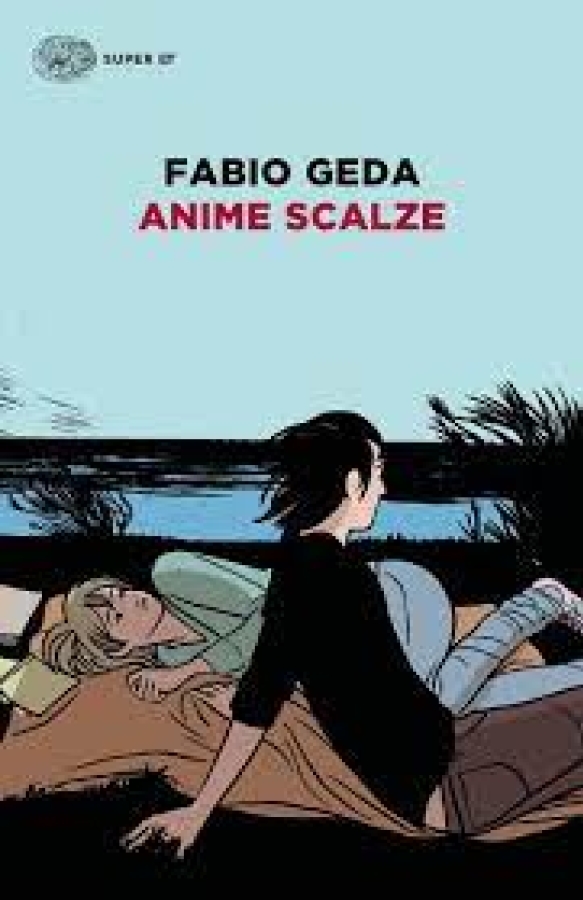
Barefoot Souls
The story opens with Ercole and his little brother Luca on the roof of a shopping mall, with the police yelling at them to come down. From the narrative, we learn that Ercole is fifteen years old, living with his older sister Asia and an absent father who takes whatever work comes his way and frequently gets into trouble. Ercole knows full well that Asia «was strong, yes, brave, but not indestructible. Tied to me, but not with me». When his sister informs him that she is moving in with her boyfriend, Ercole realizes that «mothers contain. Everything. Brothers and sisters accompany». On an old bicycle, he sets off to find his mother in a small mountain village. He gets a flat tire, has to hitch a ride, must ask for money for a train ticket, and when he arrives at the village where his mother lives, finds it difficult to locate her home because she lives in an isolated house. Stubborn and brave, Ercole faces every obstacle and overcomes his fears, yet cannot vanquish the monsters within. He cannot bring himself to ask his mother the questions he longs to ask. > Why did you leave, exactly? (...) Why don’t you ask me if I missed you? (...) That’s just how things are, Ercole. And there’s nothing you can do about it Asia used to say. Then comes a turning point. > Hanging from a spike on the outer wall was an American football helmet, yellow, with the number ten in red . It belongs to Luca, his six-year-old brother. > Life is a billiard ball; every collision makes it change direction; and if you are strong and lucky enough, you can go anywhere . Now Ercole has someone to care for, to protect, even from the world of adults. And when, at Luca's birthday, the boy's father's friends try to get the little child drunk without the mother defending him, it is Ercole who steps in and whisks his little brother to safety. Boldly conquering his fear, he gets behind the wheel of a car. The police surprise him. > Would they have believed me if I had explained what had happened, that I was doing it for Luca? Would they have believed me or the adults? (...) And if they had believed me, where would they have sent Luca? Into whose custody would they have placed him? (...) I heard Obi-Wan's voice whispering to me: use the Force, Luke. Follow your instincts. I heard the cracks crumble and the monsters emerge from the walls. I shifted into first gear. I slammed the gas pedal to the floor. And I fled. If in nineteenth-century novels the adolescent becomes an adult by braving increasingly perilous trials, thereby winning their autonomy from grownups, today the youth always remains somehow tethered to the help of adults. Consider the contrast between Stevenson's *Treasure Island*, where Jim faces perils alone—from the tempest to the pirate Silver—and the story of Harry Potter, who overcomes evil thanks to the salvific role of the arch-wizard Dumbledore (see the reviews on this site: *Treasure Island* and *Harry Potter & the Philosopher's Stone*). In *Anime scalze*, magic happily does not come into play; yet fifteen-year-old Ercole manages not to slide «from confusion to despair» because he finds solid footholds in his older sister Asia and his girlfriend Viola, his peer and yet so steadfast and determined. Woven into the primary narrative thread—that of the *Bildungsroman*—are other ingredients: the fragility and emotional distance of adults, bottling up feelings and refusing to seek help, abandonment, love as a lifeline; too many overlapping themes that are never explored in depth, as though the author wished to touch upon every conceivable facet of adolescent malaise. Coupled with frequent nuggets of wisdom, this narrative dispersion often renders the tale verbose and predictable. A weakness of the narrative lies in its literary style. Unlike the novels co-authored with Marco Magnone (see the reviews on this site of *Berlin* and *Il lato oscuro della Luna*), it lacks narrative pace, the final pages aside; the prose is also frequently prosaic, stripped of context because Turin remains distant in its post-industrial desolation, while the frequent resort to clipped, terse dialogue feels like a lifeline thrown to a narrative struggling to move forward, rather than an effective device to express incommunicability. Why read it? It is a smooth read and examines youth malaise.

A Girl Returned
> My mother from the sea died on the top bunk, on one of those nights. Looking at her, she did not seem ill, perhaps just a little greyer than usual. (...) At the funeral, the other mother accompanied me. PoorAdalgisa poorAdalgisa, she repeated, wringing her hands. But then they threw her out; her nylon stockings were all laddered and she couldn't attend the service in that state. This dream haunts the nights of the Arminuta, the “girl returned”: a thirteen-year-old sent back to her family of origin, to the “mother by necessity,” after spending her childhood with an aunt, the “mother from the sea.” Raised as an only child in an orderly, quiet home, she finds herself catapulted into a large, impoverished family, with uncouth and seemingly indifferent parents, loud brothers always ready for crude jokes, a slightly backward little brother, and an invasive younger sister, already adept at housework, who still wets herself. > Toward evening the older boys came home; one greeted me with a whistle, another didn’t even notice me. They rushed into the kitchen, elbowing their way through (...). They filled their plates amid splatters of sauce; at my corner, only a spongy meatball over a bit of sauce arrived. (...) My first parents remembered after dinner that there wasn't a bed for me in the house. Tonight you'll sleep with your sister, you're both skinny anyway, the father said . What nostalgia for her former life, for the “mother from the sea,” and what shame for such an ignorant, neglectful, and destitute family! Yet what remains inexplicable to the Arminuta are the reasons why she was sent back to her parents “by necessity,” and so hastily. Could the mother from the sea be ill? What if she had died in the meantime? With a troubled soul steeped in melancholy, the Arminuta ventures into a world unknown to her: she finds support in her eldest brother (her first love?), learns to help around the house, and, through subtle signs, discovers a gruff maternal love, even if she cannot accept it. > I had felt my mother's hand move across my back and come to a firm rest on my shoulder blade. I had drawn my head between my shoulders, like a fearful dog pleased by the first caress after a long abandonment. Yet soon I pulled away with an abrupt movement and stepped back a little. I was ashamed of her, of her chapped fingers, the faded mourning clothes she wore, the ignorance that escaped her lips with every word. I never ceased to be ashamed of her language, of that dialect that turned ridiculous whenever she made an effort to speak properly . It is her sister Adriana (“she wore skimpy clothes, dirty shoes, greasy hair”) who shatters the Arminuta’s bourgeois solitude, leading her to understand the emotional wealth born of sisterhood, of a friendship that draws strength from shared habit, from being cast into the world together, from saving each other through complicity. And it could only be Adriana who bluntly tells her the truth: the Arminuta was abandoned by the mother from the sea because the latter was expecting a child and there was no longer room for her, having been wanted only because they had been unable to conceive a child of their own. At the end of the novel, the Arminuta meets the mother from the sea once more, and from that encounter comes to understand herself: > like an improbable flower, grown in a small clod of earth clinging to the rock . There is one word that encapsulates this short novel: authenticity. One is genuine if one does not view the world through forms, rules, and appearances, but seeks deep feelings; one is genuine if culture, education, books, and knowledge acquired at school do not serve as a shield, but as a means to immerse oneself more fully into real life, to seek a mutual sense of humanity beyond divisions of class, ethnicity, religion, and gender; one is genuine if one is not ashamed of one's own language, yet refuses to retreat into a parochial and folkloric dimension. This echoes the theme already explored in Elena Ferrante’s novel (*My Brilliant Friend*), though here the pursuit of an authentic life unfolds within the family, in the relationship between daughter and mother, and among sisters. The question one might ask is this: why, in recent years, is there such a pressing need to return to the primordial wellsprings of Italian society—family and friendship? Why do we feel that culture is insufficient to teach us “resistance”? The plot is slender, and the characters are merely sketched rather than fully explored, beginning with the Arminuta, an improbable narrator. Its fundamental merit lies in the writing: banality and the style of television dramas are finally abandoned in favor of forging a new language, built on short yet unsplintered sentences, a measured blend of standard Italian with dialectal and regional terms, carrying ancient resonances deftly woven into modern syntax. Why read it? An engaging story, even if only sketched; writing that is both intriguing and pleasurable.

The Art of Joy
In the final pages of the book, Modesta, the novel’s protagonist, is accused by her son of never having loved him, > because you lived for everyone, always on the go, damn you, talking and acting familiar with everyone . And Modesta answers him indirectly a few pages later, confessing that “in my eager thirst for life, I ran too far ahead in my mind.” The account of Modesta’s life resembles a long, passionate sprint, devoid of a single moment of quiet, drawing instead ever-renewed vigor from the obstacles it encounters, from new friendships and loves, and from an extended family without boundaries, hierarchies, or defined roles. In the end, the reader is left weary and disoriented, overwhelmed by such sheer energy. The novel is set in Sicily, in Catania. Modesta is born in 1900, and the narrative traverses twentieth-century Italian history, with a keen focus on the fortunes of the Left: the socialist and communist parties. Raised in a destitute peasant family, Modesta is raped at the age of sixteen by a man who may be her father. Out of charity, she is taken into a convent. While this allows her to develop a passion for reading and study, she must endure the bigoted, hypocritical environment of the nuns and submit to rules that mortify intelligence and a fresh, inquisitive sexuality. She becomes the mother superior’s protégée, and through a series of fortuitous circumstances—seized by Modesta with remarkable cunning—she goes to live with an aristocratic family, the Brandifortis. Modesta is no Jane Austen heroine. She has no qualms about sweeping aside every obstacle in the way of her resolve > not to be a petty little woman. Like the princess I wanted to become, now she was truly a strong, willful woman, like a man . She murders the mother superior and the much-admired princess, marries the heir prince, despite his Down syndrome, and carries on two love affairs: with Carmine, the strong and overbearing estate bailiff, and Beatrice, the delicate and sweet little princess. Modesta embraces bisexuality joyously and without guilt, just as she is determined to become the mistress of her own destiny. On the other hand, in the background there always lingers the “ancient fear” of misery—both material and moral—stemming from her peasant roots. > I must not forget... the past, but rather always remember all of it, so as to keep it under control and turn it into strength against the new encounters that were surely lying in wait for me . Still very young, Modesta is already at the pinnacle of Catanian society, censured for her transgressive lifestyle, yet respected for her abilities and erudition. She could stop there. > But even now, as I write, the sun is setting, someone is knocking at the door, a car is waiting at the gate . Her encounter with Carlo, a northern physician steeped in socialist ideals, sweeps Modesta into the world of ideologies, abstract aspirations, and grand illusions. For the earthy, carnal Modesta, there is too much moralizing in Carlo, even if the protagonist appreciates his consistency and rectitude. Far more fraught, by contrast, is her relationship with Joice, herself a restless figure, weighed down by feelings of guilt she attempts to overcome through psychoanalysis. The romantic bond between Modesta and Joice is punctuated by the latter’s suicide attempts, by biting and spiteful arguments in which Joice accuses her friend of superficiality, reproaching her for a joyous, overflowing sensuality that makes no distinction between men and women, between casual lovers and deeper relationships. > Ah, Joice, what good was so much intelligence, so much science, if you failed to chip away at even a millimeter of the vice of guilt? Fortunately, there are the sea, the sun, long swims, and “a crowd of exceptional children,” whom Modesta welcomes with affection, heedless of their birth or family ties. Imposing an abrupt rupture on a romance that had grown stale, overly steeped in intellectualisms and recriminations, prison irrupts. Modesta is arrested, accused of financing and aiding the communists, and locked away in prison. In her cell she meets Nina, and it is a return to a joyous love, made of kisses and caresses, at once affectionate and sensual. With Nina, Modesta can once again abandon herself > to life, always without fear.... I would like to follow her... and keep dreaming..., but murmurs of voices, clatter of trains, the dull roar of crowded mobs tear away from my future and invade the room, pinning me to the armchair . The fall of fascism and the post-war era overwhelm Modesta. The Communist Party seeks to capitalize on her charm and capabilities, yet her ideas do not align with > that engaging, democratic smile... meant to reassure public opinion... One cannot suddenly talk of free love, abortion, divorce; one must proceed by degrees, as Comrade Giorgio (Amendola) says . Modesta is too transgressive for the bourgeois respectability of the Communist Party. Politics proves to be a disappointment, though hardly a surprise. The true novelty, which unsettles the protagonist, is her apprehension toward the young. Modesta discovers that the children, once so beloved, have grown into adults who accuse her, demanding justifications for their lives and asking why they were raised in such an unconventional way. They feel embarrassed by Modesta’s lifestyle; they do not understand it. And > to my astonishment I, too, realize that I fear their judgment . Meeting a new love—Marco, formerly Nina’s partner—gives her the strength to recount her extraordinary life, explaining to herself and to her countless “children” the reasons behind such a joyful eagerness to live. The novel was written between 1967 and 1976, when Goliarda was in her forties. It is a > journey backward into the subterranean woods of memories seemingly forgotten, which, once brought back to light, reorganized, and cleared of mold and crusts, reveal mosaics of gleaming gems for the understanding of one's own life and that of others . It is a sort of Freudian psychoanalysis, in which autobiographical elements intermingle with an imagined world—partly a transposition of the deepest traits of Goliarda’s character, and partly a chronicle of nostalgias and expectations: the large family, the children, the land of Sicily. As Domenico Scarpa observed, > this novel is a continuous victory over fear and uncertainty . Storytelling did not seem to have brought serenity to Goliarda, given that the events of the following years led the writer to a desperate and self-destructive act: the theft of jewelry from a friend, imprisonment, disgrace, and poverty. Perhaps there is too much egocentrism in Goliarda, so much so that the character system resembles the solar system, with a central star (Modesta) and countless planets (the characters) that possess no life of their own other than that which radiates from the center. Goliarda’s world is complex and intricate, yet the figures populating it are mere creations, fragments of an existential and psychological terrain that belongs exclusively to the author. The narrative structure rests fundamentally on dialogues between Modesta and the other characters: dialogues in which the context, the narrative function, and at times even the participants themselves are not entirely clear. They resemble extended soliloquies more than anything else, giving the impression that there is only ever one interlocutor: the protagonist. Because it also lacks a well-defined plot, reading it becomes arduous, and reaching the conclusion requires considerable effort. The publisher Feltrinelli refused to publish the book at the time, asking the author—who declined—to cut it back and make it less rambling and prolix. Its resounding success outside Italy somewhat ridiculed the publishing house’s stern verdict. Yet today, as the novelty of Modesta’s transgressiveness fades, that earlier assessment undoubtedly appears correct. Why read it? If one arms oneself with courage and patience, Modesta’s restless hunger for life delivers a jolt of energy in a contemporary world that is so gray and monotonous.

Ascension
In Greek mythology, Sisyphus is condemned for eternity to push an enormous boulder up to the summit, only to watch it roll back down into the valley and then be forced to haul it to the top once again. For Albert Camus, the myth of Sisyphus shows us how > the struggle itself toward the heights is enough to fill a man's heart. (...) At this subtle moment, when man turns back toward his life, a new Sisyphus returning to his rock, (...) he contemplates that series of unrelated actions which have become his destiny, created by him, brought together under the gaze of memory and soon sealed by death (*The Myth of Sisyphus* in *Opere*, Bompiani, pages 318–9). Viewed in this light, the myth of Sisyphus can serve as the interpretive key to a novel that would be simplistic to define merely as science fiction. Harold, a reclusive and solitary man, has been missing for many years when his brother learns that he has been hospitalized for evident mental disorders; he also discovers letters Harold wrote to his niece, recounting a mountain that mysteriously appeared in the sky, and its exploration by an expedition of scientists, including Harold. > I have wondered at times why I addressed these letters to you, Hattie, what this experience has to do with you. (...) At first, I told myself the letters were little more than a chronicle, a record of events that would allow me to process them at some deeper, subconscious level. (...) That is false. (...) I spent my life hiding from myself, denying my past, concealing my identity beneath new challenges and new mysteries. As Camus perceived, the thirst for knowledge and the flight from oneself are inextricably intertwined. The team of scientists comprises diverse competencies, some scientific, all within the natural sciences, an experienced mountaineer, and several military personnel. An exception is the presence of an anthropologist, whose necessity remains unclear. After being flown by helicopter to base camp, the ascent toward the mountain's summit begins. The climb entails the classic perils of high-altitude mountaineering: ferocious winds and subzero temperatures, ice and snow avalanches, ravines and crevasses. The explorers are also attacked by tentacled monsters and afflicted by paranormal phenomena, such as the collapse of temporal dimensions: a few hours can turn into months, the past and the future overlap with the future in the mind. The narrative is replete with adventure, plot twists, and Harold’s memories, as he painstakingly manages—or seems to manage—to free himself from guilt and achieve self-forgiveness. Only two men reach the summit: Harold, now physically broken, and Bettan, the mountain guide. In a sunlit environment above the clouds, surprisingly sheltered from the winds, the anthropologist appears. He is not a man; he is a Superior Being (God, perhaps?) and their expedition has been an experiment ( > I felt my entire existence shrink to the size of a rat cage ); an experiment to test the capabilities of human beings. It is by the will of the Superior Being that the ape became a hominid, then Homo sapiens, and was ultimately bestowed with the gift of Reason. The Superior Being has always intervened; now the time has come to make another leap—who will be the fortunate one? It can only be Bettan; our Harold is, deep down, a weakling. No sooner had the Superior Being placed the miraculous stone upon his chest than his body > began to glow, first with a deep blue, like that of the ocean, then yellow as the sun. (...) A surge of energy erupted from him like thunder. (...) It is done, said the Superior Being, (...) Welcome, “Other Man,” to the new era of humanity. And precisely at that moment of transformation, Bettan shoots himself in the head, killing himself, crying out: > I am the master of my fate, (...) I am the captain of my soul. The Superior Being retreats in dejection—forever, we hope. Adam preferred to leave the Garden of Eden to be free. Certain angels rebelled against God, choosing eternal damnation over being the applauding courtiers of divinity. In the novel, it is imagined that Harold's letters sparked widespread debate among the public and critics: a confused and delirious work; confirmation of a global conspiracy; an account of a phenomenon plausible from the perspective of theoretical physics; genuine clues pointing to the presence of real people who vanished without a trace; the oneiric construct of an anguished man seeking to metabolize his own guilt. It is difficult to say which of these interpretations is correct: perhaps a little of each. And this is precisely the novel’s shortcoming: attempting to say too much instead of humbly being a good science-fiction novel. The prose is straightforward and readable; a subject of such complexity would have required a more evocative writing style, capable of stirring impressions and fantasy in the reader—a language akin to Paul Lynch's in *Prophet Song* (see the review on this site). The plot is muddled, the result of striving to blend the adventure genre with psychological introspection, alongside excessive intrusions by the author into Einsteinian physics and metaphysics more broadly. Why read it? It is interesting, but do not expect a science-fiction novel.
Waiting by the Sea
The impetus to read Biamonti came to me from a poem by Montale: *Riviere*. In this masterpiece, the Ligurian landscape serves as the occasion for memories, for regret, and also for new dreams. And Pietrabruna, too—the village perched between mountains and sea to which the protagonist returns—evokes conflicting emotions: > the hills trembled in contact with the vault of the sky, shaken by a dense, luminous blue. Yet there were lands that turned their backs to the sun, despondent (as a boy they had made him dream). The rays descended from the peaks without touching them. Lands in perpetual yearning . Edoardo is a ship captain who returns to his home, awaiting a new berth. Welcoming him are > landslides clinging to the hillside and olive groves inside luminous chasms... sea light (that) welded itself to the summits, to the ridges, all the way to Pietrabruna : a village always the same, «yet where was life, outside the sabre-slashes of the sky, outside the wind?». Waiting for him, too, is Clara, who for years has been waiting for Edoardo to settle down. Theirs is an unusual love between a rootless man (like so many sailors) and a woman who is only seemingly placid and resigned: > in her sinuous, bony face, of an irregular sweetness, restlessness and reverie harmonized . Clara is the quintessential Ligurian woman, forced to be independent, and remains throughout the novel a mysterious, inscrutable, multifaceted character. Edoardo, on the other hand, is straightforward: behind financial troubles, he conceals the urge to flee. And indeed, he accepts a perilous assignment. He must deliver a cargo of weapons to Bosnia. He finds himself in command of an old tub. Soon enough, the voyage turns out to be a trap, as they lose contact with the shipowner, and upon reaching their destination, Edoardo is forced to seek out the buyers alone, amidst snipers and clashes between rival factions. The Bosnian village may resemble Pietrabruna, yet «the hills with their white ridge were shadow blue where the sun did not strike». And the woman, too, whom he meets and accompanies, could be Clara, but she had «light, distant eyes... the marks of a withered sweetness». Could the Bosnian village, left unnamed, be the inverted mirror of Pietrabruna, and Edoardo’s journey, therefore, have taken place not across geographical space, but within his own soul? It is one interpretation, as the novel remains suspended in a final, hermetic reflection by Edoardo: > in every land lies the seed of death, it is plain to see in broad daylight..... there are bursts of sunlight on hanging lands . Biamonti possesses a markedly lyrical style of writing, better suited to poetry than to prose. When describing the landscapes and figures of his native Liguria, his style often finds a felicitous balance between narrative movement and the quest for words and consonances. The first part of the novel holds a remarkable charm, especially for anyone enamored of Liguria; in the second part, the writer loses momentum and harmony: one senses that he is out of his element. Then again, current events and history are not the author’s true concerns; he is instead entirely devoted to delving into his own world, into the relationship between the luminosity of the landscape and the torments of the conscience. Why read it? It is a splendid read, though one should not expect a compelling narrative plot.
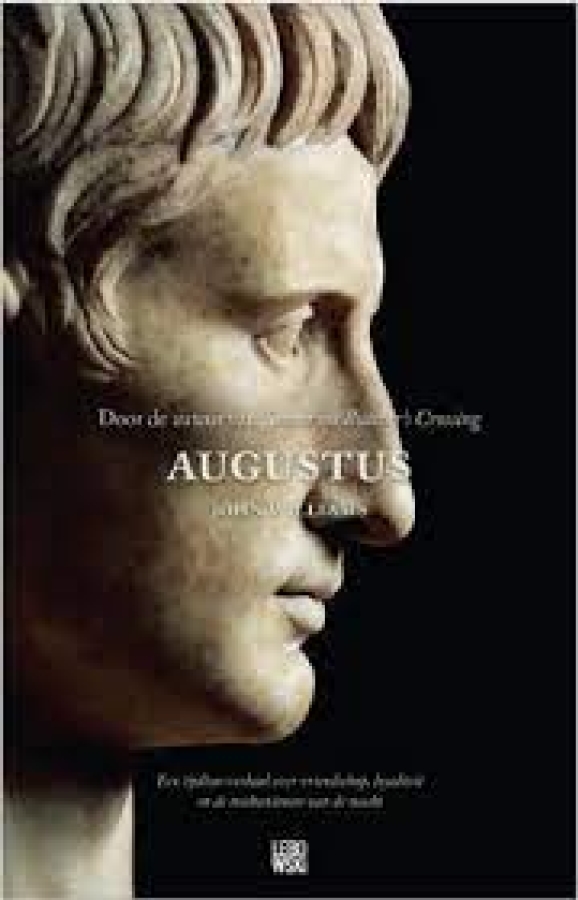
Augustus: a Novel
John Williams wrote three widely acclaimed novels: *Butcher's Crossing* in 1960, *Stoner* in 1965, and this biography of Augustus in 1972 (with this entry, all of his books have now been reviewed on this site). Williams is an exceptionally talented writer who continually reinvents his style, adapting it to the story and the characters. In this case, the author constructs the plot through letters written by various figures; Augustus himself intervenes in the first person only at the very end, allowing us to grasp key turning points—both political and personal—of his life from differing perspectives. It is an exquisite literary device, yet one that fragments the narrative and assumes the reader is already familiar, at least in broad strokes, with the complex events that led first to the Principate and later to the accession of Tiberius. Who was Octavian, later Augustus, in truth? When his great-uncle Caesar dies, naming him his heir, Octavian is an eighteen-year-old youth: he learns the news in Greece, where he is staying with his friends Maecenas, Agrippa, and Salvidienus Rufus. In his journal, the latter recounts how Octavian voices his uncertainties regarding the true loyalty of Caesar's legions and, turning to his companions, states that he will share his fears only with the three of them, > who are truly my friends, (...) a cold sorrow had settled upon him and pulled him away from us . It is as if the young Octavian had realized that youth was over and that upon him fell the grave burden of ending the civil wars and securing peace and prosperity for Rome: to accomplish this, he must become a shrewd and ruthless politician, relegating personal affection to the background and exploiting everything and everyone, even his oldest friends and his beloved daughter Julia. Paraphrasing the myth of Orpheus and Eurydice, Horace recounts Octavian's destiny. > His love was not a woman; his Eurydice was knowledge, a dream of the world, to which he sang his song. But the world of light that was his dream of knowledge was destroyed by a civil war; (...) and his dream vanished, as if evaporating, into the darkness of time and circumstance. He saw the world, and understood that he was alone, fatherless, propertyless, hopeless, without dreams..... It was only then that the gods gave him their golden lyre, and allowed him to play not as they willed, but as he himself desired . It is a magnificent synthesis of Octavian's destiny, elevating him to a singular and immortal role in history, pursuing an end to which everything is subordinated—even Julia's happiness. And it is here that we, too, venture into the darkness of the human soul. With a stroke of literary genius, Williams introduces Julia's journal on the island of Ponza, where she has been exiled. Julia’s sorrowful, resigned account is preceded by the gossip surrounding her dissolute life, almost as if to justify her father's dreadful decision. Yet one cannot help but feel sympathy for this still-young woman, who was forced to marry Agrippa, a man far older than she, and later the unsettling Tiberius. It may well be true that her father exiled her for her immoral conduct to spare her execution for treason against the state; what is certain is that Augustus's cold, cruel severity contrasts starkly with Julia’s gentle melancholy. These are exquisite pages that alone justify reading the novel: the fading of memories, rendered useless and bearing only grief, juxtaposed against the precision in the account of the encounter between Octavian and Julia, father and daughter. > His face was gaunt, and there were lines of weariness around his pale eyes; but in the uncertain light of the room, the face could have been that of the man I remembered from my childhood . Julia learns that the conspiracy has been uncovered by Tiberius, and her father can do nothing other than condemn her to safeguard his authority. > My child, he said, this has nothing to do with love. He turned away from me again and picked up some papers on the desk. (...) I have not seen my father since. I understand that he will (no longer) speak my name . The elegance of the prose, the fictionalized yet masterly reconstruction of events that remain obscure to historians, the lexical richness, and the ability to capture the idiosyncrasies of the various figures (from Mark Antony to Cicero down to the minor players) are literary merits that dazzle the reader. In many reviews it is compared to Robert Graves's *I, Claudius*; yet it is an entirely different matter. Flitting superficially across the history and the dramatis personae, Williams fails to convey passion and mystery; the novel ends up being as detached and rigid as we imagine Octavian Augustus to have been. Why read it? It demands some effort, but Julia's diary is truly beautiful.
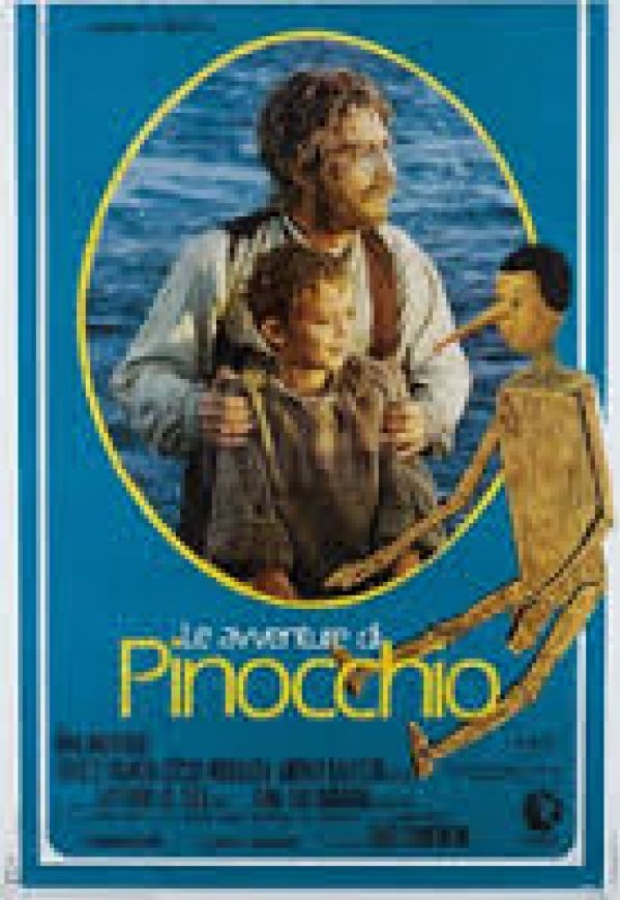
The Adventures of Pinocchio
As soon as one begins reading Collodi’s book, the mind immediately turns to a masterpiece: Gianni Rodari’s *The Adventures of Cipollino*. To our sensibilities, Pinocchio’s tale feels moralistic, with an underlying theme seemingly remote from us: > today (though too late!) I have had to convince myself that to earn an honest penny one must know how to make it, either through the work of one's own hands or the wits of one's own head , so says the Parrot to Pinocchio in the Field of Miracles. How much more amusing and captivating is Rodari’s novel, which speaks of freedom, of the struggle against the powerful, of daring imagination! And yet, looking more closely, one realizes that *The Adventures of Pinocchio* and *The Adventures of Cipollino* address the very same subject: the world is upside down, and it must be set back on its feet, onto the right path. It is evident that Collodi’s tale is a *Bildungsroman*: a child, thick-headed enough to be a puppet, learns from life how to become an adult, discerning good from evil. Yet all the characters are truly singular, beginning with Geppetto, the generous and solicitous father. who wishes to fashion a "fine puppet" in order to > travel the world, to earn myself a crust of bread and a glass of wine , and rightly the hidden "little voice" comments: "Bravo, Polendina!". And what of the Fairy "with the azure hair", the loving, sorrowful mother! Why does she not help Pinocchio, leaving him instead in the dark wood, at the mercy of the assassins? Pinocchio faces his ordeals alone—ordeals he himself brings about through his refusal to abide by social norms: instead of going to school, he goes off with the puppeteer; driven by greed, he allows himself to be duped by the Fox and the Cat; he forgets Geppetto in his destitution; he promises to be diligent only to forget it all to run with the other scamps; and thus he lands in prison, narrowly escapes being fried in a pan, and eventually lets himself be hoodwinked into going to the Land of Toys, turning into a donkey. What is it that redeems him? Good deeds. When the fierce dog Alidoro, who had chased him in order to devour him, is about to drown, after a moment's hesitation Pinocchio saves him: for indeed, > his father had told him many a time that one never loses by doing a good deed . And then, as if by magic, the various characters, the animals themselves, reveal themselves to be generous and obliging. When Pinocchio, searching for Geppetto, is swallowed by the terrible Dogfish, and there in the depths of the enormous stomach finds his "dear papa", it is a Tuna who helps them escape the mouth of the great beast: and > Pinocchio (...) planted a most affectionate kiss upon its mouth. At this display of spontaneous, heartfelt tenderness, the poor Tuna, unaccustomed to such things, was so moved that (...) he plunged his head back under the water and vanished . How it came about that Carlo Lorenzini, the real Collodi, > an implacable provincial, mythically lazy, moody and unpredictable , decided to write *The Adventures of Pinocchio* is a question best left to scholars. Perhaps because, as he wrote in the sketch *A Letter to Fanfulla*, "being born Tuscan is a misfortune that can happen to anyone." And it is precisely this provincial Tuscan character that breathes life and modernity into a novel that would otherwise be prudish and dull. Far removed from lofty, formal Italian, the language infuses the tale with vigor and brio: Pinocchio is a rogue, evoking every child in the world—their yearning for play and amusement, their naive openness to others, their reluctance to be hemmed in by the tedious social rules of adults. All of this makes the tale of Pinocchio timeless, transcending its nineteenth-century setting. Why read it? It is the story of the child we once were.
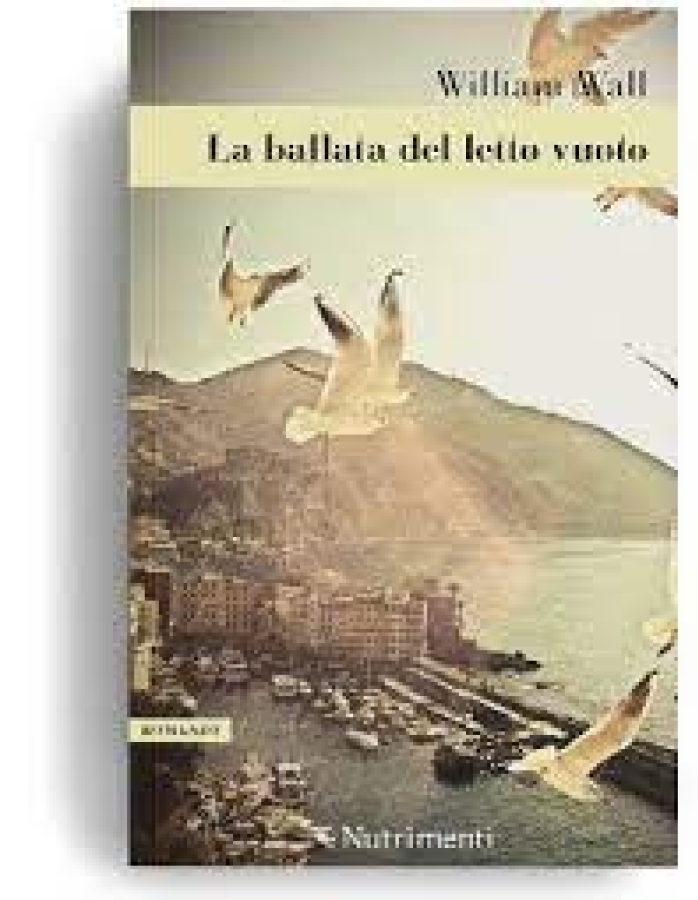
The Ballad of the Empty Bed
Kate lives in Dublin and is a middle-aged university lecturer. One day, she finds her husband dead in the bathroom and discovers herself buried in debt, hounded by creditors and banks. The man with whom she shared most of her life in an increasingly weary relationship was a scoundrel. > I wake up this morning with an awful headache, my new man had just left me a room and an empty bed . It is Bessie Smith's empty bed blues, a blues that echoes in Kate's mind with “the sax groaning in the background” and Bessie’s throaty, sensual voice. This state of stunned despair seems to offer no way out, until a young woman places a set of keys in her hand. From here unfolds a story of multiple narrative threads. Kate tracks down the house to which these keys belong: an apartment above Camogli, where “the sea eats away the land” and where Kate can see > the gleaming smoothness of newly tumbled stones beneath the cliffs of the Portofino sea, mica crystals sparkling in the winter sun, (...) the looming tenement blocks, the medieval arch, the old village, the little bars and restaurants bathed in pale golden sunlight, thin as cardboard silhouettes, (...) capable of radiating enough light and warmth to warm a soul or a heart. Perhaps even mine. In my head echoes the voice of change. Along with the splendid Ligurian harbor, Kate falls in love with Italian—with its musicality, but also its grammatical forms, which seem to reflect our own existence, > so uncertain or so complex that even the verb we use to express it must leap frenetically between different forms and even different roots . There is pleasure in addressing her husband's mistress as a *zoccola*, a sewer rat, only to discover that the masculine ending of the word carries many other meanings, but never that of a prostitute. In short, in Italian only a loose woman is a sewer rat—a subtle, ironic observation that perhaps only a non-Italian could make, accustomed as we so often are to taking the sexist usage of certain words for granted. Kate then meets Anna, an elderly neighbor with whom she forms an increasingly intimate friendship. In sketching this character, the author notes having drawn on Rossana Rossanda; what is certain is that this figure allows Wall to voice his own leftist sensibilities, mirroring himself in the image of a woman born out of the communist and activist traditions of Italian political culture. Yet an image it remains: a stereotype that impedes any genuine deepening of a singular friendship between a middle-aged, lonely, and betrayed Irish woman and an elderly, cultured lady still haunted by abandonment and nostalgia. Thus, the novel's core theme, “this headlong descent into Italy,” is not enriched by the psychological depth of an encounter, but is instead weighed down by reflections far too predictable to evoke wonder or stir our imagination. > Is it true that we can shed our lives just as snakes shed their skin? Or are we, on the contrary, tethered to old places and past times by invisible cables that bind us and thwart our every move . Wall answers these questions through Kate's journey, as she becomes a resident of Camogli and an adoptive Italian. It is striking that this question is posed on Bloomsday. Here emerges a defining trait of Wall's narrative: deceptively plain and straightforward, far removed from the stereotypically Irish idiom, yet replete with profound and evocative philosophical and literary reflections, the latter framed by quotations from Joyce's *Ulysses*. Could it be that the epiphany of the great Irish writer, in its apparent prosaicness, expresses a quest for renewal that remains too steeped in the Dublin world to ever truly succeed? The prose flows smoothly and pleasantly, marred only by an overreliance on rhetorical questions—a literary device that injects movement into the narrative but fractures and weighs down the discourse. The landscape and people of Camogli are depicted with immense affection and communicative vigor; the observations on the Italian language are engaging and gently wry. The plot, however, is fragile and ultimately unravels, and it is a pity that the psychological dimensions of the relationship between these two women—so divergent in history and culture—were not probed more deeply. Why read it? It is the chronicle of falling in love with a place and a language.

The Boy on the Train
All too often we forget the importance of places for our lives, for the shaping of our feelings, for the transmission of an individual and collective memory. As Paolo Casadio observes, walls, objects, and landscapes have the task of bearing witness to the past, of making it outlive ourselves, even if > walls know, but they can never say anything, only bear such a heavy burden in their mute immobility . At times they are not well-known or particularly distinguished sites; they are “non-places,” like the decommissioned station of Fornello on the Florence–Faenza railway line. It is with a “knot of anguish” that Lucia, wife of Giovannino, the new stationmaster, observes it: > that place overlooking the viaduct, that opening of trees and broom around the station, that drop behind the building which could conceal a fissure or a torrent, those marl stratifications that surfaced powerfully amid the garrigue, reflected back to her the image of an exile, the feeling of an invincible hostility . These are the years between 1935 and 1943, and yet, perhaps out of some dark premonition and a naturally fearful disposition, Giovannino experiences this isolation as a shield against the outside world. > Mount Castelpotente watched over the valley, and that mountain had stood there ever since the seabed had risen to form the Apennines. Nothing would happen. And nothing will ever happen, stationmaster. We, here, are forgotten. So spoke the blind man of Piandolci, like an ancient seer. Fornello and the small family—Lucia and Giovannino with the young Romeo—stand as a metaphor for Italian familism, for a life strategy that encloses everything within the realm of affection and familiar, unchanging surroundings; yet we know this to be an illusion, a vain and dangerous hope. With a slow, dreamy rhythm, the novel traces little Romeo’s childhood: the mountain environment, the village school with teachers and classmates unimaginable to us city dwellers, the relationships with peasant families, distant in space yet close in heart. It is a wondrous world for a child, where the few dangers fall within the eternal order of things and events. Nature is ultimately a friend, even when the blizzard rages, or the fields, paths, and houses are buried under snow. Everything changes when the most terrible tragedy of the Second World War bursts onto the scene: the deportation of the Jews. A train laden with poor souls destined for death halts for a night at the small Fornello station. They are permitted to disembark, sleep, and take refreshment with Lucia and Giovannino. Romeo befriends a little girl: a childish infatuation that could have a tragic outcome. > He does not yet know it, but nothing, after all, has any meaning other than what we assign to it, since everything disappears. He has truly grown up, the experience having served as a kind of initiatory ordeal: he has entered the land of loss and regret, and there is nothing more adult than grasping their irremediability and their meaning. And meaning, in that December of 1943, is truly difficult to find . It is a novel about childhood, underpinned by a haunting question for us adults: is it possible to be children? No, if even in an isolated Apennine village a child cannot grow up in peace. It would seem that the blame for this existential unhappiness lies entirely with an outside world gone mad, that it is the responsibility of others, against whom familial affection, friendships, and a benign nature are utterly powerless. Is this truly so? We cannot reveal the ending; we can say, along with the author, that we are all powerless > to alter the course of things, to neutralize the hostile relentlessness of fate, which so often turns into unappealable verdicts . And nothing remains but > the embrace, involvement, meager consolation, (...) communion in sorrow. The fundamental merit of the novel lies in its writing—perhaps somewhat unfashionable in its classicizing Italian, yet so elegant and refined as to satisfy a nostalgia for fine language. What is lacking, unfortunately, is the plot: the narrative pacing unfolds without surprises, except in the final pages: a long wait that is not redeemed by the characters, who are too sketchily drawn, nor by the description of the Apennine setting; and this latter proves a bitter disappointment—the failure to convey the magical, ancient atmosphere of a landscape and a society that have now vanished. Why read it? Beautiful, even if a bit dull.

A Boat in the Woods
Gasparre lives on an island and is the son of a weigher. He excels at school, particularly in Latin, and moves to Turin with his mother to pursue his studies. At high school, he soon realizes that the teachers themselves demand conformity and integration, regarding him with apprehension as a student who is “too good.” Mediocrity is the hallmark of the school system, and Gasparre’s life is defined precisely by his fraught adjustment to this prevailing social value. Disillusioned, he earns a law degree but opens a bar, implicitly rejecting culture and formal education. Yet, in plants, he finds an outlet for his quest for freedom and self-expression, turning his home into a woodland. The opening of the book is thoroughly engaging: the young student’s experiences, the discovery of the school and the metropolis, the encounters with his peers, and the struggle to be accepted. It is a delicate telling of a story that could belong to any young person. The style is linear and simple, highly effective. Then the book veers toward the paradoxical, toward an escape into a New Age ethos—that of salvation through nature—which, though the author may not realize it, is itself a token of conformity. The style, too, grows heavier, and the rhythm becomes prolix.
Bel-Ami
The novel is largely set in Paris during the 1880s, the period of the Third Republic following the fall of Napoleon III’s Empire. France, governed by an unscrupulous and corrupt political class, is embarking on its colonial adventure with the conquest of North Africa. Georges Duroy is a young man > tall, well-built, fair, with a reddish-tinged chestnut blondness, upturned moustaches that seemed to foam upon his lips... he looked remarkably like the worst rogue of popular romance . He is a young man from the provinces who has arrived in Paris without any precise aim, save for the allure of > places where _filles publiques_ swarmed, their dance halls, their cafés, their streets; he loved to follow them, speak to them, use familiar address, breathe in their violent perfumes . In short, he is a good-looking fellow, shallow and conceited, who will rightly come to be nicknamed Bel-Ami. Penniless, he can do little more than drift with the crowd until he happens upon a former comrade from his military service, Forestier, who has become the political editor of the newspaper _La Vie française_, owned by Monsieur Walter, an ambitious social climber who entwines business and politics, weaponising the press for his own, often illicit, ends. His friend secures him a post at the newspaper, and thus, despite himself, the young man launches into a journalistic career. Maupassant depicts with subtle irony this nascent world of the press, already by that time a compliant instrument in games of power. Duroy’s swift indoctrination enlightens the young man as to the true nature of journalism. One day, he is dispatched alongside a more seasoned colleague to interview several ambassadors. The two stop at a café; after all, there is no need to gather actual news—it suffices to construct it from secondhand information, even inventing it if necessary, and to cobble together with minimal effort an article containing precisely what the master desires. Are we speaking of nineteenth-century France or of contemporary Italy? Moving in Forestier’s social circle allows the young man to meet two women who will prove pivotal to his Parisian fortunes: Clotilde, "a little brunette, of the sort one calls pretty dark-haired women," and Madeleine, Forestier’s wife. The former shares Duroy’s tastes: she loves pleasure, is unpretentious, and takes life as it comes. She soon becomes Duroy’s ideal mistress, the only woman in whose presence he feels truly at ease and for whom he feels genuine sexual attraction, perhaps because Clotilde is somewhat of a _fille publique_. Madeleine is a modern, independent woman who relishes meddling in political and financial intrigues. As a woman, she cannot expect to play a leading role in the public sphere; she operates instead from behind the scenes through her men—her husband (a mediocre sort), her powerful lover, and Duroy himself, who allows himself to be steered, even as he chafes at her intellectual superiority. For Bel-Ami is vain and frivolous, yet the acute awareness of his own intellectual and moral inferiority breeds in him a vengeful resentment toward the very people from whom he receives aid—often crucial aid—for his career. Upon Forestier’s death, Duroy marries Madeleine; their relationship resembles a business partnership far more than a conjugal bond. Bel-Ami knows full well that Madeleine has several lovers (all men of prominence and power), but he cares little, not least because he too reaps tangible benefits from his wife’s connections: confidential intelligence, money, and honours. Yet he consistently harbours a certain bitterness and disdain toward Madeleine, who endures it patiently, perhaps out of genuine affection for the young man. Out of pure caprice and vanity, Duroy also seduces Madame Walter, the wife of the newspaper’s proprietor; she proves, however, to be a tiresome mistress, having fallen genuinely in love with him and being plagued by guilt over betraying her religious and moral values. How curious—a sincere person in a world of artifice! Life suspended between Clotilde’s eroticism and Madeleine’s intellect might have carried on placidly enough—setting aside the tedium of his liaison with Madame Walter—were it not for Duroy’s decision to marry the newspaper proprietor’s young daughter (and thus Madame Walter’s child). He must rid himself of his wife, and so he arranges for Madeleine to be caught in flagrant adultery, thereby securing a divorce. He then succeeds in marrying the young and wealthy Walter girl, once again through deceit: he persuades the girl (not yet eighteen) to elope with him, creating the necessary pretext for a shotgun wedding. Has Duroy achieved his ends: power, wealth, success? In reality, Bel-Ami’s exploits—the betrayals, the ignominious acts, the abused affections—do not stem from the pursuit of grand ambitions: the young man seeks merely the gratification of his vanity. On the day of his lavish wedding, Duroy > walked slowly down the high steps between two rows of spectators. Yet he saw no one: his thoughts drifted back to the past, and before his eyes, dazzled by the blinding sun, hovered the image of Madame de Marelle (Clotilde), rearranging before the mirror the curls upon her temples, which were always dishevelled when she rose from bed The book may be regarded as a realist novel, insofar as it portrays, with a touch both light and brutal, Parisian high society, power struggles, the role of the press, the enchantment of the boulevards, and even emergent artistic currents. It is a period of monumental upheaval, cultural as well, yet an atmosphere of vacuity pervades the narrative. The social milieu, much like certain existential themes (death, for instance), serves merely as a backdrop to Duroy’s transformation into Bel-Ami, and thence into the wealthy son-in-law of a powerful bourgeois grandee. The young man slips down a moral slope, occasionally feeling revulsion at his own deeds, only to shrug off these fleeting qualms. He is embarrassed when Clotilde suggests he meet her husband—with whom the young man will subsequently become fast friends. When Madeleine inherits a substantial sum from a lover, the young man initially refuses with righteous indignation, as accepting would lay bare his wife’s liaison with the man; yet he soon convinces himself—and seeks to convince Madeleine—that if he pockets half the estate, appearances are preserved, and all is well. It has been called the novel of money, of the press, of politics and careerism; in truth, it is the book of vacuity. And it is noteworthy, whether intentional or not, that it falls to two women (the female sex being a mere instrument for Bel-Ami) to tear through this veneer of bourgeois morality. It falls to Clotilde to fling the truth in his face: > you deceive everyone, you exploit everyone, you take money and pleasure from everyone, and you expect me to treat you like an honest man? Yet what truly enrages him is his mistress’s accusation that he bedded the proprietor’s wealthy daughter before marriage—a girl he had, in fact, respected (out of vanity? or a genuine sense of honour?). "He could endure anything, but this falsehood drove him to distraction." The question remains, then, whether Bel-Ami is entirely incapable of decent feeling, or whether he is fundamentally swept along by circumstance. It falls next to Madeleine to prove that a path through life can be forged beyond the mere chase of petty gratifications. Unlike Bel-Ami, Madeleine possesses a project of her own: to act as a mentor to men, thereby redressing the subjugation of women in nineteenth-century bourgeois society. The greatest virtue of the book lies in the writing of _Bel-Ami_. Maupassant conjures a muted, realistic atmosphere across his settings, admirably capturing the spirit of nineteenth-century Parisian society. His descriptions often seem rendered in pastel, reminiscent of Degas’s portraits. His description, for instance, of the hotel room where Madeleine is caught with her lover succeeds, in just a few strokes, in evoking that sense of the vulgar and the drab one expects from an adulterous rendezvous (within nineteenth-century bourgeois culture): > it was an ordinary hotel room with standard furnishings, where hung that hateful, stale smell peculiar to hotel bedrooms—a smell that emanated from the curtains, the brasses, the walls, the chairs; the smell of all those who had slept or lived, for a day or six months, in this public lodging, leaving behind a trace of their scent, that human scent which, blending with those that had gone before, formed over time a confused, sweet, and intolerable stench, identical in all such places . Why read it? It is a remarkably modern work in its milieu and its characters. The prose is both pleasurable and refined.

The Good Life and Others' Wars of Mr. Pyle, Gentleman
Imagine a Martian sent to Earth to understand what Humans are doing: whether war is to be expected or if we may hope for peace, which would allow interstellar commerce to continue. On the one hand, this visitor, bewildered yet indifferent (Earthlings' problems, after all!), would glean only a muddled impression; on the other, he might be an inquisitive traveler, somewhat horrified by our squalor and somewhat captivated by ancient monuments and beautiful women. Poised between metaphor and history, Barbero recounts the experiences of an American gentleman, Mr. Robert Pyle, traveling through the Prussia of 1806, at the height of the Napoleonic Wars, tasked with sending weekly dispatches to the United States ambassador in London. The first evident reality is that, traveling from Amsterdam to Berlin, he constantly encounters so many borders—some within Prussia itself—as to suggest that > the geography of European states resembles a puzzle left unfinished by a petulant child rather than a product of human reason, and it is hardly surprising that their politics should be guided above all else by fear of their neighbors. Could he be speaking of our own Europe? And then, with > that freedom the traveler enjoys to choose the roads to take, the dishes to savor, the girls to caress , Mr. Pyle can > spend the afternoon in the palace of a grand seigneur conversing in French , and end > the evening in the inn's courtyard, listening to the landlady's chatter and watching the scullery maid wash dishes in the kitchen by lantern light. Our gentleman does not merely observe; whenever possible, he reaps the fruits of fleeting encounters—be they prostitutes, young maidservants, or peasant girls persuaded by a few thalers, or fleeting, Byronic liaisons with noblewomen of the Berlin court. The only thing that holds him back is the risk of contracting some venereal disease. There are other pleasant diversions: conversations with Prussian officers, > capable even of philosophical reflections , card games where our Pyle unfailingly loses a tidy sum of thalers, the elegant salons where French is spoken and one is either for the war or against it, yet always admiring Bonaparte. Our gentleman even manages to meet Fichte and Goethe—the former just as history of philosophy presents him, the latter disappointing: a garrulous drunkard. Is this the mission entrusted to him? Amid brothels, grueling travel between coaching inns, and long conversations, our Robert even manages to meet Prussian ministers, Frederick William III himself, and the drowsy sovereigns of the minor North German states, such as Hanover and Saxony. And when he has no news to report, no matter: it is enough to read the Parisian *Moniteur*, even days old, or fabricate supposed intelligence to be denied or corrected in the following dispatch. For Mr. Pyle, it is an exhausting yet ultimately pleasant journey; for us, a splendid portrait of early nineteenth-century Germany awaiting an inevitable war, for at stake is the pride of a military caste forged by Frederick the Great and the nascent nationalism of the German nation. What shatters this grand tour, rendering all martial pretensions fatuous and reckless, are the disastrous defeats of Jena and Auerstedt, which lay bare the Prussian army's lack of preparation and the strategic backwardness of its generals. With a historian's precision, Barbero exposes the dark underside of war: soldiers marching to their deaths poorly equipped and in disarray, yet driven by the ancestral fatalism of obedient serfs; burned and pillaged homes, with civilians murdered, raped, or desperately fleeing; generals traveling in carriages, sticklers for protocol and mindful of their comforts; officers caught between discipline and solidarity toward their men, whom they cannot even provide with bread—though, after all, the soldiers are peasants accustomed to starvation. > It is all written in a little leather-bound notebook , says Mr. Pyle in the prologue, > which has been yellowing ever since, in the drawer of a wobbly desk, exiled for many years in the drawer, (...) a regrettable account of things done many years ago, and done poorly. Already in *Romanzo russo*, written in 1998 and set in Gorbachev's Russia (see the review on this site), one senses a kind of alienation regarding the moral and institutional dissolution of the Soviet Union; here, that feeling is even more pronounced, perhaps because the events are so distant in time. Robert Pyle is, at bottom, a spectator; even during the bloody Battle of Jena, his primary concern is his own survival, astonished to find himself caught up in this tragedy despite everything. On the other hand, Barbero is first and foremost a historian, and his profession compels him to remain detached, subtly ironic at times, but never emotionally enmeshed with his characters or their painful plights. To be sure, the author's convictions are clear: it is easy to talk of war from afar; one must experience it from the perspective of the humble, only then discovering the vast gulf between crisp, orderly maneuvers on a parade ground and what actually unfolds on a battlefield. Not to be seduced by technology, we must always remember that there are men and women, children and the elderly, and they are the true protagonists of war. Even more than in *Romanzo russo*, an intense ethical dimension shines through—a stern indictment of the fatuity of the ruling and intellectual classes, whether Fichte and Goethe or our American gentleman. One might say Barbero writes as he speaks: fluidly, laden with parenthetical remarks, precise and evocative in his descriptions. It reads smoothly, were it not for the fact that one all too often loses one's way in a repetitive, prolix plot. The extensive description of the Battle of Jena redeems the entire narrative, which had threatened to fray to the point of unraveling into formless excess. Why read it? For history lovers it is a gem—a remarkably timely novel.
Benediction
Dad Lewis and his wife return from Denver > away from the mountains, back out onto the high plains: in the pastures an expanse of buffalo grass, sagebrush, weeds, and blue grama, in the cultivated fields wheat and cotton. On either side of the highway there were dirt country roads running in all directions under a pure blue sky. Holt is a small Colorado town like so many others, a place hardly worth identifying because it is the same everywhere, it is where normal life is lived, > the precious ordinary life: mundane stories, with nothing exceptional about them, stories that could belong to anyone, yet which hold within them love, familial affection, unhappiness, guilt, memories, and the expectation of Death. Dad has just learned he has only a few months left to live, due to lung cancer. We witness the man’s slow, inexorable physical decline. Through frequent flashbacks, the author offers glimpses of what now torments Dad. In the past, as the owner of a supermarket, he fired an employee who had stolen from him; Dad was unrelenting, cast from a single mold, offering no second chances—not even to the man’s wife, who had gone so far as to offer her own body to pay back what had been taken. The man killed himself, leaving his family in destitution. This unyielding attitude led to a rupture with his son. When he caught him, still an adolescent, wearing his older sister’s clothes, he beat him, terrified of scandal and rejecting his homosexuality; the boy ran away from home, leaving no trace behind. With his elder daughter as well, who has returned home to care for him, he was emotionally detached, stern, and distant. Now, he realizes he has never caressed his daughter. > I was too busy. I didn't pay attention. No, she said, You weren't. She put her hand on his cheek, now. Forgive me, he whispered. I missed out on so much. I could have done better. I have always loved you. He wants to see his son again, he waits for him, he longs to reach out to the woman to apologize, he wishes he could turn back time, but now the people of his life, those he has lost, are merely part of a terminal patient’s nightmares. While Dad’s inexorable journey toward Death is the central narrative, other lives revolve around it, all marked by suffering. > Every life passes through some kind of unhappiness, (...) but there is good as well. (...) There are only brief moments. And as in Kader Abdolah's *The Parrot Flew Over the IJssel* (see review on this site), the cycle of the seasons rolls across the Great Plains. > In autumn the days turned cold and the leaves fell from the trees and in winter the wind came down from the mountains and out on the high plains of Holt County there were night storms and three-day blizzards. The novel demonstrates how our lives slip by without us seizing the opportunities to show humanity toward others, to comprehend the suffering of those around us. To be sure, Dad displayed great moral integrity in refusing the advances of an attractive woman; but wouldn't it have been better had he accepted them, had he been more forgiving of himself? Even in our prosaic lives, so far removed from those of great men, we are constantly faced with choices, and these decisions concern our relationships with others. At the end of life, nothing remains but remembrance, yet Death dissolves even that. > If one does not die, one lives, so writes Salvatore Satta in *The Day of Judgment* (see review on this site). > And this truth, seemingly obvious, is instead heavy with consequences, for life transforms everything; nothing can withstand its implacable truth. (...) To know oneself, one must live out one's life to the very end, to the moment one is lowered into the grave. The fundamental strength of the book lies in its prose: crisp, spare, and mesmerizing all at once. Short sentences, taut dialogue, and sparse digressions on the setting follow in succession; the characters are not merely described, but reveal themselves, always wrapped in that aura of mystery, of the incomprehensible, that shadows us throughout our lives. If Dad reveals himself in Death, who are the others? It is a pity that the narrative rhythm, elsewhere so intense, is compromised by an ending of a melodramatic and frankly verbose register. Why read it? Splendid prose.

Berlin: The Fires of Tegel
In a Berlin still divided by the Wall, a virus has wiped out all adults. The sole survivors are girls and boys under the age of eighteen; once they reach that threshold, the fate of the grown-ups awaits them as well. > They procured food through hunting: they had learned to build traps for rabbits; to dig pits to snare wild boars and deer. (...) They had taken over urban vegetable gardens, trying to tend them with clumsy, inexperienced gestures. (...) It had not been easy. They had suffered, especially during the first winter. But then they had learned to get by . As Francesco Petrarca wrote, “both remembrance and expectation grieve my heart”; the new masters of Berlin live in a continuous, anguished oscillation between memory—increasingly evanescent and imagined—and reality: a present orphaned of parents. > As for me, when I try to focus on their faces, I see them all blurred. But I hear their voices. And every now and then, in the air, I feel like I catch the scent of my mother’s clothes. As Ryszard Kapuściński writes in the final chapter of *The Shadow of the Sun* (see the review on this site), dissolving the memory of one’s yesterday means turning into > people without a past, which is to say, nobody. Those men would lose what bound them together, scattering each on his own way, alone. In *Berlin*, there is no future simply because they know they will all die upon turning eighteen. The girls and boys live without prospects because there can be no utopia when one is alone. Within the group, they seek that bond which might give meaning to existence, while carefully avoiding interference with the other clans—especially those with radically different values and rules. And it is out of respect for this overarching norm of coexistence that Sven, the charismatic leader of the Gropius, chooses not to aid the girls of Havel in taking back Theo, an infant kidnapped by the terrifying boys of Tegel. > Sven looked at Nora gently; she reminded him of a classmate he had fallen in love with in another life. (...) Cooperation. Solidarity. Weren’t those the rules? Sven dragged his eyes along the stained walls, down to the floor, and finally fixed them on his own feet. He knew those had been his words, just two years earlier. At the dawn of the new world. Was Tegel right, then, when mocking the Gropius kids for trying to replicate their parents’ society? > Young flesh, danger, excess: such was Tegel’s revolution, their response to the cruelty of fate. Their way of denying that the virus had snuffed out an extraordinary season of life, the one in which physical strength gives way to awareness and experience . We stand at a crossroads: we must choose between a world of solidarity and coexistence or slide madly down into the dark tunnel of blind force. It marks the opening of a battle from which a new humanity may yet be born. The reader must not be misled by what I have written. *Berlin* is not a treatise on moral philosophy; it is an adventure novel, a kind of chivalric tale, rich in plot twists and populated by characters, some of whom we will grow to love as the narrative unfolds (the book is the first installment of a saga). Adopting the adolescents’ perspective, Geda and Magnone plumb the forces beneath youth’s turbulence (the perpetual swinging between friendship and anarchy, detachment from and attachment to parents, the lure of risk and the dread of it) and confront us adults with a question: we, the absentees and the indifferent—will it fall to our children and grandchildren to find their own way alone? Will they be forced to fight for a better world without us? One is left with the urge to read on, both for the plot and to see who is right: the madness of Tegel, the solidarity of Gropius, or both. The prose is nearly flawless—perhaps excessively so. No distinct idiosyncrasies emerge, in either vocabulary or syntax, capable of mesmerizing or imparting an unusual rhythm to the narrative. The characters remain suspended within the roles they occupy in the group, lacking distinct personalities and backstories of their own. Why read it? Adventurous, distinctive, and profound.
The Brewer of Preston
The initial premise is a true event that took place in 1875 in Sicily. The prefect of Caltanissetta, a Florentine, insisted that the town’s new theatre be inaugurated with a virtually unknown opera, namely *The Brewer of Preston*. Numerous disturbances ensued, left largely unresolved by the inquiry that followed. Taking this real-life occurrence as his point of departure, Camilleri crafted a novel open to multiple readings, so much so that the chapters themselves could easily be rearranged in an order different from that of the narration. One possible trajectory is undoubtedly the detective plot, centered on the police delegate, Puglisi—the novel’s sole genuinely honest character, who may well be regarded as a precursor to Montalbano. In Camilleri’s imagination, the theatre is set ablaze by Mazzinian agitators on the very night of its opening. Acting as a true investigator, Puglisi uncovers the arson behind the fire, a crime for which the police commissioner is equally culpable, having chosen—out of petty political squabbles, and despite having been alerted by Puglisi himself—not to arrest the Mazzinian agitators upon their arrival in the city. Puglisi’s death at the hands of one of the arsonists proves expedient for many, not least the authorities of the newly formed Italian state. The book’s other interpretive key lies precisely in the corruption and arrogance of the officials dispatched to Sicily, chief among them the prefect himself, who colludes with the local mafia: an unholy alliance that bodes ill for the future of the island. Then there is the world of Sicily itself, and it is here that the author is at his finest, offering evocative, affectionately ironic, and at times paradoxical portraits of a society that watches, from the heights of a millennia-old history, the descent of new conquerors (the Piedmontese): a mix of pessimism, cynicism, pride, and stubbornness in defense of its own *sicilianità*, alongside an ingrained habit of submitting to the powerful and to violence. Further narrative threads and motifs can also be identified, particularly as the author structures each chapter around references to masterpieces of Italian and world literature, which one presumes are among those Camilleri held in highest regard. In this sense, the novel’s table of contents serves as a reading guide to other authors. The novel unfolds through continuous temporal shifts back and forth, with the result of fragmenting the plot into numerous vignettes, thereby compromising the narrative’s cohesion. The recourse to the Sicilian language, both in dialogue and narration, intrigues and at times makes for an agreeable read, yet on the whole it leaves an overriding impression of mannerism and literary preciousness pursued for its own sake. Why read it? It is an engaging read, even if one is ultimately left somewhat disappointed. What was the author trying to say?

The Broken Window
Anyone who has read or seen *The Bone Collector* in the cinema is already familiar with the book's main characters. Lincoln Rhyme is a renowned criminologist who bases his investigative techniques on the rigorous and meticulous use of "physical" evidence, even the most insignificant. Despite having been left paralyzed following a shootout. Rhyme continues to collaborate with the police, assisted by a team of detectives and by Amelia Sachs, a close and capable collaborator as well as his life partner. Rhyme's cousin is accused of rape and murder. All the evidence points to his guilt. Rhyme is quickly convinced that the clues have been fabricated by a serial killer who "knows everything." In the course of the investigation, Rhyme and his team discover the existence of a massive private organization that collects, stores, and processes information on virtually everything, selling it to corporations (for market research, for instance) as well as to public and state institutions. It is a "Digital Big Brother," whose data is seemingly inaccessible, yet which the criminal has managed to exploit and even manipulate. The thriller is skillfully constructed, boasting a plot rich in twists and an unpredictable conclusion. The best part of the book is its depiction of the world of big data processing corporations. Rhyme’s team proves remarkably inexpert (perhaps excessively so, given they do not even know Excel) and ventures into this realm step by step, left stunned, fascinated, and alarmed. Rhyme himself is disconcerted: can access to such vast amounts of information truly supplant the method and intuition that must govern criminology? And the reader, too, begins to wonder. On the surface, possessing powerful databases and sophisticated data collection tools would appear to be a monumental achievement. But is it worth it if a criminal can exploit them to commit rape and murder with impunity? Is the availability of so much information—which even enables the prediction of events—truly helpful in tracking down killers, or do traditional, obsolete investigative methods remain more effective? The premise is intriguing, the prose concise and effective, the plot well-engineered, and the characters—especially Amelia Sachs—compelling; it is a pity that, as so often happens with thrillers, the novel's sheer length renders it wordy and meandering. Are these authors paid by word count, as Salgari once was? Why read it? It is a solid thriller, and the theme is compelling.

Good Conduct
Kosovo is a small Balkan state, nestled between Serbia and Albania: it declared independence from Serbia in 2008 and is inhabited by an overwhelming Albanian majority, alongside a Serbian minority along the border with Serbia. The latter has not recognized Kosovo, and the Serbian community lives in a state of suspension, in constant tension with the Albanians. In Sumor, the small village where the novel is set, > almost everyone had remained to live there, perpetually suspended between choice and damnation. They had adapted to the inclemencies of History, surviving as best they could. Miroslav is the village doctor, esteemed by all, Albanians and Serbs alike: a man who has always sought to keep to the sidelines, quiet and balanced, letting himself drift along with the flow of life. Thus Ludmila, the peculiar sister of his best friend, teasingly mocks him: > Miroslav, Miroslav. With such a name, / will you manage to become a lion? / Or will they sing over your corpse, / oh Miroslav, Miroslav, glory to calm?. But is this very meekness the man’s true nature? Often Miroslav recalls his mother’s last words: > I always thought you had killed someone, (...) the more people spoke well of you, the more I understood you were hiding something. The man’s dark side emerges when he has himself elected mayor of the village, in the hope of mending relations between Albanians and Serbs; he seems the right person, yet he would need to display a courage and determination that he unfortunately lacks. The man dispatched from Serbia to act as shadow mayor, on the other hand, has them to spare. Humiliated and marginalized, Miroslav feels the desire to kill for the first time. In a delirium, aided by a few drinks too many, he dreams of going to the man and shooting him. > The deafening gunshot startles him, he recoils, he fails to register what happens to the man he has shot; he can only discern the splatters of blood on his pajamas. (...) In the darkness before his eyes, the figure of his mother in the hospital bed materializes, along with that final question she had asked him before dying: > have you killed someone? She already knew back then; it was a question coming from the future!. It is only the dream of an anguished man. The plot will take a surprising turn, which I do not wish to reveal. The good conduct > of Miroslav as mayor does not alter the condition of the small village, for better or worse. Everything remains locked in a fragile stillness; the past continually resurfaces with its wounds and rancor; there is nothing left to do but flee or conform. The novel can be read as a metaphor for contemporary reality. Indeed, we all live in a claustrophobic world, waiting for a change that never arrives. We are inundated with apocalyptic reports, with high-sounding declarations, yet nothing seems to alter; everything remains motionless. We dwell in an enormous dystopia, within which we forge relationships, dream of the past with nostalgia, and draft the future without knowing whether it will ever genuinely come to pass. The interpretive key of the metaphor lends the novel a universal dimension that extends far beyond the small village of Sumor; this approach, however, relegates Kosovo and its tragedy to the background. Along with Bosnia and Herzegovina, this small nation has lingered for decades in a state of suspension: sustained by the European Union, opposed by Serbia, its inhabitants live as though in a prison, oppressed by a past that shows no sign of dissolving, within a forgotten and suffering microcosm. The author’s gentle and affectionate irony, her deft narration, and the cast of characters conceal the drama in which the population lives; and while underscoring its universal value, she neglects the claustrophobic plight reminiscent of Dino Buzzati’s tales, characterized by an oppressive dread (see the review of *Sessanta Racconti* on this site). > Taking the pill at the fountain / is better than rum from Havana , hummed the eccentric Ludmila as she tossed back her daily dose of psychotropic medication. The narrative structure centers upon the cast of characters: Miroslav and his wife, with their weary marriage; the homecoming of Zbranko, in search of a center of gravity; the eccentric and intriguing figure of Ludmila (in Serbian, dear to madness") and her romance with Nebojia, the shadow mayor, an ingenuous and ill-mannered petty delinquent. The novel's merit lies precisely in its ability to delineate these figures, skillfully portraying their personalities and their mutual relationships. Sumor remains in the background, a setting for personal histories that do not seem to possess any genuine development. The psychological depth, the oneiric brushstrokes of the narrative, the character profiles, and the lightness of touch are the novel’s fundamental virtues. Why read it? It is well written, yet one comes away somewhat disappointed: one expected it to speak of Kosovo.
The Kite Runner
It would be wrong to think that this novel is about Afghanistan, which nonetheless constitutes its frame of reference. The theme of the book is cowardice. Amir lives in a fine house in Afghanistan with his father, an important and courageous man, and two servants, Ali and his son Hassan. The latter is Amir’s childhood friend, whom Amir treats with arrogance, albeit tempered by brotherly affection, believing himself superior in caste and culture, and envious of his father’s affection for Hassan. Amir and Hassan are champion kite runners, and on the very day of Amir’s greatest triumph—having won the kite tournament—he fails to intervene to save his friend, who is beaten and raped by Assaf. Amir is a coward, and this guilt haunts him throughout his life, even when he is forced to move to America, marries, and becomes a renowned writer. Only by returning to Afghanistan to rescue Hassan’s son will Amir succeed in redeeming his own cowardice, discovering along the way that his father—to him, an unattainable, flawless figure—was not blameless either, having never told him that Hassan was his brother. The first hundred pages of the book, which recount Amir’s childhood in a peaceful and happy Afghanistan, are very fine, written in a delicate and poetic style. Subsequently, the book loses its luster, ultimately losing its way in the final twenty pages, which recount how the protagonist manages to bring the child to America. The closing scene, a kite tournament in America, is predictable and trite, partly undermining the spiritual and narrative depth of the novel. In this final section, the only scene of real impact is Amir’s fight with Assaf, who has become a ruthless Taliban commander and reduced the boy to his sex slave. Assaf is beating Amir to death, yet Amir is content because he is finally freeing himself from the guilt that has haunted him all his life; he is ultimately saved by the intervention of the boy, who strikes Assaf with a slingshot.
Football in Yellow
The book brings together football-themed short stories by various noir writers, some well-known—such as Aykol, Giménez-Bartlett, Malvaldi, and Manzini—others less familiar: Gian Mauro Costa, Francesco Recami, and Gaetano Savatteri. The plots, characters, and writing styles vary, yet a common thread emerges: football, even at the amateur level or played in the minor leagues, is invariably a sordid, violent affair that brings out the worst in people. The already established authors are predictable: the narrative patterns are those of their novels, unfortunately compressed within the short story form, inherently brief. The contributions of Costa, Savatteri, and Recami are far more engaging; the first two set their stories in Palermo, while the third unfolds against the backdrop of Milan. Recami’s (*«Progresso - Audace 3-2»*) stands out as the finest story, well worth lingering over for its subject matter and deft narration. We find ourselves at a youth match, with parents cheering from the stands. Gianmarco is eleven years old, wrestling with the typical adolescent doubts about his sexual orientation, compounded by the fact that—being gentle, sensitive, and polite—he is mocked by his teammates with taunts like «Giorgi is gay». A talented player, he is targeted by a boy on the opposing team, egged on by his father («break him, take him down, finish him, kill him...»). The man, > an overweight man in his fifties, a third-generation immigrant from Puglia, rather potbellied , «in the throes of an aesthetic crisis», hurls unspeakable abuse at Gianmarco's mother, slaps her, and unleashes the fury of the other mothers, who chase after him intending to beat him. He takes refuge in an abandoned warehouse, where he is caught by Oleg, a giant of a man, clearly a criminal hailing from who knows which Eastern European country. And here the tables turn for our potbellied bully: the braggart turns into a lamb, such a coward that he literally shits himself, completely unable to protect his family from Oleg's threats and violence. Instead, it will be his wife who shields the children and the home, ready to sacrifice herself to do so; yet how could this be? A woman, belonging to the very sex the potbellied man routinely addressed with terms like: «fucking whore...». Meanwhile, Gianmarco makes an astonishing discovery: a famous player, «one of his idols, a tough guy, someone who commanded respect», had come out as gay. How was this possible? «You shouldn’t be surprised in the slightest», Sciacca the school janitor told him from the heights of his wisdom, > in the world of football, they're all faggots. (...) It was undoubtedly the most intense sex education lesson Gianmarco had ever had, and would ever receive in his entire life. He reflected. There was the principle, there was the truth, that’s why at Juventus they’re all faggots. So if I'm gay, does that mean I'm more manly than the pansies who go with women? The female janitor chimes in. > What are you doing, Sciacca, telling the boys your usual dirty little stories? What on earth are you talking about, we were discussing football. The short story format does not lend itself well to noir: it is too brief to allow for the development and suspense that form the very core of a mystery. It feels like watching an episode of *Murder, She Wrote*: at a certain point it must wrap up, and so the story either tumbles into a predictable denouement or remains suspended, leaving the reader unsatisfied. Of greater merit are the settings, the characters, and above all the prose: the latter occasionally proving to be a pleasant surprise. Why read it? It offers the chance to discover lesser-known, yet valuable writers.
The Lament of the Linnet
The novel revolves around a question to which the reader cannot find an exhaustive answer: who is the "Cardillo Addolorato", and what role does this omnipresent and obscure figure play among so many characters? And what is the meaning of the verses that recur throughout the tale, up to its seemingly tragic conclusion: «e vola vola vola lu Cardillo! e vola vola vola... oh! oh!»? To answer, one must venture into the reading of the novel, letting oneself be enchanted by the mystery of narration, which, like life, resides in the > freshness, fluidity, flow and precipitous fall, the continuous vanishing and resurrection of its infinite forms . We are at the end of the eighteenth century, in the midst of the Age of Enlightenment. Three friends—Prince Naville, the merchant Nodier, and the artist Albert—arrive from the cold North in Naples, a "strange city, wretched yet rich, softly colored," alternating "days of a purest, glittering azure" with others rainy and somber. The three young men, > radiant with a gaiety, an excitement, a pride justified by their age and, we might add, by being in a city so full of mirages, pay a visit to a well-known glovemaker. It is in the merchant’s house that the events determining the fate of the three friends unfold. First of all, they meet Elmina. "Full, yet delicate forms, stunning arms," a gaze > grave and reserved... a coldness... a distance, an abyss... that could be conquered (thinks Naville)... that could never be bridged , so it seems to Albert. The impression is so breathtakingly intense as to produce "a bewilderment of the soul"—more mundanely, causing the three young men to fall in love suddenly and like a bolt of lightning. Their lives are marked forever. Yet precisely at this moment of enchantment, a disturbing episode occurs. Elmina's little sister compares Albert to "their old goldfinch," left to die of neglect, without fresh water or millet. From a twofold and contradictory emotion, of ecstatic wonder and gratuitous cruelty, unfolds an apparently senseless story. As in an eternal return, the characters remain the same, events seem to repeat themselves identically, yet continually take on new forms and meanings: the only constant is the presence of the Cardillo, the mysterious bird, "entirely invisible and hidden." After all, is it possible to bestow > a legitimate name on the people and things of this world, all so unclear... and slowly slipping away ? Albert marries Elmina, who has undertaken a mission transcending all love and human bonds, even maternal ones: she must care for a child who might be her secret brother, but, naturally, is not. An imp, an evil spirit, or an innocent soul? In this predicament, poor Albert, a fragile and defenseless soul, cannot but succumb. Nodier, for his part, also in love with Elmina, after daydreaming of marrying her, being the pragmatic and superficial man he is, beats an orderly retreat once the incomprehensible mission the girl has set for herself becomes clear. Naville cannot accept this easy way out; he too is infatuated with Elmina, but, an Enlightenment thinker and cosmopolitan, he stubbornly attempts to find an explanation for incredible and mysterious events, to offer Elmina a definitive and fitting arrangement, showering her with gifts that are always refused, planning to marry her and take her away from Naples. All his efforts are futile, not only because events unfold in an increasingly indecipherable manner (characters are never who he thought they were; even the dead resurface to have their say...), but above all because, at decisive moments, the voice of the Cardillo bursts forth, that agonizing refrain: > Oh, had he never abandoned his home and the dull worldly life of the wealthy, solid, cold, reasonable, and thoroughly respectable society into which he was born! A kind of destiny dragged him to Naples, and against it poor Naville desperately fought, only to end up defeated. The prince returns to his homeland, to his majestic palace in Liège. To anyone who "boasted of that famous, though still newborn Progress," the prince—no longer worldly, no longer amused—would ask whether they > had heard the absolute silence of the world, the imperial joy of dawn.... the presence of the avenging Cardillo . Until one evening, just as he is about to set out once more for Naples, the Cardillo is announced to him. The familiar refrain echoed everywhere, and the prince > (blessed) the Cardillo who was arriving, and would finally explain everything to him. The madness and the separation, the grief and this joy that now arrived with him: all calm, cold, infinite . Who, then, is the Cardillo Addolorato? It is the underworld, the magma bubbling beneath ordering rationality. To grasp the meaning of the goldfinch’s voice, one must be a > patient reader, bereft of common sense and endowed instead with a private antenna to catch the glacial silence of the Universe, the quarrels of the underworld’s children, the spitting, the tears, the nein... nein of their imploring . Only in a Naples both fantastical and sorrowful, generous and cruel, could a book narrating the defeat of Reason take place. The novel’s chief virtue is its style, mesmerizing if not easy. The reader is immersed in an intricate syntax, rich in parenthetical clauses, representative of life’s complexity and vagueness. It is a prose that heralds dream, mystery, a world that refuses to be reduced to overly simple and linear narrative schemes. Its flaw lies in the confusion of the plot and character system. At first, the author manages to maintain order and logical progression; beyond a certain point, disorder bursts in victorious. The reader loses their way, and annoyance and tedium set in. Why read it? Its allure lies in the writing, but one must have the patience to press on through the final hundred pages.
The Professor's Briefcase
Let us imagine a young woman, somewhere between her thirties and forties. She was never a brilliant student, she works a monotonous office job, she has had a few romantic relationships that nevertheless came to nothing. She is alone. > All alone I took the bus, all alone I walked the streets, all alone I did my shopping, all alone I went for a drink (...). A cheerful life. Sad. Pleasant. Sweet. Bitter. Harsh. Stimulating. Irritating. Warm. Cold. Lukewarm. In short, how on earth have I lived for so long? One day, by chance, at the bar where she goes to drink (seemingly her only pastime), she runs into her former Japanese teacher. At first, it is a vague sense of feeling at ease, "settled," like buying a book and choosing to leave its wraparound band intact. Then something else takes over. > The teacher and I do not see each other often. It is only natural; we are not together. Yet I never feel he is distant, not even when he is not beside me . Finally, love emerges. > From what point onward, drawing near to him, did I begin to feel the warmth radiating from his body? Through his starched shirt, I perceived his presence. (...) A presence I was never able to grasp firmly. Just when I am about to seize it, it eludes me. When I feel it growing distant, it draws near once more . In a dream, the young woman searches for the teacher, but cannot find him. > Ah, there it is, I have already put him in the box! Now I remember. I shut him in the big box (...) that I keep at the back of the built-in wardrobe. (...) Now I can no longer take him out. Because the wardrobe is too deep . Yet what does the teacher represent, with his briefcase, his voice and his body, his past laden with mysterious meaning? Is he like the moon that must illuminate the path for a young woman who does not know herself? Is he the conscience unwilling to emerge from the depths of the soul? Or, more simply, an older friend to cling to in order to come of age and escape the loneliness of existence? We shall never know, for the novel offers no conclusion. We know only that when the aging teacher passes away, "on evenings like this," the young woman will open the briefcase and look inside. > But there is nothing in the briefcase, only emptiness, an expanding void. A hopeless void that swallows everything . To characterize this tale in some way—one that resists labels nonetheless—we might say that the novel articulates an existential suffering not confined to youth. Across the narrative, we discover that the teacher, too, has suffered from events beyond his grasp, such as his wife’s flight and sudden death. The older companion is therefore not a font of wisdom and certainty; rather, like the young woman, he is a tangle of certainties and doubts, expectations and disappointments. Their relationship, which becomes intimate and not merely spiritual, is the fruit of two kindred spirits seeking mutual support, facing existence together. The meaning of the tale must not be reduced to the trite story of an affair between a young woman and her former teacher. The slow acceptance of their love stems from the fear of opening oneself to the other, of acknowledging that one is a person only through another person. Distinctly Japanese, the novel thereby takes on a universal resonance. The charm of this brief novel lies in its narrative style: delicately ironic, thoughtfully gentle, the two protagonists, the wondrous Japanese landscapes, and ultimately the prose itself lead us softly and pleasantly along a path that might otherwise have proved somber and oppressive. Regrettably, the plot is fragile, often meandering and repetitive. A curious note: reading the novel reveals that Japanese cuisine is not merely sushi and raw fish; one can discover many intriguing recipes. Why read it? Distinctly Japanese, and therefore unique.
A house out of time
> He sets off between walls, prey to the light..../perhaps it was you, now it is an apparition/or perhaps it is all that knows no peace/ (...) It is a figure, it has no rest.../it is ours, I thought it a chimera (from "S'avvia tra i muri" in the collection *Avvento notturno* by Mario Luzi). These lines come to mind when reading this novel, which speaks of timeless presences, shadows and light dwelling in the realm of the dead during winter and among the living in summer, as in the myth of Persephone. Vera, a timid English girl of the early nineteenth century, certainly could not have expected such an extraordinary experience: becoming friends with Ginestra, whose destiny is to live for eternity like Persephone, poised between the underworld and the world of the living. The story begins in England. Vera is orphaned of both parents and has only an older brother, Caspian, who is passionate about archaeology. Vera studies Italian in the London schools founded by the exiled Mazzini (I appreciated this nod to an important, often forgotten role played by the founder of *Giovine Italia*). Caspian decides to take his sister with him to Pompeii, where he is engaged in the excavations. Vera wanders freely among the stones of the Roman city when Ginestra appears at her side. Just as in Luzi's poem, Vera becomes aware of Ginestra's sudden presence > not by any sound, because she makes none: what makes her turn around is a draft, an air pocket, like when you are swinging too high on a swing. Ginestra is > as tall as she is, (...wears flat sandals of slightly scuffed red leather... , but describing her is pointless; it is better to admire the portrait drawn by illustrator Elisabetta Stoinich of the two girls, together, hands affectionately clasped like two friends, jaunty, full of life—Vera smiling, Ginestra faintly melancholic in her Roman tunic and unruly hair, so alike yet so different from Vera in her composed Victorian attire. Yet why is a faint melancholy sensed in Ginestra? The girl knows she will lose Vera with the coming of winter, just as she will never again be able to live like mortals. There is a turning point in the story: the archaeologists succeed in capturing in a plaster cast the figure of a woman who died in the great eruption of Vesuvius; this woman is Ginestra’s mother. Ginestra's eternal vigil has become pointless; having seen her mother again, she can now leave the realm of the dead. She asks the Goddess for permission to depart the cheerful, vacuous sisterhood of her companions; in exchange for freedom, the Goddess demands Vera. Love prevails, and Ginestra condemns herself to eternal imprisonment. > They slipped away from one another, their clasped hands parted, the weave of their fingers loosened. The earth split before them, driving them apart. (...) Instead of letting Vera fall into the chasm (...) Ginestra looked her in the eyes for a long moment. Returning to cold London, will Vera remember her friend and her sacrifice? Beatrice Masini has written a delicate, subdued, almost evanescent novel. Her passion for Greek mythology and archaeology led her to intertwine Vera's coming-of-age journey—a true rebirth—with the history of the early excavations of Pompeii, suspended between conservation and greed for profit, between new technologies and the grueling, hazardous labor of the workers. One thinks of the evocative figure of little Nico, forced to work while still a child, and the description of the plaster casts, a method widely used in the nineteenth century to both preserve and popularize the works of antiquity. These realistic references frame a story of strong philosophical import: time, > which erodes and leaves nothing intact. Time, which is always hungry, and devours everything. Whereas before -- before, now, after, when it was, when it has been, when it will be -- over there, before, it was, it is all so perfect and polished. Overshadowed by so much metaphysics, the plot ends up crushed, weakened, fragile; the protagonists are not explored in existential and psychological depth, beginning with Vera and Ginestra. The prose is elegant and musical, aptly complementing the faint melancholy of the story. The sentences are concisely flawless, the vocabulary rich yet modern. The reader glides effortlessly through fine Italian prose, but at a certain point is left wondering: where is the fire amid such stylistic virtuosity? Why read it? The plot is fragile, but it makes for an enjoyable read.

Cécile is Dead
This is likely not one of Simenon’s finest novels. The plot is exceedingly simple: the niece, who served as a maid, kills her sick aunt when the latter refuses to give her money for her brother. Rummaging through the drawers, she discovers old papers proving that the aunt, together with her lover, had murdered her husband fifteen years earlier. The aunt’s former lover, who remains her business partner and lives in an adjoining flat, in turn murders Cécile to prevent her from revealing the contents of the documents she uncovered. From the standpoint of the detective genre, the events of the novel feel predictable, and the pacing certainly fails to grip the reader. The atmosphere (the figure of Maigret, the petty-bourgeois life) is sketched in a hurried, almost superficial manner. The fundamental virtue of the novel lies in its style. Even if the French language is not simple (owing to the richness of its vocabulary), it becomes readily intelligible through the sequence of clauses and words, which, even phonetically, help convey the traits of the characters, Maigret’s demeanor, and the salient aspects of the setting. What is to be appreciated is not so much the novel as a whole, but rather certain glimpses, such as the following: > Il arrivait a Maigret de hausser les épaules quand on s’émerveillait devant lui de la résignation des humbles, des malades …..sans horizon…. ; il savait par expérience que la bete humaine s’accomode de n’importe quel nid, du moment qu’elle peut le remplir de sa chaleur, de son odeur, de ses habitudes .
Chicago
The book is a collection of stories of Egyptians working and studying in Chicago, at the medical school. In some cases, they are individuals getting on in years, who have established themselves and seemingly integrated into American society. In others, they are young researchers who have received a scholarship from the Egyptian government and whose career success, therefore, depends upon the authorities of their homeland. They must strive relentlessly to achieve outstanding academic results, but they must also be exceedingly careful not to adopt critical or merely irreverent attitudes toward the Egyptian regime—at that time, Mubarak's. The stories unfold autonomously, interweaving only intermittently. Shaima is a deeply devout young woman who, > despite her exceptional scientific gifts, possessed an abysmal ignorance regarding the tools required to seduce a man . Already in her thirties, she meets an Egyptian colleague, falls in love with him, and discovers the pleasures of sex by his side. This affair seems headed toward a happy ending until Shaima finds herself pregnant and, confronted with the young man's terrified refusal (a child would disrupt his academic career), is forced to have an abortion, squarely against her religious convictions. Prior to moving to America, Marwa married a young man who appeared brilliant and respectable. In truth, her husband turns out to be a sordid individual: greedy, authoritarian, treacherous, with perverse and violent sexual inclinations, and, to top it all, an informant for the Egyptian secret service. Marwa wishes to divorce him but faces her parents' opposition; shrewdly, she engineers a situation whereby separation becomes inevitable: the husband is willing to surrender her to a powerful intelligence figure simply to secure an academic career compromised by his utter incompetence as a researcher. If the young are forced to navigate—some naively, others cunningly—the narrow confines granted by a repressive and hypocritical society, the adults themselves do not escape this fate. Saleh chose to flee Egypt, abandoning the woman he loved, whose harsh reproach still haunts him after so many years: "It is truly a pity that you are a coward!" the young woman exclaimed as she bid him farewell. Saleh married an American woman, but it was a marriage of convenience; so much so that his longing for the motherland eventually becomes uncontrollable, even taking on fetishistic dimensions, such as donning his old Egyptian clothes. He wishes to redeem himself by proving to his beloved that he is a brave man who takes risks for his people's suffering. He fails, because deep down he remains a coward, and so he takes his own life. Rafat, too, married an American woman, with whom he had a daughter. In a dramatic confrontation between father and daughter (in a last-ditch effort to save her from drug addiction), the girl violently unmasks the sham upon which Rafat has rested his entire life: > you are a fraud (she shouts at him), a failed actor playing a moronic role that convinces no one. What are you? Egyptian or American? Naghi is an idealist, receptive to the new experiences afforded him by American society, convinced of the need to fight for his country's freedom and democracy. He refuses to conform, often exposing himself to danger in the treacherous milieu of Egyptians abroad. He meets a Jewish girl and begins a romantic relationship marked by passion, affection, and mutual discovery. He is visited by an agent of the Egyptian intelligence services, who warns him to abandon his revolutionary pretenses and lets him know that they possess video footage of his fiery trysts with the young Jewish woman. Who could have planted a hidden camera in his apartment? Paradoxically, Naghi accuses his lover—so entrenched are the mistrust and the barriers dividing the two peoples. > However strong your love may be (the girl says), you will never forget that I am Jewish. I can be as honest with you as I like; your trust in me will always remain fragile . Naghi, too, an aspiring poet, cannot escape the fate of pretense and suspicion bred by a repressive society. All these stories develop in parallel, generating a kaleidoscope of lives, voices, and imagery so dense that discerning a unified narrative thread proves arduous. The vignettes of Egyptian culture, crafted with subtle irony, the deft sketches of characters and their circumstances, along with the detailed depiction of the erotic inclinations of individuals and couples, form a trap that entraps the reader within minutiae, obscuring the overarching import of the novel. There is unquestionably a critique of Egyptian society. Yet the book’s true significance likely resides in the unhappiness engendered by society’s repressive structures. There exists an indissoluble link between the social and institutional order (the absence of democracy) and individual destiny, reaching even into the realm of intimate, familial emotions. That this is not merely a feature of the Egyptian world becomes apparent in the only storyline whose characters do not hail from the North African country. Graham is a sixty-year-old professor, libertarian and eccentric. He meets Carol, a Black woman, with whom he shares a wonderful romance. Yet Carol, because she is Black, cannot find work, ends up modeling, and is coerced into yielding herself to a prominent corporate executive. They love each other, yet social segregation tears their relationship apart—for there is no escaping the devastating fallout of an unequal society, however formally democratic it may be. Aswani is a skillful writer, yet a narrative structure premised on multiple, parallel plotlines cannot be sustained indefinitely without weighing down the prose and dissipating it into too many tributaries. Moreover, there is no overarching plot to draw together the threads of the novel, leaving the narrative ultimately verbose and underwhelming. Why read it? It remains an assemblage of pleasant, intriguing vignettes.
Two Women
For Moravia, *La Ciociara* > was his tribute as a novelist to the Resistance as a collective act . The setting is Ciociaria, southeast of Rome; the historical context is the period between October 1943 and June 1944, when this region was thrown into turmoil by the protracted stalemate in the Allied advance, caused by the Cassino defensive lines and the failure of the Anzio landings in January 1944. The narrator and protagonist of the novel is Cesira: raised in Ciociaria, she married a Roman shopkeeper, a man who despises her, calling her «la burina». And indeed, Cesira is coarse, plebeian, and rural, yet strong and pragmatic, a formidable, seasoned worker. Her life revolves around the home, the shop, and her daughter Rosetta. This is how her mother describes her at the beginning of the story: > she had a face like a little sheep, with large eyes, an expression sweet and almost poignant ; later she will have to admit > that this perfection was fragile and almost artificial, like that of a flower grown in a hot-house . For Cesira, the war is far away ( > those sons of whores, let them butcher each other all they want, what do we care about their war? ). And as another character will say, > war is only bad for fools. (...) Let the Germans come, let the English come, let the Russians come, what must matter above all to us shopkeepers is still the shop, and if the shop is doing well, all is well . Cesira thinks the same way; indeed, she enriches herself through the black market throughout the war years. After September 8th, Cesira finds herself flush with cash but devoid of provisions, forced to starve. She decides to leave Rome and head to Ciociaria, to stay with her parents. The train takes the two women as far as Fondi, where the railway line ends. They find lodging with a shady family, whom they quickly abandon after Rosetta is subjected to the indecent advances of a petty Fascist hierarch. They flee, then, into the mountains, to a wretched shepherd village where numerous families who fled Fondi have taken refuge. In the extensive pages dedicated to the shared life of the evacuees and peasants, Moravia draws on his personal experience, to the extent that events and figures mirror those in his diary from those terrible days, when he was forced, alongside Elsa Morante, to seek shelter in Ciociaria. The narrative, fluid yet prolix, is skillfully driven forward, thriving on the contrast between the harrowing realities of war (desolation, bombings, roundups, violence) and the splendid indifference of nature, which follows, immutable and cynical, the eternal cycle of the seasons. The tale seems suspended, awaiting the arrival of the Allies, who are expected to bring «abundance». Enter Michele. a young intellectual, steadfast in his ideas and courageous in his conduct. Unlike Rosetta, who owes her innocence to ignorance, Michele is keenly aware of what is transpiring, of the Nazi-Fascist oppression that affects not only the insular world of the evacuees, but all of Italy, driven toward general material and moral ruin. A positive figure, he is trapped, as it were, in the life of the displaced, in the wretched and indolent day-to-day existence of waiting, focused solely on surviving somehow. Finally, the Allies arrive; it ought to be liberation, but instead the situation deteriorates rapidly. Some German soldiers take Michele away and subsequently execute him when the young man stands up in defense of a peasant family: Michele dies a hero. The two women, alone and isolated, are caught off guard by a group of Allied soldiers, who rape Rosetta. The rape changes the girl; once so innocent, she declares to her astonished mother: > him or someone else, it makes no difference to me. (...) I want to make love because it's the only thing I like and feel like doing. And from now on, I will always be like this . The rape, Michele's death, and the war profoundly alter Cesira as well: once a confident woman, she becomes uncertain, tormented, so much so that her sleep is plagued by nightmares, as though only the oneiric world might allow her to regain her original solidity; in one of these dreams, she imagines that Rosetta has married and that «she unbuttoned her bodice and gave her breast to the baby», but was it Rosetta or that poor madwoman she had encountered wandering the countryside amid the desolation of war? Whatever his intentions, the author fails to convey the tragedy of war for civilians, and this for two reasons. First of all, a pervasive pessimism regarding human nature prevails, leading to the passive acceptance of events, to resignation rather than rebellion, to submission—an attitude certainly not redeemed by the final chapter, in which grief would seem to restore perspective to Rosetta and Cesira. It is a hypocritical and sickly-sweet appendix, calculated to avoid an ending too cynical to find favor with readers. Secondly, Rosetta's metamorphosis from a good girl into a «whore» is implausible (is a rape overcome so easily?), smacks of the morbid, and mirrors a typically male conception of female sensuality. In short, the gang rape is treated as an initiation, an abrupt way of discovering the «ugly things» of the world. On the other hand, > she had now developed a taste for what the Moroccans had forced upon her . From a cathartic turning point, rape becomes the inexorable fate of all women. One cannot be accused of being politically correct in stating that this Cesira-Moravia worldview is intolerable, in addition to draining all tension from the entire narrative. The plot is admirably constructed, the characters are well drawn, and the writing is fluid, effortless, and accomplished with its airy phrasing. The reader is led by the hand up to the rape, foreshadowed throughout the narrative by subtle hints and fleeting episodes; when it occurs, it seems inevitable. Moravia confirms his immense gifts as a writer. Why read it? Cesira is a victim, and her story is emblematic of what befalls civilians in all wars.
Through the eyes of the enemy
This book collects four lectures delivered by Grossman between 2004 and 2006. Two of them concern the nature of writing, while the others address the "appalling, ambiguous, and complex" situation of Israel. What unites the reflection on literature with that on politics is the writer's mission: for Grossman, it consists of refusing the > surrender of the possibility of understanding what I truly think... So that, perhaps, it would be better not to think, not to know, to entrust the task of thinking, acting, and establishing moral norms to those who certainly know better than I do . Grossman shares the view expressed by Vargas Llosa in the preface to *Aunt Julia and the Scriptwriter*: literature originates from the writer's dissent from the world, from > what he would like to suppress, add, or correct in life . The starting point is, however, an inward search that recalls Pamuk, for whom > being a writer means being aware of the secret wounds we carry within us (*My Father's Suitcase*). Indeed, for the Israeli author, > the primary impulse that triggers and drives writing is the desire to invent and tell a story, and to know oneself. Moreover, the more I write, the more I realize the power of a second impulse, which cooperates with and completes the first: the desire to know one's fellow man from the inside, from within... to feel what it means to be another person . And thus the fundamental motive > is the yearning to voluntarily remove what defends me from the other , in order to overcome > the effort we make not to expose ourselves completely to the other... to preserve... the framework in which our multiform and erratic psyche is contained, and at times imprisoned . The pivot of this transition from the self to others is constituted by characters. > Writing a novel means, to a large extent, being fully responsible for a few dozen characters . To explain this statement, especially pertinent in light of the descriptive and psychological poverty of so many modern novels, Grossman relies on an apt metaphor. The writer is like someone who keeps dozens of people imprisoned in a cellar. > Every now and then he would do well to have a chat with them... try to defuse tensions... listen to their stories and memories, remind them of everything that is still left to dream of, to mourn, so that for a moment they forget the suffocating pit in which they find themselves . From this focus on characters arise the tasks that Grossman assigns to politics. > If there is one thing I would hope politicians and leaders might sooner or later learn from literature, it is precisely this way of dedicating oneself to a situation, and to the people trapped within it , to no small degree because of the traps those very politicians and leaders helped create. The mention of political responsibility leads directly to the lectures addressing Israel's dramatic situation. One cannot help but admire Grossman’s courage, but also his dignity, in directly calling out the Israeli government's culpability in pursuing an aggressive policy that is distorting the very foundations of the State of Israel, its institutions, and the rule of law itself, setting in motion an apparently irreversible process of "disorientation and dismemberment... of the public, social body." Yet Grossman’s most compelling reflection concerns an aspect seldom emphasized: the gradual disappearance of the > model of the universal, cosmopolitan Jew, who aspires to fulfill an intellectual and moral mission , supplanted by utilitarianism, brute force, and aggressive competitiveness. If the land of Israel was meant, in the ideals of Zionism, to end the Diaspora and render the Jewish people finally "equal" to other nations, fear and hostility toward others (first and foremost toward the Palestinians) perpetuate the psychological and spiritual patterns of the Diaspora—this time in an aggressive key. From oppressed, the Jewish people become the oppressor. It is futile to look in Grossman's lectures for the lightness and subtle irony of Pamuk or Vargas Llosa. This is not merely the author's style, which is invariably solemn, intricate, and meditative. It is the tragedy of the man—as an individual (above all, as a father mourning the loss of his son), as an Israeli witnessing the unraveling of his own people, and as a Jew confronting the betrayal of millennial values—that prevents Grossman from casting aside dark and tragic undertones. The anguish oozing from every word, the philosophical edge of his considerations, and the sense of an inescapable fate that can be counterbalanced only by utopia make for a heavy and demanding, at times repetitive, read. Only at certain moments does one emotionally empathize with the writer. It occurs when, in his magnificent commemoration of Rabin, he asks with dignity not to be judged with pity and indulgence as though driven by a "feeling of anger and vengeance" over the terrible tragedy of his son's death. Even grief can be wielded by power to silence dissent and critique! Why read it? The reflections on the writer and on literature are particularly compelling.
The Confessions of an Italian
Carlino is the natural son of the young Countess of Fratta and grows up in the household of his aunt and uncle, left to the care of the servants and regarded as a «second-class relative». At the castle of Fratta also lives his cousin, a girl younger than Carlino, named Pisana. From his boyhood, Carlino falls in love with Pisana, an increasingly vivacious and unpredictable girl who shares a conflicted relationship with him: she seeks his protection and affection whenever she needs it, only to wound his feelings by keeping company with other boys and treating him poorly. The novel (late 18th to mid-19th century) is the chronicle of this love, accompanied by the nostalgia for a childhood that was poor and neglected, yet happy and carefree. The political events (the old provincial feudal society, the decline of Venice, the Napoleonic era, the Restoration, etc. ) are important, yet remain peripheral to this troubled but profound bond that unites Carlino and Pisana. The two come together and part ways, only to reunite in an ongoing struggle of emotions and reciprocal roles that transcends all the upheavals surrounding them, in which they are deeply immersed. Two themes emerge, typically Romantic yet remarkably relevant today: nostalgia for childhood: > we were happy without effort, happy without knowing it... for me, it is true, there was also the spit to turn; but I forgive even the spit, and would gladly turn it once more to regain the innocent bliss of one of those blessed evenings, at Martino’s knee, or beside Pisana’s cradle . Yet the memory of childhood and of loved ones slowly fades across a long life: > beloved and melancholic shadows of those I loved, you live on in me... youth remained alive in the man’s mind; and the old man gathered without a curse the experience of his manhood . A pervasive sadness therefore dominates, a resignation born of the realization that everything vanishes, just like great love: > forgive me for having loved you in my own way, Pisana says on her deathbed, for having sacrificed you to a strange and inconceivable whim of mine, for having sought in your life nothing but an opportunity to indulge my strange fantasies!... You were not supposed to understand me, you were supposed to hate me, and yet you endured me! . The incomprehensibility of love, of the affection that binds two people and compels them to care for one another despite everything. And the novel closes precisely with an ode to his love for Pisana: > I glimpse you, bluish and compassionate, in the dying ray of the moon (we are in the height of Romanticism)... we hoped and loved together... without you, what would I ever have been? . Another theme of the novel is the transition from aristocratic to bourgeois society, the hopes for a free Italy, and the mounting disillusionment with this design. Yet another theme is undoubtedly the pessimism regarding the Italian spirit, its structural inability to be a free and «ethical» people. These are, as noted, peripheral backdrops, contexts within which the true central threads of the novel unfold. If it is true, as Goffredo Bellonci observes, that this is not merely the novel of Pisana—in that the author intends to depict the journey toward a growing consciousness of the individual and of a people discovering within itself the strength for rebirth—it is equally true that the web of human feeling is what confers modernity and enduring relevance upon the novel. The novel is very long and prolix. The first two hundred pages (childhood at the castle of Fratta) are very fine: swift, fresh, spirited, and ironic. They are read in a single breath. Thereafter, the novel adopts an uneven pace, frequently slow and ponderous, at times superfluous. The reader gets lost and struggles to read on.
To conquer the red spring
Written in the days immediately following April 25, 1945, this book is an autobiographical novel, a recollection of > things experienced, and still alive within, before time has calmed the turmoil of emotions ( Giorgio Amendola, introductory note to the 1975 edition). Lajolo, *nom de guerre* Ulisse, took part—out of genuine conviction—in all the Fascist wars. July 25, 1943, the day of Mussolini's resignation, catches him stunned. > It is the end... people shout with joy... a cold sweat is on my brow, the regulation shirt chokes my throat like a noose.... now begin the long days of sadness . What is to be done? On the one hand, his personal history impels him to commit to the Salò Republic; on the other, he feels inside > something irreconcilable (that) told me not to accept. I did not yet quite know how to discern what it was.... but I understood, however vaguely, that in that place I would be on the wrong path, I would do no good for the country... (and) I would walk out into the countryside. The crusted, parched earth seemed to have retreated into itself, jealous and fearful of being laid bare . For a man of action like Lajolo, spiritual torment cannot last long, nor is it resolved through meditation. It will be the youths of his village (Vinchio d’Asti) and his homeland (the Langhe) that guide his choice of path. > Those boys of mine, who in the dark had all risen at the call, ready to lay down their lives, had told me that this was the true patriotic spirit... (they are) the very same boys who had set off so many times to wage war . > My land! I could not betray it, for I felt it deep within my flesh. My land, with its villages and low, multicoloured houses, with weathered and gleaming roofs, and farmsteads whose vegetable patches are enclosed by slender cane thickets... perhaps never so much as in these times had I known my land so intimately . And it is precisely this solidarity among combatants, punctuated by a meticulous roster of partisan comrades' names, along with the imagery of the “dear Asti land,” that constitute the novel’s distinctive virtues. The author cannot dwell on them for long, as the action unfolds in a crescendo of intensity and drama leading up to the terrible winter of 1944–45. In those months, the Nazi-Fascists mount their fiercest effort to crush the partisan forces, who had succeeded in establishing what came to be known as the Republic of Monferrato in the areas surrounding Asti. It is a manhunt, partisan by partisan, which also unleashes brutal reprisals against the civilian population. Lajolo, by then one of the leaders of the Resistance, hides with a few comrades in burrows and farmhouses concealed in the scrub. The narrative calls to mind the pages of *Partigiano Johnny*, likewise set in the Langhe during the same period. Yet Lajolo’s account is cool, spare, meticulous, and for that very reason moving and compelling. Fraternity with his comrades always prevails in Lajolo—a bond steeped in admiration, affection, and understanding, even toward those who, at a certain point, take flight At times rhetoric surfaces, only to be decisively driven back by a dry style, almost akin to a military report. Lajolo, moreover, is acutely aware that he is fighting a civil war. > Such are the mournful thoughts that the cruelty of civil war unlocks in the heart, when you are forced to wage war among your own homes . And then harrowing questions arise. > Why, I ask myself, have they learned to suffer, why after so many years of war did they feel the need to fight once more? During the partisan war, Lajolo becomes a communist. Fortunately for us, the author devotes little space to political debate, just as he rarely dwells on his ideological maturation. When he does, the narrative swiftly slides into platitudes, read and heard countless times before. To us, disillusioned and pessimistic, what strikes is the immense hope animating the protagonists’ ideal world. The certainty with which they envision the future gives pause: a profound transformation in culture, ethics, and social structure. What are we to make of this steadfast assertion: > no one will daze us with words ever again. We have learned to judge by facts, dispassionately, sifting everyone and everything through the sieve of our conscience . Why read it? A recollection of the Resistance written “in the heat of the moment,” devoid of rhetoric.

Short Circuit
The book consists of a series of short stories dealing with foreign migrants in Italy. In the first, *The Turban*, a Sikh arrives in our country fleeing poverty and finds work on a farm in Tuscany. A process of rapprochement begins, both cultural and personal, between the landlady and the immigrant, leading the former to the discovery of a world and the latter to gradually assimilate into the customs of our country: discarding the turban and shaving his beard represent the visible manifestation of the rupture with his country of origin. In the second story, *Short Circuit*, a power outage in a Roman neighborhood allows the protagonist to discover a camp of Romanian migrants in an abandoned field adjacent to the apartment building. They are the cause of the short circuit, having illegally tapped into the electrical grid; the repairs will also entail the destruction of the squalid dwelling (a hovel without running water or sanitation) in which these poor people lived. The third story, *School Bus*, is undoubtedly the finest, as it joins the theme of immigration with that of childhood. A young girl has a Filipino girl as her babysitter. Usually, it is her mother who walks her to the school bus, a yellow bus. One day, however, the mother falls ill, and it is the Filipino babysitter who takes the girl to the stop and, despite her protests, puts her onto another bus, a blue one. The child thus ends up spending several days at a different nursery school, with different teachers and classmates. She desperately tries to tell her mother about the mistake, but she is not believed; on the contrary, she stokes growing concern in her parents over these fantasies and alleged lies. Eventually, the mother realizes the mistake, but the Filipino girl's blunder has allowed the child to discover a new world. The fourth story, *Suspicions*, centers on two migrant women, a Ukrainian and a Filipina, who care for two elderly women, both in wheelchairs. Due to a momentary lapse of attention by the two young women, a fatal accident occurs: both elderly women die, triggering a police investigation that will ultimately exonerate the caregivers. Finally, the last story, *The Seagull*, takes its title from Chekhov's work of the same name. The narrative is profoundly bleak: a Ukrainian woman, involved with an Italian man, longs to be reunited with her son, who stayed behind in her country of origin. She receives a marriage proposal from an elderly man for whom she works as a caregiver. His children object and cast her out, leaving her without a job. Furthermore, her Italian partner reacts violently, and she decides to leave him, finding herself alone once more. The stories trace a progression both stylistic and thematic. In terms of narrative rhythm and linguistic structure, the author gains ever greater confidence, moving from a style still hesitant and reliant on reflections to increasingly effective narrative modes that allow the meaning of events to emerge from the storytelling rather than from commentary. Likewise, the author moves from discovery to a growing awareness of a desolation and loneliness that is no longer sociological, but existential. In the first story, the cultural and social question still prevails, albeit informed by a writerly sensibility. > The reason I hold back the questions on the tip of my tongue is not merely the difficulty of communicating, but rather the conviction of intruding, with an overly casual and blatantly Western indiscretion, upon his private world, light-years removed from our own, and therefore virtually ungraspable . By the end of the book, the answer to this search for communication is loneliness, which nonetheless envelops both migrant and Italian alike. > You remember words Chekhov? Trigorin says he feels like fox that dogs run after, so feel I. I run, run, run, and dogs run even inside legs. And Masha says that when love enters inside heart, better no, better chase away, better forget. I better without, I better alone . Yet perhaps the answer is to be sought in the openness to discovery that animates the child in *School Bus*: the Filipino girl's mistake allows her to discover two profoundly different nursery schools, one modern and one of a traditional-religious cast, yet the girl likes them both, and her true concern remains her mother's affection. Why read it? It is an ostensibly slender book, yet genuinely profound. It is a pleasure to read and holds within it a veritable minor masterpiece: the story of the little girl with the *School Bus*.

A Heart So White
The novel opens with a mystery (the suicide of the presumed first wife of the father of Juan, the protagonist and first-person narrator) and closes with the resolution of the enigma, which I shall not disclose so as not to deprive the reader of the surprise. Between these two poles of the narrative, the secret unfolds slowly, for deep down it is always known, or suspected: like Lady Macbeth in Shakespeare’s tragedy, Juan would like to remain innocent, not to know, even though he is ashamed of having “a heart so white.” Indeed, the episodes resurfacing in the protagonist’s mind seem to prophesy the unraveling of the mystery. It is a succession of events, real or imagined; an increasingly tangled sequence as it churns within the consciousness: during the honeymoon in Cuba, the mulatto woman glimpsed through the hotel window (while the young bride lies ill in bed) mistakes him for the lover who never arrives and screams at him > I'll kill you ; the grandmother recounting to Juan, while still a child, the legend of a snake said to swallow young brides; the long account of his friend Berta, who seeks casual encounters and forces him to watch videotapes of a certain Bill, who does not reveal his face and makes obscene requests, readily accepted because > the ideal condition is that of waiting and ignorance ; even the girl at the stationery shop who captivated the adolescent Juan, because it made him > happy to contemplate the abstract future, everything was postponed, she was there afternoon after afternoon, always locatable, and there was no reason to materialize the future and make it cease being the future. Were the theme that of how we refuse to acknowledge the “truth,” the novel would oscillate between Teju Cole’s refined *Open City*, in which the protagonist analyzes his own life while failing to remember an ignoble episode from his youth because he does not want to know, and Salvatore Satta’s fascinating narrative, *The Day of Judgment*, where the only hope is “to create ghosts for oneself, to cling to” (see the reviews on this site). In reality, there is more. In one of the most intriguing chapters, Juan, in his work as an interpreter, must translate the conversation between two statesmen: one Spanish, the other British. Weary of the dialogue's laborious progress, he decides to invent what the two are saying to each other, leading them to speak of their feelings, even their most intimate ones. > Telling deforms, telling facts deforms facts and alters and almost negates them, everything that is told becomes unreal and approximate, albeit truthful. (...) The only truth is that which is unknown and untransmitted, concealed and uncontrolled; perhaps that is why people tell so much and tell everything, so that nothing ever actually happened, once it has been told. And so, when at the end of the novel Juan sees and overhears the conversation that reveals the secret—and does so only through the crack of a door—the revelation drives him to recount, desperately hiding the truth in a din of words and images, so that the mystery may be “as pictures and nothing more,” as Shakespeare puts it. In the novel's appendix, Marías emphasizes that only literature and the arts can narrate the vast shadowland of our existence. Yet, while in *Tomorrow in the Battle Think on Me* this approach had cast a kind of spell within which the characters moved along a structured plot, here Marías has surrendered to a muddled stream of memories, to the allure of perpetual return, to the passage of time in which not even words offer so much as a tenuous anchor (see the reviews of the aforementioned book and of *The Man of Feeling* on this site). Quoting Ungaretti, one might say that the mystery within us is unspeakable, but it is literature's task to give order to its expression, lest we lose ourselves in a multitude of vowels and consonants, of syllables and elegant syntactic structures. Why read it? It is prolix, but interesting.
From Life
The book is a collection of short stories published by a very young Matilde Serao at the age of twenty-two. In 1883, the twenty-six-year-old author, after "four years of militant artistic life," wished she could "change everything," finding these juvenile writings flawed in form, lacking "depth of impressions," and muddled by an "encumbrance of ideas." Reading them more than a century later, this judgment appears overly harsh: Serao approaches the world with surprising lucidity and a disruptive, mocking zest for life. In the story entitled *Per i bagni*, the author imagines a friend writing to Lulù, voicing a suspicion: > your bathing suit is too elegant. Of dark blue linen, embroidered with red thread, (...) the large straw hat with its cluster of poppies; the little straw-cloth shoes, tied with criss-cross ribbons—too much elegance to remain idle and ineffective. (...) Your bathing suit is too pretty for you not to want to show it to someone with your little figure inside it. Is it not so? (...) Do not smile, wretched creature, do not lose yourself in your dream: the cruelest disillusionment awaits you, the most horrible reality. (...) If you see a man in a bathing suit in the water, stripped of his unpleasant garments, he seems to you the most pitiable, the most lamentable thing on the face of the earth. (...) Oh Lulù, you who are neither an American, an emancipated woman, an old maid, a supervised wife nor a supervising one, but simply a fair, adorable creature, (...) Oh fair-haired, blue-eyed, gentle Lulù, oh my little woman, do not go swimming with those gentlemen and those ladies! Far removed from mere appearances, averse to the bourgeois destiny of woman, the young Matilde does not want a > fine, light, scented, subtle love, abandoned, resumed; (...) but nothing more than a shadow, a pale sort of love . Nor, however, does she intend to be swept away by passion, to become subservient to a man’s will; and she wonders, alongside the protagonist of her story *Fulvia*, whether she will be able and will know how to love. In truth, the writer wishes to experience social and cultural events intensely, rather than shutting herself away in a confined domestic sphere. Even when she sketches the "fleeting and sweet impressions" of the Campanian countryside and comfortable bourgeois settings, even before the sunset over Pompeii, the writer acknowledges that > we enter into life, pale and feverish pilgrims, with an ardent desire for great deeds, great passions, great horizons. (...) And tossed about, shaken, driven forward, jolted in the perennial struggle between idea and word, dismantling old ideals to forge new ones, (...) we are intimately happy . Where to stand? Serao asks herself in the story *Alla decima Musa*. > Above: a quiet, silent little room, with a softly warm atmosphere. A lamp sheds its steady, peaceful light over the pages of an engaging book; here and there a smile of friendship or love, the hours slipping by slow and placid, like beautiful, languishing figures. Below: the street, wet, muddy, slippery with mire, trampled by thousands of feet; (...) the coming, the going, the encounter, the jostling of a dense, continuous, ever-renewing crowd, speaking, laughing, shouting, clamoring, singing, yelling. (...) Then the reader is seized by a nostalgia for the street, for the fog, for the agitation; he feels a sharp desire to plunge into that tumult, to enjoy that spectacle, to contribute his share, to feel small, obliterated, absorbed: he fights no longer, he yields: and with a gigantic gust, the street vanquishes the little room . Perhaps, as Serao herself noted, there is too much of an "encumbrance of ideas," as is natural in an adolescent; yet the stories remain delightful because they exude, through the characters, the descriptions of settings, and the very words themselves, an irrepressible sensuality, a desire for fresh transgression. The narrative style is varied, shifting from tight dialogue to meticulous description, sustained throughout by a rich and elegant lexicon. The syntax is not always assured, the punctuation is at times rough, but the prose is effective, striking straight to the mark. Why read it? It is a wonderful discovery.
David Copperfield
The novel recounts the life of David Copperfield, who, after a happy childhood with his mother and a nurse, is persecuted by his stepfather. He is sent to a harsh, authoritarian school and, upon the death of his mother, is forced to work in a factory while still a child. He is subsequently taken in by an aunt, who provides him with comfort, an education, and the means for an apprenticeship at a law office. Over time, the young David grows into manhood, working hard, marrying, and gradually establishing himself as a writer. Upon his wife’s death, he embarks on a long journey, which allows him to realize his love for a childhood friend (Agnes), whom he marries upon his return to England. The novel is rich in characters and situations (grotesque, melodramatic, emblematic of contemporary society and widespread social injustice, representative of a harsh and hypocritical morality), such that David’s fortunes intertwine with other subplots, all culminating in happy endings, yet often encumbering the narrative and rendering it prolix, rambling, and fragmentary. Individual episodes stand out more vividly than the overarching plot, while the heightened exaggeration of the characters, for good or ill, comes at the expense of substance and depth in the portrayal of the figures' emotions and distinct idiosyncrasies. In truth, everything revolves around David and his representation of reality; the throng of other characters and the settings themselves constitute «background noise» or a frame within which the imagination of both author and protagonist unfolds. *David Copperfield* has been defined as an autobiographical novel, but this is only partially true. In fact, it is a novel of nostalgia for childhood and of return to a paradise, constituted precisely by the serene maternal sphere and by the figure of Agnes, ever cherished and sought after for her very tranquility and steadfastness. What prevails is a reality interpreted through a melancholic imagination: all events are seen through the eyes of a child, who narrates an unreal England, embellished (even amid its suffering and injustice) by the trusting, idealized vision typical of childhood. From this perspective, it is emblematic, and particularly evocative, how the author conceptualizes the ideal place of refuge: it is a boat, inside which one feels safe even as the waves swell and the wind rises outside, in that it ensures an emotional equilibrium and a peace that are ultimately destroyed by the arrival of adult betrayal and passion, and, metaphorically, by a storm that claims both the betrayer and the betrayed. The style features an exceptionally rich vocabulary and is characterized by a sentence structure that is often difficult to follow. The frequent use of dialectal forms further increases the difficulty of the reading experience.
Demetrio Pianelli
The novel is set in Milan at the end of the nineteenth century: a city with its > broad straight avenues and luxury shops, (...) the movement of the trams and the bustle of busy people, intent on making money, working, producing, paying little heed to idle chatter, enjoying life without fuss or fancy ; in the background of human affairs a great clamor prevails, and yet not so far away lies the serene countryside, even the sight of Monte Rosa. What can a poor devil do in a city > more good than bad, which willingly feeds those who work, but where (...) he who knows not how to dissemble knows not how to rule ? Demetrio Pianelli is a petty clerk, with “a low forehead covered with hair,” who leads a life paced by ironclad habits and modest joys. Here is how De Marchi describes Pianelli’s arrival at his workplace. > He opened the drawer and checked the two rolls in their paper wrapper. He gave a quick inspection to his round hat, (...) and placed it inside its little dust cover on the hanger. Then he opened another drawer and drew out the two oversleeves of glazed cloth that he wore for writing. He slipped them on: gave his hands a nervous, brisk rub, closing his eyes, crumpling every wrinkle on his face . The three small rooms where he lives have a little terrace, from which Pianelli can admire the flowers, and even more “the grasses, the simple weeds, clad only in green”; and when he wishes to take a breath of fresh air, it suffices for him to go for a stroll, > a few miles outside Porta Romana, (...) the classic land of greenery, of water meadows, of emerald pastures, long, wide, stretching as far as the eye can see, nestled deep among the rows of gray willows and trembling poplars . This man’s life is overturned by the suicide of his younger brother, Cesarino, known as Lord Cosmetico: handsome and elegant, he enjoyed life, and his young wife (nicknamed “the Beautiful Bigot”), lived beyond his means, ran into heavy debt, and, unable to face dishonor and imprisonment, chose to take his own life, entrusting Demetrio with his wife and three children—two young boys and a girl. At first, Demetrio refuses to shoulder the burden of his brother’s family and settle his debts; later, under the pleading of his niece, he agrees to rush to their aid. > Demetrio (...) felt beneath the hardened rock, flowing like a river, a deep emotion seeking a way out. (...) Demetrio curled up in his sullenness like a dry leaf. The nerves of his face twitched beneath the hard bark. (...) Why should I not have the will to help you? Ah, well then, (...) I too have known poverty and know what it tastes like: but against poverty there is only one remedy: the will to work and thrift, thrift and the will to work . Poor Demetrio! He thinks it is that simple, that it is enough to be a hard worker and an earnest man to be appreciated and to win—why not?—even the affection of his beautiful sister-in-law, thus building the family he never had. It takes far more than that! A solid financial standing is required, like that of the landowner cousin—he, indeed, can aspire to the “Beautiful Bigot.” Is Demetrio, then, one of the defeated? When he learns that his head of office, the powerful Cavalier Balzalotti, has attempted to seduce his sister-in-law, Demetrio rebels against hierarchy, against the secure job, against his fate as a wretched petty clerk, and shouts his utter contempt at the scoundrel before his flabbergasted colleagues. > People who judge in broad strokes might believe that the others had won, that is, the powerful and the scoundrels , yet even against the author’s intentions, we believe that an honest gentleman has won. For most critics, the novel’s theme is resignation, reminiscent of Manzoni. In a petty-bourgeois, hypocritical context, watchful of pennies and property, steeped in a bigoted and superstitious religiosity, those at the bottom of the social ladder have no choice but to surrender, scraping by in their own quiet corner. Outside the “shell,” out in the world, there is room only for those who know the art of living, which > consists, it seems, in taking things as God sends them and letting them go as the Devil takes them (according to the wisdom of Cavalier Balzalotti). And so it is that the novel’s various characters move, to the point of appearing as stereotypes, even caricatures, varnished with subtle irony. Yet this is not the case for Demetrio: true, he is a curmudgeon, “an object out of use,” yet for that very reason he embodies a stubborn and indomitable courage, a detachment from the noisy, futile clamor; in this way, he conveys to us a message of “resistance,” despite it all. The distinctive feature of De Marchi’s narrative style is irony, nurtured by idioms and turns of phrase drawn from the Lombard tongue. In this way, the writer breaks radically with Manzoni; he contaminates standard Italian and brings us back down to earth, into the spoken language. It is, unfortunately, a folkloric use of dialect, one that foreshadows what would come much later, in the second half of the twentieth century; one need only think of Camilleri and De Cataldo. De Marchi, however, is timid; he lacks the courage to go all the way, and dialect remains an affected device, an end in itself. Why read it? A delightfully depicted petty-bourgeois Milan, a humble and unwitting hero.

Divorce Islamic Style on Viale Marconi
Issa is actually an Italian young man named Christian. He has a perfect command of Arabic. Consequently, the secret services decide to recruit him and dispatch him to Viale Marconi in Rome under the guise of a Tunisian immigrant. His mission is to gather intelligence on a suspected terrorist cell, allegedly operating out of a call center. Sofia—or rather Safia—is an Egyptian woman who married a compatriot through an arranged marriage. Her husband works as a pizza maker in Rome, is deeply religious, and forces Sofia to wear the veil. Issa and Sofia’s stories unfold in parallel. Each tells their own story: a literary device that fails to lend vibrancy and appeal to the narrative, ultimately rendering it superficial due to the limited scope afforded to the protagonists. For Issa, being a Tunisian immigrant entails discovering the realities of immigration: precariousness, fear, overcrowded apartments, domineering landlords and employers, clashes of nationalities, and, above all, the divide between practicing and non-practicing believers. For Sofia, life in Rome represents an opportunity to carve out spaces of freedom and pursue her dream of becoming a hairdresser. Sofia is religious yet independent in her judgments, and she chafes under the prejudices and authoritarianism of a husband she does not love. Issa and Sofia meet only by chance and for fleeting moments, but it is clear from their exchanged glances and mutual attentiveness that something has sparked between them. Their relationship could shift from a state of suspension, typical of secret lovers, to something more concrete and intimate. Issa receives a request from Sofia’s husband to marry his wife, whom he has repudiated in a fit of rage. Under Islamic law, Sofia and her husband can only remarry after the ex-wife has wed another man, consummated the marriage, and subsequently divorced. Sofia welcomes the idea, not out of any desire to return to her husband, but because she is in love with Issa. Yet the young man cannot bring himself to decide, as he is reluctant to deceive Sofia: he is, in fact, neither Tunisian nor Muslim. The ending holds a surprise that cannot be revealed. Still, the question remains: will Issa and Sofia end up together? Lakhous is a splendid writer: short sentences, concise character sketches, and a subtle irony are the primary strengths of his writing. In this novel, however, the urge to dwell on social and cultural reflections (concerning the Muslim world, immigrants, and Italians) comes at the expense of narrative pacing. The story is at times tedious and predictable, feeling somewhat contrived. Only in flashes do the authenticity and brio that characterized the author’s previous book return. Why read it? It is enjoyable, interesting, and in many respects instructive. One grows fond of the two characters, so much so that one longs to know how their love story concludes, just like in a telenovela.
Women Informed of the Facts
In upper-bourgeois Turin, a crime is committed: a former Romanian prostitute, married to a wealthy banker, is found strangled. It is later revealed that she was killed by two thugs, hired by the banker's "dear" friend, jealous and bent on revenge after being rejected. The narrative unfolds through the accounts of women involved in one way or another in the crime: the caretaker who discovered the body, a barmaid who was present at the scene of the crime, a volunteer, a female carabiniere, a journalist, the daughter, and the banker’s dear friend. A series of female portraits takes shape, complete with their family histories, their loves, and their ideas. The book is thoroughly enjoyable, the pacing is consistently brisk, and the prose is at once elegant and simple. One senses formidable craftsmanship, yet it lacks vigor. The characters remain in the background, the plot develops slowly, devoid of plot twists, only to draw to a predictable close.

Dreams in a time of war
Thiongʼo is a Kenyan writer, and in this book he recounts his youth in 1950s Kenya, torn apart by ruthless British repression. It is not a political or historical text, although references to figures and events in the history of the African nation are numerous. > Despite my dashed hopes, the events, even the arrival of British battalions, were largely abstract, happening in a misty land as far away as a story in a distant setting alternating between dreams and nightmares . And indeed, amid dramatic events and social upheavals, the young Thiongʼo pursues a stubborn desire for schooling and education, leading him from the seemingly sealed fate of a peasant to that of a writer. This is the profound core of the book: it is possible to keep dreams alive even in times of war. Thiongʼo was born into a typical Kikuyu family. His father is a small landowner with four wives and many children. The portrayal of this community, with its multitude of brothers and sisters, is the finest part of the book. The author offers a vivid, affectionate representation, rich in memory and steeped in nostalgia. It is a happy childhood anchored by a cornerstone, his mother, who wishes for her son to “always seek the best, whatever the difficulties and obstacles.” And it is by listening to peasant tales and songs that the child “begins to hear the music in words,” the magic of choice, arrangement, cadence—everything that makes a story so beautiful and endures so long in memory. Thiongʼo falls in love with words, both written and spoken, and from that moment on, his destiny is sealed. Family upheavals and national events leave a deep mark on the boy’s adolescence: his mother is repudiated by his father, the extended family disintegrates, and British repression brings death, injustice, and devastation. The educational path itself is fraught with obstacles, as schools must often shut down or conform to British dictates, which oppose the cultural advancement of the local population. In spite of everything, the boy masters English, even having to learn it from an absurd textbook describing two Oxford boys discovering London. He knows everything about the British capital and little to nothing about his own country! He devours the great classics of English and world literature, memorizes *Treasure Island*, and it is precisely thanks to this passion for Stevenson’s great novel that he brilliantly passes the entrance exam for secondary school. He is admitted to one of the finest educational institutions in Kenya. The entire community shares in the boy’s triumph, contributing collectively to pay his tuition and provide the young Thiongʼo with the necessary school kit. Indeed, everyone knows full well that > in our times, education and schooling are the path to bettering men and women . The narrative unfolds unevenly. The portrayal of childhood, of the large paternal family, as well as several observations on the school environment, are lively and engaging. The author holds them vividly in his memory and relishes returning to them. When he shifts to recounting the events of the nation—the independence struggle, the British repression—even when narrating dramatic episodes in which he was personally involved, the prose turns cold, resembling a historian’s report, a bystander’s chronicle. The narrative grows ponderous, loses its vitality, and leaves the reader bewildered by events and figures far removed from their familiarity. Nor, on the other hand, does a clear picture emerge of the events leading to independence, for everything remains fragmented, ill-defined, as though the author himself were incapable of reconstructing his country’s history. The English is textbook-like, elegant and precise, yet—at least on the surface—concedes nothing, in either vocabulary or syntactic construction, to the author’s native tongue. And this, too, contributes to an overarching impression of sterility and abstraction. Why read it? The first part of the book offers a highly interesting and intriguing glimpse into Kikuyu society.
The Two Tigers
The setting is India and the cruel Thugs, who have abducted Tremal-Naik’s daughter to make her the “virgin of the pagoda” in service to the ruthless deity, Kali. Sandokan and Yanez set out to rescue the young girl, embarking on an expedition that leads them into the Ganges Delta—a swampy expanse infested with ferocious beasts and plagued by cholera—down into the subterranean lairs inhabited by the Thugs, and all the way to Delhi at the height of the clash between Indians and the British during the 1857 uprising. All the quintessential ingredients of Salgari’s major novels are present: the hostile environment, treachery, Sandokan’s valor and strength, and the enduring themes of friendship and honor. Yet a theme emerges with striking force—one often latent in Salgari’s fiction, though never fully articulated: that of colonialism and the conqueror’s brutality toward the Indian people. From this standpoint, Sandokan assumes an ambiguous posture: he naturally does not side with the British, even though he owes his survival to a British army safe-conduct and his friendship with a French officer; yet neither does he champion the insurgents, remaining indifferent to the wholesale slaughter of women and children. > Terrifying screams rose from every street, accompanied by tremendous volleys... Let us flee as well, said Sandokan . The Tiger of Mompracem is not the *Black Corsair*: he remains a figure confined to his own pirate sphere, bound to ties of personal friendship that never mature into a genuine political consciousness. He lingers, as it were, suspended between hostility toward the oppressor and the conviction that his individual struggle can be resolved on his own, alongside his companions. It is paradoxical that the Tiger of India, the cruel Suyodhama—leader of the Thugs, ultimately slain by Sandokan—feels the cause of the Indian subcontinent’s independence far more acutely than the pirate of Mompracem, valiant and honorable though the latter may be. Salgari’s own perspective seems quite different, as he concludes the novel with a note of admiration for the leader of the rebels: > by now the insurrection was subdued, and only the brave Tantia Topi, with the beautiful and proud Rani of Jhansie, and a handful of valiant men, still held high the banner of freedom, amid the thick jungles and numerous forests of Bundelkund . Why did he never write a novel about this extraordinary figure?

Siberian Education
Nicolai Lilin comes from Transnistria (a no man’s land between Moldova and Ukraine) and writes in Italian. He belongs to that cohort of immigrant authors who are making a significant contribution to the renewal of our literature, so often bloodless. And indeed, the novel overflows with energy, with a vitality and brutality barely kept in check by the canons and formative paths generated within the communities of origin, beyond and outside the State. The narrative opens with a few intense, harrowing pages. We are in Chechnya and the Russian soldiers are exhausted: “we kept going like water waves.... we fought always, always.” And precisely where respect for rules and hierarchy should be paramount, a soldier, > as soon as the captain turned his back... with an insolent look on his face, shot the prisoner in the head and chest. He was sleepy and tired, like all of us . There follow two long chapters, “The Hat and the Knife” and “When the Skin Speaks”, in which the author describes, with anthropological meticulousness, the rules of coexistence and the modes of communication of the Siberian criminal community, which had been forced to relocate from Siberia to Transnistria. A profound nostalgia for a world, whether real or merely envisioned, forcefully emerges: > I knew for certain that I was living through the death of our society, and so I tried to survive, passing through this great vortex of souls, of human stories, from which I drifted further away with each passing day . A narrative that still imparts a sense of security (just as in territory ruled by the mafia one feels protected from petty crime) is followed by two chapters in which the clash between gangs devolves into pure violence. In “The Day of My Birthday”, the protagonist, along with a friend, must deliver a message to a representative of another criminal community. It is a simple errand, yet it translates into clashes, fights, ambushes, all set against a degraded urban landscape abandoned to itself. And where coercion, promiscuity, and corruption prevail, as in “Juvenile Prison”, violence turns into moral, physical, and sexual subjugation. From the outset of the next chapter (the decisive one in the protagonist’s coming of age), one might expect a glimmer of hope, and perhaps of love. Ksjusa is a fragile autistic girl, protected by the Siberian community both as a woman and on account of her disability. Yet she falls victim to a gang rape, and the hunt for the rapists begins: a protracted chase through every district of the city leading up to an inexorable, bloody vengeance. Yet for the young protagonist, it is > impossible to feel peace. It was right to punish them for what they did, but by punishing them we didn't help Ksjusa. What still tortures me is her pain, against which all our justice proved useless . The epilogue is “a free fall”. It seems the protagonist has managed to carve out a different future for himself, outside the criminal community. Until, forcibly conscripted into the Russian army, he finds himself sucked into a new spiral of violence. Yet here is where one realizes that what is truly needed in life is a Siberian education. It is unclear how much of the novel is autobiographical and how much pure invention. Certain gang battles recall those recounted by other contemporary Russian authors, such as Elizarov in *The Librarian*, just as the sexual violence in the juvenile prison relies on common tropes of prison life, and some descriptions in this context are decidedly pornographic and overwrought. Yet whether fact or fiction matters little. The message is clear: the fragmentation of modern society, whose rules of coexistence seem increasingly rooted in kinship communities and clan logic rather than in state institutions. In this descent toward a medieval world, there are rare moments of serenity: the relationship with nature (the fishing scenes are the most evocative), camaraderie among peers, the connection to the wisdom of the elders, the adherence to rules and rituals. It is an anti-Enlightenment world that turns inward on itself. The painstaking description of the rules and the various criminal communities, the repetitiveness of episodes that ultimately become predictable, the deficiency in narrative pace and in character depth—characters who remain, at bottom, stereotypical and often indistinguishable—are all factors that make the reading tedious. One struggles to reach the end of the novel. Why read it? It prompts reflection on modern society, but it fails to captivate.
Emma
Emma is a young woman, determined, independent, but inclined “to think a little too well of herself.” She lives in a small English country town with her father: a frail widower, fearful of novelties and above all of being abandoned by his adored daughter. Then again, why marry? > If I were to fall in love, indeed, it would be a different thing! But I have never been in love; it is not in my way or in my nature; and I do not think I should. And, without love, I am convinced that I should be a fool to change such a situation as mine; (...) and never, never could I expect to be so truly beloved and important; so always first and only in any man’s eyes as I am in my father’s . It is not merely pride and the desire to be mistress of herself; it is also her ideal of a husband: high integrity, adherence to truth and principles, contempt for deception and pettiness. Will she remain faithful to these criteria, so confidently asserted and lived? In part. The story begins with the decision of her governess, Mrs. Weston, to marry and leave the house where she had been in service for so long. While her father is distraught, for Emma it means losing the only person in whom she could confide, the only one who managed in some way to restrain the young woman’s temperament—sensitive, reflective, yet also headstrong and determined to impose herself upon others. There is also her brother-in-law, Mr. Knightley, who has known her since childhood, but with him it is a continuous bickering, a perpetual clash of differing perspectives. Emma meets Harriet Smith, with whom she strikes up an intense friendship. But if > Mrs. Weston was an object of respect, based on gratitude and esteem, Harriet would be loved as one to whom she could be useful. For Mrs. Weston there was nothing to be done; for Harriet, everything . Harriet possesses no dowry and comes from a low social class, but that is no reason she must demean herself by marrying just any suitor! With a healthy dose of presumption and recklessness, Emma persuades the docile Harriet not to marry Martin (a humble tenant farmer!) and to set her sights on the hand of Mr. Elton, the vicar of the small town. When Mr. Elton, rejected by Emma herself (why, then, was he the right husband for her friend?), marries a vain and shallow girl who nonetheless brings a handsome fortune, Emma consoles Harriet, pointing out to her that Elton was not such a reliable man after all. Two new characters appear: Jane, a beautiful but ailing young woman who comes to live with her aunt and whose only prospect is to become a governess in wealthy households; Frank, the son of Mrs. Weston’s husband, who resides with a rich and overbearing aunt. Emma attempts to befriend Jane (another young woman to manage?), but is somehow rebuffed and kept at a distance. During the few days he spends with his father, Frank manages to pay court first to Emma and then to Harriet. Although Emma, initially flattered and intrigued by the young man, senses that there is something false in Frank’s conduct, it seems Harriet’s turn has arrived—at least so Emma thinks, and she convinces her friend accordingly. In vain does Mr. Knightley warn her, pointing out Frank’s weak character, but once again Emma stubbornly disregards her friend’s far wiser judgment. It is precisely during one of these conversations, often punctilious and contentious, that a premonitory incident occurs. > With a slight movement, quite unlike ordinary friendship, (...) Mr. Knightley took her hand; whether she had not herself made the first motion she could not say; she might, perhaps, have rather offered it . Frank’s aunt dies, and the young man, freed from constraints, confesses that he was secretly engaged to Jane and that his alleged courtship of Emma and Harriet had merely been a ploy to divert attention from the true object of his affections. Hence the cause of Jane’s distress: the false position in which she found herself. Emma feels sorry for Harriet and realizes she was mistaken once again in her assessments, but she is deeply offended by the conduct toward Jane, who was forced to submit to deception through Frank’s lack of courage and dignity. On the other hand, > it might well be said that the world does not belong to woman; its rules are not hers . For Emma, there is a surprise. When she goes to inform Harriet of the affair, she discovers that her friend is in love with Mr. Knightley and is convinced that her feelings are reciprocated. Emma ought to be happy; why then does she feel a sense of pique, of subtle jealousy, of the loss of the beloved object? > What blindness, what madness had led her on! It struck her with the force of overwhelming misery! Emma discovers that she loves and has always loved her friend; great then is her joy when Mr. Knightley, at first diffidently and then with growing assurance, confesses that he loves her too and wishes to marry her. But is Harriet deceived once more? No matter: through a subterfuge, Emma dispatches her to London to stay with her sister, so as to get her out of the way; and then, when she must finally face her, she learns that Harriet had deceived her all along, having never stopped loving Martin, whom she had continued to see in spite of Emma. All ends well, but what remains of the independent and proud Emma? She will live with her father and Mr. Knightley, withdrawing into the domestic sphere typical of a woman. Even female friendships, particularly that with Harriet, will dwindle into mere superficial acquaintances; it is difficult to sustain them when one loves a man. It is a highly intricate novel, perhaps overly long and complex, in its plot as well as in its writing. The core remains female independence, with certain distinctive elements compared to the author’s other novels. While in her other books the setting—the small town, the early nineteenth-century petty bourgeoisie, the English countryside—serves as a backdrop, here it occupies the center of the narrative. One need only consider the second volume: the superficial conversations, the drawing-room gatherings, and the country outings portray a shallow, prudish society, intensely preoccupied with appearances and fortunes. It is like reading Marcel Proust’s *The Guermantes Way* and, as in this volume of the *Search*, the endless dialogues are equally tedious, verbose, and inconclusive. Another aspect that links the novel to Proust’s work is the theme of the discrepancy between what is imagined and reality. “Myself creating what I saw,” Mr. Knightley quotes at one point; and indeed Emma imagines situations that prove to be quite different from those spun by her fancy. Addressing Harriet, Emma exclaims, “Good God! how have I never seen her!” The story unfolds slowly, devoid of narrative pace, lacking in action. Dialogue predominates, frequently repetitive. Only intermittently are the characters explored in depth; they all revolve around Emma, yet without completing or explaining her. The syntax is extremely arduous and convoluted, as though the author wished to showcase her prowess in writing and her mastery of “cultivated” English. Why read it? It is worth reading if one wishes to gain a comprehensive view of Austen’s splendid characters; otherwise, it is better left unopened, for it is long, difficult, and prolix.

Enduring Love
Like much of McEwan’s fiction, we are confronted at the outset with an extraordinary event (in this case, the death of a person falling from a hot-air balloon) that brings profound upheaval to a life that seemed quiet and settled: the couple’s relationship enters a crisis, an undercurrent of paranoia and instability emerges within the protagonist, and his professional choices are called into question. And up to a point, the novel follows this trajectory, with some truly fine and effective pages on the breakdown of the marital bond; it almost seems as though everything the protagonist endures (in particular, his harassment at the hands of a religious fanatic) were a figment of his imagination, the result of an increasingly pronounced depressive and paranoid spiral. The protagonist discovers himself to be different from who he thought he was. Then, just as the story seems to have reached an impasse, a happy ending emerges—almost worthy of a detective story—but along with it comes the reader’s disappointment. McEwan writes very well, in an English that is simple, fluid, and yet richly expressive: individual pages are remarkable, the whole somewhat less so.
Aeneid
The poem recounts the journey of Aeneas toward Italy and the war he was forced to wage > so that he might found his city and bring the Penates into Latium, giving rise to the Latin race, the Alban fathers, and the lofty walls of Rome (Book One). The poem is divided into two parts. The first, which chronicles his wanderings until his arrival on the shores of Latium, adopts the structure of the *Odyssey*, while the second, recounting the clash with the Latins, takes the *Iliad* as its model. The poem is remarkably complex, as several interpretive keys coexist and overlap. First and foremost, the *Aeneid* is the song of a preordained destiny: laying the foundations for the building of Rome. To this grand design all must submit, mortals and gods alike. Unlike in the Homeric poems, the dynamic unfolding among the gods—and in particular the clash between Juno, Aeneas’s nemesis, and Venus, the hero’s protective mother—is only apparent. In the final book, the twelfth, Jupiter addresses Juno: > What shall be the end, my wife? What remains? You well know, and must know, that as the tutelary deity of his homeland, Aeneas belongs to heaven and is raised by the fates unto the stars. What do you seek? With what hope do you cling to the icy clouds? The *Aeneid* is the epic of human history (in philosophical terms, one might say of Being becoming manifest in history) rather than that of individuals. Beneath providence, however, life quivers, yearning to break out into the open. Disrupting the established order are, above all, the female figures: Dido; the Trojan women who refuse to journey on; Amata, mother of Lavinia, the bride destined for Aeneas; Camilla, the warrior woman; and Juturna, sister of Turnus, the foe doomed to succumb. These are women who reject destiny with a furor that swells and spreads through a progressive loss of control, culminating in self-destruction. Amata’s fury is portrayed by Virgil through the famous metaphor of the spinning top (“as, driven by a lash, a top spins wild” in Book Seven), while Dido’s cries rail against the betrayal of love and trust: > Did you hope, then, to conceal such villainy, you traitor, and slip away in silence from my shores? Can neither our love, nor the hand you once pledged me, hold you back? Nor Dido, doomed to die a cruel death? . (Book Four); and Juturna, who, acknowledging her powerlessness to save her brother, begs to die, though immortal herself: > But what joy can remain sweet to me, brother, without you? Is there an abyss deep enough to open for me, plunging a goddess down into mortal depths? Having spoken, amid long moans, she veiled her head in her azure mantle and hid herself in the river’s depths .(Book Twelve). Aeneas himself at times steps outside his role as a hero obedient to duty, revealing an individuality of his own. When Vulcan gifts him a splendid suit of armor, already emblazoned with Rome’s future exploits, Aeneas behaves, at last, like any other human being: > All this Aeneas admires upon the shield of Vulcan, given by his mother, and, ignorant of the events, delights in the images, shouldering the fame and the fates of his descendants (Book Eight). Another major, and strikingly modern, theme is war. Virgil, unlike Homer in the *Iliad*, lingers over the cruelty of war, not least through a meticulous description of the wounds inflicted upon bodies by the warriors’ blows. Yet what is compelling is that the war is framed as the consequence of King Latinus’s weakness; though conscious of the need to ally with Aeneas and welcome him as a son-in-law, he retreats into seclusion, allowing events to run their course. > Swept away by the storm, at the mercy of fate, alas, we are. For all of this with sacrilegious blood, he cries, you, you, wretched men, shall pay the forfeit. For me quiet approaches: in sight of the final haven, a happy death will strip me of all things. He said no more, shut himself in his palace, and abandoned the reins of events . (Book Eight). War is always brought about by the weakness of those who desire peace yet cannot bring themselves to resist. The primary interpretive key—that of the fulfillment of an already written destiny—is so dominant that it often renders the reading heavy and tedious. The translation by Mario Ramous is splendid, just as Gianluigi Baldo’s commentary is deeply compelling. Why read it? It is well worth it for the delineation of the female figures and for certain seemingly marginal episodes, such as the heroic friendship of Nisus and Euryalus.
The Feast of the Goat
What are the mechanisms that uphold a dictatorship? Vargas Llosa sets out from history, from real protagonists and events, to investigate the dark allure of the despot, and he does so starting from a cruel character in whom the peculiarities of tyranny have been distilled, stripped of the smokescreen of ideologies and good manners. We read from the Treccani Encyclopedia that Trujillo ruled the Dominican Republic from 1930 to 1961 > through dictatorial methods until his death, thanks to his control over the armed forces, that exercised (directly or through members of his family) over the national economy, and the systematic resort to terrorist methods against his opponents ; and, I would add, through the backing of the United States and the Church, who saw him as a bulwark against communism. We are in the final phase: the regime’s atrocities have driven the United States and the Church to abandon Trujillo, strangling the small country with sanctions and isolating the dictator internationally. There are three narrative strands, running in parallel and later intertwining, always circling the baneful figure of Trujillo. Urania, a successful young woman living in New York, returns to Santo Domingo to visit her aging father, confined to bed in an almost vegetative state. For many pages we do not comprehend so much rancor toward her father; we only know that Urania > had not managed to overcome the insurmountable revulsion, the disgust men inspired in her... you had never wanted to get treatment . In the second narrative strand, the setting is where Trujillo will be assassinated and where the conspirators anxiously wait (first called executioners, then patriots): they are a heterogeneous group of figures, driven by revenge or by revulsion toward a cruel regime; they were once beneficiaries of the dictator and remain bound to him by a love-hate relationship: a > paralysis, the numbing of the will, of reason and free will that that contemptible character—dapper to the point of ridicule, with his fluting little voice and hypnotist's eyes—exercised over Dominicans, rich or poor, learned or unlettered, friends or foes . His assassination is a catharsis, a deliverance from a tragic spell, rather than a political act. And finally, we find ourselves before Trujillo and his court: the depraved, sadistic sons, the greedy and thousand-times-betrayed wife, the puppet president, the police chief—the perpetrator of the most heinous tortures and crimes—the cunning pettifogger, and many others. All live in perpetual dread: it is the Chief’s habit to dismiss them, expropriate their wealth, cast them into prison, have them killed, on a mere whim, to assert his power over life and death. And they submit; if they fall from grace, they yearn to return to the tyrant's good graces, ready for anything, like Urania's father, formerly an esteemed senate president and then cast aside without explanation. The country is falling apart, inflation and poverty run rampant, the regime is fracturing, yet just hours before his assassination, Trujillo is concerned with only one thing: he is unable to use "the part of the body I will not name" (Patrizia Valduga *La tentazione*). The narrative unfolds slowly, at times verbosely, until one reaches several splendid chapters, for which alone the book is worth reading. The conspiracy hinges on the commander of the Armed Forces, who was supposed to intervene swiftly and decisively upon news of Trujillo's death. Instead, he stalls, temporizes, > plunged into that kind of hypnosis, he thought that perhaps his indolence was due to the fact that, although the Chief's body was dead, his soul, his spirit, or whatever it was called, continued to hold him in thrall . And like the conspirators of July 25, 1943, when the Grand Council of Fascism effectively ousted Mussolini, our conspirator slips into the quicksand of torment. Next, we follow the puppet president in his seizure of power, > a defenseless little man who wrote verses and seemed of so little consequence in this world of real men with pistols and submachine guns , and, allowing for the obvious differences, the mind turns to Dino Grandi or to Pietro Badoglio himself, accomplices to the Fascist dictatorship yet ultimately its gravediggers. And finally, in the last and dramatic chapter, we understand the depth of Urania's bitterness. While still a young girl, her father sold her to the dictator simply to regain the Chief’s favor. And he, > taking her by the arm, threw her down beside him. (...) That mass of flesh crushed her, suffocated her against the mattress. (...) But the suffocation did not prevent her from feeling the roughness of that hand, of those fingers exploring, groping, and forcing their way into her . Many words can be used to describe a tyranny, yet it is epitomized in its most ancestral and brutal manifestation: rape. I am not aware whether there exists a great novel on the Fascist dictatorship capable of probing the dark fascination of tyranny as Vargas Llosa has done. Were such a narrative to exist, it would bring out of the shadows the lavish court that surrounded the dictator: his double-breasted blackshirts, the illustrious heirs of the liberal class, the magniloquent and craven intellectuals—either naive or merely pandering—the cowardly, complaisant generals, and the many women whom Mussolini used and cast aside, or dragged with him to his death. If I were the ANPI, the National Association of Italian Partisans, I would entrust Vargas Llosa with the task of giving us such a fresco, to answer the question: > who was it? (...) Whose fault is it? And all those who died, poor souls? (...) I saw them die, it was all useless... he felt like foolishly bursting into tears (Mario Tobino *Il clandestino*, see review on this site). Masterfully translated, the novel is nevertheless too long, and in particular the extensive reliance on dialogues—often soliloquies—burdens the narrative; it fails to enchant or nourish the imagination, remaining somewhat cold and detached. The writer stands at a distance from the reality of the Dominican Republic; he is a spectator to a drama, interested in investigating the mechanisms of cruelty and dominion without allowing himself to become involved, driven instead by a barely concealed irony. This approach prevents the reader from truly feeling the weight of the characters' dramatic and harrowing ordeals, the tragedy of a nation. Why read it? A profound inquiry into tyranny.

From the Land of Green Ghosts (The Boy Who Spoke to the Wind)
I have always wondered why Italian editions do not retain the original title. It often conveys the sense of the book far better, as in the case of *From the Land of Green Ghosts*, which became, who knows why, *Il ragazzo che parlava col vento*. The title "from the land of green ghosts" neatly encapsulates the autobiography of one who, to save himself, had to forfeit his own identity through detachment from the spirits of an ancestral world made of lush fruits, rice paddies, forests, water, birds, and animals. Then again, misunderstanding must be this novel's destiny, if in his preface John Casey himself—Pascal's savior, mentor, and friend—offers this definition: > this is less a book of politics and history than a spiritual autobiography, in which, uniquely, (Pascal) writes from the perspective of a member of a Bronze Age tribal society, recently opened to the outside world, and at the same time of someone who ultimately managed to receive a Western education at a famous English university . Truly an arrogant and reductive assessment for someone who endured terrible atrocities, witnessing the material and social destruction of Burma! The novel is divided into three parts. The first part, "Tribal Idyll," depicts a tribal, agrarian world on the fringes of the great forests. > We were Padaung, we were Catholic, and we seemed to live in a world of our own, with our ceremonies and traditions. We had no sense that anything different could break in. The feeling of being safe showed me that we were living in paradise . The author describes for us, as meticulously as an anthropologist, the customs, way of life, and natural environment of the Padaung, even detailing, with a wealth of particulars curious to us, the food and the manner of cooking it. We discover ancestor worship, the formidable authority of the elders, and the spiritualistic and magical elements that characterize every moment of life. Even though Catholic—and the same holds true for Buddhists—the tribe jealously continues to preserve its traditions, all while observing the precepts of the new religion. His paternal grandmother's tales permeate Pascal's childhood: they are grim stories, like all folklore of peasant societies, yet in them animals, particularly birds, seal the fate of men. One day, the young Pascal catches an owl and wishes to cook it, but his grandmother tells him to speak to it and release it, so that one day he might call upon it for help. > Years later, when I was in the greatest danger, that memory became fraught with meaning for me . Through his involvement with the parish, Pascal receives an initial education and develops a passion for learning. He leaves the village to attend first a seminary, then university. He becomes a student, which places him in the most dynamic and politicized segment of Burmese society. Toward the regime—authoritarian, cruel, mendacious, and corrupt—Pascal has yet to take a stand. There is no political consciousness, and even the grief over the imprisonment and death of his girlfriend does not seem to translate into a deliberate taking of sides. Yet he is a student, and therefore an enemy of the regime. He must flee and hide in the jungle. The second part, "Revolution and Struggle," recounts Pascal’s experiences among the rebels, who have entrenched themselves in the border areas between Burma and Thailand. Through Pascal’s pen, we witness countless atrocities; suffice it to say that Burmese soldiers advance through minefields—laid, moreover, by themselves—by herding beaten, terrorized, and starving civilians ahead of them, clearing a path through bodies torn apart by explosions. Such is the cruelty that even > the animals and birds, which regularly drank from the river, fled, leaving only the human beings trapped in a fit of madness . The third part, "Rescue," recounts how Pascal managed to escape to Thailand and reach England, where he would become a professor of English literature. The story has a happy ending, yet there is a disturbing revelation. In Cambridge, at a dinner party at the home of English friends, he learns that he was singled out for rescue because years earlier his hosts had attended a circus performance of "giraffe women"—Padaung women with elongated necks adorned with metal rings; in short, Western man delights in preserving specimens of rare and endangered species. Yet is Pascal aware of this? No, because as the closing lines tell us, by now his dreams are > images all jumbled together, the elements overlapping. Snow might fall on the jungles, or palm trees grow on the Alps. The visions are often blurred by mist . It is a long novel, dominated by a flat narrative style incapable of conveying sensations and emotions. It is as if he were a reporter investigating, describing, filing an account. While the facts undeniably speak for themselves, it is not the writing that grips us; it is the history of Burma itself. It is no coincidence that the narrative engages the reader in the second part, as the tempo accelerates and the episodes of war and violence cannot fail to shatter us. Yet even here, the narrating "I" and protagonist, Pascal, appears almost as a bystander, a social scientist. Could it be that the author is forced to write in a language not his own? Or is this apparent detachment a psychological shield to survive, to defend against memory, against a destructive existential grief? Why skip it? The book is worth reading only if one harbors a deep interest in the landscape and history of Burma.
The Late Mattia Pascal
Mattia Pascal lives in a provincial town and has found himself, almost by chance, married, poor, and working as a librarian. He suffers from the stagnation of his existence and is terrified by the idea of living “thus, always, until death, without any change, ever…”. Seeking a momentary escape, he flees to Monte Carlo, where he gambles at the casino and wins a substantial sum. He then discovers that in his hometown the unrecognizable body of a suicide victim has been found, presumed to be him, Mattia. This is the most felicitous part of the novel: briskly paced, ironic, rich in well-crafted portraits and an effective depiction of provincial life and the milieu of casino gamblers. Upon the news of his presumed death, Mattia decides to disappear, to become another man, freed from all ties to the past, > with my conscience made virgin and transparent once more, and the vigilant spirit of my new self . This is, however, an illusion, for within deceit he cannot live authentically. He becomes fully aware of this when he falls in love with a woman to whom he cannot declare himself. In truth, Pirandello is not so much interested in the drama of Mattia Pascal the man as in the paradox of a character who has managed to deceive even death. Is life not perhaps an immense mystery, Pirandello asks himself, and “all this mystery does not exist outside of us, but only within us,” and > what if death did not exist, but were merely the extinction of the wretched feeling we have of it ? In the second part of the novel, the author loses interest in the study of characters and situations, which become increasingly predictable and mundane, focusing instead on his cherished theme: life as an illusion, as a hall of mirrors reflecting consciousness—a consciousness that is, moreover, false and deceitful—of the self. The narrative pace becomes slow and repetitive, the dialogues are in many instances redundant, and the book loses the freshness and originality of its opening pages. The conclusion of the novel comes as no surprise. Trapped within a web of lies, Mattia Pascal decides to stage a second suicide—that is, to die once again—and return to being Mattia Pascal. Yet his wife has remarried, rightly believing herself a widow; thus Mattia Pascal, even having returned to “real” life, must continue to live in deceit and falsehood. He is now, irrevocably, the Late Mattia Pascal. The desire to “evaporate,” as the Japanese say, is one of the never truly voiced aspirations of every human being. Can one retrace one's steps? Can one live another life? Pirandello seems to answer in the negative, not because he believes that what matters are the authentic relationships we maintain with people and with the environment in which we live, but because he is convinced that everything is an illusion and a deception. This is the theme of Pirandello’s major plays, which, from a stylistic standpoint, hinge on the dialectic between characters—an extraordinarily effective device for unveiling the lie in which we live. Transferred to the novel, this approach renders it ponderous, diminishing the pleasure of the reading experience. Why read it? The momentum and irony of the novel’s first part compensate for the sluggishness of the second.
The Funeral of Aunt Stana
“If this were, for instance, a Hemingway story, by the second paragraph its protagonist would already be shooting fascists, (...) a nurse would have fallen in love with him (...). Naturally, she would be a woman so wonderful and caring that she would die along with the baby during childbirth, if only to save him from the monotony of family life. (...) However, I am not Hemingway. Looking at things realistically, for the most part I am merely an extra in my own story.” The narrator—such a nonentity that we are not even told her name—is a young woman who spends her time glued to the TV, binge-watching her beloved shows. How do the Japanese manage to barricade themselves inside; don’t they have mothers? And hers forces our protagonist to abandon her cozy, protective den to attend the funeral of Aunt Stana, who choked to death on a chicken bone. She finds herself thrust into ancestral, corroded family ties in the village of her childhood, where adolescent dynamics—long repressed or simply buried in the deepest recesses of the soul—resurface. The narrative is caustically ironic and yet so violent that it repeatedly forces the narrator to pause “and take a breath of fresh air.” The relatives are extreme figures, caricatures of the archetypes found in every family: the overbearing and the submissive personalities, the mutual hatred and contempt calcified over decades, the rote repetition of habits and gestures, the vulgar greed over a prospective inheritance. And at the center of it all is she, the narrator, invisible, just as when “the bus drivers would drive right past me without stopping, even when I stood in the middle of the station, even waving my hand at them.” Events rapidly escalate. A torrential downpour sweeps everything away, dragging our protagonist into a ditch of mud where she might finally rot in peace; though, knowing her luck, archaeological excavations will likely exhume her centuries later: “there’s simply no way people will ever leave you in peace!” That is, until a stroke of fortune lands her a thick roll of euros hidden inside an overcoat. “At that moment, a brilliant idea flashed through my mind. I’d love to tell you all about it in detail, but unfortunately I don’t have the time. The hill above me is about to vanish in a terrible explosion, and right now I don’t much feel like sticking around for the show. I have to leave at once. If I don't hurry, everything could easily turn to dust.” The novel is set in Bosnia, yet the backdrop could easily be Japan, Italy, or anywhere else in the world. Both the allure and the limitation of many Eastern European writers lie in the universality of their stories. As in László Krasznahorkai’s *The Melancholy of Resistance* and Elvira Mujčić’s *La buona condotta* (see the reviews on this site), here too the author operates within an ahistorical, surreal, and Kafkaesque dimension. If, on the one hand, the reader sees themselves reflected in the narrative (who among us hasn't attended a funeral among complete strangers for relatives?), on the other, one fails to sense the tragedy of a nation like Bosnia and Herzegovina—torn for years by religious, linguistic, and national divides, perpetually teetering on the brink of civil war. Or is this an escape from a harsh, harrowing reality that frees the writer to tell extraordinary tales, as the author suggests in the afterword? From a narrative standpoint, the prose flows smoothly within a well-constructed plot, even if it ultimately grows repetitive and predictable. While it is true that the narrator is merely an “extra,” the story becomes far more compelling precisely when she steps forward, offering evocative windows into her life and oneiric departures—glimpses into her personality that are all too brief. Why read it? For its biting, surreal dissection of the family unit.
Outside an Evident Destiny
The setting is an American town in Navajo territory. Jim, half-Indian and half-white, returns to his hometown only to become embroiled in a series of murders committed by an avenging shadow, unleashed by an Indian ancestor to exact vengeance for a massacre perpetrated by adventurers. It is a return to the past—both the distant one and the more immediate past tied to Jim’s childhood and his choice to leave his hometown behind. The book’s conclusion is partly predictable—the culprits of both yesterday and today meet their punishment—and partly bitter, as Jim must sacrifice himself, taking his own life to halt the vengeful fury of the shadow, which is his own shadow. The story is overly New Age, as is its style. Yet the narrative pace remains brisk, making for an enjoyable and compelling read.
The Diary of Gian Burrasca
Vamba, the pseudonym of Luigi Bertelli, imagines having discovered *Il giornalino di Gian Burrasca* “from a portress, wife of a court usher, while she was reading it to her children”; indeed, Giannino Stoppani’s diary had long remained “forgotten among the files of the Judicial Chancellery, which will certainly come as no surprise to anyone who knows how everything concerning Italian Justice is protracted and oblivious, (...) wearisome and costly... > *Il giornalino di Gian Burrasca* begins on September 20 (the day of the capture of Porta Pia) and concludes on March 2 of the following year; the years are not specified, but they are likely 1907 and 1908, when the story was published in installments in *Il Giornalino della Domenica*. The setting is the typical bourgeois family of the early twentieth century, of modest means, constantly awaiting an inheritance and anxious to find a good husband for their three grown daughters. Giannino is the youngest, and we may assume he is around ten years old: mischievous, rebellious, always ready for new pranks, the consequences of which he fails to grasp, whether out of naivety or excessive shrewdness. After the lawyer Maralli, future husband of his sister Ada, nearly loses an eye due to Gian Burrasca’s latest stunt, to his mother who tearfully tells him: “do you see, my Giannino, how much sorrow, how many misfortunes because of you!...” Giannino replies “to comfort her, (...) but if they are misfortunes, excuse me, how is it my fault?” > The diary is divided into two parts. In the first, roughly 200 pages long, Giannino's antics unfold in succession—some hilarious, others frankly exaggerated, often repetitive in their narrative structure. Vamba harbors no pedagogical intent, as is the case with De Amicis’s *Cuore* and Collodi’s *Pinocchio* (for the latter, see the review on this site). A penchant for pranks prevails over everything. In the second part, Giannino is sent to a boarding school, where the boy discovers solidarity among peers and the meaning of revolt as a challenge to authority. Highly effective are the figures of the Headmaster and the Headmistress: he “so very thin and so very tall”, she “so very short and so very fat” and who calls her husband “idiot” > . She, after all, is the owner of the boarding school, founded by her uncle. And here unfolds one of the funniest episodes of the entire story. The boys realize that the pair are fond of séances in which they summon the spirit of the founder; by means of a ruse, Giannino and his friends fake responses from beyond the grave, but they cannot contain their laughter and end up being discovered. The diary ends on a bitter note. Humiliated by the Headmaster and the Headmistress because he is a poor boarder unable to pay his tuition, feeling unworthy in front of his peers, his friend Barozzo flees the boarding school: “he turned to me and threw his arms around me, holding me tight, so very tight; he kissed me and our tears mingled upon our faces, (...) and when I came to my senses I was alone, leaning against the main gate of the institute, which was shut.” The diary could have ended with this feeling of grief and shock over a friendship lost to wounded pride; yet instead, stubbornly, Vamba chooses to add yet another of Giannino’s stunts, thereby pinning the entire diary to its caricatured aspects. Through modern eyes, the atmosphere and episodes of *Il giornalino di Gian Burrasca* seem to belong to another society, distant from our own. For us adults, the diary can serve as an intriguing portrayal of the early-twentieth-century bourgeoisie, that which Guido Gozzano depicted with irony; a social structure that endured throughout Fascism and into the early postwar decades, until it was swept away by consumerism and the sexual revolution. To teenagers, I suspect Giannino may seem an incomprehensible boy, though they might appreciate his spirit of revolt against adults, who are perceived as a hostile, rigid, and downright hypocritical counterpart. Unintentionally, Vamba chronicled the generational conflict, albeit in a paradoxical and therefore implausible manner. The Tuscan cadence of the language makes Giannino’s diary a testament to a living, popular, and authentic Italian. And this is precisely why *Il giornalino di Gian Burrasca* remains an enjoyable read. Why read it? It offers a cross-section of an Italy that is no more.

The given day
We are in Boston in 1919, at the close of the First World War. The novel's protagonists are Danny, a police officer from a traditional white family whose patriarch is a high-ranking official in the police department, and Luther, a Black man who could have been a formidable baseball player, but, because he is Black, must resign himself to menial jobs. This is, therefore, a deeply stratified American society, one in which the relations between social classes and different ethnic groups are clearly demarcated. Both protagonists feel ill at ease within this rigid social framework. Danny lives in the Italian neighborhood and is drawn to the social and ideological upheavals that characterize the years immediately following the end of the Second World War. At first, it is mere curiosity, but he soon finds himself increasingly involved. He is sent to infiltrate anarchist and Bolshevik groups as an informant, only to discover that they are simply demanding a more just society.. Meanwhile, he attends meetings of police officers demanding fairer wages and less grueling working conditions. He soon becomes their leader. Luther, in turn, is forced to flee his hometown—leaving behind a wife and child—after killing some criminals. He arrives in Boston and finds work with Danny’s father’s family: he is blackmailed by a corrupt cop who attempts to implicate him in fabricating evidence to frame the Black community for subversive activities. As this brief synopsis shows, the plot is remarkably intricate and packed with twists and turns, in the vein of the best American thrillers. It culminates dramatically with the Boston Police Strike of 1919, which leaves the city at the mercy of criminals, petty thugs, and subversives for two days. Danny emerges defeated: as the leader of the striking officers, he is accused of inciting his colleagues to abandon their posts (in reality, it was political machinations that left the city abandoned). At the beginning of the novel, Danny believes that this world belongs to men like his father (hierarchical, authoritarian, convinced that everyone must know their place), but he comes to realize that this is neither a genuine nor a just world. > - I'll tell you, Luther, it’s been a terrible year-. Luther thought back on his own year and it made him laugh, really laugh.- What-, Danny said, Luther gave him his hand:- you and me together- What do you think you do, Danny replied, when everything you have done in your life turns out to be a damn lie? Build a new life. I guess Luther replied. The most compelling aspect of the book is that a social issue—such as the great Boston Police Strike of 1919 and the birth of the American labor movement—is framed within the conventions of a thriller, making the narrative gripping and fast-paced. Like all American thrillers, it ultimately proves verbose, redundant, and even muddled. Many of its narrative threads get lost in the sheer mountain of pages, and the colloquial, distinctly American style fails to sustain the momentum, being far better suited to delivering plot twists than to exploring character and circumstance in depth. Everything is left far too unresolved. Why read it? The historical context is intriguing for us Europeans, who are unfamiliar with American history.

The Good Earth
The book is the saga of a Chinese peasant family who, from a state of abject poverty, becomes exceedingly wealthy following the discovery of a hoard of jewels, all of which are invested in the purchase of land. The protagonist is Wang Lung, an impoverished peasant who marries the maidservant of a great and powerful family. The bride, O-lan, is a plain, taciturn woman, yet tenacious and a tireless worker. She proves to be the peasant's true fortune, as much for her capacity for labor as for her wisdom and common sense. Forced to abandon their land following a severe famine, the couple moves to the city, where they lead a life of bitter hardship. During an uprising, O-lan, drawing on her experience as a servant, uncovers a hidden cache of jewels and gives them to her husband, keeping only two pearls for herself. Thus begins the fortune of Wang Lung, who betrays his wife by taking a new bride and relegating the woman to a subordinate status. O-lan’s illness and subsequent death bring home to her husband her profound importance, leaving him to feel her absence deeply. The book closes somberly with the sons’ decision to sell the land, bringing to an end a family cycle that had made the earth its steadfast anchor. The true subject of the book is the land, and consequently the quintessential peasant yearning to possess as much of it as possible. Another central figure is O-lan, who embodies the traditional role of women, along with their familial and social function. And it is precisely the examination of this character—who never mounts any genuine rebellion against her husband—that exposes the author’s conservative outlook, revealing her inability to offer a realistic, unvarnished reading of the female condition in Chinese society, or to chart a path toward emancipation that could nonetheless have been identified, even if at the cost of some strain on historical reality. Likewise, the other characters, both male and female, operate entirely within established social conventions, with the sole exception of one son who chooses the path of revolution over the quiet life of a landowner. There is no aspiration toward change, and everything is reduced to a complacently sentimental fatalism. The most compelling pages of the book are the opening ones (Wang Lung going to claim his bride-to-be from the powerful household) and the depiction of urban life, with the contrast between city and countryside, the impact of early social revolutions, and the presence of foreigners. Thereafter, the narrative turns maudlin, submerged in an often cloying pietism. While the opening seems driven by an ambition to provide a portrait—however raw and realistic—of rural Chinese life (with faint echoes of Zola’s *Earth*), this subsequently dissolves into an apologetic approach that relegates the Chinese setting to mere backdrop. The pacing of the book remains consistently effective, making for a swift and effortless read; the language is rich at the outset, drawing on the lexicon proper to peasant existence, only to thin out into an increasingly impersonal and detached English. The prose thus accentuates the drift toward a narrative that grows steadily less incisive and alive.
The Grass Harp
*The Grass Harp* is a coming-of-age novel, but it must be read as an assonance of wondrous images and extraordinary sounds, “a harp of voices telling a story.” And all that is left for us is to listen. As was already seen in Salvatore Satta's *The Day of Judgment*, remembrance is not a succession of events, a sequence of situations and characters; it is instead like closing one's eyes > to fix their image, (...) a series of ripples, rings that do not evolve with the freedom of a spiral: for me, passing from one to the next was a leap, not a gradual change . In this case, the one remembering is an adolescent: Collin. Orphaned of both parents, he is taken in at his aunts' house in a small country town. Verena, the younger of the two sisters, is an authoritarian woman, shrewd in business, always ready to impose rules and restrictions. Dolly, the other sister, is eccentric, with the eyes of > a person endowed with a natural talent, gentle, transparent eyes, of a luminous green color, like crème de menthe . And then there is Dolly's only friend, Catherine. > They were always together, and everything they had to say they said to each other: resting my ear against a beam, I could listen to the fascinating tremor of their voices flowing like a hum between the old wooden partitions. (...) I know: Dolly, they said, was Verena's cross. (...) Perhaps it was so. But those were happy years. (...) If some sprite wanted to give me a gift, he would have to give me a bottle filled with the voices of that kitchen, the ha-ha-has and the whispers of the stove, a bottle brimming with the smells of baking, of butter and sweets, even if Catherine smelled like a sow in heat . Verena, ever greedy for profit, wants her sister to agree to commercialize her natural herbal recipes, for which Dolly is famous, but also justifiably protective. For the first time, the two sisters clash, and Dolly, so fragile and docile, reveals all her stubbornness: she decides to leave, taking Collin and Catherine with her, and chooses a tree as their dwelling: > spacious, sturdy, (...) it was like a raft floating on a sea of branches, (...) Dolly knew, and made sure I knew, that it was a ship, that being in it was sailing along the cloudy shores of every dream, (...) we belonged to it, just as the sunlit branches belonged to it, a nest for night birds. It is a scandal, clearly a revolt—against Verena and against the whole town. And indeed, several times the sheriff, the reverend, and the townsfolk gather beneath the tree to convince Dolly to come down. The situation becomes even more awkward when an old retired judge joins the “revolutionaries,” who in turn allow a strange and large family of wanderers to camp near the tree. The orderly life of the town is disrupted. Things escalate to physical confrontation, to forceful action; Catherine is arrested. In the end, Dolly will be the one to decide: her wisdom, and her affection for her sister, for Collin, and for Catherine, convince her to come down, not least because Verena has realized she was in the wrong. The story concludes with Dolly’s prolonged illness and her death. It is time for Collin to leave. What does the tree symbolize? Many things: freedom, dreams, nature, and especially a bond so powerful as to outlast death: that between Collin and Dolly. > I would have invented someone, a story to find her again, because she seemed to be moving forward into the future, while I was unable to follow her in my monotonous stillness . Yet as I went on writing > we flowed together again like a stream of water that an island had divided for an instant . As had already been seen in *The Great Gatsby*, the eye of the young narrator—an adolescent—illuminates through imagination the figure of a modest provincial woman and an ordinary treehouse built by other boys at play. Imagination is the most powerful means (the only one?) to transfigure reality and make us happy. The first chapter is splendid; after that, the narrative proceeds slowly, devoid of rhythm, bogged down by too many digressions and the entrance of an excessive, redundant cast of characters. In short, the writer drags things out, failing to develop the ingenious premise of the treehouse as a refuge and a realm of dreams and freedom. Perhaps it was detrimental to insist on constructing a plot rather than surrendering to the mysterious atmosphere of the woods: too much prose, too little poetry! Why read it? It is worth reading for the first chapter alone.
The Silent Cry
> I wake in the darkness before dawn, flailing among the agonized shreds of dreams that still linger in my consciousness, searching for a burning sense of anticipation. (...) In every part of my body, I perceive separately the distinct weights of flesh and bone, sensations that coalesce into a dull ache within my consciousness, reluctant to resurface into the light. (...) I have slept with my arms and legs curled to the side, in the posture of one unwilling to recall his own nature or the circumstances in which he finds himself. This is the novel’s opening; it encapsulates the essential traits of a narrative that is oneiric yet deeply rooted in reality: the refuge of dreams to flee suffering—the latter manifested through bodies often described in grotesque terms; memory as a prison enclosing a human destiny already doomed; the ambiguity of familial and social ties, thickened by resigned silences and unspeakable memories. We find ourselves before a stream of consciousness set against a backdrop portrayed both naturalistically and like a dark fable. Mitsui, the first-person narrator, is shattered by the tragicomic suicide of a friend. His life is already scarred by his son’s monstrous disability and his wife’s alcoholism; furthermore, tragic family events weigh upon him, their recollection repressed yet ever-present in his consciousness. Perhaps to effect a turning point in his life, he accepts the invitation of his brother Taka to return to the village at the edge of the “mighty” forest, where the family home stood and where they grew up as children. It is a return to the past: for Mitsui, a desperate hope for change that translates into the definitive awareness of his estrangement from the world; for Taka, a desire for self-punishment enacted by retracing dramatic events that engulfed their family. In 1860, upon the fall of the Shogunate, their great-grandfather’s brother led a peasant uprising, later bloodily suppressed; at the end of the Second World War, in the very same village, a brother died in a clash between Japanese and Koreans, the latter prisoners of war. Seeking to retrace the deeds of his uncle and brother, Taka decides to lead the villagers in pillaging the local supermarket, owned by a Korean known as “The Emperor” (perhaps to confer upon him a sacred aura, Korean as he is!). Mitsui remains aloof from the events, curling further into his stupor, while Taka emerges as a vigorous and cunning leader; yet it is all a charade through which Taka seeks to punish himself for a grave sin: as a youth, he raped his disabled sister, driving her to suicide. Taka confesses to a murder he did not commit and then, disbelieved by Mitsui, kills himself. > He looked like a life-size plaster dummy, entirely red and dressed only in trousers. shouts the wife to Mitsui, who tries to justify himself. > You reject people and let them die, and the only thing you can do to make amends is cry out in your sleep: “I have abandoned you!” (...) In the deep gloom of the cellar, stirred by swirling eddies of wind, I saw the eyes of a dying cat. (...) As I contemplated them in the darkness, the eyes of my cat, a companion of many years, became the eyes of Taka, the eyes of the great-grandfather’s brother I had never known, and the eyes of my wife, red as plums; and they all merged into a luminous circle that was rapidly asserting itself as an undeniable part of my being. (...) And I would survive in an agony of shame, beneath the light of those stars, peering with my single eye and the timidity of a mouse into a vague, dark outside world... The setting is similar to that of *The Water Forest* (see the review on this site), and certain historical references are analogous, such as the peasant uprisings of 1860, but the narrative structure is profoundly different. Unlike in *The Water Forest*, here the first-person narrator is redundant, just as the familial relationships are intricate, unfolding along two axes: the bond between Mitsui and Taka, a mixture of affection and revulsion, and the former's relationship with his wife, which seemingly remains in the background. > Remaining silent for a moment and then staring at me with eyes full of desperate hostility, this time red from tears rather than whisky, my wife said to me: > When the time comes when, as you say, we must acknowledge that there is no turning back, perhaps then we will be a little kinder to each other! . Despite the complex interplay of themes and narrative layers, perhaps the unifying meaning of the novel lies in the acceptance of the disabled child—the sole possibility for rebuilding a relationship torn apart by merciless fate. The narrative unfolds slowly, with numerous references and digressions, as if the author were wary of uncovering the depths of consciousness too quickly. One is captivated by the spell of the words, rich in psychological and social resonance; yet an oppressive sense of claustrophobia looms over everything, offering no glimpse of development or resolution, so that reading becomes burdensome and one reaches the novel's end with difficulty. Why read it? Splendid prose, and the haunting allure of pain and death.

War and Peace
The book deals with the Napoleonic Wars, and in particular the French invasion of Russia, the sacking of Moscow, and the defeat of Napoleon. In the early parts of the novel, war is something distant, a matter for the powerful and their diplomatic games, whereas > life, the real life of men, with its fundamental necessities concerning health, illness, work, rest... , proceeded, as always, independently and outside political friendship and hostility toward Napoleon Bonaparte, and beyond all possible reforms . There exist, therefore, several narrative planes: the great political and military events, the battles and political rivalries, through the narration of which Tolstoy articulates from the outset one of the book’s fundamental themes. His philosophy of history is that everything is accomplished in accordance with an end that man is not granted to understand, being the work of Divine Providence. This philosophical conception contrasts, then, with the stark depiction of war as destruction, suffering, and death—a catastrophe that spares neither the vanquished nor the victors; the vacuous life of the court and the aristocrats, enclosed in their web of relations, their petty worldly pleasures, and their intrigues: behaviors that persist even during the sacking of Moscow itself, heedless of the danger looming over the country; the search for a meaning to existence, embodied by Pierre (Freemasonry and the ideals of French democracy), by the inner torments of Prince Andrei (who perceives the absurdity of war from the start and recoils in horror), and by Princess Marya’s steadfast religious faith; the domestic life of the Rostovs, woven of small, genuine occurrences, Natasha’s awakening to love, Sonya’s unrequited devotion to Nikolai, first infatuations, balls, and receptions. This structure of the novel shatters with the French invasion, when war intrudes into civil life. As Prince Andrei observes, > my father, too, was building at Lysye Gory and thought that was his place, his land, his air, his peasants; but Napoleon came and, without even knowing of his existence, struck him aside, casting him like a splinter out of the road, and Lysye Gory and his entire life collapsed . War reshuffles the novel’s distinct narrative planes and upends the lives of the protagonists, opening paths that once seemed impossible, yet are made viable by suffering, necessity, and the authenticity demanded by extraordinary events. Marya is rescued by Nikolai and falls in love with him; Pierre, in captivity, through close contact with privation, death, and simple souls, comes to understand the true roots of serenity and happiness; Natasha discovers love while nursing Andrei, grasping the genuine, deeper dimensions of romantic devotion, thereby preparing herself to embrace Pierre’s affection. Everything culminates in the discovery of fundamental values (family, marriage, the pleasures of country life and good stewardship, religion) in a “hosanna” to tradition and the good. The heavy religious and philosophical imprint comes at the expense of the depth and complexity of the characters and the events narrated. The protagonists are stereotypes of social and familial roles, devoid of genuine torment, substantive evolution, or change. The pace of the narrative is brisk, if one sets aside the philosophical digressions, but this is due to a sequence of episodes that, in certain instances, degenerate into impromptu snapshots, paradoxically mirroring the structure of a modern television drama. A few pages are redeemed: Nikolai’s visit to the military hospital with the vision of the sick in appalling hygienic conditions, the Battle of Borodino, the mingling of Russian soldiers and French prisoners reduced to a single shared destiny, Andrei’s death, and the grief of Marya and Natasha. From this standpoint, one cannot share the opinion expressed in the *Enciclopedia Treccani*, which casts in a positive light what is, in truth, the work’s most profound limitation. > What struck and continues to strike the reader most in this epic of recurring yet ever-new motifs is the total absence of any artistic arbitrariness, the seamless fusion of art with life. Sustained by a prose of pure substance, without a shadow of embellishment, the diverse threads of the narrative knot and unravel with absolute spontaneity. Life and death are celebrated within it with the same devotion, both humble and solemn. From the protagonists to the minor extras, all possess an unmistakable individuality, and all, in turn, are as if absorbed by a humanity that resides within them and above them. Only toward the end of the novel does one sense the presence of an author who has a thesis to defend and to preach. And this presence would indeed be grating, were it not to bring us back to the very essence of the work: man creates nothing, commands nothing; he merely follows the inevitable march of events unfolding before his eyes . The contemporary relevance of the novel lies in its agonizing portrayal of war, in its devastating repercussions on soldiers and civil society alike. In this sense, the dichotomous theme of war as a cluster of remote occurrences that do not touch individual conscience, versus war as a violent intrusion into daily existence, offers a line of reflection equally valid for today’s political landscape. Tolstoy does not condemn war in itself (his appreciation of partisan warfare and his romantic conception of war as an emancipator of authentic values are readily apparent); rather, he seems above all to condemn war as a diplomatic and political “game” that disregards the toll of suffering and grief inflicted upon the people.
She killed him
Mohamed emigrated from Morocco to France to work in a factory, a harsh life that enabled him to raise five children. They are now estranged from him because they are integrated into French society, whereas he has remained tied to his traditions, feeling Moroccan rather than French. The daily grind of an intense working life allowed him to conceal, first and foremost from his own conscience, the discomfort with a culture he does not share and his refusal to integrate, to resign himself to Western ways. Retirement age arrives, however, and he can no longer escape a sense of unease he has always harbored: that of being “someone who never found his place.” Most of the short novel is the narrative of an inner journey. Mohamed tries by every means to give meaning to life as a French pensioner, but he would have to spend his days at the café, > drink beer? Out of the question. Watch TV, follow the race results, fantasize about those half-naked girls who populate American TV shows? Or take the advice of a fellow countryman: move back to his home village and take a pretty girl as a second wife. Neither solution is possible. The bond with his own tradition, religion, land, and the customs of his Morocco is too strong within him. His rectitude and sense of family duty do not allow him, either, to offend his wife or set himself at odds with his children. > Mohamed set off, his fists clenched in his pockets. He thought of his children and had the feeling of having lost them. He felt himself plummeting into the void, hurled into nothingness like a sack of rubble. A sack full of things that are no longer of any use. In this sack lay a rat, long dead. And from it emanated an unbearable stench. He told himself: I am the sack and the rat, I am the stones and the rusted iron, I am the creature that nobody loves... Mohamed no longer exists. No one thinks of him anymore, no one calls for his presence. It is over, he has reached the end of the long road . And so Mohamed reacts to this anguish in the only way imaginable for him, an emigrant and a stranger to his new homeland: returning to his country, building a large house capable of accommodating his whole family. Yet, as a shadow that appeared before him told him, this building will be > a place of penance for lost souls like you, strangers who no longer know who they are or where they come from . The final part of the novel is, precisely, the account of this journey, which cannot but end in a solitary death, seated in an armchair that > sank deeper every day... only the head stuck out (until) on the fortieth day the earth swallowed the head.. (and) in a few days the grave was covered with lush green grass . It is as if Morocco were taking him back after a lifetime of exile: a dark yet beautiful image. The novel addresses some traditional themes of the immigrant condition, balanced between the land of origin and the host country. Retirement is the catalyst for men who found in work a way to hide from themselves that deep existential unease, which derives from a condition increasingly isolated from, if not in conflict with, the new generations. It is very interesting that the entire narrative revolves around the intergenerational relationship, rather than tackling predictable cultural and sociological issues. The distinctive element of the novel is the figure of Mohamed. He seeks no loopholes or half-measures, but stubbornly and wretchedly confronts his estrangement from French society and the dream of returning to his own culture. But to whom, then, does the author refer with that *Lei* of the title: to the nostalgia for his homeland that killed him, or rather to Mohamed's own rectitude, which forbids him from accepting compromises? Very well written, it is nevertheless a pity that an intellectualized imprint can be felt, which deprives the narrative of sincerity. The leap between the bulk of the book, made of psychological introspections, and the oneiric, surreal final section is too stark. Why read it? It is very well written; yet the author loses himself in the psychological mechanisms of the protagonist.
Harry Potter & the Philosopher's Stone
Harry Potter lives with his aunt and uncle, a prosaic bourgeois family who hate, above all, that > anyone speak of anything that shouldn't be, no matter if it is in a dream or even a cartoon, (...) it might be a dangerous idea . As in the fairy tale of Cinderella, Harry is treated dreadfully by his aunt and uncle, the butt of his cousin's stupid and brutal pranks; in short, he is a victim, orphaned by parents considered eccentric and better left unmentioned. Strange letters begin to arrive: they invite Harry to a boarding school for witches and wizards. His uncle destroys the mail, but it keeps on coming; he then flees with the family to unreachable places; all in vain, as mysteriously the mail arrives everywhere. He must accept that his nephew has been admitted to a school where they teach "what shouldn't be"; he must even accompany him to platform "nine and three-quarters," the track that isn't there. The first part of the book is built entirely on paradox, between what is real and what could be, what we often wish were so and experience through fantasy. It is the best part of the novel. From that point on, we follow Harry to his peculiar school, where the magical arts and the secrets of witches are taught, but where the mechanisms of any boarding school are at work: rivalries, friendships, discipline and how to break it, strict teachers, indulgent ones, the likable and the unlikable. The boarding school, a dark castle, conceals a mystery: a three-headed dog guards a Philosopher's Stone, the possession of which grants immortality and bestows powers capable of conquering the world. Harry suspects that a teacher wants to seize it to hand it over to Voldemort, the Lord of Evil, whose name no one dares utter, so great is the fear. Adventures, perils, and acts of courage test Harry and his circle of friends; in the end, there is a twist, with a direct confrontation between Harry and Voldemort. How did the boy manage to resist the force of evil? > If there is one thing Voldemort cannot understand, it is love. He did not understand that love as powerful as your mother's for you would leave its own mark , giving Harry protection forever. And again, > only one who wanted to find the Stone, find it, but not use it, would be able to get it . The author skillfully blends magical and adventurous elements with an environment familiar to adolescents, namely school. The narrative pace is not as intense and surprising as one would expect, not least because one remains aware that the danger is merely apparent and will always resolve for the best. The salvific role of the super-wizard Dumbledore flattens Harry's autonomy, excessively aided by forces and figures far above him. The book fails to fully become a *Bildungsroman*, in that the young protagonist never fully matures into adulthood. If one compares *Harry Potter* with *Treasure Island*, the difference between Jim and Harry is striking: the setting is always exceptional, but the former emerges a man, while the latter remains an adolescent, subordinate to the adults. Is this perhaps why youngsters read *Harry Potter* and not Stevenson's great book? Because they can cling to the illusion that someone or something will always help them in life? The chief virtue of Rowling's novel is the writing: elegant, clear, effective, grammatically flawless. The book could easily be used to teach the most demanding forms of the English language. Why read it? Beautiful English

How to Get Filthy Rich in Rising Asia
The novel presents itself in the form of a manual. The author envisions teaching how to become rich in Asia, a continent in profound transformation. > Why persist in reading the much-lauded, yet so tedious, foreign novels... if not out of a desire to understand those distant countries that, because of globalization, increasingly affect your life? What is this desire of yours, in its essence, if not a quest for self-learning? . The chapter titles and their sequence mirror the crucial stages of an ascent up the social ladder. For each of which the author offers the proper instructions: leave the countryside and move to the city, get an education even at the expense of family members, avoid falling in love and pursuing ideals, learn the ropes of business from a master and then discard him without scruple, be prepared for violence, make deals with criminality, bribe bureaucrats and the military, resort to debt without fear. > Going into debt is a way for the small to become big, for the big to become enormous, a glorious abstraction, the promise of tomorrow today, yes, a liberation from time..... going into debt is to be immortal . A splendid definition of rampant capitalism! In short, it takes a great deal of work, but one must also be ruthless, open to fraud. It is equally true that at each of these stages there are alternatives. Life is a constant fork in the road between what one has become and what one might have been. For instance, one could have helped one’s parents and siblings more by giving up an education; one could have followed the girl one went on to love, vainly, for an entire lifetime; or one could have stayed closer to one’s wife and son so as not to lose them, not to let them become strangers. A gently ironic and seemingly light style guides the reader along the protagonist’s peregrinations as he marches toward wealth with resolve yet with an inward sorrow, as if compelled by destiny, by an irresistible force. This is Asia—tumultuous, violent, and ripe with opportunity: either play the game, or succumb. > Through the windows of your office you see your city altering around you, any urban zoning and planning constraints slipping away, deep foundations and skeletons of buildings occupying the land that just a few years ago an aerial photograph would have shown frothing with opulent baroque villas . As often happens, success is followed by a fall from grace—in this case, illness and bankruptcy. The advice is to “focus on the fundamentals”: cut expenses, keep as low a profile as possible, accept defeat. And so our protagonist does, and we expect a decline unto death, in utter solitude. This does not happen, however, because our author provides an exit strategy—unhoped-for, if implausible. Our protagonist meets the girl he loved in his youth, who in turn has attained success only to find herself sorrowfully alone. The long-yearned-for love becomes reality in old age, and both realize that true happiness lies in giving oneself to the other, in wishing for the other “not to be alone.” Is the whole thing then reduced to a fairy tale? On the other hand, > all of us are in flight from our childhoods. And so we turn, among other things, to stories. To write a story, to read a story, is to escape from our status as fugitives... there was a time when everything was possible. And there will be a time when nothing is possible. But in between, we can create . The novel is a fresco of one of many possible lives. We could conceive of others, and thus it is fitting that the author offers us a happy and tender ending. Why should it not be possible to imagine one? Reading the book in English brings to light the distinctiveness of the writing—rich in uncommon vocabulary, though free of neologisms, and characterized by a complex syntactic structure, at times difficult to follow. Mohsin is undoubtedly a refined writer, possessing a stylistic imprint all his own. He ought, however, to return it to greater sobriety. He, too, stands before a fork in the road. Why read it? It is deeply enjoyable.
The Impostor
From 1975 to 2005, Spain was deceived by a great impostor. Enric Marco, the obscure owner of an auto repair shop, fabricated a past as an anti-Francoist, claiming he had been deported for it to the Flossenbürg concentration camp alongside eight thousand other Spanish Republicans sent to Germany to die in the extermination camps. Capitalizing on the halo bestowed upon him by his forged past, Marco served first as secretary general of the Confederación Nacional del Trabajo, and later as president of the Amical de Mauthausen. Thanks to an obscure historian, Marco's colossal lie was uncovered just days before he was due to speak at a ceremony in Mauthausen before the Spanish prime minister. Vargas Llosa dubbed Marco «appalling and brilliant». When Cercas meets the man for the first time, he cannot help but cry out > a horror! A genuine horror!. What held him back from writing a book about him were not merely the outrages committed by Marco, from the grief inflicted on other deportees and their relatives to the countless young people who had listened to him, captivated and trembling; Cercas feared becoming ensnared in the tentacles of the sublime liar, wondering whether he was willing > to write a book about Enric Marco without making a pact with the devil. (...) why not attempt to redeem the great impostor and the great damned soul, that consummate scoundrel who has already been condemned more than enough?. Those who have read *Soldiers of Salamis* (see the review on this site) know that Cercas tends to exploit these hesitations of his about excavating the «truth». Here too, Cercas overcomes his moral scruples, easily forgetting what Primo Levi once said—that to understand is already to justify; with the usual dedication of an investigative journalist, he sets out to reconstruct the murky events and insidious deceptions that led Marco to dominate the national stage during the post-Franco years. We leave it to the reader to delve into the details of a convoluted story that traverses Spain's recent history. Let us simply say that Cercas traces the root of Marco's success to a blend of small truths, historical facts, personal charisma, and brazen lies. It is true! Marco was indeed a villain; yet just as Limonov was for Carrère and Don Quixote for Don Alonso Quijano (see the reviews of both books on this site), Marco > gave himself (...) a new identity and a new, heroic life, (...) having passed the zenith of life, he wants to go on living when it is no longer his turn to live, or rather he wants to live on, against everything and everyone, all that he had not lived until then. Is he not like a writer permitted to lie in order to tell the truth? Poor Cercas! Little does he know that this indulgence toward deceit is a breach into which Marco will ruthlessly wedge himself, recalling that the final character in *Soldiers of Salamis*, the obscure soldier-hero, was merely a fiction of the writer; a fiction with which Cercas deceived countless readers who, after reading the novel, wrote to the nursing home in Dijon where the author had claimed the obscure hero lived. And therefore Cercas, too, is an impostor: > you are a player and a liar, possessing all my flaws and none of my virtues, and I am your reflection in a dream, or in a mirror. (...) This is the truth, Javier. The truth is that you are me. The novel's focal point is the interview that the author declares to be imaginary, for once. In a lengthy dialogue between Marco and Cercas, the latter's certainties crumble before the relentless arguments of the impostor, intoxicated by the role of inquisitor assigned to him by the Spanish author. The only explicitly fictional pages seem to upend the entire narrative. Where lies the boundary between invention and truth in historical memory? And why should lies not be accepted if they serve to illuminate the dark chapters of history, forging conscientious minds? But in doing so, as in *The Brothers Karamazov*, are we left merely to bow before the mystery of the past, hoping it to be a just and righteous mystery? (see the review of *The Brothers Karamazov* on this site). The novel's fundamental merit lies precisely in Marco's story, which tells itself, so incredible it is. Cercas layers over it a meandering and prolix plot, one that often turns in on itself, weighed down by digressions that make for heavy reading. Offsetting the narrative's convolutions is the author's characteristically fluid, lucid phrasing: a prose style that smacks perhaps a bit too much of journalism. Why read it? The story is intriguing.
Travels with Herodotus
Kapuscinski is a great reporter who has written numerous travel books. In this case, he recounts how he became a reporter and describes some of his journeys to China, India, and Africa. Above all, however, he speaks of his great literary love, Herodotus. Whenever he travels, he carries Herodotus’s *Histories* with him. Kapuscinski’s travels are simultaneously real journeys and voyages into the world of Herodotus, to the point that it becomes difficult to distinguish present reality from that of Herodotus’s era. > The more time I spent reading Herodotus, the more I felt a sense of friendship and almost affection toward him. It became increasingly difficult for me to do without not so much the book as its author . He fascinates him > for his way of being and relating to others: a person who, wherever he goes, immediately becomes a gathering point . What does Herodotus say to the modern world? > For Herodotus, the world’s cultural plurality is a living, pulsating fabric where nothing is given or established once and for all, but is continually transformed, creating new relationships and contexts . And then > a journey does not begin at the moment we set out, nor does it end when we reach our destination. In reality, it begins much earlier and never truly ends, since the reel of memories continues to play inside us even after we have stopped . > History is an uninterrupted succession of presents, and therefore the world is not the exclusive property of the living, in which the dead hold no market shares . Reading Herodotus allows the author to express his feelings about the world and about history: diversity; travel not as escapism, but as a means of knowing and listening to others; history not as a description of past events discarded in the trash, but as an immanent presence «so that the deeds of men may not be forgotten in time».
The invention of solitude
This is a book about memory, which is like > a place, a sequence of columns, cornices, porticoes. The body inside the mind, going from one place to another, and the sound of our footsteps as we walk, moving from one place to the next . The occasion to address memory arises from the death of the author’s father (the first part of the book): a man who had always lived a solitary life, not physically, but because he was somehow detached from everything taking place around him. The writer recounts his father’s life, evoking various episodes and tracing back as far as the murder of his grandfather by his father’s mother. What emerges is how memory constitutes an assemblage of fragments and images one strives to preserve: “the anecdote as a form of knowledge.” Can writing about a loved one bring them back to memory, enabling us to know them better and to know ourselves better? The book is also the search for a father never truly known to the depths of his being, the chronicle of a profound nostalgia, but also of a discovery. > The rampant, totally mystifying force of contradiction. I understand now that each fact is cancelled out by another fact, that each thought brings with it another and opposite thought. Impossible to say anything without reservation . Like all of Auster’s books, it is written in an elegant and lucid English, set within a paradoxical context that delves deep into emotions and states of mind, verging on philosophy.
The Island of the Idealists
> Many years ago, on a tiny island in an Italian lake, lived several people whom the present story concerns . Carla > already had hair turned very grey, in this nineteen-thirty, but her face was sweetly fresh, youthful, and getting to know her explained the style of her novels . Her father, old Antonio, often reprimanded her because he disapproved of his daughter's books, despite their great success; he also criticized his son Celestino, “too tall and big and strong.” > You are all intellect, just as famous tenors are all voice. As for the rest, you have nothing; you lack even common sense. There were other guests as well: a cousin and his wife, Jole and Vittorio, poor and young relatives, Giovanni the caretaker and two maids, and the dog Pangloss, whom Celestino desperately tried to teach to recognize numbers. Nothing ever happened. > It was a land, exceedingly rare, devoid of events. One merely lived, and that was already much; (...) yet this story would not exist had a certain event not occurred, beginning on a certain May evening of that year. Two petty rascals arrive on the island seeking refuge, having lived off hotel thefts, gambling, and small-time scams. Guido and Beatrice make no secret of being pursued by the police; yet Celestino decides to welcome them, partly already intrigued by the woman—of a soft, serene, and at times coarse sweetness—and partly because he has an objective: to teach the pair to be honest. Celestino devises a scientific curriculum; after all, as old Antonio remarks, > here things are taken too seriously. Eternity, truth, infinity, mathematics . As was to be expected, the program fails miserably: Guido and Beatrice steal money and jewelry, then, once discovered, depart to resume their usual life. “A year has passed, everything seems as before: but it is not true.” The island is quarantined due to scarlet fever, brought by a young orphan taken in by the family; Guido and Beatrice reappear on the island, but struck by a tone markedly different from the previous time. > The clothes they wore immediately revealed their decline, their misfortune. They must have gone through a truly bad stretch, and they stood before him (Celestino), without shame, but also without bravado. Their manners were no longer as easy as before; they stood almost awkward and conscious of their awkwardness, yet without any will to resist their dejection . This time, Celestino's program seems easier: before him are two pupils, humble, resigned, willing to learn moral values and an honest trade. There is something more: the generosity of Carla and Celestino turns first into compassion, then affection, and ultimately love—Carla for Guido and Celestino for Beatrice. And so we might say that it is neither science nor virtue that transforms humanity, but love. It would make for a fine ending, romantic and reassuring, were it not for another occurrence: Jole and Vittorio, who have spent four years on the island, have systematically stolen from the family that took them in; once discovered, they abandon the island with the stolen goods only to betray everyone, denouncing Guido and Beatrice to the police and plunging old Antonio into legal trouble for having harbored two fugitives. I refuse to reveal the ending. It is a fable, written with elegant lightness, which conveys three important messages: it is futile to retreat into an island of mediocre security, for events are larger than we are and sweep us away; scoundrels hide behind respectable and friendly figures, in a kind of “inverted world”; and finally, without empathy (pity, solidarity, fellow-feeling), one gets nowhere. These are timely messages: I leave it to the reader to judge. The novel bears the date 1942; in truth, it was never published, although it was likely commissioned by the *Corriere della Sera*. This partly explains the fragility of the plot, slender and predictable, and the superficiality of the characters, merely sketched and more stereotypical than fully realized figures (Celestino above all); the narrative also marks a watershed between the numerous stories published up to 1940 (romance fiction bearing the imprint of the fascist climate) and the great postwar detective novels: the author is on his way toward a new, more incisive style. Why read it? Elegant, steeped in sweet melancholy.
Istanbul
> I know that my inspiration draws strength from my attachment to the same house, the same street, the same view, and the same city... this bond of mine with Istanbul means that the fate of a city can become a person’s character . In this book, Pamuk recounts how he became a writer, yet in doing so he cannot help but speak of his Istanbul—the city of the 1950s and 60s, in full decline, not by chance narrated and photographed in black and white. So tight is the interweaving of the city’s history, enshrined in the “details of the past,” and the history of his own identity as a writer and an individual, that it becomes evident how the convulsive transformation of Istanbul has inexorably aged Pamuk himself, leaving him no longer an interpreter of the contemporary era. The novel has no plot in the strict sense, but is rather an assemblage of microcosms, episodes, reflections, and impressions. To give a general coherence to the narrative, three narrative threads can be identified. First and foremost, the biographical thread speaks of childhood and adolescence, of the extended Pamuk family, of the houses, and of the parents’ marital crisis. Pamuk’s formative journey does not involve the written page. There are neither reckless, childish attempts at writing nor great books that “changed a life.” The books read and reread by the young Pamuk are “the collection of facts and curiosities,” preferably enriched with drawings and photographs, that form > a seductive, terrible, and at times disgusting compendium of curiosities, events, and bizarre characters . From here, the transition to painting is natural: it allows one to contemplate and depict the panorama of Istanbul, initially “unanimously deemed beautiful,” later marked by the signs of decline. > I would draw the small mosques, the ruined walls, the Byzantine arches of which only a part remained visible, the overhanging wooden houses, and the modest dwellings . In painting, Pamuk discovers the pleasure of artistic creation. > Only now did I realize, through a more complex and astute spiritual leap, the desire to escape from myself.... sometimes I lost control of the drawing... and something would sweep me along impetuously, lifting me pleasantly: only when it ended, like a wave that dissolves as it breaks against the rocks, after freeing myself from wonder and sadness, could I rest a little . To understand why Pamuk decides to become a writer, abandoning the faculty of architecture and his passion for painting, one must turn to the second narrative thread: the survey of the great Turkish and Western writers who wrote about Istanbul. It is necessary to know this literature to appreciate the pages dedicated to it. One grasps, nonetheless, how Pamuk looks at his city through the words of Western observers, to the extent that the latter’s descriptions of Istanbul seem like > a personal memory. Naturally, this is also aided by the fact that Istanbul’s population has tenfold increased in the meantime, and certain avenues and squares, despite remaining entirely unchanged, now seem like completely different places due to the crowds. I always feel nostalgia for the years when the city was solitary and empty . One always returns to Istanbul, to > this mingling of history with ruins, of ruins with life, and of life with history . The third narrative thread consists of the description of the city, the contemplation of the Bosphorus, and wanderings among > the remnants of the old urban fabric made of wood and stone . Whoever has had the opportunity to lose themselves in the Armenian and Greek quarters or to walk down from Taksim toward the shores of the Bosphorus can appreciate what Pamuk writes and understand that > perhaps we love the place where we live only because we have no other choice, just as with family. Yet we must discover where and why to love it . It is futile to hope to find in the book a guide for a stay in Istanbul. Too distant and confined is Pamuk’s city compared to today’s—multiform, youthful, dynamic, and gigantic. The book speaks of the profound bond we all share with the places of our lives, which we often take for granted, as an obvious given. It is a reciprocal relationship, one that must be defended and built day by day, sustained by the daily effort to > attune one’s state of mind to the panoramas the city offers. And such an endeavor, if undertaken with naturalness and sincerity, leads one to unite, within memory, the city’s images with one’s deepest and most sincere feelings—with sorrow, with sadness, and from time to time with happiness, the joy of living, and optimism. If we learn to look at a city this way, and if we live in it long enough to find the opportunity to forge a lasting bond between its views and our truest, deepest feelings, after a while... the streets, the images, the landscapes of our city are transformed, one after the other, into realities that evoke certain feelings and states of mind within us . Why read it? Let us set Istanbul aside; let us speak of the bond with our own city, and of memories, and of feelings.
Italy in Giallo
The daily newspaper *La Stampa* offered alongside the paper a series of noir short stories: Macchiavelli, De Silva, Fois, Lucarelli, Manzini, Carlotto, Simi, Robecchi, Malvaldi, Fantini and Pariani, Cassar Scalia, Pastor, Recami, de Giovanni, De Cataldo, and Savatteri. It was an excellent initiative: it provided a survey of the principal Italian writers of the genre. What emerges is that Italian noir is setting-driven, the setting constructed around a character, generally a police inspector; the plot remains in the background and is often predictable. Among Northern authors, the context is realistically raw, a mirror of an amoral Italy devoid of prospects; where the South is concerned, the setting is transfigured into a fantasy of escape from the desolation of Southern society—an aspiration rendered dreamlike by the coquettish use of dialect, in the style of Camilleri. I shall focus on a few of these stories. Maurizio de Giovanni's *La febbre* takes us to Naples, and its very title recalls Matilde Serao's *Il Paese di Cuccagna* (see review on this site). The fever is the lottery game, and the victim is the *assistito*, the medium who provides numbers received from the beyond. One cannot help but feel sympathy for an inspector so intimately affected by the victim’s fate. > In the image that presented itself to my soul's gaze, and whose suffering my soul shared, the blood ran down like a long, unbroken tear, staining the cheek, the neck, and the front of the dressing gown . The story is steeped in Neapolitan spirit: airy, refined in language and syntax, with a well-constructed plot, the brief tale of the *assistito* invites us to explore further works by de Giovanni. In *Romanzo Criminale* (see review on this site), Giancarlo De Cataldo had offered a bleak, resigned fresco of Italy and of Rome in particular, leaving the characters in the background as mere criminal stereotypes. In the story bearing the emblematic title of *Medusa*, the protagonist is the heart of the narrative. Now an elderly, retired teacher renowned for her strictness, Professor Blasi spent her life in a peculiar relationship with a homosexual baron. And when the latter was murdered, > at the Caffè Centrale they spoke of nothing else. And they spoke of it in the Salento manner, with little or no pity , but while > the baron, deep down, could be forgiven anything: he was born that way, and that was how he was bound to end up. But as for her, oh no, that pointless obstinacy of hers would be held against her for eternity . It must be acknowledged: De Cataldo is a cut above other Italian noir authors, in both style and substance. Imagine an elderly man in a Milan "with that yellow sky that boded no good"—what can he possibly think when his doorbell rings? In this little gem, *Ottobre in giallo a Milano*, Francesco Recami weaves a surreal yet plausible tale. The elderly pensioner strikes an intruder, who claims to be a police inspector, with a monkey wrench; gripped by panic over what he has done, rather than turning to law enforcement as a dutiful citizen should, he dumps the bleeding, unconscious body in front of the emergency room with the help of a rogue acquaintance, and then takes refuge in the underbelly of society aided by a scoundrel nephew—part pusher, wholly greedy. What will become of our old man in a Milan, > where it looked as though a nuclear bomb had gone off, or at least that's how they color post-atomic skies in the movies ? I had first encountered Recami in another story, *Progresso-Audace 3-22* (see review on this site under *Il Calcio in giallo*), and had appreciated his elegant depiction of our era's disturbing paradoxes: I believe it would be worthwhile to explore this author through full-length novels. How I enjoy Gaetano Savatteri! The plot is insubstantial, but there is irony to spare! As in *La segreta alchimia* (see review on this site under *Viaggiare in giallo*), the protagonist is an unemployed journalist, relentlessly teased by a devoted friend and an architect who might be his girlfriend, enraptured by works of art, splendid and superfluous. The town is Gibellina, where the Belice earthquake produced a reconstruction made of rationalist urban planning and monuments by celebrated artists; a pity that the landscape is a desert, a surreal abandonment, left behind by inhabitants fleeing to the North and abroad. The subtle irony, the affectionate depiction of the setting, the rhetoric of institutional rituals—the annual conference, the buffet, and the museum visit—the characters confined to their roles: these are all the foundation of a social and political critique, presented with a light touch and therefore never banal. It is a story well worth reading. Why read these stories? They are compelling and thoroughly enjoyable.
Kafka on the Shore
> I was about to enter the ruthless world of adults, and there I had to survive on my own. Dovevo diventare più duro di chiunque altro / I had to become tougher than anyone else . First and foremost, the book is a bildungsroman, taking its cue from a short story by a major figure of Japanese literature: Natsume Soseki. He recounts the story of a student who runs away from home to work in a mine, undergoing an "experience of life and death" before returning to his former world. The singularity of Soseki's text lies in the fact that it never reveals whether the young man has changed. Reading it, one has the impression of "not understanding what it is meant to signify." Similarly, fifteen-year-old Kafka Tamura, one of the two protagonists of Haruki's novel, flees his hated paternal home to escape the pain of having been abandoned by his mother. He is weighed down by a tremendous spiritual wound, one that can only be overcome by accepting his mother's rejection without expecting explanations. He simply has to forgive her. It is an arduous existential passage, not least because doing so would bring him definitively into maturity, to the realization that all of us are like a mask in a Greek tragedy: > light and shadow, hope and despair, laughter and sorrow, trust and solitude . It is no coincidence that in a book steeped in metaphor, the library and the forest are the most crucial symbolic constructs of Tamura's inner journey. Having run away from home, Tamura finds shelter in a private library, where he befriends the clerk—a sort of philosopher, part man and part woman—and, above all, meets the woman who might be his mother, Miss Saeki, with whom he makes love. Yet the library is the symbol of the orderly arrangement of memories, without which we could not survive. > We all keep continually losing so many important things... living means this too, but each of us has a little room inside our head where we can keep all these things in the form of memories . Walking in the forest, on the other hand, symbolizes the search for a world apart, motionless, serene because it is devoid of memory. And indeed Tamura ventures ever deeper into the woods to reach > a particular place in my being, the luminous source where darkness is spawned and soundless echoes are born . There, in an unreal village, he may find that inner peace which constantly eludes him because he unceasingly wonders: > why didn't she love me? If my mother didn't love me, could it not have been because of some grave, fundamental flaw of my own? . Yet how did Tamura manage to enter this world, > where time is no longer needed and (therefore) memories are not needed either ? Here enters the parallel storyline running alongside Tamura's journey. Nakata has suffered the effects of a mysterious phenomenon that occurred during the Second World War. Still a child, he fell into a coma for several days and then, upon regaining consciousness, lost all memory, forgetting everything—even how to read and write. Ever since, he has remained somewhat impaired, endowed with strange and seemingly useless powers: for instance, he can speak with cats, as he knows the language of all living beings. Here, too, the author draws upon an ancient Japanese legend according to which there exist "living spirits" that possess the prerogative of leaving the body, traveling to faraway places, and dwelling at the edges of the world. Well, Nakata seems to possess these very qualities. His quiet life as an elderly man, somewhat odd yet harmless, is abruptly shattered because he is forced to kill a person who beheads cats (a man who is none other than Tamura's father). Nakata sets off on a journey partly because he feels he must carry out a mission: to seek the entrance stone, that is, to allow Tamura to enter the timeless world. And this is crucial for the boy, because transcending the boundaries of the real world allows him to meet his mother, forgive her, and accept coming of age. > I find myself trapped between one void and another. I cannot tell right from wrong. I do not even know what I am looking for..... yet from somewhere Miss Saeki's voice reaches me, saying in a firm tone: it doesn't matter, you have to go back anyway. I am the one who wants it. For you to be there . Narrating events and circumstances on the brink of the absurd allows the author to dispense with the criteria of verisimilitude and transport us into an oneiric world, belonging to dream rather than reality. At the outset, the narrative is structured like a classical novel; then, as one proceeds, the reader is no longer astonished by the events and characters, growing convinced that the author is recounting a dream, a journey through consciousness in which the different levels—rational and irrational—somehow merge and achieve a unified conception. One is in the presence of a book bearing strong philosophical undertones, with frequent recourse to symbolism and words laden with manifold meanings. It is a pity. Poised between psychological inquiry and fantastical tale, all too often inclined toward philosophical digressions, the story loses concision; the narrative's forward momentum dissolves, remaining in the end suspended without a definitive resolution. One is left with the sensation of having read something fascinating yet evanescent, > like water lingering in a small hollow in the ground on a summer morning before evaporating in the sun . Why read it? It is well worth reading, but one should expect neither an easy read nor a clear conclusion.
Kaijin the Shadow of Ash
For Giuseppe Ungaretti, there is a mystery within us, unknowable and unspeakable, and the purpose of poetry is not to unveil it but to allow us to strike a balance, as the protagonist of this story, Momokushi, puts it, > between that which is shown to the world and that which is kept hidden; between what is apparent and what is intimate and real. Grappling with this mystery is, ultimately, what all artists pursue; if for some, like Javier Marías, this means venturing into the labyrinth of contemporary relationships, as in *Tomorrow in the Battle Think on Me* (see the review on this site), Linda Lercari has chosen instead to investigate the secrets of the soul within a setting both dear and familiar to her: medieval Japan. The setting is the end of the Kamakura period, in 1330; following the Mongol attempts to invade Japan, the country is racked by endless warfare among rival feudal lords. Momokushi is a powerful castellan and warrior, with numerous samurai in his service. The story begins with the death in battle of Haka, the samurai closest to him in courage, prowess in combat, and loyalty. On his deathbed, Haka confesses something to him that throws Momokushi into turmoil. Deftly, the author does not reveal what his friend told him: it is a secret that Momokushi, and we alongside him, must slowly uncover. A sort of mystery novel unfolds in a setting that strikes us as fairytale-like, yet is rendered plausible through tangible details revealing Lercari’s deep knowledge of medieval Japan. Momokushi visits Haka’s concubine to ask if she knows anything, and is given a small chest containing his friend's belongings. Inside, he finds a poem of evocative yet obscure words ( > a thousand seasons / winter of the soul, / the heart dies. He discovers a *tsuba*, a small metal disc designed to protect the hand, which he realizes once belonged to him by its dragonfly motif: bewildered, he also notices that the engraving of a carp has been added, undoubtedly at his friend’s initiative. In Japanese culture, the carp symbolizes the freedom to follow one’s own path and the strength to overcome adversity. Alongside these physical clues, disordered memories of his life with Haka surface in Momokushi’s mind, particularly one episode: the two friends had walked away from the other samurai when Haka > suddenly grasped his hand and pressed it to his heart. His face scarlet red, redder than the cherry blossoms illuminated by the lanterns. In the memory > a faint pang of guilt stirred within Momokushi. Had he been more attentive, perhaps he could have divined what torment was corroding his friend’s soul, but he feared knowing the answer, and for that reason had always remained aloof. It will be the almond blossoms decorating his friend’s sword that reveal to him the secret of their life together and the words uttered by Haka on his deathbed. It is too late! As in the finale of João Guimarães Rosa's *Grande Sertão* (see the review on this site), nothing remains but the painful sense of loss for what never came to be. > Upon this meadow / among ancient trees / a sip of wine, / a song, a pillow, / no sounds / of fire and storm, / no threat, / illusion of feast. The story moves with the slow pace of a prose poem. One senses a melancholy sweetness, alternating between martial episodes, evocative descriptions of nature and the samurai milieu, and the whispers surrounding a bond as intense as that between Momokushi and Haka. The castellan Momokushi stands out in solitude: he is the proud, suffering protagonist. He scandalized the court by adopting Haka as a child, nurtured his intimacy with his friend despite the slander, and endured his grief, slowly becoming aware of what lay hidden behind their relationship—one only superficially akin to that between warriors. While the details are rich in evocative power, the plot is often redundant; frequent flashbacks confuse and weigh down the narrative flow to the detriment of rhythm. A leaner, more essential structure would undoubtedly have benefited the novel. The writing is elegant and pleasant: a remarkable mastery is evident in the descriptions of Japanese nature and society. Attention to detail lends verisimilitude to the entire narrative, steering clear of common clichés about Japan. Perhaps a deeper exploration of Haka’s character and his life choices would have been beneficial. Why read it? An engaging story, beautifully depicted settings.

The Idiot
The novel pivots on the figure of Prince Myshkin, who returns to Russia after an extended stay in Switzerland, where he was treated for "idiocy"—that is, mental illness. The protagonist’s trajectory unfolds within a setting crowded with characters, from the somber Rogozhin (virtually the personification of evil) to a succession of opportunists and nihilists, through to two female characters (Nastasya and Aglaya) who, albeit in different ways, vie for Myshkin’s love. The clash between the two women, Nastasya’s flight from Myshkin (who intended to marry her out of pity rather than love), and Rogozhin’s murder of Nastasya ultimately drive Myshkin back into madness. The novel’s central theme is Myshkin’s innocence within a false, devious, and ambiguous world that the protagonist does not comprehend, and whose conventions and rules he tends rather to disrupt through spontaneous and sincere behavior. Myshkin constitutes a disruptive element to which society fails to respond, bewildered and taken aback as it is. The dilemma is the one voiced by Aglaya’s parents: > There was something strange about the matter, and just how strange, exactly? Or was there, rather, nothing strange at all? . Naturally, the parents seek an answer in the opinion of society and its most prominent figures, arranging a reception at which Myshkin will astonish (and partly mesmerize) everyone with his disconcerting behavior. In some ways, Myshkin recalls the figure of Christ in the famous encounter with the Grand Inquisitor in *The Brothers Karamazov*: sincerity, simplicity, a sense of pity, and the will to bestow love are all elements alien to our society, and somehow misunderstood or rejected. Madness is thus not a negative condition, but a different—and truer—vantage point on reality and human relations. The characters seem somehow to grasp Myshkin’s power; they are drawn to it, yet dread it. Nastasya understands him better than the others, yet shrinks from him for fear of hurting him; Aglaya loves him, yet wishes he were different, more compliant with the rules of society; and Rogozhin hates him precisely because he perceives that Nastasya is irreversibly drawn to Myshkin’s nature. The other characters too—and they are countless—act out of the same ambivalent sentiment, wavering between contempt and admiration. Alongside this central theme run innumerable other lines of inquiry, some characteristic of contemporary society (such as the nihilism already explored in *Demons*), others more universal: among the most compelling are the anticipation of death and the anguish that grips humankind, the face as a mirror of the soul and of the observer, and the theme of evil and hatred, embodied by Rogozhin and evoked within the gloomy atmosphere of his house. *The Idiot* is a singular novel. It is highly traditional in its narrative style, which is so overburdened with dialogue as to almost resemble a play, yet it is profoundly innovative in terms of the themes it addresses. The near-total absence of the religious theme (dominant in *The Brothers Karamazov*) allows for the explosion of other concerns closer to an existential dimension, in which the individual must seek selfhood autonomously rather than relying on divinity or metaphysics. Even more than his other novels, *The Idiot* gives expression to the "new man" and thereby opens the door to postmodernism. The narrative pacing is not consistently compelling (closer to *Demons* than to *Crime and Punishment* or *The Brothers Karamazov*), and in strictly literary terms, it is not particularly successful.
The Thief and the Dogs
The novel depicts the gradual exhaustion of a man who, upon his release from prison, finds himself abandoned by the most significant figures in his life (his wife, his daughter, and his friend) and pursues an impossible revenge. It is a psychological and introspective journey (a sort of inward retreat) during which the protagonist fails even to perceive the love of those around him (the woman who took him into her home), dominated as he is by a delusion of omnipotence and victimhood that causes him to lose sight of genuine feelings in his pursuit of nothing but vengeance. No distinct setting emerges: Cairo and Egyptian society merely serve as a backdrop, but the narrative could just as easily be set in any other city. This is an apt choice, as the story is psychological and therefore common to all human beings, rather than bound to a specific social context. Yet, as an introspective work, it fails to leave a strong impression, and both the plot and the depiction of emotions feel predictable.
The Lions of Sicily
The novel traces the entrepreneurial and human history of the Florio family across a century, from 1799 to 1869, when economic and social success was fully achieved; and it does so by structuring the narrative around the commodities that laid the foundation for that success: Spices, Silk, Bark (from which quinine is derived), Sulfur, Lace, Tuna, and Sand. Historically speaking, perhaps it would have been appropriate to place greater emphasis on the other cornerstones of their rise: the fleet of steamships and thus technology, the concessions secured from the Bourbons and later from the new Kingdom, the usurious loans extended to the indebted Palermitan aristocracy, and their unscrupulous ties to political power. It is a grand family saga, boasting strong male figures while the female ones are relegated to supporting roles. If one were to seek a single interpretive key, it could be found in the John Milton quotation the author places at the opening: > The study of revenge, immortal hate, / And courage never to submit or yield . The Florios hail from a small Calabrian village, and Paolo's decision to open a spice shop in Palermo creates a rift within the family: a dispute that lies at the root of a ruthless resentment never to be overcome, which shapes the very relationship between mother and son. Another element that hangs heavy over the entire story is Palermo: > strange city, wretched, filthy, and regal all at once, (...) they cannot fathom how the stench of the sewer can coexist with the scent of orange blossoms and jasmine adorning the courtyards of aristocratic palazzi. (...) As much as he might love her and consider himself her son, Palermo treated him as an outsider. He had tried to win her acceptance, had wooed her with wealth, had provided work, had brought prosperity. Perhaps this was what could not be forgiven: the work. The power. The eyes opened wide to the world, while Palermo kept hers firmly shut . The Calabrian roots, as «bagnaroti», weigh on the Florios and lend them a hardness of character in business as well as in human relations. When Vincenzo, Paolo’s son, falls in love with Giulia, he makes her his mistress because the young woman does not belong to the Palermitan aristocracy; after two illegitimate daughters, he will marry her only when Giulia gives him a male heir and no noble daughter will have him as a husband, because he remains a «bagnaroto», wealthy though he may be. Thus Ignazio, Vincenzo’s son, chooses not to pursue the woman he loves, marrying a young aristocrat instead—at long last. In a suspended moment, stepping outside the role to which he is condemned, Ignazio looks at his mother. > And it is in that moment that he notices the dark circles under her eyes, the wrinkles around her lips, the lined forehead. How could she have aged so much? When did it happen? To answer these questions, it would be necessary to unveil the inner world, the domain of feelings between mother and son, between husband and wife. Instead, there is an > ancient rift, which business and the intimacy forged over long years of proximity had been unable to heal. Intimacy, indeed. Not that of feelings... The book could be defined as a fictionalized biography: a reconstruction of the historical context, an examination of the available documentation (how extensive remains unclear, not least because sources are not cited), and a narration of characters and events likely filtered through the author’s imagination. There was ample room to lend depth to the protagonists, especially the female ones. Take Giulia, for instance. She is introduced as a character rich in personality; raised within an entrepreneurial Milanese family, she is educated and well-versed in the dynamics of the business world. How is it possible that she succumbed so easily to the role of mistress and then to that of obedient wife, asserting her strength only in the bedroom? Why not "invent" a more complex, conflictual relationship between Vincenzo and Giulia? In the same vein, a slumberous, alluring Palermo lingers in the background; only rarely do the colors and sounds of a city undeniably known and loved by the author break through. Constrained by the family tree, the writer left no room for imagination, all too often reducing the narrative to a chronicle. For someone like me, who appreciates rich, adjective-laden, almost baroque prose, an initial sense of resistance prevails against a dry, fragmented narrative style, lexically impoverished and simplistic. Then, perhaps because the writer grows more confident in her voice, one begins to appreciate the prose: it becomes evident that the simplicity is deliberate. The aim is to reach the widest possible readership and focus on the story itself, without getting lost in Pindaric and rhetorical flights of syntax and vocabulary. There remains a lingering nostalgia for a more lush and captivating style. Why read it? It reads smoothly and is interesting, even if not gripping.
The Black Book
The novel revolves around two figures: Galip is a young lawyer who has been abandoned by his wife and sets out in search of her, following the clues left behind by the novel’s other character, Celal. The latter is a journalist who has written a column for many years, and is both Galip’s cousin and his wife’s half-brother. The book unfolds across two voices. A third-person voice recounts Galip’s wanderings through Istanbul on the trail of his wife and cousin. Celal, in the first person, draws upon reflections—paradoxical at times, yet always evocative—from his column to develop meditations on existence and Turkish society. It is a deeply dense, complex, and verbose book, with a very slow narrative pace that is, in many stretches, tedious. A primary theme is undoubtedly the context: Turkish society, poised between Europe and Asia, between modernity and Islamic tradition, perpetually on the verge of shedding nostalgia for past greatness, yet somehow pulled back by history. In an interview, the author stated that “Turkish is synonymous with confusion,” and this assertion emerges as the book’s dominant theme, particularly in its first part. From sociological and cultural contours, the focus shifts swiftly to an existential theme: nothing appears as it truly is. The wife’s ex-husband, a far-left militant, deliberately lives a bourgeois life with a wife and children. An old friend obsessively compiles documentation on leftist political movements, from the reading of which emerges a total confusion of names and facts, often fabricated. A former schoolmate married a man simply because he resembled Galip, believing that in this way she could live with him rather than with her husband. Objects themselves carry a double meaning: > what frightened him was the precise feeling that those objects had a different meaning... What is it used for?, he asked... it’s a table leg, replied the other, but some people slip them into the hem of curtains. It could also be made into a handle. What must one do to penetrate the arcane world of second meanings and uncover the mystery? . At this point, a philosophical theme opens up: there was once a felicitous era in which words (“letters”) fully represented the meaning of the object, and thus narrative and life corresponded. > In that Golden Age, the objects we placed in our homes coincided with the ones we dreamed of... everyone knew full well that words and what they described were so contiguous that, on foggy mornings, words and meanings blurred together. Upon waking, people could not distinguish dreams from reality, poetry from life, names from those who bore them. Stories and lives were so real that no one would have ever even conceived of asking where the former ended and the latter began. Dreams were lived, and lives were interpreted to their depths . The split between words and objects, between poetry and reality, between dream and life, leads to loneliness and to the incommunicability between people, as well as between people and objects: > the world he wanted to enter was not this one, but another realm that Celal had spent a lifetime creating. According to him, Celal, by calling things by their name and telling stories, had gradually walled off the world where he had sequestered himself, hiding the keys . Can one be oneself? Can narrative be reunited with life? Yes, but only in the stillness of mannequins, of cold objects that, even more than living beings, succeed in offering the exact representation of life. The key chapter of the book is that magnificent one depicting the visit to the underground workshop of a mannequin maker; in this place beneath represented life (“advertising mannequins”), this man had carried on the family tradition of crafting mannequins that genuinely represented the characters and figures of reality. Yet, if only mannequins allow narrative and life to reunite, is death not the sole moment in which the Golden Age is realized? The book appears in many respects intellectualistic and tedious, locked within philosophical and existential themes that cause the narrative and the characters themselves to lose their luster. Moreover, it feels fragmentary and redundant.
Limonov
In *Diary of a Failure* (2004), Eduard Limonov imagines that > they will all come. The delinquents and the shy (...). The drug dealers and the procurers for brothels. The onanists will come, the lovers of porn magazines and films. (...) The pensioners will come, those who queue at the supermarket in the express lane for customers buying fewer than five items. (...) They will all come, take up arms, occupy one city after another, destroy the banks, the factories, the offices, the publishing houses, and I, Eduard Limonov, will march at the head of the column, and everyone will recognize me and love me. This passage, quoted by Carrère, aptly captures who Limonov (1943–2020) was; this Russian D'Annunzio who moved through the second half of the twentieth century like a superman, seeking not to build anything (be it literature or a political party), but pursuing action solely for action's sake, outside of every framework, driven by an ideal of narcissistic aestheticism. For Carrère, Limonov is what he himself never dared to be (as the writer's sister described him as a boy: > my brother is very serious, he never does foolish things, he reads grown-up books all day long ), and so, to live a little like a superman, Carrère writes a “real” novel that suffers from the major flaw of drawing fundamentally from the character's own autobiographical accounts. And it is fortunate for us readers that the entire narrative is filtered through the halo of imagination. From the very beginning, when Carrère meets him in 2007—a sixty-five-year-old engaged alongside Kasparov in a liberal-democratic movement—Limonov appears an exceptional figure in the eyes of the French intellectual: > he is still lean: flat stomach, adolescent build, smooth and tanned Mongol skin, (...) something of the aging d'Artagnan of *Twenty Years After* (...). Or is he, the bandit, the rogue, amusing himself playing the role of the virtuous democrat...? (...) Deep down, does he relish playing the wolf in the sheepfold?.Carrère lightly retraces the entire life of our protagonist: the myth of the father, an officer in the glorious Soviet army, later shattered by the family's downward social mobility; the wild adolescent, always with a heavy knife in his pocket, yet a young poet nonetheless; the stay in Moscow during the height of the Brezhnev era among intellectuals passively chafing under the regime; and then New York and Paris, where he succeeds in publishing his American novels; and once again the return to Moscow, his association with Aleksandr Dugin, Putin's alleged ideologue, and together they found the National Bolshevik Party, which lands him in prison, from which he emerges triumphant. Bisexual, ever surrounded by gorgeous, sensual women, shifting between scenes of uninhibited sex and subtle intellectual conversations, not without his share of crimes and violence in the former Yugoslavia (after all, D'Annunzio too knew “regenerative” war), Limonov's life unfolds without remorse, like that of a true superman; or is it merely what the trickster Eduard wished to tell us, and the naive intellectual swallowed whole? Whatever Carrère’s intentions may have been, one must wonder why he did not devise an original story, the fruit of his own creativity, choosing instead to chronicle a real-life figure. This approach suffers from two principal shortcomings. First, one falls prey to the self-representation offered by Limonov himself, creating a sort of distorted lens that ultimately exalts such extreme figures—figures the media industry adores because they are simultaneously harmless and magnificent. Second, the narrative follows an uneven course: sharp and incisive when drawing upon Limonov's own novels (the years up to Paris and his imprisonment), only to flatten out into mere chronicle when forced to rely on other sources. It is no coincidence that the dialogues are concentrated where Limonov's autobiographies are used, and it is precisely in those sections that the narrative becomes most vivid. Assuming Carrère wished to depict the decline of Europe and the United States along with the root causes of the rise of Putin and sovereignist movements, why not do so through historical analysis grounded in established methodologies, or set himself a more ambitious goal: to be a new Hugo or Dostoevsky capable of true literature? In our minds, Limonov will forever remain trapped within his own era, never achieving the universality and eternity of Jean Valjean in *Les Misérables* or the characters of *The Brothers Karamazov*. The novel's merit lies in its narrative style—elegant and subtly ironic. Well-constructed, if overburdened with names, the reading flows pleasantly, particularly in the first part, which is undoubtedly the finest from a narrative standpoint. The tension begins to flag during the Parisian period, marred by a certain characteristically French complacency, before declining steadily to the point of inducing a distinct impatience. Why read it? Well-written, and an interesting depiction of the decline of Europe.

The Color Line
The novel is part of a trilogy that includes two other books: *Oltre Babilonia* from 2008 and *Adua* > from 2015 (reviews are available on this site). And indeed we find the same theme: the Black woman lives in a world of violence and abuse, because she is a woman and because she is Black. Taking up the narrative framework of *Adua* > the author pursues two parallel stories: that of Lafanu Brown, an African American painter who lived in the second half of the nineteenth century in papal Rome, a city soft, welcoming, and roguish, and that of Leila, an Italian of Somali origin who lives in today's Rome, alluring, decadent, and cruel. They are distant eras, yet with a common starting point: the Fountain of the Four Moors in Marino, featured in Rino Bianchi's photographic gallery in the book's appendix—a deeply evocative gallery, fundamental to interpreting the entire story. Thus writes Lafanu, those women, those ancestors of mine, because we descend from the suffering of slaves, want someone to give them a voice. Oh Lizzie dear, I see how they struggle to reach out toward us > . Leila is with a friend in Marino before the Fountain. The friend, an intelligent young woman, open to the world and a student of Arabic, says to her, laughing: did you see that? (...) Don't you find it beautiful? (...) She too, despite her breadth of knowledge, was blind to the pain of those four black-skinned prisoners. Perhaps she hadn't even noticed they were Black > . The two stories, Lafanu's and Leila's, unfold with different rhythms and a distinct narrative style: at the root, there is always violence. Lafanu was raped as a young girl in the abolitionist American town of Coberlin, in 1859. A model student, she attended a college that took pride in having students of color. One evening, Lafanu insisted on going to the theater, wearing an elegant dress rich in color. Every color was stripped from her. All she had left was a faint trace of mother-of-pearl in her frightened eyes and the black of her ebony skin. The black would not leave her. I will never leave you, it promised her > . Where to survive? In a place where color and surface meet. Lafanu becomes a painter; the pursuit of beauty as a lifeline brings her to Italy, to Rome. She painstakingly earns her place as an artist, enchanted by Italian Baroque and Classicism. Nightmares haunt her. She is fascinated by a painting by Lorenzo Lotto, *Santa Lucia davanti al giudice* > , where in a corner of the painting a young Black servant girl holds back an unruly child. Lafanu devotes sketch after sketch to this painting. She erases everything she considers superfluous. Everything disappears, even the child disappears; only the Black girl remains with her anxiety. A scene that Lafanu transforms into her obsession. Into the investigation of a terror > . As though beauty could free us from violence—it is an illusion! Leila, too, is Black and at the same time uprooted from Somalia: an exile from a land that ultimately was never mine > . If you are Black, it is hard to escape violence. Binti, Leila's cousin, in an attempt to reach Italy finds herself in the traffickers' infernal circle, who rape her, just as their white counterparts did to Black people during the terrible sea voyages to America. And now, Binti screams in silence. It is an agonizing sight: her mouth gapes wide, her eyes dilate, you expect a scream... but nothing comes from her lips." Perhaps salvation could be the meeting between color and surface. "I took a breath, steeled myself, and walked up to my cousin. (...) She stopped drawing. I was nearly struck dead with astonishment. There was a woman tied to a stake who was breaking her chains. She was weeping, and in her lap she held a passport. > Lafanu is a fictional character, a composite of two Black women who actually lived in Rome: the first a midwife and activist, the second a sculptor. The blending of reality and fiction gives the narrative a calm and evocative rhythm, like an escapist historical novel. While this diminishes the story's dramatic weight, it stimulates the reader's curiosity without generating anxiety: clearly there will be a happy ending, even if somewhat melancholy and bittersweet. Leila is the author, and the events unfold in the present day. There is of course imagination, but the raw reality of migration and human smuggling looms over the entire narrative: it slips into chronicle and indictment. The wounds inflicted upon our conscience—hypocritical and lazy though it is—are too deep for us to dally. As was already the case in *Adua*", it is truly demanding to sustain two narrative threads without making the story verbose and redundant. The sparse writing does not help create atmosphere and thus fails to support Leila's story, which often has a journalistic slant. Highly innovative, if not always entirely successful, is the blending of reality, fantasy, and the visual arts. Why read it? It is an innovative book that develops a dramatic story
Little Women and Good Wives (Piccole donne and Piccole donne crescono)
> Four little chests all in a row / Veiled in dust, and worn by time, / Four women, who have learned from scars and sorrows, / To love and endure in the prime of life. These lines of Jo's epitomize the meaning of the entire novel, which recounts the passage from adolescence to adulthood, and also tells us how every woman has but one destiny: to become a "good wife." The "four little chests all in a row" are four sisters, whom we meet from the opening pages of *Little Women*: Meg is the eldest, > with fair skin and large eyes, with thick, soft brown hair, a sweet expression, and white hands, of which she was particularly proud, (...) Jo was tall, thin, brown-complexioned, and resembled a colt, for she seemed never to know what to do with her long limbs, (...) grey, observant eyes, which saw everything, and were by turns fierce, amused, or thoughtful; (...) Beth, a rosy girl of thirteen, (...) of shy manners, a timid voice, and a tranquil expression. (...) Amy, though the youngest, was the most important person, at least in her own opinion. (...) Blue eyes, blonde hair, (...) pale and slender, she always behaved like a well-mannered young lady. They live in a modest home, pervaded by > a pleasant atmosphere of peace , governed by a mother > not elegantly dressed, but a woman of noble bearing, and the girls thought that the grey coat and unfashionable bonnet covered the most splendid mother in the world. There is an air of Guido Gozzano's world of "small things," yet stripped of the poet's gentle irony; the whole is pervaded by a pedagogical moralism, rooted in steadfast values and upright customs. The father, a devout man dedicated to teaching, volunteered for the war (the novel is set during the American Civil War); the paternal presence manifests through letters to the family, a decalog of good intentions. The girls grow up sensible and industrious, mindful of the family's financial straits, convinced of what their mother says: that being poor is no fault, but can rather be a virtue. Contentment seems to be the guiding rule of life; on the other hand, sisterhood seems sufficient to enrich and enliven existence, all the more so when spurred on by Laurie, a restless lad, welcomed by the girls like a brother. Anyone raised in a large family recognizes themselves perfectly in the narrative, just as teenage girls in the 1950s, before the explosion of consumer culture, likely still saw themselves mirrored in *Little Women*. As Gozzano writes, > Carlotta sings. Speranza plays. Sweet and blooming, / life unfolds to the romance of a thousand promises (from *L'amica di Buona Speranza* selected from *Poesia italiana del Novecento* edited by Eduardo Sanguineti). In one of the finest episodes of *Little Women*, the four sisters have a picnic with Laurie: five adolescents building "castles in the air," to which they hold the keys, though they know not whether they will ever be able to open the door, as Jo says. Meg > would like a lovely house, (...) I must be mistress of it, and manage it as I like. Jo > wants to write books, and become rich and famous: that would please me, that is my dearest dream. Mine is to stay peacefully at home with Father and Mother, and take care of the family, said Beth happily. Amy > has so many wishes, but the chief one is to be an artist, and go to Rome, (...) and be the best artist in the world. At the end of *Good Wives*, the girls wonder which of these dreams came true. As in Alba De Céspedes's *Nessuno torna indietro* (see the review on this site), life turned out quite differently from their castle in the air. Meg has a small house, a devoted yet poor husband, two darling children; she has known the hardships and deprivations of a housewife. > My castle is very different from what I had planned , says Amy, who had to abandon her aspirations of becoming a great artist, but marriage to Laurie made her > sweeter, deeper, and more tender, while Laurie has grown more serious, strong, and resolute, and both have learned that beauty, youth, wealth, even love itself, cannot keep from the greater part of life its duties and griefs, bereavement and suffering. As Ungaretti says, life > flows ever on as living ever does, / Unexpected gift and grief / In the ceaseless whirlwind / Of vain mutations (from > *Ultimi cori per la Terra Promessa*). Jo is the one who suffered the severest disappointments, not from fate, but by virtue of her own choices: she refused Laurie's hand, simply because she did not love him and regarded him merely as a brother; she ceased writing sensational adventure potboilers, which earned her a living but were unworthy of her moral values and of good literature; she returned to her parents' home to attend Beth's deathbed, after which she inherited the role of angel in the house > , future spinster and mere aunt. Until one day, aided by the rain and an umbrella, she discovers love with a German professor, much older than she, yet wise and eccentric like her father. With him she will open a boys' school, a home for destitute children, where she can pursue innovative pedagogies. To her mother's praise for such a courageous endeavor in raising youth, Jo replies with a shout, > with those impetuous outbursts she could never control, (...) Not half so good as yours, Mother. Here we are, and we can never thank you enough for your patient sowing and for the harvest you have reaped. The book is an autobiographical novel. Jo is undoubtedly the author, just as the father's character mirrors Alcott's own father, who pursued unorthodox educational methods throughout his life, founding schools that were invariably doomed to fail. Ostensibly, the protagonists are the four sisters, whose stories form the plot of the two novels: a family saga that would continue with *Little Men* and *Jo's Boys*. The true protagonist, however, is the mother: grounded, affectionate, of steadfast moral principles, and ever ready to offer the right counsel—advice aimed at helping her daughters accept the realities of life, whether it be marital relations for Meg or Jo's headstrong exuberance. It is she who tells Jo that Laurie is not the right man, because, like Jo herself, he is restless and unpredictable. The irony is that this will become Jo's very argument to justify turning down his proposal! Unlike Jane Austen's independent and willful heroines (see the reviews of the English author's books on this site), the "Little Women" do not rebel; they wearily resign themselves to the destiny of "good wives." They are not who truly interests Alcott: it is American and European society. The former was drifting away from Puritan virtues, swept along by the capitalist transformations of the late nineteenth century; the latter, European society, was vain and evanescent, certainly no model for young American women. The stories of *Little Women*, so immediate to our sensibilities and above all to those of young girls, serve to reinforce and disseminate a Protestant moralism (one utterly detached from Catholicism): an ethic steeped in social idealism, frugal habits, and philanthropy, yet fundamentally conservative. Beyond the plot, which is intricately woven and deftly conducted, the fundamental merit of the two novels lies in the writing. We do not refer so much to the psychological analysis of sentiment (we are far removed from Jane Austen!); the feminine realm is stereotyped, predictable in its dynamics (perhaps the very reason for its success, as girls from every corner of the world can see themselves reflected in > *Little Women*). Alcott's allure stems from her lexical richness, deeply American in character, to the point that many words are difficult to find in a standard dictionary. If in Henry James—a contemporary of Alcott's in the second half of the nineteenth century—the style remains profoundly English, in both vocabulary and syntax (see on this site *Selected Short Stories*, a collection of tales highly representative of this author's literary output), Alcott's robust and proud American stamp leads her to revive idioms, syntactic turns, and vocabulary that are at times archaic (consider the use of *blest* instead of *blessed*), and at times drawn from the vernacular of the triumphant new Nation. We are confronted with a linguistic tour de force that could not fail to leave its imprint on the evolution of United States literature, propelled by the novels' immense popular acclaim. Why read it? The language is beautiful, certain passages are captivating, but it is long-winded and ultimately melodramatic.
The Tenant
Elie Nagéar is a young cosmopolitan who grew up and lived for a long time across many countries, particularly in Turkey. On his journey to Europe, he meets Sylvie, with whom he has a relationship. The young woman works in a nightclub, and in no time the two squander what little money they possess. Seized by desperation during a train journey from Brussels to Paris, Elie robs and kills a wealthy patron of the nightclub. To hide him, Sylvie sends him to her mother, who runs a boarding house. The life of the landlady, of Antoinette, her other daughter, and of the lodgers revolves around the kitchen, where relationships intertwine and where Elie soon becomes the center of attention with the incredible stories of his life and the countries he has lived in: > like the prelude to an orchestra, one could hear the clatter of forks, plates, and glasses rising and intensifying; whenever a voice was heard, it was Elie’s... He was not lying, yet he felt as if he were. He searched his memory for something more to tell, something comforting and flowing like a Neapolitan song . Thus a surreal atmosphere is created, disrupting the house’s mediocre and monotonous existence. All the inhabitants of the boarding house are so fascinated by the new lodger that, once it becomes known that he is the killer, far from reporting him, they actually help hide him in the hope that he might escape. Even when Elie, by then captured and sentenced, is boarded alongside the other deportees onto the ship that will carry him to forced labor, the landlady will be there on the pier to see him off, filled with nostalgia for a young man who, for a brief time, brought novelty to her mediocre bourgeois life. The milieu is the Belgian petite bourgeoisie. The story unfolds slowly, attentive to the details of life in a boarding house, where the tenants can barely make ends meet and where, paradoxically, all concern is devoted to propriety, to upholding a good name: the landlady’s husband is a conductor for the Belgian railways!! Why, then, does everyone let themselves be captivated by the new lodger’s stories? Why do they not turn him in? Perhaps because, Simenon seems to tell us, we all feel constrained by the flatness of everyday life. Why not read it? It reads very well owing to its concise and effective style. Yet the narrative pace is too slow to make for an enthralling read.
The Long Good-bye
The setting is typical of the “American crime novel”: characters (Terry and Sylvia Lennox, Roger and Eileen Wade) seemingly unrelated yet with intertwined stories, an unseen and overarching power, organized crime, corrupt police, alcohol in abundance; and, what is more, > a city no worse than others, a city rich and vigorous and full of pride, a city lost and beaten and empty . The plot unfolds along a conventional pattern. Terry Lennox is accused of his wife’s murder, flees to Mexico, where he kills himself after confessing to the crime. The case is closed. Philip Marlowe, a private detective, is accused of having aided Lennox’s escape. Released, he continues to investigate because he is convinced the man is innocent and did not commit suicide at all. Several figures urge him to drop the inquiry: crime bosses, Sylvia’s powerful father, and the police themselves. Marlowe takes on the assignment of protecting a well-known writer, Roger Wade, an alcoholic prone to violence. We learn that Eileen is the widow—or so she believes—of Terry Lennox, who fought under another name in England, where he was reportedly declared dead. The story unravels: Terry’s past is vastly different from what it appeared to be. In a succession of plot twists, Roger is murdered by Eileen, who then takes her own life. And Marlowe? He is present at the moment of Roger’s murder, but is distracted by the sound of a boat; he senses that Eileen might commit a rash act; yet he does not intervene. “It just kind of grew up around me,” a phrase that is literally untranslatable; it could be interpreted in the sense that everything happens around him without his wanting it to: a resigned vision of a fate against which it is futile to fight. Besides, it is that way for everyone: > twenty hours a day someone is running, someone else is trying to catch him. Out there in the night people are dying of a thousand crimes. (...) People are beaten, robbed, strangled, raped, and killed. People are hungry, sick, bored, desperate because they are alone or full of remorse and fear, angry, cruel, excited, and shaken by despair . The novel concludes with a surprise, which unfortunately must be revealed, for otherwise the meaning of the entire book would be lost. Before doing so, one must speak of Philip Marlowe; his character, in fact, turns the story into something far removed from a traditional “whodunit.” > I could even have been a rich man (Marlowe thinks), small-town rich, an eight-room house, two cars in the garage, chicken every Sunday, (...) and me with a brain like a sack of cement. It’s for you, pal, I’ll take the big, sordid, dirty, dishonest city . It is not to play the hero; Marlowe is deeply pessimistic, almost cynical. > That’s how human beings are. (...) What do you expect, golden butterflies fluttering over a rosebush? And yet this man, seemingly disillusioned, meets another man, Terry Lennox, and—who knows why?—helps him, stubbornly trying to prove his innocence. > I thought I was tough, but there was something about that man that won me over. I didn’t know what it was, unless it was the white hair and the scarred face and the clean voice and the gentleness . “How naive can a man get, Marlowe?” a cop asks him. And indeed, at the end of the novel, Marlowe discovers that he has been deceived. Terry Lennox is alive; he merely wanted to disappear. And so the cynical and generous detective admits that once Terry meant something to him, but today not even a goodbye. > I’m not judging you. I never did. It’s just that you’re not here any more. You’ve been gone a long time. You’ve got nice clothes and perfumes and you’re as elegant as a fifty-dollar whore . Heir to the great Dashiell Hammett, perhaps the greatest crime writer of all time, as Jeffery Deaver notes, Chandler pushed the crime novel toward new frontiers, opening it up to grand narrative literature: and this is credited to the figure of Marlowe, but also to a singular prose style—elegant and demanding, composed of neologisms, novel syntactic constructions, and above all geared toward creating an atmosphere of suspension, of estrangement from the narrative. The novel is too long, excessively convoluted, with tight and often redundant dialogue. It is therefore not perfect; it is strenuous, and one senses Chandler’s frustration at being unable to fully investigate > the real enemies: expectations, betrayal, the desire for power and wealth (Deaver). Why read it? It is a strenuous read, but well worth it if one wishes to delve deeper into the human soul.
Madame Bovary
The novel recounts the fortunes of Madame Bovary, who, married to a provincial doctor, attempts to escape a prosaic and tedious existence by pursuing a series of affairs and leading an extravagant lifestyle—choices that ultimately lead her to financial ruin, emotional desolation, and, inevitably, suicide. It is a celebrated novel, widely considered the wellspring of nineteenth-century realism, which tackles the theme—subsequently taken up by numerous other authors—of the pettiness of bourgeois morality. At heart, Emma Bovary pursues a dream of happiness, striving not to be trapped within the mediocrity of everyday life. Surrounding her, by contrast, hypocrisy, the pursuit of money, social ambition, and the like prevail. In truth, Madame Bovary is herself a child of her time: there is no genuinely romantic sensibility within her, no sense of guilt, and she is willing to resort to any falsehood to achieve her ends—which are, in reality, modest, such as meeting her lovers, buying elegant dresses, and so forth. The third part of the book, unquestionably the finest, which portrays the events leading to Madame Bovary’s death, is conducted in an almost illustrative manner. The characters, in fact, emerge as cold and flat, devoid of even the slightest introspective probing into their motivations and feelings. Ultimately, this is a social novel that appears to have enjoyed a renown far exceeding its actual merits. It bears the heavy imprint of the nineteenth-century ethos and leaves little room, even in its style and narrative rhythm, for that lyricism so typical of our own day.

The Master and the Infanta
In Canto XVII of the *Paradiso*, in verses 43–45, Dante recounts that his ancestor Cacciaguida turns to music to explain his vision of the poet's impending exile: > thence (from the divine mind), even as to the ear comes / sweet harmony from an organ, so comes / to my sight the time being prepared for you . The sound of an instrument's strings, together with the sweetness of the voice, is a divine gift granted to humankind to soothe the wounds of both body and soul—and, for Dante, to endure the prophecy of his sorrowful wandering. Is this true, or is music merely a palliative? If we probe Alberto Riva's novel beneath the surface, we must conclude that while music induces a kind of wondrous bewilderment, it can do nothing to heal loneliness, depression, and madness. We are in the eighteenth century, between 1720 and 1758; Domenico Scarlatti, son of the more renowned Alessandro, arrives in Lisbon to become a musician in one of the wealthiest courts of Europe at that time. Domenico > is a man in his late thirties who looks a few years older, with a prominent knobby nose and eyes of a shifting hazel, distant, perhaps flawed by a slight squint: his skin is exceedingly pale and his clothes black, a resolute, mournful black. (...) For years, his father kept him bent, almost kneeling over the keyboard for hours on end every day, especially at night . Shy to the point of rudeness, he is certainly neither the classic cicisbeo nor a man of polished manners, as the elegant and vacuous society of the eighteenth century would demand. And perhaps precisely because of his sullen and independent nature, he is unwilling to endorse the sovereign's wish to stifle the musical inclinations of the Infanta, the plump and rather plain Maria Barbara. Instead, Domenico becomes her tutor, refining and exalting the girl's natural gifts; a bond is forged that will endure over time, even after Maria Barbara marries the heir to the Spanish throne and subsequently becomes queen. Any composer of the age, from Vivaldi to the singer Farinelli, would have seized upon such circumstances to secure fame and wealth. Not so Domenico Scarlatti; driven by a somber frenzy, he vanishes into taverns, where > he listens to imaginative arrangements transposed onto the strings, carried by female voices . In Inquisition-era Spain, he frequents the world of the gypsies, where he discovers that > within that Andalusian folk lay a buried civilization, and that civilization was music. That the guitarra is the unwritten book through which a history is handed down. But it is not just the guitarra: it is the hands, the voices, the fingers, even the feet. (...) They ask us why our singing is deep (explains the old gypsy). They ask us for the secret of cante.....And we answer: our singing is the search, our singing is the journey. (...) a mysterious drama, a drama without an ending . All his life Domenico pursues something indefinable, and finds it, perhaps, by wandering through the poorest, most disreputable quarters. > Anyone who had caught the maestro unawares on one of those nights would have seen him slightly slumped, an elbow on the table, one leg stretched out, a certain look in his eyes. (...) He looks at his hands: his relationship is with the instrument. (...) His relationship with the instrument is one of interrogation. Of progressive unveiling . Had it been up to Domenico, the musical exercises—the famous Scarlatti Sonatas—would have been lost: perhaps the musician deemed it futile to leave behind compositions incapable of soothing his *male oscuro*. It is to Maria Barbara's credit that we know them today. The novel's framework is something poised between historical reconstruction and an introspective inquiry into the two protagonists: Domenico Scarlatti and the Infanta Maria Barbara, as well as the idiosyncrasies of their relationship. Music, and the mysterious allure of the Sonnets, have prevailed over a narrative that might have placed the two protagonists on equal footing: Maria Barbara remains in the background, flattened by the duties and demands of her station; beyond the fascination of the musical exercises composed by the maestro, what truly bound Maria Barbara to a man so withdrawn and discourteous? The only significant element is Maria Barbara's stubbornness, her determination to preserve Scarlatti's work and bring him renown. Could a repressed love for the man have driven her? We shall never know, because the musical and biographical genesis of the Sonnets took precedence, consigning Maria Barbara once more to the oblivion from which the author had sought to rescue her. The prose is plain and flows placidly, neither attracting nor repelling. Only when the author depicts glimpses of Lisbon do impressions rich with vivid colors emerge. Here is Lisbon, perhaps frequented and beloved by the author: > something grim, that smell of dissatisfied souls, of unhappy men, (...) and then the city, opening onto an estuary that is already the sea, composed of shifting colors, of ascents and descents, of sudden azures, turquoises, ultramarine blues. > And the City understands/And kindles/ And the flame titillates and absorbs/ The magnificent remnants of the sun/And weaves a shroud of oblivion/ Divine for weary men . (Dino Campana, *Genova* in *Canti Orfici*).
Mansfield Park
A ten-year-old girl, a poor relation, is taken in by her uncle, Sir Thomas Bertram, a wealthy landowner and an influential member of parliament and the community. From the very beginning, the rules must be made clear: > without depressing her spirits too far, to make her remember that she is not a Miss Bertram ; and Fanny Price lives up to expectations: small for her age, without any particular beauty, exceedingly timid, bashful, and retiring, > the consciousness of being a poor relation grew hand in hand with the conviction that for a creature as insignificant as herself it was only right not to be happy . In a conversation with her cousin Edmund, with whom she strikes a chord from early adolescence, Fanny states: > I can never be important to anyone; what should prevent it? (asks her perplexed cousin), everything, my situation, my lack of judgment, my plainness . Yet it is precisely this loneliness, this feeling of being an outsider, of always having to be mindful of decorum and social norms, that helps forge a strong, independent personality, steeped in steadfast ethical values. None of this causes her to lose her "bearings" when the entire family allows itself to be swept away by the allure of the theater; taking advantage of the absence of Sir Thomas, away for an extended period on business in the West Indies, they decide to stage a then-famous play, *Loverʼs Vows* (*Lovers' Vows*). It is a period of "general madness," as Edmund will later call it, in which everyone steps outside the rigid social roles to which they must adhere, to assume the guise of the various characters in a play considered licentious at the time for its plot and dramatis personae. The only one who obstinately refuses to take part is Fanny; this allows her to observe the behavior of the others, and in particular that of Edward Crawford, a brilliant young man who shamelessly courts Fanny’s elder cousin, despite her already being engaged. Upon Sir Thomas's return, everything appears to return to normal, with Fanny more highly regarded by her uncle for the virtuous demeanor she maintained throughout the "general madness." We arrive at a turning point. Up to this moment, Fanny appears as a somewhat prudish girl, still waters, even slightly opportunistic and subservient; her true personality will emerge fully when she must confront a grave danger for someone so independent: a man seeks to decide her fate. Edward intends to "conquer" Fanny; accustomed to being pursued by women, he has found one who keeps him at a distance, and all of this intrigues him. It may be a whim, yet the man appears to have serious intentions: he is generous, affable, and through his connections he has arranged for Fanny’s brother to be made a naval lieutenant; he is an eligible match who would provide wealth and security to the impoverished girl. Yet she, now eighteen, cannot accept him. > She was feeling, thinking, trembling, about everything; agitated, happy, miserable, infinitely grateful, enormously angry. (...) No, no, no, she cried, hiding her face, all this makes no sense, (...) I will not, I cannot bear it. I must not listen to such things. No, no, do not think of me. But you are not thinking of me. I know well that all this is nothing . If she manages to withstand Edward's assault with ease, it is far more difficult to defy her uncle. Sir Thomas, bolstered by his authority, attempts to persuade Fanny; astounded and indeed angered by her lack of gratitude and respect, he runs up against the girl's categorical refusal. > With eyes intently fixed on one of the windows, she listened to her uncle in the greatest perturbation and dismay . And to her uncle’s bewildered question regarding the reasons for her refusal, Fanny's answer is simple yet revolutionary for the era: > I cannot love him, Sir, well enough to marry him. (...) Have you any reason, child, to think ill of Crawford’s character? (asks the uncle kindly). No, sir, (...) and she would have liked to add, but I have of his principles, and her heart failed her to tell the father of Crawford’s misconduct toward her cousin. Fanny’s troubles are not over. First she must face Edmund, and he too attempts to convince her; then she is sent for several months to stay with her parents—a ploy by Sir Thomas to show her the wretched social conditions in which she might live in the future, should her uncle's support be withdrawn; it would be wise of her to accept Edward's offer, a marriage to a wealthy young man. The matter resolves itself: the play was not merely an interlude of "general madness"—it unleashed the forces lurking beneath the rigid surface of bourgeois life. Sir Thomas’s family falls apart; specifically, the cousin abandons her husband and elopes with Edward. For Fanny, the story has a happy ending: she returns triumphantly to Mansfield and marries her cousin Edmund. Approaching the novel from Fanny’s point of view is perhaps an obvious and reductive perspective, given the numerous characters, the underlying social issues, and in particular the role of the theater within the narrative, its demonic and liberating function: a theme that has drawn the attention of most critics, to the extent of claiming that it would be impossible to read the book without being familiar with *Loverʼs Vows*. Beyond the historical context, the question remains remarkably relevant today: how profoundly can an eighteen-year-old’s experience be shaken? Fanny’s tribulations undoubtedly strengthened her, bestowing upon her the character that allowed her to govern her own destiny; but is all this just? Ought the girl not to have been protected, granted the opportunity to grow up peacefully? These are the questions that keep the novel relevant today. The novel is very long and does not always sustain its narrative pace; the prose is typical of Jane Austen, intricate and complex. To be appreciated, the book must be read with care and patience, seeking its value in the details, in the unexpected and ever-incisive insights into character psychology, in the spirit of independence that animates the entire work, and in the sharp, unerring judgments on humanity and society. Why read it? It is somewhat long, but well worth reading, with patience and care.

The sea does not bathe Naples
Anna Maria Ortese returns to Naples, a city from which she has been absent for many years. Officially, she was commissioned to interview young Neapolitan writers, some already renowned, others destined to become so: Prisco, Rea, Incoronato, and La Capria. A long chapter recounts, precisely, her visits to these authors, and we come to understand how the city’s immediate postwar cultural and political awakening had by then dissolved, leaving behind disillusionment, resignation, and pessimism, and driving an exodus toward Rome and Milan. When she meets Prunas, the guiding spirit of the review *Sud*—by then defunct, yet around which so many intellectuals had once gathered full of ardor and hope—Ortese perceives > an infinite grief and curiosity: you must have pity, those extinguished eyes seemed to say, you must avoid looking. Is it true that we are dead?, he asked, is it true that we have been absorbed by the city, and are now at peace? (...) The city had destroyed him. And why should it not have destroyed him? All had fallen here, those who had wished to think or to act; all tongues had grown confused and had gone to swell the sorrowful human vegetation. This nature (Naples and its people) could not tolerate reason, and against man it mobilized its armies of clouds, of enchantments, so that he might be dazed and submerged. The journalistic inquiry is merely an expedient: the author wishes to lose herself, to become disoriented, to seek out a “vision of the intolerable,” possible only in a city, like Naples, in which everything is > conceived, imagined, dreamed, and even artistically realized, but not real: a disquieting representation . The book opens with several sketches of Neapolitan life, the most accomplished of which is undoubtedly the first, *Un paio di occhiali*. In a putrid, foul-smelling district, the sun touches only the highest balconies, while the rest is nothing but shadow and filth; yet the people joyfully greet the sunny day, as though > that air, that celebration, and all that azure suspended over the paupers’ quarter were also theirs. A poor girl, nearly blind, anxiously awaits the eyeglasses that her family has purchased for her with their meager savings. Yet can someone who has never seen what reality is truly like bear the sight of it? Is it not better to see everything blurred? > Eugenia, still holding the eyeglasses with her hands, walked as far as the doorway. (...) Suddenly the balconies began to multiply (...) the vegetable carts were tumbling down upon her; the voices filling the air, the shouts, the whipcracks, struck her head as though she were diseased. (...) So many holes, so many ants ; a sense of bewilderment seized her, reality was too intense to bear. Following these sketches—brief, elegant, and evocative—comes the account of a visit to a massive tenement building, which houses families who can no longer afford a decent apartment. The author is guided through the long corridors, from the first floor, composed of dark, foul-smelling dens, up to the third floor, where the dwellings are cleaner and brighter. The trajectory of those who enter the building is always the same: at first they reside on the highest floor, only to descend, inexorably, lower and lower. > The children, once neat and cheerful, in that darkness became covered in insects and their faces grew ever more somber and pale, the young women took up with married men, the men fell ill. No one ever climbed back up from down below. (...) There was something calling from down below, and whoever began to descend was lost, but only realized it at the end . The vast tenement is a metaphor for the anthropological, social, and existential condition of Naples, where the plebeians and the bourgeoisie coexist, mutually indifferent, like > shadow, weakness, neurasthenia, resigned fear, and impudent gaiety . In the preface to the 1994 edition, Ortese admits that > the writing of the *Mare* has something exalted, febrile about it; it tends toward a high pitch, borders on the hallucinatory: and almost everywhere on the page it exhibits, despite its rigor, a certain excess: in it, all the signs of an authentic neurosis are manifest . This judgment is the perfect diagnosis of the book: the individual pages, sentences, and words are often magnificent, rich, and capable of fully rendering situations and emotions; yet the whole remains disordered, confused, and unresolved, such that any conclusions must be drawn from the author’s own words. It is an outcry, a desperate indignation against a reality that is, for Ortese, “incomprehensible and hallucinatory”: the demise of the dream of Naples’ rebirth, and therefore a defeat. Why read it? It is exceptionally well written, and above all, the visit to the vast tenement possesses an astonishing vividness: a true masterpiece.
The Melancholy of Resistance
It is singular to open the review of a Hungarian novel by invoking Hideo Fukukawa's *Tokyo Soundtrack* (see the review on this site). It is precisely the geographical and cultural distance that makes the comparison compelling. While the Japanese narrative chronicles the environmental and social unraveling of Tokyo, here the same theme unfolds in a Magyar provincial town swept up in a slow, inexplicable disorder, as if > that lethal, utterly down-to-earth reality seemed irreversibly destined to evaporate. Numerous were the unmistakable signs: the garbage piling up in the streets without anyone collecting it, the increasingly frequent power outages, centuries-old trees collapsing, public transit in chaos, few and frightened people about, even hordes of cats, > enormous beasts, gone feral, (...) returned to the primal instinct of predators, witnesses and emperors of an announced twilight—yet apparently postponed indefinitely— , akin to the dogs and crows of *Tokyo Soundtrack*, and to the wild boars, coypus, wolves, and other wild animals that now roam our streets, alongside the triumphant rat population. > A quagmire over the swamp (...) was the ideal foundation for the situation, [with] the feeling that houses, trees, streetlamps, and advertising pillars were sinking into it. It is a prophecy, if we think of our world seeming to slide into an insidious future, with us living in "a hopeless waiting." It is no easy task to identify the narrative threads of a tale steeped in magical realism, deliberately confusing and fragmented (and how could it be otherwise, when what happens is no longer rational?), marked by extensive, even philosophical digressions, by an ironic and paradoxical tone reminiscent of Kafka. I shall attempt to do so by starting with the protagonists, who, as the great German scholar Erich Auerbach remarked of Dante's characters, are a "figural representation": human beings, with their personal destiny, and allegories of timeless ideas of decline and disorder. Let us take the first character, Mrs. Pflaum; we meet her in a hilarious scene: traveling on an overcrowded train, beside dirty and uncouth people, she herself so neat and orderly. Equally amusing is the description of the small house amid > the immaculate objects of the apartment, and everything seemed to her perfectly in order, (...) it was utterly clear that all those who, like her, lived in their quiet little nest , would avoid the terrible things happening outside. How many Mrs. Pflaums do we know who are certain that tending to plants, polishing furniture, and small daily routines protect them from devastating misfortunes! Then there is Valuska, > this exceptional artist of ecstatic life , convinced that he has found harmony in the perfection of the constellations; he gazes up at the sky so as not to see what happens on earth. He does not notice—or is quite content with the fact—that his drinking companions mock him when he reconstructs the Moon's rotation around the Earth with living bodies. How many of us seek refuge in abstract ideals to avoid grappling with reality? There is also the musician Etszter: he resigned as Director of the Conservatory upon realizing that piano tuning flattened sounds into an abstract and unnatural harmony, and now lives shut away in his apartment, playing an out-of-tune piano, pontificating on the irrationality of the real with his only pupil: the kind, simple-minded Valuska. How often are we forced to listen to authoritative philosophers on the crisis of the West, or rather on the Apocalypse awaiting the earth, because our European "City of Light" cannot defend the values of the Enlightenment and Christianity! And finally, there is Mrs. Etszter, with her enormous, sensual body, > feeling herself mistress of the future, she looked upon the town with the eyes of a bold heiress, convinced that she stood on the threshold of a radically new era, fraught with promise, which would sweep everything away. But just as occurred in the first decade of the twentieth century, when many signs portended the end of a world seemingly joyful and secure, yet it took the eruption of the First World War to overwhelm that golden age, so too the arrival of a circus displaying the mummified carcass of an enormous whale shatters the fragile, declining equilibrium; and nothing is ever the same again. To halt the looting and brutalities, directed perhaps by a mysterious figure known as the Prince (the devil, the personification of Evil?), one can no longer beat around the bush, take shelter in modest domestic peace, daydream about distant worlds, or philosophize about whether "the real is rational"; what is needed is the firm, energetic hand of one who knows how to command. The town readily yields power to Mrs. Etszter, the personification of authoritarian rule. We might sorrowfully stop here: it seems undeniable that only dictatorship can grant us that craved tranquility, our cherished little domestic habits. Yet, perhaps, > the workmen of destruction (commanded by the Prince?) are still at work. As in Thomas Mann's *Buddenbrooks* (see the review on this site), the final chapter is devoted to the body's dissolution in death: a detailed and precise description reminding us how man, in his long evolution, has seen > billions of restless things, poised for continuous change; he had seen how they engaged in stern dialogue with one another, without head or tail, each on its own; billions of relations, billions of stories, billions, yet reduced to a single one that contained all the others: the struggle between that which resists and that which attempts to overcome resistance. In a recent interview (*La Stampa*, October 25, 2025) Orhan Pamuk states that > too much ethics kills literature. (...) Literature is not meant to make moral judgments. It is an art of connections, of understanding. It allows us to enter the minds of people we do not like . And I would add: it answers humanity's need to listen to and tell stories, to become passionately invested in characters, to love and despise them; literature teaches us the complexity of the human being. All of this is missing in Krasznahorkai. To be sure, the characters are described as human beings, with their weaknesses and characteristic traits; but there is no psychological depth—they are treated ironically, without empathy, the prerequisite for understanding. This holds particularly true for Valuska, who is ultimately the protagonist. His description always remains on the surface, never going beyond a paradoxical depiction of him: > the postal greatcoat, along with the leather shoulder bag, cap, a pair of boots. But who is this young man, already destined for the asylum like the village idiot? What are his feelings? Why his trusting bond with the Conservatory Director? Everything remains unresolved. The novel's paramount merit is its writing: long periods, dense with parenthetical clauses, unfolding without interruption—a flow of words and sentences that grips the reader. It is an exhausting read; one must read many pages at a stretch to enter the narrative style, allowing oneself to be guided by the author through the narrative's numerous threads; yet after fifty pages or so, one must pause, catch one's breath, and summon the strength and willpower to continue. In the end, fatigue prevails, and, it must be admitted, one cannot wait to reach the end. Why read it? The writing is intoxicating, at times thoroughly amusing.
Memorial
Albino is a young peasant who lives above a lake with his mother, an alcoholic, taciturn, and emotionally detached woman. From the sparse details of his past life, we learn that he spent his childhood in France, lost his father as soon as the family returned to Italy, served as a soldier in World War II, and was held in a prisoner-of-war camp, where he likely contracted tuberculosis. Within Albino dwell a nostalgia for a happier time, a need for points of reference (his mother, religion), and an unshakable conviction that he is being persecuted (by officers, by doctors, and later by factory foremen), coupled with a confused anarchism rooted in the peasant world in which he was raised. The lake stands as an allegorical representation of a solitary disquiet. > Blue mists hung over the lake, neither high nor low; only over the lake, like smoke. The sky was clear, and already high up, beneath the veils of day, was a small moon: > see, Albino, I thought, if only all your troubles were like those mists that the moon will surely have consumed by midnight. (...) I touched my shoulders as I had as a boy during my illness, tasting the flavour of myself, a thread of my youth. It is 1946 when Albino presents himself at the Personnel Office of a large factory to be hired as a milling machine operator. From this point two narrative strands branch out, developing in an intertwined fashion: one sociological, the other existential. Volponi, with his experience as an industrial manager, portrays the alienating factory environment with great precision: before their workstations > everyone had a taut muscle, or clenched lips, or squinted eyes, or furrowed brows. It means everyone had a thought pounding inside their head, ricocheting throughout the factory and still pounding. (...) The work itself offered no relief; it required no accompanying thought, it went on by itself pulling our hands along, because inside the factory nothing else was possible. Unlike what emerges from Ermanno Rea’s novel ( *La dimissione* > see the review on this site), there is no discernible sense of belonging to the product, to the machines, or to the organization of labour: the factory is a hostile body; Albino stands apart, feeling no solidarity with the others, nor does he accept the corporate hierarchy, which even suggests he act as an informant. A trade unionist friend tells him, > but you always keep to yourself. Was I under attack, then, because I was alone? , Albino wonders. Despite his illness and his accusations against the factory doctors, Albino is protected by Management (who knows why?), who assign him a quiet job as a gate guard. It is right from the factory gate that Albino witnesses one of the first post-war strikes and rushes to warn the canteen staff to refrain from work, in order to support the workers' struggle (today, it is difficult for us to grasp the importance of the canteen). This act of insubordination is unacceptable to Management, and they fire him. Were this the whole story, the novel would merely be a fresco of 1950s industrial Italy. But Volponi seeks to convey an existential malaise that transcends the historical context and the theme of alienation—a topic pervasive in the Marxist commentary of the 1960s. The author imagines Albino writing a kind of confession, through which he seems intent on definitively coming to terms with his state of abandonment. > As always, I watched the lake gradually swell beneath my eyes on the climb toward home. In the clarity of the afternoon, the lake had no subtleties of tone, no arms reaching out toward the countryside and the trees; locked within its shores. And its colour neither shone nor spread outward. (...) At that point I realized that no one could come to my aid: not the factory, not my comrades, not the doctors, scoundrels or not, nor much less my mother: > I am a drop/the first or the last of a downpour/fallen from the gutter/when in the air/no rain was expected,/not even that drop./my drop is lost, /no one enjoyed it. In his fine preface, Giuseppe Lupo regards the novel as an elegy for the factory, for a world set to the rhythm of machines that has savagely displaced the cycle of seasons and agricultural labours that once defined rural life. Of this transition, Giuseppe Lupo seems to suggest, Albino is both victim and bard; hence the solemn, dreamlike rhythm of the novel. It is remarkable that an industrial executive at Olivetti, such as Paolo Volponi, should have written a work at once so realistic and existential, with tones that seem to verge on psychoanalysis. If we consider that *Memoriale* is Volponi’s debut work, we must forgive its narrative confusion, needless repetitions, or digressions; and we must do so because Albino's malaise seems to mirror Volponi’s own, caught between managerial rationality and poetic tension. Written in the form of a confession, the first-person narrator is Albino himself. The extensive reading in the sanatorium and the leisure time spent in the library must have taught the poor peasant a great deal, given how well the novel is written: fluid, if at times convoluted, phrasing, tight dialogue, and descriptions of the rural landscape steeped in symbolism (echoes of Pascoli resonate throughout), contrasted with an oneiric realism when depicting the factory. What the novel lacks is plot: it stretches out needlessly over many pages, losing concision and growing prolix. Why read it? The marriage between industrial rationality and the magic of the peasant world is compelling.
Messengers of Darkness
The novel centers on a series of castrations and subsequent murders, which turn out to be the work of a cult. It is an unsuccessful effort, undoubtedly falling short of the author’s other books. The narrative is tedious, flat, and at times contrived (consider the stay in Russia): it lacks the original hallmark of Bartlett’s books, which lies in the depiction of the author’s character, her worldview, and her approach to life.

Microcosms
*Microcosmi* is an assemblage of > fragments that little by little coalesce into an orderly novel, whose structure and meaning reveal themselves (to him) at the end, as happens in life . And life is an assemblage of places, > places and things, scarcely separable from beloved persons and from the image of the world that envelops them . The first fragment is the Caffè San Marco in Trieste, setting the keynote for the narrative: a journey where one never moves. > Sitting at the café, one is on a journey; as on a train.... one cannot leave a vain personal imprint on anything, one is nobody. In that familiar anonymity, one can disguise oneself, shed the self like a peel . And what could be more motionless and yet vital than lagoons and great forests? The narrative proceeds with an evocative, memory-laden description of the sea at Grado and the forests of Monte Nevoso. Here, the forest is not a natural or fantastical place, but rather > at once the exaltation and erasure of borders, a plurality of different and conflicting worlds, held within the great unity that embraces and dissolves them . the following chapter, devoted to the Turin hills, creates a placid and gentle atmosphere (perhaps serene and happy years for the author), leading us to think that > even disappearing could be a celebration, like losing oneself among the hills that in the evening resemble a sea, great and calm waves of a long, powerful breath . And one feels the urge to «go up to one's room and let the world manage on its own». The subsequent chapters (The Absyrtides, which concerns the Croatian islands, in particular Lussino and Cherso) and Antholz (a valley in the Tyrol) lead to places (never explicitly stated) where the author spent his vacations. They are the book's less fortunate pages, overburdened with historical citations and settings difficult for the reader to identify. With the chapter dedicated to the «Public Garden» (a true literary gem), Magris abruptly brings us back to his own childhood, evoking it through a child who carries a dying goldfish to the park's small pond in an attempt to keep it alive. The Garden is a place of recreation, but also of prohibitions. Venturing into the garden is, for the child, like plunging into deep water, finding himself «beyond all those doors that usually bar entry to its secret heart». The Public Garden mirrors the complexity and variety of the human psyche. The self, like the Garden, is a dark forest, an assemblage of open clearings, ancient centuries-old trees, and recesses: > the forest is all around, but one is not inside the forest; invisible thresholds bar the way... one is outside, excluded from the woods, which perhaps begin a meter further on, but the door to enter and reach that gnawing and murmuring cannot be found . The child's return home introduces the final chapter, with the mysterious title «The Vault», which finally speaks explicitly of an episode from the author's life, bringing forth the figure of the mother with poignant tenderness. As in a dream, the child remembers an air raid and the flight into a shelter inside a church. The child is frightened, yet he is together with the others («throughout the church, people greeted one another, shook hands, some embraced») and so > he was not surprised to see her beside him... go to sleep, she told him, I'll wake you when the time comes . He is afraid, but he hears voices that reassure him. They are > two voices, almost identical to his own, the children who had filled the house, the days, life itself, telling him not to be afraid . The cycle of life comes to a close, from childhood to old age, among loved ones. *Microcosmi* possesses several virtues: the author's literary device of chronicling the places and people of his life without ever resorting to the first-person “I,” a felicitous choice in an era as narcissistic as our own; the exceptionally elegant prose, which frequently rises to the level of poetry; the depth and acuity of many reflections, tossed off with seeming nonchalance—veritable aphorisms. It is difficult to discern an overarching meaning across these narrative fragments. One might, perhaps, offer a psychoanalytic reading: revisiting the most significant places of his life allows the author to return to his childhood, to his mother, and to forge a link among the disparate moments of existence. Then there recurs the metaphor of the door—that is, the difficulty of entering, but entering where? Perhaps one's own consciousness. The book's virtues are also its flaws: there is no plot, the references and digressions are often tedious, and the narrative style easily slips into erudite mannerism, losing its candor. One senses the learned Germanist, somewhat snobbish and unwelcoming. Why read it? Reading the entire book is a heavy task. It is worth lingering only over the chapters devoted to the Caffè San Marco, the Turin hills, and the public garden—the latter being a genuine masterpiece.
Middlesex
The book recounts the story of Callie Stephanides, born with female characteristics that evolve into distinctly masculine traits with the onset of adolescence. Sexual ambiguity, stemming from a genetic trait, determines the life of the protagonist, who is unable to accept himself—a male with underdeveloped sexual organs—until the very end of the novel, which chronicles several generations of his family. The novel can be divided into three parts: the saga of the grandparents, who fled to America from a Greece besieged by the Turks; the parents' story, followed by Callie’s childhood as a girl and young woman; and finally, the discovery of this sexual ambiguity—in truth, long suspected by the protagonist—leading to the decision to live as a male and the flight from the parental home. The best part of the novel is undoubtedly the first, as the narrative subsequently loses its evocative power and momentum, becoming increasingly tedious and predictable. The novel revolves around two fundamental themes: the ambiguity of individual identity, for we can embody multiple individuals and cultures all at once; and genetic inheritance, in the sense that we are what the evolution—biological included—of our family has somehow determined. Environment, life’s vicissitudes, and the people one encounters are all crucial factors, but what leaves the deepest mark is our history, for which we bear neither responsibility nor blame. In a historical period where every affliction is traced back to behavior, the book offers instead a return to a comprehensive view of the individual’s inherent traits. From this perspective, the novel proves superficial when called upon to describe the protagonist’s turning point, wherein he decides to reject the doctor’s attempt to force his nature toward the feminine and instead embrace a new life as a male. What impels him in this direction? How can he so effortlessly abandon a world of feelings and behaviors that had governed his childhood? Is cutting one’s hair enough? The novel fails to address any of this, and the family saga seems to prevail as the underlying narrative focus, overshadowing the protagonist’s experiences and inner life. Perhaps this is why the pursuit of a cultural identity (the Greek heritage blending with the American) appears far more pronounced than the sexual and individual one, which ultimately feels like little more than an expedient device to render the novel more alluring.
The Milanese Kill on Saturday
The novel is set in 1960s Milan. A police inspector is called to investigate the disappearance of a young woman, strikingly beautiful yet mentally impaired. He discovers her body, burned at the side of the road, and uncovers a prostitution ring. Through a series of inquiries into the criminal underworld and brothels, he identifies the killers, but arrives too late: they have already been murdered by the girl’s father. The latter, a decent man, is driven to commit a crime by the sluggishness and incompetence of the police in solving the case. It is a heavy, thoroughly bitter noir: a violent, unscrupulous city and a negligent police force. The story is well constructed, with an engaging narrative pace, even if the plot twists feel somewhat predictable. The author’s interest seems to lie more in the depiction of the milieu than in the construction of the plot.
Been Here a Thousand Years
Time fills up "with interminable, communicating galleries," a labyrinth that is by no means guaranteed to lead anywhere. At the heart of the book lies an existential premise: life is a succession of unpredictable crossroads, able to find solidity and certainty only in the pursuit of one's roots, one's land, and one's ancestors. Gioia is a young woman from Matera who has fled in search of a freedom that neither her mother, nor her grandmother, nor she herself would ever have been able even to imagine. She traverses > a brief season of freedom and belonging, lost in the crowd, in the Italian piazzas, Rome, Bologna, Florence Ponte Vecchio, sleeps with a Swiss boy with skin as smooth as a girl's.... shouts the slogans P38 a hole blooms in your mouth, is moved by the sight of red flags, uses their poles as clubs, pulls the red kerchief down over her face, thinks she has the future in her hands . Inadvertently entangled in terrorism, she flees to Paris, where she works as an actress, takes a job in an erotic call center, and loses herself among many men, more often than not allowing herself to be used. Ma quando > she had become a young woman as perfect as inorganic matter, removed from the unpredictability of time she wonders > what is the point?, to whom would she answer? Now that she could be anyone, she was no longer anyone . Then she feels the urge to retrace backward, > moment by moment, everything that had led there. And so, without realizing it, you lose yourself in history . Gioia traces the history of her ancestors back to Grottole, a small town in Basilicata. The starting point is 1861, the year of Italian Unification, and from there she sets out to narrate the fortunes of her family—in particular, of the women who were decisive through their strength and character. The result is at once a social and familial narrative: a fresco of an impoverished and neglected Italy, stagnant for a century before rapidly transforming during the economic boom years after 1960: the dissolution of family ties, of a communal life that represented both the cage and the strength of peasant society. Emblematic, in this respect, is the bleak everyday existence of Gioia’s parents, Rocco and Alba, who watch the same television program in separate rooms, when such incommunicability is contrasted with the lives of their grandparents and great-grandparents, who worked, ate, quarreled, and lived entirely together. That world, once so steadfast and serene, is no more. Gioia, departing anew, sees from the train that > the rolling countryside that had cradled her nostalgia, nostalgia for a cherished sorrow, for tears, for unfulfilled curiosities, for imprisonment, had now lost its virginity. She, who had kicked against it, now mourned its loss and silently held a tearless funeral for it . The book can be divided into two parts. The first, set in Grottole, is a reconstruction—almost a historical investigation—of a social and familial structure. The narrative pace suffers precisely from this descriptive approach, which only in flashes elevates itself toward the transfiguration of history and the deepening of the characters. The second part, describing Gioia’s life through the 1960s and 1970s, displays a modern style, at times disjointed yet effective in conveying the sense of the character’s "derailment." Particularly compelling are the pages in which the author pursues a sort of parallel history: the Gioia who could have been a respectable girl, university-educated, well-married, and with children, versus the real Gioia who has lost herself in the search for her own identity. The compulsion, perhaps, to say too much in too few pages leads to a cluttered narrative, a kind of haphazard jumble of actions and situations. The reader is left disoriented, unable to fully grasp Gioia’s story. Why read it? It is an enjoyable read, compelling in its historical reconstruction, and provides an effective contrast between modernity and tradition.
The Thousand and One Nights, Volume II
If the tales of the first volume (see review on this site) have a fairy-tale quality, transporting us into a world populated by spirits and magical inventions, here the novellas have a realistic cast; the reading is less enthralling, but we derive from it a portrayal of Abbasid society, of the power of the caliph and his emirs, of court intrigues, and of the resigned obedience of the subjects. In the tale *The Power of Love*, the wretched Ghanin is severely punished on the false accusation of having seduced the caliph's favorite. Blind jealousy drives the "Commander of the Faithful" to persecute the young man and his family. When the caliph realizes his terrible mistake and asks what he can do for him, Ghanin replies that > the servant cannot in any way reproach the master for how the latter saw fit to behave toward him. (...) The servant remains the servant, and the master remains the master ; it is the young man's mother who courageously urges the caliph to reflect upon how fragile human nature is, > how often it is prone to deception and dissimulation. And think of how these wicked inclinations can be exacerbated by jealousy, to which women are all too susceptible. One must not believe that we are dealing with a sort of Arabic *Decameron* or Gogol's *Dead Souls* with a Middle Eastern flavor (see reviews on this site); in the novellas of this second volume as well, prose is interwoven with poetry, the tales interlock with one another, the beauty of men and women prevails, and one flees from reality into the implausible. Is what we recount an illusion? In the opening of the immensely long tale *The Faces of Love*, which depicts a fabulous, boundless world reminiscent of Salman Rushdie's *The Enchantress of Florence* or Abdulrazak Gurnah's *Paradise* (see reviews on this site), the beauty of the young prince is sketched with verses steeped in narcissistic desire: > He is the fawn of the gazelle with a hesitant gait!/He need only take a mirror in hand:/faithful and flattering, it will reflect/the absolute idea of beauty that his dream casts upon it. The finest novellas are those featuring Caliph Harun al-Rashid (who reigned between 766 and 809). It seems that this ruler was > fond of anecdotes, current news, and gossip ; so, disguised as a common citizen, he would go out to discover how ordinary people lived and to play pranks at their expense. How dreadfully dull life must have been in the palaces of Baghdad! In *The Sleeper Who Does Not Sleep*, the caliph, posing as a merchant, makes his way into the home of the honest Hasan; after getting him drunk, he makes him drink a potent sleeping draught; taken to the palace, Hasan spends a night as caliph, believing it to be reality: he is taken for a madman and locked in an asylum. When he comes out, he continues to live no longer knowing whether he is in a dream or in reality. > Why did you instill confusion in my mind, why did you turn my brain upside down?. And "the successor of the Prophet" candidly replies that he does it for pleasure. In the novella *The Caliph and the Madman*, al-Rashid wants to understand whether a person locked in an asylum is truly mad; what emerges is a series of interlocking tales, in a Pirandellian atmosphere, in which the wit of the grand vizier—an ever-present figure in *The Thousand and One Nights*—tests the poor lunatic; it will later turn out that, rather than wit, one should speak of deceit, for the grand vizier wished to prevent the marriage between his daughter and the alleged madman. We leave it to the reader to discover the plot of *The Persian Sage*. Here we shall merely say that a remarkably handsome "cookshop keeper," > he is the stallion/of every grace , manages to win over the splendid princess thanks to a love potion concocted by the wise sorcerer. Let us revel in these delightfully erotic verses: > Side by side, close together, with my own eyes/I saw them, I would have loved/to see them sleep together/upon my very eyelids./They were two gazelles of the desert,/and two radiant stars in the night,/two morning stars, perfect boughs,/and two incarnations of divine Beauty. René R. Khawam, the editor of this edition of *The Thousand and One Nights*, concluded after extensive research that the two books in this second volume, *Wandering Passions* and *The Taste of Days*, complement the better-known ones presented in the first volume: *Illustrious Ladies and Gallant Servants* and *Inhuman Hearts*. Naturally, I am in no position to contest the editor's choices, particularly on an issue so fraught with ambiguity due to the difficulty of imposing order upon this crucial testimony to the Arabic poetry of the Caliphate of Baghdad. It is difficult to believe that we are facing a succession of nocturnal tales, both because of the length of the novellas and because of their realistic framework; poetry too loses weight compared to prose, and the narration no longer possesses the brisk pace of the tales in the first volume. One senses a certain weariness, a certain formalistic and repetitive quality, as though the political and military decline of the great empire were reflected in its song, both nostalgic and despairing. While in the tales of the first volume there is always an ending pointing toward a happy future, here every novella concludes with an invocation of Death, of > the Destroyer of Pleasures and Severer of Gatherings, (...) May God be merciful to us on the day of that appointed meeting. Why read it? It is wordy at times, it takes effort, but it is well worth it.
In Our Own Way
The novel opens with the arrival in Paris of Xie Qing, an unassuming and unambitious man, a truck driver who has spent his entire life in Wenzhou, a provincial city near the East China Sea. He finds himself in France having been called to identify the body of his ex-wife, Yan Hong, who died in a car accident. The French police would like Xie Qing to diligently complete the paperwork, collect the insurance payout, and leave the country as soon as possible. Xie Qing refuses, partly because he wants to understand what really happened (his wife made a mysterious phone call before dying), and partly because he wishes to truly know Yan Hong. Ever since their separation, sudden and inexplicable to him, Xie Qing > had never managed to rid himself of the resentment of one who feels cheated . For the reader, the premise seems to herald a tale of intrigue, bordering on a thriller, enriched by the quest for a bond severed yet rooted in childhood and youth. Unfortunately, the novel takes a turn. A wealthy and powerful Chinese woman, who has taken the naive and disoriented Xie Qing under her wing, convinces him to radically change his life. > You didn't ask to go abroad, you didn't even run the risk of leaving as an illegal migrant; you had the opportunity to leave China only because your wife died. And an opportunity like this was your good fortune! (...) A man who embarks upon no enterprise has come into this world in vain . Thus, the unambitious truck driver finds himself involved first in human trafficking, and then in major real estate speculation in his hometown. He partakes, by chance and with no great merit of his own, in the “great enrichment,” built upon criminal acts, corruption, and contempt for the old China, which is nonetheless yearned for with a false nostalgia. > Like a caterpillar that, having painstakingly crawled among leaves and shrubs, turns into a butterfly, Xie Qing felt profoundly different from when he first arrived in Paris. His metamorphosis had been completed when the ship laden with illegal migrants sank in the Strait of Otranto, sacrificing dozens of lives in the prime of their youth . The tragedy, for which he is partly responsible, accelerates the process of enrichment while transforming the protagonist into a cynical businessman. What emerged was no butterfly, but a blowfly! Alongside Xie Qing’s story, and his metamorphosis, the novel recounts the life of Yan Hong. > She was solitary, friendless; outside of work she read, wrote, or simply sat there reflecting. Xie Qing had never managed to discover whether the deepest darkness or an invisible light reigned in that mysterious inner world of hers . Through her painful tribulations, we readers know that within Yan Hong lies a yearning for authentic values, constantly nurtured by the memory of her father—an upright man and revolutionary who took his own life rather than betray the trust placed in him by a high-ranking Red Army general. Splendid verses give voice to Yan Hong’s inner world, her bond with her father, and, at the same time, the strength of her values. > But one alone loved the pilgrim soul and the torture of your changing face. Bend down, then, over this grate of glowing embers and murmur to yourself softly: Love, see how you flee to the mountains and hide your weeping in a swarm of stars. This ever-renewed yearning for the authentic impels Yan Hong to volunteer for the re-education camps for “educated youth” during the Cultural Revolution; to stubbornly seek out her father’s secret documents to hand them over to the general’s children so as not to jeopardize their careers in modern China; to accept, surprised and intrigued, the offer to move to Paris (mother of all revolutions!) from a “pathetic” yet powerful club of revolutionary nostalgics; and ultimately to refuse to live in a villa, choosing instead to work as a laborer in a textile factory and later as a street vendor on the Atlantic coast. She wants to live like her compatriots, immigrants and undocumented workers! And like *Anna Karenina*, Yan Hong refuses to be the Parisian mistress of a high-ranking Chinese government official, demanding love for herself and for the son she had with him. And, like Anna, in her quest for an authentic life, she meets her death. The novel narrates two stories, divergent ways of conceiving modern China: unscrupulous enrichment and the desperate refusal of that life choice, the assertion of different, ethically potent values. It is the search for a new moral vision, one that cannot take root in the old revolutionary tenets that once underpinned China's liberation and rebirth. In the background, the author recounts the plight of undocumented migrants, how they made their way to Europe, and how they live and work on our continent. At the same time, there is a continuous reference to the old China: a tender melancholy for a society that now exists only in the imagination. What compromises the novel—which is otherwise well-written—is the excessive space granted to its seemingly more captivating thread: that of human trafficking; not because it lacks interest, but because it remains on the surface, bearing the hallmarks of crime fiction and detective narrative, without delving deeply into the stories of the protagonists: namely, the undocumented migrants themselves. It is a section that feels contrived rather than lived. Why read it? The figure of Yan Hong is compelling, fascinating.
The Moncalvos
Il romanzo è ambientato a Roma alla fine dell'Ottocento. E' ancora forte la rottura tra la Chiesa e il nuovo Stato italiano, ma la frattura si va lentamente ricomponendo nel crescente clima di affarismo e nazionalismo che pervade la classe dirigente. Di umili origini, un tempo rinchiusi nel ghetto, «all'ombra delle nostre vecchie sinagoghe, isolati in un mondo ostile», i due fratelli Moncalvo, Giacomo e Gabrio, si sono affermati nella società, seguendo però strade differenti: Giacomo ha fatto una brillante carriera in campo scientifico, ottenendo riconoscimenti accademici anche se non economici, Gabrio si è arricchito enormemente in Egitto per tornare a Roma e divenire un esponente importante dell'alta finanza. Sono diversi approcci alla vita, ereditati da Giorgio e Marianina. Il primo è il figlio di Giacomo e, come il padre, è dedito allo studio e all'insegnamento, indifferente alla ricchezza, morigerato e intriso di valori morali. Marianina, figlia di Gabrio, è ambiziosa, amante del lusso e dei salotti dell'alta borghesia, pronta a tutto pur di ascendere nella scala sociale. Domina un comune «indifferentismo» religioso. I Moncalvo si sentono ebrei più per tradizioni familiari che per fede e pratica. E' un tratto ricorrente in molta borghesia ebrea, desiderosa di integrarsi e influenzata dai valori positivistici, nazionalisti e affaristici di fine Ottocento. A pregiudicare la fragile unità familiare è la conversione di Marianina al cattolicesimo per poter sposare un esponente dell'aristocrazia "nera > , so designated for its ties to the Vatican, and thereby attain the rank of princess, entering the ranks of high society. It is her parents' design, yet it is the young woman who pursues it with a determination and awareness astonishing for a spoiled, wealthy heiress. Over the course of the novel, Marianina is described as a Lucifer," a "Sphinx > , a personality both mysterious and baffling even to her own parents. To attempt to understand her character, one must dwell on an exchange between the two cousins. Giorgio is distraught with passion: she would have given him an hour of intoxication, and he, the rigid scientist, swept away by a gale of madness, asked himself whether, to attain this hour, it was not worth sacrificing his entire life." In his presumption, Giorgio believes he is offering with his love "a lifeline" to prevent his cousin from casting herself "into an abyss of cowardice and deceit," buying "a wretched coat of arms at the price of your body and your soul." > She shrugged her shoulders. You are raving (she said). (...) My heart belongs to no one. (...) We should have grown up in the old town from which our families originate, within the old enclosure that penned in the people of our race, (...) narrow in ambitions and ideas, trusting only in the mission of our people.... Then, yes, we could have married and been happy.... Today it is impossible . The emblem of a daring feminism, Marianina is a personality of the future, a modern and liberated figure. The novel ends with Giacomo's bitter reflections on late-nineteenth-century Italian society as a whole. > Almost everywhere there was a debasement of character (thinks the austere professor), a shipwreck of convictions, a cynical contempt for the heroic virtues of renunciation and sacrifice, a frantic scramble toward ephemeral honors and sudden riches... This was likely Castelnuovo's objective in writing the story of the Moncalvos, and this moralizing stamp has led many critics to label the novel as "ideological": a juxtaposition between the heirs of Risorgimento values, by then unraveling, and the new, cynically upwardly mobile social class; all steeped in melodramatic tones (witness the figure of Giorgio) and D'Annunzian inflections (how remarkably Marianina resembles Sibilla Aleramo!). It is an engaging depiction of Giolittian Italy; moreover, the novel illustrates the Jewish bourgeoisie's inclination to embrace dominant values to the extent of turning a blind eye to the racial components of Fascism. For this alone, the book would be worth reading. The enigmatic figure of Marianina offers something more, granting us a glimpse into a complex and fascinating character. The literary style is spare, distinguishing itself from the prevailing rhetoric of late-nineteenth-century Italian literature. It is a virtue not to be underestimated. Why read it? Historically compelling, with a magnificent portrayal of Marianina.
The Viking Ships
The year is 900 AD. The Vikings, a people native to Scandinavia, lived off crops, herring fishing, and, for the more restless among them, sea raids—chiefly toward England and Ireland, where they found fortune by the sword, and where many eventually settled. They were beginning to be touched by the preaching of priests, “shaven-headed men,” who sought to convert them to the Christian faith and to soften their customs, still crude and violent. The novel recounts the deeds of Red Orm: the youngest son of a wealthy farmer, who, as soon as > spring arrived and the smell of tar began to permeate the air , would turn his gaze toward the sea and, out of the sheer joy of setting out, “would even compose a verse or two.” Orm was his mother’s darling, and she did not want him sailing off with his father on perilous voyages, fraught with storms and enemies. Circumstances dictated otherwise. In an attempt to defend his flock, he was captured by a ship of Vikings sailing “southward,” toward the Frankish realm and wealthy Andalusia. Thus begins the first part of the book, recounting Orm’s long voyage. It was an expedition into worlds still unknown yet already dreamed of: rich lands ripe for plunder. The Vikings had no fixed destination, and thus the book is not a Nordic version of the *Argonautica*, as Michael Chabon suggests in his introduction. Events carried the voyagers along, and they displayed courage, vigor, a knack for seizing opportunity, and a thirst to discover new places and customs. The account of this long journey is also the story of Orm’s coming of age: from a spoiled, impulsive boy, he grew into a seasoned man and a leader of men. And so, upon returning home, Orm was fully an adult, claiming mastery over his own fate. The account of his homecoming opens with one of the most compelling chapters: the Christmas feast at the king’s court. The clash between tradition and Christianity, between ancestral values and new ideals, emerges with brutal clarity. The long banquet in honor of Christmas culminated in a series of bloody duels, in which Orm himself was embroiled, defending the necklace bestowed upon him by the Caliph of Cordova. And it was precisely during his prolonged convalescence that love blossomed between Orm and the king’s daughter—a love that spurred the now-mature youth toward further spiritual growth. To win the woman he loved, Orm chose to surrender the necklace and convert to Christianity. It was a momentous choice, for it forced him to take refuge near the great forests, > where kings never come. It is there that I shall build my church . Many interpretations can be ascribed to the novel: a hybrid of fantastical narrative and social chronicle; a chronicle of the transformation of Vikings into Normans, conquerors of England and key players in the late Middle Ages; the spread of Christendom and its attendant ethical and cultural dilemmas; nostalgia for Viking society, crude yet authentic; the wandering of young men in search of their destiny and the pursuit of the new; the portrayal of a man’s long and turbulent life. Yet the novel’s truest essence is adventure, seasoned with a healthy, dry irony—a detachment that keeps us from taking the heroic figures, incredible exploits, and wondrous discoveries too seriously. As Michael Chabon writes in the conclusion to his introduction, > adventure is a dish best consumed in the comfort of one’s own home . Why read it? The narrative is at times episodic, yet it remains a captivating, epic, and popular tale.
Nemesis
In Greek mythology, Nemesis is the goddess of just and fatal retribution for unpunished transgressions. How many times have we thought that illnesses, accidents, misfortunes were fateful events that had to originate in some guilt? We inevitably have to find someone to blame in a tragedy; we cannot accept that what happens is not a necessity, that it lacks a reason; we refuse to admit that God > is the echo of all our vain crying. (...) He who knows the before and the after and the reasons for everything, and yet unfortunately cannot tell them to us for this single, so futile reason!: that He does not exist (Sebastiano Vassalli *La Chimera*). Philip Roth addresses this, and he does so by recounting the polio epidemic that swept through an American city in 1944, at the height of the Second World War. > Because this was a real war, too, a war of slaughter, ruin, loss, and grief, war with the casualties of a war, war upon the children of Newark . Bucky Cantor is a very young athletic director, a javelin champion, a solid and strong young man; he was kept from going to war by a severe visual defect. Motherless, abandoned by his father, he was raised by his maternal grandfather with a devotion to hard work, moral values, and an outsized sense of responsibility. He is a summer supervisor. With the schools closed, his duty is to look after the boys and girls of Newark’s Jewish neighborhood, and he does so with great commitment, coaching them in sports, training them in team games, and teaching them loyalty and determination. His qualities are widely recognized by both the pupils and their families. An epidemic of polio, then incurable and without a vaccine, spreads across the neighborhoods and begins striking even the children entrusted to Bucky’s supervision. The polio cases, some severe and fatal, multiply, and the young man cannot comprehend the reasons behind the calamity: he is shattered, convinced that he is not doing enough, yet he strives to maintain his composure and convey it to the children. His girlfriend is spending the summer at a camp on the shores of a lake. She has secured him a post as a swimming instructor, a discipline in which Bucky excels. Why not leave a city tainted by polio and instead spend the summer in a safe, idyllic setting alongside the woman he loves? Bucky hesitates; already burdened by guilt for not having been drafted, he is loath to abandon his boys, but ultimately he accepts. Yet he cannot escape guilt (which guilt?). A few days after his arrival, the first cases of polio break out at the camp; is he, then, the contagion bearer? Does the responsibility lie with him for the children who died or were severely disabled under his watch in Newark? Did he bring the terrible pestilence to the camp? He must serve his just punishment; and he will do so with stubborn resolve, forgiving himself nothing: he too contracts polio, remains crippled for the rest of his life, rejects the devotion of his girlfriend—who loves him regardless—and condemns himself to a solitary existence. > He smiled (...) with a smile closely resembling a pained wince, indicating fatigue and not joy. There was no light in him. What was missing was the energy and the competence that had once been at the center of his character. And certainly his athletic component was completely gone. It was not merely that an arm and a leg were useless. His original personality, all that vital purposefulness that would have struck you the moment you met him, seemed torn away as well. It is a tale that is read in a single breath: the prose is fluid, the narrative tempo pressing despite the philosophical digressions. Roth skillfully succeeds in tracing the protagonist’s trajectory: everything is already written in his fate, in the sins of his father, and yet for the reader it comes as a surprise to realize how futile it is to struggle, and how virtue counts for nothing when an invisible hand, a cruel God, pulls the strings of our lives. Are we, then, not free? Roth attempts to salvage this in the final chapter, through the confrontation between Bucky and another young man also disabled by polio, who nevertheless managed to lead a normal, happy life. Unfortunately, it is a somewhat tacked-on, redundant, and prolix chapter: a misstep in the narration, an effort to offer, at all costs, a conclusion that is not entirely bleak. The novel closes with a mesmerizing description of Bucky throwing the javelin—an exaltation of the beauty of an athlete’s motion, but also the melancholic acknowledgment of a gesture no longer possible: a breathtaking stylistic gem. Why read it? It reads exceptionally well and prompts profound reflection on good and evil.
Plebeian Nymph
> I have a daughter, fair and coquettish,/an unwed maiden, fresh as a rose;/ever close, since she was a tot,/I’ve held her fast by my skirt. . Thus Nunziata would sing of her little girl, Miluzza, while picking lice from her head. And Miluzza was truly beautiful, and all the men in town > studied the slender ankles of a racehorse, the breasts budding like a posy of flowers, the dark charm of her fourteen-year-old head . What they wanted, Miluzza knew “by prenatal memory,” and also because she had been born and raised in a destitute family of the *bassi*: a crippled, impotent, and cuckolded father; a mother notorious for giving herself to every passing soldier, doing so with joy and passion like Fabrizio De André's *Bocca di Rosa*. Daughter of the neighborhood whore, Miluzza becomes acquainted with sex while still a child: whether with her playmate or the old shopkeeper, or instead the parish priest and the austere schoolmaster. It is not true carnal intercourse, but lascivious explorations of her young vagina; on the other hand, “one doesn’t walk around with such bare legs and without knickers.” It is possible that Miluzza would have met the same fate as her mother Nunziata, a whore tolerated by the small provincial town, had not the death of her parents (and the consequent collapse of the modest tailor's shop on which they lived) and her employment as a factory hand in a local cardboard manufacturer radically altered Miluzza's life. The factory owner becomes infatuated with the girl and shamelessly makes her his mistress. Hoping to conceal the affair and to dazzle Miluzza, he whisks her away to Naples, lodging her in grand hotels and taking her to the finest restaurants. Yet it is precisely the elegant life in the big city that leads Miluzza to realize her condition as a kept woman, as “Sisina, elegant Sisina, (...) and for a lira she does the zuchetuzù,” as an insolent vaudeville performer recites. Listening to him amid the general laughter, > Miluzza gave a cold laugh. (... The Neapolitan world, so unbuttoned, was the opposite of her mood . For her, sex is a natural, melancholy, understated, and delicate affair to be consummated in a discreet setting, among the neighborhood folk, without offending anyone. Indeed, Miluzza risks being engulfed by scandal, forced to shutter herself at home amid general reprobation, or compelled to leave the small town where she has always lived. To save her comes the war, and, like the angel of the Resurrection, a deserting soldier arrives. The happy ending clashes with the overall tone of the tale—precious and effervescent, yet ever steeped in a disconsolate pessimism. The life of the poor is and always will be thus: carving out spaces for survival and simple diversion amidst daily misery and toil. But is such a life truly so sorrowful, or does one instead forge ahead, serene and confident, as part of an exuberant and festive humanity? It is no coincidence that it takes the big city to lay bare the squalor, which previously went unnoticed within one’s own milieu. The writing is the story’s primary merit. Rea forges a new idiom, a blend of Italian and Neapolitan; in doing so, he lends brio and evocative power to the entire narrative, demonstrating as well how one can employ the “language of the speakers” without turning it into a coquettish gimmick or, worse still, a protected species. Why read it? Spirited and captivating.
No longer at ease (no longer at peace)
The novel is part of a trilogy, a vast fresco of Nigeria’s recent history; the review of the first book, *Things Fall Apart*, can be read on this site. *No Longer at Ease* takes its title from a line in Eliot’s poem (“The Journey of the Magi”), which reads: > we returned to our places, these kingdoms/ but no longer at ease here, in the old dispensation/ with an alien people clutching their gods/ I should be glad of another death . Just as the three Magi, having returned to their palaces, are no longer as they once were and can no longer adapt to the old ways, so Obi, the grandson of Okonkwo, the protagonist of *Things Fall Apart*, can no longer understand Nigeria—seemingly Westernized, yet still anchored to ancient ancestral morality. At the expense of the Umuofia Progressive Union, an association bringing together the notables of the native village of Obi and his family, the young man was sent to study in England; he earned a degree in English literature, and upon his return he was hired in an office of the nascent Ministry of Education (we are in the 1950s, shortly before independence). He must repay the eight hundred pounds received from the association; Obi asks for an extension and an additional allowance, intoxicated by the intense life of Lagos, teeming with people, a melting pot of ethnicities and tongues, straining toward the future. The young man himself firmly believes in the new Nigeria destined to emerge from colonialism. He indignantly rejects every offer of money to favor a candidate in examinations and civil service competitions. The city is full of temptations; Obi also has a taste for luxury (he hires a car to drive around), and takes no account of taxes and the advances he has received. These are all venial sins that would be forgiven him, were it not that Obi falls in love with Clara, a young woman belonging to the "osu > , regarded by the Igbo as akin to lepers. With great naivety, the young man informs his father of his intention to marry Clara. His father laughed. And it was the kind of laughter that was sometimes heard from someone masked as an ancestral spirit. (...) We are Christians, but that is no reason to marry an "osu > . (...) Our fathers in their darkness and ignorance called an innocent man osu > , a thing given to the gods, and from then on he became an outcast, and his children, and his children's children forever . Obi is angry, but he is also convinced that he can persuade his father—at heart a good and submissive man, a sincere and devout Christian. In a second conversation, after a long silence, the father recounts to his son the story of Ikemefuna. > He began slowly and quietly, so quietly that it was difficult to hear the words. It seemed as if he were not really speaking to Obi. His face was turned sideways so that Obi saw him in dim profile . Ikemefuna was killed by Okonkwo to uphold ancestral rules; Obi's father abandoned his family and became a Christian; Okonkwo hanged himself out of shame. What did the father mean by recounting this tragedy to his son? Whoever abandons their "chi > , god, role, and destiny, brings terrible consequences upon themselves and their family. This message is not explicit, but that is how Obi interprets it. As often happens in Achebe's novels, the characters are granted freedom of choice and are therefore responsible for their own actions; indeed, the story could also have been an invitation to the son to forge his own path with courage, just as the father had done by becoming a Christian. Obi returns to Lagos, convinced that he cannot marry Clara; but the young woman is pregnant, and so the pregnancy must be terminated. Obi accompanies her to an obliging doctor and returns to the car. When he sees them come out to go to the clinic, where the abortion will be performed, he would like to get out of the car and shout: Stop! Come on, let's get married now, but he could not and did not do it. The doctor's car slid away. (...) Clara looked in Obi's direction and immediately looked away > . The boy is a coward: in anger he tears up the manifesto of the new Nigeria, but it is he who failed to fight to the very end for his country's future. And since, as Stevenson says, evil possesses its own fascination and begets further evil, Obi begins to take bribes shamelessly, captivated by the pile of cash. As the elders of Umuofia said, "you see this thing called blood. There is nothing like blood. That is why when you plant a yam it produces another yam, and if you plant an orange tree it produces oranges. (...) But I have not yet seen a banana tree produce a yam." A curse hangs over Obi: "it is a strange and surprising thing, but I can tell you that I have seen it before. His father did it." Charmed by the elegiac tone of *Things Fall Apart* > , by the power of its plot and its characters, one is left somewhat disappointed by this novel. Obi is a small man; he has none of the tragic stature of Okonkwo; the urban setting evokes no mysteries like the pre-colonial village of Umuofia. The style, based on tight, concise dialogue, plunges us into a bourgeois comedy", into an ostensibly flat and banal story. The characters are merely sketched, not fleshed out, in particular the figure of Clara: a subtle irony creeps in alongside an overriding sense of resignation. Everything seems already written: Obi’s story as well as the future of Nigeria. Were the elders of Umuofia right: can a banana tree not produce a yam? Why read it? I do not know why, but reading the novel brought Italy to mind.
Northanger Abbey
> A heroine returning, at the close of her story, to her native village, in all the triumph of a won reputation.... is an event on which the pen of a writer might well delight to linger.... But my story is very different; I bring my heroine back home in solitude and disgrace, and no sweet exhilaration of spirits can induce me to give a detailed account . Austen writes a book that skillfully plays on the boundary between reality and imagination to amiably mock the fashion for romantic novels that was beginning to spread among the young women of polite society. Catherine, a seventeen-year-old girl, leaves her family for the first time for a holiday in a renowned spa town. With naivety and trust, she forms friendships and makes acquaintances. She meets a brother and sister, Eleanor and Henry, whose father, a prominent general, invites her to extend her stay at their ancestral residence. An avid reader of medieval-themed novels, Catherine allows herself to be swayed by the rooms, the corridors, the seemingly secret doors, and the chests of drawers that appear to conceal mysteries and sinister tales. Catherine’s imagination runs wild. It is above all the figure of the general, whose deceitful and authoritarian nature she intuitively senses, that impels her to investigate suspicions of crimes and abuses. A clarifying conversation with Henry, who catches her wandering through the grand residence, brings her abruptly back to reality: “the novel is over”; perhaps violence and murder happen in other countries, > among the Alps and the Pyrenees, where one is either an angel or a demon. In England it is not so; among the English, she thought, in their hearts and their habits, there is a general, though unequal, mixture of good and bad . And Catherine stumbles upon this very truth: the general discovers that the girl does not come from a wealthy family, is not a good match, and rudely sends her back home. The novel really is over. The novel is an initiation. Catherine emerges from adolescence and enters the adult world, where young people are only momentarily permitted to forge relationships that disregard their families’ standing in society. The moment friendship turns into romance, social differences and money put everyone back in their place. If this is reality, it is above all hypocrisy and deceit that trample human dignity. With a skillful and pleasing syntactic construction, Austen delves into the young girl’s feelings, capturing the nuances of a character in the making. Why read it? At first, the novel seems distant in time, but as we read it, we grasp its contemporary relevance, and one comes to appreciate the depth of its psychological and social inquiry.

The Night of the Comet
In the *Tuttolibri* supplement of *La Stampa* of January 18, 2021, Donatella Di Cesare reviews Giorgio Agamben's book *La Follia di Hölderlin*: a volume recounting the events that led the great poet to shut himself away in an asylum, from 1802 to 1846. Was it true madness or, as Schelling suspected, had his friend "assumed the outward manners of one who is mad"? Hölderlin was > torn, in an existential condition that seemed to push him outside and beyond his era . Sebastiano Vassalli seeks to answer the same question, retracing the life of Dino Campana through a biography that is both documented and fictionalized, as the writer himself describes it; in doing so, he dismantles the cliché that Campana's poetry stemmed from madness. Just as it is difficult to believe that Hölderlin, out of his mind, could have translated Sophocles into German, so we wonder whether a madman could have created an absolute masterpiece like *Genova* (from *Canti Orfici*): > Since the cloud came to rest in the skies/Far over the silent infinite/Seashore enclosed in distant veils,/And the departed soul returned/For all around it was arcane-/ly illuminated the garden's green/dream in the superhuman apparition/Of its flashing proud statues: Let us stop here, because one would be tempted to speak only of this poem, rather than of Campana's mournful life. Born in 1885 in Marradi. > Stocky, blondish, of medium height, (...) He had copper-blond hair, thick and curly, framing a face glowing with health: two small moustaches that stopped at the corners of his lips, and a thrifty goatee that did not stray too far from his chin Thus a friend describes him in 1912, when the young Campana, already deemed mad by his family and by the whole of Marradi, had been cast out several times: first by locking him up in the asylum of Imola, then shipped off to Argentina with a one-way ticket, later, upon his return, sent to the Florence asylum, and subsequently led to live in modest boarding houses across the Tuscan-Romagnolo Apennines. In 1914, Campana published *Canti Orfici* at his own expense, which brought him his first taste of renown and opened the arms of Sibilla Aleramo, with whom he would have a stormy love affair. Finally, in 1918, diagnosed with syphilitic dementia, he was committed to an asylum, where he died in 1932. Vassalli retraces Campana's human ordeal with the same passion and documentary commitment found in one of his masterpieces, *La Chimera*. The protagonist, a young woman exposed to village gossip because she was free and beautiful, was guilty of making love to a "wayfarer," at night under an old oak tree believed to be the devil's abode: for this, she was burned at the stake as a witch (see the review on this site). In *3012* > , also reviewed on this site, a young slacker from Fellinia wants to bring war back into a terrifying world where peace is imposed through repression: he preaches chivalric war and is killed by the guardians of peace, becoming the Prophet. Both were persecuted because they were "out of step," free yet fragile spirits. Thus was Dino Campana. The author writes: "I was looking for madmen: I found madmen. (...) Each madman told me his story. (...) Most of them were people who caused trouble. (...) People who had to be gotten rid of by sending them to America or Australia, or by interning them in an asylum. (...) By day, I lived among the mad; by night, in the hotel, I kept dreaming their stories." For them, "the asylum is a great sounding board/and delirium becomes an echo/anonymity a measure,/the asylum is Mount Sinai,/accursed, upon which you receive/the tablets of a law/unknown to men." (Alda Merini from *La Terra Santa*). And so, nothing remains for the alleged madmen but to sing with Campana: "I know not if among rocks your pale/Face appeared to me, or smile/Of unknown distances/(...) And still through tender distant skies clear running shadows/And still I call you I call you Chimera." (*La Chimera* from *Canti Orfici*). *La notte della cometa* dates from 1984; at the time it sparked controversy: some accused the author of inaccuracies if not outright falsehoods, accusations that stemmed from the disinformation generated by Campana's first biographer (suffice it to recall that as late as 1993, Alberto Asor Rosa, in his preface to *Canti Orfici*, still repeated the far-fetched tale of the poet landing in Odessa on his return from America and then walking to Antwerp, where he had in fact disembarked from the ship *Odessa*); others, such as Edoardo Sanguineti, read Vassalli's reconstruction superciliously, especially where the author sheds light on the relationship between Campana and Soffici (Sanguineti, in his anthology of twentieth-century Italian poetry, groups Campana among the "Vociani," even though Dino despised the journal *La Voce*); still others took offense and sued the writer, such as the municipality of Marradi, because Vassalli had exposed the rancor and malice of the Marradesi toward their great fellow citizen. These are all dated controversies, which flatten Dino Campana's unique and marvelous poetics down to his wretched life. The real question to ask today is another: where does Campana's poetry originate, who were his masters, how did he arrive, while still so young, at compositions so unusual and extraordinary for our literature? Perhaps Asor Rosa is right that > there is nothing left today but to reread him as an isolated and somewhat mysterious fruit of our deepest Italian viscera (Alberto Asor Rosa, preface to *Canti Orfici*, ed. L'Unità 1993); that is, somewhat like Grazia Deledda's *Canne al vento* (see review on this site). Is this sufficient, or is it time to investigate Dino Campana's poetry more deeply? With all due admiration for Sebastiano Vassalli, one must acknowledge the shortcomings of this fictionalized biography: fragmentary and at times muddled, repetitive and verbose, it strives for literary effect at the expense of the overall vision, and it neglects the poet's literary and intellectual formation by reducing it to a sort of solitary quest, thereby paradoxically endorsing the cliché of the "eccentric" poet: not mad, but odd. Why read it? It is a book that sheds light on Campana's life, and also on what the asylum truly was.
The Novellas
The book collects the short stories of Giovanni Verga, written between 1874 and 1894. The author feels the need for retreat from the intense social life of Milan, longing to “see again” his Sicily, > the immense hearth of the Pino farmstead, on the slopes of Mount Etna . From the urge to return to his roots stems the first story, which encompasses all the major themes of Verga’s fiction. Nedda, “la varanisa,” is a wretched girl; her fate is already sealed from birth: > the liveliest imagination could never have conceived that those hands, bound to the harsh toil of every single day, scraping through the frost, or the scorching earth, or the brambles and crevices, that those feet, accustomed to walking barefoot in the snow and upon sun-baked rocks, tearing against thorns or hardening upon stones, could ever have been beautiful; (...) poverty had crushed her from childhood with all the hardships that deform and harden body, soul, and intellect—so it had been for her mother, so for her grandmother, so it would be for her daughter . How distant from this immutable, cruel reality is the gaze of the privileged, who “carelessly” contemplates the enchanting Sicilian landscape and listens > with singular interest to the talk of those folk placed so far below at the foot of his towers .( *Le storie del Castello di Trezza* in the collection *Primavera ed altri racconti*). From this contradiction between the world of the humble and that of the privileged, between the romantic vision of nature and the harsh severity of the environment, originates Verga’s project, articulated clearly at the opening of the collection entitled *Vita dei Campi*: > I tried to decipher the modest, obscure drama that must have overwhelmed the plebeian actors we met together. A drama (...) whose crux must lie in this—that whenever one of those little folk, either weaker, or more reckless, or more selfish than the others, sought to detach himself from the group out of a vague longing for the unknown, or a craving for something better, or curiosity to see the world, the world, voracious fish that it is, swallowed him up, and his kith and kin along with him . It is striking that the author titled this sort of manifesto *Fantasticheria*, almost as if to imply that he himself did not believe in it completely. And indeed, as we venture into the many stories, we realize how they lose their narrative power whenever they move away from Sicily. The author is aware of this as well. In the closing story of *Novelle Rusticane*, under the emblematic title “Di là dal mare,” Verga recounts the departure of two lovers from the island and, > when the sweet sorrow of those memories assailed him, he would look back upon the humble actors of those humble dramas with a vague, unwitting longing for peace and oblivion . It is a watershed: on this side lie the collections *Vita dei Campi* and *Novelle Rusticane*, which radiate a pessimism that is undeniably deep yet transformed into social protest by the author’s profound involvement with his stories and characters; on the other lies a series of collections (*Per le Vie*, *Vagabondaggio*, *I ricordi del capitano dʼArce*, *Don Candeloro e C*), in which the depiction of the humble loses its vitality, deteriorating into pietism, commiseration, resignation, and defeat. The finest stories are those of *Vita dei Campi*. The characters are exceptional, deviating from the norm: Jeli, Turdiddu, Gramigna, La Lupa, Rosso Malpelo, place themselves > among so many madmen who had their brains in their heels, and did the exact opposite of what a Christian usually does when he wants to eat his bread in holy peace . (Verga in the first draft, later discarded, of *Pentolaccia*, quoted in the introduction by Carla Riccardi, p. XIII). Take the story of Jeli. It opens with the recollection of the childhood friendship between the naive horse herder and Alfonso, the master’s son. Between the two boys there are no differences of class or culture: together they revel in the wonders of a primordial nature. Yet, as he grows up, Jeli suffers the collision with reality, consistently tragic in a swift crescendo, culminating in the betrayal of the highest value: friendship. For it is Alfonso who takes his wife as a mistress. > His wife leaves him to rot outside the door, the neighbors said, while the thrush is in the house! But Jeli knew nothing, cuckold that he was. When, however, he sees that Alfonso, > with his fine curly beard, velvet jacket, and the gold chain across his waistcoat, took Mara (his wife) by the hand to dance, only then, as he saw him touch her, did he leap at him, and slit his throat in a single stroke, just like a kid goat . The blind, sudden violence of the humble man who has endured too much is often the denouement of these stories. It is so as well in the renowned story “La Lupa.” > She was tall, thin; she had only the firm, vigorous bosom of a brunette, though she was no longer young; she was pale as if she had malaria perpetually upon her, and against that pallor two eyes as big as this, and lips fresh and red, that devoured you . She is not a woman who submits; will and sensuality make her a master. To possess the man she loves, she gives him her daughter in marriage, in order to bed him under the same roof, defying all propriety. Then the man, to rid himself of her, > ceased hoeing the vineyard, and went to unhook the axe from the elm. La Lupa saw him coming, pale and wild-eyed, the axe gleaming in the sun, and she did not retreat a single step, did not cast down her eyes, but kept walking toward him, her hands full of bunches of red poppies, devouring him with her black eyes . It is an extraordinary, striking image that leaves the narrative unresolved: did the man kill her, or did he throw himself once more into the arms of the Wolf? In *Novelle Rusticane*, the storytelling hardens. The characters of *Il Reverendo*, *Cosʼè il Re*, *Don Lucciu Papa*, *Malaria*, *Libertà*, are nothing other than the embodiment of the laws governing Sicilian society. Ultimately, life is like that of Saint Joseph’s donkey in the eponymous story: rebellion is futile, and animals are not necessarily worse off than many human beings. The inescapable destiny of all the humble: > I’m only buying the firewood, because this is all the donkey is worth! And he kicked the carcass, which sounded like a burst drum . The stylistic and narrative quality of the stories is uneven, since > the trajectory of Verga the short-story writer can be defined as a series of stages leading toward the novels (Riccardi’s Introduction, p. XXIV). In the short stories, Verga hides less behind verismo, behind the apparent detachment from characters and situations: the novellas are a kind of workshop in which the author works > in multiple directions and simultaneously across several fronts, including theater (Riccardi’s introduction, p. XXV), yet he reaches his finest expression precisely where his engagement is most evident—his bond with his land and the implicit protest against the inhumane conditions of the Southern people. From this perspective, the stories, particularly those of *Vita nei Campi*, have an independent life compared to the novels and are often masterpieces. Why read it? *Nedda*, *Vita dei Campi*, and *Novelle Rusticane* are magnificent stories that offer a realistic, compelling vision of our South.

The Ear of Kiev
In 1919, Kyiv was contested by multiple forces: Anton Denikin’s White Army, backed by the Entente, sought to overthrow the Bolsheviks; the Cossacks under the leadership of the *otaman* Symon Petliura fought for Ukraine's independence; the Red Army struggled to halt counter-revolutionary actions and repel Polish claims over Galicia. Although the novel is set in a specific historical moment, the narrative seems suspended in a timeless world, projected into a despotic reality dominated by disorder and violence—as though conflict, devastation, and crime were the inexorable, immutable hallmark of the borderlands between the West and Greater Russia. A bloody act initiates the tale: the very saber that had killed his father severs clean off the right ear of young Samson; an ear that the boy miraculously manages to retrieve and place inside a candy tin. Samson is frightened and disoriented; left alone, he manages to carry on in a city deprived of heating and food, where everyone’s life hangs by a thread amidst abuses and killings. At that moment, Kyiv is controlled by the Red Army, and it is astonishing how ordinary life persists, and how the new authorities strive to prosecute thefts and murders (even though the "investigators of old" are gone), expend energy taking a census of the population ("three hundred questioning the residents"), persevere in the meticulous bureaucracy of the Tsarist regime (yet paper is running out!), and ensure the supply of electricity, even as the firewood is nearly exhausted. > This is the cacophony of the revolution: too many weapons around, zero security, and a hundred times more bandits and robbers! (...) All that remains are the signatures on the official reports! It is precisely bureaucracy that saves young Samson, providing not only a daily meal, but also a purpose to his solitary life. He turns to the militia to protest the requisition of his furniture, particularly his father’s desk, where he had stored the candy tin containing his ear. The fine penmanship and lucid phrasing of his formal complaint lead to his hiring in the investigative department. And from here unfolds a thriller, as young Samson is determined to discover the perpetrators of an atrocious crime. The police investigation intertwines with a love story; a census worker comes to live with Samson, yet between them there is only a whisper from the young man, "Marry me"—a word timidly uttered while the young woman sleeps, or pretends to sleep. With a touch of irony, Kurkov writes how > the closeness, unhurried by any passion, breaks the loneliness of young Samson, who feels in his dreams like > an exhausted hero, (...) while a half-naked nymph watched over him. The skillful plot and nimble prose cannot conceal the weaknesses of the thriller, and above all do not spare the reader a sense of disappointment. From the title, one would expect the severed ear to be at the very center of the novel. Through the ear, by some miraculous phenomenon, young Samson can hear from afar, distinct and precise, the intrigues and dangers looming over him. Yet this conceit is never fully exploited; and this is because the author has no intention of resorting to magical elements, choosing instead to remain firmly rooted in a narrative realism, which in turn is laden with a "melancholy anticipation" of something that might alter Ukraine's destiny. Why read it? With gentle irony, it recounts the fraught, agonizing history of Ukraine.
The Ottoman Cage: a novel of Istanbul
A body is found in an old, typically wooden building adjacent to the Topkapi Museum, in Istanbul. It is a young man, kept locked away for years, sedated by the constant use of drugs. He is uncircumcised, and the apartment’s tenant is described by the neighbors as a reserved Armenian gentleman. Everything points to a crime within the Armenian community, but > the inhabitants of Istanbul are not known for their predilection for simple things . A difficult investigation begins. Leading it is Inspector Ikmen: a typical modern Turk, secular, seemingly broad-minded, but in fact deeply attached to tradition. Devoted to his work and to frequenting bars at night, he neglects his large family and his sick wife. Despite her serious condition, he has left his father in her care, now ravaged by senile dementia. The coroner, and Ikmen’s best friend, is a well-to-do Armenian physician, while his primary colleague on the police force is Jewish. It is a mixture of communities that reflects the history of Istanbul, with the distinction that Armenians, owing to the 1915 genocide, are > somehow a special case, even compared to the other non-Turkish communities . This distinction is called distrust. Can an Armenian be trusted, even if he has been a friend and colleague for years? Or is it true, instead, that the bond among Armenians is stronger than friendship and the institutional role one holds? Alongside the investigation, which progresses through unexpected revelations, the novel deals with cooperation among people belonging to different cultures, histories, and religions. Only if institutional loyalty takes precedence over clan solidarity is there any guarantee that freedom can exist. As Ikmen says > we who have chosen to serve the law must put it first, ahead of our personal feelings , because as long as “there are men like us, the ‘others’ cannot really take control.” It is a well-crafted noir. The author unravels the clues with skill, albeit with a narrative pace devoid of suspense, at times tedious. Alongside the main plot, the personal affairs of the various protagonists unfold. In particular, the narrative lingers on the figure of Ikmen. His indifference toward his wife makes him genuinely unsympathetic, beyond the emblematic function the author seems to assign him: that of modern Turkey’s contradiction between East and West. The inclination to dwell on sexual perversions and the trite, predictable ending compromise the quality of a novel that is, in other respects, well written. Why read it? It is a good noir.

Land of Shadows
The novel is set in the second half of the nineteenth century in Sardinia, in Norbio, a small town surrounded by ancient woodlands. Angelo was orphaned as a child: > his entire life is a slow transition from the peasant condition to the bourgeois condition, or, as they used to say in Norbio, to the gentlemanly condition . This trajectory, which constitutes the central thread of the book, is not a betrayal of peasant roots, but rather the chronicle of a complex individual's destiny. The protagonist is conscious of the pastoral reality and instinctively integrates himself into bourgeois institutions to turn them to the community’s advantage. Angelo’s life is the pursuit of an uneasy equilibrium between the preservation of the commons (above all, the forest) and property rights. While still a boy, he inherits several holdings, which he manages prudently alongside his mother. As a young man, he earns the trust of a mining engineer and becomes the overseer of the forest logging carried out to produce charcoal. And it is precisely the profound unease provoked by the ruthless exploitation of the woodland that drives Angelo toward a perilous entrepreneurial venture: taking over the management of the timber cutting himself. In the meantime, he establishes his own family, marrying first a young peasant woman—the sole love of his life, who dies giving birth to a daughter—and later the heiress of one of the wealthiest and most prominent local dynasties. A wealthy landowner, esteemed by the entire town, he is appointed Mayor by the local notables. In this role, Angelo proves his caliber as an exceptional administrator and demonstrates his fidelity to the public good: defying the mindset of local proprietors, he accomplishes an extraordinary feat by arranging for the municipality to purchase a vast woodland offered for sale, thereby enabling all citizens to benefit from the riches of the pastoral economy. Paradoxically, Angelo, now elderly yet still Mayor, dies in the midst of his people while attempting to quell the excesses of a local festival—a final scene that encapsulates his lifelong struggle for the emancipation of his community. The narrative unfolds slowly, as though the events bore nothing extraordinary. In a disappointing, post-Risorgimento Italy dominated by misrule and the exploitation of the poor, “only the extras were authentic men.” It is therefore not great men or monumental events that shape history, but the “small” figures like Angelo who, through unrelenting toil, devotion to their land, and a desire to learn, build the hope of a better future. Moreover, human existence opens and closes within an environment (the forests, the countryside, the village houses) that resembles “an hourglass in which one could perceive the slow trickle of sand.” It is in the depiction of this setting, far more than in the character analysis (excessively stereotypical) or the predictable, generic social critique, that the prose achieves its finest results, effectively capturing the attentive listening to and perpetual rediscovery of the surrounding world, ever identical yet ever changing. > But the silence of the countryside was different from that of the day before. Listening closely—and every so often Angelo would pause, ears strained—one could distinguish many subtle sounds, like tiny air bubbles in a glass of clear water: the rumble of carts, distant blows of an axe or a hoe, the rhythmic back-and-forth of a saw, and a breath of human voices, invisible presences within the rustle of the rain. Then the scattered voices merged, and he had the impression of a crowd, of a procession approaching barefoot. Shortly after, around a bend, he came upon the slate-scaled roofs of Norbio.... now the voices sounded clear in the damp air; and one could also hear the dull, continuous thrum of the small stone millstones.... driven by blindfolded donkeys turning endlessly in circles . Why read it? It is read with pleasure primarily for its evocation of the Sardinian landscape. The plot disappoints, proving predictable especially in the concluding chapters, and the characters remain flat and indistinct. Even the figure of Angelo lacks sufficient exploration of his inner contradictions, poised as he is between a peasant vocation and his life choices.
The Yacoubian Building
The Yacoubian Building is an emblematic space of contemporary Egypt, dominated by a corrupt, undemocratic regime where abuse of power, cunning, and deceit seem to be the defining traits. A young woman is forced to endure the advances of her employers, only to fall in love with an aging, depraved landowner on the verge of being driven out of his home by his sister. The girl’s former fiancé is rejected by the Police Academy for being the son of a doorman and, while at university, joins the Muslim Brotherhood. He is arrested, raped, and tortured by the police; once released, he goes to live in a training camp and marries the widow of another martyr. He is killed during the assassination of the police commissioner who had tortured him in prison. A wealthy homosexual falls in love with a young man, who murders him during an argument. A businessman marries in order to satisfy the sexual urges of his old age, but upon discovering that the woman is expecting a child, forces her to undergo an abortion and then repudiates her. In turn, the businessman is forced to pay a hefty bribe to powerful politicians. Beneath a seemingly light, ironic style and the narrative pacing of a "potboiler," the author in fact mounts a ferocious critique of both Egyptian society and the Muslim Brotherhood itself. In an oppressive world, individuals struggle to survive and forge their own path: for some, this leads to ruin (the former fiancé who is tortured and killed, the homosexual murdered by his lover, the woman who marries the businessman only to be cast aside); others are saved, finding affection despite the age gap (the young girl and the depraved old man). The novel unfolds with such lightness that it verges on the contrived, ultimately offering a false representation of Egyptian society. For much of the book, vigor is lacking; instead, the writer seems to capitalize on the most lurid aspects of the narrative. In the final part, the storytelling gains greater strength, allowing authentic, uncontrived feelings to finally emerge.
Paradise
The novel possesses two primary narrative threads. The first is a grand historical fresco of the Sultanate of Zanzibar shortly before the partition of East Africa at the 1885 Berlin Conference. As an Indian friend explains to the sixteen-year-old Yusuf, the Europeans > are not interested in trade, but in the land itself. And everything on it... us. (...) We will lose everything, including our way of life . It would have been easy for Gurnah to present the Arab-Swahili civilization—which had controlled the East African coast since the mid-eighteenth century—as an idyllic era prior to European conquest. The coexistence of different languages, sedimented over the centuries, the refined customs of the merchants, the splendor of palaces and gardens, the fragrances, garments, and jewelry of wealthy matrons, the observance of religious tenets: all are factors that might tempt us to extol the pre-colonial world in contrast to European—in this case, German—domination. Once again, Gurnah surprises us, doing so, moreover, in an unpredictable fashion by recounting the merchants' journeys into the African interior, toward the great lakes and mountains, in pursuit of ivory, gold, and slaves. With good reason, many commentators have compared the inland expeditions depicted in the novel to Joseph Conrad’s *Heart of Darkness*, in which the journey into the pestilential river forest is akin to a descent into a shadowy world where man’s primordial drives overpower civilization; in the same way, in *Paradise*, by taking part in these interior incursions, the young Yusuf will become “a wolf-man,” > he felt the thread of life slipping through his fingers, and he let it unravel without resistance. (...) There was nothing he could think of doing that would free him from the shackles of his condition. And here we arrive at the second narrative strand. Yusuf is still a child when he is taken from his family to settle a debt incurred by his father with a wealthy merchant. The uprooting is abrupt and definitive, sealed by the loss of the necklace given to him by his mother. He finds himself growing up in an opulent household, learning trade under the tutelage of a youth who was likewise handed over, along with his sister, to discharge unpaid financial obligations. In his new home, Yusuf is drawn to a magnificent garden concealed behind a high wall: a place so rich in scents and colors that Yusuf > dreamed that at night the fragrances dispersed into the air, disorienting him. In his intense sensation of pleasure, he imagined hearing music . Is it the Paradise described in the Quran? The garden conceals a secret: secluded from the outside world lives the merchant-master's mad wife; she has become infatuated with Yusuf's beauty, which she has observed through mirrors hung from the trees. And it is precisely to remove him from the woman's designs that the merchant enlists Yusuf in the expeditions into the interior, from which the youth will return a man, determined not to be thwarted: he seeks to unravel the garden's mystery to the very end. Thus he will come to understand that Hell and Paradise overlap—they are the selfsame prison: just as in Mozart's *Requiem*, where infernal tones alternate with heavenly ones, magnificence conceals despair. Beneath the veneer of a historical novel, Gurnah tackles a universal and enduring dilemma: that of freedom. The characters are dominated by the Mephistophelean figure of the merchant—ever composed, as quick to protect as he is to cast out, a true emblem of power that only a rival force can supplant. Let us not be deceived by appearances; the essence of power remains ever the same. Yusuf prefers the European's supremacy, harsher perhaps, but devoid of subterfuge. The German officer's face > was the face of a corpse, and Yusuf was appalled by its ugliness and cruel gaze. (...) The marching column was still visible when he heard a sound like a door closing behind him in the garden. He looked around quickly and then ran after the column, his eyes glistening. The prose is more restrained than that of *By the Sea*, reviewed elsewhere on this site; it is as if the author intended to write a chronicle, one in which fairy-tale motifs and digressions are curtailed in order to focus strictly on the essential elements of the tale. The reader does not lose themselves in the text, remaining constantly vigilant of unfolding events; hence, the narrative’s length begins to weigh, only to be cut short far too abruptly by the foreigner's arrival, as though the author felt compelled to wrap up the novel by any means necessary. Why read it? A splendid fresco of a civilization unfamiliar to us.
The Homeland of Celestial Visions
The book brings together 12 stories set in the Libyan desert: > in that desolate, impenetrable expanse, where spirits and mysterious enigmas hovered . The past tense is mandatory, for the primordial world of the desert has by now vanished, destroyed by the cruel colonialism of the Italians, by pervasive drought, and by war. The stories differ in content and style, yet a shared historical and human trajectory emerges—the demise of Bedouin civilization, and with it, an irreplaceable loss for humanity. The title story of the collection is undoubtedly the most captivating, as well as the most mysterious. Father and son advance through the desert: > since they had set out on their journey, the desert had continued to dilate and expand.... ultimately generating a ruthless horizon which, once yet another stretch had been traversed, gave rise to another... and in that limbo stretching between the expanse of sand and the horizon, a mirage shimmered . What was the purpose of a journey that seemed “eternal”? The father took his son, still a child, from the oasis. He did so because he wants the boy to be a “man of the desert,” because “whoever wields a hoe and wounds the earth is a slave,” whereas > the nomad has the star-strewn sky for a blanket, his pillow is the open space, he roams like gazelles and kneels before no place . The journey would seem to be the narrative of an initiation, yet the father is searching for something: his homeland, a return to the dwelling place of the desert nomads. Yet at the end of the story we discover, with surprise, that this homeland is the ultimate land of oblivion: death. > Do not regret the transitory journey you had to make, for remaining in the memory of the arcane is better than slipping into the desert of remembrance . It will be the subsequent stories that reveal the reasons behind such a drastic choice. Gradually, the author leads us toward the war, recounting the harrowing events—which we Italians have erased from memory—of the conquest of Libya by the Fascist army and the heroic, desperate resistance of the Libyans. There is no acrimony; it is a chronicle, yet one capable of conveying the profound sense of a people’s destruction. Where can the Bedouin go now? “A man who has grown accustomed to war can no longer do without it.” It would be inaccurate to say that the subject of the stories is the desert, even if the depiction of the environment, animals, fruits, and plants remains precise, almost naturalistic. In reality, the true theme is nostalgia. > All of us love the horizon and weep with nostalgia, yearning for what lies hidden beyond the desert . Thus the theme becomes universal, for “do you too, like me, feel nostalgia for the unknown?” The prose is remarkably rich and versatile, shifting from an elegiac, poetic register to one that is stark and detached. From this perspective, the most accomplished story is *The Virgin's Vow*. The life of young women in the desert is delineated with sociological precision. The two girls herding the flocks to pasture speak of loves and dreams, of betrothed grooms, like young women of any era and civilization. The sun, the arid dryness, and the heat are so unrelenting as to drive even the young goats mad, turning them unruly and aggressive. One of the two girls does not spend her days waiting for a desert horseman to take her as his bride: she dreams of water; water is her true lover. And when it suddenly arrives, she plunges into the surging torrent’s current and surrenders to its pull: > she began to undress... she knelt down and he held her in his arms. He threw himself upon her naked virgin body and gently submerged it. She drifted freely with the current.... fleeing toward the unknown together with his beautiful beloved . Why read it? One should not look for plot, narrative pace, or detailed social and psychological portraits. It is the chronicle of the end of a civilization, and, implicitly, an indictment.
Down the Ancient Staircase
The book is set in an asylum, and the narrator (and protagonist) is a psychiatrist. In the first part of the book, the character of a former hospital physician is delineated—a commanding figure and a man of science. The close examination of his persona reveals a whole series of idiosyncrasies (he never leaves the asylum, fears thunderstorms, never touches the doors leading to the various wards, and so on) that expose a mind riddled with fears, yet driven by a delusion of omnipotence. In the second part, the novel consists of a series of portraits of the mentally ill, which foreground both the ineluctability of illness and the profound humanity of these individuals, who are likewise capable of giving and receiving love, and with whom dialogue can be established if one manages to understand their language. The true protagonist, however, remains the asylum itself, which seems to hold sway over both the sane and the sick. Its enclosed structure establishes impassable boundaries that are psychological before they are physical—so much so that the doctors themselves are often led to live within its walls. Is the asylum not the paradigm of modern life, which, while ostensibly so free and open, is in truth trapped within preconceived molds and a series of constraints? And does not the mentally ill patient, in their delusions and mental wanderings, in fact embody true—and singular—freedom? The style is lean, devoid of any rhetoric, unfolding in a clear, serene manner, marked by a subtle irony and touches of tenderness.
Temporary Perfections
Guido Guerrieri is a criminal defense lawyer asked by a colleague to look into whether an investigation regarding a young woman’s disappearance can be reopened. Albeit reluctantly, Guerrieri turns investigator and uncovers a narrative of drug consumption and dealing to which the girl fell victim. The mystery is well-crafted. The reader is skillfully guided toward the conclusion, which, while not a surprise, is far from predictable; one arrives there with the same curiosity and guilelessness displayed by the author. As in all of Carofiglio’s novels, the detective plot runs parallel to the lawyer’s personal tribulations: a mature man in his forties who lives somewhat “suspended” in the present, with a past fading into oblivion and a love life facing an uncertain future. Yet, deep down, the protagonist feels at home in this suspension, for “only what is provisional is perfect,” and even the past belongs to a “kind of extended, simultaneous, and welcoming present.” The novel’s primary virtues lie in its prose—light and elegant—and in the investigative thread, which is soundly constructed and clearly the product of real, firsthand experience in the field. Its weakness resides in the portrait of the protagonist, who appears somewhat evanescent, his personal affairs—in truth, rather unengaging—failing to interweave effectively with the investigative narrative. It is no coincidence that the character gains genuine depth only when the discussion turns to the law and legal practice. Why read it? The prose and the plot make the book an exceedingly pleasurable read.
The Patience Stone
In Afghanistan, a woman finds herself beside the body of her husband, gravely wounded and seemingly in a coma. > Outside, a little shooting, a little praying, a little silence... the room is small. Rectangular. It is suffocating, despite the pale walls... the room is empty. Empty of all ornament . In a claustrophobic situation, isolated from the world and at the same time immersed in the whirlwind of war, the woman, hitherto silent and submissive, begins to speak, to confide her secrets to her husband. And she is able to do so > because you could answer me nothing, you could do nothing against me... I was at peace . A kind of exchange takes place. On the one hand, the woman cares for her husband and thereby takes possession of his body, now entirely dependent on her. On the other, the husband appropriates his wife's secrets > No one can believe it, no one! You don't eat, you don't drink, and you are still here! In fact, it is a miracle. A miracle for me, thanks to me, your breath is bound to the telling of my secrets. She stands up, weightless. Then she pauses in a gesture full of grace, as if to say: but do not worry, my secrets have no end . Outside, the world is shattered: a mad old woman wanders through the rubble, soldiers burst into the house and the woman pretends to be a prostitute to avoid being raped, but then (out of compassion?) gives herself repeatedly to a stuttering adolescent. Inside, within the suffocating enclosure of the room, we learn that the woman was forced to marry while still a child, without knowing her bridegroom, who was always away at war. We learn that she was menstruating when she had her first sexual encounter, and this was fortunate because it proved she had come to the consummation of the marriage a virgin. We discover that the woman, to avoid being repudiated, bore her daughters with another man, because her husband was sterile. > This voice erupting from my throat is the voice buried for thousands of years... if every religion is the story of a revelation, the revelation of a truth, then, my sang-e sabur (my patience stone, who listens), our story too is a religion A religion expressed in the body. We readers would wish that from this extraordinary encounter between a male body and the secrets of a female life, a communion between man and woman might be born, because > when it is hard to be a woman, it becomes hard to be a man as well! . Yet this is not the case. The husband awakens from his coma (or had he been conscious all along?) and hurls himself furiously upon the woman, killing her only to be killed in turn. The fragile unity has shattered into pieces. This tale is not an Afghan story—that is, one conceivable only within that specific social and cultural context. The author addresses a universal theme, in a situation possible, allowing for the necessary differences, across all latitudes: the distance between man and woman, their mutual incommunicability, is bridged only exceptionally, in a moment of profound suffering: beside the bed of a terminal patient, in solidarity over the loss of a child, in the midst of war or destruction. From this perspective, it is a quintessentially Western novel, drawing upon its existential dilemmas, narrative themes, and even literary devices: for instance, the opposition between inside and outside. And it is precisely this intellectualized imprint that disappoints and renders the entire narrative predictable. The narrative style effectively captures the opposition between inside and outside. External events are recounted in an objective, alienating manner, as though the woman were indifferent to them. The recounting of the secrets and of the woman's relationship to her husband's body is entrusted to a prose rich in evocative power, religious resonance, and poetic effect. The divergence in narrative styles reflects the acceptance of violence as a given and, at the same time, the woman's determination to liberate herself by confiding her secrets to her husband's inert body. Why read it? Brief and effective.
La Più Grande
> She who would one day become The Greatest tripped over a stool left in the way. (...) Three bowls crashed to the floor, shattering instantly. The fourth, however, hovered a palm’s width from the ground: a young boy stretched out his leg and managed to catch it, in perfect balance, in the hollow between his foot and ankle. It was thus that Shi Yu saw Li Wei for the first time. In these few clear words are encapsulated the novel's fundamental narrative threads. Like *Oliver Twist* (see the review on this site), Yu is a young orphan girl who, while still a child, works as a servant in a squalid, filthy inn: a place to which she will return in dreams even after becoming a powerful and feared pirate, a longing for the nook where "the ferocious charity of memory" resides, as Giuseppe Ungaretti wrote (from *Ultimi cori per la terra promessa*). > It had been a long time since Yu had returned to the inn that stood deep within her soul. (...) She felt a great ache inside, but could not remember why. There, Yu was still innocent, exploited yet happy; later, she would have to learn to be a pirate commander, enjoying the freedom of the seas, the thrill of combat, yet forced to make difficult, harsh, and agonizing decisions, such as leaving her daughter to die in battle. *La Più Grande* is a coming-of-age novel, paced by the very structure of the narrative, which traces the phases of Yu’s life. Unlike Jim in Stevenson’s *Treasure Island* (see the review on this site), Yu does not need to grow up; she is already an adult at six years old. Instead, she must learn to navigate the stages that will forge her into a leader: fighting enemies and establishing her authority in a man's world, commanding men ( > you will have to learn to put the crew's interests before your own , her cook friend tells her), enduring imprisonment and torture, breaking free, and leading her fleet to victory against the imperial ships, against the Adversary, the powerful eunuch prince. > You must be proud of yourself, Yu, he murmured. (...) Why then did she sometimes feel like running away? (...) What was all this for? (...) I just want to sink. Into the blue. Into the cold heart of the sea. Into peace. As with the characters in *Treasure Island*, the sea, the pirate life, adventure, and the eternal struggle between good and evil compel her to carry on a life of struggle, with neither serenity nor quietude in sight. Li Wei's balancing act holds the third narrative thread: martial arts. The boy is the grandson of a powerful master of the so-called Air and Water style, through which one can leap as if flying and move weightlessly through water. Yu learns these techniques, also gaining access to a mysterious book, the repository of centuries of wisdom in this martial art. Had Morosinotto been writing for early twentieth-century adolescents, or indeed for us, the youth of the 1950s, he would likely have set the novel in fabulous India, among the pirates of Mompracem, or in Caribbean waters, among privateers. Since we are in the twenty-first century and Eastern fighting styles exert great allure, the story's settings are the China Seas, the cities of Shanghai, Macau, Canton, and Hong Kong, and the historical backdrop is the decadent Beijing empire prior to the imperialist aggression of Western powers. Everything is meticulously precise, but everything is also somewhat predictable, to the point that we are neither amazed when Yu skims across the water nor captivated by sequences of movements bearing evocative yet inexplicable names. To find the magic of Eastern martial techniques, we recommend reading Linda Lercari's *Kaijin l'ombra di cenere* (see the review on this site). And finally, there is the reunion with Li Wei, the Love Yu has pursued all her life. "The Greatest" knows she has always loved him, but Li Wei now appears to be an enemy in the service of the Adversary. And just as *The Black Corsair* (see the review on this site) weeps before his crew because he must abandon the woman he loves in a lifeboat, being the daughter of the enemy upon whom he has sworn vengeance, so Yu > wiped her tears with the sleeve of her shirt. A commander cannot break down before her men. > She knew that everyone on the ships was watching her, wondering what had happened. Morosinotto is a master craftsman of plots, as he admirably demonstrated in *Il grande colpo di Crimson City* (see the review on this site); here, however, the sheer length does not help impart rhythm to the narrative, which becomes diluted in repetitions, a multitude of names, and a ceaseless swirl of digressions. Yu and Li Wei remain mere sketches, their love never deepened or enriched by encounters that are not rushed, or by expressions of feeling, however tormented. Having finished the story, the reader cannot help but think how beneficial it would have been to prune some redundant passages and instead explore more deeply the two lovers, eternally bound since childhood, yet eternally kept apart by such divergent lives: Yu the pirate, Li Wei the imperial official. The prose is incisive, composed of short, clear sentences, with a style reminiscent of Emilio Salgari. The dialogue is effective, as are the descriptions of battles and combat. Certain scenes, such as the duel between Yu and the Adversary or the girl’s rides across the sea, are exceptionally evocative and leave the reader breathless. Why read it? Adventurous, albeit at times prolix.

A place called freedom
Ken Follett imagines finding a box buried in the garden of the house where he has just moved. Inside, engraved on a collar, he discovers this inscription: > this man is the property of Sir George Jamisson, year 1767.(...) if the steel collar could speak,(...) what story would it tell? From this opening, reminiscent of the discovery of buried treasure, begins a tale that aspires to be historical and social, in the vein of Émile Zola, but quickly degenerates into a potboiler. We are in mid-eighteenth-century England, though the exploitation of the iron and coal deposits of the "Black Country" in the English West Midlands had already begun by the mid-sixteenth century. Working conditions were brutal, owing to rudimentary mining techniques and the greed of the masters, to whom the miners were even bound by seven-year indentures. Men, women, and children descended into the depths of the earth; casualties were numerous and frequent, caused chiefly by explosions resulting from gas leaks. The miners were left with nothing but dreams of freedom in a life beyond this world. > Look no more with eyes of pity/see our victory/when we build that heavenly city/all men will be free . In these words lie both resignation and redemption, an unshakeable will toward freedom. And it is this very will that impels Mack, a young and charismatic miner, to place himself at the head of his people. Within the nascent bourgeoisie, too, stir impulses toward freedom, though viewed more as an impatience with rigid social codes than as an awareness of the brutish exploitation of the people. Lizzie belongs to a once-affluent, now-impoverished family: she could marry one of the young Jamissons because she is pretty and well-mannered—if overly independent—and, above all, because she owns land particularly rich in coal. This Lizzie is a peculiar character: she likes wearing men's clothes so she can move about more freely, rides astride like a man, and seeks to understand the life of the miners; moreover, she is drawn to Mack's magnetism, to the aura he exudes: > with pride he moved his powerful body, the confidence with which he tilted his head, the intense gaze in his gleaming green eyes. She felt drawn . Lizzie refuses to acknowledge her passion for Mack, even when she descends into the mines and sees the young man at work—untamed and strong, saving lives during a gas explosion; when she admires him for his courage in demanding better working conditions; and when, at last, she sees him emerge naked from the cold waters of the stream during his flight to London. It takes time for Lizzie to recognize her love for Mack, and with it, her own desire for freedom. She will marry one of the two young Jamissons—a mendacious, soft, and obtuse man—and travel with him to Virginia to a coffee plantation, where she will once again cross paths with Mack, transported as a slave from England; and it is with him that she will ultimately find freedom in the Wild West. One cannot help but wonder what Ken Follett truly means by freedom: the independent, transgressive ways of a young bourgeois woman—aspirations closer to our own era than to anything a young woman in sixteenth-century England could have conceived—or the emancipation of a people setting out on the path toward working-class rights and social justice? Considering that the author is a Labour Party sympathizer, the novel bears subtle witness to the devolution of socialist thought: from a working-class movement to left-wing liberalism. Where is freedom to be found? Only in the Wild West, far from the bourgeois constraints of society. Would it not have been better to delve deeper into the social and individual realities of an emerging working-class world within the mining and metallurgical industries, which were to play a decisive role in the Industrial Revolution and the birth of class consciousness? Written, as with all his fiction, in fine, elegant English enriched by period slang, and carried by an intricate, at times gripping plot (such as Lizzie's descent into the mines), the novel nevertheless displays Ken Follett's customary shortcomings: too many overlapping storylines (the exploitation of the miners, the struggle of the London dockers, slavery, and the American colonists' yearning for independence) and thinly developed characters, particularly Lizzie, who is meant to be the linchpin of the entire narrative. What longing one feels for Jane Austen's heroines! Why read it? It is an easy read, even if, ultimately, it proves flat and long-winded.
The Portrait of a Lady
The novel is set in England and Italy. Isabel is a young American woman who, having been left an orphan, moves to England to live with her aunt and the latter's husband, an exceedingly wealthy banker. She befriends her cousin, Ralph, who is, however, an invalid; she also receives two marriage proposals—one from a very wealthy lord and another from a young, promising American entrepreneur—both of which she rejects, surprising everyone, as she intends to remain independent and free in order to discover the world and herself. At Ralph's urging, the uncle leaves Isabel a substantial fortune, which makes her rich and allows her to travel and live with considerable financial autonomy. Upon her uncle's death, she follows her aunt to Italy, first to Sanremo and then to Florence, where she once again meets Madame Merle, a brilliant and well-connected woman who arranges for the young woman to meet and spend time with Gilbert Osmond, an American living in Florence, collecting and studying works of art. Isabel is captivated by Gilbert Osmond, by his culture and refinement, and after a long journey with Madame Merle, she decides to marry him, despite the opposition of Ralph, her aunt, and her best friend, a brilliant American journalist. The marriage proves to be a failure, as Osmond turns out to be a selfish, conventional, and duplicitous man who married Isabel solely for her money. Isabel feels crushed by this man, who seeks to bend her to his will and to his view of life—one founded on hypocrisy and formalism, in stark contrast to Isabel's independent, pragmatic spirit. The latter lives in profound conflict, torn between the commitment she undertook by marrying (conventions, societal rules, etc. ) and her pursuit of happiness and autonomy. Her cousin’s grave illness, bringing him to the point of death, prompts her to return to England, even in defiance of her husband's wishes. Meanwhile, she learns that Madame Merle is the mother of her husband's daughter and that, to secure the girl a prosperous future, she orchestrated Isabel's marriage to Osmond. Isabel realizes she has been betrayed and that her true friends are those from her youth—the American journalist and the young entrepreneur—as well as her cousin. Having returned to England, she attends to her cousin until his death, and then, following a dramatic confrontation with the American entrepreneur, who tries to persuade her to leave her husband, she returns to the latter in their Roman home. Isabel, the central figure, is a disconcerting character, poised between the desire for independence and social duty to such a degree that she sacrifices her own happiness for the sake of the latter: beneath an appearance of strength and autonomy, there emerges a weak character, incapable not only of making vigorous decisions and taking decisive action, but also of truly knowing herself, of being able to admit to herself and to others that she was wrong. Isabel is a defeated figure, moving among strong personalities who seek to control her and impose their will upon her, with the sole exception of her cousin, who, even when mistaken, wishes to help and listen to her until the very end. In truth, all the characters operate within this tension between modernity and tradition: the brilliant American journalist, who champions American society and female independence, ultimately marries an English nobleman; Osmond's daughter is obedient to her father's wishes, despite longing to live with the young man she loves; Madame Merle, who seemed so independent of men, is in fact revealed to be a pathetic woman who commits a series of ignoble acts for the love of a man, Osmond, who does not want her and holds her in contempt. The book's message ultimately appears conservative: a woman cannot find her path without a man and without accepting social rules. In this sense, though very different in setting and style, the novel shares many affinities with *Madame Bovary* and *Anna Karenina*. Another theme of the book is undoubtedly the contrast between American society—full of energy and attentive to essentials—and European society, decadent and frivolous. This contrast is expressed, admirably and with great insight, in the depiction of landscapes and settings, such as the novel’s opening pages (the description of the English estate’s garden), the introduction to the Florentine episodes, and above all, the Roman backdrop. Isabel's house in Rome, with its vast, cold rooms, its relics and antique furniture, and Isabel’s walk among the ruins of Roman antiquity are magnificent pages, clearly revealing the decadence and ruin of a society destined to succumb and destroy, rather than to create. Italy is a simulacrum for Isabel and for American vitality. It remains unclear whether the author intended to grant the relationship between Ralph and Isabel a broader and deeper significance than mere cousinly affection; one is left with the impression that the two failed to express their mutual love, thus introducing another theme of profound interest: the difficulty of communicating genuine feelings and expressing what one thinks and feels with sincerity. Only in the face of death do Ralph and Isabel fully express their love for one another. The author's style is circuitous and complex, demanding intense concentration to follow the trajectory of sentences and paragraphs: it is therefore not an easy read, although one must acknowledge that the narrative structure is profoundly effective and produces, at times, striking impressions and almost pictorial imagery. The character analysis never achieves psychological depth, remaining ever on the surface; yet, in truth, they are symptomatic of a social role rather than fully realized individuals. The themes of feminism, social change, and the clash between societies seem to take precedence over the autonomous life of the characters. The revelation of Madame Merle's motherhood and her affair with Osmond is a lapse in style, bringing the novel close to modern melodrama and providing Isabel’s behavior (the decision to go to England against her husband’s will) with an external motive that weakens her resolve.

The Meadow at the Bottom of the Sea
Stanislao is the great-nephew of Ippolito Nievo: writer, poet, and great patriot of the Risorgimento, who died at the age of 29. To Ippolito we owe one of the masterpieces of our nineteenth-century literature: *Le Confessioni di un italiano*, the review of which is available on this site. On March 4, 1861, the steamship Ercole, having departed from Palermo for Naples with Ippolito on board, vanished in the stretch of sea between Capri and the Sorrento Peninsula. Everyone perished: along with Nievo, the accounting records of Garibaldi's army were also lost, and with them the proof of the financial rectitude of the expedition, which had been the object of slander and accusations by the Piedmontese government. Was it a shipwreck caused by sea conditions, or was it a bomb that put an end to Ippolito’s life and buried documents of vital importance in the abyss? Stanislao reconstructs these events and investigates the mysteries surrounding the ship's disappearance. One must not expect a detective story: it is the search > for someone lost and shrouded in a strange light that sometimes obscured the truth . > Elegant, detached, soft face, brown, exceptionally mobile eyes, (...) romantic, rational in action , Ippolito is a myth; he and his death were never spoken of within the Nievo family, as though only silence could immortalize a figure who desired nothing but oblivion. Stanislao’s quest begins with a vision. Looking at a postage stamp dedicated to his uncle, suddenly > the sea expanded, became enormous, life-sized. The face widened and grew exceptionally clear, then dissolved, reappearing in natural color and receding into the sea that enveloped it. On the stamp, the man had a red mark on his chest. It was a military cap, red. The color remained, but the shape changed and began to throb. (...) Everything vanished into the sea, which had become an azure door . It is a hallucination; it sets the tone for the entire novel, ostensibly built around a rational plot, yet in truth punctuated by a series of portraits, some of them powerfully evocative. Consider the chapter “The Last Minute”—a chapter that alone is worth reading the book. With a realism both unsettling and mesmerizing, the author retraces the shipwreck, even imagining the thoughts of the final minute, when “there appeared to each the old age they would never live to see,” until > a few lights came on. They were deep-sea creatures with electric organs. No one else witnessed the Neapolitan vessel reaching the bottom. It settled with a silent caress, enclosing within its wretched cargo . One is reminded of one of Ippolito's poems (“The Fireflies,” quoted in the book): > my mind resembles a little meadow/Filled with tiny fireflies at the dusk hour/ Where the gleam on this side or that/ Tremulously flits without any rest . The vessel settling to the bottom evokes the final chapters, in which the author recounts the deep-sea dives undertaken to locate the boat, or at least some of its wreckage. It is a realistic, detailed description: amid numerous vessels lying on the seabed (how immense is the sea! and how much humanity lies buried in its depths!), Stanislao realizes how his inquiry was > a wave carrying me without direction and without lightness. Where? (...) Solitude slowly emptied itself of its images. Everything became alien, weightless. I felt like a tunnel where the wind shook the timbers. And it bore me far away, into nothingness. (...) I was cast into the memory of solitude of the shipwrecked man I was seeking. A week before disappearing, Ippolito wrote: “I shall die to die, and everything will be over.” The search is futile: Ippolito Nievo wishes to remain a myth, and his disappearance must remain a mystery. How does one recount the life and death of an uncle, a father, or a grandfather? How does one convey the meaning of devotion? Stanislao offers a disconcerting answer: one does so by searching for oneself, in a whirlwind of portraits and reflections, wherein the memory of the revered figure remains suspended there, in memory and imagination. How did Ippolito Nievo disappear? We will never know, but for a nephew, what does it matter? He does not have to write a biography, nor conduct a historical investigation: he must reconstruct in his mind, relying even on imagination, the essential character of the man. For Ippolito, that was solitude; after all, he used to say: > the fireflies glow in my brain at the dusk hour, scintillating among dense shadows . Like his uncle’s masterpiece, Stanislao’s novel is uneven: chapters of great narrative power and even hilarity (think of the section entitled “The Augean Stables,” recounting his wanderings through the state archives) are followed by muddled and redundant pages, such as encounters with palmists to seek enlightenment on where to find the steamship, or pointless digressions on the efficacy of pseudo-sciences. The prose sustains the novel, with short sentences, tight dialogue, and a sparing yet effective use of adjectives; yet the author cannot prevent the pacing from turning prolix and rambling. If Uncle Ippolito had the excuse of never being able to revise his masterpiece before it went to press, dear Stanislao! You have no excuse: some healthy pruning would have done the narrative a world of good. Why read it? For the chapter “The Last Minute,” and to rediscover *Le Confessioni di un italiano*.
Pride and Prejudice
In early nineteenth-century English society, what matters are the rules of polite society: courteous and amiable manners, marriageable young women of moderate education, and advantageous marriages that offer the prospect of stability and prosperity. Appearance, much like money, reigns supreme. Two characters stand as exceptions to these two golden rules: Elizabeth, the second of five sisters from a modest family, and Darcy, a wealthy young man of high lineage. Elizabeth is a proud and independent young woman who refuses to let her destiny be determined by others: “I am only resolved to act in that manner, which will, in my own opinion, constitute my happiness.” Darcy is a taciturn, blunt, and disagreeable man, concerned only with acting according to his own convictions without answering to anyone. Yet, a society built upon appearances can prove a trap for a proud young woman. The rumours circulating about Darcy are disparaging, driving Elizabeth to reject his marriage proposal with disdain: wealth cannot compensate for the poor opinion she has formed of him! Yet pride can lead to prejudice when substance is overlooked. It is the unfolding of events, the account of the young man’s childhood, and the visit to the estate where he grew up—in short, a deeper acquaintance—that lead Elizabeth to perceive Darcy’s true character and allow her love for him to mature slowly. Yet it will be Elizabeth’s strength of character that enables her to overcome the resistance and pressure of Darcy’s relatives, who refuse to accept an alliance deemed far too modest. Pride and prejudice are two sides of the same problem: wrapped up in oneself, confined within one's own world, one is incapable of understanding others. > She was ashamed of herself. She could not think of Darcy without feeling that she had been blind, partial, prejudiced, absurd. “How despicably have I acted!” she cried; “I, who have prided myself on my discernment! I, who have valued myself on my abilities! who have often disdained the generous candour of my sister, and gratified my vanity, in useless and blameable distrust. How humiliating is this discovery!” It is an exceedingly modern book, one that invites deeper understanding and open, unprejudiced judgment. Written in elegant English, it is nonetheless weighed down by the complexity of its syntactic structure, demanding a close and not always effortless reading. The narrative pace is slow and ultimately predictable. With the exception of Elizabeth, the characters are often stereotypical, flat, and devoid of vitality. Why read it? The book’s charm resides in the figure of Elizabeth: an already modern woman in pursuit of self-affirmation.
Forbidden Notebook
If in Dan Sijie's *Balzac and the Little Chinese Seamstress* (see the review on this site) a country girl > learned from Balzac that a woman's beauty is a treasure beyond any price , for Valeria it is the purchase of a notebook through which a mother and homemaker, by now known to everyone simply as “mammà,” can guiltlessly live out > her secret of still being Valeria. It is not merely a diary, but a “forbidden” hiding place; on the other hand, > all women conceal a black notebook, a forbidden diary. And they must all destroy it. It is from the vantage point of a notebook—a singular and magical perspective—that a story unfolds set in the 1950s, in an impoverished and traditional Italy, yet already transforming through nascent economic development. The first-person narrator is Valeria herself, of course; an efficient and busy mother, she discovers that > learning to understand the smallest things that happen every day is perhaps learning to truly understand the most hidden meaning of life. But I do not know if it is a good thing; I fear not. (...) This notebook, with its blank pages, attracts me and at the same time dismays me. Through the forbidden diary, Valeria realizes that her husband, on the surface so attentive, has encased her in the stereotype of the good wife and mother, while concealing from her, he too, that he has written a novel and hopes to publish it. Her two children as well, the rebellious Mirella and the fragile Riccardo, see her in that same role, never imagining that another life could be possible for “mammà.” She realizes how within the family, > despite loving each other so much, we defend ourselves from one another like enemies. To her daughter, who sees she is tired and would like to help her, Valeria says: > do not trouble yourself with these things, Mirella. (...) Then more softly, I added: “Leave,” (...) I fear there are many ugly things here, many lies. Perhaps I will never tell you again, but remember that I told you tonight: save yourself, you who can do so. Leave, hurry. (...) No, I am petty-bourgeois, and I am more familiar with sin than with courage and freedom. As Maria Luisa Spaziani says in the poem *The Present*, > now I know what living is: a cruel game that nails every fiber deep to the wheel of time. In *There's No Turning Back*, upon leaving the boarding school and taking different paths, all the friends will in some way betray the fullness and multiplicity of female nature, resigning themselves to the role—traditional or transgressive—that we assign to women. In *Her Side of the Story*, only an extreme act, the murder of her husband, saves Alessandra from a life that fails to satisfy the depth of the female soul (see the reviews of these two novels on this site). In *Forbidden Notebook*, there is no way out: the family is a cage too powerful and cruel to allow a woman to fulfill herself as an individual, outside the role of wife and mother. As Nadia Terranova says, > writing is always a subversive act, the reappearance of conflicts even when one seeks to erase them. Beyond the plot and characters, which are fundamentally ordinary, this is the truest meaning of the novel; > writing is never innocent, it refuses to stay in its place, and it is anything but abstract: it overflows onto bodies, it reverberates across faces. Only by throwing “the book” into the fire is it possible to prevent women and men from winning their freedom. De Céspedes' writing is elegant and airy. The plot frequently turns back on itself, waiting for a resolution that arrives, perhaps, too late; a love of detail often drives the author to repeat herself, in elaborations and episodes that are redundant and unnecessary to the narrative. It is the point of view, “the forbidden notebook,” that prevents the novel from being a typical family story, giving it a cohesion and originality that it would otherwise lack. Why read it? It is the desire of us all to keep a diary, but we are afraid to. , Mire
When Teresa grew angry with God
It is the story of Alejandro’s ancestors, from their European-Jewish origins to their South American tribulations. They are all incredible characters with equally implausible life stories. The novel unfolds from the stories of the great-grandparents to the meeting of the parents, tracing a trajectory that moves from a delirious irrealism to an increasing verisimilitude of events and protagonists. It is impossible to summarize the contents of the novel in a few words: its fundamental themes can be clarified through the author's own words: > we are not the anarchists who rebel against God, Science, and the state. Nothing of the sort. Nothing can change the course of the Industrial Era... the important thing is to survive, and to do this we need no raw material other than the imagination . History, current reality, humanity, the entire world (present, past, and future) must be seen through imagination and myth, which exalts the traits of individuals, making possible situations and events that, if reduced to a concrete realism, would make living an extremely heavy burden; > do not ask yourself who you are, because you are no one. You have never existed. Like me... We are impostors in this world that is inauthentic, where there is nothing true and reality is a mirage. Uniforms everywhere, copies of copies of copies, every garment, every body, every soul is a disguise... we have been dead since the beginning of time. No one was ever born... Strangle me, deliver me from this lie ; > I do not know whether the memories prior to my birth correspond to the truth or are merely dreams. It does not matter. In any case, reality is the progressive transformation of dreams, there is no other world than the oneiric . The style and narrative rhythm correspond to the expressed content: it unfolds rapidly and convulsively, undoubtedly engaging, yet ultimately so delirious as to become, in certain stretches, tedious and superficial.
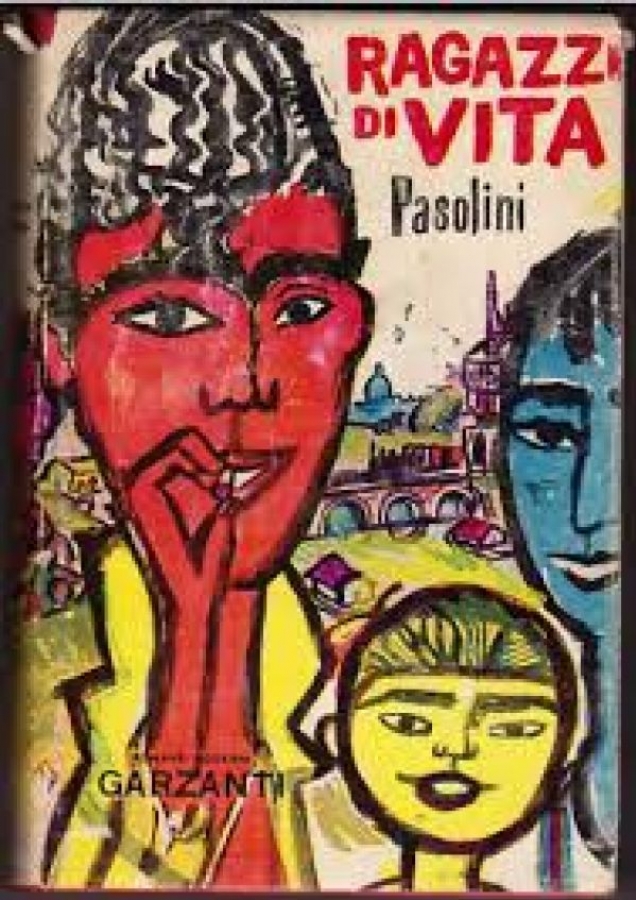
The Ragazzi
> It was hot, not with the heat of the scirocco or a scorching drought, but just hot. It was like a coat of paint brushed over the light breeze, over the yellowish walls of the *borgata*, over the fields, the carts, the buses with clusters of passengers hanging from the doors. A coat of paint that held all the joy and squalor of summer nights past and present. (...) And in the centers of the *borgate*, at the crossroads, like there in Tiburtino, people swarmed, ran, shouted, (...) even in the loneliest spots there was turmoil, with lines of youths out looking for some cheap whore, (...) one great siege encircling Rome, between the city and the surrounding countryside, with hundreds of human lives teeming among the vacant lots, their shacks of evicted paupers, or their tower blocks. And all that life was not just in the suburban *borgate*, but inside Rome as well, in the heart of the city, right beneath the Great Dome . Set in a Rome of the early 1950s—yet in truth timeless—Pasolini chronicles the daily existence of poor, ragged slum youths who, > disordered like a little swarm of flies on a dirty table (...) wanted (...) to take on the world at large, just like that, along with the whole race of men who did not know how to enjoy themselves as they did . It is a “crafty gang” of young males, narrated in their coarse Roman dialect, so far removed from the contrived Italian of the bourgeoisie. > “So what do we do here now?” Alduccio said. “Let’s take a walk, come on!” said the Begalone. (...) They kept on guffawing for a while even when the whores could no longer hear them, doubling over at the knees, leaning against the low wall or cuffing each other: more than laughing, they were making coarse faces with their mouths and spitting. (...) They were both so horny they would have done it even with a seventy-year-old crone. (...) “Man, they’re gorgeous!” yelled the Bègalo. Gorgeous were two girls sitting on the steps of the little temple: two bold, dazzling blondes firing on all cylinders, in husband-hunting skirts that were absolute knockouts, and necklines revealing half their tits. (...) “Which one would you ravish down to the bone,” Begalone asked, “the blonde or the redhead?” “Both of 'em,” said the other. (...) “Either both or neither, 'cause otherwise the other gets sour” . Naturally, they both strike out, as the two girls pay them no mind. The book is a collection of short stories centered on the same group of youths; there is no overarching plot, merely slices of human lives. The finest is “Il bagno sullʼAniene,” linked to the final tale: *La commare secca*. On a putrid river, choked with trash and industrial runoff from a nearby factory, a swarm of youths and young boys strip naked, shedding their filthy and wretched clothes to bask in the sun, play, prank and bully one another, and plunge into the water—to find relief, to wash themselves, and to prove their manhood by swimming through the river’s hazardous currents. They have fled cramped and squalid dwellings to escape violent, drunken fathers, to distance themselves from their mothers' screams and from teenage sisters already pregnant: they seek freedom. Like a pack of stray cats, they turn on the weakest among them, who is set on fire while “the boys kept on kicking and shouting.” Cocky and reckless, they drown while trying to swim across the river; in the face of death, the reaction is sheer indifference. > From below, Borgo Antico and Mariuccio could be heard shouting and crying, Mariuccio still clutching Genesio’s undershirt and shorts to his chest; and already they were starting to scramble up the embankment using their hands. \- Let’s beat it, it’s better - Riccetto said to himself . The stories remain perpetually suspended, devoid of development because there is no future for the urban lumpenproletariat; and perhaps it is better that way, for were they to rise above their wretched condition, these boys would lose their fascination, their raw authenticity, thereby precluding > that immediate, human, so-called vital experience, (...) (wherein) ideological bombardment has not yet touched, except generically, the problems of sex. (...) Therefore, the sociological necessity having subsided, I nonetheless continue to live necessarily in the periphery . So wrote Pasolini in 1958 in an article for the journal *Città Aperta*. In this aestheticizing depiction of the subproletariat, is there not the intellectual relish of “a momentary regression” from high culture to subculture? Furthermore, did not the freedom sought by these “boys of life” along the banks of the Aniene and through Roman nights in Villa Borghese inevitably evolve into the gratuitous, criminal violence of the 1980s? Are these not the forebears of the Banda della Magliana? Behind biographical and sociological justifications, Pasolini conceals a deep-seated pessimism regarding Italy, a conservative vision, and a total incomprehension of modern society. The defining peculiarity of Pasolini’s novel resides in his use of the language spoken by the inhabitants of the Roman periphery. Pasolini follows in the footsteps of Fogazzaro, Verga, and Gadda, attempting to narrate through actual spoken idiom. Yet while this constitutes the work's primary virtue—lending tangible depth to characters and situations alike—the book's limitation lies in its static nature: lacking a narrative arc, it ultimately becomes tedious. Why read it? It remains an original novel from a stylistic standpoint.

Iraqi Rhapsody
> Words that outlive their author take on a life of their own. They shift, assume new forms, generate new meanings. And they always retain their intrinsic ambiguity . This reflection by Ibn Khaldun, who lived in the fourteenth century and is regarded as one of the greatest Arab philosophers, introduces the essence of this short tale. We are in 1980s Iraq, during the bloody war between Saddam Hussein’s country and Iran. The dictatorship’s repression is particularly harsh, pervading every aspect of society, even the most intimate sphere. The author imagines the discovery of a manuscript belonging to a young inmate named Farat, who has been imprisoned and tortured for no real reason other than failing to conform to the regime’s ideas and rules, believing that “imagination fights reality.” In prison, he is given blank sheets of paper and a pencil. > The whiteness of the paper seduces me, offering me the freedom to wander within my solitude. I will tear through the silence with my ravings. Words will transform into mythological beings that will dig a tunnel and carry me outside. Or they will be prisms that I will hang all around me to look through . The blank page is a gift that seems to say: “take me and do with me what you will!” And the young man begins to recount episodes from his life, finding himself “down (t)here,” both inside and outside prison at the same time. And the reader, too, like the young narrator, is swept into the delicate freshness of everyday life: Farat’s affectionate bond with his grandmother, his only surviving relative; the clever stratagems to evade the regime’s agonizing and ridiculous rituals; the pervasive sarcasm through which anger at a power indifferent to its people’s needs is vented; the search for authentic reading; the yearning for poetry and truth; and, finally, the discovery of love and the female body. In this wandering between memories and words, it matters little if one forgets to add diacritical marks, leaving room for the ambiguity inherent in a language like Arabic, rich in semantic roots and potential variations and combinations of the alphabet’s letters. What matters to Farat are the naive sweetness and gentle irony that characterized his brief life before prison. The “over there” makes the “down here” bearable, yet it is like crouching “before the wall of this vast nightmare.” > Born of the whiteness of the pages, suns pierce the gloom of this night and summon another galaxy. Yet they are captive suns, themselves trapped behind rows of bars . When, in full delirium, the young narrator speaks of his release, we readers believe it too—only to remember that we are in 1989. “This is my last sheet... Yes, I want to keep writing.” To fully appreciate the story, one must detach oneself from the Iraqi reality and Farat’s cruel fate. One must surrender to the scattered, varied episodes of his life, to the novel’s many delightful fragments. Farat falls in love: > that day you were leafing through a magazine. You were alone, motionless as an island of silence amidst the roar of applause and slogans, indifferent to the abject circus surrounding you. In class I always tried to sit next to you, and while the students attempted to conjugate French verbs in various tenses, I tried to conjugate the details of your body in the present. I read them with the voracity of a child learning a new language . Far from the philosophy of language, fleeing bloody and obtuse dictatorships, what endures is the timeless story of youth: open to the world, irreverent, restless, and naive. Why read it? A delightful tale, if one forgets the context.
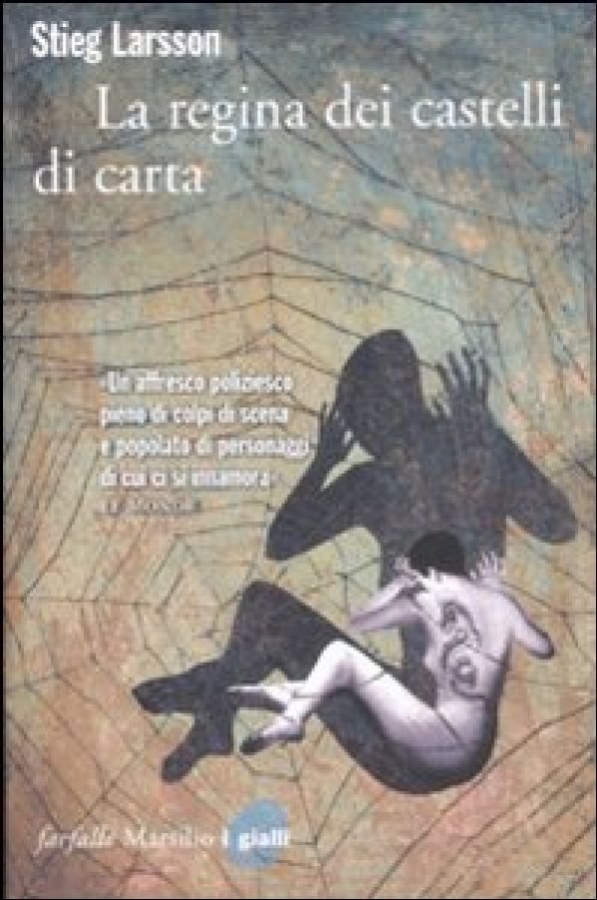
The Queen of Paper Castles
The book picks up from the closing scene of Larsson’s previous volume: *The Girl Who Played with Fire*. Lisbeth Salander, after gravely wounding her father, has been rescued by her friend Mikael Blomkvist. She is, however, in critical condition, undergoing surgery and hospital confinement. Meanwhile, a special unit within the secret service attempts to have Lisbeth recommitted to a psychiatric institution to prevent the exposure of plots orchestrated over many years—targeting prominent politicians as well—which hinged upon the figure of Lisbeth’s father. The latter is murdered by a secret service operative, further killings are carried out, and, above all, evidence is fabricated to frame the young woman once again. Complementing the main narrative is the work of Mikael, a true journalist, who gathers information and corroborating evidence to save the girl and unmask the "rogue" secret services. Action is subsequently set in motion by the "good" secret services, who collaborate with Mikael to expose the rogue unit and excise the "cancer" threatening to destroy Swedish democracy. As is typical of the author, other subplots unfold, one of which centers on Mikael’s business partner—and lover—who takes charge of a major newspaper, endures sexually charged smear campaigns, and is ultimately forced to resign after discovering that the paper’s owner exploits child labor in an East Asian country: this does not, however, prevent her from publishing the investigation—as true journalism demands—and ruining the avaricious chairman. Ultimately, everything concludes happily with Lisbeth’s exoneration and the triumph of hard-hitting journalism and of a country that—unlike others—possesses robust institutional antibodies. The book’s underlying theme appears to be the stark confrontation between good and evil: the villainous doctor is contrasted with the benevolent, competent one; the superficial, easily manipulated prosecutor is counterbalanced by honest police officers and judges; and so forth. The conflict is far too overt and so entirely devoid of ambiguity as to become utterly predictable. It is a thriller, yet even more so than the author’s first two novels, the plot unfolds slowly and at times tediously, weighed down by an overabundance of characters and a redundancy of dialogue at the expense of actual action. Furthermore, the formidable operational prowess attributed to a task force made up of secret service retirees strains credulity, making it glaringly obvious from the outset that the threat will be thwarted with ease. Moreover, the sheer multiplicity of themes addressed (rogue intelligence services, the resilience of democratic institutions, the duties of real journalism—which must investigate and speak the truth—sexual intimidation, and women’s uphill battle to assert themselves) produces a sense of fragmentation that undermines the narrative’s cohesion. One gets lost in the digressions, blunting the overall effectiveness of the storytelling. What remains is envy for an honest, investigative journalism so far removed from the Italian variety: if only our own country had a magazine like *Millennium*!!

Romanzo Criminale
We are in the Rome of the 1970s and '80s, in an Italy stepping into the consumer society and traversed by terrorism and subversive plots. A few youths from the Roman outskirts decide to > assert undeniably a dominion destined to last forever over the Old Whore . From drifters, they become a gang and turn into the masters of Rome: they are the famous Banda della Magliana. What gives the group strength is friendship, a leader (the Lebanese), and > the dream of finally counting for something, all of them intolerant of the old bosses and the foreigners coming to lord it over our home turf. All fired up by the fantasy of taking, once and for all, the eternal old whore, complete with she-wolf and twins. (...) But even that wasn't entirely true. Beyond all agendas, well beyond reason, the cement of it all was action . It is hardly surprising, then, that their political ideology is fascist, that the group gravitates toward black squadrismo. In their race toward criminal dominion over the city, the gang contends and, in spite of itself, allies with a series of surrounding organizations and figures: the Mafia and the Camorra, who concede control of Rome to the gang, but dictate its boundaries and use it for their own criminal ends; the fixers, who allow dirty money to be laundered into clean—or near-clean—enterprises; the institutions (the police, the judiciary, the lawyers, the prison system), which in one way or another abet the gang's criminal operations, sometimes unwittingly out of a legalistic conception of justice, and far more often because they are collusive, corrupt, and acquiescent. Yet presiding over it all is the Old Man, who > commanded an intelligence unit (of the Secret Services) with a neutral name (and played) at throwing the world into disarray . He is the master puppeteer and the gang one of the puppets: > you take a deviant or presumed deviant, you make him deviate, you grab him while he’s deviating. (...) And now he had the Lebanese and his boys. To do what with them? To play with them, of course . The only one to realize the trap is Freddo, the gang's "pure" soul, who yells at the Lebanese: "So now we work under a boss! And what a boss! The State! The filthy State! > Amid the general apathy and cowardice, the only one standing up to the gang is a police commissioner: Nicola Scialoja. To him it is clear, right from the start, that this is a criminal organization, and not merely a gang of petty hoodlums, that drugs were the key to everything. (...) Whoever controls the drug market controls the city. The Lebanese's boys controlled the city > ; and slowly he realizes that behind the gang there is a puppet master, pulling the strings from an obscure office of the Secret Services. Scialoja is the positive hero: he stubbornly fights the gang; he is defeated, betrayed, vilified, yet he never lets go. He witnesses the unraveling of the Banda della Magliana. The Lebanese is killed, and from that moment the ties holding the group together snap: the boys went their separate ways. (...) The loyalty to the group was becoming loyalty to the groups > . Scialoja knows the gang is becoming more vulnerable; he attempts to strike at it by every means, but as long as the Old Man shields it, all his efforts shatter against the wall of omertà, corruption, and collusion. Scialoja defeats the Banda della Magliana only after the Old Man, by now dying, designates him as his heir, co-opting him as head of his obscure yet all-powerful office. He had the Old Man's diary! He was the custodian of the Republic's secret history. (...) He could do virtually anything. He had power. (...) But as he slipped into the elevator, (...) he felt a sharp, painful pang deep in his heart. At the moment of triumph, from what obscure recesses of the past could this incomparable sense of defeat possibly be welling up? > The story can be read from different angles: a fictionalized chronicle of real events, a desolate fresco of Italian society and of Rome in particular, a painful, resigned indictment of Italy's dark malady: the perverse connection between politics, the underworld, rotten businessmen, rogue Secret Services.... when this cancer is rooted out... if it ever is rooted out... > . There is a simpler reading: the story of a group of boys, of their desire for rebellion and freedom, and of how their dreams, and their friendship, founder in the Roman quagmire of money, drugs, and compromises. When Roberta, after making love, asked him for the umpteenth time why he did all this, (Freddo) managed to find the honest answer: 'cause this way I feel free > . In the prologue, a survivor of the gang, after gunning down a petty criminal in cold blood, indifferent to the weeping, the sound of footsteps, the approaching sirens, turned his back on him, and aiming his weapon at the bastard moon screamed with all the breath in his lungs: I was with the Lebanese!" The setting is the book’s fundamental asset. Its flaws lie in the characters and the plot. The former are stereotypes, treated superficially—perhaps because the author does not favor the trajectory of certain figures over others: they all crowd onto the very same plane, appearing and disappearing in ways that cause the reader to lose track of their trials and sentiments. The plot unfolds slowly, devoid of surprises, in repetitive fashion: years go by, the gang evolves, yet the events feel perpetually identical, as though criminal deeds were inherently monotonous, forever repeating themselves; without a great writer to grant them depth and rhythm, boredom inexorably sets in. Why read it? It represents a chapter of our history, but in the end, the novel is prolix and tedious.
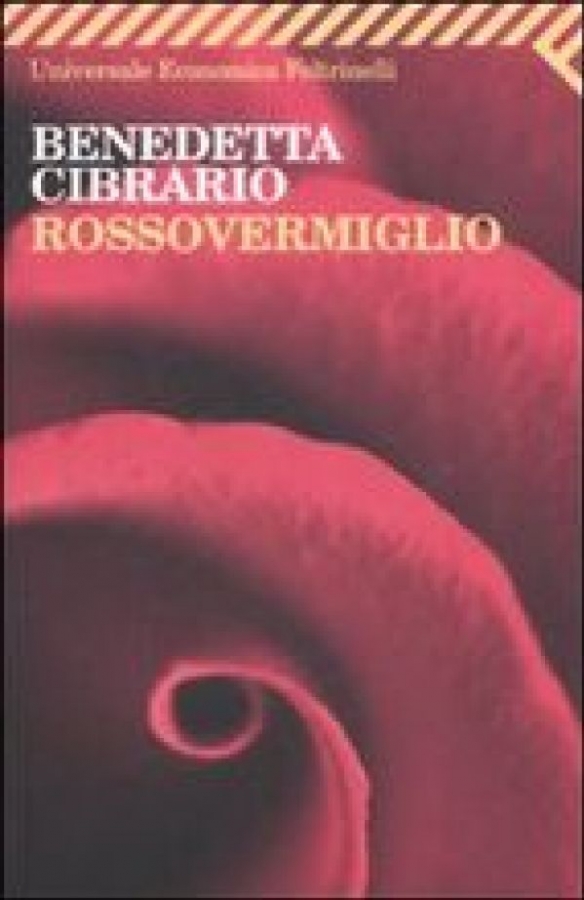
Vermilion Red
> I feel as though I have lost myself in an underground cave full of perilous crevices and labyrinthine hollows unknown to me, so many chasms into which I might slip. Questo mi succede adesso, quando guardo avanti e mi accorgo che non cʼè più strada, e allora mi volto indietro e vedo che di strada non ce nʼè neanche lì . The protagonist, the first-person narrator, is now an elderly woman living on an estate in Tuscany where she has succeeded in producing a wine of great quality, *Rossovermiglio*. Her mind now frequently wanders back to distant times, and the novel unfolds, indeed, through a continuous alternation between present and past. Born into an aristocratic Turinese family, she marries very young to a man of her own social station. It is an arranged marriage that will bring the young woman nothing but misery. Betrayed, wounded in her deepest sensibilities, repulsed by the coldness of her husband and of a formal, vacuous social class, the protagonist decides to take refuge in Tuscany on an estate inherited from her brother. And here she leads an isolated life, with her beloved horses and a growing passion for the land. When a man with whom she had once been infatuated reappears. An affair begins, and the young woman finds herself pregnant. Yet the man disappears, and the woman, to preserve propriety, decides to pass off her own child as that of the estate bailiffs. Why did the man disappear? Up to this point, the protagonist appears as a “sleeping beauty”: young, wealthy, restless, slightly eccentric, over whom the great shifts of history—such as fascism, the world war, the partisan struggle, the dawn of the republic—merely glide. Yet at the very end of her life, the protagonist discovers that the man she loved disappeared because he received a handsome sum from her husband, who, even from afar, meddled once more in her life. She was condemned to live as others dictated. From her social class she received nothing but sorrow and deceit, while she is surrounded by the affection and loyalty of the local people. Only the land (the vines, the olive trees, the woods) is something steadfast and true. > At times I dismount from my horse and sit on a stone, and I remain there looking at this land, unchanged through time, with these colors and these scents, slow and silent as I have known it . Yet on the other hand, “we do not live tragedies, we only have sorrows.” At the beginning of the novel, the reader is left somewhat disconcerted by the vacuity of the events, settings, and characters. Why should we care about nobles who squander their fortunes on elegant, refined receptions? First comes the prose, exquisitely refined and meticulous, and then the growing discovery that the superficiality and detachment from the present of aristocratic life are the interpretive key to the novel. We often live a life “made of nothing,” and thus find ourselves swept along by chance and by others. Why read it? It is written in beautiful Italian.

Sardinia Blues
Three young men—Davide, the protagonist, Licheri, and Corda—drag out their existence in a Sardinia far removed from the one known to tourists: the sun and the sea are there, but above all, there is boredom and a yearning to escape the provinces to experience the wider world. All three have spent considerable time abroad falling in love with extraordinary women, dancers, but have returned disillusioned to their homeland, whiling away their days between nightclubs and petty thefts. The protagonist, Davide, is thalassemic and therefore bound to constant blood transfusions. Yet his illness is not the root of his *mal de vivre*: what weighs on him most heavily is his mother’s death and the unraveling of his family, marked by his father’s remarriage and the emotional—even spiritual—estrangement of his sister. For the most part, the novel drifts between depictions of the three youths' nightlife, Davide’s memories of his adolescence and his life in London, fleeting love affairs, and episodes of petty delinquency: everything unfolds with lightness and resignation, devoid of anger, almost in acceptance of life’s futility. Then events spiral: Davide sleeps with Daniela, one of the most beautiful girls at the club, and the two are caught by her boyfriend, who murders them. The fundamental theme of the novel is what it means to be Sardinian: > often my friends and I would have dinner and smoke, holding forth on love and art, on being Sardinian and the meaning—or lack thereof—of this fortuitous element of our existence, on our desire to travel and understand the world, on our phobias and our aimlessness . And it is precisely this need to transcend parochialism, “the identitarian and anti-identitarian paranoias,” that constitutes the book’s most compelling trait: in an Italy increasingly diminished and provincialized by the rhetoric of territory, this novel serves as an anthem—perhaps unintended by the author—to globalization, to an openness toward the world, to “accepting that we are like everyone else.” It is no coincidence that Davide consistently refers to foreigners when speaking of other thalassemics: illness unites rather than divides. Sorigo’s prose is highly idiosyncratic and innovative: the narrative unfolds without punctuation (or with faulty punctuation), as though the words tumble forth unchecked, staking everything on musicality and verbal juxtapositions. The touchstone is poetry rather than prose. This stylistic approach is occasionally effective, yet it renders the reading experience fragmented, eroding the novel’s overarching coherence and leaving it, in the end, as an assemblage of episodes and impressions.
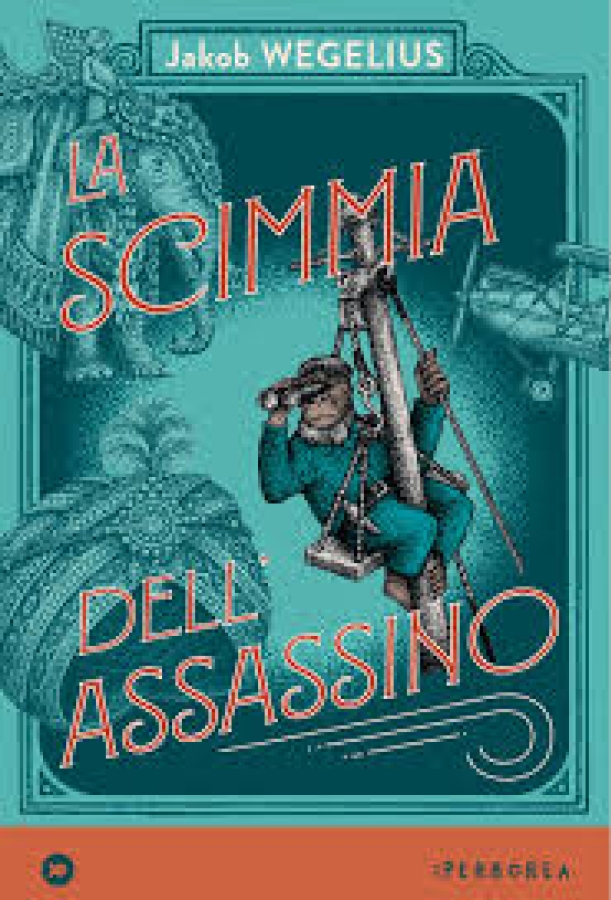
The Murderer's Ape
> For those who do not know me, it is best to state first of all that I am not a human being. I am an anthropoid ape. (...) How I ended up among humans I do not know, and in all likelihood I never will. Sally Jones, the simian narrator of this novel, is intelligent; she lacks only the gift of speech, but understands human language, knows how to write (which is how she communicates), and is exceptionally skilled at repairing mechanical objects, from ship engines to musical instruments and an old typewriter, with which she presumably penned "her memoirs." Her gifts (technical prowess, dedication to work, a deep sense of friendship) have made her the indispensable companion of a solitary seaman, owner of an old boat. Finding themselves in Lisbon, waiting for cargo to haul, Sally Jones and her Chief cross paths with Alphonse Morro, ( > he had a thin, deathly pale face and a tormented look), who charters the ship to pick up cargo—officially tiles, in reality crates filled with weapons. In a series of unpredictable events (the sinking of the boat, the unexpected encounter with Alphonse Morro ( > his eyes seemed to be bulging from their sockets in terror ) and the latter's disappearance at sea, the captain is accused of having murdered Morro, whose body is nowhere to be found. While the man is taken to prison, Sally Jones flees into a hostile, shadowy Lisbon. Trembling and hungry, she takes shelter in an attic, when there reaches her, as if in a dream, a song, > a sad and beautiful voice, (...) and suddenly, without understanding why, I felt a sense of warmth wash over me. (...) The woman was sitting before the open window of a dormer. As she sang, she worked on something in her lap. She wore a shawl, and her dark hair was gathered in an untidy bun. From this point on, the narrative unfolds into a series of adventures that lead Sally Jones from Lisbon on the run to distant India, only to return to the Portuguese city, ever determined to prove her captain's innocence. It would be tedious to retrace every episode, continually marked as they are by dramatic twists, new characters, and a suffused atmosphere of melancholic hope. Whence comes the gentle strength of Sally Jones, this strange ape? It springs from Love, expressed through the profound bond linking the ape to the people she encounters—those who help her and whom she helps in turn: the sorrowful Anna, a poor factory worker and wondrous Fado singer; Fidardo, the surly musical instrument repairer; the cemetery keeper where Sally Jones discovers the grave of Morro’s fiancée and her tragic love story; the eccentric maharajah, to whom Sally Jones is no courtier, but a true friend; and finally Alphonse Morro himself, in truth a suffering victim racked with remorse. There are villains too, manifestly stronger than the poor ape; how often does Sally Jones curl up on the bed, feeling tears well up, overwhelmed by fear and longing! Stubborn, seemingly fragile yet steadfast in her values, Sally Jones is a harbinger of hope at a time when we—adolescents and adults alike—stand in great need of it. The novel is divided into three parts: the first and third set in Lisbon, the second in India. One must wonder why the author devoted so many pages to Sally Jones's sojourn with the maharajah, dissipating Lisbon's enchanting atmosphere in trite descriptions. Reading the pages set in the Portuguese city, one feels imbued with that melancholic sense of existence so distinctive of Lisbon; and the author has proven exceedingly deft at lending contrasting palettes to the streets and the sky—somber in the first part, radiant in the last, when Sally Jones returns to her friends and familiar haunts. And what can be said of the song, the Fado, which threads through the entire narrative, managing to convey even to the maharajah the sweet sorrow of Portuguese music, capable of transforming a self-absorbed man into a generous and benevolent soul, at least once in his life. The plot alone would not have sufficed to give depth to the story. It is the prose that defines the entire narrative: fluid, deceptively simple, alternating between dialogue, the ape's inner reflections and states of mind, and deft atmospheric descriptions; the style captivates the reader, even in passages that are frankly prolix and redundant. Why read it? Sally Jones seems to personify Kant’s categorical imperatives: liberty, equality, and fraternity.

Senso and Other Stories
Camillo Boito, elder brother of the more renowned Arrigo, was an art expert who engaged only marginally in literature. Yet his short stories are strikingly modern in the cold detachment and amorality with which the author confronts the ambiguous, unspeakable egoism lurking within the human soul. In his most famous story, *Senso*, Livia is a harsh, shallow, and conceited woman who entrusts a terrible secret to a “sheaf of papers.” And she does so with the joy of > confiding solely in oneself, free from scruples, from hypocrisies, from reticence, honoring the truth in memory even regarding that which stupid social affectations make hardest to proclaim: one's own vileness! Still very young, yet already wed to a wealthy, elderly aristocrat, she takes an Austrian officer as her lover. Even while acknowledging him to be a dissolute, cynical man of virtually no moral principles, Livia is swept away by physical passion. The description of the beginning of their affair is a masterclass in literary craft. With few words, light and veiled, the author captures the profound sensuality of the bond between Livia and her lover. The woman is in a bath, naked, reclining supine in complacent admiration of her own beauty, of the “rosy beauty of her skin,” when, through the wide apertures connecting the pool to the men's quarters, her lover bursts in. > I did not cry out, I was not afraid. He seemed carved from marble, so fair and beautiful was he; yet his broad chest heaved with deep breaths.... standing erect, half-veiled by the water, still trembling, he raised his soft, muscular arms: he seemed to thank the gods, as if to say: At last! But the man soon reveals himself to be a rogue, constantly extorting money from the wealthy countess, even to the point of stripping her of her jewels to bribe doctors and evade the war. Livia lives in Trento; the man must remain in Verona, where his military regiment is stationed. The distance allows the man to deceive his mistress further, professing his fidelity while carousing with other women on the countess’s dime. Yet blind love can transform into cruel hatred. Livia discovers the betrayal and, out of revenge, denounces her lover, who is executed by firing squad. Will this infamy weigh forever on Livia’s conscience, or was it merely the wretched conclusion of a whim? The author offers no answer to this question; he is not interested in passing moral judgment, much less in conducting a sociological analysis. Ultimately, the author is like a painter whose sole task is to depict—with all its chiaroscuro—a landscape, a state of mind, an ensemble of characters: nothing more. The narrative plot is Boito’s fundamental virtue. It is linear, simple, yet brimming with suspense. Another compelling aspect of the author’s style lies in his depictions of landscapes, especially the subalpine foothills, an environment that must have been particularly dear to him. There is a meticulous attention to detail, almost Verist, accompanied by a transfiguration that hinges on imagery and colors. Consider, for instance, this excerpt from a minor tale, *Il demonio muto*. > Between those two barren slopes of a dark, reddish hue, one sees, almost horizontally, the pale blue ridge of a distant mountain. The clouds had parted, and, across the wide blue field, from that lower corner, a white cloud rose and rose, illuminated by the sun. At first it seemed a silver crown set upon the peak of the far-off mountain; then it expanded, engulfing a vast portion of the sky. It took the shape of an immense bull, advancing with its horned head... Then, in a minute, the bull altered its appearance: its massive head lengthened, turning into the snout of a pig, and the figure, once majestic, became grotesque . Why read it? It is enjoyable—entertainment of no trivial sort.
The Shadow King (The Shadow King)
The novel is set in Ethiopia during the Italian occupation (1935–1941). The first part, entitled "Invasion", deals with the war between October 1935 and May 1936 that led to the capture of Addis Ababa by Italian forces and the flight of Haile Selassie; the other two parts, "Resistance" and "Return", recount the bloody partisan war that deeply undermined Italy’s colonial ambitions in Ethiopia. Finally, a brief epilogue takes place in 1975, when Mengistu deposed and imprisoned Haile Selassie. In addition to historical research, notably that of Angelo Del Boca (*Gli italiani in Africa orientale*, Volumes I and II), the author drew upon photographic documentation, also from Italian sources. And it is precisely from the "photograph as memory" that the narrative takes its cue, right from the introduction of the protagonist: the servant Hirut. In 1935, a French photographer visits the home of an Ethiopian feudal lord and is asked for a portrait of the servants. > This is Hirut. This is her broad, friendly face with a curious gaze. Eyes full of light are suspicious but calm, (...) a pretty girl with a slender, attractive neck and slightly rounded shoulders. (...) She looks away from the lens, trying not to squint, her face turned toward the blinding sun. (...) No other way to remember the untainted body she once carried with the lightness of a child. The depiction of Ethiopian feudal society and the condition of women is ruthless: brutal exploitation of the peasantry, total subjugation of women—even those belonging to the feudal caste—violence, and sexual abuse. Hirut is a proud young woman; she keeps the sword left by her father, out of affection and to assert the rank to which she believes she belongs; the weapon is stripped from her by her master, as women are not permitted to fight. Hirut’s persistent disobedience is punished by rape, and the other women, rather than showing solidarity, condemn her to ostracism. Her fate is not so different from that of her mistress: the aristocratic Aster, who is likewise forced to acknowledge her husband’s superiority, humbling herself. When Aster asks to fight, she is met with a flat refusal. > Get back here with your women. (...) She looks at him for a long time, long enough for the resentment to vanish from her face. She lets it fall between them like a curtain dropping onto a stage. Then she nods and walks away. The condition of women changes radically when, following defeat, the resistance begins, and the role of women becomes pivotal to a struggle that requires the involvement of the entire population. We know from Angelo Del Boca that there were numerous and famous female partisans; these are historical figures who truly lived, even if transfigured by the imagination. Haile Selassie's exile dismays the Ethiopian people in their struggle against the Italians; a stratagem is devised: the resemblance between a beggar and the Negus is exploited to spread the rumor that the sovereign has returned. The man must show himself among the villages; escorting him is a magnificent Amazon: Hirut. From a humiliated and subjugated servant, the young woman becomes a fighter, essential to lending credence to the deception, but she is herself a heroine through her acts of valor and courage. At this point, a new character bursts into the narrative: Ettore, an Italian photographer of Jewish descent, who, out of fear of denunciation and sheer pusillanimity, complies in photographing the most horrific crimes committed by the Italians. These are dramatic pages of high narrative caliber. The author draws on the photographs of this forgotten soldier to document the savagery of our compatriots. Continuous roundups are carried out, and the captives—mostly the elderly, women, and children—are hurled into a ravine; as they plunge into the void, they scream their names, asserting that they had lived, that they were human beings. > This cannot be annihilated: let him repeat his name until that final fall, (...) and the echo of his voice is the world's dirge, the earth cursing this cruelty. (...) He had found a way not to hear their prayers and curses when they moved, with the elegance of a dance, along the crest of the precipice for that final photograph. (...) Every photograph had become a broken vow to himself, a breach in the defenses he had erected to ignore what he truly is: the archivist of obscenities, the collector of terror, a testament to everything that penetrates us and dissolves our self-esteem, leaving human beings dead. The sprawling novel reaches its climax, dramatically epic; then, exhausted by so many horrific and inhuman images, it folds back in on itself in an implausible bond between the virile, determined Hirut and the fragile, hypocritical Ettore. Let us dispel a possible misunderstanding: the novel is not an indictment of our country. The author charts a destiny common to women: independence and prestige are granted to them only when they contribute to the liberation struggle, in this case against the Italian invader. Hirut carves out a role for herself by fighting and risking torture, rape, and death; in doing so, she redeems herself from the violation she suffered, almost as if it had been her own fault. There is a strength in her that captivates us, particularly because it contrasts with Ettore's weakness of character and values. At the same time, the author seeks to recount the tragedy of Ethiopia: assaulted, defeated because poisoned by the criminal use of nerve gas (with tens of thousands, perhaps hundreds of thousands, of dead among the civilian population), and subsequently subjected to a repression that spared no one. Unfortunately, Maaza Mengiste is no Chimamanda Ngozi Adichie (see *Half of a Yellow Sun* on this site): she fails to build outward from her characters to tell the story of a people; the protagonists remain stereotypes onto which, nevertheless, the author unloads far too many existential themes (witness the relationship between Ettore and his father); the tragedy of Ethiopia is treated as an epic poem, burdened further by certain devices—such as the chorus and the reflective pauses on Haile Selassie—that are frankly redundant. The two levels remain separate; it is evident that the author feels far more at home when adopting lyrical and dramatic registers. From the standpoint of writing, the novel gets off to a somewhat halting start; subsequently, the writer gains confidence and growing stylistic mastery, displaying a rich vocabulary and increasingly expressive syntactic forms. The excessive length does not help the overall effectiveness of the narrative, and it becomes an effort to reach the end. Why read it? For us Italians, coming to terms with colonialism is indispensable.
Signoria
We are in Spain in 1799. Don Rafel is the powerful chancellor of the Royal Tribunal of Barcelona. The author succinctly describes him as a man > whose life was marked by an unrelenting craving and the restlessness of dissatisfaction, which drove him to dream without being a poet, to fall in love without being a Don Juan, to climb ever higher above others, hoping to attain happiness. Yet, because he was intelligent, he knew how to hold the ground he had won, even at the cost of the hatred and envy of others . His skill and unscrupulousness had allowed him to climb the social ladder to an unimaginable standing—non-aristocrat that he was—and to amass considerable wealth. Powerful and feared, he seemed unassailable and insisted on being addressed as His Lordship, the prelude to a barony. A seemingly marginal incident—the murder of a singer—drags him into the abyss. The woman was murdered after a romantic liaison with a young poet, Andreu, who is accused of the crime. At the young man’s home, a document is found revealing that Don Rafel murdered his own mistress. The powerful chancellor ensures that the youth, though innocent, is swiftly convicted and sent to his execution. Yet the situation rapidly unravels: others are aware of Don Rafel’s crime, and they either blackmail him or seek revenge for the young man’s death. Don Rafel feels no remorse, but he dreads scandal and “wondered when they would begin to pounce on him to strip him of everything.” Overcome with despair, he goes to confession, only to reveal the full extent of his cynicism before the priest: when urged to surrender to the authorities, he candidly declares that > the law is a collection of arbitrariness gathered into a Code, and justice is by definition unjust . Not even God can welcome him, and at that point nothing is left for him but suicide. The society portrayed in the book is decadent: a lust for money and power, abuses and violence against the weak, a life built on appearances and sordid sexual affairs. It sounds just like modern-day Italy!! Even authentic relationships are destroyed in a corrupt society, helping to create predestined victims: Teresa’s love for Andreu led her to give him the medallion that will serve as the evidence for his conviction; the letters from Nando—naive and full of affection for Andreu, written far from Barcelona and oblivious to his friend’s fate—become cruel and insipid in light of the condemned youth's plight. The prose is pleasant, but the story unfolds slowly, circling around the figure of Don Rafel without ever investigating him deeply enough—so much so that the drama of the conclusion feels both predictable and abrupt, as if rushing to wrap up an overly protracted tale. Why not read it? It has the length of a thriller without being one.

Smoke
It is a short story. The setting is the rural society of the American South. An authoritarian father has effectively driven his two sons from the property: the younger because he had demanded the partition of the land, the elder because he can no longer tolerate his father. While the younger lives as a hermit, the elder goes to live with a cousin. The father dies, seemingly killed by a horse, and the judge—the executor of the estate—is also murdered. The prosecutor manages, through his dialectical skill and careful use of words, to drive the real culprit, the cousin, to confess. The contrivance hinges precisely on smoke, which the prosecutor conceals in one of the judge's boxes and whose presence at the crime scene corners the culprit, who turns out to be a heavy smoker. The plot purports to be that of a detective story, but in truth the real subject of the tale lies in the barrenness and harshness of the rural world and of family relations, shaped beneath the desire to possess the land. In contrast with this brutality and a squalid everyday existence unfolds the elegant phrasing of the prosecutor: > he had graduated from Harvard... capable of spending whole afternoons in the company of men squatting against the walls of country stores, speaking to them in their own tongue. He called them his moments of leisure . The rural world is somehow manipulated by language, by the intellectual who speaks well and knows how to devise tricks and traps for naive country folk. The story's style, particularly its sentence structure, develops in a highly complex fashion, and is therefore difficult to read.

Solar
Michael Beard was awarded the Nobel Prize when he was barely in his twenties. He himself cannot fathom the reasons for such a prestigious accolade (perhaps the committee confused him with Sir Michael Bird?), but ever since, > like a castaway, he had clung to this solitary plank, seeing himself as a privileged being . The novel has little to do with science and solar energy; rather, it primarily recounts the tale of a wretched man—lying, selfish, opportunistic—who moves through the affections of those closest to him with sheer indifference. The narrative opens at the moment of Michael’s separation from his fifth wife, who is cheating on him in retaliation for her husband’s numerous infidelities. Michael heads a government research centre tasked with finding solutions to reduce carbon dioxide emissions and thereby combat climate change. In reality, our protagonist does not believe in the catastrophic effects of atmospheric pollution in the slightest; yet, with the very same flippancy that governs his love life, he endorses an absurd project to install small wind turbines on every British home. The brainchild of a young researcher, a renewable energy fanatic, who irritates the cynical Michael with his environmentalist idealism. Returning from an expedition to the Antarctic continent—where he was compelled to take part in an eccentric research party studying melting ice caps—Michael catches the young researcher in his home: he is one of his wife’s lovers. During the exchange that follows the discovery, the young researcher kills himself, tripping over a rug as he rushes toward Michael to beg not to be sacked. Our protagonist is entirely innocent, yet he realises he might be the prime suspect. And so he orchestrates the wrongful conviction of another of his wife’s lovers, a violent and absurdly jealous man. To this first deceit, another is soon added: Michael comes into possession of the young researcher’s papers, which demonstrate the feasibility of extracting hydrogen from water using solar energy. It is the breakthrough of the century, poised to resolve at a single stroke both carbon emissions and the depletion of energy reserves. The narrative then leaps forward many years. Michael—now an obese man, an insatiable gourmand and drinker—has persisted in his cynical, superficial existence. In his private life, alongside casual mistresses, he finds himself burdened with two ongoing relationships: one with an Englishwoman, who bore him a daughter despite his fierce resistance, and another with an American, whom he met in New Mexico where he is overseeing the prototype plant for extracting hydrogen from water, critical to proving the industrial viability of the concept. On the business front, he must contend with investors who are often sceptical of the venture, questioning above all whether it is worth sinking money into such unproven technology when an environmental catastrophe is not even guaranteed—meaning fossil fuels (such as coal, oil, and the like) might not actually need to be abandoned. Confronted by the anxieties of his partner, who has invested several million dollars and cites the opinions of numerous experts denying global warming, Beard, bolstered by his Nobel status, > placed a hand on his friend’s arm, a clear sign that he was overstepping his mark. Toby, listen, the catastrophe is coming . He, who had never believed in global warming! Yet, unlike the theory that earned him the Nobel Prize—which untangles the intricate interplay between energy and mass with mathematical precision—Michael remains ensnared in the tangle of falsehoods and contradictions that define his life. Just as he is on the verge of proving his sheer genius (though is this what truly drives him, or does only momentary gratification matter?), his "women" call him to account for his hollow promises, the wrongly convicted man returns seeking vengeance, and a lawsuit is brought against him for intellectual theft. He realises he has failed, while keenly feeling the cancer that is killing him. Finally conscious of his own wretchedness, he sees his daughter, who loves him unconditionally, running toward him, but > he doubted, as he held her, that anyone would ever believe him now that it was true love . The prose is brilliant, the plot unfolds engagingly in parts, and the characters are sharply drawn: all elements that ought to captivate the reader. Yet, much like the novel’s protagonist, there is a certain flippancy and an excess of irony that renders the narrative evanescent. Everything feels paradoxical; consequently, deceit and cynicism—the core themes of the tale and such emblematic traits of our age—remain addressed only superficially, failing to deliver the revelatory weight one would expect. McEwan is a major author squandering his craft. Why read it? It is exquisitely written, and the premise is compelling.
Soldiers of Salamis
> In 1989, my first novel had been published; (...) the book was met with utter indifference. What followed was a prolonged depression and the breakdown of my marriage, until, coming to the rescue of the failed writer, arrived the sensual Conchi and the miraculous story of Rafael Sánchez Mazas. The former was a fortune-teller, > who was crazy about dating a journalist (an intellectual, she called him) and who danced singing > Land glorious to my heart,/blessed land of scents and passion,/(...) Alas, what sorrow,/as I part from you, Spain,/for they tear me away from your rose garden. The episode, both famous and incredible, is set in 1939 at the end of the Civil War. The Republican army, retreating toward France, took with it a group of Falangist leaders to execute them by firing squad. Sánchez, founder of the Falangist movement and later a Francoist minister, managed to escape and survive, fashioning around this ordeal his aura of an immortal hero. Cercas imagines that our failed writer comes into possession of a notebook in which Sánchez had jotted down what had happened: the name of the peasant family that took him in and a reference to unspecified "friends of the forest." Fragmentary accounts, contradictions between differing versions, and the very condition of the notebook, which appeared forged, led the aspiring writer to assume that everything was false: > a colossal fabrication meticulously concocted by Sánchez Mazas's imagination, (...) to redeem himself from his reputation as a coward, to conceal some dishonorable incident from his strange wartime vicissitudes. The investigation of archival documents and in the field leads to validating the entire affair: the execution and the escape truly occurred, and the "friends of the forest" are three draft dodgers who had been hiding in the undergrowth and helped Sánchez; a presence expunged by the Falangist leader so as not to admit that he had been aided by brave young men who were not fascists—he, the great poet of the Fatherland. There remains an episode which, who knows why, the aspiring writer does not explore further. In a narrative that seems drawn from *Una nobile follia* by Ugo Igino Turchetti, which likely inspired Fabrizio De André's *Canzone di Piero* (see the review on this site), our aspiring writer describes the event thus. > The soldier is looking at him; Sánchez Mazas stares back at him, but his tired, myopic eyes cannot interpret what they see; beneath the locks of wet hair and the broad forehead and dripping eyebrows, the soldier's gaze expresses neither compassion nor hatred, nor even contempt, but a kind of secret or fathomless joy, (...) and at a certain point he shouts into the wind without ceasing to stare at him: "There's no one here!". To truly become a writer, our protagonist must discover who this soldier was: the narrative leaves mere chronicle behind, gains momentum and mystery, and reveals a truly discreet hero in the service of Freedom and Spain, an account of real events, with real people. It is pointless to object that every novel is real to the reader and that one might as well invent characters about whom nothing is known. Unlike Carrère, who, to write about Limonov, draws heavily upon the biographies of the Russian writer and politician himself (see the review on this site), Cercas conducts an investigation like a good journalist. Too bad that when he writes a factual account, however brilliant, the narrative flattens, becomes tedious, and the reader wonders why bother when we already have historians. On the contrary, on all the pages where the writer relies on imagination and mystery (think of the figure of Conchi and the discovery of the soldier-hero), the story changes tenor, becoming intriguing and engaging. In the end, one senses the passion when the writer comes out into the open and extols the soldier-hero. We ought to find a boundary between fiction, chronicle, and historiography; we live in the present and process the past through the facts of the present, yet the representation of the past conditions our vision of reality and must therefore be handled with care, pursuing the "truth" on the basis of historical research methodologies. The prose flows smoothly and with slight mischief. The author creates an almost unreal atmosphere, so that the events, even the dramatic ones, and the characters dance to the tune of the celebrated song. Its merit lies precisely in a narrative style far removed from the journalistic, capable of making us dream. Its main defect is the plot, confused and repetitive. Why read it? The story is interesting, and some pages are truly beautiful.

The Kreutzer Sonata
During a long train journey, the passengers begin a discussion on the institution of marriage. Can there be spiritual affinity in married life, or is it nothing more than > a horrifying hell, on account of which one ends up an alcoholic, shoots oneself, or commits murder ? The conversation is abruptly interrupted when a traveler declares that he is “the one who, fancy that, killed his wife.” And he begins to recount his story. Like most men, he had led a licentious life for many years, frequenting brothels and despising women, from whom he sought only sexual pleasure. Then, like everyone of his social standing, he married, because that was simply what one must do. Already during the honeymoon, > the infatuation had run dry with the satisfaction of the senses, and we found ourselves facing one another in the true reality of our relations: that of two egoists, utter strangers to one another, wishing for nothing more than to extract from the other as much pleasure as possible . For many pages, the narrative serves as an occasion to discuss marriage and, more broadly, the relations between men and women: reflections to which Tolstoy would return more explicitly in his postscript. We must live an authentic life, the great Russian writer asserts, in the service of a higher ideal: love of God and of one’s neighbor. Along this path, marriage—a mere compliance with external rules—is a disruptive impediment, because > one ends up dedicating the finest period of one’s existence—men, respectively, to eyeing, seeking out, and possessing the finest objects of love in the form of love affairs and marriage, and women and girls to luring and drawing men into an affair or into marriage . And to those who counter that marriage legitimizes sexual relations without which there would be no procreation, and thus the human species would become extinct, Tolstoy responds drastically: > a Christian would be conscious of not sinning or not falling, in marrying, only if the necessities of life were guaranteed for all the children in the world . Is the novella, then, a moral essay? In large measure, yes, and that is how his contemporaries interpreted it. At a certain point, however, comes an unexpected turning point. The protagonist, the murderous narrator, attends his wife’s concert, in which she plays, alongside her lover, a piece by Beethoven: the first presto of the *Kreutzer Sonata*. Many authors have written about music, more often than not associating listening with an elevation of the human soul. Tolstoy astounds us once again. > They say that music elevates the soul: nonsense, it isn’t true! (...) Music compels me to forget myself, my true state of mind; it transports me into a different, alien situation; under the spell of music, I seem to feel what I do not actually feel, to understand what I do not understand, to be capable of what I am incapable of. (...) Upon me, at least, this piece had a terrible effect; feelings were revealed to me that seemed completely new, new possibilities I had never known before. Not as I had previously thought and lived, but as though a new voice were speaking within my soul . And an irrepressible force rises within the protagonist’s consciousness, one the reader has already encountered in the final pages of *Anna Karenina*, immediately before the suicide: > some demon, entirely outside my will, devised and suggested the most bloodcurdling hypotheses . From this moment on, the narrative, previously slow and somewhat tedious, becomes relentless and overwhelming, driving toward a dramatic scene. Returning home unexpectedly, he catches his wife and her alleged lover in the drawing room; first he attacks the man, who flees—unpursued, at that (“it was ridiculous to run in stockinged feet”—even during a murder, bourgeois propriety prevails!); then he violently turns upon his wife, stabbing her to death. He even has the impudence to beg her forgiveness. “Forgive you? That is nonsense. If only I didn't have to die!” the woman replies. The novella hinges entirely on its final forty pages, both from a literary standpoint and in terms of thematic substance. The narration of the murder, as the final act of a lucid and frenzied hatred, possesses an astonishing expressive power: even while foreseeing the inevitable conclusion, the reader hopes until the very end that something might happen (a pang of conscience, someone’s intervention), before ultimately surrendering to a sentence terrible in its cold matter-of-factness. > I felt and remember the momentary resistance offered by the corset, and beneath it something else, then the knife sinking into the softness . Tolstoy’s condemnation of the man is clear and unequivocal: the victim is the woman, the culprit is the husband, who is fully conscious of what he is doing. The judges will decide otherwise, acquitting the murderer on the grounds of the alleged adultery. Conscience will not acquit him, and the novella closes with a desperate plea for forgiveness. Why read it? If one pushes past the first eighty pages, one discovers a story of femicide, recounted by a great writer.

Spaccanapoli
The book is a collection of short stories written between 1943 and 1947, expressing the author’s effort to reckon with reality, with the lush, carnal, amoral, and shrewd humanity of that “Babel of history” that is Naples: hence, in all likelihood, the title *Spaccanapoli*, the thoroughfare around which the city’s life has always gravitated. Let it be said at once that this reckoning with reality was not entirely successful; indeed, the narrative is steeped in a dreamy, melancholic hope. In the first story (*“La figlia di Casimiro Clarus”*), set in a small town in northern Italy “where men are courteous and live on few words,” the now elderly narrator believes he catches a glimpse of the woman he loved in his youth and calls out to her: in his imagination he longs for her once more, but she is not there; he was mistaken. “She always wore a broad-brimmed yellow hat, with violets in the ribbon.” Immediately I would say, Katy, are you here? No, I am not, she replied. Then I would chase after that butterfly > . If one could still afford to write of lukewarm loves before the war, afterward Rea felt the need to use a linguistic system closer to the new reality > . The subsequent stories are sketches of Neapolitan society, where a cynical instinct for survival prevails, allowing the characters to get by. Take *L'Americano* > . A poor baker’s boy takes advantage of the attentions of his master’s wife, wins the infatuation of the young duchess, and finally, getting ahead of himself, brings a prostitute from Taranto with whom he stirs up both scandal and envy. Having killed the young duchess’s fiancé, he flees to America where he becomes a *ganghesterro*, impregnates a wretched prostitute, makes his fortune, and returns to Italy, abandoning the girl to her fate. Having landed, I went to the Madonna of Pompeii. (...) May I become an old man who looks like a boy, for I have harmed no one, I tell you as a son. (...) I will buy you the diamond-studded slippers. (...) I am a good man. (...) 'Go,' the Madonna gestured with her finger > . It reads like a novella by Boccaccio. The influence of the great fourteenth-century writer is glimpsed in another story, *L'interregno*”. The opening of the narrative bears the stamp of the plague described by Boccaccio. “In our mild country, the war had arrived by report.” The return of peace was feared, because “it was also that of commercial legality and taxes on war profits. (...) Many idlers owed the flourishing of their clandestine trades to the dark. (...) The middle class fretted over it. But they were few in number and likewise strictly bound to propriety and restraint, sacrificing proud appearances > . But then war bursts in, the poor rush into cellars for shelter, while the rich, the quickest to notice in the mirror that their consciences were tarnished, promptly took them out through secret doorways to be aired in the countryside > . The life of the refugees is rendered with bold, incisive strokes, without neglecting the personal fortunes of the protagonist—a decent man with a shrewd knack for seizing whatever opportunities present themselves, be they of love or money. The distinctive hallmark of the stories is the writing: at times linear, but more often poised between prose and poetry, with stylistic inflections typical of Boccaccio. Take as an example this passage from another story, *I capricci della febbre* > . The protagonist has been hospitalized for smallpox, and there he encounters a nurse. The muscles of my thighs quivered at a fresh draft of air. But she took it as a call of love: (...) and, with arms raised as if surrendering, she fell to her knees with a loud clatter before my shame, which she stared at in astonishment. (...) I am a poor girl. I'm afraid to go out in the middle of the street to sin. With you, I was doing it out of pure love. (...) I could no longer keep my memory still: another Nina, the one summoned in delirium, blurred into this living one: incredible before my eyes.” And it is precisely the analysis of this fleeting amorous encounter that pinpoints the difference between Rea and Boccaccio: in the former, the narrative unfolds in a state of yearned-for reality (the rediscovered woman, the cynical self-justification, the fantastical life under the bombs); in Boccaccio, the narrative possesses the same voluptuousness of language, but is developed from the perspective of an urchin who jests and refuses to become embroiled in the events and characters. Why read it? Evocative, even if often difficult to decipher
A Spiral of Mist
La vita è > una specie d'inganno, cui ci si addestra, questo mentire a se stessi su se stessi , sfuggendo (...) «la sconosciuta e torbida paura della rivelazione». Come in *Open City* di Teju Cole (vedi la recensione in questo sito), nel quale il protagonista dimenticò persino di aver violentato una ragazza perché «per me sono sempre l'eroe» (ma «il piacere della negazione non è stato possibile per lei»), pure questo romanzo indaga > quella profondità misteriosa e segreta fatta d'emozioni inespresse, di verità celate agli occhi di tutti . L'indagine assume la forma apparente del giallo. Valeria, la moglie milanese di Fabrizio Sangermano, una potente famiglia campana, è rimasta uccisa durante una battuta di caccia col marito: un incidente o un omicidio? C'è un commissario, ci sono numerosi personaggi che dovrebbero aiutare a dipanare la vicenda, ma non è questo che interessa all'autore: la morte di Valeria dovrebbe essere quel fatto traumatico che potrebbe finalmente dissolvere la nebbia dei sentimenti umani. Si sviluppano una serie di ritratti. Assistiamo alla riunione di famiglia, che discute sconcertata e preoccupata il possibile coinvolgimento di Fabrizio che trascinerebbe nello scandalo il clan Sangermano; la discussione termina a un istante quando il nonno, il gran vecchio, > fece un cenno con la mano e poi disse: sono contento d'aver previsto la conclusione di questo nostro incontro , (...) nello studio si rifece il silenzio, zii e cugini assunsero l'espressione compunta che avevano imparato ad assumere alla perfezione dopo tanti anni di allenamento e di acquiescenza: facce attente indifferenti inespressive di persone a un tratto svuotate della loro più intima personalità > . Maria Teresa, una Sangermano che rischiava di restare zitella, ha sposato per volontà della famiglia un noto avvocato della Curia: un uomo stimato e influente. Il matrimonio non è stato mai consumato perché lui è impotente e quando lei ne viene a conoscenza (è stata ingannata dalle sue bugie), pur sapendo che deve infischiarsene dello scandalo, pur ripetendosi che non deve cedere, disse, come in sogno senza rendersene conto«che andava bene così,»non se ne parli più, non avere paura > . E che fa l'illustre avvocato della Curia? Fa mettere incinta la domestica per dimostrare che lui non è impotente e può chiedere lo scioglimento del matrimonio per colpa della moglie; e la moglie si chiude nel silenzio come estremo atto di dignità. Ci sono altre storie di inganno, di ipocrisia, di cose non dette, in certi casi semplicemente frutto di quel monotono meccanico corso«della quotidianità, il quale allontana»irreparabilmente dall'essenza della vita, dallo scoprire che cosa veramente la vita sia, come succede a tanti milioni d'individui che crescono e vivono vite brevi o lunghe ma consacrati, si direbbe, per costituzione o incapacità o chissà che altro, a una specie di perpetua rinunzia alla vita > . E' un approccio mortifero, che non poteva che non concludersi con un ritratto inquietante del funerale di Valeria, lei come morta finalmente parte della famiglia Sangermano, che l'aveva respinta in vita. Il nonno si trovava in piedi fra l'altare e un inginocchiatoio in un atteggiamento compassato«: era veramente commosso o fingeva? E i Sangermano sono tutti intorno, malgrado»nessuno piange, nessuno s'è commosso: ma era proprio necessario commuoversi? (...) E adesso ritornava la nebbia, (...) forse saliva proprio dalla terra senza alcun altro compito che questo di smussare ogni rilievo e confondere annullare almeno per il tempo della sua presenza anche loro: non loro persone fisiche, ma i risentimenti e le passioni e le speranze e le pene e le paure e insomma il nodo fitto inestricabile dei sentimenti. > Il romanzo è come sospeso: non c'è un finale e soprattutto la narrazione non si evolve, resta impigliata nell'introspezione psicologica dei personaggi, scavati fino in fondo, sezionati nei loro sentimenti ma senza empatia; d'altra parte non c'è dinamismo nella vicenda umana, tutto è rinchiuso nella superficialità delle relazioni sociali, nella rassegnazione di un destino individuale già segnato dalla società. Ricorda le gabbie esistenziali di Andre Dubus, i cui racconti non si sviluppano perché i protagonisti sono prigionieri dei rapporti interpersonali e delle loro menzogne ( si veda in questo sito *Separate Flights and other stories* e *Dirty Love*). Al di fuori delle vicende umane incombe un contesto grigio, non tempestoso, ma piovoso e nebbioso: > più che pioggia era una polvere d'acqua e cadeva adagio senza rumore come se fosse la nebbia a sciogliersi in una leggera e umida peluria d'argento . E' un romanzo degli anni '60 ma la distanza stilistica rispetto ad oggi è abissale. Il «bell' italiano» del Liceo Classico invade l'articolazione sapiente delle frasi, la sua ricca punteggiatura, gli aggettivi ben scelti e ben collocati, le parole ricche di potenzialità espressive. Talvolta si è avvinti ma alla fine si capisce che l'autore pregusta la sua abilità con un narcisismo che pare dire: vedete come sono bravo! E noi sentiamo una intensa nostalgia per Cesare Pavese, per la sua scrittura sobria, scevra di virtuosismi. Forse non riusciamo più a scrivere come Prisco, e come Moravia, però è meglio cosi: la nostra lingua ne ha guadagnato in termini di leggibilità e fruibilità. Perché leggerlo? Bisogna godersi la scrittura, è comunque una bella lingua.

A Spiral of Mist
Life is > a kind of deception, one trains oneself for, this lying to oneself about oneself , fleeing (...) “the unknown, murky fear of revelation.” As in Teju Cole's *Open City* (see the review on this site), where the protagonist even forgot having raped a girl because “for myself, I am always the hero” (yet “the pleasure of denial was not available to her”), this novel also investigates > that mysterious, secret depth made of unexpressed emotions, of truths concealed from everyone's eyes . The investigation takes on the outward guise of a detective novel. Valeria, the Milanese wife of Fabrizio Sangermano—a powerful Campanian family—is killed during a hunting trip with her husband: an accident or a murder? There is a police commissioner, there are numerous characters supposed to help unravel the plot, but that is not what interests the author: Valeria's death should be that traumatic event capable of finally dissolving the fog of human feelings. A series of portraits unfolds. We witness the family gathering, bewildered and worried as they debate Fabrizio’s possible involvement, which would drag the Sangermano clan into scandal; the discussion comes to an abrupt halt when the grandfather, the grand old man, > waved his hand and then said: I am glad to have foreseen the conclusion of this meeting of ours , (...) silence fell once more in the study, aunts, uncles, and cousins assumed the contrite expression they had learned to master to perfection after so many years of training and acquiescence: attentive, indifferent, expressionless faces of people suddenly emptied of their most intimate personality > . Maria Teresa, a Sangermano who risked remaining an old maid, married a prominent Curia lawyer at the family's behest: an esteemed and influential man. The marriage was never consummated because he is impotent, and when she finds out (having been deceived by his lies), even knowing she should not give a damn about the scandal, even repeating to herself that she must not yield, she said, as in a dream, without realizing it “that it was fine this way,” speak no more of it, do not be afraid > . And what does the illustrious Curia lawyer do? He impregnates the housemaid to prove he is not impotent and can file for the dissolution of the marriage on the grounds of his wife’s fault; and the wife retreats into silence as a final act of dignity. There are other tales of deception, of hypocrisy, of unsaid things, in certain cases merely the result of that monotonous, mechanical course “of everyday life, which leads” irreparably away from the essence of life, from discovering what life truly is, as happens to so many millions of individuals who grow up and live short or long lives, yet consecrated, one might say, by constitution or incapacity or who knows what else, to a kind of perpetual renunciation of life > . It is a mortiferous approach, which could only culminate in an unsettling portrait of Valeria's funeral, she, as a corpse, finally part of the Sangermano family that had rejected her in life. The grandfather stood between the altar and a kneeler in a sedate posture “: was he truly moved or feigning? And the Sangermanos are all around, although” no one weeps, no one was moved: but was it really necessary to be moved? (...) And now the fog was returning, (...) perhaps it rose right from the earth with no other purpose than to smooth over every contour and confuse, annul, at least for the duration of its presence, even them: not their physical bodies, but the resentments and passions and hopes and sorrows and fears, in short, the dense, inextricable knot of feelings. > The novel feels suspended: there is no resolution, and above all, the narrative does not evolve; it remains tangled in the psychological introspection of characters excavated to their core, dissected in their feelings yet without empathy. On the other hand, there is no dynamism in the human drama; everything is enclosed within the superficiality of social relations, in the resignation to an individual destiny already sealed by society. It recalls the existential cages of Andre Dubus, whose stories do not progress because the protagonists are prisoners of interpersonal relationships and their own lies (see on this site *Separate Flights and Other Stories* and *Dirty Love*). Outside the human drama looms a gray backdrop—not stormy, but rainy and foggy: > rather than rain, it was a dust of water, falling softly and soundlessly as though the fog itself were dissolving into a light, moist silver down . It is a novel from the 1960s, yet the stylistic distance from today is abyssal. The “fine Italian” of the classical high school permeates the deft articulation of sentences, its rich punctuation, the well-chosen and well-placed adjectives, words brimming with expressive potential. At times one is captivated, but ultimately one realizes the author is relishing his own skill with a narcissism that seems to declare: look how good I am! And we feel an intense nostalgia for Cesare Pavese, for his sober prose, devoid of virtuosity. Perhaps we can no longer write like Prisco, or like Moravia, but it is better this way: our language has gained in terms of readability and accessibility. Why read it? One must savor the writing; it remains, nonetheless, beautiful prose.
Stamboul Train
The novel recounts the journey from Ostend to Istanbul of a group of travellers: a female journalist with her lover, a young Jewish merchant on a business trip, a thief turned murderer despite himself (on the run), a famous political fugitive, and a young woman named Coral. During the journey, adventures and love stories intertwine, in particular the romance between the young merchant and Coral, between whom a genuine and lasting relationship seems to blossom. At the Hungarian border, the police arrest the political fugitive (tipped off by the journalist), along with the thief and Coral. The three manage to escape, but during the flight the political fugitive is mortally wounded and Coral stops to tend to him. The young merchant, who was waiting with a car, leaves nonetheless for Constantinople, where he enters into a marriage of convenience. All the characters are driven by selfish interests (money, fame, business, etc. ) with the exception of Coral, who gives up the young merchant in order to care for the political fugitive. The girl is thus the only figure who reflects genuine feelings, unmediated by economic and ideological superstructures, but oriented toward the deeper dimensions of human life, such as solidarity toward a person in distress. This novel, too, belongs to Greene’s “entertainment” vein, yet frankly from this perspective it is undoubtedly disappointing: the pacing is slow by the standards of modern detective fiction to which we are accustomed, and in any case insufficient to generate suspense and drive interest in the plot. The most compelling section is the detention at the Hungarian border, as the contradictions of the various characters finally emerge and Coral’s figure comes to the fore. Unlike *Our Man in Havana*, the novel is marked by a pervasive, profound bitterness: selfishness and vacuity invariably prevail over altruism and sincerity. Interpersonal relationships are dominated by false feelings and by the pursuit of self-interest and narcissistic gratification.
Red Star: A Utopian Novel
In an unspecified year (though let us assume it is 1908), a Martian presents himself to the revolutionary and scientist Aleksandr Bogdanov, inviting him to come to Mars to study its society and disseminate superior Martian values on Earth. The Red Planet possesses a flawless organization that makes it possible, for instance, to assign to each individual the work most useful to the community while simultaneously most congenial to the person, realizing Marx's utopian dictum: "from each according to his ability, to each according to his needs." It is the ideal communist society—one that will not be easy for the revolutionary Bogdanov to accept, vexed as he is by the Martians' attentiveness toward him, which he presumes to be a form of surveillance, whereas instead > the solicitude they showed toward me was the very same—perhaps less frequent—that they displayed when helping one another. (...) I, who came from an individualistic world, involuntarily set myself apart from others and morbidly perceived their kindness and friendly assistance, which I, child of a materialistic world, could not afford to repay. And so, > one had to make haste, one had to summon all one's strength and energy, for the responsibility was colossal! What an immense benefit for our old and suffering humanity, what titanic progress and prosperity would the energetic, vigorous influence of that superior, powerful, and harmonious culture bring! But are we truly certain that Martians and Earthlings are so different? Are we convinced that socialist society dissolves individualistic impulses into a higher sphere where only rationality and solidarity prevail? And what if love were to burst into this exquisitely harmonious society? Netti, a slender and gentle Martian woman, falls in love with the fragile, bewildered Earthling. > I love you not merely as a wife; I love you as a mother accompanying her child into a new, alien existence, fraught with hardships and perils. This love is stronger and deeper than any other capable of binding two beings together. Thus Netti writes to Bogdanov when the latter discovers that she is also married to Stenni—a cold, heartless scientist capable of dissecting everything, yet incapable of understanding people's thoughts and feelings. And there is unquestionably jealousy and antipathy, sentiments so un-socialist, at the root of Bogdanov's murder of Stenni. And there is also homesickness for Earth: > a swarm of familiar faces and past events flickered in my mind (...) earthly landscapes, theatrical scenes, images from children's fairy tales were silently reflected in my soul; as in a mirror, they dissolved and interchanged without any sense of turmoil, but only with a mild curiosity accompanied by a faint sensation of pleasure. In an agitated and confused state, where jealousy and earthly allegiance overlap, Bogdanov cannot help but kill Stenni upon reading the minutes of a secret meeting in which the "cold scientist" urges the invasion of Earth, the extermination of its population, and the plundering of its resources, which Mars desperately needs. Is this a premonition of what was to come, when genocides of entire peoples would be perpetrated behind the veneer of class and racial utopias? What will become of Bogdanov and his beloved Netti? The author envisions Bogdanov being sent back to Earth: using him as a potential "bridge" between the two worlds has proved a failure. Netti journeys to Earth to join him, and then? All that remains > on the parlor table, before a huge, wide-open window, (...) a note. A few words were inscribed there in a trembling hand: "greetings to the comrades, Farewell". Wu Ming imagined a continuation of Bogdanov and Netti's story (see the review of *Proletkult* on this site); yet, as in their preface to *Red Star*, the Bologna-based collective offers a historical-ideological reading, informed naturally by hindsight. What is lost is that crucible of sentiments and relationships that forms the pivot of the plot and keeps the novel so captivating. Why read it? Though at times tedious, the story of Bogdanov and Netti is beautiful.
Stoner
The novel chronicles the obscure career of a professor of English literature. William is the only son of a modest farming family. At the cost of great sacrifices, his parents sent him to study agriculture, in the hope that he would one day return with what he had learned to improve the management of the land. At university, the young Stoner falls in love with literature, and with books. Above all, he chooses the shelter of the university’s secure walls. As a friend once told him: > in the world you would have always been on the brink of success, but you would have been destroyed by your failures. So you chose, you were chosen; providence.... snatched you from the clutches of the world and placed you safe here, among your brothers... Who are you?. A simple son of the soil, what do you expect of yourself? These words prove prophetic of what will be a mundane life: a gradual retreat into mediocrity, shrinking into a corner, accepting defeat before even fighting, demanding little from existence. He marries only to discover immediately that he is not loved, yet he does not rebel; he takes on an exorbitant debt for his modest salary, simply to buy the house his wife desires; and it is she, once again, who decides to get pregnant, giving him a daughter whom William, however, cannot love as he would like and who soon becomes a stranger to him. Our protagonist accepts everything for the sake of an easy life, for a sluggish peace of mind. He falls in love with a young teacher, who reciprocates his love. But when the dean of the faculty urges him to bring the affair to a resolution, what does our “courageous” William do? > He leaned back in his chair and looked up at the low, dark ceiling that had been the sky of their world. He said calmly: if I threw it all away, if I quit and went away, you’d come with me, wouldn’t you? Yes, but you know I won’t do it, don’t you? Yes, I know.... Because then, Stoner explained to himself,... we would both become something else, something other than ourselves. We would be nothing . And like all those who bury “their heads in the sand,” William is quite glad that his young lover left without telling him and that > she left him no farewell note to say things that could not be said . It is better to live within the walls of the University of Columbia, where William had entered as a student, had become a professor, and would retire, as late as possible. No matter if, in the meantime, epochal events unfold in real life, overwhelming the lives of millions of individuals: the First World War, the Great Depression of the 1930s, the Second World War, and the harsh postwar years. As happens with many intellectuals, it is enough to contemplate them, not to live them. It comes as no surprise, then, that he touches a book on his deathbed. Books gave him that security he sought all his life, and for which he renounced truly living. In his introduction, John McGahern states that Stoner is “a real hero” because > he bore witness to values that are important... The important thing in the novel for me is Stoner’s sense of a mission. Teaching for him is a mission.... his mission gave him a particular kind of identity and made him what he was . For teaching, Stoner renounced everything. But are we sure one can be a good teacher by refraining from fighting for the people one loves, from defending one's country, from staying close to the land of one's parents—in other words, educating others without living oneself? And did not William think so as well? At the end of his life, he indeed acknowledges that > he had wanted to be a teacher, and he had become one; yet he knew, he had always known, that for most of his life he had been an indifferent man... Dispassionately, rationally, he contemplated the failure that his life must appear to have been... What did you expect? he asked himself. The academic setting must not mislead us. The real story of the novel is the timeless tale of someone who prefers a mediocre life to an intense existence, habitual and quiet relationships to turbulent yet profound emotional bonds. In short, someone who chooses indifference and withdrawal into oneself (an escape into books?) rather than allowing themselves to be swept away by events and affections. The novel is deemed a masterpiece today, fifty years after its publication. Could the copyright have expired? For it is difficult to fathom what reasons there might be to consider it a masterpiece. To be sure, the writing is exceedingly elegant and grammatically flawless, worthy of a fine professor of English. Yet it is banal, just as the plot proves tedious. This petty academic world is particularly irritating. It is not a slice of the world. It is like reading about the serene life of a medieval monastery while the barbarians rage outside: a useless microcosm. Granted, we live in the era of anti-heroes, but for God’s sake—give us some real stories and characters rich in personality! Why read it? It reads well, but leaves little behind.
History
> There is no word, in any human language, capable of consoling the guinea pigs who do not know the reason for their death (a Hiroshima survivor). Elsa Morante places this quotation as an epigraph to the novel, indicating that her aim is to recount the victims during a dramatic and painful period of our recent history: the years between 1941 and 1947. It would nonetheless be mistaken to think oneself before a modern version of Riccardo Bacchelli's novel (*Il Mulino del Po*, reviewed on this site), with which the great Bolognese writer intended to narrate post-unification history from the perspective of the humble. And how could that be, when the author is the very same behind *Menzogna e Sortilegio* (see review on this site)? How could we imagine ourselves before a historical, combative, trenchant, ideological novel, when Elsa Morante's narrative universe is oneiric and introspective? Ida, widow Mancuso, lives in Rome: a schoolteacher by profession, thirty-seven years of age, with a restless, engaging son named Nino; she has an > undernourished body, and formless in its structure, with a withered chest and an awkwardly swollen lower half, the face of a worn, delicate little girl. (...) In her large, dark, almond-shaped eyes there was a passive sweetness, of a deep and incurable barbarism, resembling a precognition. (...) The strangeness of those eyes recalled the mysterious idiocy of animals, who know the past and future of their destiny not with the mind, but through a sense of their vulnerable bodies. We shall call that sense (...) the sense of the sacred (...) the universal power that can devour and annihilate them, for the guilt of having been born . While returning home, she is raped by a German soldier, who impregnates her; Giuseppe, known as Useppe, is born. Nino is always out roaming; alone with little Useppe, Ida endures the bombings and the destruction of her house, the evacuation to Pietralata into a vast communal room devoid of intimacy, the harsh German occupation, the deportation of the Jews, and, indirectly through Nino, the partisan resistance; then she somehow retreats into a small rented room, still alone with Useppe, sharing quarters with a family waiting in vain for their son missing in Russia. Finally, she achieves a respectable security that seems to set her on course for a peaceful life. All these tragic events pass through the lives of Ida and Useppe like a fairy tale, wherein the child resembles a cheerful yet wise gnome: > one would have said, indeed, from his laughter, from the constant brightening of his little face, that he did not see things confined within their usual appearances; but as multiple images of other things, infinitely varying . It is as if the song of two woodland birds, whose words were crystal clear to Useppe's ears, expressed in their repetitive refrain the indecipherable meaning of what was taking place: "it's a joke, a joke, all a joke!". Were it not for the fact that Anna Maria Ortese's novel *Il Cardillo addolorato* dates from 1993, and Elsa Morante could thus not have drawn inspiration from the mysterious little song ( > and fly, fly, fly, cardillo...., see the review on this site), there nonetheless emerges the same subterranean world, the magma seething beneath ordering rationality. Ida, Nino, and Useppe seem to survive just like their two dogs, Blitz and Bella, unwitting victims; dreams, on the contrary, reveal from the very beginning the anxieties stemming from the unconscious, submerged in fear and pain, to which one can neither assign meaning nor simply bear witness to such cruelty. Ida walks with her father, who shelters her beneath his coat; when suddenly the coat flies away as if on its own, without her father. And she finds herself a little girl alone along certain mountain paths, trickles of blood escaping her vagina. (...) Instead of running away, she has stopped on the path to play with a young goat.... But she does not notice that the goat is crying out, in labor, about to give birth! And meanwhile, right there, already waiting, is a quartermaster from the electric slaughterhouses....(...) In the dream, Useppe was not on the shore, but in the water of the river-lake. And this water, though enclosed in a circle by the hills, appeared infinitely vast. (...) Useppe swam in this water naturally, like a little fish; and around him throughout the warm lake emerged countless little heads of other swimmers, companions of his. (...) But the most extraordinary thing about this joyful lake was that the circle of hills, battered by the bleak tempest, was mirrored within it, instead, intact and blissful, in the serene fullness of an early summer > . How to attain peace, how to break free from pain? Nothing remains but death or madness. The reader departs from the book with a deeply evocative image. Useppe has fallen ill, suffered an epileptic seizure, Bella rushes toward home to summon Ida, and she awakens from a dream ( and then the kid and she, joyful, board the ship together"), is seized by an "incoherent panic" and rushes to save her son. "The three of them walked, huddled close together: Useppe perched on Bella as on a hobbyhorse, his head resting against Ida's side, who encircled him with her arm to support him > . What muted, melancholy tenderness! Clustered together, in the only solidarity they know, the three hope to save themselves! Elsa Morante stated in a 1959 interview, the novelist (...) presents, in his work, a complete system of the world and of human relations of his own. Only, instead of expounding his system in terms of reasoning, he is driven, by his nature, to configure it in a poetic fiction, by means of narrative symbols" (quoted by Cesare Garboli in the introduction). With the aim of speaking of the victims, the writer seeks to abide by this canon; she gives her novel a nineteenth-century imprint, with a meticulous description of stories, places, and details, in an effort to legitimize the imaginary and grant it coherence. She slips into a lengthy, redundant scene in the manner of Dostoevsky, almost a replica of the Grand Inquisitor chapter from *The Brothers Karamazov* (see review on this site). However, the oneiric world is irrepressible; the unconscious bursts forth and dismantles the novel's overarching order: what emerges is a *zibaldone*, a miscellany where History merges with individual stories in an exaggerated and prolix mixture; Useppe lends a chivalric momentum to the narrative that might have redeemed us, but it is not enough. Why read it? Certainly a great novel, but surely not on par with *Menzogna e Sortilegio*.
The Story of the Golden Yoke
The novel is set in Shanghai between 1911, the fall of the Chinese empire, and the late 1930s, just prior to the Japanese occupation. Traditional China is unraveling; the centuries-old certainties underpinning the families at the apex of the social hierarchy—the imperial bureaucracy and the vast landed estates—are collapsing. It is a prolonged transitional period, in many respects akin to the one we are experiencing today. Against this backdrop, the author tackles a universal theme: the madness spawned by familial rules and relationships, the devastating effect of the "redundancy of artificial appearances." Cao Qiqiao comes from a family of shopkeepers and has married the "second elder brother" of a high-ranking, albeit declining, house. In doing so, she has made a social leap, becoming the "Second Sister-in-law," but she has entered a > great clan, where the older generations use their prestige to oppress others, and the younger ones are like wolves and tigers . Qiqiao is well aware of being despised for her inferior background; she must tend to a husband disabled since birth, with whom she has shared sporadic moments of intimacy; she hates her own brother, who traded her away in exchange for a handsome dowry and relentlessly pesters her for money. She is alone, feels like a captive, akin to > a butterfly specimen inside a glass case, dazzling and desolate . She harbors a profound resentment, which vents itself in malice and gossip meant to harm her sisters-in-law, "young ladies from honored and respectable families." She anxiously awaits the moment she can come into her inheritance and become wealthy. Yet she is shortchanged by the "Old Master," the head of the family, who favors male heirs over females and factors her humble social origins into the division of the estate. Qiqiao retreats into her home, guarding the assets she inherited and raising her children. Her self-hatred—born of a bitter fate and the failure to seize the few opportunities that came her way—translates into a burgeoning madness. > It seemed to her that before her eyes was a veil of frozen pearls, which a gust of hot wind pressed against her face; then the wind passed, sweeping the veil away with it, and before she could catch her breath, the wind blew once more, enveloping her entirely—head and face—one gust cold, one hot . Growing ever more vicious and violent, she seeks solace and oblivion in opium. Her lucid madness is destructive, both to herself and to those around her: her daughter, whose prospects of marriage she destroys and whom she turns into an opium addict; her son, weak and corrupted, subjugated to his mother's despotic will; her daughter-in-law, despised, abused, alienated from her husband, and forced to retrace Qiqiao's own wretched existence; even the son's concubine, though elevated to the status of wife, cannot endure the familial atmosphere and kills herself. > Qiqiao lies dozing on the opium couch. For more than thirty years she has worn this golden yoke around her neck; she has used its heavy corners to strike down several people, and those who did not die now live only half-lives. (...) Feeling the jade bracelet on her wrist, she pushes it up her bony arm, now thin as a matchstick, until it reaches her armpit, and then slides it back down again. She can hardly believe she had plump, rounded arms in her youth. (...) They are all ghosts—ghosts from decades ago, ghosts that were never born... What is truth? What is a lie? The theme of madness within enclosed domestic walls is a well-trodden subject in literature. Were it not for the Chinese context, the story would not be particularly innovative. The depiction of the rigid and ruthless hierarchy of the great Chinese clans evolves rapidly: the characters move with greater freedom and could make their own choices, as tradition has by now grown frail. And herein lies the drama. Qiqiao, her children, and the other minor figures could forge lives of their own, but they do not—out of indolence, resignation, and a self-destructive urge. It is as though the author were critiquing her own social milieu, the upper-middle class of Shanghai, offering a characteristically Western novel that allows no sheltering behind the constraints of custom. Yet Zhang Ailing is not so severe; she favors "nuanced contrast," achieving it through description: the use of color, the interplay of moonlight and shadow, and interiors cluttered with now-useless objects evoke an existential desolation, a sense of an irrevocable and therefore universal destiny. It is not merely Chinese society, but the human condition at large. > Bluish shadows on the floor, and bluish shadows on the canopy ceiling, and even her feet are steeped in that deadly shadow. (...) Outside the window hung that bizarre, hair-raising moon, a glittering little white sun set against a black lacquer sky. (...) Such an expansive room, crammed with chests and trunks, mattresses, bedding, among which she would surely find a sheet to hang herself from. (...) She was afraid of this moon, yet lacked the courage to turn on the light . Why read it? A brief tale, captivating in its narrative style.

The Stranger
Beatrice, known as Bea, is a young woman from Turin, raised in a typical middle-class family, a lover of mountains, climbing crags, and ascents of great peaks—of that view of mountaineering as a performance, a competition with oneself and with others. We know little about her, because the author does not probe Bea's history prior to her choice: going to work in a mountain refuge. We catch a glimpse of a solitary, restless soul seeking an authentic life, one she can no longer find in the city, nor on the high peaks. When she is already working at the refuge and has begun a tenuous romance with Elbio, “the handsome shepherd,” Bea recounts to the boy—awestruck and in love—her encounter with a Sherpa, whom she asked what it felt like to stand on Everest. The man simply replied that it is beautiful. > I was expecting a revelation about life, I don't know. I was disappointed, but he was probably more disappointed, because I was yet another person who understood nothing about the mountains. (...) In reality, there is nothing. Only ice, rock, and so much sky. The novel, instead, speaks of larch forests, refuges at the foot of peaks, high pastures and mountain dairies—places often visited, but for us merely incidental to sublime vistas. Aidala recounts life in these settings with meticulous care: there is the Barba, the refuge warden, gruff and stubborn as a man living in the high mountains must be; there are her co-workers, all male, who welcome Bea among them as though she were one of the boys, with just a hint of affectionate chivalry; there are the hikers, numerous on weekends, clamorous, demanding, and often ill-mannered, as tourists all too often are. And there are also the men and women of the high pastures, where livestock are driven to graze during the summer. Bea's eyes still light up at the sight of high summits, but she is already drawn to the prosaic, harsh reality of mountain life. > The refuge was situated at the threshold of a plateau that opened onto an amphitheatre of peaks, the highest in the entire valley. (...) The Becca (a 3,000-metre peak in the spurs of Monte Rosa) loomed before me with its severed pinnacles, upon which the white grip of the ice had loosened its talons. From the refuge terrace, they seemed to wrap me in an embrace that, on that day of dark clouds, had turned into a vice. (...) Through the fog, the approach of the cows could be sensed from the clanging of cowbells, the herders' calls, the barking of dogs. The very orchestra that had arrived up here in early June was now moving elsewhere: the cold was swooping down like a hawk, the pastures future horizons of barren earth. Suspended between so many worlds (nostalgia for the din of the city, the still-vivid allure of the peaks, the subtle pull of the mountain's nature and its true inhabitants), Bea seems to have found an equilibrium in the arduous work of the refuge, in friendship, in the stern, paternal figure of the Barba. So deep is her conviction that she has found her true element that Bea stays with the Barba even through the long winter, when the refuge sees few visitors or is entirely cut off by snow. Until an incident bursts in to shatter this certainty. Left alone at the refuge, she loses her composure the moment Alpine Rescue asks her to alert the Barba and hold the post regardless: two mountaineers are lost on the Becca. > That people die up there is something you have to accept, like an apple falling from a tree. (...) For me, those were days of confusion. The refuge felt distant; I drifted aimlessly. I had believed I had managed to carve out a space for myself amid elbows and shoves, sleepless nights, grueling shifts. (...) Everything was familiar to me, and yet nothing belonged to me anymore. For the first time, I felt truly «strangera»—an outsider, without a homeland, without a home to return to. Bea resolves to leave the refuge and seek a new life, in mountains far from the great peaks, from those summits: splendid and mysterious, cruel and murderous. If the central theme of the novel is the relationship with the mountain—one so dominant as to overshadow the analysis of Bea's personality and her tenuous loves—there is another subject running throughout the narrative: the relationship between the girl and the Barba. He initially appears as a hardened man, with his precise orders, with those sharp words that seemed to carry > a different gait, a suspicious cadence. (...) The Barba had (...) a stern face, uncouth movements, an angular tenderness. Had he been a tree, he would have sprouted as a walnut. Normally, the walnut tree does not grow at high altitude; it is not found deep in the woods, and stands always solitary. His exchanges with Bea—this clueless city girl!—are summed up in one scornful phrase: > You don't understand anything about this place. Little by little, beneath this crust of a gruff mountaineer, a patient and trusting old man emerges, granting the girl room: small changes to the refuge routine, two cats Bea wanted to keep the mice away, Elbio's presence with the lovers' displays of affection, Bea's requests that the boy be allowed to stay the night—requests all the more disconcerting to the Barba because the poor lad is invariably sent home. Besides, only Bea can decide whether to make love or not! Slowly, we come to learn the Barba's story, his solitude: a desire to live secluded that he shares with Bea, as though he were the girl's mirroring self. During the long winter at the refuge, Bea is no longer the city girl oblivious to mountain life; to the Barba, she has become a kind of daughter—the embodiment of everything he never had, or never wanted out of a scornful rejection of others. And so, when Bea reveals her decision to return to the city, perhaps for a few days, perhaps forever, the impostor Barba deceives her, asking her to wait a few days even though he knows snow is on the way, making it impossible to leave the refuge. It is the frailty of a lonely old man; for Bea, it is a betrayal that definitively severs her bond with the Barba. > Had the mountain been alive, she and I would have been kindred spirits at that moment. I felt stripped bare, like a slope from which an avalanche has just broken away. The few passages cited here give a sense of Aidala’s style; one might define it as a lyrical approach, charting the protagonist’s inner states through descriptions of landscapes, situations, and events. In an ambiguous, suspended play of elegant, fluid prose, Bea never truly reveals herself to the reader; she remains concealed behind the mountain's light and shadows. Everything seems ethereal and distant; this impression stems also from the tenuousness of the plot and the evanescence of the characters: faded figures that would have demanded a writer more willing to delve into their psychology, to inhabit the viewpoint of others as well, and not just her own. Why read it? It places at its center a mountain rarely chronicled.
Suite Française
Following the defeat of the French army in 1940, the Germans occupied France until 1944—directly in the North and via the collaborationist Vichy regime in the South. Despite dire circumstances (Némirovsky and her husband being Jewish), the author embarked upon a grand fresco of a defeated France, not so much to discern its causes or analyze its events, but to address a single question: did the war, the defeat, the flight, and the coexistence with the invader change the French people? The answer is that > nothing was changing, everything remained the same, that they were not witnessing an extraordinary cataclysm, the end of the world as they had believed, but rather a series of human relationships, bounded in time and space. The author was only able to complete the first two parts of *Suite Française* before being deported to an extermination camp. The first part, "Storm in June," recounts the frantic and terrified exodus of Parisians in June 1940, doing so through microcosms that mirror the social structure of the French bourgeoisie: the wealthy Péricand family, steadfast in their wealth and adherence to authority; Gabriel Corte, a renowned man of letters, self-assured yet disgusted by such fleeing rabble; the Michaud couple, loyal bank clerks betrayed by the cynical banker Corbin; and finally Charlie Langelet, a vain and miserly collector, willing to do anything to save his porcelain. They are clearly archetypes, treated with affectionate irony in their struggle for survival, to save themselves, their family, and their worldly goods. They are patriots, but sensible ones; charitable within reason; pragmatic in their moral principles, always ready to adapt them to circumstances. Whoever naively believes that war is an opportunity for redemption will meet the fate of Philippe Péricand, brutally murdered by the young orphans entrusted to his care. It is better not to lift the lid on the human soul, lest we discover that we are "between Satan and God, plunged in deep darkness." The second part of *Suite Française*, "Dolce," is set in a village in central France, a small town occupied by the Germans. The author recounts the relationships between the locals and the invader by taking small-scale incidents as her starting point. Shades of gray prevail over black and white. The troops are composed of young soldiers, disoriented and eager for acceptance; the population professes hostility yet seeks coexistence, at times pursuing personal gain, if not actively collaborating. Némirovsky abandons irony and sweeping strokes, immersing herself instead in detailed descriptions of the settings, in a realistic yet severe portrayal of an obtuse rural bourgeoisie. There is a faint undercurrent of disdain, softened only in the figure of Lucile. Married to a narrow-minded and unfaithful man, currently a prisoner of war, the young woman lives a bleak existence with her grim mother-in-law. She falls in love with a young German officer; in him, Lucile sees not merely a gentle, cultured, and refined man, so unlike her husband, but glimpses the possibility of change: > to be free, inwardly, to choose my own path, to follow it, not to follow the swarm. (...) I am a poor, useless woman, I know nothing, but I want to be free! . And romantically, the young officer, himself a prisoner of conventions, of Ideas, and of the State, dreamed for Lucile of a > white dress with wide muslin flounces, flared like a corolla, so that dancing with her (...) every now and then he would feel around his legs the frothing rustle of her lace . These are dreams, futile hopes. The killing of a German by a partisan, who is then hidden by Lucile herself, brings both back to harsh reality: > those quiet peasants with impenetrable faces, those women who only yesterday were smiling, (...) were nothing more than a mass of enemies! Lucile cries: > Never, no! No! Never! Never would she be his. (...) What made them enemies was neither reason nor the heart, but those dark impulses of the blood on which they had relied to unite them, and over which they had no power whatsoever . The novel was published posthumously in 2004 to great critical and commercial acclaim. The tragic human ordeal of the author perhaps fostered an overly flattering critical reception. The first part has a lively and engaging pace, but the narrative leads nowhere; it remains as if suspended, with even grotesque conclusions that recall the paradoxical, unsettling stories of Dino Buzzati (think of "Fear at the Scala" in Dino Buzzati's *The Sixty Stories*, reviewed on this site). The second part, undoubtedly more robust from a psychological standpoint, is reminiscent of Émile Zola's *The Earth* (*La Terre*), offering an all-too-predictable depiction of the narrow-mindedness and cowardice of the rural bourgeoisie. The figures of Lucile and the handsome officer are too steeped in romanticism—at times cloying—to be truly compelling. Why read it? Enjoyable: the prose is elegant and fluid.
Tarabas
We find ourselves in the eastern lands (Ukraine?) during the years of the First World War and the Russian Revolution. It is a period of violence and upheaval, yet the author also depicts these times with nostalgia, because vagabonds > can (still) live on the mercy of men. Although machines have begun, with punctual steel tread, their sinister march toward Eastern Europe, men still look kindly upon the misery of others . A communal spirit still prevails, but Tarabas, a brilliant and violent man, leads a life of his own, while the men of the eastern lands endure one in common. The novel unfolds in two parts, with a significant caesura marked by an anti-Jewish pogrom. In the first part, Tarabas, cast out by his family, lives in war, which is > his great, bloody homeland. He would arrive in peaceful regions, set villages ablaze, leave behind the ruins of towns large and small, weeping women, orphaned children, men beaten, hanged, and butchered . He cares nothing for history or the motives behind this endless war; what matters is continuing his soldierly existence. He is tasked with forming a regiment in the town of Koropta, home to a significant Jewish settlement. All fear him: the poor peasants, the Jews, and his own soldiers and officers, who > did not speak, they whispered. For in their midst, as on an island of silence, as though surrounded by a wall of mute and gleaming ice, sat the feared Colonel Tarabas alone at his table. He drank . And it is precisely during a massive drinking bout that, in a Jewish inn in the small town, the soldiers begin shooting at the courtyard wall, knocking down the plaster: the image of a Madonna emerges, which everyone believes to have been desecrated and hidden by the Jews. “They climbed down from the wagons, armed with whips and clubs,” and fell upon the Jews coming out of the synagogue, and precisely > in the dark solemnity of their long open caftans... the peasants believed they recognized the truly infernal origin of that people who fed on commerce, arson, robbery, and theft . A Jew hunt breaks out, which Tarabas’s men are unable to stop. It is the novel’s finest moment; the author renders in epic fashion, as if it were a phenomenon of nature, the murderous and senseless fury of the mob against the Jews. Perhaps the author shares Pascal’s view that the survival and the misery of the Jewish people “are equally necessary to prove the truth of Christ.” What occurred is ineluctable (“it was God’s will,” a Jewish man tells Tarabas), but it is also Tarabas’s fault, having drunk the night before and lingered too long in the barracks without keeping his soldiers in check. To this guilt he reacts in the only way a violent man knows: with further brutalities. One evening he comes across a poor Jew attempting to hide the sacred books of the Torah. In a fit of rage, Tarabas beats the man and rips out tufts of his red beard. It is an act of gratuitous brutality toward a wretched man. This marks rock bottom for Tarabas, who deep within his conscience has always sensed that he was a violent man, while simultaneously yearning for his childhood and harboring a desire to “flee from the present; backward into the past did the mighty Tarabas find refuge.” He resolves to abandon everything to atone, embarking on a kind of pilgrimage, a descent into destitution and solitude. His long wandering brings him back to Koropta to seek, somehow, forgiveness from the poor Jew. Only thus can he die in peace. Critics dwell on the figure of Tarabas as emblematic of a rootless man, “a guest on this earth,” as the novel’s subtitle puts it. I believe, rather, that the book pivots on a profoundly timely theme: how war can transform men, habituating them to cruelty and indifference—as though evil begat evil—in a descent into the underworld. What, after all, is the devastation of this small, harmless Jewish community if not an abandonment to evil, a release of the fury that ignorance and oppression suppress yet continually fuel? Tarabas’s atonement is ultimately a reaction against all this, a refusal to accept what appears ineluctable. The narrative style, essentially epic in character, transforms the tale into a legend; while highly effective in individual passages, it renders the overall narrative architecture fragile, leaving it, truth be told, frequently superficial and predictable. Why read it? It reads very smoothly, albeit with little emotional engagement.
The thin man
*The Thin Man* (generally translated into Italian as *l’uomo ombra*) is a wealthy inventor who disappeared a few days ago, just as his secretary is murdered. These two events set in motion the classic detective story: a famous former detective (Nick, the first-person narrator) is in New York with his wife, Nora, and finds himself reluctantly drawn in by the inventor's family (his ex-wife and two children, a spoiled girl and an eccentric young man) and the missing man's lawyer. One cannot recount the plot of a mystery novel, nor its ending, of course. The story unfolds, light and shrewd, around Nick and Nora—the latter seemingly a minor character, but in reality an exceptional foil: willfully detached, ironic, and patient. Her view is that a detective should be able to find anything, even a piece of duck in an overcrowded plate of food. Then there are the inventor’s relatives: greedy, selfish, indifferent to the fate of the missing husband and father; “Aren’t they perhaps the first of a new breed of monsters?” Nora wonders. The detective story and its characters also serve as a pretext for a portrait of 1930s America, battered by the stock market crash that is not yet perceived as the profound societal upheaval it would eventually become: people continue to drink heavily, frequent nightclubs, and believe that the money can just keep circulating. The strength of Hammett’s novel is undoubtedly its narrative style. It is crafted from tight dialogue and concise sentences, all relying on a masterful use of verbs—often phrasal—characteristic of colloquial speech, though they never slide into slang. One gets the impression that Nick is in a rush, that the action moves too fast to afford lingering over descriptions and in-depth character exploration. Or is it boredom that pervades the protagonist, driving him to race through life? Why read it? It is a great classic of the detective genre, but it is also an incisive depiction of a society in crisis—one in which, however, people still manage not to be sloppy.
The Thing Around Your Neck
The book is a collection of short stories that center on the solitude of women. In the title story, the protagonist has left Nigeria to live in the United States with an uncle who attempts to molest her. The young woman flees her relatives’ home, and her American dream is shattered in an underpaid job as a waitress. She would like to write to her parents, but > there was nothing to write about... Nobody knew where you were, because you told no one. Sometimes you felt invisible..... At night, something wrapped around your neck, something that almost choked you before you fell asleep . A woman’s freedom is possible only in solitude, as only then is her destiny not determined by a man—be he husband, father, or brother. In *Tomorrow Is Too Far* (a story reminiscent of Morrison’s *Beloved*), the narrative skillfully unfolds through an alternation between present and past. The protagonist, now an adult, lives in the United States. She returns after many years to Nigeria, where, as a child, she had pushed her brother to climb a tree and then screamed that there was a venomous snake that might bite him. The boy, terrified, fell to his death. This episode will condemn the girl to remorse and exclusion, yet it was the only way, cruel and reckless, to rebel against the privileges tradition bestowed upon males: > you knew that something had to happen to Nonso (the brother) so that you could survive . Solitude also stems from fleeing a violent, yet beloved country: Nigeria. *The American Embassy* is the narrative, poised between journalistic chronicle and psychological suspension, of a long wait on “a palpitating pavement” before the American Embassy to secure an exit visa. The protagonist, with her grief “somewhere between the eyes,” seeks to leave Nigeria because the Nigerian police killed her son, still a young child. When she finds herself before the American official, the woman realizes that she cannot abandon her country, where her child is buried: she “wanted to return to their ancestral home,” to the flowers of her land, to dishes cooked with palm oil, and so “she turned slowly and walked toward the exit.” The uprooting between the bond to one’s native land and expatriation to the United States is present throughout all the stories; it does not, however, depend on a woman’s free choice, but on the will of husband and family. The primary virtue of the stories lies in their narrative structure and writing. The author makes masterly use of the second-person singular (the “you”) to keep the narration suspended between autobiography and the impersonal form. The result is a sense of inevitability, as though events could not possibly be otherwise, as though no alternative resolutions were possible, since the facts unfold beyond the will and agency of the protagonists. Life is what it is, and there are no alternatives. The prose is elegant, simple, and measured, never indulging in neologisms or national and local idioms. Indeed, with subtle malice, the writer often underscores the differing uses of vocabulary, contrasting the typically British terms the female protagonists would prefer to use (all belonging to the educated Nigerian elite) with American vernacular—as if estrangement, flight, and solitude were reflected even in the abandonment of customary forms of English. The limitation of the book lies precisely in the narrative structure of the stories, which the author fails to resolve, leaving them perpetually unfinished and suspended. What emerges is a fragmentation that makes it difficult to draw together the narrative thread and its meanings. Why read it? It is an enjoyable and interesting read.
The Tigers of Mompracem
Sandokan > has a broad forehead, shaded by magnificent, boldly arched eyebrows, a small mouth that reveals teeth as sharp as those of wild beasts and gleaming like pearls; two pitch-black eyes, possessing a brilliance that fascinates, that burns, that forces any other gaze to drop . He is the "Tiger of Malaysia", "leader of the fierce pirates of Mompracem", sworn enemy of the British, avenger of oppressed peoples, but also an assassin, cruel, ferocious, terrifying. And so he would have remained, had word not reached him of a woman of great beauty, known as the Pearl of Labuan. An "irresistible force" drives him toward this maiden. He sets out with a few ships and encounters a British cruiser; his fleet is destroyed, his men are killed or drown, and he himself, gravely wounded, barely manages to survive. > I will recover (...) and he uttered that word with such energy as to make one believe he was the absolute arbiter of his own existence , then fear ( > the darkness (...) I do not want to die!...) and finally madness. Completely beside himself, he rushed forward frantically. (...) He believed he saw enemies everywhere. (...) Human beings rose from the ground groaning, screaming, some with bleeding heads, others with severed limbs and torn flanks. All were laughing, sneering, as if mocking the powerlessness of the terrible Tiger of Malaysia > . Sandokan’s delirium is the product of fever and physical exhaustion; the nightmares also arise from the resurfacing in his conscience of all the evil he has done, his ruthlessness, the many dead of his existence. What prevents him from descending into the depths of the earth > is love. After losing consciousness, he comes to in Lord James’s house, where he is cared for by Marianna, the Pearl of Labuan, with whom he falls madly in love: a passion immediately reciprocated. The novel, which seemed to be sliding down the slope of interior soul-searching, regains the typical rhythm of Salgari’s great books: discovered, Sandokan flees, only to return later to free Marianna and take her away; he succeeds thanks to his friend Yanez, who tricks Lord James into undertaking a journey, thereby exposing him to the pirates’ assault. Together at last, Sandokan and Marianna take refuge on Mompracem; to win back the young woman, the powerful Lord James gathers a formidable fleet, which attacks and captures the pirate stronghold after a great battle. It is true that for that heavenly creature, for her I shall have to lose everything, everything, even this sea that I called mine and considered as the blood in my veins. (...) Everything is dead or about to die here > . Marianna asks Sandokan whether he regrets his past power and whether she herself should wield the scimitar", the pirate answers her plainly: "You! You!, he exclaimed, No, I do not want you to become such a woman. It would be a monstrosity". A choice must be made, also because "two happinesses (Marianna and Mompracem) would be too much and I do not want them, (...) and that man, who had never wept in his life, burst into sobs, murmuring: The Tiger is dead, and forever!" The book went through five versions, from the first edition in 1883 to the last in 1891, testifying to a troubled writing process: the author could not find the right register for an audience largely composed of young readers. In particular, it lacks those narrative devices that give pace and surprise to Salgari’s tales. There are some amusing episodes (for instance, when Sandokan and Yanez hide inside a large stove and by pure luck go undiscovered), others seem somewhat contrived and far-fetched, such as the clash between an ape and a panther, while still others recall Salgari’s intense naval battles without the tension and plot twists that typically distinguish them. The author fails to engage the reader because the narrative focuses too heavily on the figure of Sandokan—fascinating, to be sure, but rigid and roughly hewn; nor is he leavened by other characters, as would happen later, when Yanez takes on an expanded, almost protagonist role. Salgari’s craft is not yet fully mastered, and to achieve this the author would have to conceal his own existential anxieties more thoroughly, moving only within a more superficial yet more captivating realm: that of adventure. Why read it? Despite its limitations, the hero Sandokan possesses a powerful appeal.

Tokyo Soundtrack
The book recounts the environmental and social unraveling of Tokyo from the perspective of two adolescents. Were this story told by a Western writer, it would be steeped in violent realism or intense subjectivism. Consider the *Berlin* saga (see the review on this site), in which a city abandoned to an epidemic becomes the stage for struggles and romance within a dystopian setting, yet rendered in distinctly naturalistic tones. Hideo, however, is a Japanese writer, and he does not escape that magical realism that makes us love the literature of the Land of the Rising Sun so dearly (see the numerous reviews of Japanese novels on this site). Surprisingly, the sprawling narrative sets out from an island where two children have been shipwrecked: little Hitsujiko and the slightly older Touta. The pair must survive in a savage environment, overrun by feral goats. > Their world was there, on the island; there was no other place to go and, after all, what trust could they possibly place in human beings: Hitsujiko having survived by chance a mother who drowned herself, dragging the girl along to end her daughter's life as well; Touta dragged along by his father in a madly speeding motorboat to display the courage and strength of a true Japanese. It is with hatred that they receive the expedition dispatched to cull the goats, which discovers the two children in utter astonishment. > Yes, they were ready to challenge everyone, down to the very last one. From the top of the promontory, they hurled their scornful defiance at the Tokyo official, at the men with rifles, and at all the rest. And something gleamed in the right hand of one of them. A blade. There is in these two children a destructive fury that transcends a rebellious spirit: they are deeply convinced that "good and orderly Japanese society" is hostile, and that only an apocalyptic upheaval can save them, preventing them from slipping back into abandonment. This feeling will bind them forever, even when the two are separated. Hitsujiko is adopted by a couple who take her to Tokyo, to one of the city's most elegant neighborhoods, Nishi-Ogikubo; she is enrolled in an exclusive school and is able to study dance, an art in which she excels. Touta, on the other hand, now of age, goes to live in the Kagurazaka district, teeming with red-light establishments, prostitution, and an underworld interwoven with growing illegal immigration. One does not need to know Tokyo to appreciate the novel: the complex topography, with its meticulously detailed clustering of neighborhoods, the maze of highways, viaducts, subways, elevated and subterranean, aims to give us a tentacular image of the great metropolis—imaginative, mesmerizing, and terrifying. Tokyo is all the more dreadful because its tropicalization is underway: the magnificent cherry trees are vanishing, giving way to exotic plants that harbor unknown and lethal bacteria and viruses; the carp have died in the poisoned canals, wild animals roam the streets—in some cases, dogs abandoned by their owners. The stifling heat, air conditioners blasted to the maximum, torrential rains, and finally an epidemic overwhelm the tenuous coexistence of the different Tokyos: that of the "true > Japanese, like the inhabitants of Nishi-Ogikubo, who defend themselves against immigrants with private militias; the non-Japanese > who came from outside, having settled primarily in Okubo and Kagurazaka; and the subterranean city, populated by the Korpokkur, the first inhabitants of northern Japan before the arrival of the Ainu, the modern-day Japanese. The government relocates the purely > Japanese population to the mountains, where the water is still pure and untainted by the effects of tropicalization: did Hideo prophetically foresee the ideology of the tech oligarchs close to Trump? Specialized troops will disperse DDT and mutant insects underground, while the poor, the infected, and the immigrants are abandoned to their lethal fate. In this scenario, the author's concern is not to delve into the personal dramas of the two protagonists: they are embedded within an apocalyptic upheaval, in which ancient nightmares and new fears resurface. The two adolescents serve merely as the detonator of this upheaval: Hitsujiko with her captivating, mysterious dance, which leads the well-behaved schoolgirls into revolt; Touta with his warrior strength, cunning, and destructive will. Numerous other characters crowd the novel—a crow and a boy-girl lead us into the underground tunnels; countless episodes unfold without the reader always being able to trace the thread; unthinkable weapons are deployed, such as dance and cinema. Within this chaotic kaleidoscope, the reader catches a glimmer of hope that does not require fleeing to another, still-unspoiled planet: it is possible to rebel, to generate a chaos from which a new world might be born; yet this undertaking is entrusted to the humble and to the animals. As the author states in the afterword to the Italian edition: "I will never stop believing that singing all together is the best way to bless this century of ours and rejoice." And in this new harmony, perhaps Hitsujiko and Touta will find each other again on the island of their childhood. The novel develops in a traditional manner in its first part, up until the two youths are separated: the shipwreck, life on the wild island, the understandably difficult integration into the small school and community of one of the Ogasawara Islands. One seems to glimpse a coming-of-age story, albeit with distinctly Japanese idiosyncrasies. The relocation to greater Tokyo could have been the continuation of a tale of growth, and even of love. Instead, the plot veers in another direction: the political and environmental backdrop takes over, and the dark monsters of Japan, veiled beneath a shroud of cultural respectability, emerge with devastating force. The mind turns to the great novels of Kenzaburo Oe, such as *The Silent Heart* and *The Water Forest* (see the reviews on this site). Everything spirals into confusion, almost delirious, and the reader is better off simply getting lost, rather than wondering why a crow understands human speech, why diminutive beings dwell underground, or why dance and silent cinema can serve as lethal weapons, instruments of a revolution. It is fascinating, yet the lengthy digressions, the multitude of characters, and the surreal environments certainly contribute to our disorientation, making for a demanding read. Perhaps a touch of the solid nineteenth-century European novel would have brought order to a narrative that is all too often disjointed. What remains etched in memory is the prophecy of modern times—a prophecy startling in its prescience, considering the novel was written in 2003. Why read it? It is another face of Japan.
The Children's Train
Between 1945 and 1952, approximately 70,000 children, mostly from the South, were taken in by peasant families in the Centre-North; this was made possible by the Communist Party, local Liberation Committees, the National Association of Italian Partisans, municipal administrations, and the local populations. It was a remarkable demonstration of national solidarity, which came to be known as the "Trains of Happiness." As Maddalena—a fighter in the Four Days of Naples—says in the novel to convince mothers to let their children go, > when we had to drive out the Germans, we women did our part. Mothers, daughters, wives, young and old: we took to the streets and we fought. You were there, and I was there too. This is like another battle, but against the most dangerous enemies: hunger and poverty. And if you fight, your children will win! The social and political theme of this glorious, often forgotten experience remains in the background, allowing the author to develop a different subject. Toward the end of the narrative, the protagonist and narrator articulates the overall meaning of his story: "I let time slip away, and now it is too late." To understand this sentence, we must retrace the journey of Amerigo Speranza, son of Antonietta Speranza and an unknown father, officially gone to America to seek his fortune. > My mother in front and me behind. Through the alleyways of the Spanish Quarters my mother walks fast: for every step of hers, two of mine. I look at people's shoes. Intact shoe: one point; shoe with a hole: I lose a point. No shoes: zero points. New shoes: bonus star. I've never had shoes of my own; I wear other people's, and they always hurt my feet . Amerigo accepts the squalor of the *bassi* and Antonietta's apparent coldness—she is too consumed by making ends meet to show affection to her son—as a natural state of affairs. Then, unbidden, the "Train of Happiness" bursts in. Along with so many other children, Amerigo leaves Naples for the North. > My mother Antonietta remains in a corner of the station that grows ever more distant, her arms crossed over my coat. As if she were holding me tight through the bombardments. (...) I look out the window, I think of my spot in Mama's bed. (...) I think of the streets where I used to wander all day collecting rags, rain or shine. I think of Pachiochia, who by now has gone to bed in her *basso* with the picture of the mustachioed king on the nightstand. I think of Zabagliona, and I seem to catch the smell of her onion frittata. I think of the alleyways where I lived, narrower and shorter than this train . These images are too distant from the lovely fairy tale awaiting Amerigo in the North: a room of his own, new clothes, plenty of food, the affection of Derna—the woman who took him in—and above all, the discovery of the violin and of music. "By now we are split in two." For Amerigo, piecing the two halves back together proves impossible, as Antonietta does everything in her power to obliterate anything pertaining to life in the North, even going so far as to sell the violin. > she does something she has never done before: she steps even closer and holds me with both arms. (...) You have to wake up from that dream, Amerì; your life is here. (...) I did it for your own good. (...) I tear myself from her embrace, I get out of bed . Amerigo would like to say so much, but can only voice his bitterness over the loss of his violin. "You're a liar," and he flees, catching the train back North. Many years later, Amerigo returns to Naples for his mother's funeral: he bears a different surname, he is a renowned musician, a stranger to his mother and to his city. Or at least he wishes he were, because > the cries from the markets, the endless gossiping of the women on the doorsteps of the *bassi*, the children chasing one another through the streets, and then a voice preserved in the deepest core of memory. Amerigo, Amerì! Come down, hurry, go ask Pachiochia for two lire... He would like to reclaim his life, but it is too late. > Gone. Destroyed by ruthless fevers,/consumed by an unknown affliction, far away, I cannot tell./Nor do I know if they will return, or when, or how,/the friends, the days, the brightest season,/if the life lost through inattention/will ever return. (Luciano Erba, "Lo svagato" from *Il nastro di Moebius*). Reading the novel leaves a singular, almost incomprehensible impression. The book tackles a great theme, the plot unfolds linearly, and the prose is fluid, if at times pedestrian. And yet, one cannot help but remain uninvolved, as though its many threads (the Trains of Happiness, the maternal bond, the *napoletanità*, the bittersweet and somewhat petty-bourgeois ending) blended so superficially as to leave the reader detached, cold, and even baffled. The truth is that the characters lack psychological depth, just as the settings—particularly the northern peasant world—feel purely literary, contrived at a desk rather than lived. Why read it? It is well written.
The Man of the Instant
> My illness is fatal and death is necessary to the cause to which I have long dedicated all my spiritual resources, for which I alone could fight and I alone was designated . Dalager imagines that with this sentence Søren Kierkegaard encapsulates the diagnosis of his ailment, and his destiny, at the moment he has himself admitted to the hospital in Copenhagen, in 1855. He is a broken man: alone, reduced to destitution, despised and derided by his fellow citizens, persecuted by the Lutheran Church, which considers him a madman and a heretic. In his brief life—he was born in 1813—Kierkegaard produced a vast body of work revolving around a concept revolutionary both then and now: man's essence lies in choice and in the "ardour of freedom" that underlies it. > If a man could always maintain himself upon the pinnacle of the moment of choice, if he could cease to be a man, if in his inmost being he were merely an ethereal thought, (...) it would be foolishness to say that for a man it might be too late to choose, because, in the deepest sense, one could not speak of a choice . Yet man > constantly rushes forward and poses the terms of the choice now in one way, now in another, so that the choice in the following moment becomes more difficult, (...) because when choice is deferred, the personality chooses unconsciously, and the dark powers decide within it . To avoid being dragged along, one must choose oneself, > as a free spirit (...) born of the fundamental principle of contradiction, born by virtue of having chosen himself. (...) This troubles him, yet so it must be: for when the ardour of freedom has awakened within him, (...), he chooses himself and the struggle for this possession as for his supreme salvation, and this is his supreme salvation . (*Either/Or*, pages 39, 40 and 93 Ed. Mondadori 1956). It was no easy task to fictionalize the life of a philosopher seemingly alien to his time, almost detached from reality, concerned with another realm: consciousness. Dalager succeeds brilliantly because Kierkegaard is captured in a state of extreme vulnerability, in the days preceding his death, when the courage to live is now bound solely to memory, not to the present instant. > To him, memory is exceedingly young, like water meandering through the desert of life; it always tells the same story and soothes his pain, (...) but his remembering is not that of the old, of things distant in time. For me (Kierkegaard writes to his beloved, Regine) every harmonious contact between the idea and life is instantly transfigured into memory. (...) In memory (Dalager adds) there is something distant that has lost the sting of grief and retained the sweetness of melancholy . Now dying, frail, subjected to humiliations like all terminally ill patients, reduced to his fragile physical nature, in his mind Kierkegaard retraces the fundamental milestones of his life: his severe and authoritarian father, an affectionate mother who would die far too soon, the many brothers and sisters who would not reach the age of thirty; his promising studies that already pointed to an independent and overly brilliant student; the engagement to Regine and the decision to break it off (the pivotal episode of his life, to which he would constantly return in memory); the sojourn in Berlin, officially to attend lectures on German philosophy, but in reality to write desperately and in solitude; and finally the last chapter of his life, ever more steeped in spirituality and faith, yet ever more critical of ecclesiastical authorities and official religion. The lengthy biographical digressions, frequently underpinned by passages from Kierkegaard's works, alternate with glimpses of hospital life, returning us to the reality of a suffering, terminally ill patient. > In the dark he feels a hand succouring him, helping to lift his frail body just enough, (...) for a moment he thinks once again that he is near death. Instead, he succumbs to a deep sleep that leads him into a hidden room of the soul, similar to the room of his childhood (...) yet different, because along the walls are the beds of all his brothers and sisters (...) voices and laughter blend together. until suddenly their mother appears, singing something to lull them to sleep. (...) Where are you going? his mother asks him. Toward my death. And already here, she replies, you are in eternity. The narrative is very well written, and this is its primary virtue. Its flaw lies in the work's spurious nature: it is not a biography, because there is too much fictionalization, beginning with the brilliant literary device of the dying Kierkegaard; it is not a synthesis of the Danish philosopher's thought, even though Dalager frequently delves into illustrating his major writings, rendering the narrative long-winded and intricate; it is not a novel, because the psychological analysis of the protagonist is deficient and the characters are flattened into their historical dimension. In particular, one theme of great interest remains unexplored: the narrative reveals how Kierkegaard regrets the choices he made, especially the breaking of his engagement to Regine. The desire to choose breeds anxiety, and it is better to be carried along by events—this is part of the Danish philosopher's thought. Yet why did Kierkegaard make certain choices that he would later, in some way, perceive as detrimental to his happiness? What prevented him from giving tangible form to his love for Regine? Was it enough for him merely to fantasize and write about it, as he did in *The Seducer's Diary*, moreover without the slightest regard for Regine? Is there not in Kierkegaard a narcissistic desire for manipulation and complacent superiority that makes him resemble a cynical seducer more than the noble moral figure he purported to be? It would have been interesting to investigate these aspects of Kierkegaard's character and life, for what would have emerged is a far more complex personality than the one portrayed in this novel. Why not read it? It is not an introduction to Kierkegaard; it is a middle ground that leaves one unsatisfied.
My Father's Suitcase
> The culprit is not just that book, the book that deceived my son, but all books pouring from the printing presses; they are all enemies of our time, of our life . So speaks the protagonist’s father in the novel *The New Life*, referring to the book whose pursuit forms the core of the son’s whirlwind journey across Turkey. And in another passage of the same novel, Pamuk clarifies how > a good book is a piece of writing that explains things that do not exist, a sort of absence, a kind of death. But it is futile to search outside the book for the country that lies beyond words . These are bleak and despairing reflections that seem to lead, by way of literature, to loneliness, to the incommunicability between people and between them and objects, to a world where one shuts oneself away, "hiding the keys" (from *The Black Book*). Can narrative be joined with life, or is this possible only in the immobility of the mannequins so brilliantly fabulated in the final chapter of *The Black Book*? It is with the hope of clarifying what Pamuk truly thinks that one approaches the reading of this short volume, which collects several lectures by the author. And once again, Pamuk surprises us. In his Nobel lecture, the author addresses the theme of literature by recounting an emblematic episode from his life—a kind of metaphor, yet real. He relates how his father had kept in a small suitcase some pages written during a youthful stay in Paris. For a long time, Pamuk was afraid to open the suitcase > and read his notebooks because I knew he would not have tolerated the hardships I had endured, that it was not solitude he loved, but mingling with friends, the crowd, salons, jokes, company... In truth, I was angry with my father because he had not lived as I had, had not suffered anxieties, and had spent his life happily, laughing and joking with the people he cared for... (and only sometimes) my father would stretch out on the sofa before his books, let the volume or magazine in his hand drop, and lose himself for long stretches in his thoughts, in dreams . In the differences between the father, reconciled with the world, and the son, at odds with himself and his surrounding context, lies unhappiness—or rather, the pursuit of an unattainable happiness: > to be a writer is to acknowledge the secret wounds we carry inside us, wounds so secret that we ourselves are barely aware of them, patiently exploring them, studying them, illuminating them, and making these wounds and pains a part of our writing and our identity . Writing is like a medicine that "tastes of ink and paper"; if unable to take it, > I feel unhappiness turning me into a kind of concrete man . Shutting oneself in a room to write is > managing to find the hope to get through the day, or rather being happy and rejoicing if the book or page that takes you into a new world is good . Novels > are shaped to carry with happiness the dreams novelists wish to dream. Just as they bestow happiness upon the good reader, they offer the good writer a solid and secure new world where he can escape and be happy at every hour of the day . Writing and reading are an escape from reality into a world created by ourselves, > patiently, as if digging a well with a needle, it then appears to me more real than anything else . > Now I understand that thousands of miniaturists, in delicate secrecy drawing the very same patterns for centuries, had drawn the secret and delicate transformation of the world into another world (from *My Name Is Red*). Literature is a continual return to the same tender and nostalgic dream: yearning to be happy without truly transforming the world. Why read it? It clearly illuminates Pamuk’s thought.
The Old Man at the Sea
> I was heading to the beach, (...) minding my own business, when suddenly everything came to a halt: the wind, the sea, the shrubs, the beating of heart and flutter of eyelashes, (...) and in that moment of disoriented stillness the only thing moving was a small figure outlined in gold: not a body, not a pirouette of dust, not a flicker of light, but a presence that dashed along the wood of the step and slipped into the sand just ahead. For the first-person narrator, the eighty-two-year-old on vacation by the sea, this small figure > emerged from deep within my body , like the "chimera" celebrated by Mario Luzi? ("she sets out between the walls, is prey to the light... / perhaps it was you, now it is an apparition"). Or is she instead one of Giorgio Caproni's girls? ( > girls barely visible / yet acutely sensitive / in the black air that shines / gleaming like a pupil ). Starnone's answer is not unequivocal; he leaves us in suspense. > Of what I know and do not know (...) that I should attempt to write. But it is difficult; it would take energy and confidence, not this present, doubting exhaustion that drifts into a sudden nod of sleep. The old writer nevertheless endeavors to construct a story, slender and elegant as a poem. The small figure is Lu, athletic, full of energy and youthful authority. Then there are other women, from Evelina, the owner of a clothing boutique, to her client-friends: all of them lovers of Evelina's husband, Silvestro the deceiver. Are they real characters or resurfacing remembrances? In Lu, as in the other women, the writer projects no senile erotic desire; instead, he seeks to extract from the girl's body > a mother alive, vividly alive, (...) a mother free of disease, under thirty, of benevolent radiance, capable of arousing envy and then taming it, transforming it into sympathy and affection. (...) Even now, in old age, that is the risk. I start with Rosa (that is the mother's name) and I want more Rosa, ever more Rosa, too much Rosa, so that I lose what little truth there is—a laugh as she fixes her hair with both hands—and slip into falsehood. And as often happens when one lets oneself become enveloped by memory, the mind returns to a recurring fragment of the remembered person's life; so it is for the writer in the most captivating scene of the entire novella, wonderfully poised between reality and fantasy. Rosa was a seamstress and received clients at home in front of her young son. Invited into Evelina's shop, all the sensations of those sessions resurface as he witnesses the client-friends choosing dresses. > I didn't miss a single flutter of an eyelash. (...) I violently caught the vital scent of that dressing and redressing, shaping and reshaping, and I recognized it. It was the very same as that of my mother's clients. The old writer asks to try some dresses on Lu, who until that moment was present only as a sales assistant. It is a crescendo of sensuality and remembrance. > The girl no longer had the eyes of a fatigued servant, but gleaming pupils. (...) Bodies evaporate, there's little to be done, ambitions scatter, possibilities thin out. But at least for now, that is not what is happening to Lu. She has closed herself off once and for all from my dying mother, and dress after dress, pleased gesture after pleased gesture, she has regained a healthy color; she is strong again, radiating the light of someone determined at all costs to take a breathtaking leap right up to the top of the world. The image of a sick old man facing the sea evokes Thomas Mann's *Death in Venice*; and perhaps it is this work that inspired Starnone rather than Ernest Hemingway's *The Old Man and the Sea*, echoed by the novel's title. It lacks the vigor of the American writer's masterpiece, while breathing that sensually decadent atmosphere of Mann's novella. The main theme is certainly the thought of death: nostalgias, remembrances, childhood images crowd the mind, brought to the surface by the regulars on the beach where the eighty-two-year-old spends his days, overlooking the sea. Running beneath the surface is a theme dear to Starnone: the craft of the writer. Nearing the end of life, one realizes that > manipulating the reality of facts, using it to draw out inventions with flashes of truth, was deceptively easy when I was young; in old age, it is a feeble attempt always one step away from dismay. What meaning is left in imagination, in believing oneself alive by making up stories? Starnone is one of Italy's most refined writers. Every single sentence deserves to be taught for its masterly handling of syntax and lexical elegance, all while remaining within a contemporary and universally accessible idiom. Yet this pursuit of detail comes at the expense of the overarching plot, which is slender and inconclusive. The focus on the first-person narrator flattens characters who are potentially interesting, causing the narrative to slip into a kind of narcissistic self-indulgence. Why read it? A masterclass in splendid Italian.

Evenings on a Farm Near Dikanka
> How intoxicating and magnificent is a summer day in Little Russia! (...) The towering oaks stand motionless with a lazy, carefree air, like individuals strolling aimlessly. (...) The variegated gardens are bejewelled with the emerald, topaz, and sapphire of airborne insects, and shaded by slender sunflowers. (...) Splendid is the Dnieper in fine weather: it flows free and majestic, swollen with waters, amid woods and hills, without a rustle or a murmur In this radiant setting, so beloved by Gogol, lies a small village, Dikanka, contented in the eternal cycle of the seasons, living a poor and serene peasant life. During the long, cold winters, it is the tales of the elders, the dances and festivities with pretty girls, and the Cossack revelries that make time pass merrily—"a casual cheerfulness, without mincing or affectation," as Pushkin wrote (see the quotation in Vittorio Strada's preface). Yet, these landscapes so rich in feeling, the brio, and the magic of these little tales are permeated by a subdued sorrow over the disappearance of Cossack society. We are in the second half of the eighteenth century, in the era of Catherine the Great (Empress of Russia from 1762 to 1796), when the independence of the proud Cossacks was subjugated to Moscow’s authority. There is none of the desperate cry of grief of *Taras Bulba*, faced with defeat and the betrayal of his son (see the review on this site); here, the looming destruction is embodied by "demons and witches," traditional figures of peasant lore used by Gogol to lend a shadowy cast to destiny. In the short story *A Terrible Vengeance*, a sorcerer employs all his diabolic power to bring death and bloodshed among the Cossack folk, slaying the noble ataman and his own daughter Catherine; and, echoing the Revelation of John > an unheard-of wonder had occurred near Kiev (...): the horizon had suddenly expanded so immensely that the outermost boundaries of the world could be seen. (...) The clouds lifted from the highest mountain, and upon its summit appeared an individual on horseback in full knightly array, (...) fearful and immense, (...) he hurled the sorcerer into the abyss , and all the dead > threw themselves upon him and seized him, sinking their teeth into him. What cheerfulness there could be in this harrowing prophecy would be good to ask Pushkin, if only one could. Not all the tales bear this apocalyptic stamp, so difficult to interpret. Throughout the stories, however, the petty tales of the people of Dikanka interweave two planes of existence: that of human beings, fashioned from weaknesses, subterfuges, intrigues, and greed, and that of the devils, who operate to disrupt and direct human life. Masquerading as a beekeeper-narrator, the writer seeks to gather the chatter exchanged around hearths on long winter nights, when one grows weary of music, songs, and revelry, as though he were a mere transcriber of oral accounts; and perhaps, therefore, it is I who have concocted who knows what morbidly prophetic fantasies in my head! In the 1842 novel *Dead Souls* (see the review on this site), Gogol writes that he wishes to narrate > the irritating sediment of petty things that clog our lives ; if there the setting is provincial society, here it is instead the humble folk, as in Émile Zola's *The Earth* and Giovanni Verga's *I Malavoglia* (see the reviews on this site). Particularly accomplished is the collection's central story, owing to the complexity of its characters and plot: *The Night Before Christmas*. Take, for instance, the scene in which the village notables are hidden in sacks so as not to be caught with their mistress: one feels as though witnessing a performance of the *commedia dell'arte* or a play by Molière. Or, in this very same tale, the meeting between the Cossack chieftains and Empress Catherine, in the presence of her renowned prince-lover, the founder of Little Russia and the port of Odessa (could he be the sorcerer?). With subtle irony, and without exposing himself politically, Gogol depicts the subjugation of the Cossack leaders; an aspect made all the more striking by the cunning of the humble village blacksmith, who manages to secure as a gift from the Tsarina a pair of little slippers he had promised to the girl he loved. For this tale alone, the book is worth reading. Why read it? It is sweet to lose oneself in a magical, ancestral world.

Broad wind
Varì lives in Aùrno, a “dying sandstone village” on the Ligurian coast, near the French border. The olive trees, now old, no longer provide a living, and Varì works as a *passeur*, guiding clandestine migrants into France along mountain trails. In villages steeped in sun and sea salt, amid the wind and the heady fragrance of mimosa, many characters have sought a hiding place, from others and from themselves: an aging Dutch professor, his daughter who takes up with a smuggler, a butterfly collector, a gold prospector. The old peasants, the last inhabitants of these parts, and the newcomers live as if suspended, awaiting love, a different life, death. An old *passeur* is murdered and a young woman loved by Varì, Sabèl, disappears: she has gone to hide on an island near a convent in search of peace and a renewed balance. Was it she who killed the old *passeur* upon discovering she was his daughter? Varì waits for her in vain in his now-deserted village, until he realizes that his destiny is to live and die in hiding: “what life is there on those trails? None.” The subject of the book is presumably the existential angst of modern man, which manifests in solitude and the consciousness of having no future. In truth, however, what captivates about the book is its depiction of a nature that is magical, unreal, unchanged across centuries, and now unraveling. > Aùrno, six houses, had grand flights of terraces, among the rocks... a fountain gurgled all year long.... Aùrno was windy; but the winds, which lashed it, passed over the sea, which tempered them....Aùrno was dead. Luminous on account of the heights, the rocks, and the sun; yet now held in the grip of the lords of darkness . The fundamental merit of the book lies in the landscape, rendered in a style both spare and chromatic, almost like that of a painter contemplating the colors and sensations of nature. The existential anguish of the characters is eclipsed by the pursuit of pictorial effect, and their story remains mysterious, inscrutable, almost metaphysical. Why avoid reading it? To read it with full satisfaction, one would need to be in Liguria, up on those mountains: removed from that context, the story is too slight to be genuinely compelling.
Via delle Oche
We are in Bologna in the days immediately preceding the 1948 elections, amid a climate of fierce conflict between the Christian Democrats and the Popular Front. Deputy Commissioner De Luca has just been transferred to Bologna to take charge of the Vice Squad—he who had been Italy's youngest commissioner and was renowned for having solved numerous murders. He has been demoted, somehow spared from the purges if not from the firing squad, guilty of having served in the investigative division of the notorious Muti Brigade. He does not know well the «political geography» of the questura, where a Christian Democratic deputy questore and a Communist chief of staff coexist; yet De Luca remains stubbornly wedded to his mission as a policeman, regardless of the context. To Marshal Pugliese, his only friend in Bologna, who urges caution, he emphatically declares that he does not care if they are using him, > I am a policeman, Pugliese, I do police work, and I stand with whoever allows me to do my job! A death in Via delle Oche, the brothel district, allows him to bring his investigative abilities into play. The body belongs to the bouncer of a brothel, and De Luca immediately realizes it is murder. He does not stop even after the crime is downgraded to «intentional suicide» and the deputy chief of staff advises him not to stray outside his remit. > Jurisdictional overreach is not welcomed here. (...) Assistant Deputy Commissioner, keep your mind on the whores—they matter too . He pursues the investigation and stumbles across other murders and the disappearance of a young prostitute, who is likewise found murdered. The key witness is a brothel keeper, «Claudia Tagliaferri, known professionally as Tripolitina, miss and not missus»; De Luca could lose himself in the seasoned prostitute's arms, find moments of peace in the woman's «skin, warm and slightly damp with sweat», but the policeman never forgets his mission. What link connects the various crimes? Why is the deputy questore so intent on a cover-up and the chief of staff so keen on urging De Luca forward? Rebuffed, «with a hard smile that brought back the wrinkles to the corners of her mouth», Tripolitina cries, > you're not so strong, commissario, neither of us is. You're just a cop and I'm just a whore . De Luca knows he is a defeated man, yet, like a «discreet hero», he stubbornly persists in his investigation until he uncovers the connection between the various crimes and the > political geography behind them. The new Italy is just like the old one, made of murky and unmentionable secrets, and like De Luca we would want to run into the bathroom, lock ourselves inside, turn on all the taps, and sob loudly without anyone being able to hear us weep. The past is the present that lives on memory > , as Saint Augustine used to say. In the figure of Deputy Commissioner De Luca, within a political world already cynical, an authority already subservient to the dictates of power, we rediscover the Italy of today: that of covered-up massacres, of subjugation to unmentionable designs, of moral and civic decline. De Luca is vulnerable to blackmail; he would be better off accepting the alluring courtesan's advances, and dreaming himself, like the young Dino Campana, through the inviting streets of Bologna; and yet he sighed and got out of bed«: he slipped into solitude and defeat simply to remain a »discreet hero«. The present is so overbearing that it relegates Bologna, Campana's »turreted city", to the background; yet despite everything, the shadows and the light, the background noise, and the variegated human fauna constantly surface in a fresco of a Bologna now vanished. The plot, which aims to be that of a noir, the often redundant dialogic structure, and the somewhat stereotyped characters—with the exception of De Luca and Tripolitina—do not compromise an evocative, precise narrative style capable of conjuring the novel's underlying atmosphere: perhaps it deserved a broader, more intricate story. Why read it? A fine portrayal of De Luca, an evocative depiction of 1940s Bologna

The Viceroys
*I Viceré* is a nineteenth-century version of the television series *Brothers & Sisters*. The Uzedas are an ancient noble family from Catania, counting even a saint among their ancestors. > The old Spanish stock, mingled over the centuries with island elements—half Greek, half Saracen—had gradually lost its purity and bodily nobility: who, for instance, could have distinguished Don Blasco from a coarse friar spawned by serfs, or Donna Ferdinanda from an old weaver woman? As in the famous television series, the members of this vast family bicker, trade insults, and scheme, yet they always live together, ever returning to the grand princely house. The year is 1850, in the wake of the Sicilian revolution of 1848–1849, which ended in bloodshed. The princess mother, a greedy and wicked woman, dies leaving two heirs: the eldest son, who assumes the title of prince, and the favored son, the young count Raimondo. The prince immediately sets to work seizing the entire inheritance through intrigue and subterfuge. Meanwhile, history marches on, and the “new Italy” allows the family—thoroughly Bourbon and reactionary though it is—to profit from public offices, now elective, and from the confiscation of ecclesiastical property. A conflict inevitably arises between the prince and his son Consalvo, whose transgression is hurting the prince in the “strongest feeling of all,” “his purse.” Yet Consalvo is an Uzeda, too. If > the prince had fought all his life to amass as much money into his own hands as possible, wresting it from his mother, his brothers, his sisters, his wife , Consalvo thought only > of his own individual interest; to satisfy his vanity he was willing to turn anything to his advantage . Ultimately, both were representatives > of those greedy Spaniards solely bent on enriching themselves, incapable of understanding any power, value, or virtue greater than that of money . And this is perhaps the true conclusion of the novel. When Consalvo becomes a member of parliament by posing as a democrat and visits Aunt Ferdinanda, who exclaims in anger: “Disgraceful times... Degenerate race!”, the new prince, and member of the Parliament of the Kingdom, replies with a truth that is profoundly pessimistic, yet often true: > history is a monotonous repetition; men have been, are, and will always be the same. No, our race has not degenerated: it is always the same . *I Viceré* is a choral novel. The individual protagonists are stereotypes of a social role to which they are condemned. The reader fails to become invested in the characters or the events, which are themselves repetitive and often predictable. The novel, like all great nineteenth-century books, flows slowly, devoid of leaps or rapids, like a mighty river. It is easy to read, yet also monotonous. Why read it? Because it is a good read under a beach umbrella.
The Life of Euripides
Euripides is one of the three great tragic playwrights of ancient Greece (the other two being Aeschylus and Sophocles) and lived between 480 and 408 B. C. in a historical period characterized by three fundamental phases: the peak years of Athens under the governance of Pericles, the prolonged Peloponnesian War between Athens and Sparta with the consequent decline of the former’s political and cultural life, and the defeat followed by the emergence of Macedonia as a hegemonic power. Marie Delcourt is a Belgian scholar and humanist who belonged to the French literary circles of the 1930s and was particularly influenced by Gide. Her biography of Euripides highlights the link between the evolution of his literary output and three fundamental aspects: the political and civic fortunes of Athens: the author paints a portrait of Euripides as deeply nostalgic for the Periclean era and underscores the constant invocation in his tragedies of the values of civic coexistence, tolerance, and hospitality characteristic of the Athens of that time. It is precisely the quest for a “prince” that drives Euripides to leave Athens and move to the court of the King of Macedonia, where he would meet his death; the philosophical currents of the era: the figure of Anaxagoras (and therefore the influence of his naturalistic views and critical stance toward myth and religion in general), the dialectic of the Sophists as a destructive force against truths and rules, and finally the thought of Socrates, as a search for values no longer rooted in religion but grounded in individual conscience. In reality, this familiarity seems to translate in Euripides into a confused syncretism in which the individual dimension prevails, with difficulty, over the collective one; the innovative and contradictory nature of Euripides, who is perpetually exploring new inspirations and expressive techniques, never willing to settle upon what has already been established and achieved. It is difficult to determine how much of these considerations stems from a critically rigorous reading of Euripides and how much, instead, reflects the existential and cultural milieu of the author. The fact remains that the author succeeds in offering a highly stimulating and engaging profile of Euripides, one that also prompts a series of reflections on the current state of disorientation in Italian society: one is led to think how valuable an author like Euripides would be for our country, capable of interpreting it beyond intimistic readings and sociological analyses. Reading the book is at times demanding due to the relentless historical and literary references, yet it is generally smooth and pleasurable: the style is frequently rhetorical and emphatic, the sentence structure convoluted and ornate, as is the vocabulary.

Villages
Owen, the novel’s protagonist, grew up in a small town, where > sex and religion had distinct, antique smells; families were balanced like frail nests on knobby branches of preceding history . It is a world of vague certainties, which Owen leaves behind to study computer science at university. There he marries Phyllis, a brilliant mathematics student. Owen is captivated by his wife’s intellect and erudition, yet subconsciously senses a kind of detachment, as though she lived in a world of her own, populated by mathematicians and poets, while the real world were a “tedious and insignificant place of exile.” The couple moves to a small town, where Owen, together with a partner, launches a software company that proves to be a major success. Four children follow, Phyllis devotes herself to the family, and with the nineteen-sixties American customs shift, not least as a result of the sexual revolution; computer technology evolves rapidly, confronting Owen with a relentless technological challenge. The couple takes part in local high society, and in this gossipy, hypocritical milieu, Owen begins a succession of affairs—the first ones more emotionally involving, the later ones progressively confined to purely sexual encounters. Owen is an attractive, obliging man, yet scandal and gossip fail to destroy the marriage thanks to Phyllis’s determination to safeguard the family, and above all because she forgives her husband out of love. The marriage unravels when Owen, by now weary of these flings, meets Julia and asks for a divorce. In a confrontation—the only true argument of their marriage—Owen justifies this decision by claiming that Julia, a deeply religious woman, will save him from his own weaknesses. Phyllis rebels, but, disgusted by her husband’s hypocrisy, flees. Whether by accident or suicide, she dies in a car crash, and once again Owen is spared from having to make his life’s choices alone. One of the book’s central themes is undoubtedly the evolution of American society, observed from two distinct vantage points: the revolution in sexual mores (with Owen’s escapades becoming increasingly explicit) and the computer revolution, from mainframes to the personal computer. Another theme is the depiction of small-town American life, which in many respects recalls episodes of the television series *Desperate Housewives*. Then there is the figure of Owen himself—pliable, fragile, yet opportunistic—who merely drifts along with events while taking advantage of a protective cocoon (his mother, his two wives, and his business partner) that allows him to remain an adolescent all his life. It is no coincidence that the novel concludes with a description of Owen’s dreams, reminiscing nostalgically about his mother and the village of his childhood. Updike’s style is lush with adjectives and baroque constructions that lend musicality and expressive vitality to the narrative. Although the book is scarce in incident, it is the prose style that sustains the narrative rhythm, making for an enjoyable read. Yet such verbal redundancy does not favor economy, and the reader easily gets lost amid “so many fireworks.” Why read it? It is a thoroughly enjoyable read, especially in the original language.

The Violinist
Christian and Noemi are two youths from markedly different social backgrounds (Christian deeply impoverished, Noemi from a wealthy Jewish family), yet both are driven by a fierce ambition and the pursuit of an “extraordinary life.” A dramatic episode from their childhood—the fire and destruction of Noemi’s home—also shatters a tender friendship and irreparably sunders the lives of the two youths. The wondrous garden where they first met is no more: childhood happiness has dissolved. In the first part, the most evocative also for its depiction of Danish rural culture, we follow Christian’s journey: the awakening of his vocation as a violinist, his father’s flight, a new family and solitude, life at sea, and his upbringing within another household. A tragic undertone prevails, yet the boy confronts misfortune with an enduring hope for the future. Particularly striking is the portrayal of the human and natural milieu that develops around a spring whose waters are believed to cure ailments. The relationship with nature takes on magical, animistic, and fairy-tale dimensions, placing animals—birds in particular—on a plane of intimate communion with human beings. How distant Andersen’s society is from our own, and how clear the transition from a rural to an industrial world! Even in the first part, the motif of the South emerges as one of the book’s fundamental touchstones: the migrations of storks and other birds are precisely the bridge between Northern and Southern Europe—a South dreamt of and experienced as a land of sun, warmth, and culture. The final part of the book focuses on Noemi, now a beautiful young woman, first enamored of a jockey and later wed to a wealthy French aristocrat. Vienna, Rome, and Paris provide the settings for Noemi’s life, while Christian remains in Denmark to dream and live in penury. The lives of the two youths diverge markedly, yet their conclusion is dramatically alike. Christian dies weary and disillusioned; Noemi returns to Denmark, wealthy and elegant, yet equally conscious of having fulfilled none of the aspirations of her youth. Was it worth it? Would it not have been better for the two youths to accept a quiet, routine life from the outset; or was there an alternative rooted in feelings far deeper than the quest for something wondrous? Andersen’s moral remains obscure: perhaps the book’s underlying thread is the struggle for survival and self-advancement, in which only the strongest prevails. The stork that was Christian’s companion is killed by its fellow migrants because it is no longer capable of making the long journey South. The narrative pace is highly effective in the first part of the book, only to unravel and become cumbersome and tedious.