Finished reading on: July 23, 2021
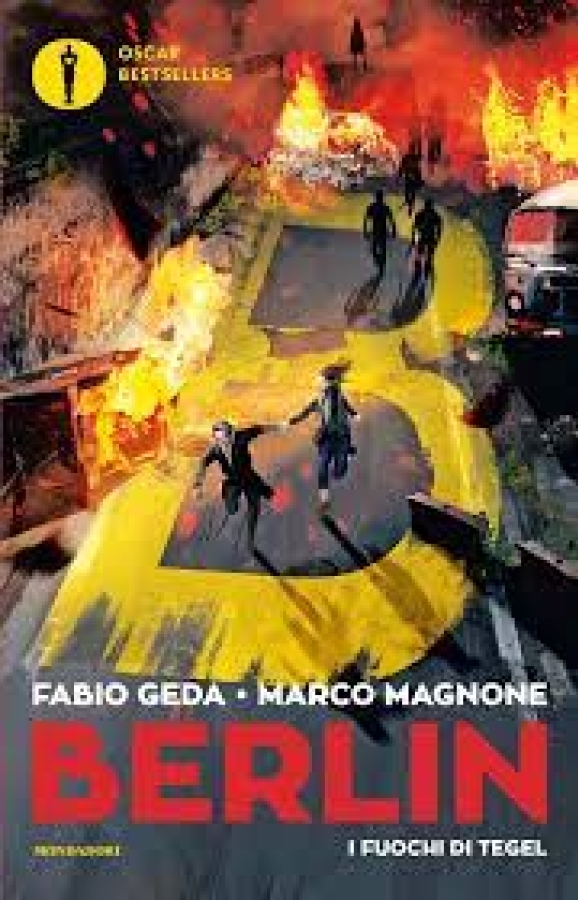
Berlin: The Fires of Tegel
Title of the original version reviewed: «Berlin I fuochi di Tegel»
AI Translation Notice: This review was translated from the original Italian using artificial intelligence. Book quotes and excerpts are translated interpretations and will not match the author's original English phrasing or official published translations.
In a Berlin still divided by the Wall, a virus has wiped out all adults. The sole survivors are girls and boys under the age of eighteen; once they reach that threshold, the fate of the grown-ups awaits them as well.
They procured food through hunting: they had learned to build traps for rabbits; to dig pits to snare wild boars and deer. (...) They had taken over urban vegetable gardens, trying to tend them with clumsy, inexperienced gestures. (...) It had not been easy. They had suffered, especially during the first winter. But then they had learned to get by
. As Francesco Petrarca wrote, “both remembrance and expectation grieve my heart”; the new masters of Berlin live in a continuous, anguished oscillation between memory—increasingly evanescent and imagined—and reality: a present orphaned of parents.
As for me, when I try to focus on their faces, I see them all blurred. But I hear their voices. And every now and then, in the air, I feel like I catch the scent of my mother’s clothes.
As Ryszard Kapuściński writes in the final chapter of The Shadow of the Sun (see the review on this site), dissolving the memory of one’s yesterday means turning into
people without a past, which is to say, nobody. Those men would lose what bound them together, scattering each on his own way, alone.
In Berlin, there is no future simply because they know they will all die upon turning eighteen. The girls and boys live without prospects because there can be no utopia when one is alone. Within the group, they seek that bond which might give meaning to existence, while carefully avoiding interference with the other clans—especially those with radically different values and rules. And it is out of respect for this overarching norm of coexistence that Sven, the charismatic leader of the Gropius, chooses not to aid the girls of Havel in taking back Theo, an infant kidnapped by the terrifying boys of Tegel.
Sven looked at Nora gently; she reminded him of a classmate he had fallen in love with in another life. (...) Cooperation. Solidarity. Weren’t those the rules? Sven dragged his eyes along the stained walls, down to the floor, and finally fixed them on his own feet. He knew those had been his words, just two years earlier. At the dawn of the new world.
Was Tegel right, then, when mocking the Gropius kids for trying to replicate their parents’ society?
Young flesh, danger, excess: such was Tegel’s revolution, their response to the cruelty of fate. Their way of denying that the virus had snuffed out an extraordinary season of life, the one in which physical strength gives way to awareness and experience
. We stand at a crossroads: we must choose between a world of solidarity and coexistence or slide madly down into the dark tunnel of blind force. It marks the opening of a battle from which a new humanity may yet be born.
The reader must not be misled by what I have written. Berlin is not a treatise on moral philosophy; it is an adventure novel, a kind of chivalric tale, rich in plot twists and populated by characters, some of whom we will grow to love as the narrative unfolds (the book is the first installment of a saga). Adopting the adolescents’ perspective, Geda and Magnone plumb the forces beneath youth’s turbulence (the perpetual swinging between friendship and anarchy, detachment from and attachment to parents, the lure of risk and the dread of it) and confront us adults with a question: we, the absentees and the indifferent—will it fall to our children and grandchildren to find their own way alone? Will they be forced to fight for a better world without us? One is left with the urge to read on, both for the plot and to see who is right: the madness of Tegel, the solidarity of Gropius, or both.
The prose is nearly flawless—perhaps excessively so. No distinct idiosyncrasies emerge, in either vocabulary or syntax, capable of mesmerizing or imparting an unusual rhythm to the narrative. The characters remain suspended within the roles they occupy in the group, lacking distinct personalities and backstories of their own.
Why read it? Adventurous, distinctive, and profound.