Fabio Geda & Marco Magnone
Books by this author (3)
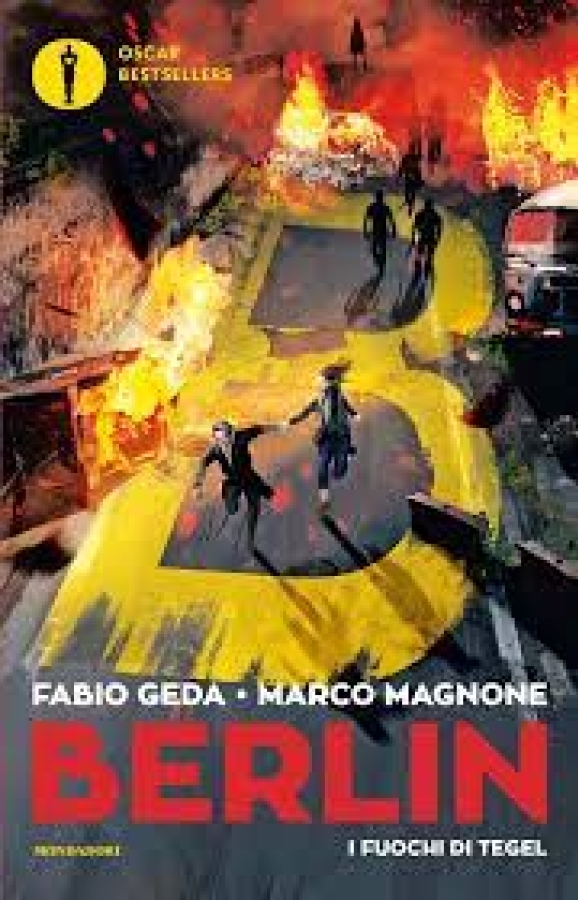
Berlin: The Fires of Tegel
In a Berlin still divided by the Wall, a virus has wiped out all adults. The sole survivors are girls and boys under the age of eighteen; once they reach that threshold, the fate of the grown-ups awaits them as well. > They procured food through hunting: they had learned to build traps for rabbits; to dig pits to snare wild boars and deer. (...) They had taken over urban vegetable gardens, trying to tend them with clumsy, inexperienced gestures. (...) It had not been easy. They had suffered, especially during the first winter. But then they had learned to get by . As Francesco Petrarca wrote, “both remembrance and expectation grieve my heart”; the new masters of Berlin live in a continuous, anguished oscillation between memory—increasingly evanescent and imagined—and reality: a present orphaned of parents. > As for me, when I try to focus on their faces, I see them all blurred. But I hear their voices. And every now and then, in the air, I feel like I catch the scent of my mother’s clothes. As Ryszard Kapuściński writes in the final chapter of *The Shadow of the Sun* (see the review on this site), dissolving the memory of one’s yesterday means turning into > people without a past, which is to say, nobody. Those men would lose what bound them together, scattering each on his own way, alone. In *Berlin*, there is no future simply because they know they will all die upon turning eighteen. The girls and boys live without prospects because there can be no utopia when one is alone. Within the group, they seek that bond which might give meaning to existence, while carefully avoiding interference with the other clans—especially those with radically different values and rules. And it is out of respect for this overarching norm of coexistence that Sven, the charismatic leader of the Gropius, chooses not to aid the girls of Havel in taking back Theo, an infant kidnapped by the terrifying boys of Tegel. > Sven looked at Nora gently; she reminded him of a classmate he had fallen in love with in another life. (...) Cooperation. Solidarity. Weren’t those the rules? Sven dragged his eyes along the stained walls, down to the floor, and finally fixed them on his own feet. He knew those had been his words, just two years earlier. At the dawn of the new world. Was Tegel right, then, when mocking the Gropius kids for trying to replicate their parents’ society? > Young flesh, danger, excess: such was Tegel’s revolution, their response to the cruelty of fate. Their way of denying that the virus had snuffed out an extraordinary season of life, the one in which physical strength gives way to awareness and experience . We stand at a crossroads: we must choose between a world of solidarity and coexistence or slide madly down into the dark tunnel of blind force. It marks the opening of a battle from which a new humanity may yet be born. The reader must not be misled by what I have written. *Berlin* is not a treatise on moral philosophy; it is an adventure novel, a kind of chivalric tale, rich in plot twists and populated by characters, some of whom we will grow to love as the narrative unfolds (the book is the first installment of a saga). Adopting the adolescents’ perspective, Geda and Magnone plumb the forces beneath youth’s turbulence (the perpetual swinging between friendship and anarchy, detachment from and attachment to parents, the lure of risk and the dread of it) and confront us adults with a question: we, the absentees and the indifferent—will it fall to our children and grandchildren to find their own way alone? Will they be forced to fight for a better world without us? One is left with the urge to read on, both for the plot and to see who is right: the madness of Tegel, the solidarity of Gropius, or both. The prose is nearly flawless—perhaps excessively so. No distinct idiosyncrasies emerge, in either vocabulary or syntax, capable of mesmerizing or imparting an unusual rhythm to the narrative. The characters remain suspended within the roles they occupy in the group, lacking distinct personalities and backstories of their own. Why read it? Adventurous, distinctive, and profound.
The Dark Side of the Moon
> Come to this wall if you hate your place/and face a taste of cosmic space/where no form of life can exist/and objects do nothing but fall (Joseph Brodsky, *The Berlin Wall Song*, 1983, from the special insert of *Internazionale*, 2019). This poem apt encapsulates the narrative under review, set in Berlin in 1975. It is no coincidence that the opening image is that of a bird falling, as if out of nowhere, at the feet of one of the protagonists, sixteen-year-old Sven. The boy has just fallen in love with a peer: green-haired Cloe. > I wish I could remember what we talked about. I really do. And yet, nothing. What I remember is that Cloe’s right shoe and my left shoe brushed against each other (...); I remember her skin, on her wrist, almost translucent, and her tense arms and her head hunched into her shoulders. Her hair. (...) Every now and then Cloe would turn and give me a strange look . It would seem like a typical adolescent story, and for a long time the narrative unfolds slowly and prosaically around the two teenagers, who alternate as narrators with a somewhat repetitive cadence. We gather from subtle clues that Sven and Cloe’s circumstances are profoundly different. Sven lives in a “normal” family: his parents, small shopkeepers, would still like to control the boy, but are too consumed by arguing and separating. Cloe was abandoned by her mother, has an eccentric, fragile father who drifts through precarious jobs, and must care for her grandmother, who suffers from Alzheimer’s. She survives an attempted rape, is at times seized by suicidal urges, and procures a gun to avenge the assault given her father’s pusillanimous inertia; inwardly, she scoffs at the romantic Sven for wanting to help her. > Trust by the bucketload. In what he does. In who he is. In what awaits him. Probably, he even trusts me. (...) Stomach-turning stuff . But this is Berlin, where a Wall divides the city, and to those who, like Cloe and Sven, live in the West, the East seems a mysterious place, albeit so remarkably similar: > streets and buildings, and more streets and other buildings, just like here. Perhaps, looking closer, it would have been different, but I had never been to East Berlin. There had never been any reason . Kurt, Sven’s best friend, wants to liberate Frida, his childhood sweetheart who lives in East Berlin. The plan fails because Kurt and Frida are taken prisoner by a criminal gang; upon learning this, Sven resolves to go rescue them, and Cloe decides to help him. Why? Does she love him after all? Nothing of the sort. > Berlin is at our feet, burning in the sunset, (...) it is a promise. And the East burns too, where I have never been, yet even just seeing it from here, (...) it is a promise. (...) A promise of adventures like the ones when I was little, but more exciting. And wilder. (...) My hand gripping a gun. Nothing is real. That is why I want to enjoy everything, and I want to suck every moment down to the marrow . In an adventure that tastes of a thriller and lacks a happy ending, Cloe is irrevocably lost, but Sven fails to grasp this and searches for her in vain. One is led to wonder whether this is merely an adolescent story, or rather a tale that speaks of ourselves, of that “no man’s land,” of that > painful time that for me and you and all of us painfully wears away (Arrigo Bertolucci "time wears away" from *Viaggio d'inverno*). And if the poet finds his son again in the crowd at midday Mass, such is not the case for Sven: with a restless, naive gaze he searches for Cloe through a tumultuous and indifferent Berlin, believing that love alone can save her, can redeem us. Bleak is our fate! It is a fine novel: the writing is clear and precise, the protagonists intense, and the plot well-crafted, gripping us from a certain point onward and building suspense. At times one gets the impression of something contrived, deliberately engineered, but this feeling is overcome by the landscape of Berlin—deeply loved by the two authors—and by its steering clear of the expected conclusion, the happy ending. Why read it? Highly compelling; the figure of Cloe is fascinating!
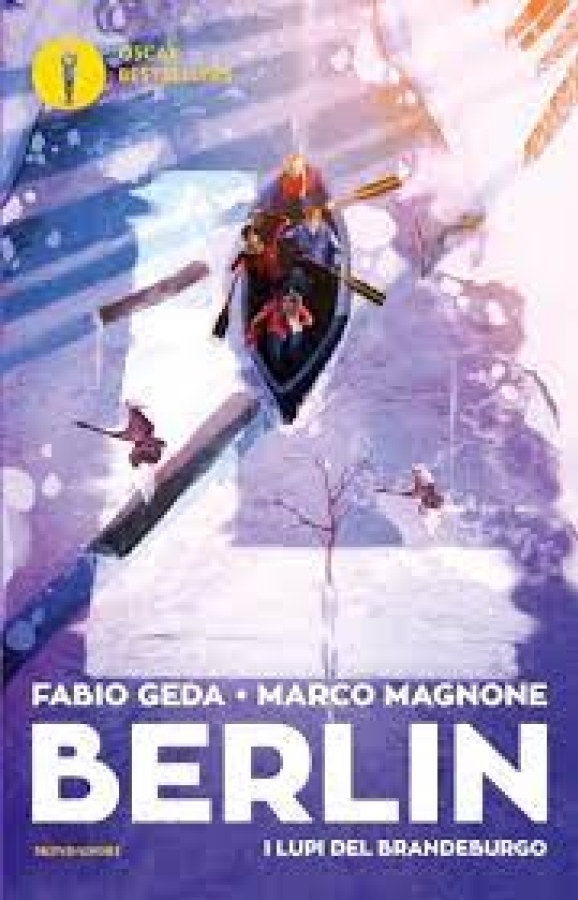
Berlin
On this site, we have already published a review of the first volume of the great Berlin saga, written between 2015 and 2018 by Fabio Geda and Marco Magnone (see *I fuochi di Tegel*). In a “worn and decaying Berlin,” an epidemic had wiped out all adults, leaving only those under the age of eighteen alive: they had plummeted into a > violent, primordial world beyond time, [that] was robbing them even of words . They must carry on living, even though > they were certain that something hideous would leap out at them from a balcony, or from inside a car, catching them unawares . They have banded together into factions with distinct values and dynamics, within a wall encircling the whole of Berlin—a kind of prison that protects them yet confines them to a claustrophobic fate, living with the knowledge that they will die at eighteen. While in *I fuochi di Tegel* the authors introduced the setting and characters, the subsequent volumes chronicle life in this feral world: in *L'alba di Alexanderplatz*, it is the fight against a panther, a ferocious beast lurking in abandoned subway tunnels; in *La battaglia di Gropius*, amidst a freezing winter, with the vast supplies of food and firewood from abandoned supermarkets and buildings exhausted, hunger and cold drive a major battle between the Tegel faction, led by the savage Wolfrun, and the Gropius faction, headed by the hesitant Jacob; in *I lupi di Brandeburgo*, our heroes must venture beyond the wall to rescue little Nina; and finally, in the last two books (*Il richiamo dell'Havel* and *L'isola degli Eroi*), the epic saga culminates in a clash between adults and youths, in a haunting finale albeit brightened by a Hollywood-style epilogue. The narrative is kaleidoscopic, multifaceted and rich in viewpoints, allowing each reader to pursue whichever dimension appeals most, should one wish to look beyond the adventure—which remains consistently surprising and compelling. Identifying a common thread might seem challenging, yet it becomes clear if one follows the trajectory of a single character. Sixteen-year-old Jacob has found himself reluctantly thrust into leadership of the Gropius group; Sven, the former leader, was a charismatic figure, confident in his choices because he was always guided by the values of solidarity and peace. Jacob, by contrast, longs to continue living his adolescence (first loves, friendships, nostalgia, melancholy), but cannot; he must shoulder his responsibilities. And he does so in his own way, not always conforming to conventional notions of leadership: he is hesitant, often ponders what Sven or his father would have done, and does not always make decisions that prove right. It is his conscience that drives the pivotal choice of the entire epic saga. In a frozen and hostile landscape, a brave few have ventured beyond the wall in search of Nina. They cross paths with Wolfrun, the ruthless leader of the Tegel faction, an unsparing enemy driven by hatred toward life. Stranded with her horse, Wolfrun has fallen into icy water and would surely perish were it not for Jacob’s decision to rescue her. > Jacob thought of that idea of the world they had tried to build day after day, a world where saving one's own life was not enough to feel safe, and without giving himself any more time to think, he turned back . And it will be Jacob and Wolfrun, so divergent yet now allied and perhaps already in love, who lead the youths to face their final, most daunting challenge. Deftly constructed in terms of style and narrative, it reads like an epic poem, a blend of the *Aeneid* and the *Iliad*. Alongside the grand battles shines a sense of mutual humanity, a Virgilian *pietas*, the bedrock of familial sentiments of care and friendship. To be sure, the narrative depicts mechanisms of power and domination, extending to the racist attitudes of adults toward the young, yet the numerous positive characters consistently make choices that defy the delusion of subjugation. It is regrettable that the authors eventually abandon the backbone of the narrative—namely, the rebuilding of a society liberated from the burden and errors of the “grown-ups”—only to become ensnared (who knows why) in a plotline recalling the horrors of Nazism, weighing down the narrative unnecessarily and redundantly. Why read it? It captivates through its setting and characters.