Finished reading on: January 09, 2021
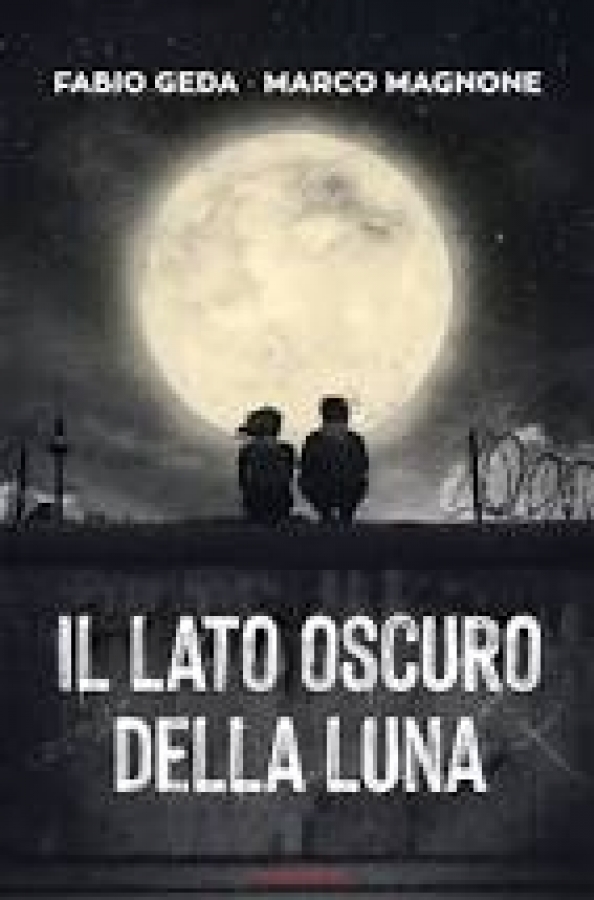
The Dark Side of the Moon
Title of the original version reviewed: «Il lato oscuro della Luna»
AI Translation Notice: This review was translated from the original Italian using artificial intelligence. Book quotes and excerpts are translated interpretations and will not match the author's original English phrasing or official published translations.
Come to this wall if you hate your place/and face a taste of cosmic space/where no form of life can exist/and objects do nothing but fall
(Joseph Brodsky, The Berlin Wall Song, 1983, from the special insert of Internazionale, 2019). This poem apt encapsulates the narrative under review, set in Berlin in 1975. It is no coincidence that the opening image is that of a bird falling, as if out of nowhere, at the feet of one of the protagonists, sixteen-year-old Sven. The boy has just fallen in love with a peer: green-haired Cloe.
I wish I could remember what we talked about. I really do. And yet, nothing. What I remember is that Cloe’s right shoe and my left shoe brushed against each other (...); I remember her skin, on her wrist, almost translucent, and her tense arms and her head hunched into her shoulders. Her hair. (...) Every now and then Cloe would turn and give me a strange look
. It would seem like a typical adolescent story, and for a long time the narrative unfolds slowly and prosaically around the two teenagers, who alternate as narrators with a somewhat repetitive cadence. We gather from subtle clues that Sven and Cloe’s circumstances are profoundly different. Sven lives in a “normal” family: his parents, small shopkeepers, would still like to control the boy, but are too consumed by arguing and separating. Cloe was abandoned by her mother, has an eccentric, fragile father who drifts through precarious jobs, and must care for her grandmother, who suffers from Alzheimer’s. She survives an attempted rape, is at times seized by suicidal urges, and procures a gun to avenge the assault given her father’s pusillanimous inertia; inwardly, she scoffs at the romantic Sven for wanting to help her.
Trust by the bucketload. In what he does. In who he is. In what awaits him. Probably, he even trusts me. (...) Stomach-turning stuff
. But this is Berlin, where a Wall divides the city, and to those who, like Cloe and Sven, live in the West, the East seems a mysterious place, albeit so remarkably similar:
streets and buildings, and more streets and other buildings, just like here. Perhaps, looking closer, it would have been different, but I had never been to East Berlin. There had never been any reason
. Kurt, Sven’s best friend, wants to liberate Frida, his childhood sweetheart who lives in East Berlin. The plan fails because Kurt and Frida are taken prisoner by a criminal gang; upon learning this, Sven resolves to go rescue them, and Cloe decides to help him. Why? Does she love him after all? Nothing of the sort.
Berlin is at our feet, burning in the sunset, (...) it is a promise. And the East burns too, where I have never been, yet even just seeing it from here, (...) it is a promise. (...) A promise of adventures like the ones when I was little, but more exciting. And wilder. (...) My hand gripping a gun. Nothing is real. That is why I want to enjoy everything, and I want to suck every moment down to the marrow
. In an adventure that tastes of a thriller and lacks a happy ending, Cloe is irrevocably lost, but Sven fails to grasp this and searches for her in vain.
One is led to wonder whether this is merely an adolescent story, or rather a tale that speaks of ourselves, of that “no man’s land,” of that
painful time that for me and you and all of us painfully wears away (Arrigo Bertolucci
"time wears away" from Viaggio d'inverno). And if the poet finds his son again in the crowd at midday Mass, such is not the case for Sven: with a restless, naive gaze he searches for Cloe through a tumultuous and indifferent Berlin, believing that love alone can save her, can redeem us. Bleak is our fate!
It is a fine novel: the writing is clear and precise, the protagonists intense, and the plot well-crafted, gripping us from a certain point onward and building suspense. At times one gets the impression of something contrived, deliberately engineered, but this feeling is overcome by the landscape of Berlin—deeply loved by the two authors—and by its steering clear of the expected conclusion, the happy ending.
Why read it? Highly compelling; the figure of Cloe is fascinating!