Finished reading on: March 20, 2022
Berlin
AI Translation Notice: This review was translated from the original Italian using artificial intelligence. Book quotes and excerpts are translated interpretations and will not match the author's original English phrasing or official published translations.
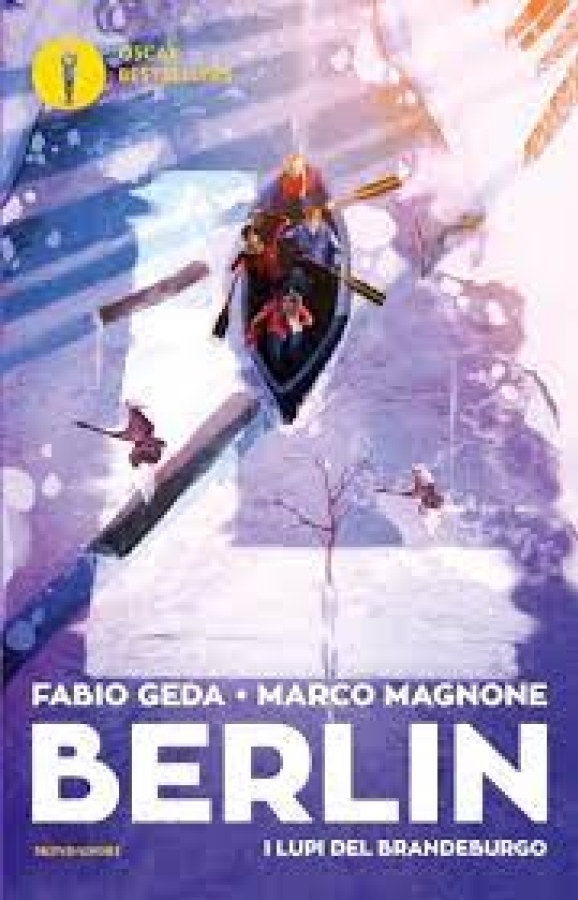
On this site, we have already published a review of the first volume of the great Berlin saga, written between 2015 and 2018 by Fabio Geda and Marco Magnone (see I fuochi di Tegel). In a “worn and decaying Berlin,” an epidemic had wiped out all adults, leaving only those under the age of eighteen alive: they had plummeted into a
violent, primordial world beyond time, [that] was robbing them even of words
. They must carry on living, even though
they were certain that something hideous would leap out at them from a balcony, or from inside a car, catching them unawares
. They have banded together into factions with distinct values and dynamics, within a wall encircling the whole of Berlin—a kind of prison that protects them yet confines them to a claustrophobic fate, living with the knowledge that they will die at eighteen. While in I fuochi di Tegel the authors introduced the setting and characters, the subsequent volumes chronicle life in this feral world: in L'alba di Alexanderplatz, it is the fight against a panther, a ferocious beast lurking in abandoned subway tunnels; in La battaglia di Gropius, amidst a freezing winter, with the vast supplies of food and firewood from abandoned supermarkets and buildings exhausted, hunger and cold drive a major battle between the Tegel faction, led by the savage Wolfrun, and the Gropius faction, headed by the hesitant Jacob; in I lupi di Brandeburgo, our heroes must venture beyond the wall to rescue little Nina; and finally, in the last two books (Il richiamo dell'Havel and L'isola degli Eroi), the epic saga culminates in a clash between adults and youths, in a haunting finale albeit brightened by a Hollywood-style epilogue.
The narrative is kaleidoscopic, multifaceted and rich in viewpoints, allowing each reader to pursue whichever dimension appeals most, should one wish to look beyond the adventure—which remains consistently surprising and compelling. Identifying a common thread might seem challenging, yet it becomes clear if one follows the trajectory of a single character. Sixteen-year-old Jacob has found himself reluctantly thrust into leadership of the Gropius group; Sven, the former leader, was a charismatic figure, confident in his choices because he was always guided by the values of solidarity and peace. Jacob, by contrast, longs to continue living his adolescence (first loves, friendships, nostalgia, melancholy), but cannot; he must shoulder his responsibilities. And he does so in his own way, not always conforming to conventional notions of leadership: he is hesitant, often ponders what Sven or his father would have done, and does not always make decisions that prove right. It is his conscience that drives the pivotal choice of the entire epic saga. In a frozen and hostile landscape, a brave few have ventured beyond the wall in search of Nina. They cross paths with Wolfrun, the ruthless leader of the Tegel faction, an unsparing enemy driven by hatred toward life. Stranded with her horse, Wolfrun has fallen into icy water and would surely perish were it not for Jacob’s decision to rescue her.
Jacob thought of that idea of the world they had tried to build day after day, a world where saving one's own life was not enough to feel safe, and without giving himself any more time to think, he turned back
. And it will be Jacob and Wolfrun, so divergent yet now allied and perhaps already in love, who lead the youths to face their final, most daunting challenge.
Deftly constructed in terms of style and narrative, it reads like an epic poem, a blend of the Aeneid and the Iliad. Alongside the grand battles shines a sense of mutual humanity, a Virgilian pietas, the bedrock of familial sentiments of care and friendship. To be sure, the narrative depicts mechanisms of power and domination, extending to the racist attitudes of adults toward the young, yet the numerous positive characters consistently make choices that defy the delusion of subjugation. It is regrettable that the authors eventually abandon the backbone of the narrative—namely, the rebuilding of a society liberated from the burden and errors of the “grown-ups”—only to become ensnared (who knows why) in a plotline recalling the horrors of Nazism, weighing down the narrative unnecessarily and redundantly.
Why read it? It captivates through its setting and characters.