Wolfgang Goethe
Books by this author (1)
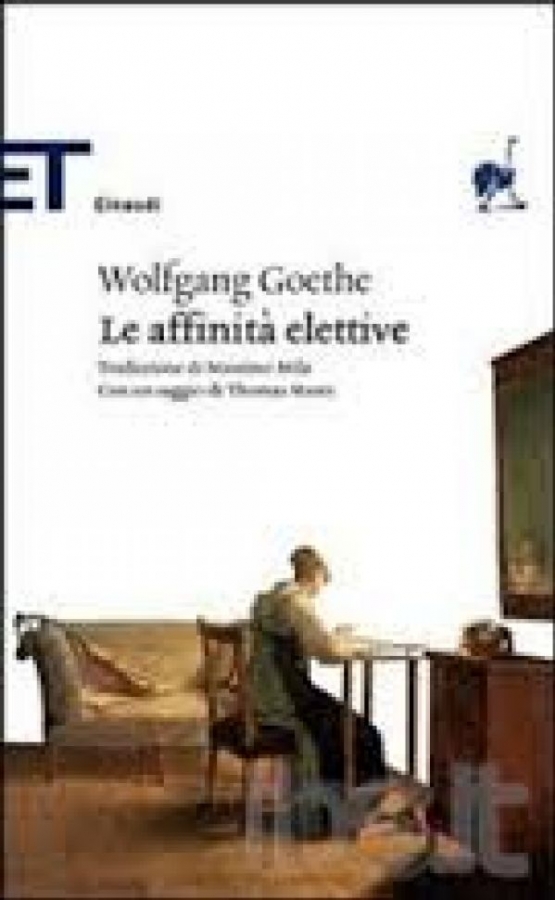
Elective Affinities
In early nineteenth-century Germany, Eduard and Charlotte are two wealthy landowners. Though they loved each other in their youth, they married late in life, after both had been widowed. They possess differing temperaments that seem to complement each other perfectly: Eduard is “in the prime of manhood,” impetuous, generous, but superficial and at times reckless; Charlotte is reflective, patient, and prudent in managing both household and estate. Life flows serenely, as they enjoy “undisturbed the happiness finally attained,” until two guests arrive. The Captain, a friend of Eduard’s, is a poised man of vast experience who places his skills as a planner, engineer, and organizer at their disposal. He cannot help but find himself in tune with Charlotte. Ottilie, Charlotte’s niece, is a graceful, sensitive, introverted, and seemingly quiet young woman. The boyish quality within Eduard cannot fail to resonate with Ottilie’s youth. And very soon > the secret attraction and the power of imagination asserted their rights over reality , with such overwhelming force that in the dark, during the couple’s most intimate moments, > it was none other than Ottilie whom Eduard held in his arms; the phantom of the Captain hovered near or far before Charlotte’s soul, and thus they entwined, the absent and the present, in an exquisite mingling of voluptuous excitement . Seizing the opportunity of the Captain’s departure, Charlotte wisely proposes sending Ottilie to a boarding school, but Eduard abruptly leaves the estate, seemingly relinquishing the happiness of loving the young woman. The two women remain together in an apparent calm, yet without returning to “a full and open harmony.” The marital crisis might be resolved, with a new bond, by the birth of a child, who nevertheless has Ottilie’s eyes and the Captain’s features. It is the physical proof of adultery, having indeed been conceived on that very night when, making love, the spouses were thinking of their respective beloveds. Affection and care for the child bring Charlotte and Ottilie back together: > everything seems to follow its usual course, as happens even in the most extraordinary circumstances, when everything is at stake, yet one still continues to live as if nothing were amiss . New characters enter the scene, such as a talented young architect who lavishes attention on Ottilie. Daily life is disrupted by Charlotte’s lively daughter—cheerful, tumultuous, even excessively so. The two women complete the projects already initiated by the Captain: the rearrangement of the vast park, the merging of several ponds into a lake, the construction of a new dwelling on a magnificent scenic viewpoint, and the restoration of the parish church. The pursuit of perfection pervades the characters’ actions, even driving them to recreate famous paintings through *tableaux vivants*, in which Ottilie commands admiration. Charlotte, out of affection for Ottilie or a secret desire to reunite with the Captain, would be willing to accept divorce and Eduard’s union with Ottilie. Yet it is the girl who refuses, making an entirely spiritual choice, though only seemingly resolute. In this part of the novel, the external narrator is joined by the young woman’s diary: brief entries alternating moral maxims and romantic reflections with the manifestation of the profound yearning of a youthful heart in love. And it is Eduard’s reckless impetuosity that precipitates such a fragile situation. He surprises Ottilie by the lakeside on an autumn evening; the two lovers embrace and > for the first time they kissed openly, freely, and parted with painful effort . The girl remains “troubled and agitated.” To return to the manor, she commits the imprudence of using the boat, despite having the child with her. Through a series of accidental circumstances, the child falls into the water and drowns. At this point, the narrative reaches its inexorable denouement. Ottilie, despite an outward serenity and expressions of diligent expiation, starves herself to death. Goethe, who was by no means religious, closes the novel with a sort of sanctification of the girl, likely indicating her spiritualization—Ottilie’s death as moral elevation. Thomas Mann defined the novel as > the clearest fusion of Eros and Logos, of sensuality and morality, of immediacy and reflection... a German work of the highest moral culture . Ottilie’s death by starvation would express > the obedience rendered to the law of the spirit, paying its tribute, with virile tragedy, to the ethical norm . *Elective Affinities* would thus be “a spiritual construction,” a philosophical text in the form of a novel, a sort of manifesto of Germany’s “moralizing mission,” its “imperious instinct.” Perhaps Merkel had read *Elective Affinities* all too closely when demanding that we Italians do our homework: she personifies Germany’s didactic intent toward the pleasure-seeking Mediterranean peoples. Without detracting in the least from the great writer, Mann’s interpretation freezes the book in the past, as a testament to the history of German thought, overshadowing what still makes it so modern: “the story of the magical attraction” between kindred souls that shatters friendship, mutual esteem, the most sacred institutions—such as marriage—and the orderly, elegant world we desperately strive to build. And Ottilie, taking everything too seriously, falls victim to the superficiality and selfishness of some, like Eduard, and the tedious wisdom of others, like Charlotte, who, often through excessive self-assurance, fail to grasp in time the tragedy of fragile, sensitive souls like Ottilie. Alongside the characters, another protagonist is the landscape. Within it, and in the continuous attempt to reshape it according to human design, the contradiction between present and past is expressed. The present seeks to confer upon everything a more harmonious and rational order; the past returns to us the spontaneity of nature, which also serves as a vessel for transmitting memories. By bestowing a new and more fitting arrangement upon the cemetery, Charlotte unwittingly offends the reverence felt for the departed, as relatives were accustomed to visiting them buried in different spots, however haphazardly scattered across the churchyard. It is as though the notion of time were lost, and with it memory, so inextricably bound to familiar places and their traditional disorder. The novel’s limitation lies in its frequent philosophical and moral dissertations. Particularly in the second half of the narrative, after Eduard has abandoned the house, these digressions weigh down and fragment the reading, breaking up the overall unity and marring both the narrative pace and the psychological depth of the characters. Even Goethe failed to construct the perfect work. Why read it? The story and the characters remain remarkably modern, if one allows oneself to be captivated by the plot.