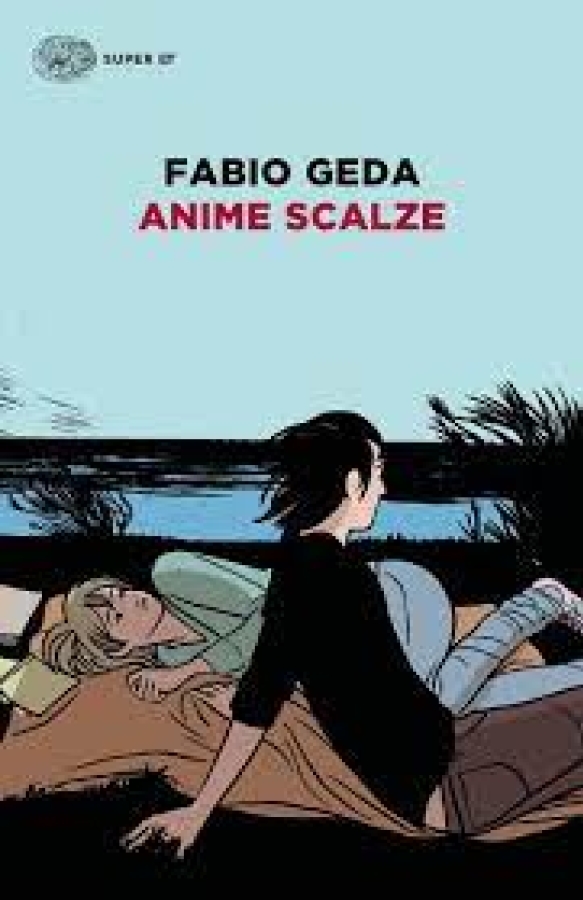
Finished reading on: May 08, 2022
Barefoot Souls
Title of the original version reviewed: «Anime scalze»
AI Translation Notice: This review was translated from the original Italian using artificial intelligence. Book quotes and excerpts are translated interpretations and will not match the author's original English phrasing or official published translations.
The story opens with Ercole and his little brother Luca on the roof of a shopping mall, with the police yelling at them to come down. From the narrative, we learn that Ercole is fifteen years old, living with his older sister Asia and an absent father who takes whatever work comes his way and frequently gets into trouble. Ercole knows full well that Asia «was strong, yes, brave, but not indestructible. Tied to me, but not with me». When his sister informs him that she is moving in with her boyfriend, Ercole realizes that «mothers contain. Everything. Brothers and sisters accompany». On an old bicycle, he sets off to find his mother in a small mountain village. He gets a flat tire, has to hitch a ride, must ask for money for a train ticket, and when he arrives at the village where his mother lives, finds it difficult to locate her home because she lives in an isolated house. Stubborn and brave, Ercole faces every obstacle and overcomes his fears, yet cannot vanquish the monsters within. He cannot bring himself to ask his mother the questions he longs to ask.
Why did you leave, exactly? (...) Why don’t you ask me if I missed you? (...) That’s just how things are, Ercole. And there’s nothing you can do about it
Asia used to say. Then comes a turning point.
Hanging from a spike on the outer wall was an American football helmet, yellow, with the number ten in red
. It belongs to Luca, his six-year-old brother.
Life is a billiard ball; every collision makes it change direction; and if you are strong and lucky enough, you can go anywhere
. Now Ercole has someone to care for, to protect, even from the world of adults. And when, at Luca's birthday, the boy's father's friends try to get the little child drunk without the mother defending him, it is Ercole who steps in and whisks his little brother to safety. Boldly conquering his fear, he gets behind the wheel of a car. The police surprise him.
Would they have believed me if I had explained what had happened, that I was doing it for Luca? Would they have believed me or the adults? (...) And if they had believed me, where would they have sent Luca? Into whose custody would they have placed him? (...) I heard Obi-Wan's voice whispering to me: use the Force, Luke. Follow your instincts. I heard the cracks crumble and the monsters emerge from the walls. I shifted into first gear. I slammed the gas pedal to the floor. And I fled.
If in nineteenth-century novels the adolescent becomes an adult by braving increasingly perilous trials, thereby winning their autonomy from grownups, today the youth always remains somehow tethered to the help of adults. Consider the contrast between Stevenson's Treasure Island, where Jim faces perils alone—from the tempest to the pirate Silver—and the story of Harry Potter, who overcomes evil thanks to the salvific role of the arch-wizard Dumbledore (see the reviews on this site:
Treasure Island and Harry Potter & the Philosopher's Stone). In Anime scalze, magic happily does not come into play; yet fifteen-year-old Ercole manages not to slide «from confusion to despair» because he finds solid footholds in his older sister Asia and his girlfriend Viola, his peer and yet so steadfast and determined. Woven into the primary narrative thread—that of the Bildungsroman—are other ingredients: the fragility and emotional distance of adults, bottling up feelings and refusing to seek help, abandonment, love as a lifeline; too many overlapping themes that are never explored in depth, as though the author wished to touch upon every conceivable facet of adolescent malaise. Coupled with frequent nuggets of wisdom, this narrative dispersion often renders the tale verbose and predictable.
A weakness of the narrative lies in its literary style. Unlike the novels co-authored with Marco Magnone (see the reviews on this site of Berlin and Il lato oscuro della Luna), it lacks narrative pace, the final pages aside; the prose is also frequently prosaic, stripped of context because Turin remains distant in its post-industrial desolation, while the frequent resort to clipped, terse dialogue feels like a lifeline thrown to a narrative struggling to move forward, rather than an effective device to express incommunicability.
Why read it? It is a smooth read and examines youth malaise.