Finished reading on: December 30, 2025
Ascension
AI Translation Notice: This review was translated from the original Italian using artificial intelligence. Book quotes and excerpts are translated interpretations and will not match the author's original English phrasing or official published translations.
In Greek mythology, Sisyphus is condemned for eternity to push an enormous boulder up to the summit, only to watch it roll back down into the valley and then be forced to haul it to the top once again. For Albert Camus, the myth of Sisyphus shows us how
the struggle itself toward the heights is enough to fill a man's heart. (...) At this subtle moment, when man turns back toward his life, a new Sisyphus returning to his rock, (...) he contemplates that series of unrelated actions which have become his destiny, created by him, brought together under the gaze of memory and soon sealed by death
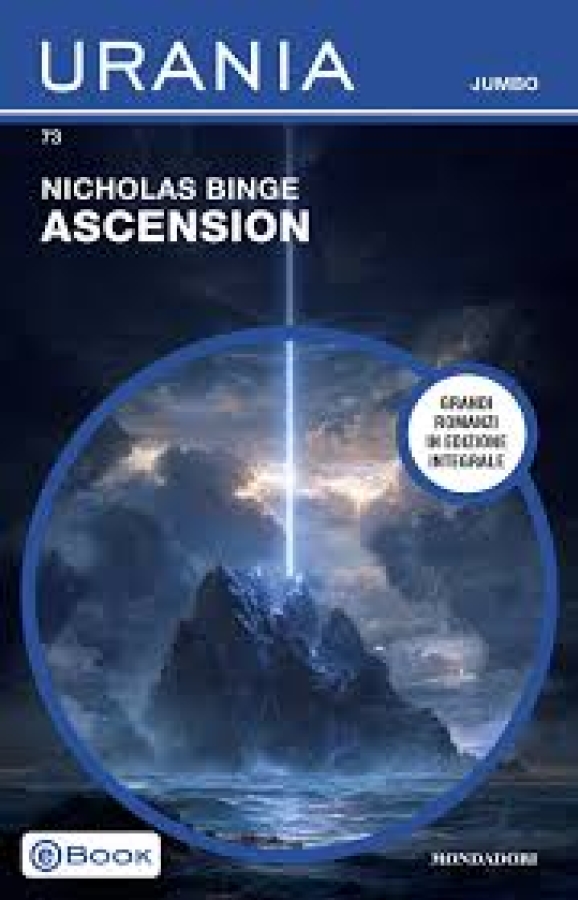
(The Myth of Sisyphus in Opere, Bompiani, pages 318–9). Viewed in this light, the myth of Sisyphus can serve as the interpretive key to a novel that would be simplistic to define merely as science fiction. Harold, a reclusive and solitary man, has been missing for many years when his brother learns that he has been hospitalized for evident mental disorders; he also discovers letters Harold wrote to his niece, recounting a mountain that mysteriously appeared in the sky, and its exploration by an expedition of scientists, including Harold.
I have wondered at times why I addressed these letters to you, Hattie, what this experience has to do with you. (...) At first, I told myself the letters were little more than a chronicle, a record of events that would allow me to process them at some deeper, subconscious level. (...) That is false. (...) I spent my life hiding from myself, denying my past, concealing my identity beneath new challenges and new mysteries. As Camus perceived, the thirst for knowledge and the flight from oneself are inextricably intertwined. The team of scientists comprises diverse competencies, some scientific, all within the natural sciences, an experienced mountaineer, and several military personnel. An exception is the presence of an anthropologist, whose necessity remains unclear. After being flown by helicopter to base camp, the ascent toward the mountain's summit begins. The climb entails the classic perils of high-altitude mountaineering: ferocious winds and subzero temperatures, ice and snow avalanches, ravines and crevasses. The explorers are also attacked by tentacled monsters and afflicted by paranormal phenomena, such as the collapse of temporal dimensions: a few hours can turn into months, the past and the future overlap with the future in the mind. The narrative is replete with adventure, plot twists, and Harold’s memories, as he painstakingly manages—or seems to manage—to free himself from guilt and achieve self-forgiveness. Only two men reach the summit: Harold, now physically broken, and Bettan, the mountain guide. In a sunlit environment above the clouds, surprisingly sheltered from the winds, the anthropologist appears. He is not a man; he is a Superior Being (God, perhaps?) and their expedition has been an experiment (
I felt my entire existence shrink to the size of a rat cage
); an experiment to test the capabilities of human beings. It is by the will of the Superior Being that the ape became a hominid, then Homo sapiens, and was ultimately bestowed with the gift of Reason. The Superior Being has always intervened; now the time has come to make another leap—who will be the fortunate one? It can only be Bettan; our Harold is, deep down, a weakling. No sooner had the Superior Being placed the miraculous stone upon his chest than his body
began to glow, first with a deep blue, like that of the ocean, then yellow as the sun. (...) A surge of energy erupted from him like thunder. (...) It is done, said the Superior Being, (...) Welcome, “Other Man,” to the new era of humanity. And precisely at that moment of transformation, Bettan shoots himself in the head, killing himself, crying out:
I am the master of my fate, (...) I am the captain of my soul. The Superior Being retreats in dejection—forever, we hope. Adam preferred to leave the Garden of Eden to be free. Certain angels rebelled against God, choosing eternal damnation over being the applauding courtiers of divinity.
In the novel, it is imagined that Harold's letters sparked widespread debate among the public and critics: a confused and delirious work; confirmation of a global conspiracy; an account of a phenomenon plausible from the perspective of theoretical physics; genuine clues pointing to the presence of real people who vanished without a trace; the oneiric construct of an anguished man seeking to metabolize his own guilt. It is difficult to say which of these interpretations is correct: perhaps a little of each. And this is precisely the novel’s shortcoming: attempting to say too much instead of humbly being a good science-fiction novel.
The prose is straightforward and readable; a subject of such complexity would have required a more evocative writing style, capable of stirring impressions and fantasy in the reader—a language akin to Paul Lynch's in Prophet Song (see the review on this site). The plot is muddled, the result of striving to blend the adventure genre with psychological introspection, alongside excessive intrusions by the author into Einsteinian physics and metaphysics more broadly.
Why read it? It is interesting, but do not expect a science-fiction novel.