Alessandro Barbero
Books by this author (2)
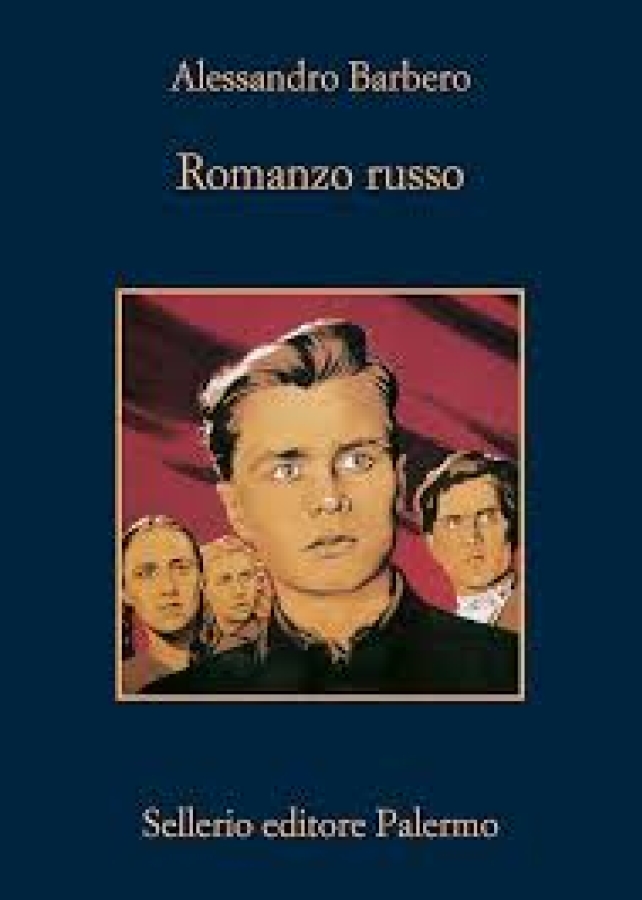
Russian novel
The novel is set in Russia between 1987 and 1991, during the Mikhail Gorbachev years, amid those turbulent events that led to the dissolution of the Soviet Union in December of that same year. What unfolded was > a carpet woven of countless threads , a sort of Rubik's cube across which fingers chase > the colored squares that never click into the right place. To untangle this knot, without success, Barbero imagines "someone" recounting what occurred: a first-person narrator, perhaps an obscure Muscovite Jewish actor who, faced with a demonstration of anti-Zionist hatred, > suddenly had a flash of an idea which, for who knows what reason, did not seem monstrous to him at all, but rather most felicitous: well now, he thought, I will stand by and watch, and then I will describe everything in my novel. For, of course, how else could one survive such filth?. And if the plot lacks the order of great nineteenth-century novels, one must resign oneself to it, for it is devised by an actor, or perhaps by a historian who, like Ariosto with *Orlando Furioso*, is delighting in the captivating passion of storytelling. Besides, even the great Emmanuel Carrère lost his way describing recent Russian events (see *Limonov* on this site). The novel revolves around two characters. Tania, a young historian, has decided to write her doctoral dissertation on the obscure disappearance of Party officials in Baku during the 1940s. Why are they no longer mentioned in the minutes of congresses and regional committees? It must be a delicate matter, since the novel itself opens with a scene at once amusing and alarming: two envoys from Baku dump tomato sauce over the desk and suit of Tania's supervisor to make him understand that it would be best for the girl to abandon her inquiry into what happened. > Never mind the merits and the faults. But oblivion, no. A free people must remember , and with the resolve of one who believes in "historical truth" as a moral imperative for the researcher, Tania sets off for Baku to uncover the mystery, unbeknownst to the Historical Institute where she works, and at the risk of her life. Nazar is a federal prosecutor: he believes fiercely in justice—a legality by now eroded by the Brezhnevian swamp—nostalgic as he is for Stalinist severity, to the point of championing capital punishment (at home he proudly keeps the "pink slips" recording the executions of his death sentences!). He is assigned to investigate the murder of an ayatollah in Baku; it is feared that Armenians might be blamed, unleashing the vengeful fury of the Azerbaijanis: we are witnessing the disintegration of Soviet power. As in a thriller, the two plotlines unfold with twists, moments of danger in distant Baku as well as in a safer Moscow, intertwining in surprising and haphazard ways. In a world disintegrating in terms of values as well as state institutions, who cares about historical or judicial truth? Nothing remains but to withdraw into familial affection. Losing oneself in the narrative, a doubt arises: is Barbero speaking of Russia or of Italy? Rampant corruption at every level, the intertwining of political power and criminality, ideology reduced to mere ritual, the complete absence of any vision of the future, the disregard for "truths" except on the part of a stubborn few—all are elements we find in our own country's recent history. As in *Limonov*, one must admit that dissolving societies, whether Russian or Italian, possess a certain allure, especially when described ironically, without passing pointless moral judgments. Moreover, the world of historians is depicted in its inner workings, where power, complacency, archival research, and methodology mingle in unpredictable ways, and only those driven by an unshakeable faith, like Tania, can see it through to the end. Barbero speaks of himself, as both historian and Italian. Barbero writes the way he speaks: colloquially, with constant parentheticals and delectable descriptions, blending factual events with sketches of social mores, not forgetting a dash of sex. The pages turn briskly and pleasantly; nevertheless, the reader gets lost in the narrative’s countless embellishments, to the detriment of the overall pace—essential in what is ostensibly a thriller—and of a coherent grasp of the plot. Barbero must have realized this toward the end, for he offers a preemptive defense: > And it all comes down to this, that one has to be good: it would be too easy if the first comer were able to write in a flash what crosses the minds of his characters at a moment like this. (...) The pen writes and knows not what, the ink does not corrode the paper, the notebook does not catch fire.... Why read it? Enjoyable and interesting; the figure of Tania is finely drawn.
The Good Life and Others' Wars of Mr. Pyle, Gentleman
Imagine a Martian sent to Earth to understand what Humans are doing: whether war is to be expected or if we may hope for peace, which would allow interstellar commerce to continue. On the one hand, this visitor, bewildered yet indifferent (Earthlings' problems, after all!), would glean only a muddled impression; on the other, he might be an inquisitive traveler, somewhat horrified by our squalor and somewhat captivated by ancient monuments and beautiful women. Poised between metaphor and history, Barbero recounts the experiences of an American gentleman, Mr. Robert Pyle, traveling through the Prussia of 1806, at the height of the Napoleonic Wars, tasked with sending weekly dispatches to the United States ambassador in London. The first evident reality is that, traveling from Amsterdam to Berlin, he constantly encounters so many borders—some within Prussia itself—as to suggest that > the geography of European states resembles a puzzle left unfinished by a petulant child rather than a product of human reason, and it is hardly surprising that their politics should be guided above all else by fear of their neighbors. Could he be speaking of our own Europe? And then, with > that freedom the traveler enjoys to choose the roads to take, the dishes to savor, the girls to caress , Mr. Pyle can > spend the afternoon in the palace of a grand seigneur conversing in French , and end > the evening in the inn's courtyard, listening to the landlady's chatter and watching the scullery maid wash dishes in the kitchen by lantern light. Our gentleman does not merely observe; whenever possible, he reaps the fruits of fleeting encounters—be they prostitutes, young maidservants, or peasant girls persuaded by a few thalers, or fleeting, Byronic liaisons with noblewomen of the Berlin court. The only thing that holds him back is the risk of contracting some venereal disease. There are other pleasant diversions: conversations with Prussian officers, > capable even of philosophical reflections , card games where our Pyle unfailingly loses a tidy sum of thalers, the elegant salons where French is spoken and one is either for the war or against it, yet always admiring Bonaparte. Our gentleman even manages to meet Fichte and Goethe—the former just as history of philosophy presents him, the latter disappointing: a garrulous drunkard. Is this the mission entrusted to him? Amid brothels, grueling travel between coaching inns, and long conversations, our Robert even manages to meet Prussian ministers, Frederick William III himself, and the drowsy sovereigns of the minor North German states, such as Hanover and Saxony. And when he has no news to report, no matter: it is enough to read the Parisian *Moniteur*, even days old, or fabricate supposed intelligence to be denied or corrected in the following dispatch. For Mr. Pyle, it is an exhausting yet ultimately pleasant journey; for us, a splendid portrait of early nineteenth-century Germany awaiting an inevitable war, for at stake is the pride of a military caste forged by Frederick the Great and the nascent nationalism of the German nation. What shatters this grand tour, rendering all martial pretensions fatuous and reckless, are the disastrous defeats of Jena and Auerstedt, which lay bare the Prussian army's lack of preparation and the strategic backwardness of its generals. With a historian's precision, Barbero exposes the dark underside of war: soldiers marching to their deaths poorly equipped and in disarray, yet driven by the ancestral fatalism of obedient serfs; burned and pillaged homes, with civilians murdered, raped, or desperately fleeing; generals traveling in carriages, sticklers for protocol and mindful of their comforts; officers caught between discipline and solidarity toward their men, whom they cannot even provide with bread—though, after all, the soldiers are peasants accustomed to starvation. > It is all written in a little leather-bound notebook , says Mr. Pyle in the prologue, > which has been yellowing ever since, in the drawer of a wobbly desk, exiled for many years in the drawer, (...) a regrettable account of things done many years ago, and done poorly. Already in *Romanzo russo*, written in 1998 and set in Gorbachev's Russia (see the review on this site), one senses a kind of alienation regarding the moral and institutional dissolution of the Soviet Union; here, that feeling is even more pronounced, perhaps because the events are so distant in time. Robert Pyle is, at bottom, a spectator; even during the bloody Battle of Jena, his primary concern is his own survival, astonished to find himself caught up in this tragedy despite everything. On the other hand, Barbero is first and foremost a historian, and his profession compels him to remain detached, subtly ironic at times, but never emotionally enmeshed with his characters or their painful plights. To be sure, the author's convictions are clear: it is easy to talk of war from afar; one must experience it from the perspective of the humble, only then discovering the vast gulf between crisp, orderly maneuvers on a parade ground and what actually unfolds on a battlefield. Not to be seduced by technology, we must always remember that there are men and women, children and the elderly, and they are the true protagonists of war. Even more than in *Romanzo russo*, an intense ethical dimension shines through—a stern indictment of the fatuity of the ruling and intellectual classes, whether Fichte and Goethe or our American gentleman. One might say Barbero writes as he speaks: fluidly, laden with parenthetical remarks, precise and evocative in his descriptions. It reads smoothly, were it not for the fact that one all too often loses one's way in a repetitive, prolix plot. The extensive description of the Battle of Jena redeems the entire narrative, which had threatened to fray to the point of unraveling into formless excess. Why read it? For history lovers it is a gem—a remarkably timely novel.