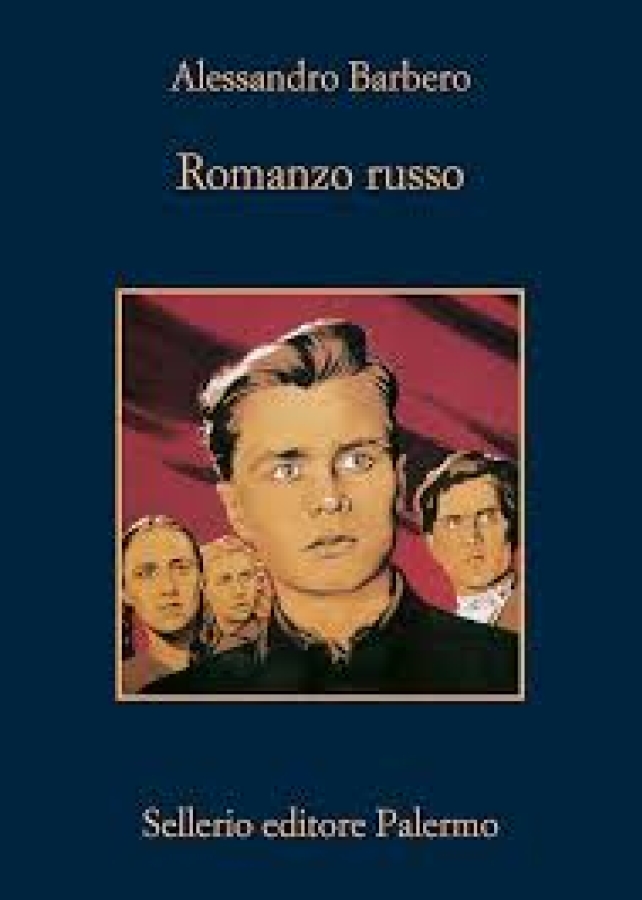
Finished reading on: March 02, 2025
Russian novel
Title of the original version reviewed: «Romanzo russo»
AI Translation Notice: This review was translated from the original Italian using artificial intelligence. Book quotes and excerpts are translated interpretations and will not match the author's original English phrasing or official published translations.
The novel is set in Russia between 1987 and 1991, during the Mikhail Gorbachev years, amid those turbulent events that led to the dissolution of the Soviet Union in December of that same year. What unfolded was
a carpet woven of countless threads
, a sort of Rubik's cube across which fingers chase
the colored squares that never click into the right place. To untangle this knot, without success, Barbero imagines "someone" recounting what occurred: a first-person narrator, perhaps an obscure Muscovite Jewish actor who, faced with a demonstration of anti-Zionist hatred,
suddenly had a flash of an idea which, for who knows what reason, did not seem monstrous to him at all, but rather most felicitous: well now, he thought, I will stand by and watch, and then I will describe everything in my novel. For, of course, how else could one survive such filth?. And if the plot lacks the order of great nineteenth-century novels, one must resign oneself to it, for it is devised by an actor, or perhaps by a historian who, like Ariosto with Orlando Furioso, is delighting in the captivating passion of storytelling. Besides, even the great Emmanuel Carrère lost his way describing recent Russian events (see Limonov on this site). The novel revolves around two characters. Tania, a young historian, has decided to write her doctoral dissertation on the obscure disappearance of Party officials in Baku during the 1940s. Why are they no longer mentioned in the minutes of congresses and regional committees? It must be a delicate matter, since the novel itself opens with a scene at once amusing and alarming: two envoys from Baku dump tomato sauce over the desk and suit of Tania's supervisor to make him understand that it would be best for the girl to abandon her inquiry into what happened.
Never mind the merits and the faults. But oblivion, no. A free people must remember
, and with the resolve of one who believes in "historical truth" as a moral imperative for the researcher, Tania sets off for Baku to uncover the mystery, unbeknownst to the Historical Institute where she works, and at the risk of her life. Nazar is a federal prosecutor: he believes fiercely in justice—a legality by now eroded by the Brezhnevian swamp—nostalgic as he is for Stalinist severity, to the point of championing capital punishment (at home he proudly keeps the "pink slips" recording the executions of his death sentences!). He is assigned to investigate the murder of an ayatollah in Baku; it is feared that Armenians might be blamed, unleashing the vengeful fury of the Azerbaijanis: we are witnessing the disintegration of Soviet power. As in a thriller, the two plotlines unfold with twists, moments of danger in distant Baku as well as in a safer Moscow, intertwining in surprising and haphazard ways. In a world disintegrating in terms of values as well as state institutions, who cares about historical or judicial truth? Nothing remains but to withdraw into familial affection.
Losing oneself in the narrative, a doubt arises: is Barbero speaking of Russia or of Italy? Rampant corruption at every level, the intertwining of political power and criminality, ideology reduced to mere ritual, the complete absence of any vision of the future, the disregard for "truths" except on the part of a stubborn few—all are elements we find in our own country's recent history. As in Limonov, one must admit that dissolving societies, whether Russian or Italian, possess a certain allure, especially when described ironically, without passing pointless moral judgments. Moreover, the world of historians is depicted in its inner workings, where power, complacency, archival research, and methodology mingle in unpredictable ways, and only those driven by an unshakeable faith, like Tania, can see it through to the end. Barbero speaks of himself, as both historian and Italian.
Barbero writes the way he speaks: colloquially, with constant parentheticals and delectable descriptions, blending factual events with sketches of social mores, not forgetting a dash of sex. The pages turn briskly and pleasantly; nevertheless, the reader gets lost in the narrative’s countless embellishments, to the detriment of the overall pace—essential in what is ostensibly a thriller—and of a coherent grasp of the plot. Barbero must have realized this toward the end, for he offers a preemptive defense:
And it all comes down to this, that one has to be good: it would be too easy if the first comer were able to write in a flash what crosses the minds of his characters at a moment like this. (...) The pen writes and knows not what, the ink does not corrode the paper, the notebook does not catch fire....
Why read it? Enjoyable and interesting; the figure of Tania is finely drawn.