Finished reading on: August 10, 2022
Augustus: a Novel
AI Translation Notice: This review was translated from the original Italian using artificial intelligence. Book quotes and excerpts are translated interpretations and will not match the author's original English phrasing or official published translations.
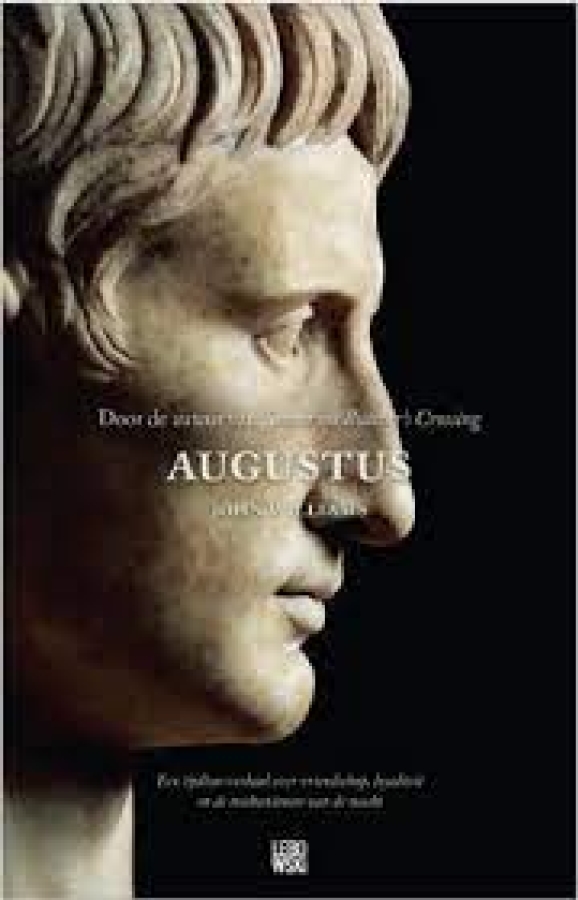
John Williams wrote three widely acclaimed novels: Butcher's Crossing in 1960, Stoner in 1965, and this biography of Augustus in 1972 (with this entry, all of his books have now been reviewed on this site). Williams is an exceptionally talented writer who continually reinvents his style, adapting it to the story and the characters. In this case, the author constructs the plot through letters written by various figures; Augustus himself intervenes in the first person only at the very end, allowing us to grasp key turning points—both political and personal—of his life from differing perspectives. It is an exquisite literary device, yet one that fragments the narrative and assumes the reader is already familiar, at least in broad strokes, with the complex events that led first to the Principate and later to the accession of Tiberius. Who was Octavian, later Augustus, in truth? When his great-uncle Caesar dies, naming him his heir, Octavian is an eighteen-year-old youth: he learns the news in Greece, where he is staying with his friends Maecenas, Agrippa, and Salvidienus Rufus. In his journal, the latter recounts how Octavian voices his uncertainties regarding the true loyalty of Caesar's legions and, turning to his companions, states that he will share his fears only with the three of them,
who are truly my friends, (...) a cold sorrow had settled upon him and pulled him away from us
. It is as if the young Octavian had realized that youth was over and that upon him fell the grave burden of ending the civil wars and securing peace and prosperity for Rome: to accomplish this, he must become a shrewd and ruthless politician, relegating personal affection to the background and exploiting everything and everyone, even his oldest friends and his beloved daughter Julia. Paraphrasing the myth of Orpheus and Eurydice, Horace recounts Octavian's destiny.
His love was not a woman; his Eurydice was knowledge, a dream of the world, to which he sang his song. But the world of light that was his dream of knowledge was destroyed by a civil war; (...) and his dream vanished, as if evaporating, into the darkness of time and circumstance. He saw the world, and understood that he was alone, fatherless, propertyless, hopeless, without dreams..... It was only then that the gods gave him their golden lyre, and allowed him to play not as they willed, but as he himself desired
. It is a magnificent synthesis of Octavian's destiny, elevating him to a singular and immortal role in history, pursuing an end to which everything is subordinated—even Julia's happiness. And it is here that we, too, venture into the darkness of the human soul. With a stroke of literary genius, Williams introduces Julia's journal on the island of Ponza, where she has been exiled. Julia’s sorrowful, resigned account is preceded by the gossip surrounding her dissolute life, almost as if to justify her father's dreadful decision. Yet one cannot help but feel sympathy for this still-young woman, who was forced to marry Agrippa, a man far older than she, and later the unsettling Tiberius. It may well be true that her father exiled her for her immoral conduct to spare her execution for treason against the state; what is certain is that Augustus's cold, cruel severity contrasts starkly with Julia’s gentle melancholy. These are exquisite pages that alone justify reading the novel: the fading of memories, rendered useless and bearing only grief, juxtaposed against the precision in the account of the encounter between Octavian and Julia, father and daughter.
His face was gaunt, and there were lines of weariness around his pale eyes; but in the uncertain light of the room, the face could have been that of the man I remembered from my childhood
. Julia learns that the conspiracy has been uncovered by Tiberius, and her father can do nothing other than condemn her to safeguard his authority.
My child, he said, this has nothing to do with love. He turned away from me again and picked up some papers on the desk. (...) I have not seen my father since. I understand that he will (no longer) speak my name
.
The elegance of the prose, the fictionalized yet masterly reconstruction of events that remain obscure to historians, the lexical richness, and the ability to capture the idiosyncrasies of the various figures (from Mark Antony to Cicero down to the minor players) are literary merits that dazzle the reader. In many reviews it is compared to Robert Graves's I, Claudius; yet it is an entirely different matter. Flitting superficially across the history and the dramatis personae, Williams fails to convey passion and mystery; the novel ends up being as detached and rigid as we imagine Octavian Augustus to have been.
Why read it? It demands some effort, but Julia's diary is truly beautiful.