Finished reading on: May 27, 2018
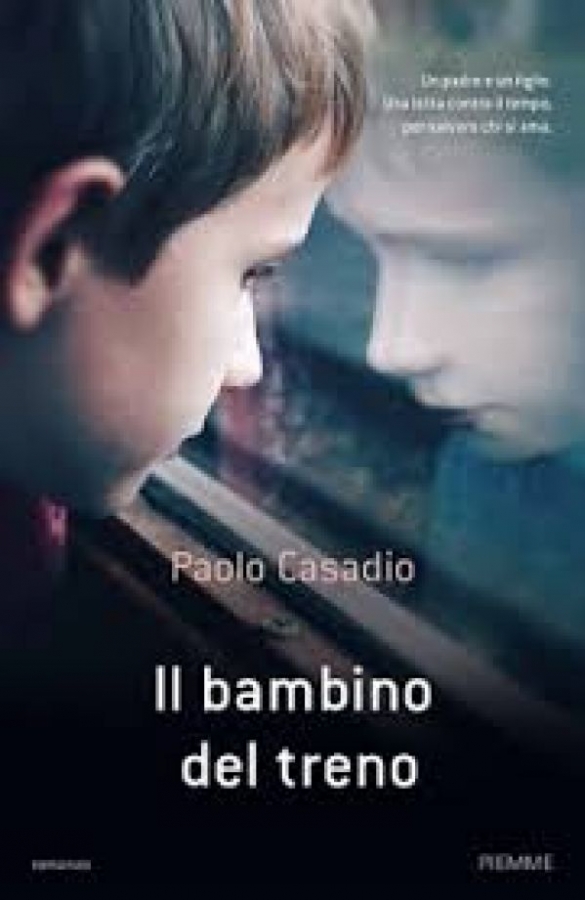
The Boy on the Train
Title of the original version reviewed: «Il bambino del treno»
AI Translation Notice: This review was translated from the original Italian using artificial intelligence. Book quotes and excerpts are translated interpretations and will not match the author's original English phrasing or official published translations.
All too often we forget the importance of places for our lives, for the shaping of our feelings, for the transmission of an individual and collective memory.
As Paolo Casadio observes, walls, objects, and landscapes have the task of bearing witness to the past, of making it outlive ourselves, even if
walls know, but they can never say anything, only bear such a heavy burden in their mute immobility
.
At times they are not well-known or particularly distinguished sites; they are “non-places,” like the decommissioned station of Fornello on the Florence–Faenza railway line.
It is with a “knot of anguish” that Lucia, wife of Giovannino, the new stationmaster, observes it:
that place overlooking the viaduct, that opening of trees and broom around the station, that drop behind the building which could conceal a fissure or a torrent, those marl stratifications that surfaced powerfully amid the garrigue, reflected back to her the image of an exile, the feeling of an invincible hostility
.
These are the years between 1935 and 1943, and yet, perhaps out of some dark premonition and a naturally fearful disposition, Giovannino experiences this isolation as a shield against the outside world.
Mount Castelpotente watched over the valley, and that mountain had stood there ever since the seabed had risen to form the Apennines.
Nothing would happen.
And nothing will ever happen, stationmaster.
We, here, are forgotten.
So spoke the blind man of Piandolci, like an ancient seer.
Fornello and the small family—Lucia and Giovannino with the young Romeo—stand as a metaphor for Italian familism, for a life strategy that encloses everything within the realm of affection and familiar, unchanging surroundings; yet we know this to be an illusion, a vain and dangerous hope.
With a slow, dreamy rhythm, the novel traces little Romeo’s childhood: the mountain environment, the village school with teachers and classmates unimaginable to us city dwellers, the relationships with peasant families, distant in space yet close in heart.
It is a wondrous world for a child, where the few dangers fall within the eternal order of things and events.
Nature is ultimately a friend, even when the blizzard rages, or the fields, paths, and houses are buried under snow.
Everything changes when the most terrible tragedy of the Second World War bursts onto the scene: the deportation of the Jews.
A train laden with poor souls destined for death halts for a night at the small Fornello station.
They are permitted to disembark, sleep, and take refreshment with Lucia and Giovannino.
Romeo befriends a little girl: a childish infatuation that could have a tragic outcome.
He does not yet know it, but nothing, after all, has any meaning other than what we assign to it, since everything disappears.
He has truly grown up, the experience having served as a kind of initiatory ordeal: he has entered the land of loss and regret, and there is nothing more adult than grasping their irremediability and their meaning.
And meaning, in that December of 1943, is truly difficult to find
.
It is a novel about childhood, underpinned by a haunting question for us adults: is it possible to be children? No, if even in an isolated Apennine village a child cannot grow up in peace.
It would seem that the blame for this existential unhappiness lies entirely with an outside world gone mad, that it is the responsibility of others, against whom familial affection, friendships, and a benign nature are utterly powerless.
Is this truly so? We cannot reveal the ending; we can say, along with the author, that we are all powerless
to alter the course of things, to neutralize the hostile relentlessness of fate, which so often turns into unappealable verdicts
.
And nothing remains but
the embrace, involvement, meager consolation, (...) communion in sorrow.
The fundamental merit of the novel lies in its writing—perhaps somewhat unfashionable in its classicizing Italian, yet so elegant and refined as to satisfy a nostalgia for fine language.
What is lacking, unfortunately, is the plot: the narrative pacing unfolds without surprises, except in the final pages: a long wait that is not redeemed by the characters, who are too sketchily drawn, nor by the description of the Apennine setting; and this latter proves a bitter disappointment—the failure to convey the magical, ancient atmosphere of a landscape and a society that have now vanished.
Why read it? Beautiful, even if a bit dull.