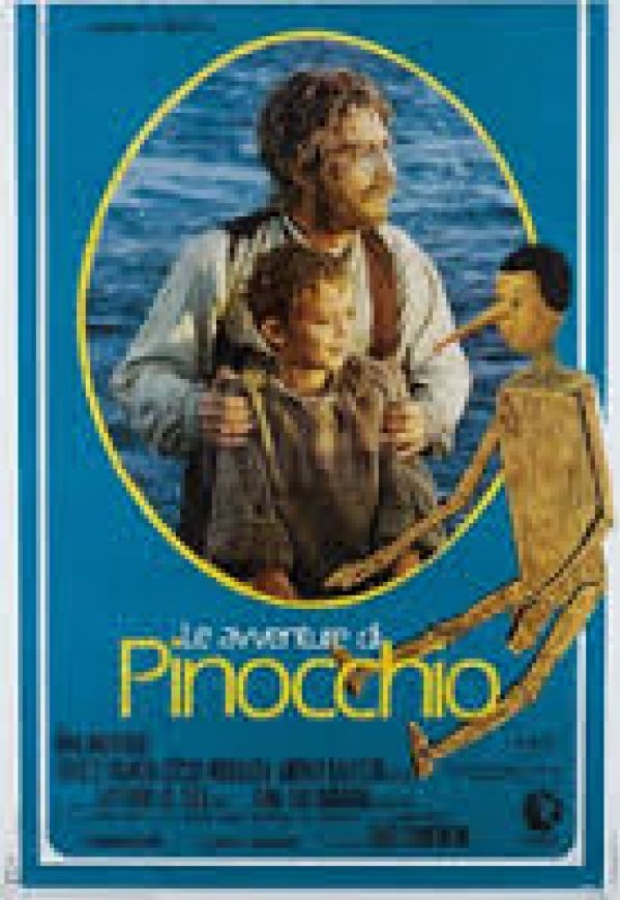
Finished reading on: November 01, 2016
The Adventures of Pinocchio
Title of the original version reviewed: «Le avventure di Pinocchio»
AI Translation Notice: This review was translated from the original Italian using artificial intelligence. Book quotes and excerpts are translated interpretations and will not match the author's original English phrasing or official published translations.
As soon as one begins reading Collodi’s book, the mind immediately turns to a masterpiece: Gianni Rodari’s The Adventures of Cipollino.
To our sensibilities, Pinocchio’s tale feels moralistic, with an underlying theme seemingly remote from us:
today (though too late!) I have had to convince myself that to earn an honest penny one must know how to make it, either through the work of one's own hands or the wits of one's own head
, so says the Parrot to Pinocchio in the Field of Miracles.
How much more amusing and captivating is Rodari’s novel, which speaks of freedom, of the struggle against the powerful, of daring imagination! And yet, looking more closely, one realizes that The Adventures of Pinocchio and The Adventures of Cipollino address the very same subject: the world is upside down, and it must be set back on its feet, onto the right path.
It is evident that Collodi’s tale is a Bildungsroman: a child, thick-headed enough to be a puppet, learns from life how to become an adult, discerning good from evil.
Yet all the characters are truly singular, beginning with Geppetto, the generous and solicitous father.
who wishes to fashion a "fine puppet" in order to
travel the world, to earn myself a crust of bread and a glass of wine
, and rightly the hidden "little voice" comments: "Bravo, Polendina!".
And what of the Fairy "with the azure hair", the loving, sorrowful mother! Why does she not help Pinocchio, leaving him instead in the dark wood, at the mercy of the assassins? Pinocchio faces his ordeals alone—ordeals he himself brings about through his refusal to abide by social norms: instead of going to school, he goes off with the puppeteer; driven by greed, he allows himself to be duped by the Fox and the Cat; he forgets Geppetto in his destitution; he promises to be diligent only to forget it all to run with the other scamps; and thus he lands in prison, narrowly escapes being fried in a pan, and eventually lets himself be hoodwinked into going to the Land of Toys, turning into a donkey.
What is it that redeems him? Good deeds.
When the fierce dog Alidoro, who had chased him in order to devour him, is about to drown, after a moment's hesitation Pinocchio saves him: for indeed,
his father had told him many a time that one never loses by doing a good deed
.
And then, as if by magic, the various characters, the animals themselves, reveal themselves to be generous and obliging.
When Pinocchio, searching for Geppetto, is swallowed by the terrible Dogfish, and there in the depths of the enormous stomach finds his "dear papa", it is a Tuna who helps them escape the mouth of the great beast: and
Pinocchio (...) planted a most affectionate kiss upon its mouth.
At this display of spontaneous, heartfelt tenderness, the poor Tuna, unaccustomed to such things, was so moved that (...) he plunged his head back under the water and vanished
.
How it came about that Carlo Lorenzini, the real Collodi,
an implacable provincial, mythically lazy, moody and unpredictable
, decided to write The Adventures of Pinocchio is a question best left to scholars.
Perhaps because, as he wrote in the sketch A Letter to Fanfulla, "being born Tuscan is a misfortune that can happen to anyone."
And it is precisely this provincial Tuscan character that breathes life and modernity into a novel that would otherwise be prudish and dull.
Far removed from lofty, formal Italian, the language infuses the tale with vigor and brio: Pinocchio is a rogue, evoking every child in the world—their yearning for play and amusement, their naive openness to others, their reluctance to be hemmed in by the tedious social rules of adults.
All of this makes the tale of Pinocchio timeless, transcending its nineteenth-century setting.
Why read it? It is the story of the child we once were.