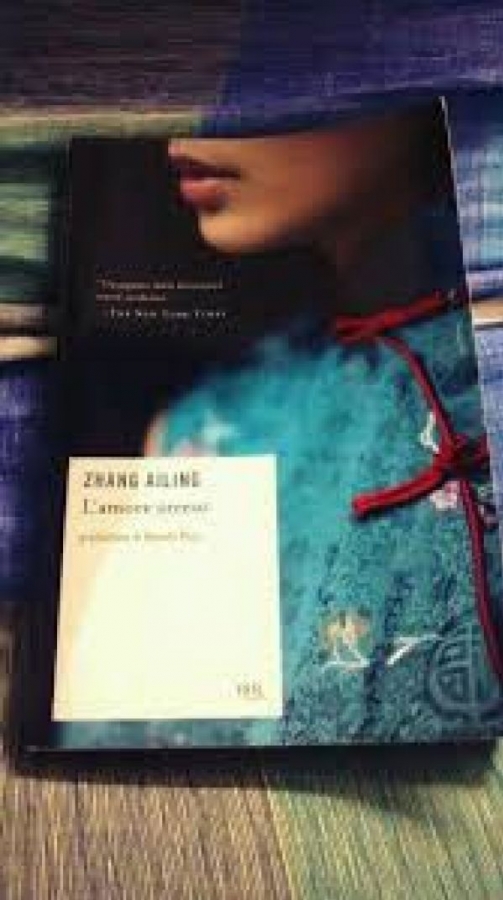
Finished reading on: April 16, 2015
Surrendered Love
Title of the original version reviewed: «L'amore arreso»
AI Translation Notice: This review was translated from the original Italian using artificial intelligence. Book quotes and excerpts are translated interpretations and will not match the author's original English phrasing or official published translations.
In an earlier novel, The Golden Cangue, the protagonist fails to escape the mechanisms of her family and descends into madness, bringing ruin upon herself and those around her.
In the first of the two stories in this book, Love in a Fallen City, Liusu is likewise despised by her relatives, but seizes the opportunity of a chance encounter to escape a house that
had something of a dwelling of fairies and spirits: here, the slow passing of a day was like the lapse of a thousand years in the world.
Yet spending a thousand years here was roughly like a single day, because all the days were equally monotonous and senseless
.
And it is boredom, not passion, that drives her—watchful and almost reluctant—to enter into a liaison with a Westernized Chinese man, a figure of dubious repute: wealthy, cultured, and refined, yet hostile to marriage.
From the outset, Liusu knows full well that binding herself to this man means becoming his concubine.
While yielding to her lover’s flatteries, she thinks to herself:
if I were a thoroughly respectable woman, you would not have noticed me at all.
Yet she smiled, tilted her head toward him, and said, You want me to be a respectable woman in front of others, but not with you
.
With consummate skill, the author guides us through the unraveling of a relationship in which
both [were] too busy talking about love; where could they find the time to truly love each other?
.
The conclusion is a foregone one: the wealthy lover accommodates Liusu in a grand, empty house, where she will await his visits like a quintessential concubine.
What overturns this destiny is the war.
The Japanese bomb Hong Kong, and amid the battered city, the man resolves to marry Liusu.
Hong Kong’s fall had sealed her victory.
Yet in this unreasonable world, who could ever tell cause from effect? Who could know? And had an entire city fallen merely so that she might triumph? In the second story,
Red Rose, White Rose
, the author ponders whether transgression and respectability can coexist within the same personality.
Zhenbao is a
rational and meticulous sort, through and through the perfect modern Chinese man.
Having started out on the right foot from the very beginning, (...) he now held an excellent position in a renowned foreign textile firm
Everything seems beyond reproach: the university-educated wife from a good family, the little daughter for whom funds have already been set aside for college tuition, the devoted care shown toward his mother and siblings, his dedication to work, and his benevolence toward friends.
Yet is that truly the case? From the story, we learn that Zhenbao had an intense, fulfilling affair with a married woman.
When his lover, genuinely enamored, confesses the adultery to her husband, Zhenbao abandons her because he realizes the scandal would ruin him.
Merely crossing paths with the woman many years later is enough to unhinge him and shatter his drab bourgeois existence: he frequents prostitutes, succumbs to drink and gambling, neglects his work, beats his wife.
And you.
Are you well?, she asked.
As he searched for the right words to summarize the perfect happiness of his life in a few simple sentences, Zhenbao raised his head and saw his own face in the mirror to the driver’s right.
(...) Suddenly, however, he began to tremble in earnest and saw in the mirror that tears were streaming down his cheeks.
He himself did not understand why.
In that sort of encounter, it is always she who weeps, not he.
(...) Far from consoling him, she fell silent for a long time, then said: Isn’t this your stop?
The author probes the ambiguity of the human soul through a markedly Western lens.
While the opening of the first story still evokes the traditional Chinese family, the remainder of the tale could easily be set in any European city.
The thematic core and the very prose of the second story echo much of Western literature, from which the author drew extensively.
There is little originality.
What continues to captivate the reader is Zhang’s mastery in navigating chiaroscuro and plumbing the depths of the human psyche, particularly the female heart.
Jiaorui and Zhenbao are in bed: the woman realizes that the man intends to leave her.
Lifting her swollen, flushed face, Jiaorui stared at him, then sprang to her feet, almost astonished herself to have been reduced to such a state.
(...) She dried her eyes with her handkerchief, blew her nose, and walked out.
(...) In his sleep, it seemed to him that someone had lain down on top of him, weeping.
(...) He realized Jiaorui had returned.
(...) The warmth of that womanly body enveloped him like a down quilt lined with silk, imparting a pleasant, intensely sensual warmth.
When Zhenbao was fully awake, Jiaorui slipped away without a word, nor did he utter a sound".
Why read it? They are short tales, the prose is fluid and graceful, and certain pages are remarkably evocative.