
And he did not even say a word
We find ourselves in Germany in the years immediately following the Second World War. The wounds of war are still palpable, physical and psychological: destruction, destitution, memories of the conflict’s horrors, and no hope for the future. Fred, a telephone operator at the city’s archbishopric, has abandoned the family home where his wife, Kate, and their children live, after catching himself venting his rage on the children, beating them. He can, in fact, no longer endure the cramped misery and desolation of the single room in which they live. Given over to drink, he roams the city and arranges clandestine encounters with his wife in squalid hotel rooms, in parks, and amidst abandoned courtyards. The story is indeed constructed around one of these meetings, through the alternating narration of Fred and Kate. In this way, it becomes possible to grasp the two different points of view: Fred’s despair and Kate’s exhaustion. Despite their mutual love, they are now divided by the different ways in which they have responded to hardship. Kate is sustained by a profound devoutness, grounded in a direct relationship with God. > God alone seemed to remain with me in that malaise that overwhelmed my heart, filled my veins, circulated within me like my own blood..... I was seized by a great indifference toward them all, and nothing remained with me but the word of God . In Fred, religion offers no comfort, but rather further proof of the falsity and vacuity that govern the world; for him, nothing remains but a dark affliction, a somber existential despair, a monotonous succession of tavern visits, hurried meals, and the desperate hunt for money, often to be spent on drink. Are they by now two strangers, or is love stronger than desolation? The novel’s conclusion leans toward the former outcome. In several remarkably powerful pages, the author brilliantly renders the sense of a growing estrangement. After a night during which Kate has told Fred of her intention to leave him, the man, locked in a mute resignation and an agonizing passivity, walks aimlessly and catches sight of a woman > no longer young, but beautiful, I could see her legs, the green skirt, the worn brown jacket, I could see the green hat, but above all the sad and gentle profile..... and suddenly I knew that it was Kate. Then she seemed a stranger to me once more..... it was she, but she was different from how I remembered her.... so we walked on, one behind the other, both thinking of the children, and I did not have the courage to catch up with her, to speak to her . The novel has been interpreted in various ways: an erotic tale, where the reader waits in suspense for the love scene between husband and wife, turned once again into clandestine lovers; a meditation on the loss of meaning in religion and, more broadly, of values after a war; the description of a battered city, where survivors wander in an endless struggle to stay alive, and thus the representation of a mutilated Germany. Toward this latter interpretation points a narrative inextricably fused with madness, visions, noises, advertisements, and the popular songs of the metropolis where the protagonists live. To me, however, it seems that the novel should be read in the simplest way. It is a love story that does not, despite everything, survive destitution, because Fred and Kate react with differing moral strength to their own desolation and to that of society. Kate still looks to the future despite a deep-seated malaise; Fred allows himself to be dragged along, with self-pitying indulgence, in an attitude of victimhood and self-destruction. The narrative plot, slender and sparse, is sustained by an exceptionally effective style. The spare yet incisive prose and the stripped-down syntactic structure are clear proof of how a complex narrative can be crafted without getting lost in linguistic redundancy. Why read it? It remains intensely relevant, capturing as it does the sense of disorientation before a society that is dissolving, while no traces of the emerging one can yet be seen.

Ebony
*The Shadow of the Sun* is a collection of notes from journeys across Africa spanning thirty years: from the independence of the continent to its more recent upheavals, such as the Rwandan genocide. The book encompasses both the nature of an essay and that of a memoir of lived experience, profoundly engaging for the author. A penniless reporter for an equally cash-strapped Warsaw daily, Kapuściński falls ill with tuberculosis and explains to the doctor that he cannot return home: “The dream of my life, working in Africa, would have vanished forever.” From this passion for travel and for Africa begins a journey across the continent: from Ghana on the west coast to the island of Zanzibar in the east, through Sub-Saharan and tropical Africa, all the way to the Horn of Africa and the Great Lakes. The reader skips along, and > everything blurs, overlaps, fades. (...) Often our memory is so saturated with names of localities, regions, and countries that we can no longer associate them with an image, a view, a landscape, an episode, or a face. (...) World unity, so difficult to achieve in practical reality, comes into being in our brains, in their layers of lost and confused memory . No differently from the superficial businessman who knows only the world's airports, fine restaurants, and luxury hotels, the inquisitive reporter risks his life to deliver the very same portrait: an Africa unchanged across time and space, and ever devoid of hope, because all corners of the vast continent are united “by the same misfortune, the same fate, and the same uncertainty.” To be sure, Kapuściński raises his voice loud and clear against “the international of predatory rabble,” just as he feels part of the “tormented life, the painful vegetating forever on the brink of death” of an oppressed and violated people, and for that reason perpetually in exile. Yet, after so many years on the road, the splendid concluding chapter, bearing the evocative and elusive title “In the Shade of a Tree, in Africa,” leaves us with a message of bitter resignation. Slavery, rapacious and cruel colonialism, the greed of ruling elites, desertification and environmental plunder, and the death and displacement of entire populations have destroyed the “shade of the tree” under which stories and traditions were once handed down: without this shade, the African > would lose every notion and even the memory of his yesterday, becoming people without a past, that is to say, nobody. Those men would lose everything that united them, scattering each on his own way, alone. Africa spans an area of 30.37 million square kilometers—large enough to contain the United States, China, India, Europe, and several other nations. It has 54 states and 1,500 languages. One cannot help but wonder why we persist in viewing Africa as a monolith, never attempting to grasp its diversity, and with it the changes and potential of this great continent. However well-meaning and observant, Kapuściński falls into the same Eurocentric and exoticizing trap that has long characterized relations between the West and Africa. From this, and not merely from the disjointed structure of the book (travel notes left as they were, without an overarching narrative), arises a sense of repetitiveness: each account seems identical to the last, personal encounters and singular stories rarely break through, while the critical assessments—agreeable though they may be—feel prepackaged. In *Orientalism* > Edward Said argued that the West sees the Orient as a mirror of itself: it seeks what it fantasizes the Orient to be (a cherished idea, sedimented across its history) without genuinely studying the peoples and cultures that make up the Orient of today; through this very same process, we view Africa: it is always *Heart of Darkness*", a land vibrant and fascinating, to be sure, but forever detached from modernity and consequently doomed to subjugation, to endure unspeakable suffering from which it cannot escape. Why read it? It is worth it for the final chapter.

Echo Mountain (The Echo Girl)
We are in Maine in 1934: in the wake of the Great Depression, a family has had to leave the city and relocate to the foot of a mountain, on the edge of the forest, adapting to life in an environment entirely foreign to their urban past. The mother confesses to her daughter Ellie, still an adolescent: > she looked at her ruined hands. I feel like a stranger in this new skin. I left behind too much of who I had always been. Ellie, by contrast, is fascinated by this new life; she wants to understand and adapt. In this she has been helped by her father, a vital anchor for the young girl. > This bond with my father and the wilderness drove a wedge between me and my mother, and especially my sister, because both seemed to think that I had somehow betrayed them by feeling happy when they were not. To understand what the "mountain’s echo" represents for the girl, one can point to the episode of her encounter with the bear. > But then I made the mistake of reading, in his eyes, that primitive quality I so admired. Of sensing, in him, a love for things I loved: lying in a meadow with the grass growing tall all around, hiding from everything except the sky and swarms of bees, heavy with flower pollen, nodding toward me (a splendid turn of phrase!) bobbing the way bees fly. Or the pink of the sunset. Or the clear whisper of a wood thrush. We are in the throes of a full romantic idealization of nature! In Ellie, contradictory feelings coexist: an aching loneliness because she no longer feels part of the family, and a sense of freedom in an environment where she can roam, exploring the forest, learning to harvest honey, and doing practical chores under her father’s guidance. This precarious situation unravels when her father suffers a grave accident that leaves him in a coma. Ellie takes the blame upon herself, concealing the truth of what had happened: it was her little brother who, chasing a rabbit while the father was sawing a tree, caused the man to move, leading him to be struck by the falling trunk. > Part of me wanted to tell her that it was Samuel’s fault (the little brother), if the little boy could be blamed for anything. But when I thought of saying those words, I felt fragile and sad. (...) I decided that shifting the blame would be worse than shouldering it. If I had learned anything from the mountain, and from my father, it was that I would feel stronger and happier if I were able to face adversity and do it well. So I remained silent. And they took the silence for a confession. How will Ellie overcome the anguish that overwhelms her: the estrangement from her mother and sister, the sight of her paralyzed father, the strained relationship with her little brother, the arduous life in the wilderness, the material hardships of an impoverished and isolated family? She will do so by venturing into mysterious nature, uncovering its magical and salvific secrets. It is certainly a *bildungsroman*, though it must be said that Ellie appears to be a strong, resolute girl right from the outset. It is as if life’s hardships and the forces of nature merely brought out something Ellie already possessed. What weighs upon the entire narrative, rich in characters and adventures, is the banal depiction of a benign nature—the dream of an escape from urban and industrial life. It is too easy! The woods, the mountain, the wild animals are not friends, but primordial forces answering to the blind laws of the primitive world. Ellie ostensibly sets out to discover her new surroundings; in reality, the latter are merely a mirror of what we romantically daydream nature to be. To understand the novel’s limitations, one must turn to *Treasure Island* (see review on this site), where Jim faces dangers alone, evades the allure of evil—which exists regardless of what we might think—and in doing so truly comes of age. The writing is elegant, alternating tight dialogue with fine descriptions rich in musical and captivating phrasing. Across too protracted an expanse, the plot frays, grows prolix, and loses the sharpness of the opening chapters. Why not read it? It is banal.

Siberian Education
Nicolai Lilin comes from Transnistria (a no man’s land between Moldova and Ukraine) and writes in Italian. He belongs to that cohort of immigrant authors who are making a significant contribution to the renewal of our literature, so often bloodless. And indeed, the novel overflows with energy, with a vitality and brutality barely kept in check by the canons and formative paths generated within the communities of origin, beyond and outside the State. The narrative opens with a few intense, harrowing pages. We are in Chechnya and the Russian soldiers are exhausted: “we kept going like water waves.... we fought always, always.” And precisely where respect for rules and hierarchy should be paramount, a soldier, > as soon as the captain turned his back... with an insolent look on his face, shot the prisoner in the head and chest. He was sleepy and tired, like all of us . There follow two long chapters, “The Hat and the Knife” and “When the Skin Speaks”, in which the author describes, with anthropological meticulousness, the rules of coexistence and the modes of communication of the Siberian criminal community, which had been forced to relocate from Siberia to Transnistria. A profound nostalgia for a world, whether real or merely envisioned, forcefully emerges: > I knew for certain that I was living through the death of our society, and so I tried to survive, passing through this great vortex of souls, of human stories, from which I drifted further away with each passing day . A narrative that still imparts a sense of security (just as in territory ruled by the mafia one feels protected from petty crime) is followed by two chapters in which the clash between gangs devolves into pure violence. In “The Day of My Birthday”, the protagonist, along with a friend, must deliver a message to a representative of another criminal community. It is a simple errand, yet it translates into clashes, fights, ambushes, all set against a degraded urban landscape abandoned to itself. And where coercion, promiscuity, and corruption prevail, as in “Juvenile Prison”, violence turns into moral, physical, and sexual subjugation. From the outset of the next chapter (the decisive one in the protagonist’s coming of age), one might expect a glimmer of hope, and perhaps of love. Ksjusa is a fragile autistic girl, protected by the Siberian community both as a woman and on account of her disability. Yet she falls victim to a gang rape, and the hunt for the rapists begins: a protracted chase through every district of the city leading up to an inexorable, bloody vengeance. Yet for the young protagonist, it is > impossible to feel peace. It was right to punish them for what they did, but by punishing them we didn't help Ksjusa. What still tortures me is her pain, against which all our justice proved useless . The epilogue is “a free fall”. It seems the protagonist has managed to carve out a different future for himself, outside the criminal community. Until, forcibly conscripted into the Russian army, he finds himself sucked into a new spiral of violence. Yet here is where one realizes that what is truly needed in life is a Siberian education. It is unclear how much of the novel is autobiographical and how much pure invention. Certain gang battles recall those recounted by other contemporary Russian authors, such as Elizarov in *The Librarian*, just as the sexual violence in the juvenile prison relies on common tropes of prison life, and some descriptions in this context are decidedly pornographic and overwrought. Yet whether fact or fiction matters little. The message is clear: the fragmentation of modern society, whose rules of coexistence seem increasingly rooted in kinship communities and clan logic rather than in state institutions. In this descent toward a medieval world, there are rare moments of serenity: the relationship with nature (the fishing scenes are the most evocative), camaraderie among peers, the connection to the wisdom of the elders, the adherence to rules and rituals. It is an anti-Enlightenment world that turns inward on itself. The painstaking description of the rules and the various criminal communities, the repetitiveness of episodes that ultimately become predictable, the deficiency in narrative pace and in character depth—characters who remain, at bottom, stereotypical and often indistinguishable—are all factors that make the reading tedious. One struggles to reach the end of the novel. Why read it? It prompts reflection on modern society, but it fails to captivate.
The Paseo de Gracia
Eugenio is a well-known Italian set and costume designer living in Los Angeles. A phone call from Italy takes him back to the origins of his career and to the figure of Olga. Many years earlier, when he was still in Italy, Eugenio had had an affair with a friend of his wife, namely Olga: > petite, pretty, dark-haired, with fringe and kiss curls à la Louise Brooks (...) she had an elusive, ambiguous gaze . Eugenio loved his wife, an intelligent, cultured, and refined woman, yet he was captivated by the repetitive cadence of the encounters with his mistress: a long period of indifference, a furtive, silent, violent, swift coupling, and then indifference once more, as if nothing had happened. What is the appeal of a betrayal so barren of eroticism and sentiment? > Eugenio felt superior to Olga, (...) to the point of taking pleasure only if he risked—oh, with impunity!—the charade of pretending to be inferior and worshipping her as though she were truly his superior (...) (yet) Eugenio always knew that Olga was a wretched slave . It was the pleasure of deceiving himself, even if only for five minutes (the duration of the coupling), that was the trigger of Eugenio’s desire; he who, in his selfishness, relished the thought that Olga deluded herself into believing she was the mistress, knowing all the while that it was merely a game. Naturally, this was not the case: the woman had no desire to be the futile occasion for the man’s outsized ego, for a "double lie" perpetually identical to itself. > Eugenio never noticed, and found it convenient not to notice, or even suspect, that she too might possess a soul, might even, in the long run, begin to care for him . Olga fled, vanishing without a trace, yet she lingered in Eugenio’s fantasy: the aspiration of a subject woman who becomes sovereign for a few minutes. The novel resumes "in the present." Eugenio has returned to Italy to shoot a film, but his stay in Europe is nothing other than a search for Olga. And when he must travel to Barcelona, where the woman is rumored to live, Eugenio repeatedly walks down El Paseo de Gracia in the hope of crossing paths with Olga, who, > strangely, miraculously, would appear to him identical to how she had been fifteen years before: with her sleek helmet of hair à la Louise Brooks, her silly yet sly little face, her pouty smile . And he would have said to her, > with the greatest possible composure: Of course it is all over. But... but perhaps, we could try once more... just once . The backdrop is the marvelous yet hollow world of cinema. The author also develops a series of intrigues, intended to impart at least some narrative pace to a plot composed essentially of sensations and reflections. A primary layer of meaning in the novel lies in the depiction of transgression, all the more captivating the further removed it is from ordinary life. As the author observes, > long periods of abstinence (...). Then, a sudden, subtle awakening of desire, but, for a few days, merely a distracted reminder, a seemingly harmless memento. Finally, all at once, a restlessness that gave him no peace (...) And everything repeated itself more or less as it had the time before . There exists, moreover, a deeper, existential and philosophical key to the text, aptly expressed by the passage on the obsession with tiles. Eugenio sees the same pattern continually repeated across the bathroom tiles, yet with endless subtle variations. Viewing the tiles from different vantage points, two recurring figures emerge: the Bravo, who could be recognized > always in profile, his coarse, heavy hooked nose immediately visible, his cruel mouth, the piercing eye of a stalking beast; and the Soubrette, a small and graceful little face (...) with her delicate little mouth smiling in turn . The Soubrette was the Bravo reversed: the dominator can become the dominated, the violent the docile, and so forth; in varying circumstances, we can all be both at the same time. Already in *Lo Smeraldo*, a visionary novel, Soldati explored the theme of the double by resorting to the device of the dream. Do other worlds exist within us? In the more traditional *A cena col commendatore*, he returns to the complexity of the human soul: the mask behind which we hide is not an artifice, but an intrinsic part of consciousness. In these two novels, the narrative is sustained by the prose; in the former, D’Annunzian and lavishly imaginative; in the latter, simple and reminiscent of the nineteenth century. In this book, by contrast, the style is fractured, laborious, verbose, poorly sustained by a slender and inconclusive plot. Why avoid it? It does not do justice to Soldati the writer. It marks a decline in quality.

Elias Portolu
Upon picking up this novel by Grazia Deledda, one's mind immediately turns to *Canne al Vento* (see the review on this site), hoping to rediscover the same magical atmosphere of the Sardinian author’s masterpiece. The environmental and social context is the same; here too, pain is treated as destiny, life as a journey toward death, yet that living, magical, and indecipherable nature—the hallmark of *Canne al Vento*—is missing. Instead, the Sardinian landscape serves as a counterpoint to a human drama irremediably doomed from the outset. This is how the author describes the *tanca*, the land set aside for pasture. > The lush pastures, as spring drew to a close, took on a luminous, golden green: thistles opened their golden and purple blossoms, brambles flaunted their wild roses. (...) In certain places, the watercourse flowed among groves of elder trees, where the sun barely penetrated, forming mysterious green pools surrounded and intersected by rocks, against which the water broke murmuring . Petrarch’s verses seem to echo here, yet we are not in Provence; we are in harsh, savage, ancestral Sardinia. It may well be that the verdant, luminous *tanca* is not real, but rather a delirium of Elias Portolu, a way to bring solace to a restless soul. Unlike his brothers and his father, "short, sturdy, bearded, with bronzed faces and long black hair," Elias "was tall and slender, with an extremely pale, delicate, clean-shaven face." He has returned from the prisons of the Kingdom, and this experience has transformed him profoundly, physically and spiritually: > the long imprisonment had made his hands and face pallid, (...) his laugh was tired and fractured, his voice faint; (...) he looked like a woman dressed as a man. Furthermore, his language had taken on something peculiar, half Italian and half dialect, with curses that were entirely continental . In prison he learned to read and write; he brought back church books with him, which he studies in secret. "Confused visions" sway through his sleep. In his dreams, it seemed to him that > strange sheep with human faces leaped over the wall that enclosed the *tanca*; and he pursued them, panting . When a man comes toward him. It is Uncle Martinu, a sort of giant whom everyone calls the father of the forest. To him, still in his dream, Elias confesses that he is weak, that he can take no more. And with his mighty voice the giant tells him, "if you don't want trouble, go become a priest!" And it is to Uncle Martinu once again that Elias turns, no longer in a dream, when he realizes he has fallen in love with his future sister-in-law, the beautiful Maddalena; he rejects the old man's counsel to openly declare his love, fearing he might offend his brother, shatter a marriage arranged long ago by the families, terrified of scandal, lacking courage. But > unfailingly, Maddalena appeared to him in dreams. And they were dreams that troubled and painfully aroused him. Above all, the scene of the dance with Maddalena returned incessantly in his dreams, > for his shoulders, his waist, his hand retained intact the physical impression of Maddalena’s body and hand: and his mind, recollecting her words, lost itself once again in a vertigo of pleasure and anguish . His pusillanimity will be his undoing, and it will be up to Death to decide for him. Before the lifeless little body of the child had with Maddalena, he will feel "a tenuous veil of peace and almost joy descend," alone and free from all human passion. If we look beyond the Sardinian context, the figure of Elias is emblematic of those unable to break out of society’s constraints, of unwritten rules of which he is, in fact, a prisoner. How difficult it is to voice one's feelings and be authentic! Reaching perhaps beyond Grazia Deledda’s own intentions, there appear to be three worlds in the novel: the simple world of the common folk who accept death and suffering with resignation, and who would be ready to acknowledge the love between Elias and Maddalena; the hypocritical and superstitious world of religion, which represses feelings while tolerating petty carnal sins provided they remain buried beneath a blanket of silence; and the figure of the wild sage, who does not believe in God and urges courageous choices. It is an interpretation that would make the novel compelling, were it not engulfed by a melodramatic and penitential tone. Why not read it? Melodramatic and mawkish, a disappointment.
Emma
Emma is a young woman, determined, independent, but inclined “to think a little too well of herself.” She lives in a small English country town with her father: a frail widower, fearful of novelties and above all of being abandoned by his adored daughter. Then again, why marry? > If I were to fall in love, indeed, it would be a different thing! But I have never been in love; it is not in my way or in my nature; and I do not think I should. And, without love, I am convinced that I should be a fool to change such a situation as mine; (...) and never, never could I expect to be so truly beloved and important; so always first and only in any man’s eyes as I am in my father’s . It is not merely pride and the desire to be mistress of herself; it is also her ideal of a husband: high integrity, adherence to truth and principles, contempt for deception and pettiness. Will she remain faithful to these criteria, so confidently asserted and lived? In part. The story begins with the decision of her governess, Mrs. Weston, to marry and leave the house where she had been in service for so long. While her father is distraught, for Emma it means losing the only person in whom she could confide, the only one who managed in some way to restrain the young woman’s temperament—sensitive, reflective, yet also headstrong and determined to impose herself upon others. There is also her brother-in-law, Mr. Knightley, who has known her since childhood, but with him it is a continuous bickering, a perpetual clash of differing perspectives. Emma meets Harriet Smith, with whom she strikes up an intense friendship. But if > Mrs. Weston was an object of respect, based on gratitude and esteem, Harriet would be loved as one to whom she could be useful. For Mrs. Weston there was nothing to be done; for Harriet, everything . Harriet possesses no dowry and comes from a low social class, but that is no reason she must demean herself by marrying just any suitor! With a healthy dose of presumption and recklessness, Emma persuades the docile Harriet not to marry Martin (a humble tenant farmer!) and to set her sights on the hand of Mr. Elton, the vicar of the small town. When Mr. Elton, rejected by Emma herself (why, then, was he the right husband for her friend?), marries a vain and shallow girl who nonetheless brings a handsome fortune, Emma consoles Harriet, pointing out to her that Elton was not such a reliable man after all. Two new characters appear: Jane, a beautiful but ailing young woman who comes to live with her aunt and whose only prospect is to become a governess in wealthy households; Frank, the son of Mrs. Weston’s husband, who resides with a rich and overbearing aunt. Emma attempts to befriend Jane (another young woman to manage?), but is somehow rebuffed and kept at a distance. During the few days he spends with his father, Frank manages to pay court first to Emma and then to Harriet. Although Emma, initially flattered and intrigued by the young man, senses that there is something false in Frank’s conduct, it seems Harriet’s turn has arrived—at least so Emma thinks, and she convinces her friend accordingly. In vain does Mr. Knightley warn her, pointing out Frank’s weak character, but once again Emma stubbornly disregards her friend’s far wiser judgment. It is precisely during one of these conversations, often punctilious and contentious, that a premonitory incident occurs. > With a slight movement, quite unlike ordinary friendship, (...) Mr. Knightley took her hand; whether she had not herself made the first motion she could not say; she might, perhaps, have rather offered it . Frank’s aunt dies, and the young man, freed from constraints, confesses that he was secretly engaged to Jane and that his alleged courtship of Emma and Harriet had merely been a ploy to divert attention from the true object of his affections. Hence the cause of Jane’s distress: the false position in which she found herself. Emma feels sorry for Harriet and realizes she was mistaken once again in her assessments, but she is deeply offended by the conduct toward Jane, who was forced to submit to deception through Frank’s lack of courage and dignity. On the other hand, > it might well be said that the world does not belong to woman; its rules are not hers . For Emma, there is a surprise. When she goes to inform Harriet of the affair, she discovers that her friend is in love with Mr. Knightley and is convinced that her feelings are reciprocated. Emma ought to be happy; why then does she feel a sense of pique, of subtle jealousy, of the loss of the beloved object? > What blindness, what madness had led her on! It struck her with the force of overwhelming misery! Emma discovers that she loves and has always loved her friend; great then is her joy when Mr. Knightley, at first diffidently and then with growing assurance, confesses that he loves her too and wishes to marry her. But is Harriet deceived once more? No matter: through a subterfuge, Emma dispatches her to London to stay with her sister, so as to get her out of the way; and then, when she must finally face her, she learns that Harriet had deceived her all along, having never stopped loving Martin, whom she had continued to see in spite of Emma. All ends well, but what remains of the independent and proud Emma? She will live with her father and Mr. Knightley, withdrawing into the domestic sphere typical of a woman. Even female friendships, particularly that with Harriet, will dwindle into mere superficial acquaintances; it is difficult to sustain them when one loves a man. It is a highly intricate novel, perhaps overly long and complex, in its plot as well as in its writing. The core remains female independence, with certain distinctive elements compared to the author’s other novels. While in her other books the setting—the small town, the early nineteenth-century petty bourgeoisie, the English countryside—serves as a backdrop, here it occupies the center of the narrative. One need only consider the second volume: the superficial conversations, the drawing-room gatherings, and the country outings portray a shallow, prudish society, intensely preoccupied with appearances and fortunes. It is like reading Marcel Proust’s *The Guermantes Way* and, as in this volume of the *Search*, the endless dialogues are equally tedious, verbose, and inconclusive. Another aspect that links the novel to Proust’s work is the theme of the discrepancy between what is imagined and reality. “Myself creating what I saw,” Mr. Knightley quotes at one point; and indeed Emma imagines situations that prove to be quite different from those spun by her fancy. Addressing Harriet, Emma exclaims, “Good God! how have I never seen her!” The story unfolds slowly, devoid of narrative pace, lacking in action. Dialogue predominates, frequently repetitive. Only intermittently are the characters explored in depth; they all revolve around Emma, yet without completing or explaining her. The syntax is extremely arduous and convoluted, as though the author wished to showcase her prowess in writing and her mastery of “cultivated” English. Why read it? It is worth reading if one wishes to gain a comprehensive view of Austen’s splendid characters; otherwise, it is better left unopened, for it is long, difficult, and prolix.
The Enchantress of Florence
We are in the East, in the magical empire of Akbar the Great. > If the war-torn world was a hard truth, then Sikri (the capital of the empire) was a splendid lie . It is a magical world where the mystery of the great sovereign "enchants all the earth, and the future, and all of eternity." Into this wondrous land arrives a traveler hailing from the West, who calls himself Mogor dellʼAmore. He enchants the sovereign and the entire court with tales of an incredible city, Florence: > for him knowledge was of no use, except to remind him of what should never be forgotten: that sorcery requires no potions, familiar spirits, or magic wands. Language made of silver words is enough for enchantment . Mogor dellʼAmore tells of three young Florentines: one of them leaves his native city in search of adventure and becomes a great general in the Ottoman army. In a war against the Persians, he meets a princess who becomes his bride. With this woman he returns to Florence to become the captain of its army. This princess is "the enchantress of Florence," who uses her magical powers to bewitch the entire city. Yet the boundary between sorcery and enchantment is exceedingly tenuous, and soon superstition is unleashed against the woman. What a contrast between the magical world of Sikri and the paltriness of Florence! The princess flees to the New World, but > her magic was no longer strong enough to help withstand temporal forces, just as it was not powerful enough to alter the geography of the earth. No middle passage was found, and she found herself trapped in the new world until she chose to die . Yet even the magical world of Sikri must vanish to yield to the force of reality. > I have returned home after all (said the princess to the great emperor), you allowed me to return, and so here I am, at the end of my journey. End until you are not, said the great regulator of the universe, my love, until you do not exist . Everything can exist within the imagination, even beyond time; nothing can survive in reality. With an imagistic and baroque style, the author narrates an incredible, entirely fictional tale that nonetheless, beneath the tone of a fairy tale, develops three arguments: a) the East is superior to the West, insofar as the East gives expression to the wealth of the imagination; b) fantasy is an enchanted realm that allows one to achieve perfection; c) the movement of history from East to West (from Sikri to Florence, and ultimately to the New World) corresponds to a slow, inexorable decline of civilization. The individual words and the phrasing captivate the reader, yet the events are too implausible and, at the same time, excessively real to enthrall and convince. The digressions—which appear to stem more from a brand of literary narcissism than from the requirements of the plot—encumber the novel, rendering it prolix. Why not read it? Certain pages are delightful, the premise of the book is intriguing, yet it is too fragmented and long-winded to make the overall reading experience genuinely compelling.

Enduring Love
Like much of McEwan’s fiction, we are confronted at the outset with an extraordinary event (in this case, the death of a person falling from a hot-air balloon) that brings profound upheaval to a life that seemed quiet and settled: the couple’s relationship enters a crisis, an undercurrent of paranoia and instability emerges within the protagonist, and his professional choices are called into question. And up to a point, the novel follows this trajectory, with some truly fine and effective pages on the breakdown of the marital bond; it almost seems as though everything the protagonist endures (in particular, his harassment at the hands of a religious fanatic) were a figment of his imagination, the result of an increasingly pronounced depressive and paranoid spiral. The protagonist discovers himself to be different from who he thought he was. Then, just as the story seems to have reached an impasse, a happy ending emerges—almost worthy of a detective story—but along with it comes the reader’s disappointment. McEwan writes very well, in an English that is simple, fluid, and yet richly expressive: individual pages are remarkable, the whole somewhat less so.
Aeneid
The poem recounts the journey of Aeneas toward Italy and the war he was forced to wage > so that he might found his city and bring the Penates into Latium, giving rise to the Latin race, the Alban fathers, and the lofty walls of Rome (Book One). The poem is divided into two parts. The first, which chronicles his wanderings until his arrival on the shores of Latium, adopts the structure of the *Odyssey*, while the second, recounting the clash with the Latins, takes the *Iliad* as its model. The poem is remarkably complex, as several interpretive keys coexist and overlap. First and foremost, the *Aeneid* is the song of a preordained destiny: laying the foundations for the building of Rome. To this grand design all must submit, mortals and gods alike. Unlike in the Homeric poems, the dynamic unfolding among the gods—and in particular the clash between Juno, Aeneas’s nemesis, and Venus, the hero’s protective mother—is only apparent. In the final book, the twelfth, Jupiter addresses Juno: > What shall be the end, my wife? What remains? You well know, and must know, that as the tutelary deity of his homeland, Aeneas belongs to heaven and is raised by the fates unto the stars. What do you seek? With what hope do you cling to the icy clouds? The *Aeneid* is the epic of human history (in philosophical terms, one might say of Being becoming manifest in history) rather than that of individuals. Beneath providence, however, life quivers, yearning to break out into the open. Disrupting the established order are, above all, the female figures: Dido; the Trojan women who refuse to journey on; Amata, mother of Lavinia, the bride destined for Aeneas; Camilla, the warrior woman; and Juturna, sister of Turnus, the foe doomed to succumb. These are women who reject destiny with a furor that swells and spreads through a progressive loss of control, culminating in self-destruction. Amata’s fury is portrayed by Virgil through the famous metaphor of the spinning top (“as, driven by a lash, a top spins wild” in Book Seven), while Dido’s cries rail against the betrayal of love and trust: > Did you hope, then, to conceal such villainy, you traitor, and slip away in silence from my shores? Can neither our love, nor the hand you once pledged me, hold you back? Nor Dido, doomed to die a cruel death? . (Book Four); and Juturna, who, acknowledging her powerlessness to save her brother, begs to die, though immortal herself: > But what joy can remain sweet to me, brother, without you? Is there an abyss deep enough to open for me, plunging a goddess down into mortal depths? Having spoken, amid long moans, she veiled her head in her azure mantle and hid herself in the river’s depths .(Book Twelve). Aeneas himself at times steps outside his role as a hero obedient to duty, revealing an individuality of his own. When Vulcan gifts him a splendid suit of armor, already emblazoned with Rome’s future exploits, Aeneas behaves, at last, like any other human being: > All this Aeneas admires upon the shield of Vulcan, given by his mother, and, ignorant of the events, delights in the images, shouldering the fame and the fates of his descendants (Book Eight). Another major, and strikingly modern, theme is war. Virgil, unlike Homer in the *Iliad*, lingers over the cruelty of war, not least through a meticulous description of the wounds inflicted upon bodies by the warriors’ blows. Yet what is compelling is that the war is framed as the consequence of King Latinus’s weakness; though conscious of the need to ally with Aeneas and welcome him as a son-in-law, he retreats into seclusion, allowing events to run their course. > Swept away by the storm, at the mercy of fate, alas, we are. For all of this with sacrilegious blood, he cries, you, you, wretched men, shall pay the forfeit. For me quiet approaches: in sight of the final haven, a happy death will strip me of all things. He said no more, shut himself in his palace, and abandoned the reins of events . (Book Eight). War is always brought about by the weakness of those who desire peace yet cannot bring themselves to resist. The primary interpretive key—that of the fulfillment of an already written destiny—is so dominant that it often renders the reading heavy and tedious. The translation by Mario Ramous is splendid, just as Gianluigi Baldo’s commentary is deeply compelling. Why read it? It is well worth it for the delineation of the female figures and for certain seemingly marginal episodes, such as the heroic friendship of Nisus and Euryalus.
Heinrich von Ofterdingen
> When numbers and figures are no longer the key to every creature, when those who sing or kiss know more than the learned, when the world returns to free life, and returns into the world, when light and shadow unite once more in authentic clarity, and the eternal tales of the world are known in fables and poems, then before a single secret word, absurd existence will vanish . These verses express “in the sweetest way the spirit that animates” Novalis’s book: a spiritual journey, even before a physical one, leads a young man to understand how only poetry can synthesize the dichotomies that trouble the world (good and evil, light and shadow, peace and war, man and nature); at that point “freedom will break through,” yet with it an existence will come to an end—one that holds meaning only in the perpetual search for balance with itself and with the world. A contemporary of Goethe and Kant at the height of the Enlightenment, Novalis is a restless soul who remains unsatisfied by truths old and new alike. To express this longing for something else, the author imagines that in medieval Germany the young Heinrich embarks on a journey from his father’s house to that of his mother's parents—from a cold, industrious, and mundane Thuringia to a warm Swabia, full of allure and passion. In a propitiatory dream, Heinrich finds himself immersed in a magical nature, in which > new images, never seen before, (...) seemed like a dissolution of alluring maidens. (...) A sweet slumber overcame him, (...) What drew him, however, was a tall, luminescent blue flower, (...) this began to stir and transform; the leaves grew more radiant, (...) the flower leaned toward him, and its petals revealed a wide blue corolla in which hovered a tender face . What does the blue flower represent, unattainable yet all-encompassing? An expectation, which can only be defined through the various stages of the journey and its characters: the merchants who accompany him, taking him under their wing and telling him fantastic tales; the crusaders with their exaltation of war; the young Eastern slave girl and the injustices she suffered; the miner who reveals to him the complexity and grandeur of nature; and finally the hermit, whose wisdom demonstrates that inner peace can be achieved only in solitude. In each of these episodes and characters, an ambivalence of opposing sentiments and contrasting situations still lingers: the spirit has not yet reconstituted itself into unity. This occurs upon his arrival in Swabia, where Heinrich not only encounters love—the young Mathilde—but, above all, listens to a long fairy tale. Rich in mythical and symbolic motifs, in oneiric and speculative digressions, the tale begins with the destruction of celestial harmony at the hands of the King’s scribe—a sordid personification of the intellect. The scribe has seized dominion over the world, ridding himself of Sophia (wisdom) and Eros (love). It will fall to Fable, the personification of poetry, to restore peace and order to the world, uniting Eros and Sophia, love and wisdom. > The handsome stranger will not tarry long. Warmth approaches, eternity begins. (...) The cold night will depart from these realms only when Fable claims her ancient right. (...) Founded is the realm of eternity; in love and peace the struggle ends, the long dream of sorrow is passed. Sophia is, for eternity, the priestess of hearts . The work is neither poetry nor prose, but stands at the threshold between the two literary genres; it is an early and unfinished work, as Novalis died in 1801 at only thirty years of age. It exerted a profound influence on German literature as a harbinger of Romanticism, through its intense and evocative style and its near-pantheistic conception of nature. Beyond these considerations, what endures of such a unique work? Precisely its core message: namely, the idea that without deep feeling, it is impossible to bring harmony to the World. For instance, what is missing today from the European Union—a complex yet successful institutional construct, given that it has secured peace for Europe? Precisely the lack of a vision, of grand aspirations—in short, of poetry. Solidarity and wisdom are not enough to tear down nationalistic barriers unless sustained by a powerful idealistic drive. Rich in poetic digressions, Novalis’s work often loses itself in heavily philosophical dialogues and narratives; all of this drains the overall narrative of its momentum, often reducing it to meditations on the world and life. So immense is the urge to say, and so pervasive the reliance on myth, symbols, and even the esoteric, that the lengthy fairy tale—the central pivot of the book—proves difficult to comprehend in all its narrative and expressive ramifications. Why read it? It is brief, fascinating, and offers abundant food for thought.
The Equation of the Heart
Massimo, an elderly retired mathematics professor, lives in solitude on an island in the Gulf of Naples: he lost his wife Maddalena a few years ago; his daughter Cristina married a wealthy northern entrepreneur and only returns in the summer for a brief stay, accompanied by her eight-year-old son, Checco. In dreams, Massimo imagines telling his wife about the fruit trees and > that sea bass and grey mullet could be caught from the rocks year-round, whereas striped seabream and gilthead bream only in spring. (...) Maddalena, whose voice was so low that it was strange it could even be heard amidst the blowing of the wind and the cries of the seagulls , would ask him about Cristina, and the old professor would reply that he had so much to do and, above all, could dedicate himself to mathematics, > follow the cyclical waves of the sea and calculate their variables with the wind and the moon ; and Maddalena, before fading away, would remind him that behind a daughter, even an adult one, "one must see a child that never ends." The state of bliss in which the old professor seems to live is abruptly shattered by a telephone call announcing the death of his daughter and son-in-law in a car accident, in which Checco was also involved and is now in hospital in critical condition. Massimo is forced to leave his earthly paradise and travel, reluctantly, to a cold and foggy northern town. For a while, the narrative seems intent on exploring industrious provincial Italy, with its undercurrent of intrigue, gossip, and tedious, fragile affluence; then it takes the path of Noir, albeit grafted onto a story that has little of the classic "mystery" about it. The book's true theme lies elsewhere: how to reconcile rationality and feeling? A rational approach would dictate ending Checco's life when faced with the prospect of the child remaining in a coma or emerging severely disabled. And so the professor would do (he could return at once to his earthly paradise!) were it not for the furious intrusion of Alba, the child's nanny. > Who the fuck are you, useless hermit, not even knowing how much he loves you...? (...) Massimo stood motionless where he was, in the exact same position. Suddenly he felt cold, an immense cold. (...) Yes, perhaps I didn't take something important into account, doctor . Alba's outcry, in its primal and boundless love, compels the old professor to react. He does so in his own way. He must understand why a seemingly flawless order—a constellation of affluence, social prestige, and strong family ties—shattered, leaving Checco on the brink of death. "Tomorrow I leave, if there is nothing for me to understand." It remains unclear whether the old professor wishes to investigate the causes and dynamics of the accident out of genuine empathy, or whether he does so merely to identify a rule that might "render the disorder intelligible," bringing peace to his mathematical mind. Dear professor, there is not always a relationship of cause and effect; at times it is impossible to find a method that lends equilibrium to human beings; often emotions burst in unbidden where reason would have it otherwise. In the final chapter, de Giovanni cites Paul Dirac's equation, erroneously dubbed the equation of love: it supposedly indicates that two particles that have interacted with each other for a certain time will continue to do so even after they have been separated. It is like saying that bonds of love are destroyed and do not evolve, insofar as two people who have loved each other are indissolubly linked. In reality, the physicist Dirac's equation states the opposite: it describes the motion of a free particle that interacts neither with external fields nor with other particles. It is disheartening that a writer like de Giovanni resorts so superficially to an urban legend used to sell tattoos to lovers; nor is it clear why he should do so, foregoing a deeper exploration of the story of an old hermit discovering his daughter's true personality and finally grasping his profound bond with his grandson. The novel is very well written; the narrative flows pleasantly and smoothly. The first fifty pages possess great intensity; thereafter, the plot unfolds laboriously, almost as if the writer had lost his direction. The shifting of the narrative voice, increasingly frequent over the course of the story, and the recourse to conversations with the comatose grandson are devices that demonstrate de Giovanni's storytelling skill, but they also expose the structural weakness of the narrative: it does not hold up if left to its natural evolution, neither as a Noir nor as psychological analysis. Why read it? It is enjoyable.

The Legacy of the Goddesses
> The Kopanice region lies on the border between Moravia (the south-eastern area of today’s Czech Republic) and Slovakia, comprising various villages scattered across the slopes of the White Carpathians. Si tratta di una regione che ha pienamente conservato le sue tradizioni folcloristiche, anche perpetuate in una forma arcaica, soprattutto perché è un luogo quasi isolato dal mondo circostante . The women called goddesses are > subjects who possess, according to widespread belief, specific abilities enabling them to heal illnesses, to see the past, to foretell the future, and to uncover information generally inaccessible to ordinary people . So read Gestapo documents, intent on confirming the theory that a remnant of Germanic population had survived in Moravia, thereby justifying the Third Reich’s claims over Central Europe. It is not political motives, however, that prompt Dora, a young ethnography researcher, to study the goddesses. She herself was raised by a goddess, her aunt Surmena, ever since discovering—still a child—the body of her mother, hacked to death with an axe by her father. > For a long time, she had thought that this was the origin of all her suffering. But that was not true. (...) Dora was not stupid, and the stricken faces of the villagers spoke clearly: her and her brother’s misfortune had begun much earlier, at a time that her short memory could not recall . With the resolve of a scientist and the tension of someone personally implicated, Dora retrieves and scrutinizes archival documents, tracing back the course of history: from the witch hunts to the meticulous Nazi investigations, right through to the socialist era, with its rationalistic and conspiratorial theories. She does not confine herself to analyzing and comparing police reports, research by anthropologists and ethnographers, letters and accounts; she frequently returns to the places of her childhood to gather the women’s testimonies and experience anew > the woods filled with beeches and oaks, (...) the meadows teeming in summer with rare orchids, marsh orchids, and anemones, interspersed with strips of cultivated fields, with low cottages clinging to the ground, (...) with those cold mornings of a sweltering summer, (...) and with those harsh winters. (...) With that round, gigantic moon rising over the dense mountain peaks. (...) And before the doorstep, on the ridge of the hill, one seems to be in heaven, with the entire world unfolding at our feet. Ma perché tornare al passato? Riportare alla luce i mostri? Sulla famiglia di Dora incombe la maledizione di una dea cattiva, contro la quale Surmena aveva combattuto tutta la vita. Se non si affida a «quelle occulte mani che mʼintridono» (come dice Ungaretti) come può spiegare Dora i tragici eventi: il truce omicidio della madre, il fratello minorato in coma per un attacco epilettico, la zia Surmena rinchiusa in manicomio a morire come una povera pazza, il suicidio del padre? > She rested her head against the tiled wall of the hospital and closed her eyes. (...) And what if it really was the fault of the curse that had dragged itself down to them? What would it have meant for her to grow up with that awareness? The novel can be read from many angles: as a historical thriller, a conflict between science and superstition, a romantic immersion into an ancestral world of women, a search for Central Europe’s common roots—Germanic and Slavic at once because steeped in the same Indo-European paganism; and above all the story of Dora, of her loneliness, of her desperate need for a family, of her resilience that refuses to surrender to mystery. Dora cannot accept the vilification of her beloved Aunt Surmena, accused of collaborating with the Nazis and for that reason unjustly persecuted by the socialist regime. The author wanted to tackle too many subjects: the result is an overabundance that wearies the reading, dissolves the plot, and fragments the narrative. And the reader is left with one question: who is Dora? The protagonist is submerged beneath too many facts and too many characters, and we still do not understand who she is, even after more than four hundred pages. Why not read it? It is intriguing at the beginning, but ultimately proves prolix and tedious.
The Ferramonti Inheritance
Chelli is a “minor” nineteenth-century author, forgotten and relegated to the margins of Italian literature. Only Benedetto Croce remembered him in his *Letteratura della Nuova Italia*, misspelling his surname to boot (calling him Ghelli) and citing him as a chronicler of the bourgeoisie of Rome as capital. Chelli, however, is a fine writer, both for his narrative technique and his original handling of the character system. The historical context is Rome in the second half of the nineteenth century, undergoing profound urban and social transformation since becoming the capital of a major state. The social milieu consists of petty-bourgeois shopkeepers and clerks; the dominant values are the “god of money” and social ascent at all costs. > From Piazza di Ponte to Campo dei Fiori, Padron Gregorio Ferramonti enjoyed the notoriety and esteem accorded to a man believed to be nearly a millionaire. He had built his fortune with his own hands . It is true that his wealth was the subject of much gossip, but Ferramonti, > like all enriched wretches, navigating murky waters, knew men, held them in no esteem, and above all mistrusted them . This contempt extended to his children as well: his two sons, Mario and Pippo, and his daughter, Teta. The first squanders his father’s money; the second is coarse and ignorant; while the daughter bears the grave fault of having married a modest, even penniless, petty ministry clerk. Padron Ferramonti severs all relations with his children, who are full of rancor toward their father and, above all, terrified of being disinherited. Yet they are so superficial, so devoid of energy and ambition, that they could hardly wage a successful fight for the Ferramonti inheritance. Irene will take this task upon herself. > She brought... a note of elegance, a charming smile, and a splendor of beauty, a thrill, a joy, a subtle intoxication that permeated men and things, (yet) she felt in her nerves, in her blood, and in her brain something she could not define: a fever consuming her whole being, warning her that she was born for wealth and dominion . The Ferramonti inheritance had to be hers! She had to overturn a destiny that had decreed her > born poor, among shopkeepers, among people who would have thought her raving mad had they been able to know her for what she really was . To achieve her goal, Irene marries Pippo, manages to reconcile the three siblings, and becomes Mario’s mistress in order to enter the “grand circuit” of the Roman bourgeoisie and profit from her brother-in-law’s fortunate financial speculations. And finally, she targets her father-in-law, Padron Gregorio, winning him over with her charm, > with her myriad caresses of an affectionate kitten... with gentle chatter that steeped him in ineffable bliss . When the old man dies of an apoplectic stroke, brought on by the many delicacies fed to him by his so-very-affectionate daughter-in-law, Irene finds herself holding a document that would make her the heir to the lion’s share of the estate. We readers follow her, intrigued and astonished, in the execution of her ambitious and daring design; and Chelli is so skillful that we fail to see where he is heading, or the rationale behind so many unpredictable moves. We are convinced of her victory because the psychological gulf between Irene and the other characters is simply too vast. And yet, our “heroine” suffers a resounding defeat. Why? Chicanery, ruthlessness, the lust for money, and well-concealed adultery are all acceptable to the Roman bourgeoisie—public scandal is not. > She was unhappy. She could not recall a single day of her existence that marked a truce in the secret rebellion against her own destiny, with which her heart was poisoned... (and so she surrendered) to the audacities of a woman who defies the world, having once sought to deceive it through hypocrisy . She flaunts her affair with her brother-in-law (Mario is a notorious libertine) and consents to dress scandalously and provocatively, letting herself be seen walking > with a roguish sway of the hips that momentarily revealed through the slit of her skirt her left leg, seemingly bare under the flesh-colored stocking, the scarlet garter against the white hose, and her arched little feet in satin slippers; then came an explosion: it was a marvel! nothing like it had ever been seen! And to think that at first she had wanted to refuse!.. In short, the desire to please, to feel pursued by > a wave of obscene thoughts, like an outpouring of equivocal smirks and reckless glances , gains the upper hand over the cold calculator and ruins her. Her fragility betrays her. It becomes easy for the lawyers to argue that Irene duped old Gregorio with the vile arts of a harlot, and that the will was therefore extorted by deceit. The victor turns out to be none other than the despised yet shrewd petty ministry clerk, who finds himself heir to a vast fortune after Pippo and Mario die tragically, driven to despair after being abandoned by the woman they loved, Irene. Prudent, opaque bourgeois conduct triumphs over the courage—transgressive though it may be—of one who seeks to upend the social hierarchy: a bleak omen for the new Italy. Behind a seemingly simple plot lies a sophisticated narrative technique. It is as if we were standing before a film in which the camera constantly shifts perspective, without lingering on a single character or setting. Each protagonist becomes, in turn, the focal point of the narrative, so that each appears able to move freely and steer the story toward an outcome different from the one that actually unfolds. Only intermittently does Irene’s point of view emerge, and the reader realizes, with astonishment, that the entire sequence of events is part of the woman’s overarching design. Yet precisely when the camera focuses on her, it becomes apparent, contrary to all expectation, that she is not, perhaps, a purely wicked orchestrator of deceit. She is also a woman, solitary and vulnerable, with her own doubts and weaknesses. The author acts like a director who allows his actors to improvise. Without an omniscient psychologist, > the official portraits of the actors and the explanations of the inner workings of their actions fall away; each is described and intelligible only insofar as they are the object of their own analysis or that of others, and the persuasiveness of these diverse perspectives is in direct proportion to the perspicacity of the observer , that is, of the reader (Roberto Bigazzi, preface to the 1972 Einaudi edition). Why read it? A sophisticated fresco of the Roman bourgeoisie; a splendid portrait of a woman—social-climbing and transgressive.

The Discreet Hero
Don Rigoberto is the director of a major insurance company, has just retired, and is about to embark on his long-awaited trip to Europe. He is a cultured man, a lover of literature: he chose a managerial career "out of cowardice," deciding to > not be a creator, only a consumer of art, a dilettante of culture. (...) How sad to be forced to deal with lawyers and judges, (...) instead of immersing oneself from morning to night in those volumes, those engravings, those drawings, and, listening to good music, daydreaming, traveling through time, experiencing extraordinary adventures, being moved, growing sorrowful, reveling, weeping, being exalted and thrilled . Felicito Yanaqué is the owner of an established transport company: a pragmatic man, a self-made, successful entrepreneur who rose through sheer determination and hard work, he too needs to dream; he has done so by taking a mistress, a young woman—a kept woman, admittedly, but one with whom he has nonetheless fallen in love, without many illusions. Two ordinary lives, until certainties are shattered and everything seems to descend into chaos. The insurance company's owner, an octogenarian widower, decides to marry his maid, young and beautiful; a scandal that Don Rigoberto is forced to confront alone because the "newlyweds" have embarked on an extended trip to Europe. Felicito receives threatening letters and extortion demands. The man, a true "discreet hero," refuses to submit, even though he is terrified and everyone advises him to give in and pay the protection money. He constantly remembers the words uttered by his father before dying: > never let anyone walk all over you, son. This advice is the only inheritance I can leave you . The two storylines develop in parallel, with a narrative pacing that aspires to be that of a thriller, yet falls short; the figure of Don Rigoberto serves as a pretext for lengthy digressions on art and the human condition, all of which weighs down the narrative and sidelines Felicito’s story, whose stubborn moral fortitude fails to emerge as forcefully as it should. The two plots conclude, intertwining, with a series of plot twists: surprises that should not be revealed so as not to spoil the reader's enjoyment of the tale; suffice it to say that this is not about organized crime, but about petty, sordid family affairs. As Don Rigoberto—behind whom the author hides—puts it, > in this country one cannot build even the tiniest space of civilization; barbarism eventually destroys everything . There are no redemptive spaces, which is to say > the idea that civilization (...) survived in minuscule citadels, built across time and space, which resisted the permanent assault of that instinctive, violent, obtuse, ugly, destructive, and bestial force that ruled the world . The contrasts between the two protagonists are the linchpin of the entire narrative: on one hand, Don Rigoberto retreats into aestheticism and individualism; on the other, Felicito, naive to the point of absurdity, fights for his dignity and takes charge of his own destiny. Whose side are we on? At one point, Don Rigoberto’s son notes that his father is always talking about Europe and asks him if there is anything he actually likes about Peru. The answer is disconcerting: > three things, Fonchito, he said, feigning the pomp of a great visionary, the paintings of Fernando de Szyaszlo, the poetry in French of César Moro. And the Majes river shrimp, naturally. How often have we heard the very same remarks from a representative of our ruling class—xenophilic, defeatist, and provincial? Could it be that hope lies precisely within the many "discreet heroes" rather than vain intellectuals? Beneath the surface and with subtle irony, Vargas Llosa’s book speaks to the inadequacy of a ruling elite. It is certainly not Vargas Llosa’s best novel. The prose, the portrayal of the characters and settings, the plotting all remind us of the great author; yet the narrative is lackluster and devoid of bite, as though the hand were tired, longing only to drift into senile fantasies. Why read it? It is enjoyable, but do not expect the great Vargas Llosa.

The Examination
> I publish this old story today because I hopelessly love its free language, its fable without a moral, its *porteña* melancholy (typical of the inhabitants of Buenos Aires) and also because the nightmare in which it was born is still awake and roams the streets . With this note Cortázar introduces a story written in 1950, during the years of the first Peronism, between 1945 and 1955. It was a period of profound social change: emerging wealthy from the Second World War, under Perón's leadership Argentina seemed to face a future of development. And yet, unease and pessimism were growing among intellectuals and within the urban middle class; a moral and psychological malaise born of the muted, tacit awareness of the contradiction between a cosmopolitan city, as Buenos Aires was, and a regime obtusely hostile to culture and individual freedoms. The characters of the story—the young couple Juan and Clara, Andrés, Clara, and the chronicler—wander through the night in an unreal city, shrouded in fog. Theirs is a seemingly senseless banter, constantly revolving around the futility of the intellectual. > All this talk, passing papers to one another, these café tables with books and books and books and premieres and exhibitions.... Believe me, there is a swindle here, a betrayal. All that is left for you is to join betrayal to reality, to life, to action, and with this and an emblem on the jacket lapel you are ready to embark on any career . The group has no destination, nor do the events involving them lend a plot to the narrative; alternating between prose and poetry, Argentine, Latin American, and European literary quotations, the youths continue to dwell on the very same theme, in an obsessive and patently futile manner: > a good biologist would laugh his head off hearing our squeaking. Because we don't even scream; ours is the piping of mice . > So absurd to talk at random, thought Juan as they stepped out, to hear oneself talk and know that one is never sufficiently in the right. This is another, perhaps the worst, of our acts of cowardice . Juan, you are truly right! Unfortunately, we are weary of so much idle chatter; we would like a bit of reality, of sound pragmatism. It is for this reason, together with the lack of plot and the shallowness of the characters, that I painfully decided to abandon the book at the end of the first chapter. The story might well proceed to change its narrative pace radically; I shall never know, so be it! «Free language» is fine, provided it is taken in small doses. The question that naturally arises for us Italians of the second millennium is this: how much of this story do we find in our own country? > Creation is born of morality, not of ingenuity (says Juan). Ay, ay, went Clara, we are spineless. Right, spineless, without tension. (...) I mean that we lack a spirit of system (be it freedom or for freedom), and this is above all a moral defect . Why not read it? It is profoundly boring.
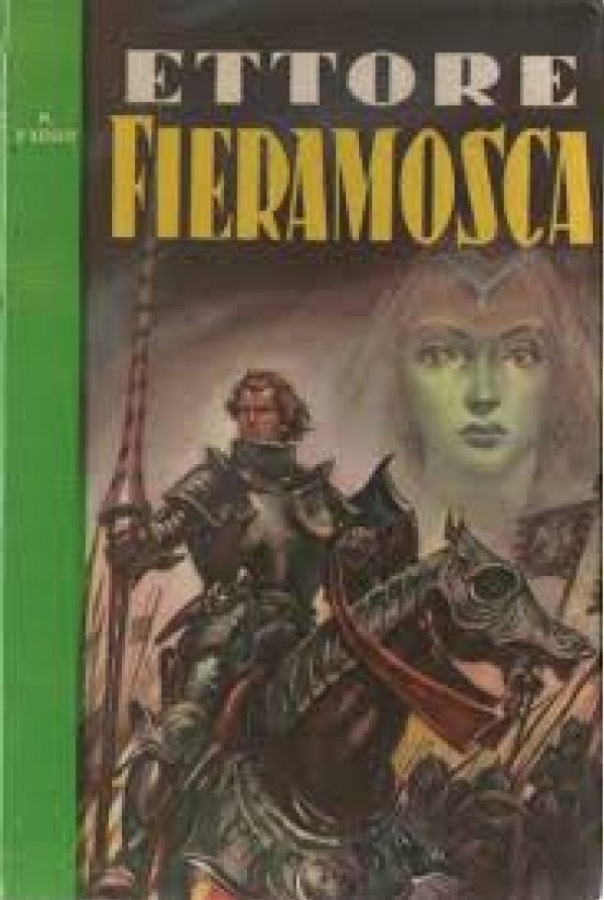
Ettore Fieramosca
> Fieramosca's father, grown old in the wars that tore Italy asunder during the fifteenth century, could give Ettore nothing but a sword; and as a youth, the latter believed the profession of arms to be the only one worthy of him, nor could he for many years conceive thoughts above the times in which he lived, wherein the force of arms was employed solely to augment reputation and wealth. Ma wisdom grew with the passing of years; and in the brief lulls from warring, rather than spending his leisure in hunts, jousts, and other youthful pleasures, he held studies and letters dear; and having come to know the ancient authors, and the honorable deeds of those who had shed their blood for the good of their homeland and not for the profit of whoever could best pay them, he understood how wicked a trade the profession of arms was in itself, if practiced in the manner of a brigand with the sole aim of enriching oneself with the spoils of the weak, and not for the virtuous cause of defending oneself and one's people from foreign aggression . This lengthy quotation, with which D’Azeglio encapsulates the protagonist’s formation, aptly conveys the style and meaning of the novel: the story of a duel fought to redeem slighted Italian honor, but also a reflection of a towering figure of our Risorgimento, Massimo D’Azeglio. A man of letters, painter, writer, soldier, patriot, and ultimately prime minister and mentor to Victor Emmanuel II during the turbulent years that followed the defeat in the First War of Independence. With this novel, D’Azeglio embellishes with imagination a historical event that genuinely took place in 1503: the Challenge of Barletta. Several Italian knights in the service of Spain were gravely insulted by a French baron, who had cast doubt upon the valor and loyalty of our fighters. A challenge ensued, from which the Italians emerged victorious. The historical event, however, serves as a backdrop to an intense and ill-fated love story. Ettore Fieramosca, > perfect in the proportions of his body, [which] he displayed... in close-fitting attire , is in love with Ginevra. The young woman is the object of Cesare Borgia’s depraved desires. Ettore fortuitously manages to save Ginevra, hiding her in a convent near Barletta. It is not merely romantic passion—chaste though it is—that binds the two youths. Ginevra, too, is a fervent patriot. When Ettore informs her of the challenge, > Ginevra’s breathing grew more hurried; her bosom, like a sail caught by the gusts of an oncoming wind, rose and fell, swelling with vehement, conflicting passions, yet all worthy of her; her eyes, which seemed to temper themselves according to the youth’s words, caught fire, casting sparks. What daring sensuality in D’Azeglio’s words! It is pointless to expect a happy ending. We are in the nineteenth century, and love stories must end tragically. Ginevra dies, abducted and defiled in her virtue by the cruel Borgia. Ettore, unaware of the loss of his beloved, wins the challenge, but upon learning the truth, disappears without a trace. For many years, the mountaineers of the Gargano spoke > of an armed knight upon the summit of certain inaccessible crags, which hung above a chasm plunging sheer into the sea . Adventures of daring and love, intrigues and betrayals follow one another with an agility and mastery that are surprising and in some ways unique for nineteenth-century Italian literature. D’Azeglio is a forerunner of Salgari. The wealth of episodes and characters nevertheless weighs down the plot, often making it difficult to return to the main thread. In many instances, the narrative seems merely an occasion for grand frescoes. D’Azeglio, as an accomplished painter, depicts with meticulous detail and vivid colors the feasts, receptions, and duels of a century that loved amusement even while constantly waging war. And the author recalls that the culinary art was exceedingly difficult in those days, because > all dishes were required not only to please the palate, but likewise to delight the eyes of the guests... the platters of confections were fashioned, now like mounds upon which grew trees laden with candied fruits, now in the likeness of ponds of distilled waters, wherein floated little skiffs of worked sugar, filled with sweets: some depicted an alpine mountain with a volcano at its peak, and the smoke that issued from it was of the most delightful fragrance . It is difficult to find the novel in its unabridged form, as D’Azeglio’s Italian is often archaic, even grandiloquent. One must not surrender. It is precisely his writing that imparts that sense of the imaginative and the unreal which is the book’s very charm. Why read it? It is a pleasure to lose oneself in D’Azeglio’s ardor and imagination.